Search Results(13797)

2014-11-26
PIER Letters
Vol. 50, 55-60
A Multiband Four-Antenna System for the Mobile Phones Applications
Jing-Li Guo , Bin Chen , You-Huo Huang and Hongwei Yuan
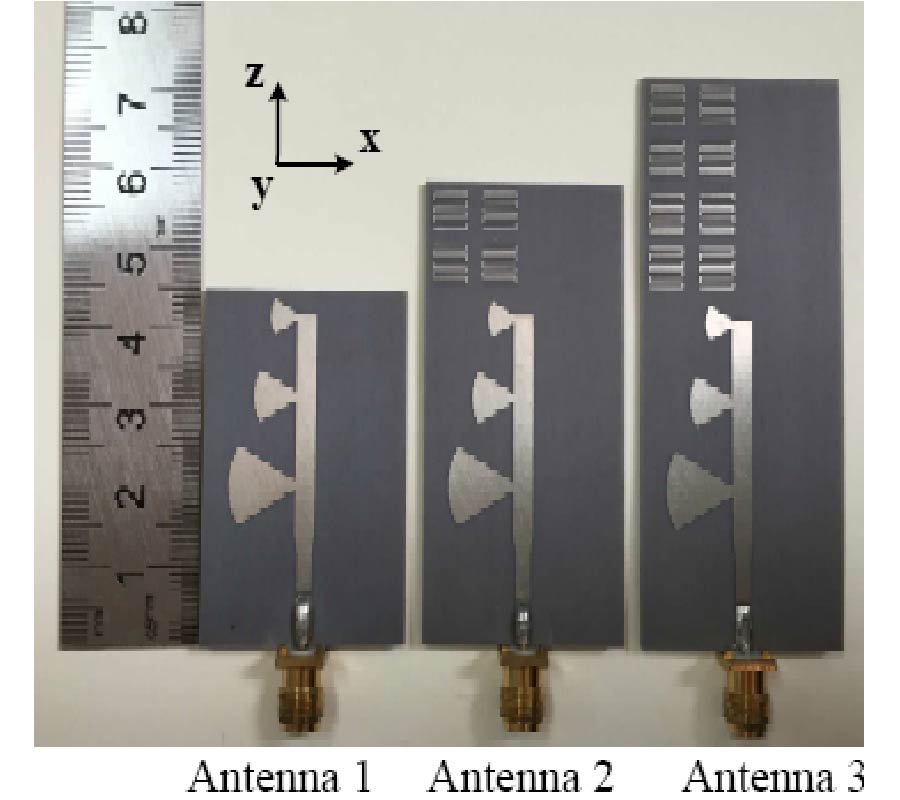
A multiband four-antenna system with high isolation for the mobile phone applications is presented in this paper. The four antennas consisting of a main antenna and three auxiliary antennas are located on a 135×65×0.8 mm3 FR4 epoxy board. The main antenna is an improved monopole antenna which can cover LTE700/2300/2500, GSM850/900/1800/1900/UMTS, and 2.4-GHz WLAN bands. Three identical auxiliary antennas with a size of 40×6×0.8 mm3 are located vertically in the sides and bottom of the circuit board, respectively. By adopting three slots in each radiating patch of the auxiliary antennas, they can successfully cover 704-746 MHz and 1880-2690 MHz band with S11 less than -6 dB. The isolation among the four antennas is better than 13 dB. The measured efficiency of the main antenna in the operation band can reach 40%, and the efficiency of auxiliary antennas can reach 25% at upper frequency band and about 10%-20% at 704-746 MHz band.
A MULTIBAND FOUR-ANTENNA SYSTEM FOR THE MOBILE PHONES APPLICATIONS
2014-11-24
PIER B
Vol. 61, 185-196
High Bit Encoding Chipless RFID Tag Using Multiple E Shaped Microstrip Resonators
Mohan Sumi , Raghavan Dinesh , Chakkanattu Nijas , Shanta Mridula and Pezholil Mohanan
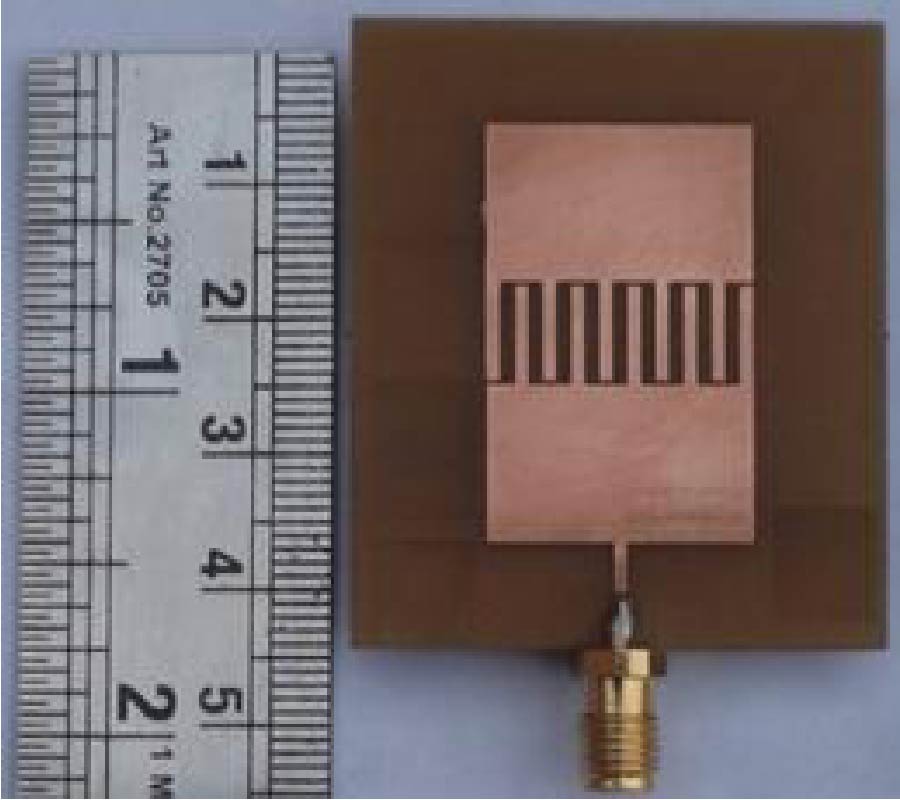
Encoding a large number of bits within a narrow band is an important factor in the development of chipless RFID tags. A novel 8 bit chipless RFID tag with a limited bandwidth of 650 MHz is proposed here. The proposed tag comprises a multi-resonating circuit with eight E-shaped microstrip resonators in the frequency band of 3.12 to 3.77 GHz and two cross-polarized transmitting and receiving monopole antennas. The unique feature of the proposed tag is that a different set of frequencies can be derived by changing a single parameter of the structure. The prototype of the tag is fabricated on a substrate C-MET LK4.3 of dielectric constant 4.3 and loss tangent 0.0018. Different tag combinations are designed and tested using bistatic measurement setup. Measurement results on realized prototypes are provided to ensure the reliability of the proposed design.
HIGH BIT ENCODING CHIPLESS RFID TAG USING MULTIPLE E SHAPED MICROSTRIP RESONATORS
2014-11-23
PIER Letters
Vol. 50, 49-54
A Compact Triple-Band Passband Filter Using Multi-Stub Loaded Resonator and Asymmetrical SIRs
Jun-Mei Yan , Liangzu Cao and Xing-Guo Wang
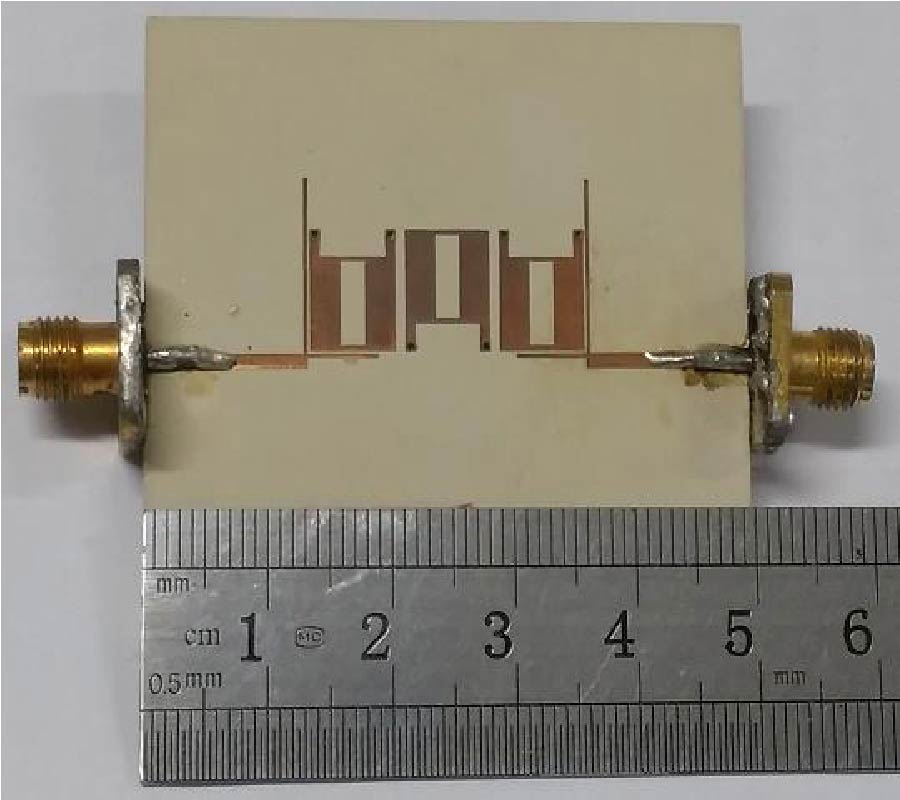
This letter presents a compact triple-band passband filter with high frequency selectivity. The first and second passbands are formed by a multi-stub loaded resonator. The width of the second passband can be independently adjusted by tuning the coupling strength between the two loaded open stubs. The third passband is implemented using two asymmetrical stepped impedance resonators (SIRs) with a tapped line structure as external coupling form. The asymmetrical SIRs also serve as one part of the external coupling structure of the multi-stub resonator so as to achieve a compact circuit size. Additionally, a source-load coupling is introduced, thus, multiple transmission zeros are generated to improve the frequency selectivity. After a detailed introduction of the operation principle, a triple-band passband filter with centre passband frequencies of 1.5, 2.6 and 3.6 GHz is designed and fabricated. The measured results verify the effectiveness of the proposed filter.
A COMPACT TRIPLE-BAND PASSBAND FILTER USING MULTI-STUB LOADED RESONATOR AND ASYMMETRICAL SIRS
2014-11-23
PIER Letters
Vol. 50, 41-47
A Penta-Band Planar Inverted-F Antenna for Mobile Phone Application Using LC-Tank-Stacked Network
Chao-Shun Yang , Po-Chun Huang and Christina F. Jou
In this paper, a penta-band antenna design using matching network for mobile phone application is proposed. This design is composed of a planar inverted-F antenna (PIFA) and a LC-tank-stacked network. The LC-tank-stacked network consists of two pairs of stacked chip-LC tank, which is parallel with the microstrip line feeding to the antenna. The PIFA works for generating dual bands, and each pair of chip-LC tanks can effectively enhance the lower band and upper band, respectively. According to measured results, the bandwidth can cover 824-960 MHz/1710-2170 MHz band for WWAN application for VSWR = 3:1. The peak antenna gain is better than 0.5 dBi and 3.4 dBi for lower and higher operation band, respectively. And the measured radiation efficiency is about 40-60% and 40-70% lower and higher operation band, respectively.
A PENTA-BAND PLANAR INVERTED-F ANTENNA FOR MOBILE PHONE APPLICATION USING LC-TANK-STACKED NETWORK
2014-11-23
PIER Letters
Vol. 50, 35-40
Compact and High Selectivity Tri-Band Bandpass Filter Using Multipath-Embedded Resonators
Shuai Yang , Bian Wu , Cheng Zhu , Yi Wang and Chang-Hong Liang
In this paper, a novel compact tri-band bandpass filter (BPF) with compact circuit size and high passband selectivity has been presented and implemented using multipath-embedded resonator (MER). This filter includes two multipath-embedded stepped impedance resonators (SIRs), connected with stub-coupling at the symmetric plane. By tuning admittance ratio and length ratio of the multipath-embedded resonator, it can be designed at 1.84, 2.45, 3.05 GHz. Through internal edge-coupling and extemal zero-degree feed lines, a tri-band BPF can be achieved with compact circuit size, high passband selectivity and low insertion loss. The measured results validate the full-wave EM simulated results with good agreement.
COMPACT AND HIGH SELECTIVITY TRI-BAND BANDPASS FILTER USING MULTIPATH-EMBEDDED RESONATORS
2014-11-21
PIER C
Vol. 55, 53-61
Accurate Coupling Matrix Synthesis for Microwave Filters with Random Initial Value
Guo Hui Li
A hybrid optimization method that synthesizes coupling matrices for cross-coupled microwave filters is presented. This method consists of a general solvopt algorithm and fmincon algorithm, respectively. To avoid divergence from the coupling matrix, two cost functions are built, where the first one is constructed from the eigenvalues of the coupling matrix and its principal sub-matrices, while another one is dependent on the determinant of the coupling matrix and one of its cofactors. The values of non-zero elements of the coupling matrix serve as the independent variables to minimize the cost functions by using solvopt and fmincon. Although the stochastic initial values are not sufficiently close to the global optimum, the hybrid optimization procedure is still robust to find multiple coupling matrices to overcome the initial problem. It is significant that the suitable coupling matrix can be chosen from the multiple solutions to meet the given requirements in practice. For demonstrating the proposed hybrid optimization algorithm, some extraordinary prototype topologies are provided which validate the efficiency of the proposed synthesis procedure.
ACCURATE COUPLING MATRIX SYNTHESIS FOR MICROWAVE FILTERS WITH RANDOM INITIAL VALUE
2014-11-21
PIER M
Vol. 40, 9-18
Ultra-Wide-Band Microwave Composite Absorbers Based on Phase Gradient Metasurfaces
Yongfeng Li , Jiafu Wang , Jieqiu Zhang , Shaobo Qu , Yongqiang Pang , Lin Zheng , Mingbao Yan , Zhuo Xu and Anxue Zhang
In this paper, we propose to realize ultra-wide-band absorber (UWBA) based on anomalous refraction/reflection of phase gradient metasurfaces(PGM). To achieve high absorption and meanwhile keep small thickness at low frequencies, PGM is incorporated into conventional magnetic materials (MM). The absorptivity is increased due to prolonged propagation length in the MM, which is produced via anomalous refraction/reflection mediated by the PGM. Three typical composite configurations of PGM-based absorbers are investigated and an UWBA design method is finally formulated. Due to small thickness and ultra-wide bandwidth, such absorbers possess great application potentials in EM protection, RCS reduction, etc.
ULTRA-WIDE-BAND MICROWAVE COMPOSITE ABSORBERS BASED ON PHASE GRADIENT METASURFACES
2014-11-21
PIER M
Vol. 40, 1-8
An Efficient Mode Reduction Technique for Modeling of Waveguide Gratings
Lijun Yuan and Yu Mao Wu
In this paper, an efficient mode reduction technique for eigenmode expansion method is developed to analyze 2-D waveguide grating structures which are a special class of piecewise uniform waveguides. To take advantage of the periodicity property of the structure, the eigenmode expansion method (EEM) is used with the scattering matrix method and a recursive-doubling procedure. In this situation, our proposed mode reduction technique achieves a significant speedup for gratings with large number of periods. Comprehensive numerical examples on the waveguide gratings are studied to validate the efficiency of our proposed mode reduction technique.
AN EFFICIENT MODE REDUCTION TECHNIQUE FOR MODELING OF WAVEGUIDE GRATINGS
2014-11-20
PIER C
Vol. 55, 43-52
Dual-Band Circularly-Polarized Monopulse Antenna System with Single Layer Patches and Separated Feed Networks
Mahdi Fartookzadeh and Seyed Hosein Mohseni Armaki
This paper introduces a new method for the design and realization of two monopulse antennas with circular polarization and unique phase center for two different frequency bands. The design uses compact sequential-rotation serially fed 2×2 patch array for each section of the monopulse antenna for X band at 8.2 GHz and a patch for S band at 2.25 GHz. The patches are placed on one layer, and the monopulse network and feeds are placed on different layers. The antennas use sequential rotation serial feeds with four and three probes for X band and S band, respectively. Also, the packaging and coupling effects are considered and compensated for this design. Finally, the antenna with a compact multi-layer structure is fabricated, and the simulation results are validated. The bandwidth of X band monopulse antenna system is at least 12.7% in simulation and 10% in fabrication, and it is about 10.2% and 10.3% for S band in simulation and fabrication, respectively. While the phase centers of both frequency bands are approximately at one point, the antenna system can be employed as a feed for reflectors.
DUAL-BAND CIRCULARLY-POLARIZED MONOPULSE ANTENNA SYSTEM WITH SINGLE LAYER PATCHES AND SEPARATED FEED NETWORKS
2014-11-20
PIER C
Vol. 55, 35-42
A Monopole Antenna with Dual-Band Reconfigurable Circular Polarization
Shujie Shi , Wei-Ping Ding and Kang Luo
This paper describes a monopole antenna with dual-band switchable circular polarization (CP) sense in WLAN and WiMAX bands. The proposed antenna consists of a rectangular patch fed by a microstrip line and a ground plane embedded with a T-shaped slot integrated with PIN diodes. The slotted ground is capable of exciting CP sense around 2.45 GHz for WLAN and around 3.4 GHz for WiMAX, respectively. Two triangular strips are added to improve impedance matching. The CP sense of the proposed antenna can be reconfigured between the right-handed circular polarization (RHCP) and left-handed circular polarization (LHCP) by switching the states of PIN diodes in the slot. The lower band 3-dB axial ratio (AR) bandwidth is 8.6%, and the upper band 3-dB AR bandwidth is 20.8%, in which the return loss is less than -10-dB. Simulated analysis and measured results are carried out and good agreement is achieved.
A MONOPOLE ANTENNA WITH DUAL-BAND RECONFIGURABLE CIRCULAR POLARIZATION
2014-11-19
PIER Letters
Vol. 50, 29-34
A Broadband Circularly Polarized Square Slot Antenna
Chao Tian , Yong-Chang Jiao and Wei-Long Liang
A novel broadband circularly polarized slot antenna with a rotated slot for bandwidth enhancement is proposed. The antenna has a simple structure, consisting of a microstrip feed line, a substrate, and a rotated rectangular slot with two branches etched on the plane. By appropriately adding the rotated rectangular slot and two branches on the ground-plane, the impedance bandwidth of the antenna is enlarged, and its wide axial-ratio (AR) bandwidth is achieved. Experimental results show the proposed antenna has good right-hand circular polarization (RHCP) characteristics. The measured -10-dB return loss impedance bandwidth and 3 dB axial-ratio bandwidth are 38.8% (1.5 GHz~2.2 GHz) and 25.6% (1.56 GHz~2.02 GHz) at the center frequency of 1.8 GHz.
A BROADBAND CIRCULARLY POLARIZED SQUARE SLOT ANTENNA
2014-11-18
PIER B
Vol. 61, 169-184
Three-Dimensional Far-Field Holographic Microwave Imaging: an Experimental Investigation of Dielectric Object
Lulu Wang , Ray Simpkin and Ahmed M. Al-Jumaily
This work presents experimental investigations of three-dimensional (3-D) far-field holographic microwave imaging (HMI) method for diagnosing inclusions within dielectric objects, and in particular, it relates to electromagnetic imaging to reconstruct dielectric properties of inhomogeneous, lossy bodies with arbitrary shape. The apparatus is designed for operation at a single frequency of 12.6 GHz. 16 antennas are located on a 2-D array plane which is placed under the object in the far-field region, with air in the space between the antenna array and the object. Experimental results indicate that the 3-D HMI system has the ability to produce a 3-D image of multimedia dielectric object and detect small inclusions embedded within an object. The invention has potential application to tissue imaging.
THREE-DIMENSIONAL FAR-FIELD HOLOGRAPHIC MICROWAVE IMAGING: AN EXPERIMENTAL INVESTIGATION OF DIELECTRIC OBJECT
2014-11-18
PIER C
Vol. 55, 25-33
Miniaturized Microstrip Patch Antenna with Defected Ground Structure
Hanae Elftouh , Naima Amar Touhami , Mohamed Aghoutane , Safae El Amrani , Antonio Tazón and Mohamed Boussouis
The aim of this work is to miniaturize a microstrip patch antenna resonating at 3 GHz. For this purpose, defected ground structure (DGS) has been employed to shift the resonance frequency of an initial microstrip antenna from 5.7 GHz to 3 GHz by disturbing the antenna's current distribution. The proposed DGS is incorporated in the ground plane under the patch antenna to improve its performances. Finally, a miniaturization up to 50%, with respect to the conventional microstrip antenna, is successfully accomplished. A prototype of the antenna was fabricated with the FR4 substrate and tested. The measurements results were in good agreement with simulation results.
MINIATURIZED MICROSTRIP PATCH ANTENNA WITH DEFECTED GROUND STRUCTURE
2014-11-18
PIER C
Vol. 55, 17-24
High Power 12-Element Triangular-Grid Rectangular Radial Line Helical Array Antenna
Xiang-Qiang Li , Qing-Xiang Liu and Jianqiong Zhang
A 12-element triangular-grid rectangular radial line helical array antenna is proposed and investigated. The major characteristic of this antenna is that its radiation elements are arranged in triangular-grid, which is helpful to reducing the number of elements demanded for a certain antenna aperture and grating lobe suppression capacity. The radiation element is optimized to facilitate the manufacture. The feed system with six different groups of output ports is designed to obtain equal-amplitude output using three kinds of probes. An antenna prototype with the center frequency of 2.856 GHz is simulated and measured. In the range of 2.75-2.95 GHz, the experimental result shows an antenna VSWR below 1.2, an antenna gain over 16.3 dB, and an aperture efficiency more than 80%. The field distributions of this antenna are analyzed through simulation, which prove its advantage of high power-handling capacity. Its ability to be used as a sub-array is also demonstrated by forming a 48-element array antenna.
HIGH POWER 12-ELEMENT TRIANGULAR-GRID RECTANGULAR RADIAL LINE HELICAL ARRAY ANTENNA
2014-11-17
PIER B
Vol. 61, 149-168
Influence of Slots and Rotor Poles Combinations on Noise and Vibrations of Magnetic Origins in `U'-Core Flux-Switching Permanent Magnet Machines
Guillaume Verez , Georges Barakat and Yacine Amara
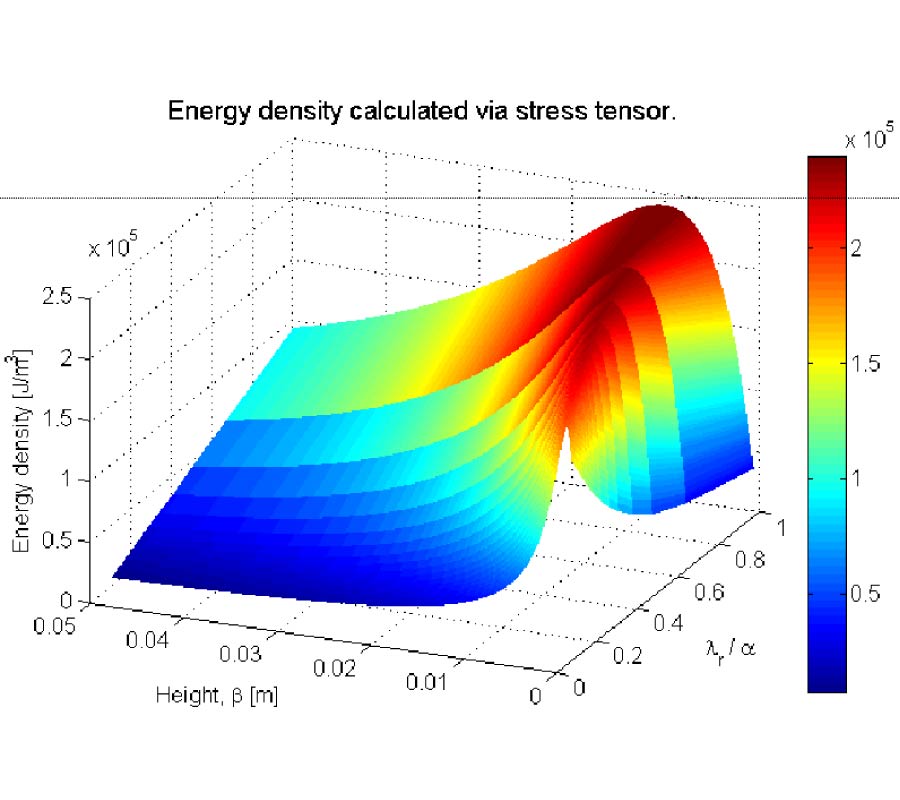
This paper deals with the computation of vibrations and noise of electromagnetic origin for `U'-shaped stator core flux switching permanent magnet (FSPM) machines. The investigation concerns a family of FSPM stator/rotor configurations with 12 slots and 10, 11, 13, and 14 rotor poles. More precisely, the study focuses on the influence of different number of rotor poles on the sound power level of U-core FSPM machines. Electromagnetic forces acting on the stator frame inner surface are calculated with the Maxwell stress tensor thanks to 2-D finite element (FE) simulations. The local magnetic force density serves then as a boundary condition to the 3-D finite element vibrational simulations of the whole stator frame with housing. Finally, obtained displacements help the authors to conduct the acoustic computations using a dedicated 3-D FE analysis model. The obtained vibro-acoustic spectra help electric machines designers to make appropriate choice of stator/rotor pole combination with respect to specifications at early stages of the design process.
INFLUENCE OF SLOTS AND ROTOR POLES COMBINATIONS ON NOISE AND VIBRATIONS OF MAGNETIC ORIGINS IN `U'-CORE FLUX-SWITCHING PERMANENT MAGNET MACHINES
2014-11-17
PIER
Vol. 149, 281-289
Realizing Flexible Ultra-Flat-Band Slow Light in Hybrid Photonic Crystal Waveguides for Efficient Out-of-Plane Coupling
Jianhao Zhang , Yaocheng Shi and Sailing He
The realization of slow light with ultra-flat dispersion in hybrid photonic crystal (HPhC) waveguide is systematically investigated. Metal strips have been introduced to the photonic crystal (PhC) waveguide. The dispersion of the odd mode is commendably flattened in the leaky region. Ultra-flat-band slow light with nearly constant average group indices of 192 over 2 nm (i.e., 330 GHz) bandwidth is achieved. Flexible tuning for the ultra-high group index can also be achieved while keeping the normalized delay-bandwidth product fairly high. The introduction of the metal strips is further demonstrated to help reduce the azimuthal angle of the farfield and provide a high coupling efficiency.
REALIZING FLEXIBLE ULTRA-FLAT-BAND SLOW LIGHT IN HYBRID PHOTONIC CRYSTAL WAVEGUIDES FOR EFFICIENT OUT-OF-PLANE COUPLING
2014-11-17
PIER
Vol. 149, 275-280
Casimir Force for Complex Objects Using Domain Decomposition Techniques
Phillip R. Atkins , Weng Cho Chew , Maokun Li , Lin E. Sun , Zu-Hui Ma and Li Jun Jiang
A method for calculating the Casimir force between large, complex 3D objects is presented. Difficulties have previously arisen in broadband multiscale calculation using CEM methods. To expand the range of problems that can be calculated, we use an integral equation, domain decomposition method (DDM) and argument principle to derive the Casimir force formula. The broadband integral equation DDM, which is the augmented equivalence principle algorithm (A-EPA), allows for an efficient broadband solution of large, complex objects. A-EPA subdivides a complex problem into separate smaller subproblems that are later recombined into a reduced matrix. This yields a reduced number of unknowns for complex structures making them feasible with modest computer resources. We demonstrate the advantages of the A-EPA by simulating large, finite, 3D, unaligned corrugated plates, which have previously only been modeled approximately as infinite plates using 2D techniques.
CASIMIR FORCE FOR COMPLEX OBJECTS USING DOMAIN DECOMPOSITION TECHNIQUES
2014-11-14
PIER M
Vol. 39, 181-191
Along-Track Motion Compensation for Strip-Map SAR Based on Resampling
Hui Ma , Ming Bai , Bin Liang and Jungang Miao
The airborne or vehicle-based SARs are very vulnerable to the influences of airflows or road conditions so as to deviate from the predicted trajectory, which undermines the uniformity of the azimuth sampling. As a result, the SAR image quality can get impaired in varying degrees. Since the SAR systems are sensible to the track deviation, the motion compensation (MOCO) algorithms are always applied as pre-processing of SAR raw data. In this paper, mainly with regard to the motion error caused by the forward velocity variation, a `resampling MOCO' algorithm is proposed as an auxiliary of the widely used bulk MOCO. The simulation result has verified that the performance of the fundamental bulk MOCO algorithm is greatly improved utilizing the proposed method.
ALONG-TRACK MOTION COMPENSATION FOR STRIP-MAP SAR BASED ON RESAMPLING
2014-11-14
PIER M
Vol. 39, 171-180
Investigation of a Conductivity Logging Tool Based on Single Coil Impedance Measurement Using FDTD Method
Shiwei Sheng , Kang Li , Fanmin Kong and Bin Wang
Eddy current test has been widely used in many fields because of its simplicity and robustness. In this paper, numerical simulations based on the finite-difference time-domain method were carried out to validate if the eddy current coil can effectively be used in the logging while drilling system. The simulation results showed that the impedance of the eddy current coil is a function of conductivity of the surrounding media. The formation conductivity is strongly dependent on the concentration of hydrocarbons, so different formation layers can be distinguished by measuring coil impedance. Different source frequencies were applied, and it was found that this method works well in frequency range from 100 MHz to 1 GHz. The investigation depth was studied in this paper, and a 3-layer formation model was simulated in this paper. The results showed that this novel method could be effectively used in a well logging system.
INVESTIGATION OF A CONDUCTIVITY LOGGING TOOL BASED ON SINGLE COIL IMPEDANCE MEASUREMENT USING FDTD METHOD
2014-11-12
PIER Letters
Vol. 50, 19-27
Analysis of mm-Wave Bands Quasi-Optical Unstable Bessel-Gauss Resonator by Idgf Algorithm
Yan-Zhong Yu , Hongfu Meng and Wen-Bin Dou
An analysis of quasi-optical unstable Bessel-Gauss resonator (QOUBGR) at millimeter wavelengths is presented in this paper. The QOUBGR, formed by a conical mirror and a convex mirror, is designed on the basic of quasi-optical theory and techniques. For the purpose of precisely analyzing the designed QOUBGR, a new algorithm known as iterative dyadic Green's functions (IDGF) is proposed, which originates from famous Fox-Li algorithm. The IDGF algorithm can calculate not only two-dimension (2-D) but also three-dimension (3-D) resonating modes in the cavity. Simulation results demonstrate that the designed QOUBGR can steadily support both zero-order and high-order resonant modes that are approximations to Bessel-Gauss beams. These beams will find their promising applications in the MM- and/or quasi-optical imaging and measurement systems.
ANALYSIS OF MM-WAVE BANDS QUASI-OPTICAL UNSTABLE BESSEL-GAUSS RESONATOR BY IDGF ALGORITHM