Search Results(13797)

2014-12-21
PIER
Vol. 150, 41-48
Efficient Evaluation of Near-Field Time-Domain Physical-Optics Integral Using Locally Expanded Green Function Approximation
Xiao Zhou and Tie-Jun Cui
A time-efficient method is proposed to calculate the near-field time-domain physical-optics (TD-PO) integral to analyze the transient electromagnetic fields scattered from three-dimensional perfectly conducting objects under the illumination of a pulsed plane wave. It is shown that the TDPO integral can be reduced to a close-form expression by introducing locally expanded Green-function approximations used in conjunction with the surface partitioning. As a result, the near-field TD-PO response to a general pulsed plane wave excitation is derived by a convolution of the excitation waveform with the TD-PO impulse response, which can be performed in a closed form. To satisfy the causality, i.e., the transient field cannot travel away from the sources faster than the speed of light, the high-order derivative of a modulated-Gaussian wave is specified as the excitation waveform. The efficiency and accuracy of the proposed near-field formulas are validated through numerical examples.
EFFICIENT EVALUATION OF NEAR-FIELD TIME-DOMAIN PHYSICAL-OPTICS INTEGRAL USING LOCALLY EXPANDED GREEN FUNCTION APPROXIMATION
2014-12-19
PIER Letters
Vol. 50, 117-123
A Novel Compact Planar Triple-Band Monopole Antenna for WLAN/WiMAX Applications
Shan Shan Huang , Jun Li and Jian Zhong Zhao
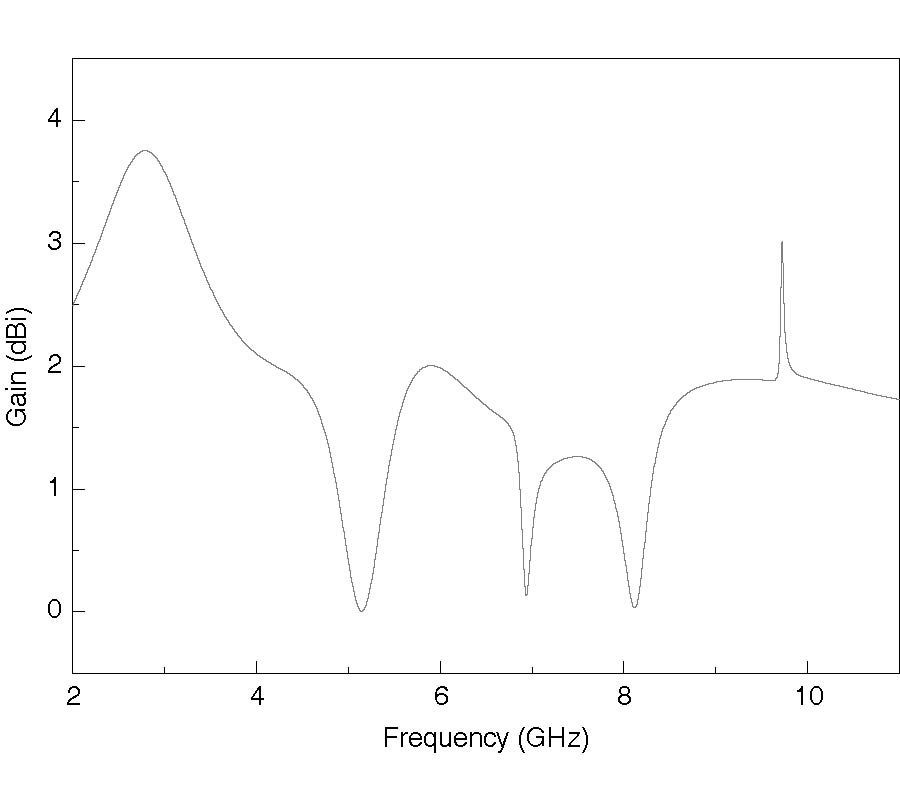
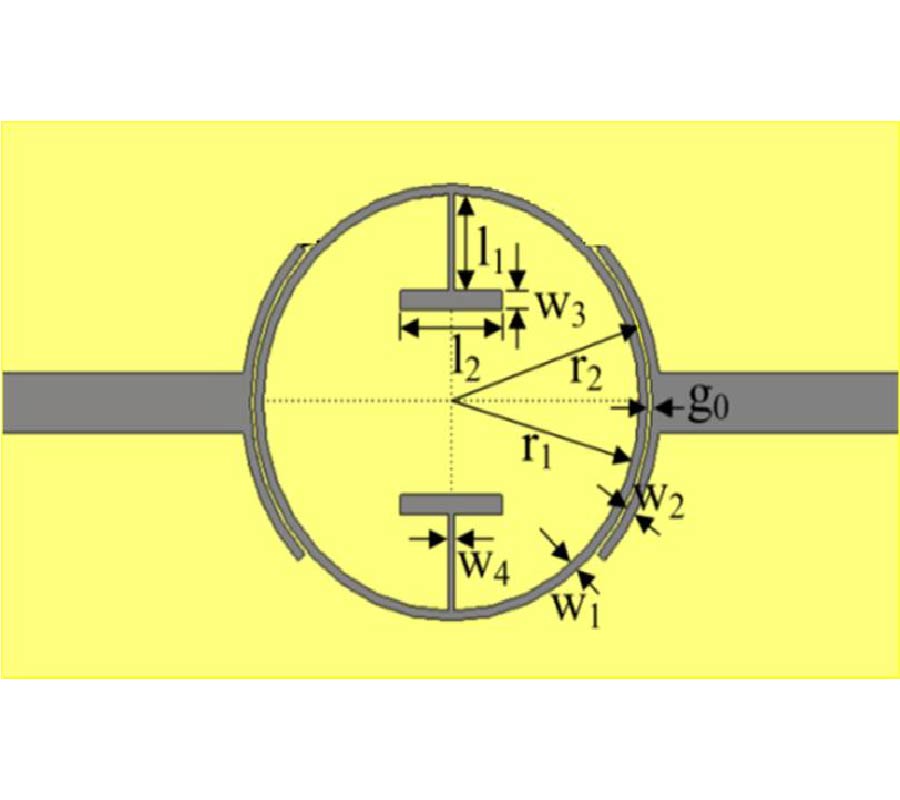
In this article, a novel compact triple-band monopole antenna for WLAN/WiMAX applications is proposed. The proposed antenna is designed on an FR-4 substrate with thickness of 0.8 mm, relative permittivity of 4.4, and loss tangent of 0.02. It consists of a square ring, an open ended stub, and an inverted T-shaped stub. Three bands covering 2.3-2.76, 3.387-3.73, and 4.97-6.28 GHz are achieved, which cover all the 2.5/3.5/5.5 GHz WiMAX and 2.4/5.2/5.8 GHz WLAN operation bands. Moreover, the presented antenna has a compact size of 24 × 36 mm2. Experimental results show that the proposed antenna gives good gains and has nearly omnidirectional radiation patterns across all the operation bands.
A NOVEL COMPACT PLANAR TRIPLE-BAND MONOPOLE ANTENNA FOR WLAN/WIMAX APPLICATIONS
2014-12-19
PIER Letters
Vol. 50, 111-116
Design of a Compact Wilkinson Power Divider with High Order Harmonics Suppression
Xin Xu and Xiaohong Tang
A new method for designing compact Wilkinson power dividers with three order harmonics suppression is presented. The quarter-wavelength transmission line in the traditional Wilkinson power divider is replaced by two pairs of parallel coupled lines with one end connected in series with an open stub. With this structure, the quarter-wavelength line will be shorter and three attenuation poles can be added in the stopband. As a result, this newly proposed structure carries the functions of impedance matching at operating frequency and three orders harmonics suppression. In this study, an example of power divider operating at 1 GHz is designed and fabricated. The measured results show good performance at the operating frequency. In addition, the second, third and fourth harmonics suppressions are 43 dB, 49 dB and 37 dB, respectively, which validates the feasibility of the proposed design.
DESIGN OF A COMPACT WILKINSON POWER DIVIDER WITH HIGH ORDER HARMONICS SUPPRESSION
2014-12-19
PIER M
Vol. 40, 129-141
Estimation of the Ageing of Metallic Layers in Power Semiconductor Modules Using the Eddy Current Method and Artificial Neural Networks
Tien Anh Nguyen , Pierre-Yves Joubert and Stephane Lefebvre
In high power operations, the ageing of power semiconductor modules has been often observed by several failures due to high temperature cycling. The main failures may be metallization reconstruction, solder delaminations, bond wire lift-offs or bond wire heel crackings, conchoidal breaking of ceramics. The paper focuses on the non-contact monitoring of the ageing of the aluminum metallization top layer and of the solder bottom layer of a power die, using the eddy current method. The ageing is assumed to induce a decrease of these layers conductivity. The evaluation of both layers conductivity changes are estimated using artificial neural networks starting from eddy current data provided by finite element computations carried out in the case of several aged die configurations. The error of estimation is less than a few percent in the considered cases and it demonstrates the relevance of the eddy current method to monitor the ageing state of power modules. The proposed approach provides relevant results which will be validated on experimental data in future works.
ESTIMATION OF THE AGEING OF METALLIC LAYERS IN POWER SEMICONDUCTOR MODULES USING THE EDDY CURRENT METHOD AND ARTIFICIAL NEURAL NETWORKS
2014-12-19
PIER
Vol. 150, 29-40
A Waveguide Verification Standard Design Procedure for the Microwave Characterization of Magnetic Materials
Benjamin R. Crowgey , Junyan Tang , Edward J. Rothwell , Balasubramaniam Shanker and Leo C. Kempel
A waveguide standard is introduced for validation purposes on the measurement accuracy of electric and magnetic properties of materials at microwave frequencies. The standard acts as a surrogate material with both electric and magnetic properties and is useful for verifying systems designed to characterize engineered materials using the Nicolson-Ross-Weir technique. A genetic algorithm is used to optimize the all-metallic structure to produce a surrogate with both relative permittivity and permeability within a target range across S-band. A mode-matching approach allows the user to predict the material properties with high accuracy, and thus compensate for differences in geometry due to loose fabrication tolerances or limited availability of component parts. The mode-matching method also allows the user to design standards that may be used within other measurement bands. An example standard is characterized experimentally, the errors due to uncertainties in measured dimensions and to experimental repeatability are explored, and the usefulness of the standard as a verification tool is validated.
A WAVEGUIDE VERIFICATION STANDARD DESIGN PROCEDURE FOR THE MICROWAVE CHARACTERIZATION OF MAGNETIC MATERIALS
2014-12-19
PIER
Vol. 150, 13-27
Stored Electromagnetic Energy and Antenna q (Invited Paper)
Mats Gustafsson and Lars Jonsson
Decomposition of the electromagnetic energy into its stored and radiated parts is instrumental in the evaluation of antenna Q and the corresponding fundamental limitations on antennas. This decomposition is not unique and there are several proposals in the literature. Here, it is shown that stored energy defined from the difference between the energy density and the far field energy equals the energy expressions proposed by Vandenbosch for many but not all cases. This also explains the observed cases with negative stored energy and suggests a possible remedy to them. The results are compared with the classical explicit expressions for spherical regions where the results only differ by the electrical size ka that is interpreted as the far-field energy in the interior of the sphere. Q
STORED ELECTROMAGNETIC ENERGY AND ANTENNA Q (Invited Paper)
2014-12-18
PIER C
Vol. 55, 129-137
Pebbles Tracking Thanks to RFID LF Multi-Loops Inductively Coupled Reader
Marjorie Grzeskowiak , Antoine Diet , Pape Sanoussy Diao , Stephane Protat , Christophe Bourcier , Yann Le Bihan and Gaelle Lissorgues
The Radio Frequency IDentification (RFID) Low Frequency (LF) serial loops structure is proposed to improve TAGs detection when a TAG coil-antenna rotates by any angle, due to the tagged pebble moving. The detection zones of two types of TAGs (the token and glass TAG) and two types of reader coils, in function of the TAG size, TAG orientation and shape of the reader coils are tested. The effect of the proposed multi-coil inductively coupled is confirmed by measurement using a commercial LF RFID system.
PEBBLES TRACKING THANKS TO RFID LF MULTI-LOOPS INDUCTIVELY COUPLED READER
2014-12-18
PIER Letters
Vol. 50, 103-109
A Compact Four-Element UWB MIMO Antenna with Qsca Implementation
Jian-Feng Yu , Xianglong Liu , Xiao-Wei Shi and Zedong Wang
In this paper, a new approach using quasi-self-complementary antenna (QSCA) to reduce the wideband mutual coupling is proposed and discussed. QSCA element proposed in this paper is composed of a semi-circular radiation patch and a complementary-cut ground plane, which is easy to achieve ultra-wideband operation because its impedance is frequency independent. The proposed compact four-element ultra-wideband (UWB) multiple-input multiple-output (MIMO) array consists of four QSCA elements, and by arranging them anticlockwise, a good impedance matching and high port-to-port isolation (|S11| covers 2.95-12.1 GHz with |S21| = |S31|≤-15 dB, |S41|≤-17.8 dB) can be achieved. Notably, the isolation is obtained without using any other decoupling methods and totally benefits from the asymmetrical radiation property of QSCA. As an example, the proposed four-element UWB MIMO array is fabricated and tested. And the measured radiation pattern, gains and total efficiencies are displayed and show good performances which make it a nice candidate for future UWB diversity applications.
A COMPACT FOUR-ELEMENT UWB MIMO ANTENNA WITH QSCA IMPLEMENTATION
2014-12-18
PIER Letters
Vol. 50, 101-102
Errata to ``Utilization of Screen Printed Low Curing Temperature Cobalt Nanoparticle Ink for Miniaturization of Patch Antennas" by m. Nelo, a. Sowpati, V. k. Palukuru, j. Juuti, and h. Jantunen, in Progress in Electromagnetics Research, Vol. 127, 427-444, 2012
Mikko Nelo , Arun K. Sowpati , Vamsi Krishna Palukuru , Jari Juuti and Heli Jantunen
Previous ink characterization results published in the paper are corrected by new characterization measurements from Co ink consisting of the same Co nanoparticles bound together with poly(methyl methacrylate). New measurement result is reported as vol% whereas previous result was reported as wt.%. Correlation 50 vol% = ∼90 wt.%.
2014-12-18
PIER Letters
Vol. 50, 99-100
Errata to ``Formulation of Screen Printable Cobalt Nanoparticle Ink for High Frequency Applications" by m. Nelo, a. Sowpati, V. k. Palukuru, j. Juuti, and h. Jantunen, in Progress in Electromagnetics Research, Vol. 110, 253-266, 2010
Mikko Nelo , Arun K. Sowpati , Vamsi Krishna Palukuru , Jari Juuti and Heli Jantunen
Previous ink characterization results published in the paper are corrected by new characterization measurements from Co inks based on same cobalt nanoparticles bound together with poly(methyl methacrylate). New measurements results are reported as vol% whereas previous results were reported as wt.%. Correlations are 30 vol% = ∼80 wt.%, 40 vol% = ∼86 wt.% and 50 vol% = ∼90 wt.%.
2014-12-17
PIER M
Vol. 40, 119-127
An Improved Predesign Procedure for Shaped-Beam Reflectarrays
Jian-Feng Yu , Lei Chen , Jing Yang and Xiao-Wei Shi
This article describes an improved design procedure for shaped-beam reflectarrays, which is advanced mainly in accuracy and concision. Specifically, the excitation has been computed by a new approach named local simulation instead of mathematical modeling, which demonstrates more advantage in precision. The intersection approach has been applied to optimization, and it is improved by introducing a new multi-stage strategy into the synthesis process to avoid local minima. Moreover, the phase-only optimization, calculation of the reflection phase data table and the simulation verification processes are combined as a co-simulation procedure by VBScript (Visual Basic Script). This procedure is very beneficial to design reflectarrays with efficiency. As an example, a reflectarray consists of 621 dual-loop elements is optimized, and a good sectored-cosecant squared beam result is obtained.
AN IMPROVED PREDESIGN PROCEDURE FOR SHAPED-BEAM REFLECTARRAYS
2014-12-17
PIER M
Vol. 40, 111-118
A New Self-Decoupling Magnetic Levitation Generator for Wind Turbines
Yanjun Yu , Huangqiu Zhu and Si Zeng
In order to decouple traditional levitation windings and armature windings, a new self-decoupling magnetic levitation generator (SDMLG) is proposed for wind turbines. This new generator adopts double-stator structure. The armature windings are in the outer stator, and the levitation windings are in the inner stator. The rotor is made of a distributed hollow structure, so that it can effectively decouple the levitation subsystem and armature subsystem. The new structure and operating principle of the generator are presented in this paper. Then the expressions of levitation forces are deduced by analyzing magnetic flux distributions and winding flux linkages. Finite-element analysis method (FEA) is used as the tool for analyzing the performance of the new generator. And the results verify that the levitation windings and armature windings are effectively decoupled.
A NEW SELF-DECOUPLING MAGNETIC LEVITATION GENERATOR FOR WIND TURBINES
2014-12-17
PIER M
Vol. 40, 101-110
Review and Assessment of Electromagnetic Wave Propagation in Sand and Dust Storms at Microwave and Millimeter Wave Bands --- Part II
Abdulwaheed Musa , Saad Osman Bashir and Aisha Hassan Abdalla
Suspended particles in the atmosphere during sand and dust storms have numerous consequences on electromagnetic wave propagation in arid regions. The electromagnetic wave signal may suffer attenuation and cross polarization upon encounter with the suspended particles. However, meager information has hitherto been reported about effect of storms on the telecommunication systems operating in such regions. This paper presents a survey of current understanding of the electromagnetic wave propagation in sand and dust storms. A review of the literature covering electromagnetic scattering theory and applications is given. The review describes the principle of approach and technology adopted for the investigation highlighting both strengths and drawbacks. Detailed parametric assessment of the effects of storms on wave propagation as it concerns signal attenuation and cross polarization is also carried out. The results demonstrate that most authors have calculated the attenuation effect, revealing that it is not very significant unless very high suspended dust densities are assumed (i.e. during severe sand and dust storms). A few papers indicate the possibility of more significant cross polarisation. The obvious gap in knowledge of this field is finally also clearly established.
2014-12-15
PIER M
Vol. 40, 91-100
Review and Assessment of Electromagnetic Wave Propagation in Sand and Dust Storms at Microwave and Millimeter Wave Bands --- Part I
Abdulwaheed Musa , Saad Osman Bashir and Aisha Hassan Abdalla
Electromagnetic wave propagation in arid and semi-arid regions is influenced by sand and dust storms. Meagre information has hitherto been reported as to the effect of storms on telecommunication systems operating in such regions. This paper presents a survey of current understanding of the electromagnetic wave propagation during sand and dust storms. In the first part of the review, detailed parametric assessment of some electrical and mechanical properties affecting wave propagation in sand and dust storms is given. The second part of the review (Part-II) describes the principle of approach and technology adopted for the investigation highlighting both strengths and drawbacks. The results demonstrate that most authors have calculated signal attenuation effect, revealing that it is not very significant unless very high suspended dust densities are assumed (i.e. during severe sand and dust storms). A few papers indicate the possibility of more significant cross polarisation. Part-I explicitly gives an account of the sand and dust storms' phenomenon, reviews the storms' parameters affecting electromagnetic wave propagations and discusses the microwave and millimeter wave bands.
2014-12-15
PIER M
Vol. 40, 79-90
Sturm-Liouville Matrix Equation for the Study of Electromagnetic-Waves Propagation in Layered Anisotropic Media
Rene Pernas-Salomon and Rolando Perez-Alvarez
We obtain a Sturm-Lioville matrix equation of motion (SLME) for the study of electromagnetic wave propagation in layered anisotropic structures. Conducting media were taken into account so that ohmic loss is considered. This equation can be treated using a 4×4 associated transfer matrix (T) in layered anisotropic structures, where the tensors: permittivity, permeability and the electric conductivity have a piecewise dependence on the coordinate perpendicular to the layered structure. We use the SLME eigenfunctions and eigenvalues to analyze qualitatively the numerical instability (Ωd problem) which potentially affects practical applications of the transfer matrix method. By means of the SLME coefficients we show analytically that T determinant value can be used to keep a check on the numerical accuracy of calculations. We derive equations to analyze wave propagation in linear layered isotropic structures. The SLME approach is applied on two typical layered structures to verify theoretical predictions and experimental results.
STURM-LIOUVILLE MATRIX EQUATION FOR THE STUDY OF ELECTROMAGNETIC-WAVES PROPAGATION IN LAYERED ANISOTROPIC MEDIA
2014-12-14
PIER M
Vol. 40, 69-78
Modelling the Impact of Operating Frequencies on Path Loss and Shadowing Along Multi-Floor Stairwell for 0.7 GHz-2.5 GHz Range
Omar Abdul Aziz and Tharek Bin Abdul Rahman
Given that building occupants and more importantly public safety personnel regularly use stairwell to move about different floors in a multi-floor building, wireless network coverage for the setting may come as necessary in order to ensure seamless telecommunication connectivity. Nevertheless, wireless network planning pertaining to multi-floor stairwell scenario requires unique radio characterization since the scenario is different from other indoor environments. This paper presents a frequency dependent path loss and shadowing model for the multi-floor stairwell environment that was developed and tested at six dog-leg style stairwells. The empirical model covers frequency spectrum from 0.7 GHz up to 2.5 GHz which envelop numerous public safety and long term evolution operating bands. The model demonstrates good precision and is shown to outperform standard path loss model when comparison was made since it includes site-specific parameters describing radio characteristics natural to stairwell setting. The straightforward mathematical expression of the model can easily be applied when setting up or studying wireless network for the stipulated frequency range with respect to the multi-floor stairwell.
MODELLING THE IMPACT OF OPERATING FREQUENCIES ON PATH LOSS AND SHADOWING ALONG MULTI-FLOOR STAIRWELL FOR 0.7 GHZ-2.5 GHZ RANGE
2014-12-12
PIER Letters
Vol. 50, 91-98
An Investigation on the Use of ITU-R P.1411-7 in 802.11N Path Loss Modelling
Siva Priya Thiagarajah , Shamini Pillay Narayanasamy Pillay , Manogaran Saargunawathy and Dinesh Madhavan
Free space path loss modelling is a model used to model path loss propagation for Wireless Local Area Networks. In some cases, the estimation of path loss by the FSL model can be inaccurate as FSL modelling does not take into account the effect of multipath propagation. The International Telecommunication Union Recommendation, ITU-R P.1411-7 provides prediction methods for the planning of short-range outdoor radio communication systems and radio local area networks in the frequency range 300 MHz to 100 GHz. This recommendation further proposes a location variability correction, ρ, which models the standard deviation of field strength due to small scale fading. This paper investigates the feasibility of using the ITU-R P.1141-7 Recommendation to estimate the path loss for 802.11n signals experienced by pedestrians in a suburban environment. Received signal strengths were collected from field experiments, and the measured path loss was compared with estimated path loss values. The results show that for areas with high levels of small scale fading, the ITU-R P.1141-7 was able to estimate the path loss for IEEE 802.11n signals with a higher accuracy of 5-7 dB than the FSL model.
AN INVESTIGATION ON THE USE OF ITU-R P.1411-7 IN 802.11N PATH LOSS MODELLING
2014-12-11
PIER B
Vol. 61, 269-296
Finite Element Based Eigenanalysis for the Study of Electrically Large Lossy Cavities and Reverberation Chambers
Constantinos L. Zekios , Peter C. Allilomes , Michael T. Chryssomallis and George Kyriacou
An Eigenanalysis-based technique is presented for the study and design of large complicated closed cavities and particularly Reverberation Chambers, including conductor and dielectric material losses. Two different numerical approaches are exploited, while a Perturbation technique is employed to acquire an approximate reference solution. First, a straightforward approach is adopted where the finite walls conductivity is incorporated into the Finite Element Method (FEM) formulation through the Leontovich Impedance boundary conditions. The resulting eigenproblem is linearized through an eigenvalue transformation and solved using the Arnoldi algorithm. To address the excessive computational requirements of this approach and to achieve a fine mesh ensuring convergence, a novel approach is adopted. Within this, a linear eigenvalue problem is formulated and solved assuming all metallic structures as perfect electric conductors (PEC). In turn, the resulting eigenfunctions are post-processed within the Leontovich boundary condition for the calculation of the metals finite conductivity losses. Mode stirrer design guidelines are setup based on the eigenfunction characteristics. Both numerical eigenanalysis techniques are validated against an analytical solution for the empty cavity and a reverberation chamber simulated by a commercial FEM simulator. A series of classical mode stirrers are studied to verify the design guidelines, and an improved mode stirrer is developed.
FINITE ELEMENT BASED EIGENANALYSIS FOR THE STUDY OF ELECTRICALLY LARGE LOSSY CAVITIES AND REVERBERATION CHAMBERS
2014-12-11
PIER C
Vol. 55, 115-127
An Approach for Efficient Two-Stage 2D-DOA Estimation in High-Altitude Platforms Mobile Communications
Yasser Albagory
High-Altitude Platform (HAP) is a promising technique for providing wireless communications services with improved performance compared to terrestrial and satellite systems. A critical issue in this emerging system is the difficulty of providing user location information through two-dimensional direction-of-arrival (2D-DOA) estimation due to the high computational complexity and the large covered area. Therefore, in this paper, an efficient technique has been proposed to determine user location through 2D-DOA with a reduced processing time. The proposed technique estimates the 2D-DOA in two stages. In the first stage, a low-resolution 2D-DOA estimation technique will be utilized, such as Bartlett algorithm performed on a low-resolution distance grid, then a suitable threshold is applied on the normalized Bartlett 2D-DOA spectrum to define ground windows for the next high-resolution 2D-DOA stage. The second stage is carried out by a high-resolution technique such as MUSIC algorithm and will be performed on a high-resolution distance grid. Two scenarios are examined for the proposed technique to investigate the reduction in processing time compared with the conventional 2D-DOA MUSIC algorithm without windowing. Simulation results show that at 40 meters resolution, the required processing time is only 20% of the conventional MUSIC algorithm and can be further reduced to 4% at resolution of 100 meters at the same array size. In addition, the proposed technique can be applied to any other efficient low-complexity 2D-DOA algorithms.
AN APPROACH FOR EFFICIENT TWO-STAGE 2D-DOA ESTIMATION IN HIGH-ALTITUDE PLATFORMS MOBILE COMMUNICATIONS
2014-12-11
PIER Letters
Vol. 50, 85-90
Highly Directive Hybrid Plasmonic Leaky Wave Optical Nano-Antenna
Leila Yousefi
A novel traveling-wave hybrid plasmonic optical antenna is proposed for operation at the standard telecommunication wavelength of 1550 nm and with the frequency bandwidth of more than 16 THz. A highly directive radiation pattern with 15.2 dBi directivity and 82% efficiency is achieved. The developed antenna benefits from high directivity advantage of leaky-wave antennas, and low loss properties and confinement of hybrid plasmonic structures. The designed device can have applications in inter/intera chip optical interconnect, and absorption enhancement of photodetectors, and solar cells.
HIGHLY DIRECTIVE HYBRID PLASMONIC LEAKY WAVE OPTICAL NANO-ANTENNA