Search Results(13798)

2014-05-15
PIER
Vol. 147, 1-22
Photoacoustic Tomography: Principles and Advances (Invited Review)
Jun Xia , Junjie Yao and Lihong V. Wang
Photoacoustic tomography (PAT) is an emerging imaging modality that shows great potential for preclinical research and clinical practice. As a hybrid technique, PAT is based on the acoustic detection of optical absorption from either endogenous chromophores, such as oxy-hemoglobin and deoxy-hemoglobin, or exogenous contrast agents, such as organic dyes and nanoparticles. Because ultrasound scatters much less than light in tissue, PAT generates high-resolution images in both the optical ballistic and diffusive regimes. Over the past decade, the photoacoustic technique has been evolving rapidly, leading to a variety of exciting discoveries and applications. This review covers the basic principles of PAT and its different implementations. Strengths of PAT are highlighted, along with the most recent imaging results.
PHOTOACOUSTIC TOMOGRAPHY: PRINCIPLES AND ADVANCES (Invited Review)
2014-05-14
PIER Letters
Vol. 46, 49-57
Space-Borne Hexagonal Array Element Failure Correction Using Iterative Convex Optimiztion
Haiwei Song , Guang Liang , Wenbin Gong and Jinpei Yu
Element failure distorts the main-lobe pattern and increases side-lobe power level, which is almost impossible to be corrected artificially for space-borne array. It might be solved by redistributing the excitations of the left functional elements; however, this is a nonlinear, non-convex, and NP-hard problem. In this paper, two effective approaches are proposed for failure correction, which is performed for space-borne hexagonal array using digital beamforming (DBF). One method, a modified real-code genetic algorithm (RCGA), is employed that uses reinsertion and worst-elimination schemes, but it pays the high computation complexity. The other approach based on convex optimization chooses the excitations synthesized by RCGA as the initial points, and skillfully transforms the non-convex problem into a sequence of second-order cone programming (SOCP) problem, which is solved iteratively by efficient optimization tool. Numerical results confirm that after the correction based on iterative convex optimization, the average root-mean-square error (RMSE) is reduced by 36%, and the relative side-lobe level (RSLL) is improved by 6.7 dB, with respect to the RCGA-based correction pattern.
SPACE-BORNE HEXAGONAL ARRAY ELEMENT FAILURE CORRECTION USING ITERATIVE CONVEX OPTIMIZTION
2014-05-13
PIER B
Vol. 60, 35-48
Bistatic RCS Prediction of Composite Scattering from Electrically Very Large Ship-Sea Geometry with a Hybrid Facet-Based Ka and Shadow-Corrected Greco Scheme
Mingyuan Man , Zhen-Ya Lei , Yong-Jun Xie and Xiaofeng Li
This paper presents a hybrid scheme for fast calculation on the bistatic composite scattering from electrically very large ship-sea geometry at high frequencies. Based on the Kirchhoff approximation (KA), we try to break the large-scale sea surface into myriads of plane facets, then derive the Kirchhoff integration analytically on each individual discretized facet. The analytical expression obtained, so-called the ``facet-based Kirchhoff approximation (FBKA)'', is suitable for a quick scattering calculation on the electrically very large sea surface, since it is beyond the intensively refined meshes as the usual Monte Carlo implementation does. Meanwhile, combined with graphical electromagnetic computing method (GRECO) to extract the illuminated and shadow facets in accordance with the incident direction, the conventional physical optics method (PO) is improved by employing current marching technique (CMT) to calculate the currents in the shadow region. The shadow-corrected GRECO is presented in this hybrid model to solve the bistatic scattering from complex and very electrically large perfectly electric conducting (PEC) objects. The accuracy of the shadow-corrected GRECO is confirmed well by exact numerical methods, especially at large scattering angles. The electromagnetic interactions between the ship and sea surface are estimated by the famous ``four-path model'', which has been proved to be valid for ship scattering at relatively calm sea state. Several numerical examples have been presented to demonstrate the efficiency and accuracy of the proposed hybrid method.
BISTATIC RCS PREDICTION OF COMPOSITE SCATTERING FROM ELECTRICALLY VERY LARGE SHIP-SEA GEOMETRY WITH A HYBRID FACET-BASED KA AND SHADOW-CORRECTED GRECO SCHEME
2014-05-13
PIER
Vol. 146, 125-132
A Low RCS Dual-Frequency Microstrip Antenna with Complementary Split-Ring Resonators
Ying Liu , Yuwen Hao , Yongtao Jia and Shu-Xi Gong
A novel dual frequency microstrip antenna with low radar cross section (RCS) is proposed in thispaper. Compared with the traditional microstrip antenna, the novelmicrostrip antenna loaded complementary split-ring resonators (CSRRs) has a low RCS. The novel and traditional dual-frequency microstrip antennas with the center frequency of 3.4 GHz and 5 GHz are designed and fabricated. The results demonstrate that the monostatic RCS of the proposed antenna has beenwell reduced. The RCS reduction at 5 GHz is as much as 17 dB. Besides,in the case of the φ-polarized incident wave, the RCS reduction can be achieved in the angular ranges of -90°≤θ≤+90° in xoz-plane and yoz-plane. At the same time, the CSRRs cause no obvious deterioration in radiation performance.
A LOW RCS DUAL-FREQUENCY MICROSTRIP ANTENNA WITH COMPLEMENTARY SPLIT-RING RESONATORS
2014-05-13
PIER
Vol. 146, 117-123
Multicarrier Multipactor Analysis Based on Branching Levy Walk Hypothesis
Qingqing Song , Xinbo Wang , Wan-Zhao Cui , Zhiyu Wang , Yichen Shen and Li-Xin Ran
In this paper, we propose a stochastic approach for the analytical analysis of the multicarrier multipactor discharge occurring in high-power vacuum microwave devices, in which electric fields are not homogeneously distributed. We indicate that the statistical behavior of large amount of secondary electrons in the process of a multipactor discharge can be well described by the probabilistic random walk and Levy walk theory. Based on the derived probability density of the lateral diffusion of secondary electrons in homogeneous fields, the multicarrier multipaction in inhomogeneous fields can be analytically computed with significantly enhanced efficiency. As a demonstration, the accumulation of secondary electrons of a multicarrier multipaction in a rectangular waveguide supporting TE10 mode is given. The theoretical results comply well with the results achieved by the time-consuming particle simulation, the slope difference of which is less than 0.8%, while only costs one-order less computational time. To the best of our knowledge, this is the first time that the probability density of the lateral diffusion of secondary electrons during a multipaction is theoretically derived. This density depicts the physical picture of the statistical movement of secondary electrons during the process of a multicarrier multipactor, which can be widely used in the areas of high-power electronics and electromagnetism.
MULTICARRIER MULTIPACTOR ANALYSIS BASED ON BRANCHING LEVY WALK HYPOTHESIS
2014-05-12
PIER B
Vol. 60, 15-34
Design of Multiple Beam Forming Antenna System Using Substrate Integrated Folded Waveguide (Sifw) Technology
Wriddhi Bhowmik , Shweta Srivastava and Laxman Prasad
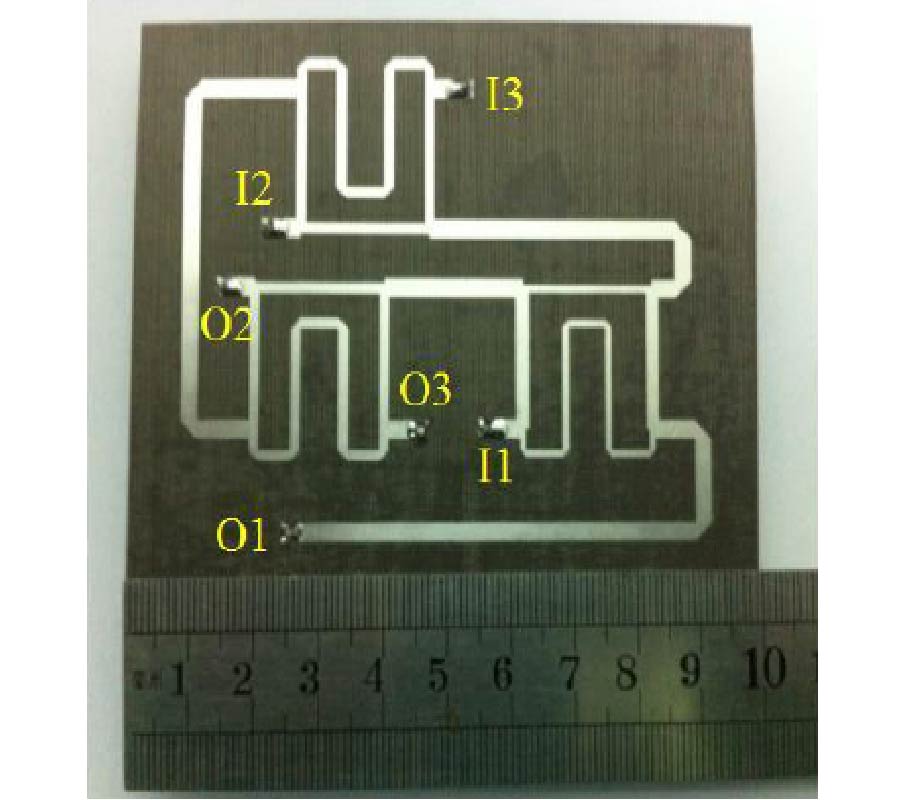
This paper introduces a novel structure of 4×4 multiple beam forming antenna system using substrate integrated folded waveguide technology. For high speed wireless communication it is necessary to minimize the interferences and multipath fading. Multiple beam forming antenna system is a good solution to these problems. The substrate integrated folded waveguide (SIFW) technology reduces the width of substrate integrated waveguide (SIW) by half. All the basic building blocks required for the antenna array system are designed and simulated individually. They are then combined to form the butler matrix fed antenna array system. The SIFW technology reduces the total width of butler matrix. The radiation performance of the multiple beam forming antenna system is realized by integrating the H-plane SIFW horn antennas with the output ports of the butler matrix. The system is practically realized and good directive multiple beams with symmetric gain (5.8 dB, 5.63 dB, 5.31 dB and 5.9 dB for the beams 1R, 2L, 2R and 1L) have been achieved.
DESIGN OF MULTIPLE BEAM FORMING ANTENNA SYSTEM USING SUBSTRATE INTEGRATED FOLDED WAVEGUIDE (SIFW) TECHNOLOGY
2014-05-12
PIER B
Vol. 60, 1-13
Interaction of Electromagnetic Waves with a Moving Slab: Fundamental Dyadic Method
Atieh Kashaninejad Rad , Ali Abdolali and Mohammad Mahdi Salary
This paper concerns with the interaction of electromagnetic waves with a moving slab. Consider a homogeneous isotropic slab moving uniformly in an arbitrary direction surrounded by an isotropic medium (free space). In this paper a new simple and systematic method is proposed for analyzing reflection and transmission of obliquely incident electromagnetic waves by a moving slab based on the concept of propagators. In the previous works complex relations were arrived but using this novel method those complexities will not appear thus the method may be extended to more complex structures. In this method, first, electric and magnetic fields are decomposed into their tangential and normal components then each constitutive dyadic is decomposed into a two-dimensional dyadic in transverse plane and two two-dimensional vectors in this plane. Substituting these dyadics into Maxwell's equations gives a first order differential equation which contains fundamental dyadic of the medium. From the solution of this equation, fields inside the slab may be expressed in terms of fields at the front surface of the slab and the propagator matrix which is an exponential function of fundamental dyadic. Using this method the up-going and down-going tangential electromagnetic fields may be obtained at the same time. As a limiting case a slab with vanishing velocity is discussed using this method, and reflection and transmission coefficients of this slab are derived, which ends in Fresnel's equations. At last, several typical examples are provided to exemplify the applicability of the proposed method. Moreover, the results are compared with the method of Lorentz transformation. A good agreement is observed between the results which verifies the validity of the proposed method.
INTERACTION OF ELECTROMAGNETIC WAVES WITH A MOVING SLAB: FUNDAMENTAL DYADIC METHOD
2014-05-11
PIER C
Vol. 50, 95-102
A Compact Printed Dipole Antenna for Wideband Wireless Applications
Jiangniu Wu , Zhiqin Zhao , Zai-Ping Nie and Qing Huo Liu
A compact printed dipole antenna with wide impedance bandwidth is proposed in this paper. This antenna consists of a pair of radiation metal arms and a microstrip-to-slotline transition structure. At the end of the feeding slotted line, a beveled slot with stepped connection structure is designed to realize an offset feeding structure for feeding the dipole antenna. By using the beveled offset feeding structure, the bandwidth of the dipole antenna is significantly improved. The microstrip-to-slotline transition is used as an integrated balun to realize a balanced feeding for the dipole antenna. To demonstrate the effectiveness of the proposed design, a prototype of the designed antenna is fabricated and measured. The measured results show that the designed dipole antenna achieves a gain of 2.2-4.4 dBi across a wide impedance bandwidth from 2.65 GHz to 17.5 GHz with a compact size (33 mm×16 mm). The performance of the proposed dipole antenna is also compared with some similar printed dipole antennas with respect to overall size, substrate dielectric constant, impedance bandwidth and antenna gain.
A COMPACT PRINTED DIPOLE ANTENNA FOR WIDEBAND WIRELESS APPLICATIONS
2014-05-11
PIER C
Vol. 50, 87-93
Bandwidth Enhancement of a Printed Slot Antenna with a Diamond-Shaped Tuning Stub
Yingying Tan , Liping Yan , Xiang Zhao , Changjun Liu and Kama Huang
A printed slot antenna fed by a microstrip line with a diamond-shaped tuning stub for bandwidth enhancement is proposed and experimentally validated. The simulated results show that the impedance matching of the proposed rotated slot antenna is greatly affected by the dimension of the slot and by the size and the position of the diamond-shaped tuning stub. The experimental results demonstrate that the impedance bandwidth is over 123% for |S11|≤-10 dB ranging from 2.80 to 11.81 GHz. Moreover, the proposed antenna has a small size, and stable and omnidirectional radiation patterns are observed within the operating bandwidth.
BANDWIDTH ENHANCEMENT OF A PRINTED SLOT ANTENNA WITH A DIAMOND-SHAPED TUNING STUB
2014-05-09
PIER C
Vol. 50, 75-85
A Slim Horizontally Polarized Omnidirectional Antenna Based on Turnstile Slot Dipole
Cheng-Yuan Chin and Christina F. Jou
A novel horizontally polarized (HP) antenna with omnidirectional pattern is presented in this paper. The proposed antenna applies the concept of rotating electric field method to conventional slot dipoles. Two CPW-fed slot dipoles are placed in a perpendicularly conjugate form. By properly arranging the magnitude and phase of input signals, the omnidirectional pattern can be synthesized at broadside. A prototype is developed at the 2.6 GHz band, which offers a horizontally polarized omnidirectional radiation pattern with gain of 2.5-3.4 dBi, and the measured antenna efficiency is greater than 73% through the operating band (2.4-2.8 GHz). Furthermore, a 20-dB polarization purity is achieved in this design. The overall volume of the proposed antenna is 22×22×90 mm3 (0.19λ0×0.19λ0×0.78λ0). Distinct from the other proposed HP antennas provided with planar geometry, this antenna is slim in shape, and it can be readily integrated with vertical dipoles to form a polarization diversity system in current wireless router and AP applications.
A SLIM HORIZONTALLY POLARIZED OMNIDIRECTIONAL ANTENNA BASED ON TURNSTILE SLOT DIPOLE
2014-05-09
PIER C
Vol. 50, 65-74
Characterization and Design of Millimeter-Wave Full-Band Waveguide-Based Spatial Power Divider/Combiner
Kang Yin , Kedi Zhang and Jinping Xu
The design and implementation of millimeter-wave full-band waveguide-based spatial power divider/combiner are presented in this paper. The divider/combiner is based on a compact waveguide-to-microstrip (Wg-Ms) probe-array transition structure, providing full-band frequency coverage and low insertion loss. Efficient design and analysis method for this type of power divider/combiner is developed using spectral domain method combined with the image theory. Ka-band two-way (1×2) and four-way (2×2) power combining structures are analyzed and optimized. The performances of the both optimized power dividers/combiners are evaluated by experiments in back-to-back configurations. The measured overall insertion loss for the 1×2 power divider/combiner is better than 1.4dB over the entire Ka-band, which demonstrates the low-loss performance of the divdier/combiner. The optimized 2×2 power divider/combiner shows a same performance as the 1×2 structure without any degradation in operating bandwidth and insertion loss.
CHARACTERIZATION AND DESIGN OF MILLIMETER-WAVE FULL-BAND WAVEGUIDE-BASED SPATIAL POWER DIVIDER/COMBINER
2014-05-09
PIER C
Vol. 50, 57-63
UWB Multilayer Power Divider with High Isolation
Long Xiao and Tao Yang
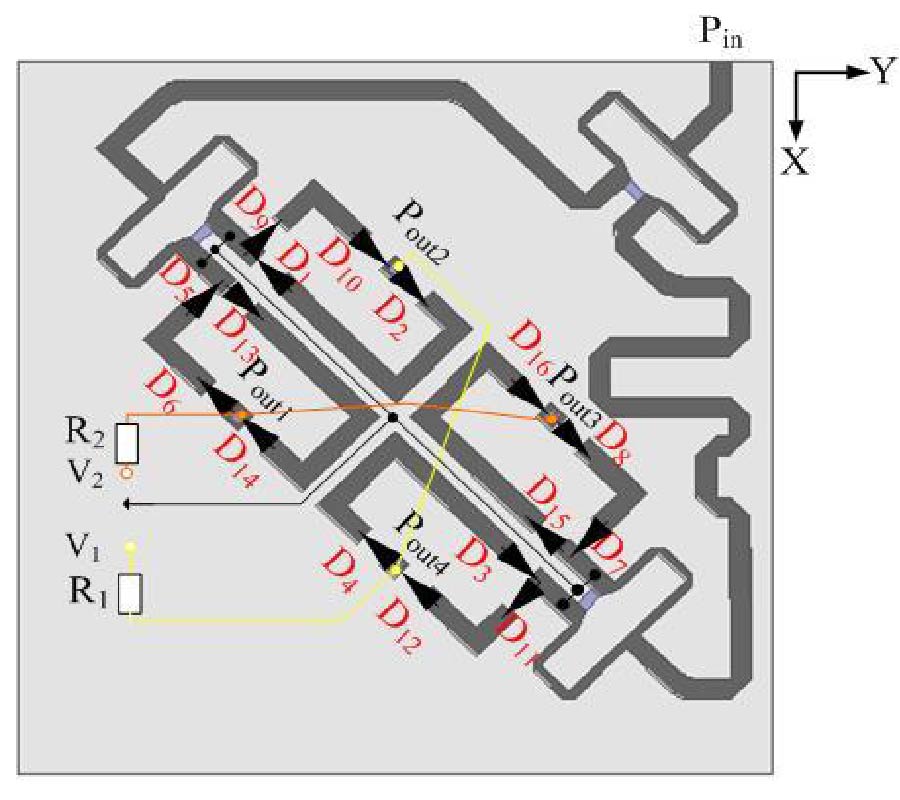
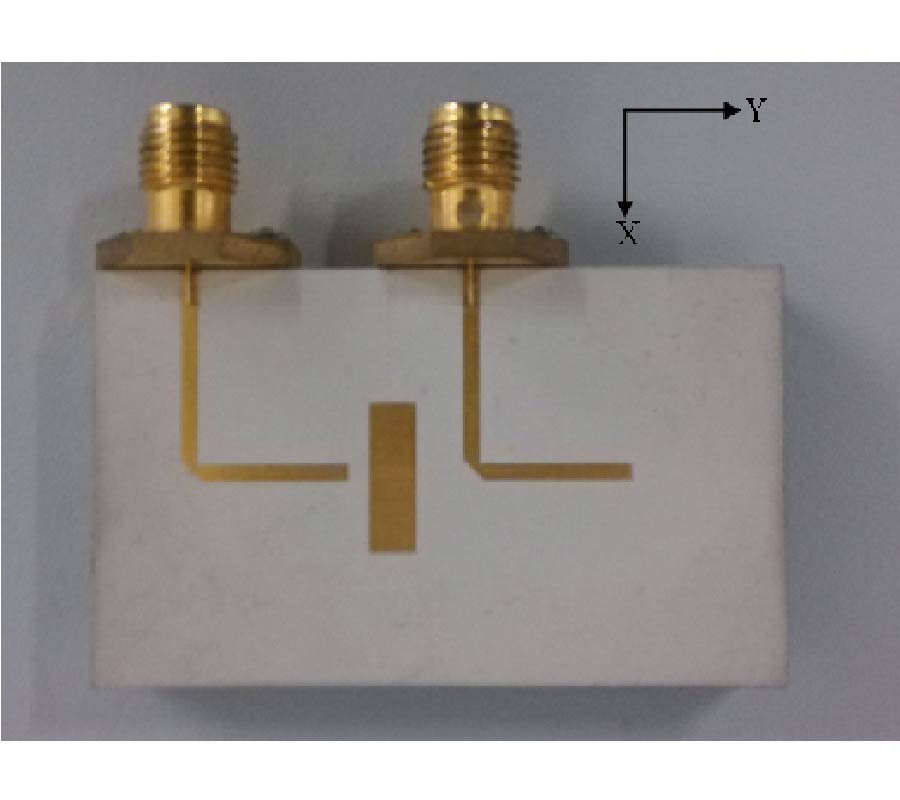
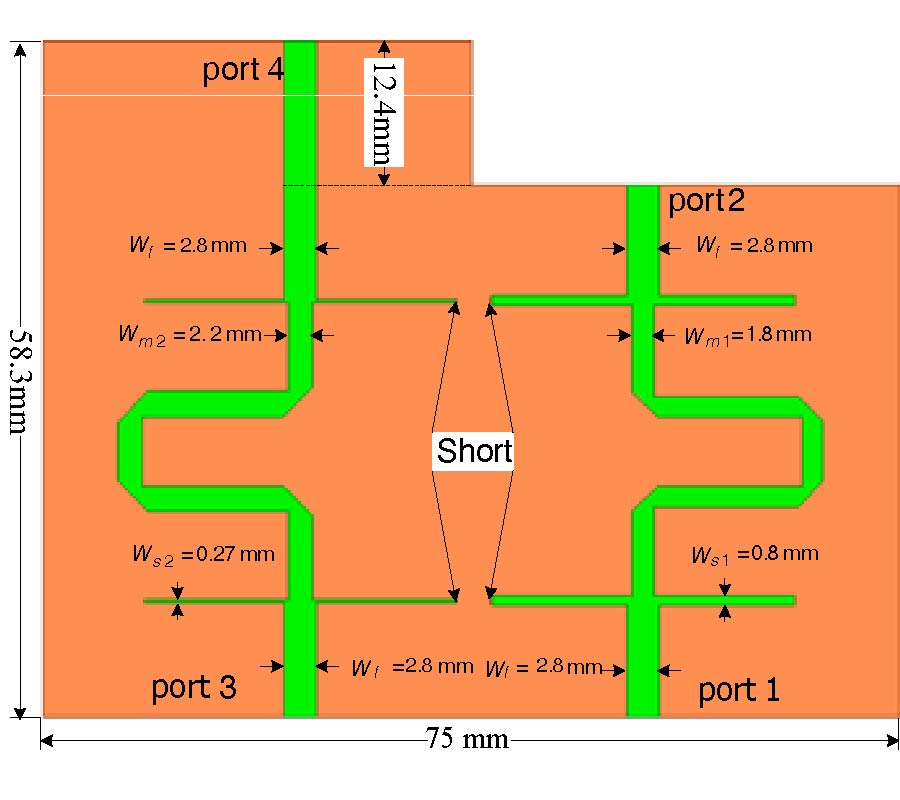
A novel compact slotline power divider is proposed in this article. This presented power divider employs a novel configuration with one lumped resistor, which makes it surpass most antecedent UWB power dividers based on microstrip-to-slotline transitions in aspect of isolation between output ports and return losses at output ports. The simulated and measured results illustrate the good performances of the novel power divider on return losses at all ports, isolation, amplitude and phase balances between output ports, as well as group delay over the wide frequency band from 3.8 GHz to 10.4 GHz.
UWB MULTILAYER POWER DIVIDER WITH HIGH ISOLATION
2014-05-09
PIER C
Vol. 50, 47-56
A Very Compact Novel Multi-Band BPF for Recent Mobile/Satellite Communication Systems
Hesham Abd Elhady Mohamed , Heba B. El-Shaarawy , Esmat A. F. Abdallah and Hadia El-Hennawy
This paper presents a novel compact dual-tri bandpass microstrip filter employing meander and open stub loaded resonators. With the proposed technique, a simple transformation from dual-band to tri-band BPF is realized. A novel structure using embedded resonators is designed to generate multi-band response. The main resonators control the low-band resonant frequency, the meander resonators control the two high-band resonant frequency and the open stub resonators control the high-band resonant frequency. The meander/stub resonators are embedded into the main spiral resonators, which makes the filter compact where its size is reduced by 64% compared to traditional filters. Passbands improvements and high selectivity are realized by the short circuit stubs which generate additional transmission zeros. The proposed filter has advantages such as low insertion loss, compact size and high selectivity. The theory is validated using the commercial full-wave solver CST 2012. Finally, the proposed structure is implemented and the measurement results are found to be in good agreement with the simulation results.
A VERY COMPACT NOVEL MULTI-BAND BPF FOR RECENT MOBILE/SATELLITE COMMUNICATION SYSTEMS
2014-05-09
PIER
Vol. 146, 109-115
A 3-Dimensional Stacked Metamaterial Arrays for Electromagnetic Energy Harvesting
Thamer Almoneef and Omar M. Ramahi
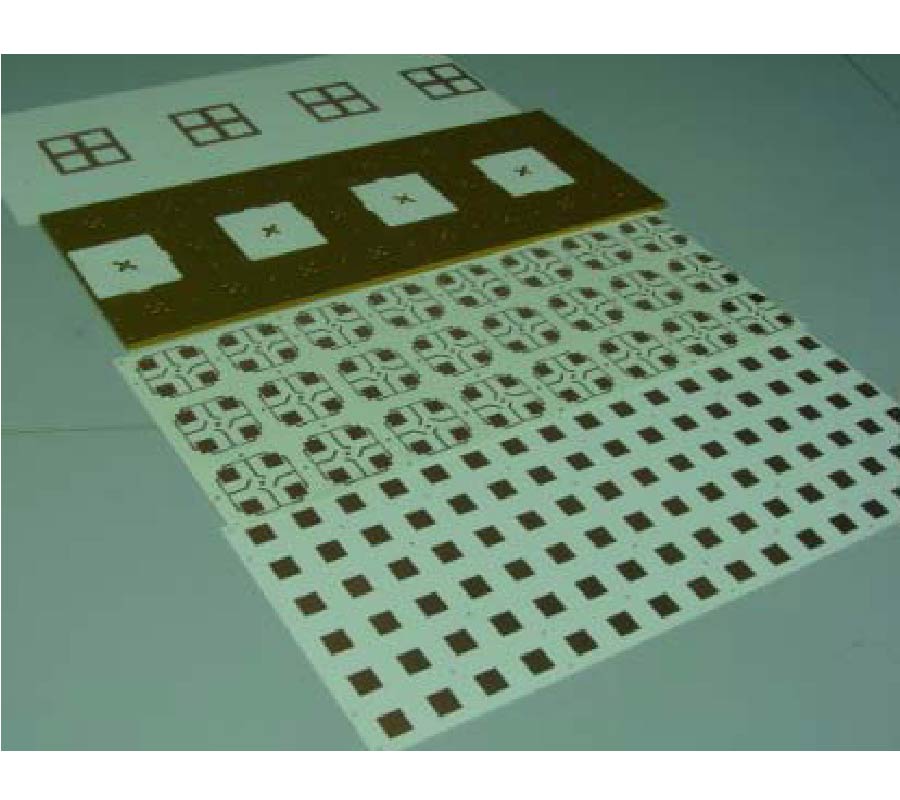
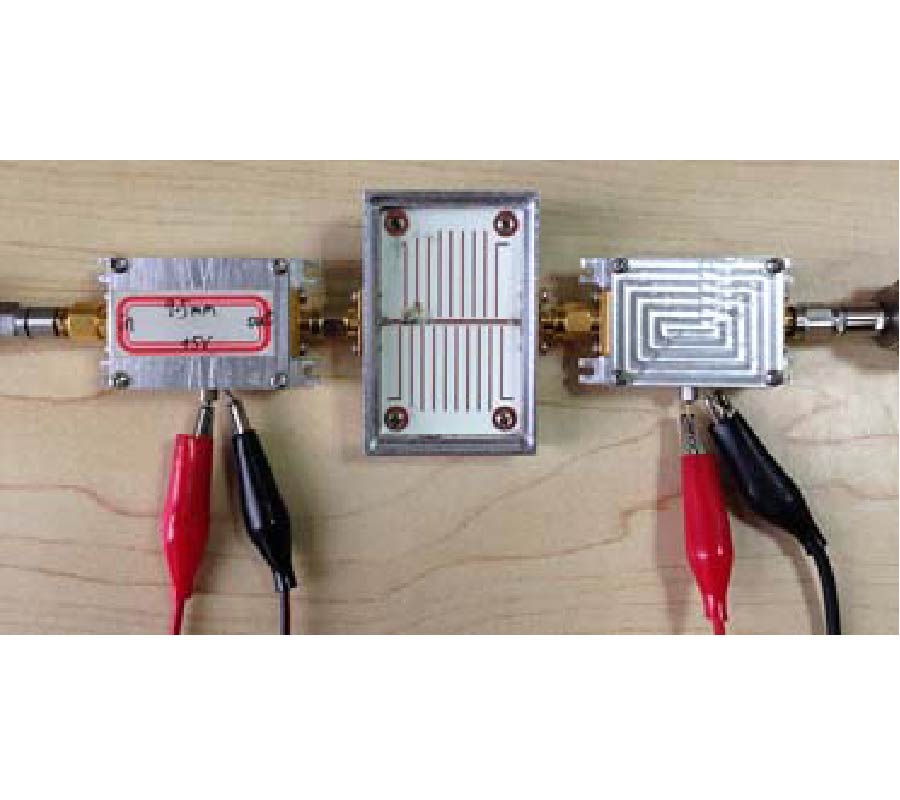
We present the design of 3-D metamaterial stacked arrays for efficient conversion of electromagnetic waves energy into AC. The design consists of several vertically stacked arrays where each array is comprised of multiple Split-Ring Resonators. The achieved conversion efficiency is validated by calculating the power dissipated in a resistive load connected across the gap of each resonator. Numerical simulations show that using stacked arrays can significantly improve the efficiency of the harvesting system in comparison to a flat 2-D array. In fact, the per-unit-area efficiency of the 3-D design can reach up to 4.8 times the case of the 2-D array. Without loss of generalization, the designs presented in this work considered an operating frequency of 5.8 GHz.
A 3-DIMENSIONAL STACKED METAMATERIAL ARRAYS FOR ELECTROMAGNETIC ENERGY HARVESTING
2014-05-07
PIER Letters
Vol. 46, 43-48
Bandpass-Response Power Divider with High Isolation
Long Xiao , Hao Peng and Tao Yang
A novel wideband multilayer power divider with high isolation and bandpass response is presented in this article. This presented power divider employs microstrip-slotline coupling structure to realize the basic function of dividing input power. One lumped isolation resistor is introduced to improve the isolation between output ports. In order to solder the chip resistor between output branches, bending microstrip structure is utilized. For the sake of rejecting the unwanted signals locating in adjacent channels, interdigital structure and defected ground structure are designed to obtain a bandpass response and a wide upper stopband. The experimental results have indicated that the proposed wideband power divider has good performance on return losses, isolation, amplitude and phase balances, as well as group delay over the band 4.5 GHz-10 GHz.
BANDPASS-RESPONSE POWER DIVIDER WITH HIGH ISOLATION
2014-05-07
PIER Letters
Vol. 46, 37-42
Band-Notched Ultra-Wideband Bandpass Filter Using Dual-Mode Resonator Loaded Slotline
Xuehui Guan , Tao Xiong , Fangqi Yang , Pin Wen and Hai-Wen Liu
In this article, a novel band-notched ultra-wideband (UWB) bandpass filter based on hybrid microstrip/slotline structure is proposed. A quad-mode stubs-loaded slotline resonator is fed by two orthogonal microstrip lines and ultra-wideband bandpass characteristic is excited. A stub-loaded dual-mode microstrip resonator is externally loaded to the quad-mode slotline resonator, and a notched band with sharp roll-off characteristic is achieved. The circuit model for the dual-mode microstrip resonator loaded slotline is given and analyzed. The proposed filter is designed and fabricated. Simulated and measured return losses are -12 dB/-18 dB and -18 dB/-10 dB in lower and higher passband. The return loss in the notched band is greater than 15 dB.
BAND-NOTCHED ULTRA-WIDEBAND BANDPASS FILTER USING DUAL-MODE RESONATOR LOADED SLOTLINE
2014-05-05
PIER C
Vol. 50, 39-46
A Broadband CPW-Fed Circularly Polarized Square Slot Antenna for UHF RFID Applications
Shaoshuai Zhang , He Huang and Yingzeng Yin
A broadband CPW-fed circularly polarized square slot antenna for ultra-high-frequency (UHF) radio frequency identification (RFID) applications is proposed. It consists of a square slot embedded with a spur line along diagonal and an F-shaped feeding structure. The proposed antenna achieves an imped-ance bandwidth about 307 MHz (34.6% @886 MHz) and a 3 dB axial ratio (AR) bandwidth about 232MHz (24.3% @954 MHz). The 3 dB AR beam-width is about 96 degrees over the UHF band of 840-960 MHz. The proposed reader antenna based on CPW structure is easy to integrate. With the symmetry and bidirectional radiation pattern, there are less readers needed in some applications, such as access con-trol, than the reader with unidirectional pattern, which will definitely decrease the implemented cost. Therefore, this universal design with desired performance across the entire UHF RFID band (from 840 MHz to 960 MHz) can be applied to all the UHF RFID applications worldwide. Detailed considera-tions of the design and main parameters will be studied in this paper.
A BROADBAND CPW-FED CIRCULARLY POLARIZED SQUARE SLOT ANTENNA FOR UHF RFID APPLICATIONS
2014-05-05
PIER C
Vol. 50, 29-37
Compact UWB MIMO Antenna with ACS-Fed Structure
Hao Qin and Yuan-Fu Liu
A compact UWB (Ultrawideband) MIMO (Multiple-input multiple-output) antenna with asymmetric coplanar strip (ACS)-fed structure is proposed in this paper. The antenna consists of two modified ACS feeding staircase-shaped radiation elements which are orthogonally placed, and the wideband isolation is achieved through a fence-like stub between them. The effectiveness of the fence-like stub is analyzed. Measured results show that the presented antenna can achieve a broad impedance bandwidth (|S11|≤-10 dB) of 3.1-11 GHz with good performance in terms of isolation >15 dB. Radiation patterns and correlation coefficient (ECC) denote the consistent diversity performance across the entire UWB bandwidth. By introducing the ACS-fed structure, the antenna size can be considerably reduced to 43.5 mm×43.5 mm×1.6 mm compared to the recently published UWB MIMO antennas, which makes the antenna suitable for portable UWB MIMO applications.
COMPACT UWB MIMO ANTENNA WITH ACS-FED STRUCTURE
2014-05-05
PIER Letters
Vol. 46, 31-36
Dual-Band CPW-Fed Circularly Polarized Slot Antenna with Improved Ground Plane Structure
Bo Chen and Fu-Shun Zhang
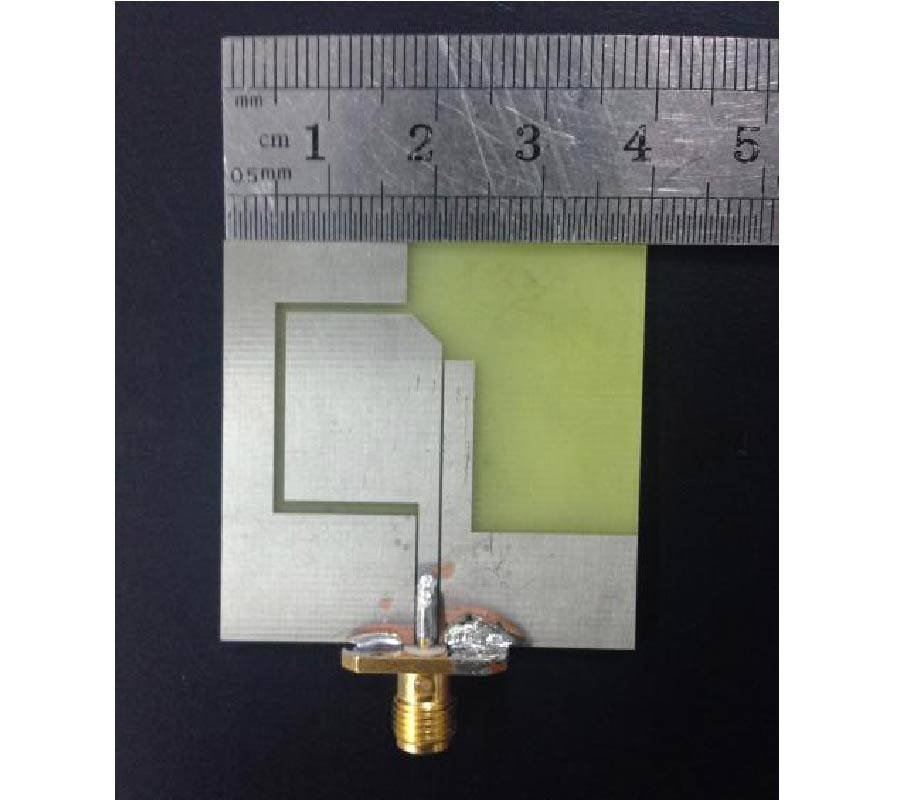
In this letter, a new design of dual-band circularly polarized (CP) slot antenna is proposed. By embedding a vertical stub, a T-shaped strip and a slit to the ground plane, the CPW-fed slot antenna can radiate right-handed circularly polarized (RHCP) wave in two bands 3.0 GHz and 5.0 GHz. The designed antenna with a size of 33 × 27 × 1 mm3 is fed by a 50-Ohm SMA connector and fabricated on a low-cost FR-4 substrate. Experimental results show that the measured 10-dB return loss impedance bandwidths are 20.4% for the lower band and 23% for the upper band, and the measured 3-dB axial-ratio (AR) bandwidths are 14.1% and 15.8%, with respect to 3 GHz and 5 GHz, respectively.
DUAL-BAND CPW-FED CIRCULARLY POLARIZED SLOT ANTENNA WITH IMPROVED GROUND PLANE STRUCTURE
2014-05-05
PIER M
Vol. 36, 47-56
A Dual Grating Waveguide Structure for Wakefield Acceleration at THz
Ganeswar Mishra and Geetanjali Sharma
A dual grating waveguide accelerator structure is investigated and compared with the dielectric wakefield accelerator at THz frequencies. In a dielectric wakefield accelerator, thinner liners for a given current and liners having lower dielectric constant are not preferable due to the fact that they generate much lower axial wakefields. This limits the operation of the device at THz. On the other hand, it is shown that a grating waveguide is tuned at THz with shallower slot heights with competitive wakefield gradients than a dielectric wakefield accelerator.
A DUAL GRATING WAVEGUIDE STRUCTURE FOR WAKEFIELD ACCELERATION AT THZ