Search Results(13798)

2013-12-01
PIER
Vol. 143, 503-518
Analysis of a Double-Layered Vivaldi Antenna Inside a Metallic Enclosure
Majid OstadRahimi , Lotfollah Shafai and Joe LoVetri
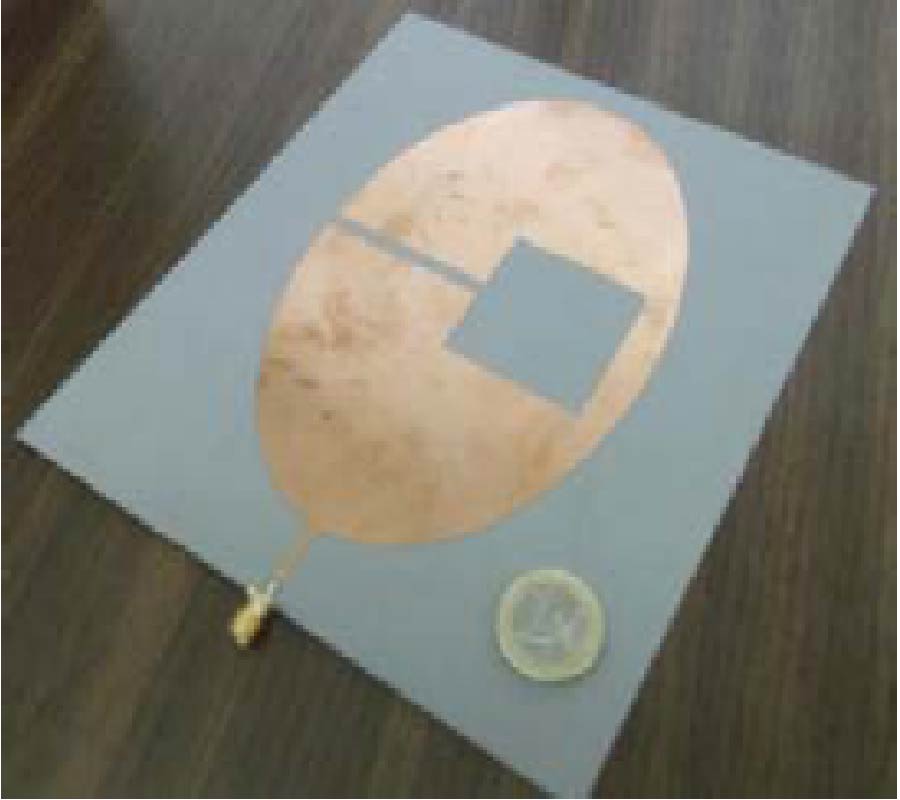
A double-layered Vivaldi antenna enclosed by a metallic cylindrical cavity is investigated. The antenna is correlated to the same-size circular horn antenna to exploit the equivalent modal distribution of the Vivaldi-cavity antenna. It is shown that the TM11 and TE11 are the dominant modes and the proposed antenna operates similar to a dual-mode conical horn. The antenna is fabricated and successfully tested. The radiation characteristics, mutual coupling, as well as cross-polarization level are compared to a similarly sized Vivaldi without any metallic enclosure.
ANALYSIS OF A DOUBLE-LAYERED VIVALDI ANTENNA INSIDE A METALLIC ENCLOSURE
2013-11-30
PIER B
Vol. 57, 87-104
Large-Signal Field Analysis of a Linear Beam Traveling Wave Amplifier for a Sheath-Helix Model of the Slow-Wave Structure Supported by Dielectric Rods. Part 1: Theory
Natarajan Kalyanasundaram and Amita Agnihotri
A rigorous field-theoretic method of analyzing the large-signal behavior of a linear beam traveling wave tube amplifier (TWTA) with slow-wave structure modeled to be a dielectric-loaded sheath helix is presented. The key step in the analysis is a representation of the field components as nonlinear functionals of the electron arrival time through a Green's function sequence for the slow-wave circuit. Substitution of this functional representation for the axial electric field component into the electron ballistic equation casts the latter into a fixed point format for a nonlinear operator in an appropriate function space. The fixed point, and therefore the solution for the electron-arrival time and hence the solution for the electromagnetic field components, can be obtained by standard successive approximation techniques. The calculations of the gain, the efficiency and the other amplifier parameters, comparison of the results of the present theory with experimental results etc., on the basis of such a successive approximation solution for the field components, will be presented in the second part of this paper.
LARGE-SIGNAL FIELD ANALYSIS OF A LINEAR BEAM TRAVELING WAVE AMPLIFIER FOR A SHEATH-HELIX MODEL OF THE SLOW-WAVE STRUCTURE SUPPORTED BY DIELECTRIC  RODS. PART 1: THEORY
2013-11-29
PIER
Vol. 143, 485-501
Theoretical Analysis of Resonant Wireless Power Transmission Links Composed of Electrically Small Loops
Alexandre Robichaud , Martin Boudreault and Dominic Deslandes
This paper presents an analytical method to calculate the scattering parameters of a wireless power transmission link composed of electrically small single loop resonators. The proposed method takes into account all the different couplings in the structure. First, the method is presented and used to find the S-parameters for links composed of circular and rectangular resonators. The model is then used to find the optimal topology for a given transmission distance. Validation of the model is done by comparing its results with experimental measurements. Based on this model, a software used for the design of wireless power transmission links has been developed and is presented. Finally, demonstrations that this model produces excellent results are provided. At resonant frequency, an accuracy better than 2% is reached.
THEORETICAL ANALYSIS OF RESONANT WIRELESS POWER TRANSMISSION LINKS COMPOSED OF ELECTRICALLY SMALL LOOPS
2013-11-26
PIER Letters
Vol. 44, 35-41
A Novel Dual-Band Metamaterial Absorber and Its Application for Microstrip Antenna
Hao Zhang , Xiang-Yu Cao , Jun Gao , Huanhuan Yang and Qun Yang
In this letter, a novel dual-band metamaterial absorber is presented and analyzed. The absorber is composed of four patches on the top of a thin grounded dielectric substrate which can absorb incident wave at two different frequency bands effectively. Then the absorber is loaded on the dual-band microstrip antenna, whose working frequency bands are overlapped with that of the absorber, to reduce the in-band RCS (Radar Cross Section) of antenna. The prototype is simulated, manufactured and measured. Simulated results show that the absorption of the absorber is as high as 98.6% at 4.29 GHz and 99.8% at 6.49 GHz. As to the dual-band antenna loaded with the proposed absorber, its radiation performance is unchanged while the RCS has declined by 8.59 dB at 4.29 GHz and 9.9 dB at 6.49 GHz respectively. There is a good agreement between simulated and measured results, which verifies that this absorber can be used for in-band RCS reduction of dual-band antenna so as to improve its in-band stealth performance.
A NOVEL DUAL-BAND METAMATERIAL ABSORBER AND ITS APPLICATION FOR MICROSTRIP ANTENNA
2013-11-25
PIER M
Vol. 34, 47-54
Calculation Absorption Coefficient of a Weak Electromagnetic Wave by Confined Electrons in Cylindrical Quantum Wires in the Presence of Laser Radiation by Using the Quantum Kinetic Equation
Nguyen Thi Thanh Nhan and Nguyen Vu Nhan
We calculated analytic expressions for the absorption coefficient (ACF) of a weak electromagnetic wave (EMW) by confined electrons in cylindrical quantum wires (CQW) in the presence of laser radiation by using the quantum kinetic equation for electrons in the case of electron-optical phonon scattering. The ACF of a weak EMW depends on the intensity E01 and frequency Ω1 of the external laser radiation (E1 = E01sin(Ω1t1)); the intensity E02 and frequency Ω2 of the weak EMW (E2 = E02sin(Ω2t)), the temperature T of the system and the radius R of CQW. Then, the analytic results are numerically calculated and discussed for GaAs/AlAs CQW. The numerical results show that the ACF of a weak EMW in a CQW can have negative values. So, in the presence of laser radiation, under proper conditions, the weak EMW is increased. This is different from the similar problem in bulk semiconductors and from the case of the absence of laser radiation.
CALCULATION ABSORPTION COEFFICIENT OF A WEAK ELECTROMAGNETIC WAVE BY CONFINED ELECTRONS IN CYLINDRICAL QUANTUM WIRES IN THE PRESENCE OF LASER RADIATION BY USING THE QUANTUM KINETIC EQUATION
2013-11-25
PIER M
Vol. 34, 39-46
Parametric Instability of Surface Electron Cyclotron TM-Modes
Volodymyr Girka and Vitalii Viktorovych Iarko
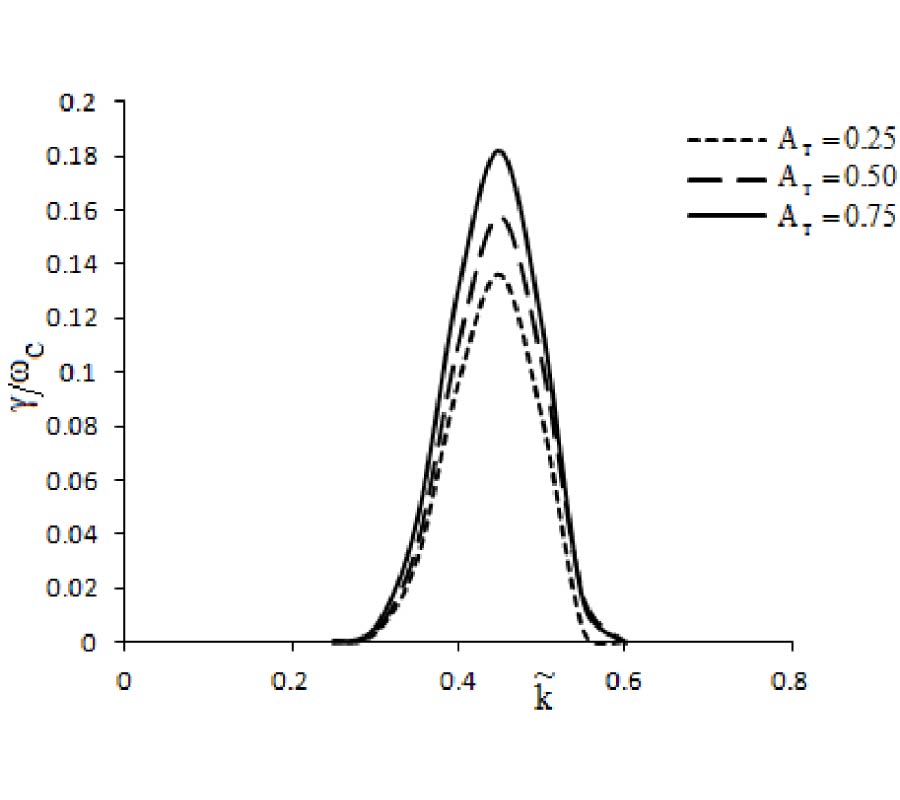
Excitation of waves at harmonics of electron cyclotron frequency due to utilization of an external alternating electric field is under the consideration. It is proved that they are eigen modes of plasma-dielectric-metal structures in both long (as compared with electron Larmor radius) wavelength range and short wavelength range if an external steady magnetic field is oriented perpendicularly to the plasma interface. It is assumed that uniform external electric field operates at the frequency, which belongs to the range of electron cyclotron frequencies. The problem is solved theoretically using kinetic Vlasov-Boltzmann equation for description of the plasma particles motion and Maxwell equations for description of TM polarized field of these modes. Non-linear boundary condition for tangential magnetic field of these TM-modes is formulated using conception of non-linear surface electric current. Infinite set of equations for harmonics of their tangential electric field is derived due to this condition. This set is solved using approach of the wave packet consisting of the basic harmonic and two nearest satellite harmonics. Simple analytical expression for growth rate of surface electron cyclotron TM-modes' parametric instability is obtained and analyzed numerically.
PARAMETRIC INSTABILITY OF SURFACE ELECTRON CYCLOTRON TM-MODES
2013-11-23
PIER B
Vol. 57, 75-85
Frequency Selective Surface with Arbitrary Shapes and Its Application to Filter Design
Maurice Sesay , Xin Jin and Zhengbiao Ouyang
Investigation on dielectric frequency selective structure with arbitrary shaped grating is done numerically for filter applications. To obtain well designed parameters, the effects of shape, size and dielectric constant of the structure are carefully studied. We examine in detail various structures and their spectral response which have not been reported by other authors. It is also shown how the frequency selective behavior of the structure can be controlled to meet a specific purpose for narrow linewidth filtering for normal incident angle. Results obtained for the scattering of several dielectric frequency selective surfaces are compared with both theoretical and experimental results presented in the literature, showing very good agreement. The effect of arbitrary angle of incidence is also shown to excite higher-order Floquet modes that affect the filtering properties.
FREQUENCY SELECTIVE SURFACE WITH ARBITRARY SHAPES AND ITS APPLICATION TO FILTER DESIGN
2013-11-22
PIER B
Vol. 57, 63-73
Passive Millimeter Wave Image Denoising Based on Adaptive Manifolds
Shujin Zhu , Yuehua Li , Jianfei Chen and Yuanjiang Li
Since the characters of poor inherent resolution and low signal-to-noise limit the application of the passive millimeter wave (PMMW) image, it is particularly important to improve the resolution and denoise the PMMW image. In this paper, the adaptive manifolds filtering algorithm based on non-local means (AM-NLM) is illustrated in detail. And an improved version of AM-NLM filtering algorithm is proposed for processing the PMMW image. The proposed algorithm firstly applies the AM-NLM filtering to obtain the basic denoised PMMW image. Then the image enhancement based on Laplacian of Gaussian operator is performed to enhance the edge of the target in PMMW image. Finally, the hard-threshold filtering with different thresholds is adopted to filter each dimension to achieve the final filtering response. Experimental results have shown that the proposed PMMW filtering algorithm has better and more satisfactory performance compared to AM-NLM, both in subjective visual effect and objective image quality metric. Additionally, our proposed algorithm is also available for real PMMW images.
PASSIVE MILLIMETER WAVE IMAGE DENOISING BASED ON ADAPTIVE MANIFOLDS
2013-11-21
PIER B
Vol. 57, 47-61
A Mathematical Model for the Transient Lightning Response from Grounding Systems
Zhong Xin Li , Yu Yin , Cui-Xia Zhang and Liu-Cun Zhang
A mathematical model for accurately computing, when combined with the Fast Fourier Transform (FFT), the lightning currents flowing along a high voltage a.c. substation's grounding system buried in half infinite homogenous earth has been developedn in this paper. It is a hybrid of Galerkin's method of moment and the conventional nodal analysis method. The model can calculate the distribution of both branch and leakage currents along the grounding system. The dynamic state complex image method and the closed form of Green's function of a dipole or monopole in the half infinite homogenous earth model are introduced into this model to accelerate the calculation of the mutual impedance and induction coefficients. Analytical formulae for the mutual induction and impedance coefficients have been developed to accelerate the calculation for near field case by Maclaurin expansion. With the inverse FFT, the model can be used to study the transient lightning response of a grounding system.
A MATHEMATICAL MODEL FOR THE TRANSIENT LIGHTNING RESPONSE FROM GROUNDING SYSTEMS
2013-11-21
PIER B
Vol. 57, 21-46
Fully Time-Domain Scanning of EM Near-Field Radiated by RF Circuits
Yang Liu and Blaise Ravelo
This paper deals with planar scanning technique of electromagnetic (EM) near-field (NF) emitted by electronic printed circuit boards (PCBs) fully in the time-domain (TD). The proposed EM scanning metrology is essentially based on the NF test bench available at the IRSEEM laboratory. It comprises motorized mechanical structures for moving the probe interconnected to electronic measurement instruments and controlled by a driver PC. The synoptic of the test bench is presented and technically examined. The characteristics of different elements constituting the measurement chain of the TD test bench understudy are described. The NF metrology developed is originally focused on the measurement of time-dependent magnetic field H(t) dedicated to the radiated emission electromagnetic compatibility (EMC) applications. An innovative calibration technique of the loop probe for detecting H(t) is established in order to ensure the post processing and extraction of the measured NF data. Then, validations were carried out via comparison with different simulations run with standard commercial tools. Mathematical analyses were also conducted for the improvement of the measurement post processing. To realize the mapping of time-dependent EM field components, a software interface edited with the graphical language LabVIEW was emulated to synchronize the probe displacement and the data acquisition. An UWB amplifier with average gain about 30 dB from DC to 300 MHz was designed and fabricated in order to decrease the measurement noise and to improve the quality of measured signals. As results of the study, TD NF mapping is demonstrated successfully by measuring the EM radiation emitted by electronic planar circuits. The technique developed is extremely useful in the field of EMC engineering for predicting the transient perturbations susceptible to degrade electronic functions in complex systems encountered usually for the automotive and aeronautic applications.
FULLY TIME-DOMAIN SCANNING OF EM NEAR-FIELD RADIATED BY RF CIRCUITS
2013-11-21
PIER B
Vol. 57, 1-20
Field Measurements Within a Large Resonant Cavity Based on the Perturbation Theory
Mohamed Nasserdine , Stephanie Mengue , Christophe Bourcier and Elodie Richalot
Due to the sensitivity of the field distribution within a resonant cavity to the presence of an object, conventional measurement techniques employing a probe suffer from a limited accuracy. Therefore we propose a new measurement technique of the electric field distribution that avoids the use of a probe. Based on the perturbation theory, it consists of a measure of the cavity resonant frequency variation while displacing a small perturbing object within the cavity. The choice of the perturbing object shape, dimension and material is discussed with the help of simulation and measurement results in a canonical case. The case of reverberation chamber equipped with a mode stirrer is also considered, as well as the insertion of a metallic box within the cavity. Our measurement setup is very low-cost, simple to set up and to use, and adapted to any cavity geometry.
FIELD MEASUREMENTS WITHIN A LARGE RESONANT CAVITY BASED ON THE PERTURBATION THEORY
2013-11-21
PIER C
Vol. 45, 203-221
Hardware Implementation of a Proposed QR-Tls DOA Estimation Method and MUSIC, ESPRIT Algorithms on Ni-Pxi Platform
Nizar Tayem , Syed Ahmed Raza , Muhammad Omer , Mohamed El-Lakki and Jamal F. Nayfeh
In this paper, we present an experimental verification of a novel QR-TLS algorithm. Two other algorithms for direction of arrival (DOA) estimation of multiple incident source signals called multiple signal classification (MUSIC) and estimation of signal parameters via rotational invariance techniques (ESPRIT) are implemented on a National Instruments (NI) PXI platform. The proposed method is based on subspace decomposition of a received data into a signal and a noise space using QR decomposition. The angle of the signal arrival information is extracted from the signal subspace by using the method of total least squares (TLS). The algorithms are implemented in LabView NI hardware. The experimental procedures are discussed in details which includes interfacing of the uniform linear array (ULA) of antennas with the NI-PXI platform, calibrating phase differences between the RF receivers, and selecting transmitter and receiver parameters, for determining the DOAs of the multiple incident source signals. The experimental results are shown for a single and two sources lying at arbitrary angles from the array reference to verify the successful real time implementation of the proposed and other DOA estimation algorithms.
HARDWARE IMPLEMENTATION OF A PROPOSED QR-TLS DOA ESTIMATION METHOD AND MUSIC, ESPRIT ALGORITHMS ON NI-PXI PLATFORM
2013-11-21
PIER Letters
Vol. 44, 29-34
Compact LPF with Sharp Roll off and Wide Stopband Using Coupling Stepped Impedance Triangular Resonator
Zebao Du , Hao Yang , Haiying Zhang and Min Zhu
A lowpass filter with sharp transition and wide stopband using a novel coupling stepped-impedance triangular resonator is presented. The L-C equivalent circuit is developed for designing this type filter and analyzing the mechanism for improving roll-off and rejection property. The stopband width, passband edge, roll-off rate and overall suppression level are affected by coupling capacitance. The effect of coupling capacitance is analyzed using calculated frequency response. Coupling triangular stubs provide adequate coupling capacitance resulting in balance among transition property, stopband width and suppression level easily. A single LPF unit is designed and fabricated with cutoff frequency of 860 MHz. The single LPF unit exhibits 40-dB suppression level from 1.11 GHz to 2.28 GHz. A cascaded LPF with three asymmetric units provides 40-dB suppression level from 1.1 GHz to 6.76 GHz, and roll-off rate of 154 dB/GHz with compact size as small as 0.23λg × 0.05λg, where λg is guided wavelength at cutoff frequency.
COMPACT LPF WITH SHARP ROLL OFF AND WIDE STOPBAND USING COUPLING STEPPED IMPEDANCE TRIANGULAR RESONATOR
2013-11-21
PIER M
Vol. 34, 29-37
Accurate and Fast Extraction of the Bloch Eigenmodes of Fiber Gratings
Amir M. Jazayeri
Based on Bloch-Floquet's theorem and ordinary matrix calculations, a rigorous method for extraction of the eigenmodes of fiber gratings is developed. This method is also applicable to fiber gratings which are either physically multilayer or mathematically divided into layers along the radial coordinate. Although the well-known coupled mode theory (CMT) is accounted a method for extraction of the coefficients of reflection and transmission of finite-length FBGs, its inadequacy for extraction of the Bloch eigenmodes of FBGs is illustrated, even if the modulation depth of refractive index is small and the Bragg condition is satisfied.
ACCURATE AND FAST EXTRACTION OF THE BLOCH EIGENMODES OF FIBER GRATINGS
2013-11-21
PIER
Vol. 143, 447-461
Spectral-Domain Formulation of Pillar-Type Photonic Crystal Waveguide Devices of Infinite Extent
Yoshimasa Nakatake and Koki Watanabe
This paper presents a novel formulation for the modeling of electromagnetic wave propagation in pillar-type photonic crystal waveguide devices. The structure under consideration is formed in an in nitely extended pillar-type photonic crystal and the wave propagation is controlled by removing some cylinders from the original periodic structure. The structure is considered as cascade connections of straight waveguides, and the input/output properties of the devices are obtained using an analysis method of multilayer structure. Each layer includes periodic circular cylinder array with defects, and the transfer-matrix is obtained by using a spectral-domain approach based on the recursive transition-matrix algorithm with the lattice sums technique and the pseudo-periodic Fourier transform.
SPECTRAL-DOMAIN FORMULATION OF PILLAR-TYPE PHOTONIC CRYSTAL WAVEGUIDE DEVICES OF INFINITE EXTENT
2013-11-20
PIER C
Vol. 45, 191-201
Triode Magnetron Injection Gun for 132 GHz Gyrotron for 200 MHz Dnp-NMR Application
Nitin Kumar , Udaybir Singh and Ashok Kumar Sinha
A 132 GHz gyrotron, operating at fundamental harmonic, is designed for the 200 MHz DNP-NMR experiment. In this article, the design of high quality electron beam source is presented. 2.5 dimensional code EGUN and 3 dimensional code CST-Particle Studio are used in the design and optimization of electron gun. The design of electron beam source is performed for a band of magnetic field values at the emitter surface and cavity center which is necessary for the frequency tunabilty of 2-3 GHz needed in DNP/NMR experiments. The results confirm the axial and transverse velocity spreads around 1% and 2.2% and a pitch factor of 1.5. The parametric analyses are also performed for the various electrical parameters such as emitter voltage, anode voltage, emitter magnetic field, etc.
TRIODE MAGNETRON INJECTION GUN FOR 132 GHZ GYROTRON FOR 200 MHZ DNP-NMR APPLICATION
2013-11-20
PIER C
Vol. 45, 179-190
A Novel Loop-Like Monopole Antenna with Dual-Band Circular Polarization
Kang Ding , Tongbin Yu , De-Xin Qu and Cheng Peng
A novel loop-like monopole antenna with dual-band circular polarization (CP) for the reception of WiMAX and WLAN is designed and implemented in this paper. The antenna consists of a radiating patch which is composed of an annular-ring linked by a square ring over the corner and a ground plane with embedded rectangular slit. The broad impedance bandwidth is achieved based on a novel monopole structure which is the combination of two perturbed loops and the perturbation causes the generation of right-hand circular polarization (RHCP) at 3.52 GHz and left-hand circular polarization (LHCP) at 5.75 GHz. In addition, by embedding a rectangular slit on the ground, the impedance bandwidth can be greatly enhanced. The measured results show that the proposed monopole antenna has an impedance bandwidth of 3.65 GHz from 2.65 to 6.3 GHz, reaching the particularly broad bandwidth of 81.6%. Furthermore, the measured 3-dB axial ratio (AR) bandwidths are about 440 MHz at the lower band (3.52 GHz) and 220 MHz at the upper band (5.75 GHz). The radiation characteristics of the implemented antenna are also presented.
A NOVEL LOOP-LIKE MONOPOLE ANTENNA WITH DUAL-BAND CIRCULAR POLARIZATION
2013-11-20
PIER
Vol. 143, 421-445
A Wideband Frequency-Shift Keying Modulation Technique Using Transient State of a Small Antenna (Invited Paper)
Mohsen Salehi , Majid Manteghi , Seong-Youp Suh , Soji Sajuyigbe and Harry G. Skinner
The rate of wireless data transmission is limited by the antenna bandwidth. We present an efficient technique to realize a high-rate direct binary FSK modulation by using the transient properties of high-Q antennas. We show that if the natural resonance of a narrowband resonant-type antenna is switched at a high rate, the radiating signal follows the variation of resonant frequency and provides a high-rate data-transmission regardless of the narrowband characteristics of the antenna. The bit-rate in this method is dictated by the switching speed rather than the impedance bandwidth. Since the proposed technique employs the antenna in a time-varying arrangement, carrier frequencies are not required to be simultaneously within the antenna bandwidth. When demanded, the antenna is tuned to required carrier frequency according to a sequence of digital data. Moreover, if the switching frequency is properly chosen such that the stored energy in the near-zone is not dramatically disturbed, any variation in the antenna resonance will instantaneously appear in the far-field radiation due to the previously accumulated energy in the near field. Therefore, depending on the Q factor and switching speed, radiation bandwidth of the antenna can be improved independently from the impedance bandwidth. Furthermore, we show that a single RF source is sufficient to excite both carrier frequencies and the need for a VCO is obviated. Experimental results are presented to validate the feasibility of the proposed technique.
A WIDEBAND FREQUENCY-SHIFT KEYING MODULATION TECHNIQUE USING TRANSIENT STATE OF A SMALL ANTENNA (Invited Paper)
2013-11-19
PIER Letters
Vol. 44, 23-28
Broadband and Small-Size 3-DB Ring Coupler
Stefan Simion and Giancarlo Bartolucci
A topology for a 3-dB broadband and small-size ring coupler is proposed. It consists of fullydistributed Composite Right-/Left-Handed phase shifters and a Lange coupler. For the fabricated coupler, the frequency bandwidth is one octave, centered on 1.5 GHz, while the footprint area is 25% compared to the conventional ring coupler topology. The experimental results are in good agreement with the expected ones, obtained by electromagnetic simulation.
BROADBAND AND SMALL-SIZE 3-DB RING COUPLER
2013-11-19
PIER Letters
Vol. 44, 15-21
Phase Shifting Holography for THz Near-Field/Far-Field Prediction
Gary Junkin
With a view to extending techniques for THz antenna near-field/far-field prediction, this communication derives general analytic expressions for calibrated phase shifting holography (PSH) and introduces a new 120º three-step PSH method that avoids switching off the reference field and has symmetrical performance over the entire complex plane, providing spurious free far-field prediction. Numerical tests with simulated near-field patterns at 372GHz confirm the convenience of the method and give an indication of the precision required for the phase shifts.
PHASE SHIFTING HOLOGRAPHY FOR THZ NEAR-FIELD/FAR-FIELD PREDICTION