Search Results(13798)

2013-10-31
PIER B
Vol. 56, 185-201
Quasi Self-Complementary UWB Notched Microstrip Antenna for USB Application
Anwer S. Abd El-Hameed , Deena A. Salem , Esmat A. F. Abdallah and Essam A. Hashish
UWB antenna is a crucial part of any UWB system required for indoor application. In this paper a novel design is presented, which relies on self-complementary structure. The structure is fed by a microstrip line, where a triangular notch is embedded in the ground plane. The design in this paper yields a UWB bandwidth that extends from 2.86.0-40.0 GHz. To ensure coexistence of UWB with WLAN applications (5.15-5.825 GHz) with minimal interference, a frequency notch is introduced using two parasitic U-shaped elements embracing the microstrip feeding line that resonates in the vicinity of the band notch frequency band. The proposed design was subject to parametric study to reach optimum parameters. The final design was fabricated using photolithographic technique and the measured results showed very good agreement with simulated ones.
QUASI SELF-COMPLEMENTARY UWB NOTCHED MICROSTRIP ANTENNA FOR USB APPLICATION
2013-10-31
PIER C
Vol. 45, 101-112
Design and Analysis of Double U Slot Loaded Dual Frequency Microstrip Antenna
Sathiyamoorthy Murugan , Elamurugan Sathish Kumar and Vayanaperumal Rajamani
The objective of the work is to design a dual frequency microstrip antenna for small frequency ratio applications. The proposed geometry comprised of suspended truncated circular microstrip antenna, with double U slot etched on the radiating element. The design parameters are radius of circular patch, width and length of slot, height of air gap. The proposed design of the antenna has enough freedom to control the dual design frequencies/frequency ratio by varying the above design parameters. FR4 substrate with dielectric constant 4.4 is chosen for design and fabrication. The dual design frequencies are 1.93 GHz and 2.17 GHz, covering the applications such as WCDMA, 3G mobile data terminals, and 4G LTE applications. The antenna is fed by a 50 Ω coaxial probe. The simulation of the antenna is performed using ANSOFT HFSS and analyzed for return loss, VSWR and radiation pattern. The antenna is fabricated and tested for impedance matching and radiation characteristics. The simulation and experimental results show that the antenna worked well at desired dual frequencies. The impedance matching is well at both frequencies (VSWR <2). Though, the measured radiation pattern is unidirectional in co-polarisation, nearly omnidirectional (butterfly) pattern is obtained in cross-polarisation and gain is about 5.54 dB at 1.93 GHz and 8.23 dB at 2.17 GHz. Also, the design is well suited for small frequency ratio dual frequency applications.
DESIGN AND ANALYSIS OF DOUBLE U SLOT LOADED DUAL FREQUENCY MICROSTRIP ANTENNA
2013-10-31
PIER C
Vol. 45, 87-100
Design and Realization of Three-Pole Bandpass Filter with Spurious Response Suppression Using Defected Ground Structures
Alia Zakriti , Naima Amar Touhami , Khadija Bargach , Mohammed Lamsalli and Mohammad Essaaidi
In this paper, a three-pole bandpass filter (BPF) using a new defected ground structure (DGS) is discussed. The proposed DGS is incorporated in the ground plane under the feed lines and the coupled lines of a bandpass filter to improve the performance of the filter in both passband and stopband. The banpass filter is designed with a center frequency of 1.8 GHz and a bandwidth of 270 MHz. The suppression of better than 20 dB was achieved for frequencies between 2.2 and 5 GHz. A prototype of BPF was fabricated and tested. Prototype measured data was in good agreement with simulation results.
DESIGN AND REALIZATION OF THREE-POLE BANDPASS FILTER WITH SPURIOUS RESPONSE SUPPRESSION USING DEFECTED GROUND STRUCTURES
2013-10-31
PIER Letters
Vol. 43, 137-147
Development of Accurate Multi-Pole Debye Functions for Electromagnetic Tissue Modelling Using a Genetic Algorithm
Finn Krewer , Fearghal Morgan and Martin O'Halloran
The development of anatomically and dielectrically representative tissue models is key to the design and refinement of electromagnetic based diagnostic and therapeutic technologies. An important component of any such model are accurate and efficient Debye models which allow for the incorporation of the frequency dependent properties of biological tissues. The establishment of multi-pole Debye models is often a compromise between accuracy and computational cost. Furthermore, some finite difference time domain schemes impose constraints on the minimum Debye pole time-constant. In this study, the authors have developed an optimised genetic algorithm to establish Debye coefficients with minimal yet sufficient Debye poles for several different biological tissues. These Debye coefficients are fitted to existing Cole-Cole models and their accuracy is compared to previously fitted Debye models.
DEVELOPMENT OF ACCURATE MULTI-POLE DEBYE FUNCTIONS FOR ELECTROMAGNETIC TISSUE MODELLING USING A GENETIC ALGORITHM
2013-10-31
PIER M
Vol. 33, 239-249
Performance of a Wide Angle and Wide Band Nulling Method for Phased Arrays
Khalil Hassan Sayidmarie and Jafar Ramadhan Mohammed
In most practical applications of the phased array antennas, the generated nulls toward the interfering signals should have enough depth and width to accommodate fluctuations in frequency and direction of the interferer. Due to these fluctuations, the nulls can be easily deviated from its desired angular locations in the traditional adaptive nulling arrays since the nulls are very sharp and sensitive. An innovative technique for wide nulling arrays has been recently presented. The wide nulls can be introduced by setting properly the excitation coefficients of the two edge elements of the antenna array. In this paper, the effect of frequency fluctuation on the nulling performance is investigated. By generating wide and deep nulls toward and around the interference directions, the proposed method provides robustness against frequency fluctuation. Simulation results in realistic situations with frequency fluctuation are presented to illustrate the performance of the proposed technique. Comparisons with the standard fully adaptive nulling array are shown.
PERFORMANCE OF A WIDE ANGLE AND WIDE BAND NULLING METHOD FOR PHASED ARRAYS
2013-10-31
PIER
Vol. 143, 187-206
Radiometric Method for Emissivity Retrieval in High Reflective Materials
Marco Canavero and Axel Murk
High reflective materials in the microwave region play a very important role in the realization of antenna reflectors for a broad range of applications, including radiometry. These reflectors have a characteristic emissivity which needs to be characterized accurately in order to perform a correct radiometric calibration of the instrument. Such a characterization can be performed by using open resonators, waveguide cavities or by radiometric measurements. The latter consists of comparative radiometric observations of absorbers, reference mirrors and the sample under test, or using the cold sky radiation as a direct reference source. While the first two mentioned techniques are suitable for the characterization of metal plates and mirrors, the latter has the advantages to be also applicable to soft materials. This paper describes how, through this radiometric techniques, it is possible to characterize the emissivity of the sample relative to a reference mirror and how to characterize the absolute emissivity of the latter by performing measurements at different incident angles. The results presented in this paper are based on our investigations on emissivity of a multilayer insulation material (MLI) for space mission, at the frequencies of 22 and 90 GHz.
RADIOMETRIC METHOD FOR EMISSIVITY RETRIEVAL IN HIGH REFLECTIVE MATERIALS
2013-10-30
PIER M
Vol. 33, 223-238
Three Dimensional Radar Coincidence Imaging
Dongze Li , Xiang Li , Yongqiang Cheng , Yu-Liang Qin and Hongqiang Wang
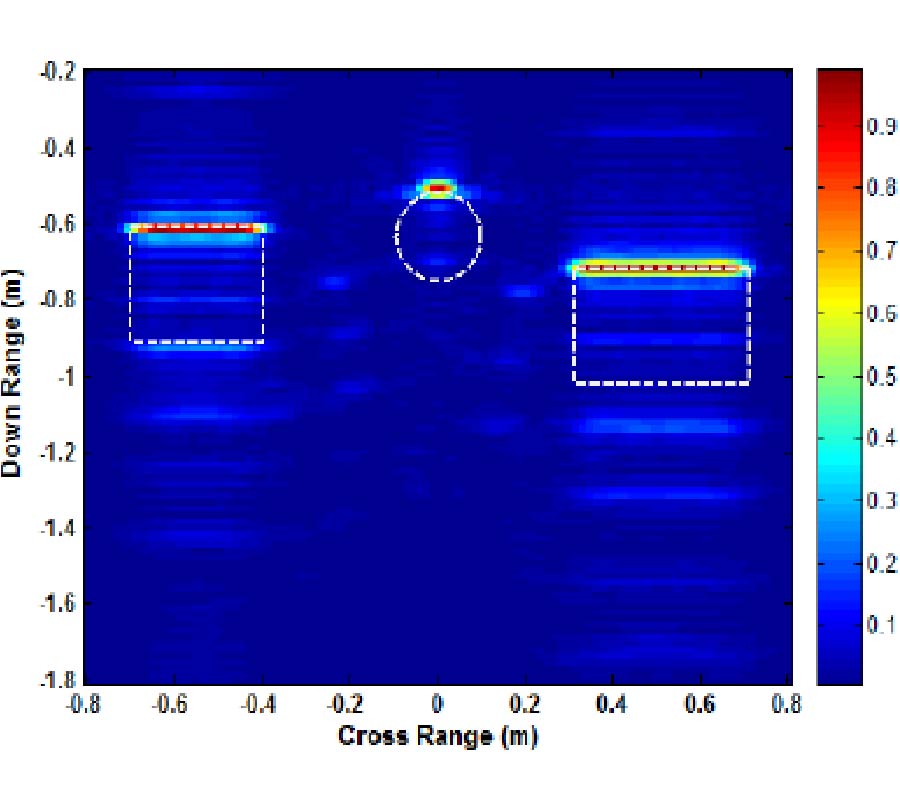
Two dimensional (2D) radar coincidence imaging is an instantaneous imaging technique which can obtain 2D focused high-resolution images using a single pulse without the limitation to the target relative motions. This paper extends the imaging method to three dimensions. Such a three-dimensional (3D) radar imaging technique does not rely on Doppler frequency for resolution and has an extremely short imaging time (shorter than a pulse width), resulting in two remarkable properties: 1) it does not require the relative rotation between targets and radar; 2) it can considerably avoid the image blurring in processing noncooperative targets without motion compensation. 3D radar coincidence imaging consequently can derive high-quality images for either the targets that are stationary with respect to radars or the ones in maneuvering 3D rotations. The validity of the proposed imaging technique is confirmed by numerical simulations.
THREE DIMENSIONAL RADAR COINCIDENCE IMAGING
2013-10-29
PIER
Vol. 143, 165-185
Azimuth Nonlinear Chirp Scaling Integrated with Range Chirp Scaling Algorithm for Highly Squinted SAR Imaging
Qinglin Zhai , Wei Wang , Jiemin Hu and Jun Zhang
The difficulty of focusing high-resolution highly squinted SAR data comes from the serious azimuth-range coupling, which needs to be compensated in the procedure of imaging. Generally, the linear range walk correction (LRWC) can reduce the coupling effectively, however, it also induces the problem of azimuth-dependence of residual range cell migration (RCM) and quadratic phase. A novel algorithm is proposed to solve this problem in this paper. In this algorithm, the azimuth nonlinear chirp scaling (ANCS) operation is used, which can not only eliminate the azimuth space variation of residual RCM and frequency modulation (FM) rate but also remove the azimuth misregistration. In addition, the range chirp scaling operation is applied to correct the range-dependent RCM. After implementing the unified RCM correction, range compression and azimuth compression sequentially, the focused SAR image is acquired finally. The experimental results with simulated data demonstrate that the proposed algorithm outperforms the existing algorithms.
AZIMUTH NONLINEAR CHIRP SCALING INTEGRATED WITH RANGE CHIRP SCALING ALGORITHM FOR HIGHLY SQUINTED SAR IMAGING
2013-10-29
PIER
Vol. 143, 143-163
Propagation of a Lorentz-Gauss Vortex Beam in a Turbulent Atmosphere
Guoquan Zhou and Guoyun Ru
The propagation properties of a Lorentz-Gauss vortex beam in a turbulent atmosphere are investigated. Based on the extended Huygens-Fresnel integral, the Hermite-Gaussian expansion of a Lorentz function, etc., analytical expressions of the average intensity, effective beam size, and kurtosis parameter of a Lorentz-Gauss vortex beam are derived in the turbulent atmosphere. The spreading properties of a Lorentz-Gauss vortex beam in the turbulent atmosphere are numerically calculated and analyzed. The influences of the beam parameters on the propagation of a Lorentz-Gauss vortex beam in the turbulent atmosphere are examined in details. Upon propagation in the turbulent atmosphere, the vale in the normalized intensity distribution of a Lorentz-Gauss vortex beam gradually rises. The rising speed of the vale is opposite to the spreading of the beam spot. When the propagation distance reaches to a certain value, the Lorentz-Gauss vortex beam in the turbulent atmosphere becomes a flattened beam spot. When the propagation distance is large enough, the beam spot of the Lorentz-Gauss vortex beam tends to be a Gaussian-like distribution. This research is beneficial to optical communications and remote sensing that are involved in the single mode diode laser devices.
PROPAGATION OF A LORENTZ-GAUSS VORTEX BEAM IN A TURBULENT ATMOSPHERE
2013-10-29
PIER
Vol. 143, 131-141
Three-Dimensional Thermal Cloak with Homogeneous and Nonsingular Conductive Materials
Tiancheng Han and Zheng-Mao Wu
Most three-dimensional omnidirectional cloaks proposed to date (using optics, electromagnetics, and acoustics) are not easily realized, as they possess inhomogeneous and singular parameters imposed by the transformation-optic method. In this study, we theoretically demonstrate that a thermodynamic spherical cloak with homogeneous and finite conductivity and employing only naturally available conductive materials may be achieved. More interestingly, the thermal localization inside the coating layer can be tuned by anisotropy, which may lead to nearly perfect functionality in an incomplete cloak. The practical realization of such a homogeneous thermal cloak by using two naturally occurring materials has been suggested, which provides an unprecedentedly plausible way to flexibly achieve a thermal cloak and manipulate heat flow. Numerical experiments validate the excellent performance of the proposed homogeneous cloak functions.
THREE-DIMENSIONAL THERMAL CLOAK WITH HOMOGENEOUS AND NONSINGULAR CONDUCTIVE MATERIALS
2013-10-28
PIER C
Vol. 45, 73-85
A Spiral Slot Antenna with Reconfigurable CPW-to-Slotline Transition for Polarization Diversity
Yihong Chen , Fu-Shun Zhang , Mao-Ze Wang , Jinlin Li and Yuyu Chen
A polarization reconfigurable spiral slot antenna with polarization states switched among left-hand circular polarization (LHCP), right-hand circular polarization (RHCP) and linear polarization (LP) is proposed in this paper. The antenna consists of a coplanar waveguide (CPW) input, a pair of reconfigurable CPW-to-slotline transitions, two separated same size single-arm spiral slot radiators, and four PIN diodes for reconfigurability. A good impedance match (VSWR≤2) for both linear and circular polarization is achieved from 2.1 to 2.9 GHz. The bandwidth for axial ratio AR≤3 dB for both RHCP and LHCP states ranges from 2.27 to 2.66 GHz (15%). The simulation and measurement results agree well and hence sustain the reconfigurability of the proposed design.
A SPIRAL SLOT ANTENNA WITH RECONFIGURABLE CPW-TO-SLOTLINE TRANSITION FOR POLARIZATION DIVERSITY
2013-10-28
PIER
Vol. 143, 105-130
A Systematic Design Procedure for Microstrip-Based Unidirectional UWB Antennas
Purna B. Samal , Ping Jack Soh and Guy Vandenbosch
A design procedure for microstrip antenna topologies operating within the full UWB band is described. The presence of the full ground plane successfully results in a unidirectional antenna, which is important in applications related to Wireless Body Area Networks (WBAN). The existing broadbanding concepts have been creatively combined throughout the design to enable the UWB behavior, while simultaneously keeping the full ground plane intact. The procedure is validated with a concrete design of a microstrip type UWB antenna operating from 3.6 GHz to 10.3 GHz.
A SYSTEMATIC DESIGN PROCEDURE FOR MICROSTRIP-BASED UNIDIRECTIONAL UWB ANTENNAS
2013-10-28
PIER
Vol. 143, 87-104
Micro-Doppler Analysis of Korean Offshore Wind Turbine on the L-Band Radar
Joo-Ho Jung , Un Lee , Si-Ho Kim and Sang-Hong Park
To cope with the energy shortage and the rising cost of the fossil fuel, many wind farms are being constructed under the supervision of Korean government along the coasts of Korean peninsula to generate clean and renewable energy. However, construction of these wind farms may cause negative effect on various L-band radars in operation. This paper presents the result of the micro-Doppler (MD) analysis of the influence of the wind turbine on the L-band radar using the point scatterer model and the radar cross section of the real turbine predicted by the method of physical optics. The simulation results obtained at three observation angles show that the range of MD occupies a considerable portion of the helicopter MD range, and thus, the operations using helicopters need to be avoided in the wind farm region, and additional radars are required for the recognition of helicopter-like objects.
MICRO-DOPPLER ANALYSIS OF KOREAN OFFSHORE WIND TURBINE ON THE L-BAND RADAR
2013-10-28
PIER
Vol. 143, 67-86
Compact Electromagnetic Absorbers for Frequencies Below 1 GHz
Rodolfo Araneo , Giampiero Lovat and Salvatore Celozzi
A novel Frequency Selective Surface (FSS) configuration is proposed for the design of polarization-insensitive metamaterial absorbers operating below 1 GHz, where the first resonances of small commercial enclosures appear. The novel FSS shows a strong subwavelength response, enhanced by the dielectric substrate, which allows the design of compact planar absorbers with excellent angular and polarization stability.
COMPACT ELECTROMAGNETIC ABSORBERS FOR FREQUENCIES BELOW 1 GHZ
2013-10-25
PIER B
Vol. 56, 161-183
Comparison and Optimization of Dispersion, and Losses of Planar Waveguides on Benzocyclobutene (Bcb) at THz Frequencies: Coplanar Waveguide (CPW), Microstrip, Stripline and Slotline
Lei Cao , Anne-Sophie Grimault-Jacquin and Frederic Aniel
This paper proposes an investigation in the terahertz (THz) frequency range of the dispersion and an individual quantitative treatment of the losses of the most classical microwave waveguides (coplanar, slotline, microstrip and stripline) numerically led in three dimensions (3D). An original strategy has been used to quantify radiation losses associated with leaky modes. A very low THz permittivity polymer (benzocyclobutene (BCB)) was used as a very convenient substrate to be easily grafted as a THz environment of integrated passive or/and active devices. Direct comparisons of the losses and the dispersion have been performed following two criteria: a constant characteristic impedance Zc fixed at 100 Ω and a constant effective width Weff fixed at 30 μm. The best waveguides are microstrip (αT= 2.52 dB/mm for Zc= 100 Ω and for W/H=35/50 μm (with W the strip width and H the substrate height) and αT =2.29 dB/mm for Weff = 30 μm at 1 THz with H = 30 μm) and stripline (with quasi-null radiation losses and the best quality factor QT= 63 for Zc = 100 Ω). The large dispersion and radiation losses of the slotline (SL) can be reduced with a thick BCB encapsulation to enhance the THz signal. The coplanar waveguide (CPW) remains in a medium position. Besides the parasitic mode (SL) and low QT problems due to mainly ohmic losses, its major advantage is its planar geometry allowing to an easy circuit integration with THz sources, amplifiers and detectors based on semiconductor. Consequently, these THz studies on BCB microwave standard waveguides open to various perspectives to carry out a broad panel of integrated THz circuits.
COMPARISON AND OPTIMIZATION OF DISPERSION, AND LOSSES OF PLANAR WAVEGUIDES ON BENZOCYCLOBUTENE (BCB) AT THZ FREQUENCIES: COPLANAR WAVEGUIDE (CPW), MICROSTRIP, STRIPLINE AND SLOTLINE
2013-10-25
PIER B
Vol. 56, 137-160
Design and Analysis of Multi-Band Filters Using Slot Loaded Stepped Impedance Resonators
Rajas Khokle , Raj Kumar , Raghupatruni Ram Krishna and Nagendra Kushwaha
Two multi-band filters operating in the 1-10 GHz range are designed, analytically studied and experimentally verified. The filters are developed by making modifications to a series capacitively coupled, microstrip line filter. The middle section of the microstrip line is widened and rectangular slots are etched on it. Widening increases the effective dielectric constant which helps in miniaturization of the circuit. On the other hand, the rectangular slot cause various longitudinal, transverse and slot mode resonances to be excited resulting in multi-band operation. An extensive parametric analysis with respect to the physical parameters of the filter leading to the development of a semi-empirical model is presented. The model can be used to predict the resonant frequencies with sufficient accuracy for a given geometrical structure. The model also predicts the limit of miniaturization achievable with the presented design. The proposed filters besides being compact have good out of band rejection and are easy to design and fabricate without the need of additional matching circuits.
DESIGN AND ANALYSIS OF MULTI-BAND FILTERS USING SLOT LOADED STEPPED IMPEDANCE RESONATORS
2013-10-25
PIER
Vol. 143, 47-66
Generalized Wait-Hill Formulation Analysis of Lumpedelement Periodically-Loaded Orthogonal Wire Grid Generic Frequency Selective Surfaces
Christos Mias and Angelo Freni
By combining the work of J.R. Wait on a periodically loaded vertical wire grid and the work of D.A. Hill and J.R. Wait on a wire mesh, a novel generalized formulation, the Wait-Hill formulation, is obtained for the analysis of lumped-element periodically-loaded orthogonal wire grid generic frequency selective surfaces. The Wait-Hill formulation is simple and not restricted by the miniaturization assumption of current approximate simple methods for the analysis of loaded and unloaded wire grids. The results of the Wait-Hill formulation are shown to agree well with those of a commercial software.
GENERALIZED WAIT-HILL FORMULATION ANALYSIS OF LUMPEDELEMENT PERIODICALLY-LOADED ORTHOGONAL WIRE GRID GENERIC FREQUENCY SELECTIVE SURFACES
2013-10-24
PIER B
Vol. 56, 109-136
Mathematical Models of Electrodynamical Processes of Wave Scattering and Generation on Cubically Polarisable Layers
Lutz Angermann and Vasyl V. Yatsyk
Results of a self-consistent computational analysis based on a mathematical model of resonance scattering and generation of waves on an isotropic nonmagnetic nonlinear layered dielectric structure excited by a packet of plane waves are presented, where the analysis is performed in the domain of resonance frequencies. Physically interesting properties of the nonlinear permittivities of the layers as well as their scattering and generation characteristics are obtained, for instance the characteristic dynamical behaviour of the relative Q-factor of the eigenmodes and the energy of higher harmonics generated by canalising as well as decanalising nonlinear layers. The results demonstrate the possibility to control the scattering and generating properties of a nonlinear structure by means of the excitation intensities.
MATHEMATICAL MODELS OF ELECTRODYNAMICAL PROCESSES OF WAVE SCATTERING AND GENERATION ON CUBICALLY POLARISABLE LAYERS
2013-10-24
PIER B
Vol. 56, 89-107
Experimental Model for Study of Electromagnetic Phenomena in Stator Core-End Laminations of Large Generators
Gilles Vogt , Cristian Demian , Raphael Romary , Guillaume Parent and Valentin Costan
This paper describes an experimental model for the characterization of electromagnetic phenomena that occur in the end regions of large turbo-generators. The study is based on a test bench that contains a stack of steel laminations from a 900 MW turbogenerator stator and two exciting circuits in order to combine a transverse magnetic flux with the in-plane flux. In order to explain the flux penetration within the magnetic sheet stack, accurate experimental measurements are performed. Results are compared with the finite element simulations using code_Carmel3D. In the same time, theoretical and experimental results are analyzed with a view to examining the influence of transverse flux on additional losses.
EXPERIMENTAL MODEL FOR STUDY OF ELECTROMAGNETIC PHENOMENA IN STATOR CORE-END LAMINATIONS OF LARGE GENERATORS
2013-10-24
PIER B
Vol. 56, 51-88
Magnetic-Dipolar-Mode Oscillations for Near- and Far-Field Manipulation of Microwave Radiation (Invited Paper)
Eugene O. Kamenetskii , Roman Joffe , Maksim Berezin , Guy Vaisman and Reuven Shavit
There has been a surge of interest in the subwavelength confinement effects of the electromagnetic fields. Based on these effects, one can obtain new behaviors of the near- and farfield radiation. It is well known that in optics, the subwavelength confinement can be obtained due to surface-plasmon (or electrostatic) oscillations in metal structures. This paper is a review of recent studies on the subwavelength confinement in microwaves due to magnetic-dipolarmode (MDM) [or magnetostatic (MS)] oscillations in small ferrite samples. MDM oscillations in a mesoscopic ferrite-disk particle are quantized oscillations, which are characterized by energy eigenstates. The field structures are distinguished by power-flow vortices and non-zero helicity. Also in vacuum, the near fields originated from MDM particles are designated by topologically distinctive power-flow vortices, non-zero helicity, and a torsion degree of freedom. To differentiate such field structures from regular electromagnetic (EM) field structures, we term them as magnetoelectric (ME) fields. In a pattern of the microwave field scattered by a MDM ferrite disk and MDM-disk arrays, one can observe rotating topological-phase dislocations. This opens a perspective for creation of engineered electromagnetic fields with unique symmetry properties. In the near-field applications, we propose novel microwave sensors for material characterization, biology, and nanotechnology. Strong energy concentration and unique topological structures of the near fields originated from the MDM resonators allow effective measuring chiral properties of materials in microwaves. Generating far-field orbital angular momenta from near-field microwave chirality of MDM structures can be a subject of a great interest. Realization of such vortex generators opens perspective for novel microwave systems with topological-phase modulation.
MAGNETIC-DIPOLAR-MODE OSCILLATIONS FOR NEAR- AND FAR-FIELD MANIPULATION OF MICROWAVE RADIATION (Invited Paper)