Search Results(13798)

2013-10-24
PIER M
Vol. 33, 211-222
Exactly Calculable Field Components of a Horizontal Electric Dipole in Boundary Between Isotropic and One-Dimensionally Anisotropic Media
Guo Hua Lin , Ye-Rong Zhang and Kai Li
In this paper, the integrated formulas for the electromagnetic field in the planar boundary between isotropic and onedimensionally anisotropic media due to a horizontal electric dipole situated on the interface are treated in detail, and the calculable field components are given in terms of series that involve confluent hypergeometric functions, namely, the Fresnel and exponential integrals, and the expressions are more complex than the isotropic case. The exact expressions and simplified formulas can be easily reduced to the corresponding isotropic case. The results are useful to study the propagation of the electromagnetic waves on the boundary of one-dimensionally anisotropic earth or sediments.
EXACTLY CALCULABLE FIELD COMPONENTS OF A HORIZONTAL ELECTRIC DIPOLE IN BOUNDARY BETWEEN ISOTROPIC AND ONE-DIMENSIONALLY ANISOTROPIC MEDIA
2013-10-23
PIER B
Vol. 56, 25-49
An Analysis of Junction Discontinuity Effects in Multi-Element Coupled Lines and Its Diminution at Designing Stage
Rana Pratap Yadav , Sunil Kumar and Sanjay V. Kulkarni
The analysis and design of the multi-element coupled lines, in conjunction with the junction discontinuity effect, is presented, and its applicability in high power rf regime is discussed. Junctions are usually employed to connect two different coupled elements, which gives rise to undesirable reactance i.e. junction discontinuity effect. These effects are found prominent in the high power coupled lines for HF and VHF applications because of its large structural dimensions. The design and simulation of 3-element, 8.34±0.2 dB coupled line section rated for 38 to 112 MHz and 200 kW has been performed. The simulated results are significantly deviated from the theoretically calculated ones where the discontinuity effect is usually ignored. A generalized theoretical procedure is developed to take into account the effect of junction discontinuity at the designing stage. The theory is applied to the 3-element 8.34±0.2 dB coupled-line section, and simulation is performed by using standard Ansoft HFSS software. The HFSS simulation results are in close agreement with the theoretical predictions.
AN ANALYSIS OF JUNCTION DISCONTINUITY EFFECTS IN MULTI-ELEMENT COUPLED LINES AND ITS DIMINUTION AT DESIGNING STAGE
2013-10-22
PIER B
Vol. 56, 1-24
Finite Element Modeling of Selective Heating in Microwave Pyrolysis of Lignocellulosic Biomass
Baishali Dutta , Satyanarayan R. S. Dev and Vijaya G. S. Raghavan
Microwave pyrolysis overcomes the disadvantages of conventional pyrolysis methods by efficiently improving the quality of final pyrolysis products. Biochar, one of the end products of this process is considered an efficient vector for sequestering carbon to offset atmospheric carbon dioxide. The dielectric properties of the doping agents (i.e., char and graphite) were assessed over the range of 25°-400°C and used to develop a finite element model (FEM). This model served to couple electromagnetic heating, combustion, and heat and mass transfer phenomena and evaluated the advantages of selective heating of woody biomass during microwave pyrolysis. The dielectric properties of the doping agents were a function of temperature and decreased up to 100°C and thereafter remained constant. Regression analysis indicated that char would be a better doping substance than graphite. The simulation study found that doping helped to provide a more efficient heat transfer within the biomass compared to non-doped samples. Char doping yielded better heat transfer compared to graphite doping, as it resulted in optimal temperatures for maximization of biochar production. The model was then validated through experimental trials in a custom-built microwave pyrolysis unit which confirmed that char doping would be better suited for maximization of biochar.
FINITE ELEMENT MODELING OF SELECTIVE HEATING IN MICROWAVE PYROLYSIS OF LIGNOCELLULOSIC BIOMASS
2013-10-22
PIER B
Vol. 55, 401-419
Effects of Microelectrode Array Configuration and Position on the Threshold in Electrical Extracellular Stimulation of Single Nerve Fiber:a Modeling Study
Xin-Tai Zhao , Zhi-Gong Wang and Xiao-Ying Lv
A transient finite-element model has been presented to simulate extracellular potential stimulating in a neural tissue by a nonplanar microelectrode array (MEA). This model allows simulating the extracellular potential and transmembrane voltage by means of a single transient computation performed within single finite element (FE) software. The differential effects of the configuration and position of MEA in electrical extracellular stimulation are analyzed theoretically. 3-D models of single nerve fiber and different MEA are used for the computation of the stimulation induced field potential, whereas a cable model of a nerve fibre is used for the calculation of the transmembrane voltage of the nerve fiber. The position of MEA and the spacing of the microelectrodes are varied while mono-, bi-, tri-, and penta-polar MEAs are applied. The model predicts that the lowest stimulation voltage threshold is obtained in the stimulation with penta-polar MEA. Moreover, the relationships, which exist between the thresholds of the electrical extracellular stimulation and the parameters including position of the electrode array and the spacing of the microelectrodes in array, are studied and obtained.
EFFECTS OF MICROELECTRODE ARRAY CONFIGURATION AND POSITION ON THE THRESHOLD IN ELECTRICAL EXTRACELLULAR STIMULATION OF SINGLE NERVE FIBER:A MODELING STUDY
2013-10-22
PIER B
Vol. 55, 383-399
Rigorous Approach to Calculation of Capacitance Images of Metallic Samples for Use in Capacitance Microscopy
Galyna Safonova and Elena D. Vinogradova
A high-efficiency rigorous approach for the solution of the two-dimensional Laplace equation with Dirichlet's boundary conditions is developed to tackle electrostatic problems involving metallic cylinders of arbitrary cross-sections. In this paper we demonstrate how this novel algorithm can be used to address the problems arising in the capacitance microscopy to provide a higher resolution in studies of micro-cavities and whiskers on the surface of metallic samples. The precise capacitance images of the probe/sample systems are presented.
RIGOROUS APPROACH TO CALCULATION OF CAPACITANCE IMAGES OF METALLIC SAMPLES FOR USE IN CAPACITANCE MICROSCOPY
2013-10-22
PIER C
Vol. 45, 57-72
Near Field Image Reconstruction Algorithm for Passive Millimeter-Wave Imager Bhu-2D-U
Xianxun Yao , Cheng Zheng , Jin Zhang , Baohua Yang , Anyong Hu and Jungang Miao
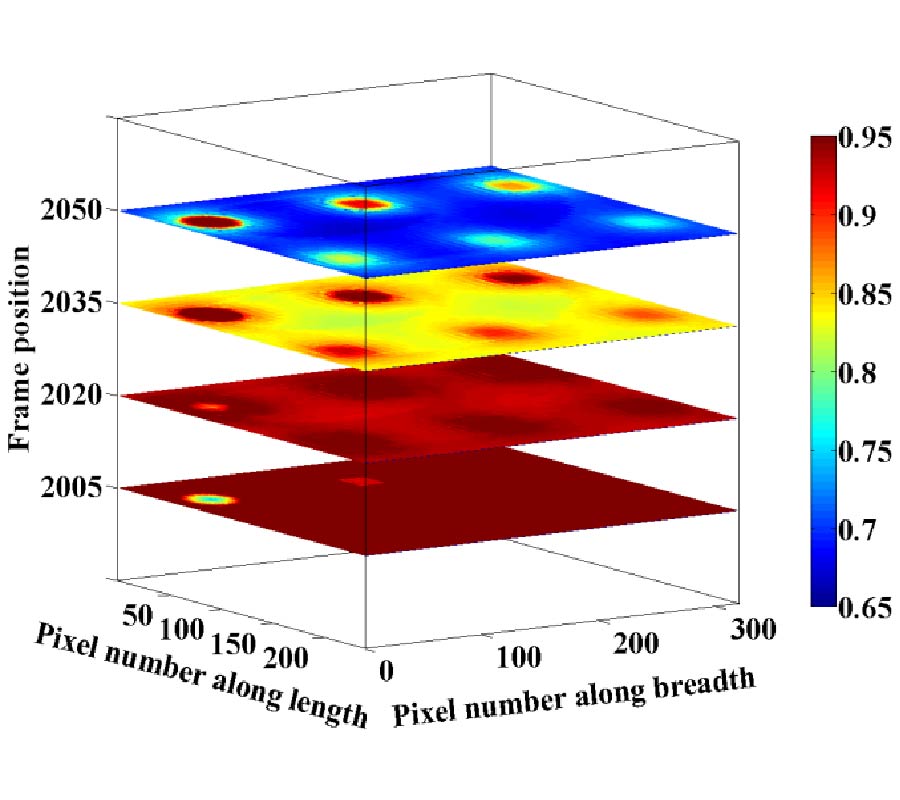
A passive millimeter-wave imager BHU-2D-U based on synthetic aperture interferometric radiometer (SAIR) technique has been developed by Beihang University. The imager is designed for detecting concealed weapons on human body and operated under the near-field condition of the antenna array, thus the conventional Fourier imaging theory does not apply. In this paper, an accurate numerical image reconstruction algorithm using regularization theory is proposed. By means of adding a prior information of desired brightness temperature image, the influences of measurement noise and focusing error on the reconstructed image have been reduced. Numerical simulations and experiments on BHU-2D-U have been performed to verify the superiorities of the proposed algorithm over the corrected Fourier method and the Moore-Penrose pseudo inverse method. The results demonstrate that the proposed method is an advantageous imaging algorithm for near-field millimeter-wave SAIR.
NEAR FIELD IMAGE RECONSTRUCTION ALGORITHM FOR PASSIVE MILLIMETER-WAVE IMAGER BHU-2D-U
2013-10-21
PIER B
Vol. 55, 365-382
An Iterative Approach for the Synthesis of Optimized Sparse Time-Modulated Linear Arrays
Paolo Rocca , Michele D‘Urso and Lorenzo Poli
In this paper, the synthesis of sparse time-modulated linear arrays with minimum number of elements and controlled harmonic radiations is investigated. The proposed iterative approach based on a particle swarm optimization is aimed at finding the array configuration with the minimum number of elements and the optimal pulse sequence that affords a beam pattern with the same features of a reference one also limiting the amount of sideband radiations under a specific threshold. A set of representative numerical examples are discussed to assess the effectiveness and the reliability of the proposed approach.
AN ITERATIVE APPROACH FOR THE SYNTHESIS OF OPTIMIZED SPARSE TIME-MODULATED LINEAR ARRAYS
2013-10-21
PIER C
Vol. 45, 43-55
The Squarax Spatial Power Combiner
Alberto Leggieri , Giancarlo Orengo , Davide Passi and Franco Di Paolo
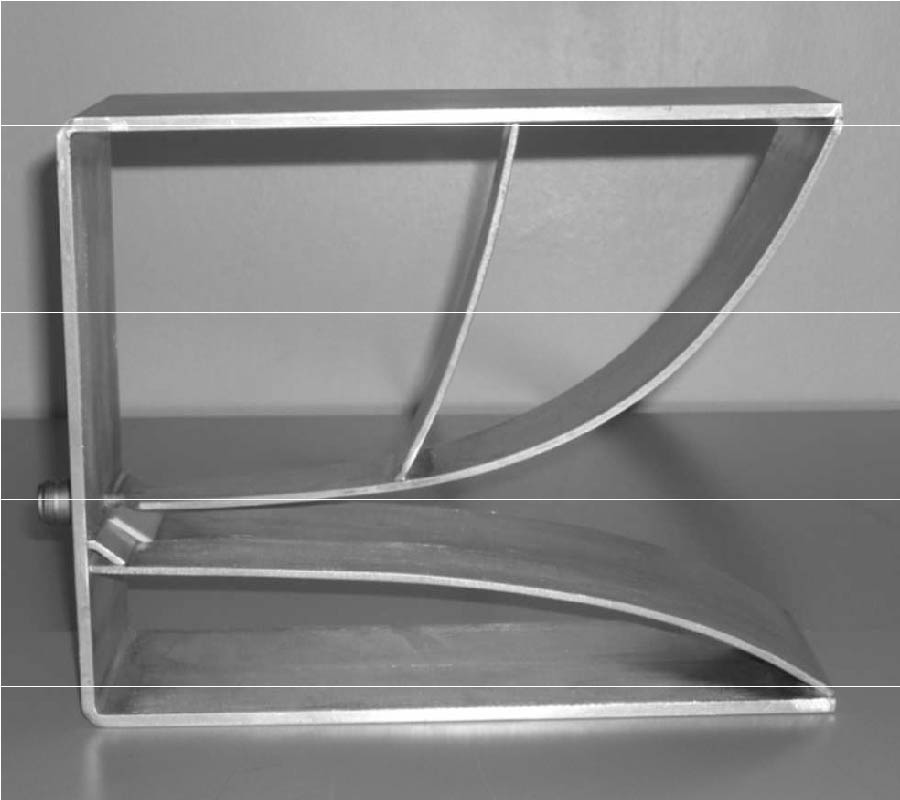
A broad-band transmission line spatial power combiner (SPC) is proposed in this paper, which uses a square coaxial (Squarax) transmission line (TL). This structure has some advantages over the traditional circular coaxial spatial power combiner, which have been described in this paper. Fin-Line to microstrip transitions are inserted into the Squarax TL, in order to allow an easy integration of Monolithic Microwave Integrated Circuit (MMIC) Solid State Power Amplifier (SSPA). The Squarax SPC geometry allows the feeding of a higher number of MMIC than in a Waveguide SPC, so that this structure ensures high power outputs and small sizes, together with theoretical DC frequency cut-off. In this work, the design and simulation of a passive 4-18 GHz Squarax SPC are reported.
THE SQUARAX SPATIAL POWER COMBINER
2013-10-21
PIER C
Vol. 45, 33-42
Experimental Investigations of Ultra-Wideband Antenna Integrated with Dielectric Resonator Antenna for Cognitive Radio Applications
Idris Messaoudene , Tayeb Denidni and Abdelmadjid Benghalia
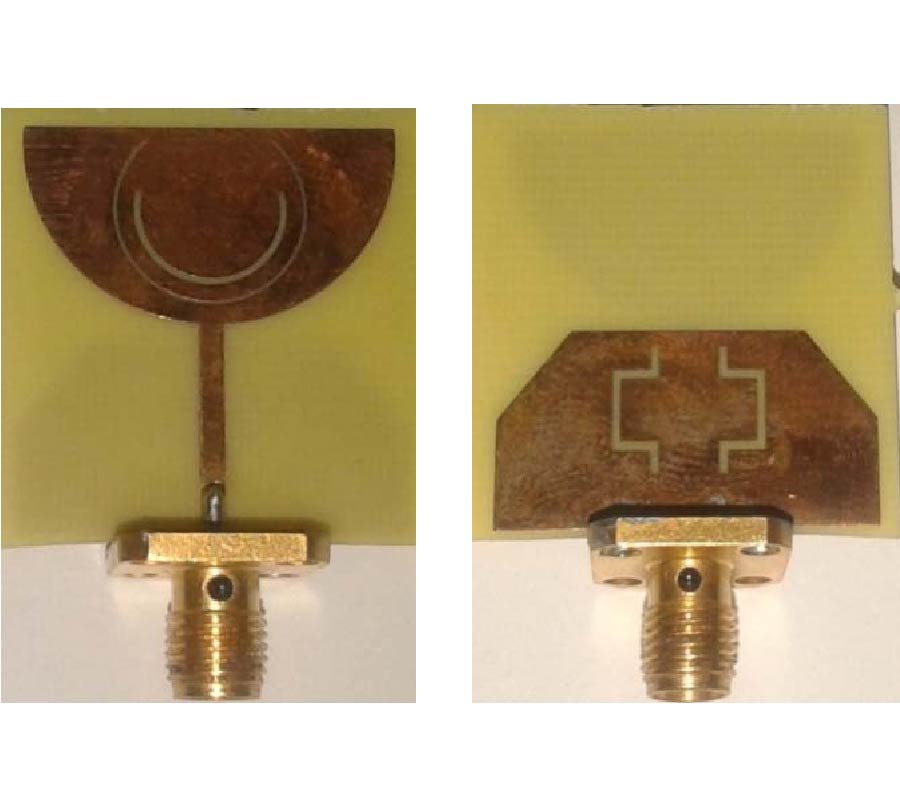
In this paper, an ultra-wideband (UWB) patch antenna integrated with a dielectric resonator is proposed for cognitive radio applications. The patch antenna is fed by a coplanar waveguide (CPW) line, and it consists of a rectangular monopole having an elliptical base, and operates from 2.44 to 12 GHz, this UWB antenna is intended to collect the information. Moreover, the proposed structure integrates a narrow-band rectangular dielectric resonator antenna (RDRA) for operation, with very good isolation between the two ports (transmission coefficient S21 less than -20 dB). The RDRA provides a bandwidth from 5.23 GHz to 6.11 GHz. The electromagnetic analysis is carried out using tow commercial software tools. Furthermore, to validate the proposed concept, experimental measurements are also performed.
EXPERIMENTAL INVESTIGATIONS OF ULTRA-WIDEBAND ANTENNA INTEGRATED WITH DIELECTRIC RESONATOR ANTENNA FOR COGNITIVE RADIO APPLICATIONS
2013-10-21
PIER M
Vol. 33, 197-209
A Novel Antenna System for Body Temperature Change Detection Appropriate for Multi-Channel Microwave Radiometry
Christos D. Nikolopoulos and Christos N. Capsalis
A planar inverted F antenna is combined with passive (reactively loaded) elements in order to implement a multi-frequency configuration appropriate for biomedical applications in microwave frequencies. A case study of an electronically Reconfigurable PIFA (R-PIFA) is pursued for the detection of temperature abnormalities in human tissue phantom using microwave radiometry, where the performance of the structure is optimized with respect to input impedance matching in multiple frequencies. The optimization of the array is performed using a Genetic Algorithm (GA) tool as a method of choice. Due to its limited physical size, the proposed R-PIFA can also be used as a portable antenna system for deployment in mobile medical applications.
A NOVEL ANTENNA SYSTEM FOR BODY TEMPERATURE CHANGE DETECTION APPROPRIATE FOR MULTI-CHANNEL MICROWAVE RADIOMETRY
2013-10-21
PIER
Vol. 143, 19-46
A Refined Two-Dimensional Nonlinear Chirp Scaling Algorithm for Geosynchronous Earth Orbit SAR
Tao Zeng , Wenfu Yang , Zegang Ding , Dacheng Liu and Teng Long
Taking into account long signal propagation time, curved orbit and ``near-far-near'' slant range histories at apogee, a refined slant range model (RSRM) is presented for geosynchronous earth orbit synthetic aperture radar (GEO SAR) in this paper. Additional linear component and high order components are introduced into straight orbit assumption (SOA) model to describe relative motion during long signal propagation and curved orbit respectively. And the special slant range histories at apogee are considered through adding terms changing with the sign of Doppler rate. Then, based on RSRM under an ideal acquisition and ignoring nonideal factors (such as depolarization and attenuation effects), a refined two-dimensional nonlinear chirp scaling algorithm (RTNCSA) is proposed. Space-variant range cell migration (RCM) caused by range-variant effective velocities is corrected by refined range nonlinear chirp scaling algorithm, and the variable Doppler parameters in azimuth direction are equalized through refined azimuth nonlinear chirp scaling algorithm. Finally, RSRM is verified by 600-second direct signal received by a stationary receiver on a tall building from BeiDou navigation satellite, and RTNCSA is validated through simulated point array targets with resolution of 5 m and scene size of 150 km.
A REFINED TWO-DIMENSIONAL NONLINEAR CHIRP SCALING ALGORITHM FOR GEOSYNCHRONOUS EARTH ORBIT SAR
2013-10-18
PIER B
Vol. 55, 347-364
A Passive Wireless Gas Sensor Based on Microstrip Antenna with Copper Nanorods
Taha Ahmed Elwi and Wisam J. Khudhayer
Applications of copper (Cu) nanorod arrays, produced by glancing angle deposition (GLAD) technique, which extends the function of conventional microstrip antennas to encompass passive wireless gas sensors at microwave frequencies are presented. The proposed microstrip antenna consists of Cu nanorod arrays grown on silicon wafers which were coated with thin films of Cu of 50 nm in thickness. To study the effect of the length of Cu nanorods on antenna performance, Cu nanorods of different lengths (400, 700, and 1000 nm) were fabricated. The effects of Cu nanorods morphologies (Cu thin film, closely-spaced Cu nanorods, and well-separated Cu nanorods), were investigated too. Conventional microstrip antennas based on sputtered Cu thin film were prepared for comparison. It was found that as the length of Cu nanorods increases, the antennas exhibit a wider bandwidth and lower frequency resonance than those of the conventional antennas based on Cu thin film. Furthermore, moving from flat surface to well-separated nanorods results in a decrease in the resonant frequency, while there was no observable effect on the bandwidth. These enhancements are attributed to the mutual coupling occurring among Cu nanorods. Based on the antenna characterization, the 1000 nm long Cu nanorods sample was selected for gas detection measurements due to its observed sharp resonance and narrow bandwidth. The detection mechanism is based on the change of in the magnitude of the reflection coefficient as well as the resonant frequency due to the introductions of different gases. The proposed sensor based on Cu nanorods shows a significant response in response to the introduction of different gases such as oxygen, nitrogen, and nitrogen, while the conventional antenna shows no measurable response. It is believed that the proposed sensor is applicable to the other gases based on the suggested sensing mechanism.
A PASSIVE WIRELESS GAS SENSOR BASED ON MICROSTRIP ANTENNA WITH COPPER NANORODS
2013-10-18
PIER B
Vol. 55, 325-345
Design Dual-Mode Bandpass Filters Based on Symmetrical T-Shaped Stub-Loaded Stepped-Impedance Resonators with High Frequencies Selectivity
Changhai Hu , Xiang-Zheng Xiong , Yan-Liang Wu and Cheng Liao
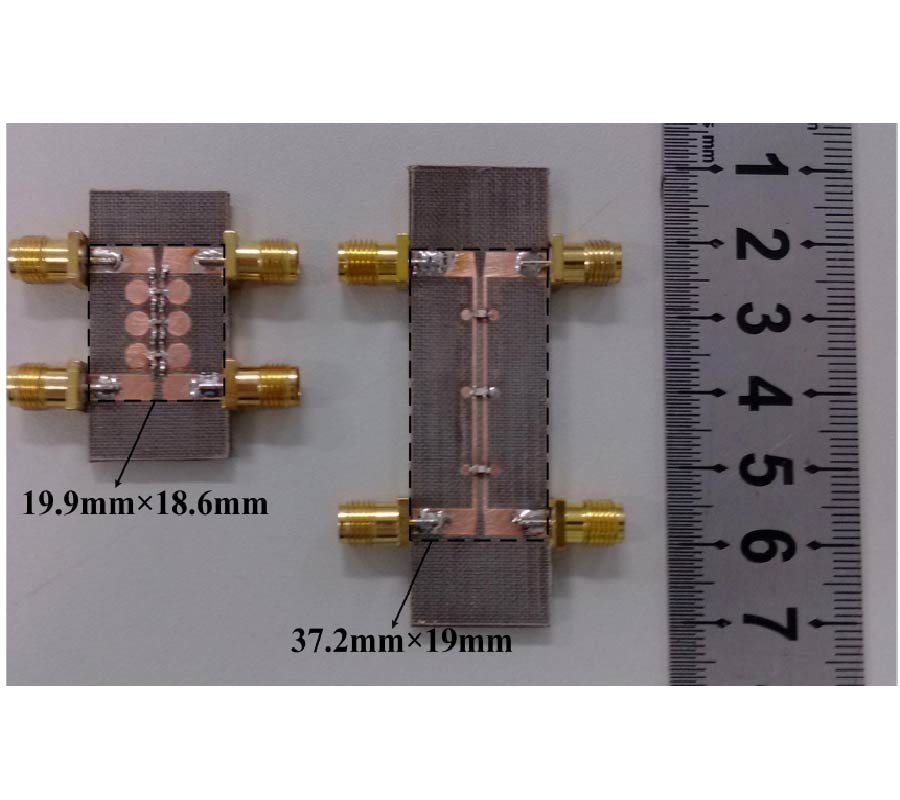
A novel approach for designing planar dual-mode bandpass filters using symmetrical T-shaped stub-loaded stepped-impedance resonators (TSLSIRs) with high frequencies selectivity is presented. The proposed symmetrical TSLSIR structure is mainly composed of three elements, i.e. a stepped-impedance resonator (SIR), and two T-shaped stubs which symmetrically loaded at the middle sections of the SIR. Then, two dual-mode bandpass filters based on TSLSIRs with high frequencies selectivity are proposed for experimental verification. Firstly, a dual-mode single passband filter with two transmission zeros located at the both sides of passband is presented, whose passband is centered at 5.23 GHz with the fractional bandwidth of 10.1%, and a wide upper-stopband with harmonic suppression better than 20 dB in range of 5.9 GHz to 12.9 GHz is achieved. Secondly, a dual-mode dual-band bandpass filter with four transmission zeros located at the both sides of the two passbands is presented, whose two passbands are centered at 3.4 GHz and 4.54 GHz with the corresponding fractional bandwidth of 8.4% and 7.5% respectively, and the spurious frequencies from 4.9 GHz to 8.45 GHz are successfully suppressed to the level lower than -20 dB. Both filters have been designed, fabricated and measured. The measured results show good agreements with those of the simulation.
DESIGN DUAL-MODE BANDPASS FILTERS BASED ON SYMMETRICAL T-SHAPED STUB-LOADED STEPPED-IMPEDANCE RESONATORS WITH HIGH FREQUENCIES SELECTIVITY
2013-10-18
PIER B
Vol. 55, 297-324
Localization of 3D Near-Field Source Using the Aperture Extension Method and Nonuniform Cross Array
Jia-Jia Jiang , Fa-Jie Duan , Yao-Chao Li and Xiang-Ning Hua
Depending on the aperture extension (AE), a high performance three-dimensional (3D) near-field (NF) source localization algorithm is proposed with the nonuniform linear array (NLA). The proposed algorithm first generates some fictitious sensors to extend the array aperture by constructing a new Toeplitz matrix, and then obtains a two-dimensional (2D) covariance matrix which only contains the elevation angle and range parameters, and another 3D covariance matrix which contains the elevation/azimuth angle and range parameters. Then based on the 2D covariance matrix, both the elevation angle and range parameters are estimated by using the NLA along the Z axis. With the estimates of both the elevation angle and range parameters and combining the 3D covariance matrix, the estimates of the azimuth angle parameters are obtained using the NLA along the Y axis. The proposed algorithm has four main merits: i) unlike some classical NF source localization algorithms, the quarter-wavelength sensor spacing constraint is not required and more sources can be located simultaneously by the proposed algorithm; ii) the 3D parameters of the proposed algorithm are paired automatically; iii) the 3D search required in conventional 3D multiple signal classification (MUSIC) algorithm is replaced with only one-dimensional (1D) search, and thus the computational burden is reduced; iv) the proposed algorithm gains superior parameter estimation accuracy and resolution.
LOCALIZATION OF 3D NEAR-FIELD SOURCE USING THE APERTURE EXTENSION METHOD AND NONUNIFORM CROSS ARRAY
2013-10-18
PIER C
Vol. 45, 15-31
Equivalent Lumped-Element Circuit of Aperture and Mutually Coupled Cylindrical Dielectric Resonator Antenna Array
Affan Aziz Baba , Mohd Azman Zakariya , Zuhairi Baharudin , Muhd. Zaka ur Rehman , Mohd Fadzil Ain and Zainal Arrifin Ahmad
This paper presents an electrical model of aperture and mutually coupled three-elements cylindrical dielectric resonator antenna (CDRA) array designed for 802.11a system applications. In electrical model, each antenna component is represented by its equivalent RLC circuit. The advanced design system (ADS) software is used to build the electrical model and predict the behavior of return loss, while the antenna structure is simulated using CST microwave studio before fabrication. The first and last radiating elements of the proposed array are excited through the aperture slots while the middle element is excited through the mutual coupling of its neighboring elements. The slot length and inter-slot distance effects on bandwidth are comprehensively analyzed and presented. The maximum gain of the proposed array for 5.0 GHz band is about 10.8 dBi, and the achieved simulated (CST, ADS) and measured impedance bandwidths are 1.076 GHz, 1.0 GHz, and 1.2 GHz respectively. The proposed CDRA array antenna exhibits an enhancement of the gain (7.4%) and bandwidth (93.3%) as compared to a literature work with aperture slots. In this study, it is also observed that by using the mutual coupling instead of third slot to excite the middle CDRA, side lobe levels are also reduced significantly over the entire 5.0 GHz band.
EQUIVALENT LUMPED-ELEMENT CIRCUIT OF APERTURE AND MUTUALLY COUPLED CYLINDRICAL DIELECTRIC RESONATOR ANTENNA ARRAY
2013-10-18
PIER C
Vol. 45, 1-13
Broadband Series-Fed Dipole Pair Antenna with Parasitic Strip Pair Director
Junho Yeo , Jong-Ig Lee and Jin-Taek Park
A method to increase the bandwidth of a series-fed dipole pair (SDP) antenna by using a parasitic strip pair director is presented. A conventional SDP antenna consists of two dipole elements having different lengths and a ground reflector, which are serially connected with a transmission line. In the proposed antenna, a parasitic strip pair director is appended to the conventional SDP antenna. Initially, a conventional SDP antenna that operates in a frequency range of 1.7-2.7 GHz is designed by optimizing the lengths of the elements (two dipoles and ground reflector) and the distances between these elements. Subsequently, a parasitic director containing a pair of strips is placed near the top dipole element to improve the bandwidth and gain of the conventional SDP antenna. Then, the effects of the location and size of the director on the impedance bandwidth and realized gain are investigated. A prototype of the proposed antenna is fabricated on an FR4 substrate, and its performance is compared with that of the conventional SDP antenna. The experimental results show that the proposed antenna has an enhanced bandwidth of 1.63-2.97 GHz (58.26%) and an increased gain of 5.6-6.8 dBi.
BROADBAND SERIES-FED DIPOLE PAIR ANTENNA WITH PARASITIC STRIP PAIR DIRECTOR
2013-10-18
PIER
Vol. 143, 1-18
Modeling and Layout Optimization Techniques for Silicon-Based Symmetrical Spiral Inductors
Choon Beng Sia , Wei Meng Lim , Beng Hwee Ong , Ah Fatt Tong and Kiat Seng Yeo
A scalable and highly accurate RF symmetrical inductor model (with model error of less than 5%) has been developed from more than 100 test structures, enabling device performance versus layout size trade-offs and optimization up to 10 GHz. Large conductor width designs are found to yield good performance for inductors with small inductance values. However, as inductance or frequency increases, interactions between metallization resistive and substrate losses render the use of large widths unfavorable as they consume silicon area and degrade device performance. These findings are particularly important when exploiting the cost-effective silicon-based RF technologies for applications with operating frequencies greater than 2.5 GHz.
MODELING AND LAYOUT OPTIMIZATION TECHNIQUES FOR SILICON-BASED SYMMETRICAL SPIRAL INDUCTORS
2013-10-18
PIER
Vol. 142, 799-823
Circuit and Multipolar Approaches to Investigate the Balance of Powers in 2D Scattering Problems (Invited Paper)
Inigo Liberal , Inigo Ederra , Ramon Gonzalo and Richard Ziolkowski
Circuit and multipolar approaches are presented to investigate the correlation between absorption and scattering processes in 2D problems. This investigation was inspired by earlier works of Prof.R.E. Collin, which pointed out deficiencies of the Th'evenin/Norton circuit models to evaluate the scattered and absorbed powers associated with receiving antennas and, thus, encouraged research on new analytical tools to address these problems. Power balance results are obtained with both circuit and multipolar approaches that are fully consistent. This analysis serves to illustrate how the correlation between absorption and scattering processes results in upper bounds for their power magnitudes, as well as stringent design trade-offs in both far-field and near-field source and scattering technologies.
CIRCUIT AND MULTIPOLAR APPROACHES TO INVESTIGATE THE BALANCE OF POWERS IN 2D SCATTERING PROBLEMS (Invited Paper)
2013-10-18
PIER
Vol. 142, 771-798
Polarization-Agile Ads-Interleaved Planar Arrays
Giacomo Oliveri , Leonardo Lizzi , Fabrizio Robol and Andrea Massa
This paper presents a class of polarization-agile arrays with controlled sidelobes. The architecture is based on the interleaving of two independently polarized sub-arrays through a deterministic strategy derived from Almost Difference Sets (ADSs). The efficiency, flexibility and reliability of the proposed design technique is assessed by means of a set of numerical simulations. Moreover, selected experiments aimed at comparing the performances of the presented approach with state-of-the-art design are provided. Finally, mutual coupling effects are numerically analyzed and discussed.
POLARIZATION-AGILE ADS-INTERLEAVED PLANAR ARRAYS
2013-10-17
PIER C
Vol. 44, 251-261
Two Kinds of Dual-Band Bandpass Filter Based on a Single Square Ring Resonator
Kun Deng , Shou Jia Sun , Shuai Yang , Bian Wu and Chang-Hong Liang
In this paper, two kinds of dual-band bandpass filter (BPF) based on a single square ring resonator are presented, which are realized by loading capacitance or inductive stubs, respectively. Even-odd-mode analysis is applied to explain their model characteristics. One filter is implemented by loading a pair of capacitance stubs, and both in-band couplings can be tuned in a reasonable range. Another filter is completed by loading a pair of inductive stubs, and the first and second passband center frequencies can be controlled independently. For demonstration, two filters operating at 2.45/5.25 GHz and 2.4/5.25 GHz are designed and fabricated. The simulated and measured results show good agreements.
TWO KINDS OF DUAL-BAND BANDPASS FILTER BASED ON A SINGLE SQUARE RING RESONATOR