Search Results(13879)

2007-04-16
PIER
Vol. 73, 239-247
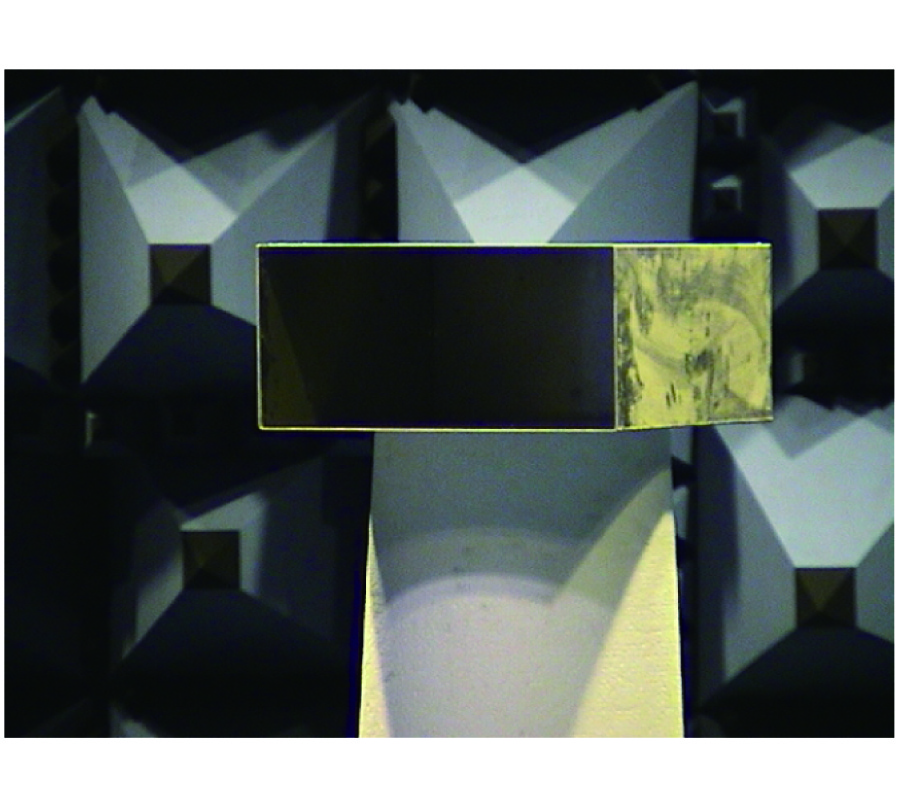
Analysis of the Connection Between k Connector and Microstrip with Electromagnetic Bandgap (EBG) Structures
Hong-Jie Xu , Yong-Hong Zhang and Yong Fan
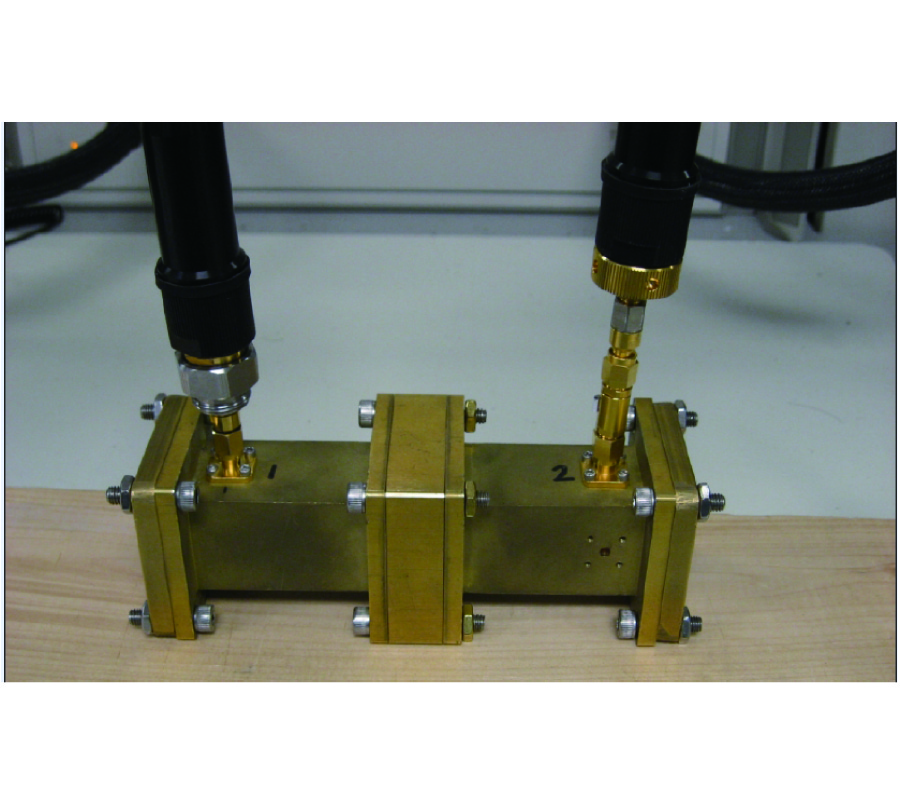
For the application of K connector (K103F) at Ka-band, many problems exist, due to the complex method of installation. In this paper, the test fixture is simplified, and the performance of this section is improved with the Electromagnetic bandgap (EBG) structure. Simulation results are presented for the connection structure with EBG; plots of the input reflection of geometrical and physical parameters are reported and commented on.
ANALYSIS OF THE CONNECTION BETWEEN K CONNECTOR AND MICROSTRIP WITH ELECTROMAGNETIC BANDGAP (EBG) STRUCTURES
2007-04-16
PIER
Vol. 73, 213-238
An Effective Technique for Reducing the Truncation Error in the Near-Field-Far-Field Transformation with Plane-Polar Scanning
Francesco D'Agostino , Flaminio Ferrara , Claudio Gennarelli , Rocco Guerriero and Giovanni Riccio
An effective approach is proposed in this paper for estimating the near-field data external to the measurement region in the plane-polar scanning. It relies on the nonredundant sampling representations of the electromagnetic field and makes use of the singular value decomposition method for the extrapolation of the outside samples. It is so possible to reduce in a significant way the error due to the truncation of the measurement zone thus increasing the farfield angular region of good reconstruction. The comparison of such an approach, based on the optimal sampling interpolation expansions, with an existing procedure using the cardinal series has highlighted that the proposed technique works better. Some numerical tests are reported for demonstrating its effectiveness.
AN EFFECTIVE TECHNIQUE FOR REDUCING THE TRUNCATION ERROR IN THE NEAR-FIELD-FAR-FIELD TRANSFORMATION WITH PLANE-POLAR SCANNING
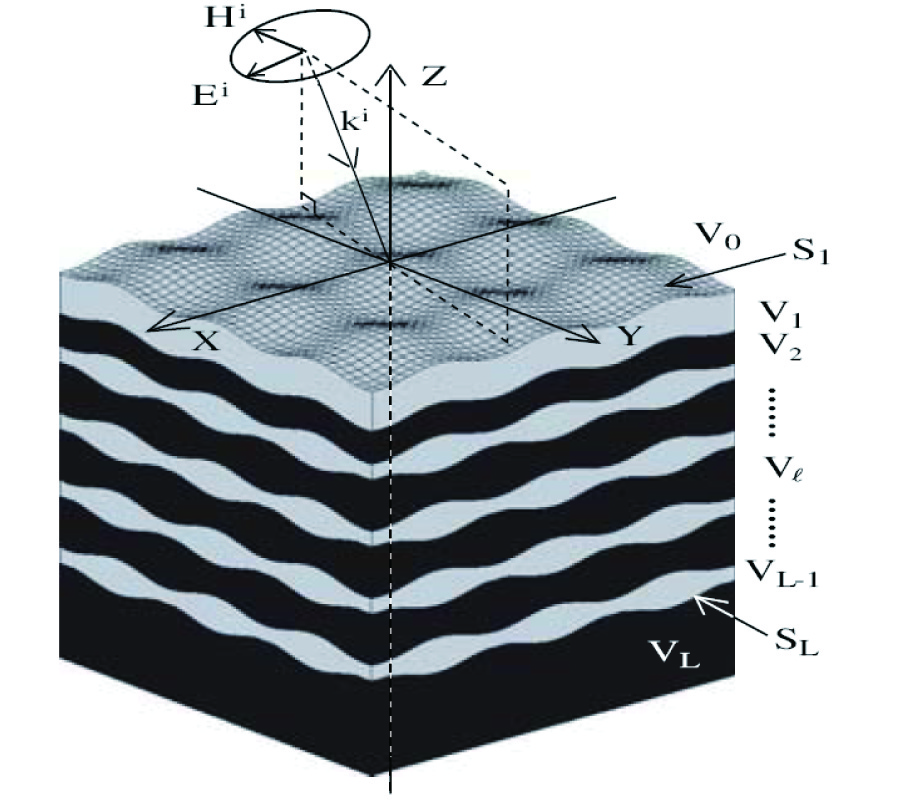
THE SMALL-SLOPE APPROXIMATION METHOD APPLIED TO A THREE-DIMENSIONAL SLAB WITH ROUGH BOUNDARIES
2007-04-11
PIER
Vol. 73, 107-129
Radiation Characteristics of the Wood Lens Using Maslov's Method
Akhtar Hussain , Qaisar Abbas Naqvi and Kohei Hongo
The field refracted by a Wood lens is determined analytically and numerically in the focal region by Maslov's method. Results are compared withth ose obtained by weak focusing approximation and Kirchhoff's diffraction integral. Agreement among them is fairly good when the parameters satisfy the conditions associated to the approximation.
RADIATION CHARACTERISTICS OF THE WOOD LENS USING MASLOV'S METHOD
2007-04-07
PIER
Vol. 73, 93-105
Computations of Electromagnetic Fields Radiated from Complex Lightning Channels
Ting-Xin Song , Yao-He Liu and Jian-Min Xiong
In this paper, three methods for calculating electromagnetic fields radiated from complex lightning channels are discussed, which includes channel obliqueness, branches and tortuosity. By rotating and moving the coordinate system of the vertical channel, differential expressions of electromagnetic fields from the irregular channel can be derived from the conclusions of the straight and vertical channel. Through analyzing calculation results of two examples reveals that channel tortuosity and branch is to introduce the higher frequency content above 100 kHz into lightning electromagnetic fields.
COMPUTATIONS OF ELECTROMAGNETIC FIELDS RADIATED FROM COMPLEX LIGHTNING CHANNELS
2007-04-05
PIER
Vol. 73, 71-91
Electromagnetic Field from a Horizontal Electric Dipole on the Surface of a High Lossy Dielectric Coated with a Uniaxial Layer
Jian Mei and Kai Li
In this paper, the explicit formulas are derived for the six components of the electromagnetic field in air excited by a horizontal electric dipole over a planar high lossy dielectric coated with an anisotropic uniaxial layer. Similar to the case of the three-layered region consisting of air, a uniaxial layer,and a perfect conductor, the total field consists of the direct field,the ideal reflected field or the field of an ideal image, the lateral-wave field,and the trappedsurface- wave field. It should be pointed out that the trapped surface wave can be separated into the trapped wave of electric type and magnetic type. The wave numbers in the ρ̂ direction of electric-type trapped surface wave, which are between k0 and kL, are different from those of the magnetic-type trapped surface wave, which are between k0 and kL . When the thickness l of the uniaxial layer satisfies nπ < kT/kL (k2L - k20)1/2 · l < (n + 1)π, there are n + 1 modes of the electric-type trapped surface waves. When the thickness l satisfies (n − 1/2)π < (k2T −k20)1/2 · l < (n + 1/2)π, there are n modes of magnetictype trapped waves.
ELECTROMAGNETIC FIELD FROM A HORIZONTAL ELECTRIC DIPOLE ON THE SURFACE OF A HIGH LOSSY DIELECTRIC COATED WITH A UNIAXIAL LAYER
2007-04-04
PIER
Vol. 73, 61-69
Perfect Electromagnetic Conductor (PEMC) and Fractional Waveguide
Akhtar Hussain and Qaisar Abbas Naqvi
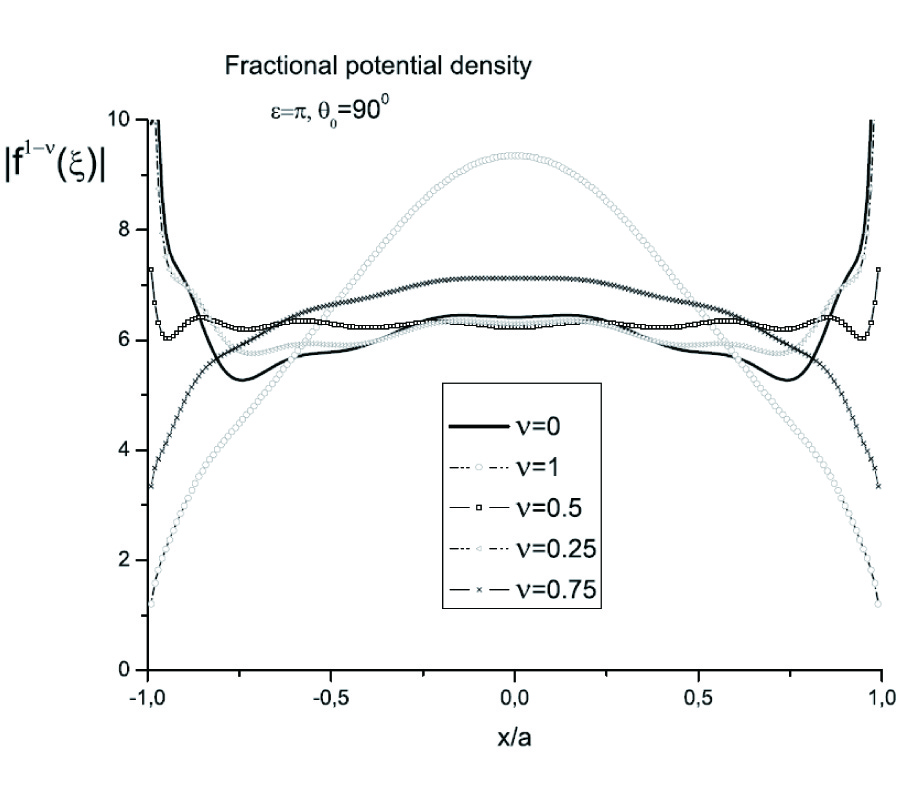
Fractional curl operator has been utilized to study the fractional perfect electromagnetic conducting waveguide. The fractional perfect electromagnetic conducting waveguide may be regarded as intermediate step between the two given waveguides. One of the waveguide is composed of perfect electromagnetic conducting (PEMC) walls while other is dual of it as (DPEMC). Corresponding fields and surface impedance have been determined and boundary conditions for DPEMC surface have been derived.
2007-04-04
PIER
Vol. 73, 49-59
Near-Field to Far-Field Transformation with Planar Spiral Scanning
Sandra Costanzo and Giuseppe Di Massa
A transformation procedure directly computing the antenna far-field pattern from near-field samples acquired on a planar spiral is proposed in this paper. The convolution property of the radiation integral is exploited to efficiently perform the evaluation by taking advantages of the Fast Fourier Transform, without the need of any intermediate interpolation process. Validations on circular arrays of elementary dipoles are presented to show the effectiveness of the method.
NEAR-FIELD TO FAR-FIELD TRANSFORMATION WITH PLANAR SPIRAL SCANNING
2007-04-04
PIER
Vol. 73, 39-47
Microwave Surface Impedance of a Nearly Ferroelectric Superconductor
Chien-Jang Wu , Chao-Ming Fu and Tzong-Jer Yang
The intrinsic microwave surface impedance for a nearly ferroelectric superconducting film of finite thickness in the dielectriclike response is theoretically investigated. It is based on the electrodynamics of a nearly ferroelectric superconductor that incorporates the Maxwell's equations, the lattice equations for an ionic lattice, and the superconducting London equation as well. It is found that the surface resistance will be enhanced with decreasing the film thickness when the thickness is less than the London penetration depth. However it will begin to resonate as a function of film thickness at the thickness being more than one London penetration depth. The anomalous resonance peaks occur when the thickness equals the even multiple of the London penetration depth. In the frequency-dependent surface resistance, the number of the resonance peaks is strongly dependent on the film thickness, increasing with increasing the thickness. In addition, these peaks are not regularly spaced at a fixed interval. Discussion on this anomaly in the surface resistance will be given.
MICROWAVE SURFACE IMPEDANCE OF A NEARLY FERROELECTRIC SUPERCONDUCTOR
2007-03-31
PIER
Vol. 73, 29-38
The Generalized Chebyshev Substrate Integrated Waveguide Diplexer
Shihu Han , Xi-Liang Wang , Yong Fan , Ziqiang Yang and Zhaner He
A new generalized chebyshev substrate integrated waveguide diplexer is presented for high performance. The diplexer is designed with triplet topology based on substrate integrated waveguide technique, which exhibit the generalized chebyshev responses. The triplet topology can facilitate the resonator arrangements of diplexer design for compact size. This diplexer possesses of the advantages of SIW and the generalized chebyshev filters. All couplings, including the negative coupling, are realized by H-plane open windows. A diplexer is designed by using 3th order asymmetric generalized chebyshev filter. Measured results are good agreement with simulation results.
THE GENERALIZED CHEBYSHEV SUBSTRATE INTEGRATED WAVEGUIDE DIPLEXER
2007-03-30
PIER
Vol. 73, 15-27
Guided and Leaky Wave Characteristics of Periodic Defected Ground Structures
Hamidreza Oskouei , Keyvan Forooraghi and Mohammad Hakkak
In recent years, there has been significant research interest in microwave applications of defected ground structures. In this paper, three kinds of Periodic Defected Ground Structures are analyzed to assess their effects on surface and leaky waves. To achieve this purpose, the finite element method accompanied by Periodic boundary conditions is used to show the propagation characteristics of these periodic structures. Also, the existence of surface wave reduction property is investigated and finally the simulation Results are compared to the experimental results with reasonable agreement.
GUIDED AND LEAKY WAVE CHARACTERISTICS OF PERIODIC DEFECTED GROUND STRUCTURES
2007-03-30
PIER
Vol. 73, 1-13
Modal Dispersion Characteristics of a Single Mode Dielectric Optical Waveguide with a Guiding Region Cross-Section Bounded by Two Involuted Spirals
Praveen Pandey , Akta Mishra and Sant Ojha
With the use of scalar field approximation we make an analytical study of a dielectric waveguide whose core cross-section is bounded by two spirals of the form 1/r = ξθ. This waveguide is similar to that of a distorted slab waveguide in which both a curvature and a flare are present. We derived the modal characteristic equation by analytical analysis under the weak guidance approximation. We find the modal dispersion curve, which support only single mode propagation and the same compared with the same kind of waveguide with metal claddings.
MODAL DISPERSION CHARACTERISTICS OF A SINGLE MODE DIELECTRIC OPTICAL WAVEGUIDE WITH A GUIDING REGION CROSS-SECTION BOUNDED BY TWO INVOLUTED SPIRALS
2007-03-28
PIER
Vol. 72, 307-323
Phase-Matching the Hybrid Fv24/S22 FDTD Algorithm
Mohammed Hadi and R. Dib
This work demonstrates an efficient and simple approach for applying high-order extended-stencil FDTD algorithms near planar perfect electric conductors (PEC) boundaries while minimizing spurious reflections off the interface between the high-order grid and the mandated special compact cells around PEC boundaries. This proposed approach eliminates the need for cumbersome subgridding implementations and provides a superior alternative in minimizing spurious reflections without any added modeling complexity or computing costs. The high-order algorithm used in this work is the recently proposed three-dimensional FV24 algorithm and the proposed approach can be easily extended to the standard Fang high-order FDTD algorithm which represents a special case of the highly phasecoherent FV24 algorithm.
PHASE-MATCHING THE HYBRID FV24/S22 FDTD ALGORITHM
2007-03-28
PIER
Vol. 72, 279-306
Resonant Frequency Calculation for Circular Microstrip Antennas with a Dielectric Cover Using Adaptive Network-Based Fuzzy Inference System Optimized by Various Algorithms
Kerim Guney and Nurcan Sarikaya
This paper presents a method based on adaptive-networkbased fuzzy inference system (ANFIS) to calculate the resonant frequency of a circular microstrip antenna (MSA) with a dielectric cover. The ANFIS is a class of adaptive networks which are functionally equivalent to fuzzy inference systems (FISs). Six optimization algorithms, hybrid learning, least-squares, nelder-mead, genetic, differential evolution and particle swarm, are used to determine optimally the design parameters of the ANFIS. The resonant frequency results predicted by ANFIS are in very good agreement with the results reported elsewhere. When the performances of ANFIS models are compared with each other, the best result is obtained from the ANFIS model optimized by the LSQ algorithm.
RESONANT FREQUENCY CALCULATION FOR CIRCULAR MICROSTRIP ANTENNAS WITH A DIELECTRIC COVER USING ADAPTIVE NETWORK-BASED FUZZY INFERENCE SYSTEM OPTIMIZED BY VARIOUS ALGORITHMS
2007-03-27
PIER
Vol. 72, 269-278
Relative Power Distributions in Omniguiding Photonic Band-Gap Fibers
Abdel-Baset Ibrahim and Pankaj Kumar Choudhury
Using Bloch formulations, an analysis is presented of the confinement of power in omniguiding photonic band-gap fibers of different dimensional values. Results are compared for four-layer and eight-layer fibers. Power peaks are observed that correspond to different propagation modes. Power patterns are found to be fairly smoothly matched at the different layer interfaces, which confirm the validity of the analytical approach.
RELATIVE POWER DISTRIBUTIONS IN OMNIGUIDING PHOTONIC BAND-GAP FIBERS
2007-03-27
PIER
Vol. 72, 253-268
Autonomous Genetic Algorithm for Functional Optimization
Zhiqi Meng
Genetic algorithm (GA) is effective for global optimizations, but needs the user to define several parameters. Unless these parameters are defined appropriately, search efficiency drops significantly. There are, however, no clear rules for the defining, and almost all users have considerable difficulty to use GA efficiently. A good algorithm must be use-friendly. It should not, if possible, need the user to define such parameters and can play high performance for any optimization problem. This paper proposes an autonomous GA addressing these problems.
AUTONOMOUS GENETIC ALGORITHM FOR FUNCTIONAL OPTIMIZATION
2007-03-24
PIER
Vol. 72, 241-252
Fuzzy Characterization of Flawed Metallic Plates with Eddy Current Tests
Matteo Cacciola , Francesco Carlo Morabito , Daniela Polimeni and Mario Versaci
Eddy Current Techniques (ECT) for Non-Destructive Testing and Evaluation (NDT/NDE) of conducting materials is one of the most application-oriented field of research within electromagnetism. In this work, a novel approach is proposed in order to characterize defects on metallic plates in terms of their depth and shape, starting from a set of experimental measurements. The problem is solved by means of a hybrid classification system based on Computation with Words (CWs) and Fuzzy Entropy (FE). They extract information about the specimen under test from the measurements. Main advantages of proposed approach are the introduction of CWs as well as the usage of the FE based minimization module, in order to improve flaw characterization by a low computational complexity system.
FUZZY CHARACTERIZATION OF FLAWED METALLIC PLATES WITH EDDY CURRENT TESTS
2007-03-24
PIER
Vol. 72, 195-214
Free-Space Relativistic Low-Frequency Scattering by Moving Objects
Dan Censor
The present study brings together two aspects of electromagnetic theory: the recently discussed low-frequency series expansions based on the concept of Consistent Maxwell Systems, and Einstein's Relativistic Electrodynamics. Combined, this facilitates the analysis of pertinent low-frequency scattering problems involving objects moving with arbitrary constant velocities in free space. The low-frequency series expansions start with leading terms that are prescribed by solutions of the vector Laplace equation, thus significantly simplifying the conventional analysis in terms of the Helmholtz wave equation. The method is demonstrated by deriving relativistically exact explicit results leading terms for perfectly conducting circular-cylindrical and spherical scatterers. The results apply to arbitrary reference frames where the objects are observed in motion. For simplicity of notation expressions are given in terms of spatiotemporal coordinates native to the object's restframe. Subsequent substitution of the Lorentz transformation for the coordinates is then a straightforward matter. Previous exact relativistic results for scattering by moving objects have demonstrated the existence of velocity induced mode coupling. It is shown that the low-frequency expansions used here display the same effects for various orders of the partial fields appearing in the series.
2007-03-24
PIER
Vol. 72, 187-194
Compact Ring Monopole Antenna with Double Meander Lines for 2.4/5 GHz Dual-Band Operation
Gang Zhao , Fu-Shun Zhang , Yue Song , Zibin Weng and Yong-Chang Jiao
A novel compact ring monopole antenna with double meander lines is proposed for wireless local area networks (WLAN) applications in IEEE 802.11b/g/a systems. The designed antenna, fed by a 50Ω microstrip transmission line, is only 32mm in height and 16mm in width. By introducing a horizontal and a vertical branched strips to a closed rectangular strip ring, the proposed antenna can generate two separate impedance bandwidths. Prototypes of the proposed antenna have been constructed and tested. The obtained impedance bandwidths reach about 12% for the 2.4 GHz band and 45.3% for the 5 GHz band, which meet the required bandwidth specification of 2.4/5 GHz WLAN standard. Also, good radiation performance and antenna gain over the two frequency ranges have been obtained.
COMPACT RING MONOPOLE ANTENNA WITH DOUBLE MEANDER LINES FOR 2.4/5 GHZ DUAL-BAND OPERATION
2007-03-22
PIER
Vol. 72, 159-185
On Reducing the Phase Errors in the Aperture of a Radial Waveguide PIN-Fed Non-Resonant Array Antenna
Lev Pazin and Yehuda Leviatan
With a proper design, the aperture field of a conventional radial waveguide pin-fed non-resonant array antenna (RWPFAA) can be rendered equiphase at a given central frequency. However, when the operating frequency deviates from this central frequency, the aperture field will exhibit an undesired conical phase error. To alleviate this problem, we propose a novel design in which the frequency-dependent aperture phase error distribution is rendered serrated. The gain and side-lobes of an RWPFAA with serrated phase error distributions are studied by resorting a simple model of a line source as well as a more representative model of a circular aperture. The theoretical results are supplemented by numerical data. Schemes of RWPFAAs comprising two and three sections, which render the phase error distribution in the antenna aperture serrated, are suggested.
ON REDUCING THE PHASE ERRORS IN THE APERTURE OF A RADIAL WAVEGUIDE PIN-FED NON-RESONANT ARRAY ANTENNA