Search Results(13879)

2007-05-22
PIER
Vol. 74, 241-271
Two-Dimensional Electromagnetic Scattering of Non-Plane Incident Waves by Periodic Structures
Koki Watanabe and Kiyotoshi Yasumoto
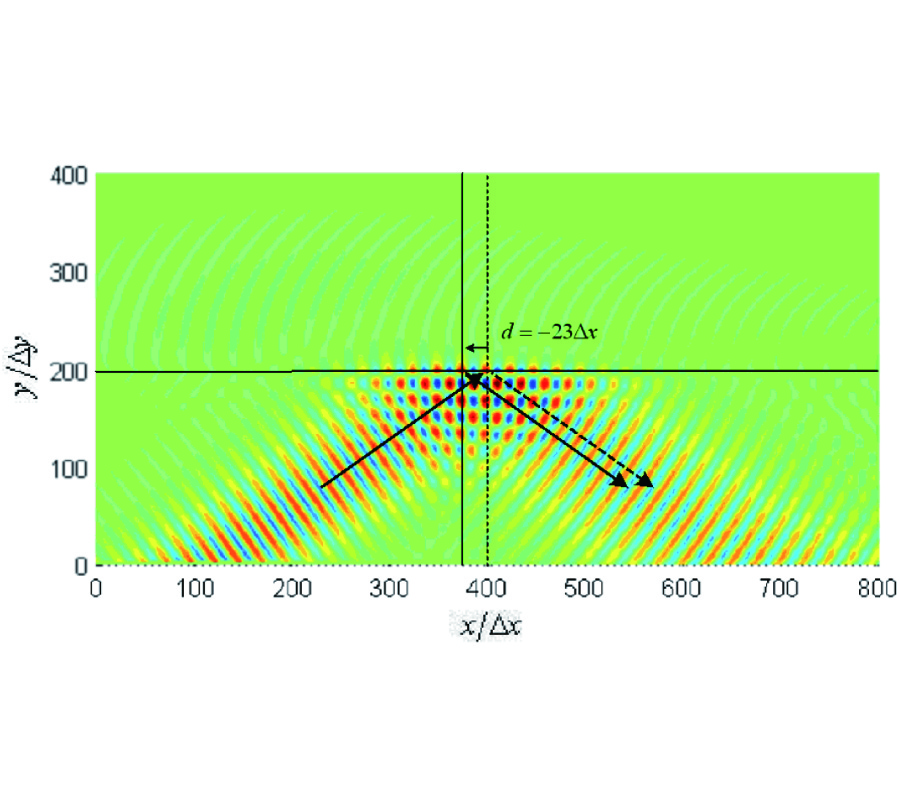
This paper proposes the pseudo-periodic Fourier transform to analyze the electromagnetic scattering from periodic structures with non-plane wave incidence. The pseudo-periodic Fourier transform converts arbitrary field components into pseudo-periodic functions and the conventional grating theories based on the Floquet theorem become applicable. The inverse transform is given by integrating with respect to the transform parameter over a finite interval and the near field analysis requires numerical integration. Some application examples are numerically examined and the results show good convergence.
TWO-DIMENSIONAL ELECTROMAGNETIC SCATTERING OF NON-PLANE INCIDENT WAVES BY PERIODIC STRUCTURES
2007-05-18
PIER
Vol. 74, 217-240
Analysis of Planar Dielectric Multilayersas FSS by Transmission Line Transfer MatrixMethod (Tltmm)
Homayoon Oraizi and Majid Afsahi
The transmission line transfer matrix method (TLTMM) is presented for the analysis of multilayer electric structures as frequency selective surfaces (FSS), whereby the reflection, transmission and absorption coefficients, field distribution and power flow may be computed inside and outside of the layers. The TLTMM formulation may be developed for any arbitrary angle of incidence, any polarization (linear TE or TM, circular, elliptical) of the incident plane wave, at any frequency of operation (microwave, millimeter wave, optical), any number dielectric layers with arbitrary thicknesses, lossless or low loss dielectric media, inclusion of dispersion relation, etc. A general formulation is given for both the TE and TM polarization of the incident wave. Several practical situations are treated by TLTMM namely, anti-reflection coatings, high reflection surfaces, computation of the axial ratio of the reflected and transmitted plane waves, distributed brag reflector (DBR), a narrow band filter consisting of two Fabry-Perot resonators, cantor superlattices in optics, field distribution and power flow for a multilayer structure. Consequently, it is verified that TLTMM is capable of analysis a variety of practical multilayer dielectric structures.
ANALYSIS OF PLANAR DIELECTRIC MULTILAYERS
AS FSS BY TRANSMISSION LINE TRANSFER MATRIX
METHOD (TLTMM)
2007-05-15
PIER
Vol. 74, 195-216
Analysis of Two-Dimensional Magneto-Dielectric Grating Slab
Ahmed Attiya , Ahmed Kishk and Allen Wilburn Glisson
Vectorial modal analysis of a 2-D magneto-dielectric grating structure is presented. The modal analysis is combined with the generalized scattering matrix to obtain the transmission and reflection coefficients of multilayered 2-D magneto-dielectric grating slabs. The results are verified with available commercial codes. Physical interpretation of the grating slab behavior is introduced. An equivalent homogeneous magneto-dielectric slab is found using a simple approach for extracting the equivalent permittivityand permeability. Several examples are presented to find the relation between the physical parameters of magneto-dielectric grating slabs and their equivalent parameters. Emphasis on the possibilityof designing a metamaterial with equivalent negative permittivityand/or negative permeability by using these grating structures is considered.
ANALYSIS OF TWO-DIMENSIONAL MAGNETO-DIELECTRIC GRATING SLAB
2007-05-13
PIER
Vol. 74, 181-194
Omnidirectional Reflection Bands in One-Dimensional Photonic Crystal Structure Using Fullerene Films
Sanjeev Srivastava and Sant Ojha
We study the omnidirectional reflection (ODR) in onedimensional photonic crystal (PC) structures consisting of alternate layers of fullerene-gallium arsenide (GaAs), fullerene-germanium (Ge) and fullerene-telurium (Te). The proposed structures give 100% reflection within a very wide range of wavelength in the visible and in a very narrow portion of near IR region of the EM spectrum. Fullerene (C60) in the form thin film structure is a suitable candidate for the designing the PC structure because alkali-metal doped thin film of fullerene acts as conductor and have almost zero absorption in the wavelength range > 530nm and near IR region. Also, in this region its dielectric constant has very small dependence on the frequency and can be ignored. Thus being a metallic counter part as well as almost frequency independent dielectric constant and easier fabrication technique it is useful in designing the PC structure. The investigation has also been made for the study the role of ambient medium and effect of number of layers in the formation of ODR.
OMNIDIRECTIONAL REFLECTION BANDS IN ONE-DIMENSIONAL    PHOTONIC CRYSTAL STRUCTURE USING FULLERENE FILMS
2007-05-11
PIER
Vol. 74, 167-180
Pad Modeling by Using Artificial Neural Network
Xiuping Li and Jianjun Gao
An approach for the PAD modeling technique for microwave on wafer measurement based on a combination of the conventional equivalent circuit model and artificial neural network (ANN) is presented in this paper. The PAD capacitances are determined from S parameters of different size of PAD test structure based on EM (electromagnetic) simulation and described as functions of the dimensions of the PAD structure by using sub-ANN. Good agreement is obtained between ANN-based modeling and EM simulated results up to 40 GHz. The de-embedding procedure for PHEMT device utilizing the ANN based PAD model is demonstrated.
PAD MODELING BY USING ARTIFICIAL NEURAL NETWORK
2007-05-10
PIER
Vol. 74, 157-166
Soliton Based Optical Communication
Ramgopal Gangwar , Sunil Singh and Nar Singh
The group velocity dispersion (GVD) imposes severe limit on information carrying capacity of optical communication systems. By choosing appropriate pulse shape highly stable light pulses known as solitons are generated when effect of GVD is balanced by self-phase modulation (SPM). The application of solitons in communication systems opens the way to ultrahigh-speed information superhighways. Transmission speed of order of Tbit/s can be achieved if optical amplifiers are combined with WDM in soliton based communication systems.
SOLITON BASED OPTICAL COMMUNICATION
2007-05-10
PIER
Vol. 74, 141-155
Frequency Selective Structures with Stochastic Deviations
Anders Karlsson , Daniel Sjöberg and Björn Widenberg
This paper deals with the performance of frequency selective structures with defects. A frequency selective structure is in this case a periodic pattern of apertures in a conducting plate. The plate can be of arbitrary thickness. The defects can be due to deviations in the placing of the apertures, in the material parameters, or in the shape of the apertures. First, the perturbation to the farfield pattern from a deviation in one aperture is analyzed. It is then shown how this affects the mean scattered power from the structure. Numerical illustrations of the perturbed fields on the structure are given.
FREQUENCY SELECTIVE STRUCTURES WITH STOCHASTIC DEVIATIONS
2007-05-07
PIER
Vol. 74, 131-140
Wideband X-Band Microstrip Butler Matrix
Jun He , Bing-Zhong Wang , Qing-Qiang He , Yu-Xia Xing and Zhong-Liang Yin
This paper presents the design of a wideband X-band microstrip 4×4Butler matrix. The wideband performance of the Butler matrix means that it possesses equal coupling and difference of phases throughout the operating band. Design of the wideband components such as 3-branch branch line hybrid, crossover and Schiffman line phase shifter are presented in this paper. A final design of the Butler matrix is proposed. The Butler matrix exhibits couplings and phase errors within −6.7 ± 0.7 dB and 10 over a 20% bandwidth with a center frequency at 10 GHz.
WIDEBAND X-BAND MICROSTRIP BUTLER MATRIX
2007-05-05
PIER
Vol. 74, 113-130
A Stable Integral Equation Solver for Electromagnetic Scattering by Large Scatterers with Concave Surface
Mei Song Tong
Electromagnetic scattering by electrically large scatterers usually requires a large number of unknowns. To reduce the matrix size, one expects to choose a small sampling rate for the unknown function. In the method of moments (MoM) scheme, this rate is about 10 unknowns per wavelength for electrically small or medium scatterers. However, this rate may not work well for electrically large scatterers with a concave surface. The concave area on the scatter is observed to be the oscillatory part in the solution domain. The oscillation property requires more samplings to eliminate the numerical noises. The multiscalets with a multiplicity of two are higher-order bases. It is shown that the multiscalets are more suitable to represent the unknown function with oscillatory characteristic. Furthermore, the testing scheme under the discrete Sobolev-type inner product allows the MoM have the derivative sampling which enhances the tracking quality of the multiscalets further. Numerical Examples of scattering by 1000 and 1024 wavelength 2D scatterers demonstrate that the use of multiscalets in the MoM can keep the same discretization size for electrically large scatterers as for electrically small scatterers without losing the accuracy of the solution. In contrast, the traditional MoM and Nyström method require the finer discretization scheme if achieving a stable solution.
A STABLE INTEGRAL EQUATION SOLVER FOR ELECTROMAGNETIC SCATTERING BY LARGE SCATTERERS WITH CONCAVE SURFACE
2007-05-03
PIER
Vol. 74, 85-112
Study on Shielding Effectiveness of Metallic Cavities with Apertures by Combining Parallel FDTD Method with Windowing Technique
Ji-Zhao Lei , Chang-Hong Liang and Yu Zhang
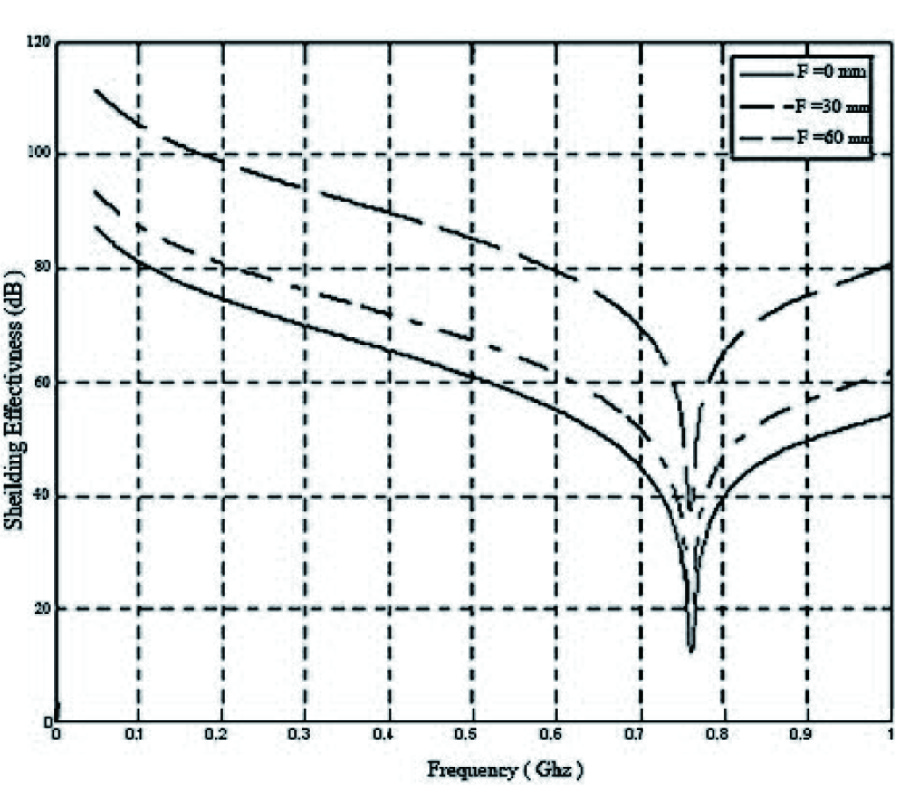
A novel hybrid method combining 3D Parallel Finite- Difference Time-Domain (FDTD) method with Windowing technique through a new Controlling factor to study the Shielding Effectiveness (SE) of metallic cavities with apertures is firstly presented in this paper. The simulating time when the sampling electric field in cavity converges can be reduced greatly by the MPI-based Parallel FDTD method with the optimum virtual topology for the scattering problem. And then the sampling electric field in cavity is dealt with Windowing technique,whic h can further reduce the total time steps that Parallel FDTD method needs. The numerical results show that combination of Parallel FDTD with Windowing technique can enhance the simulating efficiency greatly. Finally,the SE of metallic cavities with different configurations is studied by the hybrid method and some useful conclusions to the practical electromagnetic shielding problems are obtained.
STUDY ON SHIELDING EFFECTIVENESS OF METALLIC CAVITIES WITH APERTURES BY COMBINING PARALLEL FDTD METHOD WITH WINDOWING TECHNIQUE
2007-05-03
PIER
Vol. 74, 69-84
Characterization of Perfectly Conducting Targets in Resonance Domain with Their Quality of Resonance
Janic Chauveau , Nicole de Beaucoudrey and Joseph Saillard
In resonance domain, the radar scattering response of any object can be modelled by natural poles of resonance with the formalism of the Singularity Expansion Method. The mapping of these poles in the complex plane gives useful information for the discrimination of a radar target, as its general shape, its characteristic dimension and its constitution. In this paper, we use an analogy with resonant circuits modelling to define the quality factor Q of each resonance. Therefore, we propose to characterize the resonance behavior of perfectly conducting targets with this quality factor Q and the natural pulsation of resonance ω0. Indeed, this new representation in {ω0;Q} allows to better separate information than the usual mapping of natural poles of resonance in the complex plane. For perfectly conducting canonical and complex shape targets, we present results exhibiting advantages of these two parameters {ω0;Q}.
CHARACTERIZATION OF PERFECTLY CONDUCTING TARGETS IN RESONANCE DOMAIN WITH THEIR QUALITY OF RESONANCE
2007-05-01
PIER
Vol. 74, 57-67
Analysis of Longitudinally Inhomogeneous Waveguides Using the Method of Moments
Mohammad Khalaj-Amirhosseini
A new method is introduced to analyze arbitrary Longitudinally Inhomogeneous Waveguides (LIWs). In this method, the integral equations of the LIWs, converted from their differential equations, are solved using the method of moments (MOM). It is assumed that the electric permittivity function is known at all or only at some points along the length of LIWs. The validity of the method is verified using a comprehensive example.
ANALYSIS OF LONGITUDINALLY INHOMOGENEOUS WAVEGUIDES USING THE METHOD OF MOMENTS
2007-05-01
PIER
Vol. 74, 47-56
On the Equivalent Radius of a Radiating Slot in Impedance Calculations
Ashish Tiwari , Dipak Poddar and Biswanath Das
By means of evaluating impedance of a slot by spectral domain analysis, the radius of the equivalent cylindrical dipole is found in terms of slot parameters. The analysis proceeds from the integral equation for the surface current density induced on a planar strip. Explicit expressions for real and imaginary parts of impedances are derived in visible and invisible regions respectively.
ON THE EQUIVALENT RADIUS OF A RADIATING SLOT IN IMPEDANCE CALCULATIONS
2007-04-26
PIER
Vol. 73, 327-341
FDTD Modeling of Arbitrary Linear Lumped Networks Using Piecewise Linear Recursive Convolution Technique
Zhi-Hui Chen and Qing-Xin Chu
Based on the piecewise linear recursive convolution (PLRC) technique, FDTD modeling of Arbitrary linear lumped networks is studied in this paper, including one-port networks and two-port networks. Their general FDTD iterative formulations are obtained. Firstly, the admittance parameters in Laplace domain of lumped network are written as a summation form of several rational fractions; then the time domain admittance parameters can be obtained by means of inverse Fourier transform technique. Finally the time domain results are directly incorporated into the Maxwell- Ampere's difference equation using the PLRC technique. It is worth pointing out that this approach preserves the second-order accuracy and the explicit nature of the conventional FDTD method. The proposed technique can be extended to model arbitrary linear multiport lumped networks. To show the validity of the proposed algorithm, we analyze two microstrip circuits including lumped networks. The results are compared with those obtained from the Z-transform technique and the good agreement is achieved.
FDTD MODELING OF ARBITRARY LINEAR LUMPED NETWORKS USING PIECEWISE LINEAR RECURSIVE CONVOLUTION TECHNIQUE
2007-04-25
PIER
Vol. 74, 39-46
Wideband Cavity-Backed Patch Antenna for PCS/IMT2000/2.4 GHz WLAN
Fa Wang and Jin-Sheng Zhang
A wideband cavity-backed patch antenna is presented for operating at PCS, IMT200, and 2.4 GHz WLAN bands. A parasitic patch and a probe with a capacitor patch is used to enhance the bandwidth. The cavity-backed and without cavity-backed antenna has been compared. It has been found that the cavity backed antenna has wide impedance bandwidth of 43% and high gain level. It can simultaneously serve most of the modern wireless communication applications that operate at 1.7 GHz-2.5 GHz.
WIDEBAND CAVITY-BACKED PATCH ANTENNA FOR PCS/IMT2000/2.4 GHZ WLAN
2007-04-25
PIER
Vol. 74, 21-38
Optimal Design of Dualband CPW-Fed g-Shaped Monopole Antenna for WLAN Application
Wen-Chung Liu
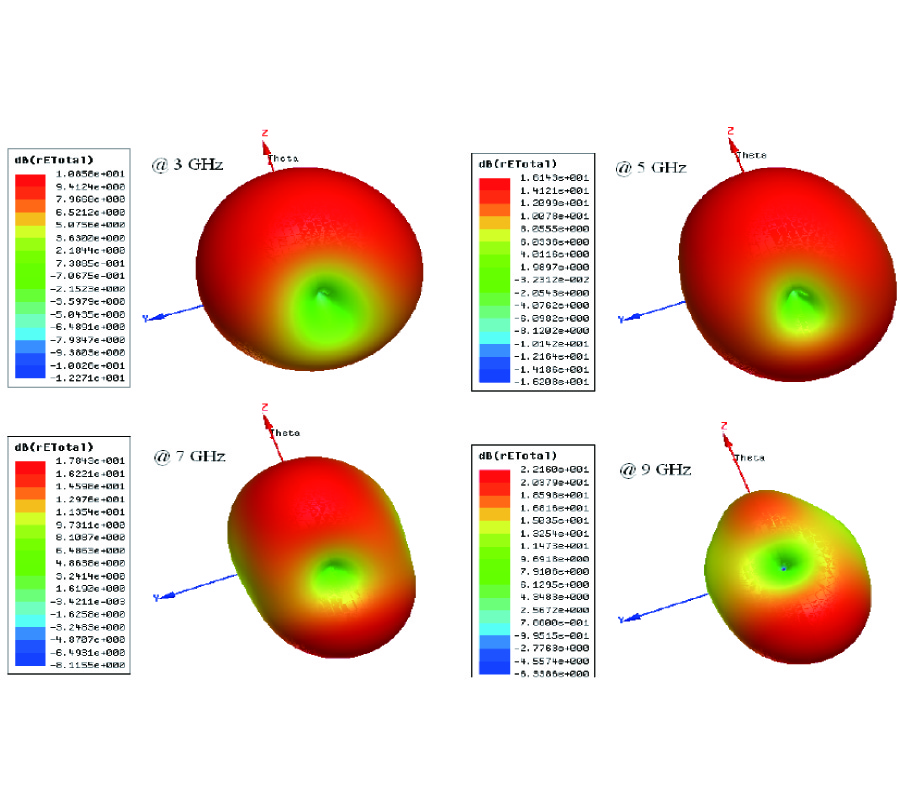
A dualband coplanar waveguide (CPW)-fed planar monopole antenna suitable for WLAN application is presented in this paper. The antenna resembling as a "G" shape and optimally designed by using the particle swarm optimization (PSO) algorithm can produce dual resonant modes and a much wider impedance bandwidth for the higher band. Prototypes of the obtained optimized antenna have been constructed and tested. The measured results explore good dualband operation with −10 dB impedance bandwidths of 9.7% and 62.8% at bands of 2.43 and 4.3 GHz, respectively, which cover the 2.4/5.2/5.8 GHz WLAN operating bands, and show good agreement with the numerical prediction. Also, good antenna performances such as radiation patterns and antenna gains over the operating bands have been observed.
OPTIMAL DESIGN OF DUALBAND CPW-FED G-SHAPED MONOPOLE ANTENNA FOR WLAN APPLICATION
2007-04-23
PIER
Vol. 74, 1-19
Analysis of Interaction Between a Crystallographically Uniaxial Ferrite Resonator and a Hall-Effect Transducer
Marina Koledintseva and Alexander Kitaitsev
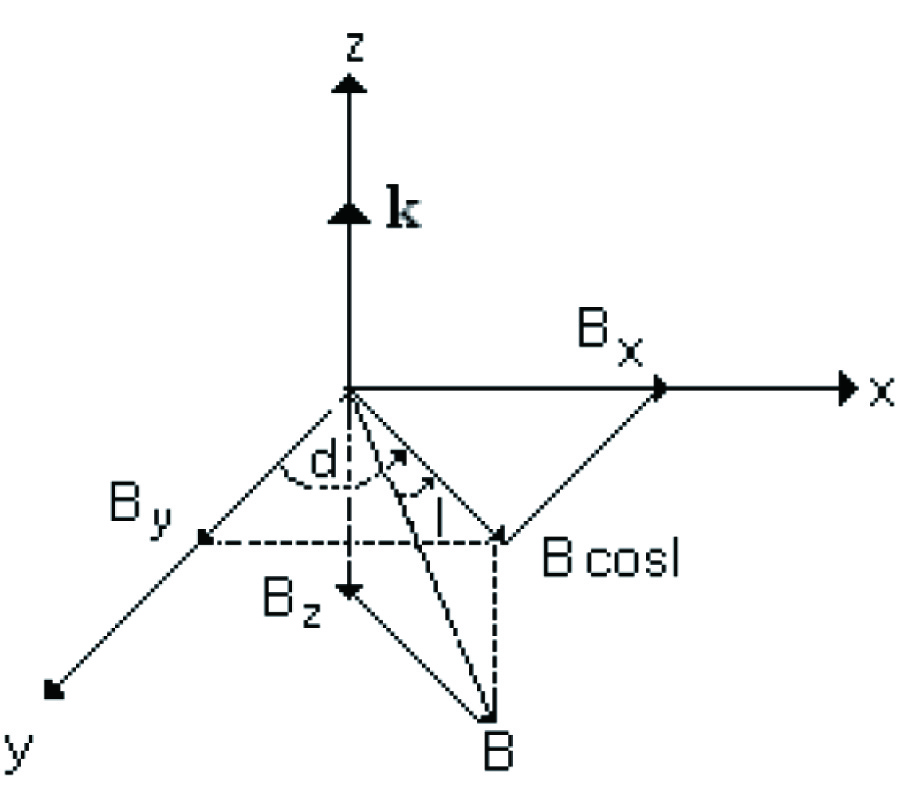
In this paper, a number of physical phenomena taking place at the interaction of a crystallographically uniaxial ferrite resonator (UFR) with a semiconductor element, such as a Hall-effect transducer (HET), are analyzed. The UFR in this study is in a direct contact with an unpackaged HET. The interaction is studied in the vicinity of the ferromagnetic resonance in the UFR. The analytical model based on the combination of the problem of interaction of an arbitrarily orientated and shaped UFR with electromagnetic field of a multimode transmission line (waveguide) and thermal balance equations is proposed. A number of thermo/electro/magnetic phenomena that cause a voltage additional to that of the Hall-effect in the HET are analyzed. It is shown that this additional voltage is mainly due to Nernst-Ettingshausen thermo-magnetic effect. Some experimental results in 8-mm waveband are presented. This structure may serve as a frequency-selective primary transducer for detection and measurement of microwave (or millimeter-wave) power.
ANALYSIS OF INTERACTION BETWEEN A CRYSTALLOGRAPHICALLY UNIAXIAL FERRITE RESONATOR AND A HALL-EFFECT TRANSDUCER
2007-04-22
PIER
Vol. 73, 297-325
Study of an Electrically Anisotropic Cylinder Excited Magnetically by a Straight Strip Line
Constantinos Valagiannopoulos
An infinite homogeneous circular cylinder with full permittivity tensor is excited by a straight strip flowed by arbitrary axial magnetic current. A nontrivial differential equation is derived for the single axial magnetic component which is assigned a plane wave representation. The boundary conditions lead to an integral equation with nonsingular kernel which is solved by supposing a Dirac comb representation for the unknown function. The resultant Green's function multiplied by the current distribution is integrated numerically over the source to give the total field. Various numerical examples are presented and discussed.
STUDY OF AN ELECTRICALLY ANISOTROPIC CYLINDER EXCITED MAGNETICALLY BY A STRAIGHT STRIP LINE
2007-04-18
PIER
Vol. 73, 277-296
Basis of Ionospheric Modification byHigh-Frequency Waves
Spencer P. Kuo
The requirements of achieving ionospheric modification by ground-transmitted HF heating waves are discussed. The directly relevant processes including linear mode conversion and parametric instabilities are explained physically. The nonlinear Schrodinger equation for Langmuir waves is reviewed and the initial conditions of two types of nonlinear solutions are discussed; from which the criterion for Langmuir soliton generation is pointed out.
BASIS OF IONOSPHERIC MODIFICATION BY
HIGH-FREQUENCY WAVES
2007-04-18
PIER
Vol. 73, 249-275
Nonlinear Effects in Optical Fibers: Origin, Management and Applications
Sunil Singh and Nar Singh
The nonlinear effects in optical fiber occur either due to intensity dependence of refractive index of the medium or due to inelastic-scattering phenomenon. This paper describes various types of nonlinear effects based on first effect such as self-phase modulation, cross-phase modulation and four-wave mixing. Their thresholds, managements and applications are also discussed; and comparative study of these effects is presented.
NONLINEAR EFFECTS IN OPTICAL FIBERS: ORIGIN, MANAGEMENT AND APPLICATIONS