Search Results(13979)

2007-06-18
PIER
Vol. 74, 407-419
Bandwidth Widening Techniques for Directive Antennas Based on Partially Reflecting Surfaces
Halim Boutayeb , Tayeb Denidni and Mourad Nedil
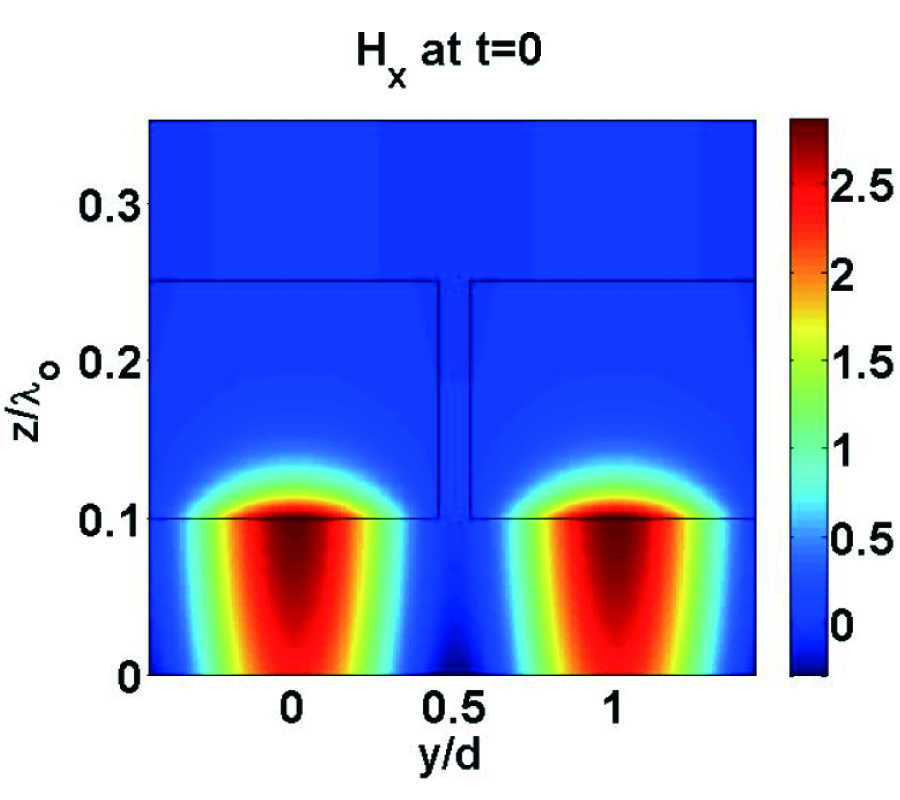
The directivity bandwidth of Fabry-Perot directive antennas is first evaluated theoretically. Then, different techniques are proposed to widen the directivity bandwidth of antennas using Partially Reflecting Surfaces. The bandwidths obtained with the proposed solutions are compared to the bandwidth of a classical Fabry- Perot directive antenna.
BANDWIDTH WIDENING TECHNIQUES FOR DIRECTIVE ANTENNAS BASED ON PARTIALLY REFLECTING SURFACES
2007-06-17
PIER
Vol. 75, 225-237
A New Architecture of UWB Radar Utilizing Microwave Chaotic Signals and Chaos Synchronization
Shan Qiao , Zhi-Guo Shi , Tao Jiang and Li-Xin Ran
In this paper, we present a new scheme for the realization of a wide-band chaotic RADAR system. The remarkable characteristics of such scheme are: (1) Wide-band chaotic signal generated from microwave chaotic Colpitts oscillator is directly used as the RADAR signal; (2) Chaos synchronization is used to recover the chaotic signal from the back-scattered signal by targets; (3) The intrinsic sensitivities of the chaotic signal to the parameters of the chaotic circuit and to the initial conditions are used to realize the "multi-user" property. System simulations show that such RADAR can still work in an environment when the signal-to-noise ratio (SNR) is lower than −20dB.
A NEW ARCHITECTURE OF UWB RADAR UTILIZING MICROWAVE CHAOTIC SIGNALS AND CHAOS SYNCHRONIZATION
2007-06-14
PIER
Vol. 75, 209-224
A Principal Investigation of the Group Velocity Dispersion (GVD) Profile for Optimum Dispersion Compensation in Optical Fibers: A Theoretical Study
Ali Rostami and Ghassem Rostami
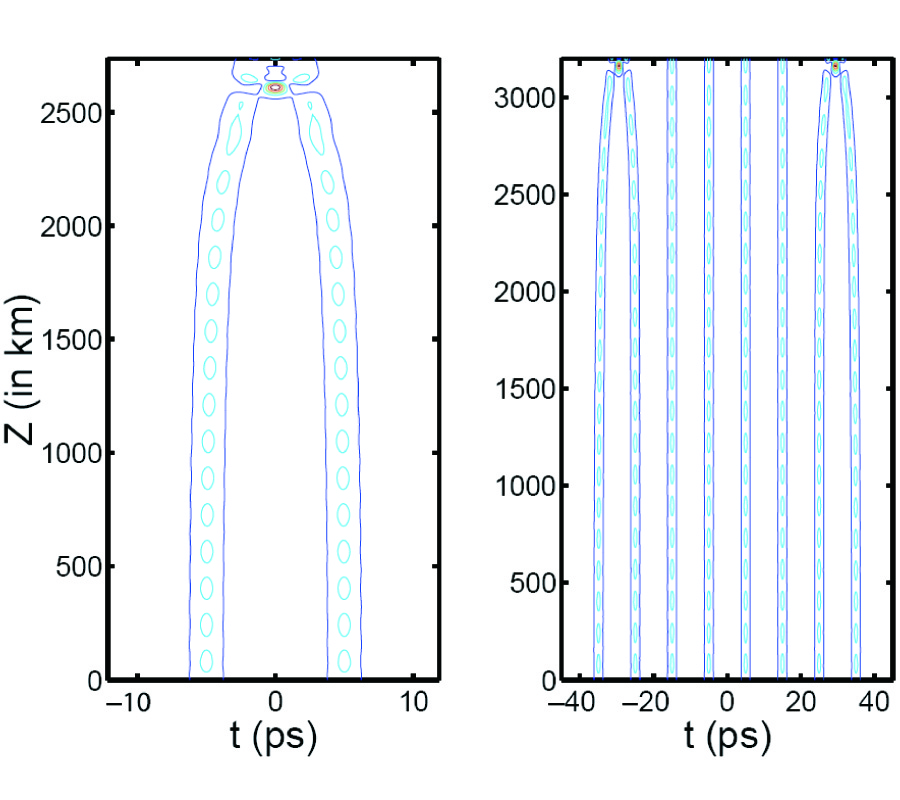
In this paper, an analytical method for management of optimum group velocity dispersion (GVD) for compensation of chromatic dispersion in optical fibers is proposed. The proposed method mathematically is based on the Volterra series as alternative method for solution of the nonlinear Schrödinger equation (NLS). Based on analytical solution of the nonlinear equation in pulse propagation, we propose a differential equation including optimum GVD for complete dispersion compensation for given dispersion coefficient and fiber length. The obtained integro-differential equation is solved for special cases and it is shown that the obtained results are so better than traditional dispersion compensation cases. Also, the proposed technique can be applied to fiber design to introduce an especial GVD profile for dispersion less transmission.
A PRINCIPAL INVESTIGATION OF THE GROUP VELOCITY DISPERSION (GVD) PROFILE FOR OPTIMUM DISPERSION COMPENSATION IN OPTICAL FIBERS: A THEORETICAL STUDY
2007-06-12
PIER
Vol. 75, 171-207
Physical Theory for Particle Swarm Optimization
Said Mikki and Ahmed Kishk
We propose an inter-disciplinary approach to particle swarm optimization (PSO) by establishing a molecular dynamics (MD) formulation of the algorithm, leading to a physical theory for the swarm environment. The physical theory provides new insights on the operational mechanism of the PSO method. In particular, a thermodynamic analysis, which is based on the MD formulation, is introduced to provide deeper understanding of the convergence behavior of the basic classical PSO algorithm. The thermodynamic theory is used to propose a new acceleration technique for the PSO. This technique is applied to the problem of synthesis of linear array antennas and very good improvement in the convergence performance is observed. A macroscopic study of the PSO is conducted by formulating a diffusion model for the swarm environment. The Einstein's diffusion equation is solved for the corresponding probability density function (pdf) of the particles trajectory. The diffusion model for the classical PSO is used, in conjunction with Schr¨odinger's equation for the quantum PSO, to propose a generalized version of the PSO algorithm based on the theory of Markov chains. This unifies the two versions of the PSO, classical and quantum, by eliminating the velocity and introducing position-only update equations based on the probability law of the method.
PHYSICAL THEORY FOR PARTICLE SWARM OPTIMIZATION
2007-06-12
PIER
Vol. 75, 163-170
Generation of High Repetition Rate Picosecond Pulse Train Based on Ultra-Small Silicon Waveguide
Jian-Wei Wu and Feng-Guang Luo
A designed model based on the ultra-small silicon waveguide(WG) is demonstrated to generate high repetition rate picosecond pulse train. Research result shows that 50 GHz repetition rate pulse can be obtained inside a 2-mm-long ultra-small silicon WG using signal wave at 1550nm with a cw power of 0.2mW and different delay modulation Gaussian pulses at 1670nm with peak of 0.6mW before the WG. the signal pulse train obtained has duration time as short as around 6 ps full width of half maximum(FWHM) and extinction ratio as large as up to 30 dB. Additionally,eac h pulse of signal pulse train obtained holds equal intensity and close Gaussian waveform.
GENERATION OF HIGH REPETITION RATE PICOSECOND PULSE TRAIN BASED ON ULTRA-SMALL SILICON WAVEGUIDE
2007-06-12
PIER
Vol. 75, 137-152
An Overview of the Watson Transformation Presented through a Simple Example
Constantinos Valagiannopoulos
One of the methods developed for accelerating the convergence speed of infinite series is theWatson transformation. It is a technique with an interesting theoretical background which is applied in a restricted number of cases due to its complexity. Most of the papers using this method do not extensively analyze every step of implementation. In this work we apply Watson transformation in a simple case and we focus on each aspect of the procedure.
AN OVERVIEW OF THE WATSON TRANSFORMATION PRESENTED THROUGH A SIMPLE EXAMPLE
2007-06-09
PIER
Vol. 75, 119-135
An Improved Time Domain Finite Element-Boundary Integral Scheme for Electromagnetic Scattering from 3-D Objects
Zhao-Jie Qiu , Jia-Dong Xu , Gao Wei and Xin-Yu Hou
This paper proposes an improved time domain finite element-boundary integral scheme for 3-D scattering from arbitraryshaped objects. The proposed scheme, which uses only one auxiliary boundary, is more efficient than the one reported in the literature that uses two auxiliary boundaries. While preserving the sparseness and symmetry of the finite element matrices, the proposed scheme reduces the computational domain for the finite elements. A major difficulty, here, is the treatment of the singularity of Green's function arising from this scheme. To overcome this problem, the contribution of singular point is computed analytically, and equivalent transformation technique is also included to reduce the integrals' singularity. And, a remedy is presented for the numerical error encountered in the course of the equivalent transformation, which essentially may be attributed to the inherent routine with the time domain finite element-boundary integral method. The validity and accuracy of the hybrid scheme are verified by numerical tests.
AN IMPROVED TIME DOMAIN FINITE ELEMENT-BOUNDARY INTEGRAL SCHEME FOR ELECTROMAGNETIC SCATTERING FROM 3-D OBJECTS
2007-06-07
PIER
Vol. 75, 85-117
Biased Magnetic Materials in RAM Applications
Jörgen Ramprecht and Daniel Sjöberg
The magnetization of a ferro- or ferri-magnetic material has been modeled with the Landau-Lifshitz-Gilbert (LLG) equation. In this model demagnetization effects are included. By applying a linearized small signal model of the LLG equation, it was found that the material can be described by an effective permeability and with the aid of a static external biasing field, the material can be switched between a Lorentz-like material and a material that exhibits a magnetic conductivity. Furthermore, the reflection coefficient for normally impinging waves on a PEC covered with a ferro/ferrimagnetic material, biased in the normal direction, is calculated. When the material is switched into the resonance mode, two distinct resonance frequencies in the reflection coefficient were found, one associated with the precession frequency of the magnetization and the other associated with the thickness of the layer. The former of these resonance frequencies can be controlled by the bias field and for a bias field strength close to the saturation magnetization, where the material starts to exhibit a magnetic conductivity, lowreflection (around −20 dB) for a quite large bandwidth (more than two decades) can be achieved.
BIASED MAGNETIC MATERIALS IN RAM APPLICATIONS
2007-06-07
PIER
Vol. 75, 69-84
Spectral Analysis of Fibonacci-Class One-Dimensional ‎Quasi-Periodic Structures
Saeed Golmohammadi , Mohammad Moravvej-Farshi , Ali Rostami and Abbas Zarifkar
Abstract-In this paper, spectral properties of the Fibonacci-class one-dimensional quasi-periodic structures, FCJ(n), as an important optical structure are investigated. Analytical relations for description of the spectral properties of FCJ(n) are used. Fast Fourier Transform (FFT) for investigation of the spectral properties of these structures is proposed. FFT spectrum of the Fibonacci-class one-dimensional quasi-periodic structures contains peaks that are equivalent to photonic bandgaps or multiband reflection filter. Based on the proposed relations and FFT simulation results, the optical bandgap and other properties of these structures are studied. In this paper, the effects of the optical and geometrical parameters on optical properties of the Fibonacci quasi-periodic structures are considered. Our proposed relations show that the spectral contents of the Fibonacci-class onedimensional quasi-periodic structures have two main terms including the low and high frequency parts. Our results illustrate that the high frequency term depends up on the class order, n, and the width of the layer B, db, while the low frequency term depends on the width of the layer A, da. According to the proposed method, the spectral contents of FCJ(n) includes multi narrowband peaks multiplied by a quasi periodic envelope function. The number of multi narrow bands within a periods of the envelope function can be controlled by varying db and n and also the number of period of envelope function can be manipulated by da. Results obtained from our proposed analytical relations and FFT based simulation results are close together.
SPECTRAL ANALYSIS OF FIBONACCI-CLASS ONE-DIMENSIONAL ‎QUASI-PERIODIC STRUCTURES
2007-06-07
PIER
Vol. 75, 63-68
Reconfigurable Microstrip Patch Antenna with Switchable Polarization
Wen-Bo Wei , Qi-Zhong Liu , Ying-Zeng Yin and Hai-Jin Zhou
A new reconfigurable microstrip patch antenna allowing switching between two circular polarizations is proposed. It consists of a square radiating patch and a 3 dB hybrid coupler. Using only a single-polar-double-throw (SPDT) switch,the polarization switching can be achieved. This design of the dc-bias network is extremely simple. From experimental results,the proposed antenna avoids the frequency offset phenomena which often happened to antennas with switchable polarization.
RECONFIGURABLE MICROSTRIP PATCH ANTENNA WITH SWITCHABLE POLARIZATION
2007-06-07
PIER
Vol. 75, 51-62
Dispersion Characteristics of Electromagnetic Waves in Circularly Cored Highly Birefringent Waveguide Having Elliptical Cladding
Alok Shahi , Vivek Singh and Sant Ojha
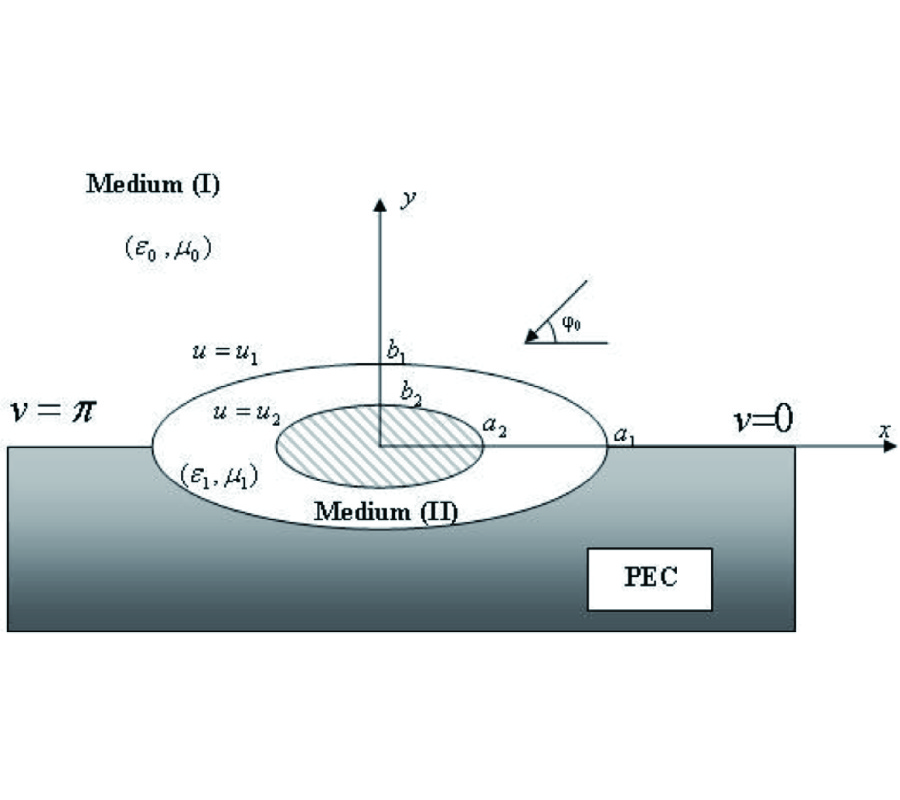
In this article a new type of circularly cored highly birefringent (Hi-Bi) waveguide having elliptical cladding is proposed and analyzed for the first time in our knowledge. By choosing appropriate orthogonal co-ordinates and using the boundary conditions of the considered waveguide, the eigen value equation in terms of modified Mathieu functions is derived under the weak guidance condition and is presented in this paper. Using this equation the modal dispersion curves for even and odd guided modes are obtained and plotted for different cladding ellipticity e. It is seen that the proposed (Hi-Bi) fiber supports less guided modes than standard circular fiber. Finally, the modal birefringence in the said fiber is also estimated.
DISPERSION CHARACTERISTICS OF ELECTROMAGNETIC WAVES IN CIRCULARLY CORED HIGHLY BIREFRINGENT WAVEGUIDE HAVING ELLIPTICAL CLADDING
2007-06-07
PIER
Vol. 75, 11-50
Multi-Antenna Information Theory
Geyi Wen
It is well known that the performance of a wireless multiple-input and multiple-output (MIMO) system depends on the propagation channel. The propagation channel models can generally be divided into two different groups, the statistical models based on information theory and the site-specific models based on measurement or ray tracing. In this paper, a general procedure for predicting the MIMO channel model has been presented. Analytical expressions for the channel matrix elements in a general scattering environment have been derived from the statistical theory for a narrow-band electromagnetic field, and have been verified by numerical simulation and experiments. The limitations of information capacity of the MIMO wireless communication system imposed by the antennas have also been discussed, and analytical upper bounds on the information capacity in terms of the antenna parameters for multiple antenna system in free space have been obtained. Once the capacity of a MIMO system is specified, these upper bounds can serve as a criterion for estimating how many antennas are needed or how big the antenna must be to achieve the capacity.
MULTI-ANTENNA INFORMATION THEORY
2007-06-07
PIER
Vol. 75, 1-10
Numeric Calculation of Input Impedance for a Giant VLF T-Type Antenna Array
Chao Liu , Qi-Zhong Liu , Long Gen Zheng and Wei Yu
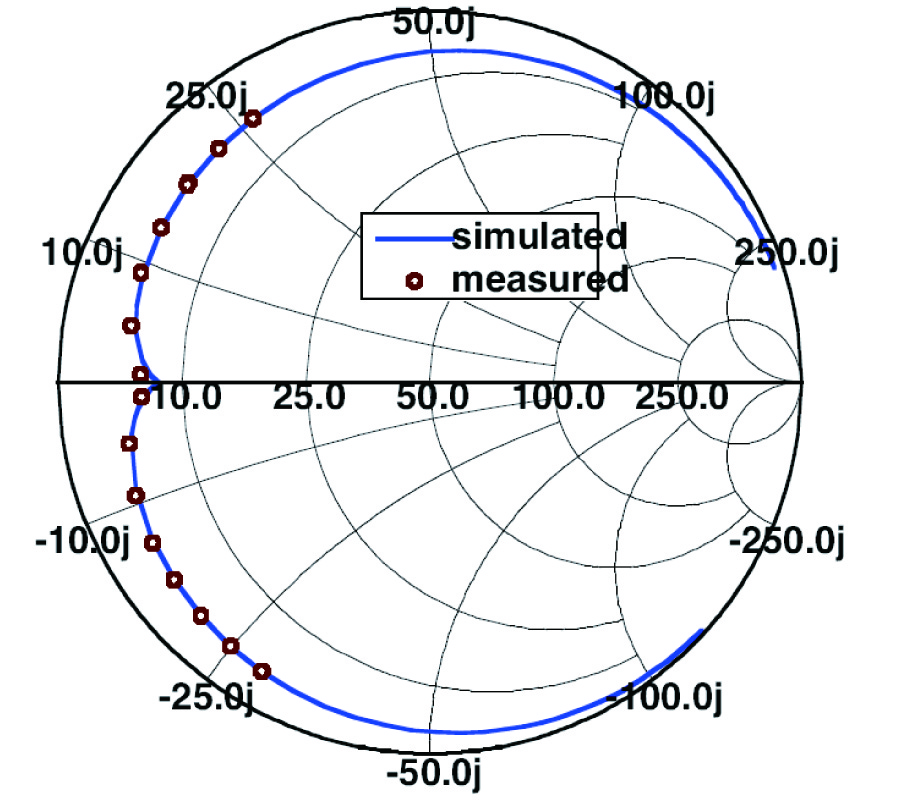
The input reactance and radiation resistance of a giant very low frequency (VLF) ‘T type' antenna with ground screen is computed by Method of Moment (MoM). The loss resistance of a complex grounding system is calculated by numeric integral of near field from MoM solution of the antenna on the ground surface. The numeric calculation results agree well with the measured data.
NUMERIC CALCULATION OF INPUT IMPEDANCE FOR A GIANT VLF T-TYPE ANTENNA ARRAY
2007-06-06
PIER
Vol. 74, 379-405
Nonlinear Scattering Effects in Optical Fibers
Sunil Singh , Ramgopal Gangwar and Nar Singh
The nonlinear scattering effects in optical fiber occur due to inelastic-scattering of a photon to a lower energy photon. This paper describes stimulated Brillouin scattering and stimulated Raman scattering processes. Their thresholds, reduction in power penalty and applications along with comparative study of these effects are also presented.
NONLINEAR SCATTERING EFFECTS IN OPTICAL FIBERS
2007-05-31
PIER
Vol. 74, 353-377
An Efficient Analysis of Vertical Dipole Antennas Above a Lossy Half-Space
Xiao-Bang Xu and Yongfeng Huang
The electromagnetic modeling of radiation by vertical dipole antennas above a lossy half-space is an important subject. The modeling often encounters Sommerfeld-type integrals that are normally highly oscillatory with poor convergence. Recently, an efficient computation of the electric field radiated by an infinitesimal electric dipole above a lossy half-space has been reported, in which the Sommerfeld-type integrals are reduced to rapidly-converging integrals. Using such efficiently-calculated electric field as the Green's function, in this paper, an electric field integral equation (EFIE) is formulated for the analysis of a vertical dipole antenna above a lossy half-space. Then, the EFIE is solved numerically employing the Method of Moments (MoM). Sample numerical results are presented and discussed for the current distribution as well as the input impedance and radiation pattern of the antenna. In particular, the EFIE solutions of the current distribution on an antenna in free space are checked with that obtained using a traditional approach of solving the Pocklington's equation. Also, the current distributions on an antenna above a very lossy halfspace are checked by comparing them with that for the antenna above a PEC plane. Data of the current distribution and the input impedance show that for an antenna close to the media interface separating the two half-spaces, the electromagnetic parameters of the lower half-space can significantly affect the antenna characteristics. The radiation patterns of the antenna presented all exhibit properties as expected and similar to that documented in literature for infinitesimal vertical dipoles above a lossy half-space.
AN EFFICIENT ANALYSIS OF VERTICAL DIPOLE ANTENNAS ABOVE A LOSSY HALF-SPACE
2007-05-31
PIER
Vol. 74, 341-351
Analysis of Balanced Composite Right/Left Handed Structure Based on Different Dimensions of Complementary Split Ring Resonators
Jia-Xiao Niu and Xi-Lang Zhou
In this paper, rectangular shape complementary split ring resonators (CSRRs) with different dimensions are introduced to realize balanced composite right/left handed (CRLH) structure. As the dimensions of CSRRs is altered, the required series capacitance should also be modified and the propagation characteristics will be changed, which gives the facility of designing microwave/RF components using the balanced CRLH structure. The propagation characteristics of proposed structures are demonstrated by simulated and measured results, which are in good agreement.
ANALYSIS OF BALANCED COMPOSITE RIGHT/LEFT HANDED STRUCTURE BASED ON DIFFERENT DIMENSIONS OF COMPLEMENTARY SPLIT RING RESONATORS
2007-05-30
PIER
Vol. 74, 319-340
Design Equations of Two-Dimensional Dielectric Photonic Band Gap Structures
M. El-Dahshory , Ahmed Attiya and Essam Hashish
This paper presents simple formulas for designing different configurations of two-dimensional photonic band gap (PBG) structures. These formulas are obtained by interpolating full wave analysis based on the plane wave expansion method. The design parameters of these formulas include the physical dimensions of the unit cell and the electrical properties of both host and inclusion in the structure. These formulas represent an efficient and fast method to obtain the band gap and the center frequency of different PBG structures.
DESIGN EQUATIONS OF TWO-DIMENSIONAL DIELECTRIC PHOTONIC BAND GAP STRUCTURES
2007-05-24
PIER
Vol. 74, 309-317
Multiple Targets Detection Method Based on Binary Hough Transform and Adaptive Time-Frequency Filtering
Wei Xue and Xiao-Wei Sun
When the echo energy of multiple targets of vehicle volume detecting radar diverge greatly, small targets are easily masked by the platform of large targets, it is difficult to detect the all the targets by the Wigner-Hough Transform simultaneously. In this paper, a method based on binary Hough Transform and adaptive time-frequency filtering is proposed, which can avoid the problems of detecting the platform of large targets as well as platform masking of small targets and detect all the targets with different energy at the same time. The experimental results show the method has good performance and high practical value.
MULTIPLE TARGETS DETECTION METHOD BASED ON BINARY HOUGH TRANSFORM AND ADAPTIVE TIME-FREQUENCY FILTERING
2007-05-24
PIER
Vol. 74, 291-307
Reconstruction of 2D PEC Targets Using Limited Scattered Information
Jing Wu and Tie-Jun Cui
An efficient method is proposed in this paper to reconstruct the shape of a two-dimensional perfectly electrically conducting (PEC) target using limited scattered information. Based on the physical optics approximation, a Fourier transform relation has been obtained between the PEC target and the scattered fields. In theory, all scattered-field data are required for the reconstruction in the whole angle range (from 0 to 2π) and in the whole frequency range (from 0 to ∞). However, such data are impossible in practical applications. In this paper, we have discussed the influence of limited frequencies and limited incident angles on the imaging, where a Pade interpolation technique has been developed to obtain the scattered information in the whole angle range from limited-angle information. In order to overcome the ill-posed problem in the interpolation, the Tikhonov regularization has been used. Reconstruction examples are given to validate the efficiency of the proposed approach.
RECONSTRUCTION OF 2D PEC TARGETS USING LIMITED SCATTERED INFORMATION
2007-05-22
PIER
Vol. 74, 273-289
Transient Solutions of Maxwell's Equations Based on Sumudu Transform
Malek G. Hussain and Fethi Bin Muhammad Belgacern
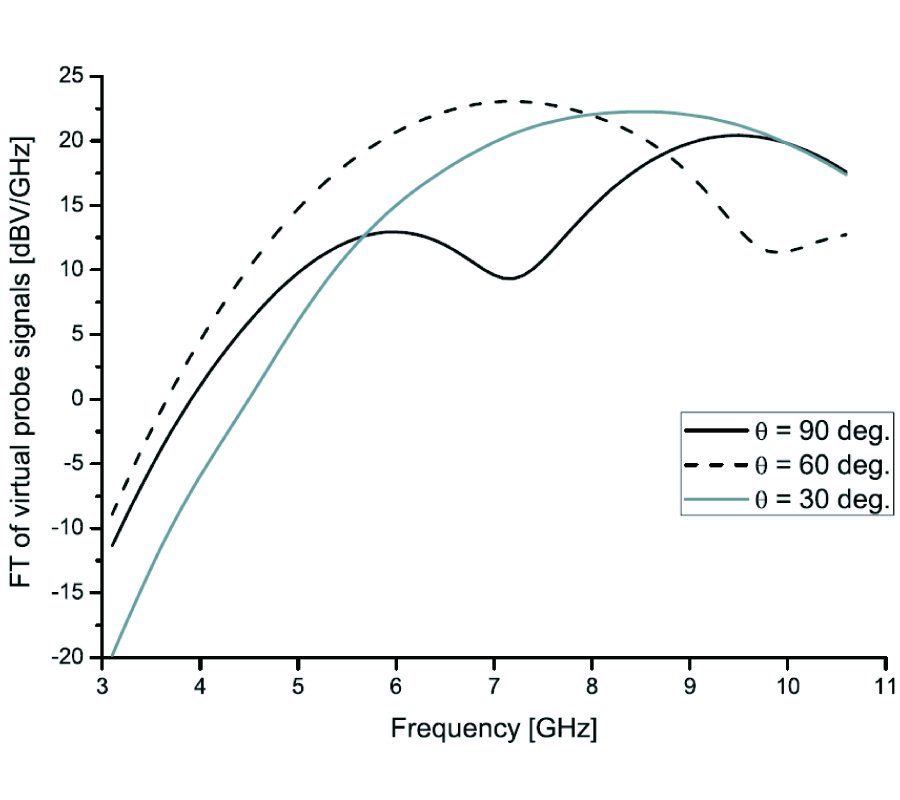
The Sumudu transform is derived from the classical Fourier integral. Based on the mathematical simplicity of the Sumudu transform and its fundamental properties, Maxwell's equations are solved for transient electromagnetic waves propagating in lossy conducting media. The Sumudu transform of Maxwell's differential equations yields a solution directly in the time domain, which neutralizes the need to perform inverse Sumudu transform. Two sets of computer plots are generated for the solution of Maxwell's equations for transient electric field strength in lossy medium. A set of plots presents the Sumudu transform of the transient solution and another one presents inverse Sumudu transform. Both sets of plots reveal similar characteristics and convey equal information. Such property is referred to as the Sumudu reciprocity.
TRANSIENT SOLUTIONS OF MAXWELL'S EQUATIONS BASED ON SUMUDU TRANSFORM