Search Results(13790)

2019-09-16
PIER Letters
Vol. 87, 67-73
Design of Compact Vertically Stacked SIW End-Fire Filtering Antennas with Transmission Zeros
Changzhou Hua , Xiangyu Jin and Meng Liu
This paper presents a new type of vertically stacked substrate integrated waveguide (SIW) filtering antenna. It is composed of an SIW bandpass filtering circuit and an antipodal linearly tapered slot antenna (ALTSA). The filtering circuit consists of two vertically stacked SIW cavity resonators which are coupled with each other by etching slot on the common metal layer. By introducing electric and magnetic mixed coupling structures, close-to-passband transmission zeros can be realized and flexibly adjustable. Due to the partially vertically stacked structure, the proposed filtering antenna also shows a compact physical size. For validation, two vertically stacked SIW filtering antennas operating at 30 GHz with transmission zero at the upper or lower side of the passband are designed, fabricated, and measured. Good agreement is observed between the measured and simulated results.
DESIGN OF COMPACT VERTICALLY STACKED SIW END-FIRE FILTERING ANTENNAS WITH TRANSMISSION ZEROS
2019-09-14
PIER M
Vol. 85, 71-81
A Compact Switchable and Tunable Bandpass Filter
Muhammad Faeyz Karim and Mohammed Yakoob Siyal
In this paper, an integrated switchable and tunable bandpass filter is designed, simulated, and fabricated. This integrated bandpass filter is able to switch as well as tune in the ultra-wideband (UWB) as well as 2.4 GHz band. At first, a UWB bandpass filter is developed which consists of two bent shorted quarter-wavelength stubs and a connecting half-wavelength stub. Subsequently, a 2.4 GHz bandpass filter is realized by connecting another half-wavelength stub on top of the UWB filter. RF pin-diodes are used for switching the bands between UWB and 2.4 GHz bandpass filter. The switchable bandpass filter converts into a tunable filter by changing the inductance or the length of shorted stubs through the pin diodes. A detailed parametric analysis is done for calculating different stubs lengths of the UWB as well 2.4 GHz bandpass filter. The simulation results show a high rejection level of >40 dB at the lower frequency and a low insertion loss of 0.8 dB in the passband for UWB filter. For 2.4 GHz bandpass filter, the simulation results show an insertion loss of 0.42 dB and a 3 dB bandwidth of 796 MHz. The filter is fabricated on a Rogers 4003 substrate, and the measurement results of the switchable filter in the UWB band show an insertion loss of 2.1 dB and a 3 dB bandwidth of 7 GHz. In the case of 2.4 GHz bandpass filter, the insertion loss is 0.78 dB.
A COMPACT SWITCHABLE AND TUNABLE BANDPASS FILTER
2019-09-14
PIER M
Vol. 85, 1-10
A Ku-Band Filtering Duplex Antenna for Satellite Communications
Mostafa Gamal Aly , Chunxu Mao , Steven Gao and Yi Wang
In this paper, a dual-polarisation shared-aperture duplex antenna is presented for satellite communications at the standard microwave Ku-band, based on the integrated filtering-antenna concept and co-design approach. The design relies on the use of resonators coupled to the radiating dual-band dual-polarisation antenna. The resonant patch antenna forms one pole of each channel filter, resulting in a third-order filter in the Rx channel and a second-order filter in the Tx channel. The Rx and Tx ports of the antenna take in horizontal and vertical linear polarisations, respectively. The integrated duplexer helps to increase the isolation between the ports and the selectivity of each channel. The integration between the filter and the antenna is achieved by electromagnetic coupling, without the need of external matching circuits. Thus it attains a compact footprint. The operation frequencies of the demonstrated duplexantenna are from 11 to 12.5 GHz (12.8%) for the downlink to the Rx port, and from 13 to 14.4 GHz (10.2%) for the uplink at the Tx port. High port-to-port isolation of over 40 dB is realized to reduce channel interference. Flat in-band average gains are achieved to be 8.3 and 8.6 dBi, for the low- and high-bands, respectively.
A KU-BAND FILTERING DUPLEX ANTENNA FOR SATELLITE COMMUNICATIONS
2019-09-12
PIER M
Vol. 85, 59-69
Scatterer Characterization Based on the Condiagonalization of the Sinclair Backscattering Matrix
Georgios Kouroupis and Vassilis Anastassopoulos
In this paper we revisit the condiagonalization of the Sinclair backscattering matrix, to overcome the Huynen decomposition issues, so as to correctly extract scatterer polarimetric properties. The correct extraction of scatterer polarimetric properties will lead to the correct classification of the scatterer predominant scattering mechanism. Huynen used the congruence transformation by a special unitary matrix to diagonalize the Sinclair matrix into a real and nonnegative diagonal matrix. He also expressed the special unitary matrix in terms of the polarization ellipse parameters and associated them with the scatterer orientation, asymmetry, and skip angle. Unfortunately, this association was found misleading. As a result, it makes the scatterer classification ambiguous, for it is based on the scatterer skip angle and the diagonal matrix. To overcome these ambiguities, we perform the diagonalization procedure founded on the consimilarity transformation by a special unitary matrix, as proposed by Lüneberg. In order to correctly extract the scatterer asymmetry degree and orientation, we express the special unitary matrix in terms of an asymmetry operation and a pure rotation operation. Moreover, we integrate the scatterer skip angle in the diagonal matrix of the consimilarity transformation by having it complex, leading to an unequivocal scatterer characterization.
2019-09-11
PIER C
Vol. 95, 227-238
Stability Improvement of Analog Adaptive Self-Interference Cancellation System with Phase Compensation
Yunshuo Zhang , Qing Wang , Huanding Qin , Fangmin He and Jin Meng
The self-interference problem of linear frequency modulated continuous wave (LFMCW) radar is a known issue that limits the radar's detection range. Analog adaptive interference cancellation (AIC) technique is effective to mitigate the self-interference problem. However, we find that the phase difference between the error signal and reference signal paths may significantly deteriorate the stability of the AIC system. Therefore, in this paper, we analyze the effect of phase difference on system stability through the mathematical modeling and simulation. We find that the system is stable when the phase difference is between -90 and 90 degrees, and diverges when it is between 90 and 270 degrees. Therefore, to avoid system instability, we propose to add a phase shifter in the reference signal path to compensate the phase difference. The experiment results show that compared with the traditional delay-based compensation method, our phase compensation based method can increase interference cancellation ratio (ICR) by 15 dB for a single-antenna system and 12 dB for a dual-antenna system.
STABILITY IMPROVEMENT OF ANALOG ADAPTIVE SELF-INTERFERENCE CANCELLATION SYSTEM WITH PHASE COMPENSATION
2019-09-11
PIER M
Vol. 85, 49-58
Study of Nonlinear Effect on Electronic System Induced by TVS Limiter When Illuminated by HPEM Pulse
Haiyan Xie , Hailiang Qiao , Yong Li and Jianguo Wang
This paper studies the nonlinear effects induced by a TVS limiter on an entire system illuminated by a high power electromagnetic (HPEM) pulse through a simple model. The relations between the load responses and the incident electric field under different conditions are obtained numerically. The results show that the TVS limiter not only protects the circuit which it is intended to but also may increase the response of the other end which is connected to the circuit by a transmission line. The nonlinear effect of the TVS limiter on the other end is dependent on the incident direction of the external HPEM pulse, TVS location, line length, electric field level, and shielding cavity. When the effective coupling length (ECL) of a load is longer than the line length, or its coupling with external HPEM is much weaker than the other end, its response will be affected by the other end connected with a TVS limiter and will become nonlinear. The addition of a shielding cavity will increase the effect because the cavity will increase the duration of the field which results in a larger ECL. Due to the nonlinear effect of the TVS limiter, special attentions, such as considering different incident directions as many as possible in the real testing and setting more margins, should be paid in the protection design.
STUDY OF NONLINEAR EFFECT ON ELECTRONIC SYSTEM INDUCED BY TVS LIMITER WHEN ILLUMINATED BY HPEM PULSE
2019-09-11
PIER M
Vol. 85, 39-48
A Broadband High-Isolation Dual-Polarized Antenna for 5G Application
Ming Yang and Jinzhi Zhou
In this paper, a novel broadband high-isolation dual-polarized antenna is proposed for 5G application. The proposed antenna consists of L-shaped elements, Γ-shaped feeding strips, and a box-shaped reflector. The use of simple L-shaped antenna elements not only simplifies the manufacturing process, but also greatly increases the isolation between the two ports. Stable gain and radiation patterns are achieved by using box-shaped reflectors. Results show that an impedance bandwidth of 50.6% for S11 < -10 dB & S22 < -10 dB from 3.1 to 5.2 GHz was achieved, and port to port isolation was higher than 45 dB within the bandwidth. The gains of the measured antenna were 8.7±1.1 dBi in the whole operating frequency band. In addition, stable radiation pattern with low cross polarization, low back radiation was achieved.
A BROADBAND HIGH-ISOLATION DUAL-POLARIZED ANTENNA FOR 5G APPLICATION
2019-09-10
PIER C
Vol. 95, 209-225
Direction of Arrival (DOA) Estimation for Smart Antennas in Weather Impacted Environments
Bongani Pridence Nxumalo and Tom Walingo
Direction of arrival estimation (DOA) is critical in antenna design for emphasizing the desired signal and minimizing interference. The scarcity of radio spectrum has fuelled the migration of communication networks to higher frequencies. This has resulted in radio propagation challenges due to the adverse environmental elements otherwise unexperienced at lower frequencies. In rainfall-impacted environments, DOA estimation is greatly affected by signal attenuation and scattering at the higher frequencies. Therefore, new DOA algorithms cognisant of these factors need to be developed and the performance of the existing algorithms quantified. This work investigates the performance of the Conventional Minimum Variance Distortion-less Look (MVDL), Subspace DOA Estimation Methods of Multiple Signal Classification (MUSIC) and the developed estimation algorithm on a weather impacted wireless channel, Advanced-MUSIC (A-MUSIC). The results show performance degradation in a rainfall impacted communication network with the developed algorithm showing better performance degradation.
DIRECTION OF ARRIVAL (DOA) ESTIMATION FOR SMART ANTENNAS IN WEATHER IMPACTED ENVIRONMENTS
2019-09-10
PIER Letters
Vol. 87, 59-66
CPW-Fed Miniaturized Isosceles Triangular Slot UWB Planar Antenna with Triple Band-Notched Characteristics
Mourad Elhabchi , Mohamed Nabil Srifi and Rajae Touahni
In this paper, a compact triangular defected ground plane monopole antenna with 5G, WLAN, and a downlink/uplink of X-band notched characteristic for UWB applications is presented. The initial design consists of a CPW rectangle-shaped patch with a triangular, slotted ground plane to obtain ultra-wideband feature. The 3.3-3.7 GHz for the 5G band is eliminated by inserting dual symmetrical T-shaped slots at the upper edge of the ground plane. Further, a metamaterial as dual symmetrical single split ring resonator slits is etched at the bottom edge of the ground plane to suppress electromagnetic interference at IEEE upper WLAN band from 5.72 to 5.84 GHz. To restrict the interferences with the existing downlik and uplink for X-band signals from 7.1 to 8.39 GHz, we load a single I-slot to the radiator patch. The small size of the presented triple band eliminated antenna makes it a candidate suitable for recent communication systems.
CPW-FED MINIATURIZED ISOSCELES TRIANGULAR SLOT UWB PLANAR ANTENNA WITH TRIPLE BAND-NOTCHED CHARACTERISTICS
2019-09-09
PIER C
Vol. 95, 195-207
Improvement of Phase Noise Performance in Tracking Array of UAV Signal Based on Mixed Phased/Retrodirective Array
Alaa Salman , Shokri Almekdad and Mohamad Alhariri
An improved mixed phased/retrodirective array is presented. The phase conjugation technique will be achieved in base band instead of in intermediate frequency (IF) band. Canceling the need to the intermediate frequency stage in the receiver will reduce the complexity and cost of the system. The ability to the entire processing of the tracking array function to be applied using software defined radio (SDR) system is added. The effect of the phase errors at each channel is compensated phased array, and the noise performance of the tracking array is improved. Also an expanded analytical study of the noise performance of the array to include the impact of the phase errors on the array performance is presented. The proposed equivalent one-channel model of the N-channel array provides a clear and efficient way to characterize the noise performance of array receiver systems with any amplitude tapering and also considering the phase errors. The improvement provided by the mixed phased/retrodirective array compared to the traditional phased array is evaluated. The of array size on the tracking array performance in the presence of phase error is discussed. A monopulse tracking array is taken as an example.
IMPROVEMENT OF PHASE NOISE PERFORMANCE IN TRACKING ARRAY OF UAV SIGNAL BASED ON MIXED PHASED/RETRODIRECTIVE ARRAY
2019-09-09
PIER M
Vol. 85, 29-38
Improvement of Resolution of Liquid Refractive Index Measurement Using Metallic Grating
Taikei Suyama , Zhaoxia Qian , Fenghui Shi , Hiroki Enomoto and Akira Matsushima
The excitation of surface plasmon on a metallic grating can be observed by varying the polar angle, accompanied by the absorption of incident light. The absorption occurs at a resonance angle which is sensitive to the refractive index of the liquid coated on the surface of the grating. As a result, an application in index sensing is developed. However, the sensitivity by varying the polar angle is almost at the same level as a conventional prism couple-based sensor through angular detection. In our new setup, we propose two methods to improve the sensitivity to refractive index change using an index sensor. Our first method is a slight modification of the conventional setup by varying the azimuth angle instead of the polar angle. Absorption of the incident is also observed while scanning the azimuth angle. The second method is to utilize phase detection to realize high resolution in finding the refractive index of liquids. In the phase detection, a good linearity is observed in the experimental results, with a resolution 10 times higher than that of a conventional setup.
IMPROVEMENT OF RESOLUTION OF LIQUID REFRACTIVE INDEX MEASUREMENT USING METALLIC GRATING
2019-09-09
PIER M
Vol. 84, 197-209
Discontinuous Galerkin VSIE Method for Electromagnetic Scattering from Composite Metallic and Dielectric Structures
Yu-Yu Zhu , Qiang-Ming Cai , Runren Zhang , Xin Cao , Yan-Wen Zhao , Bin Gao and Jun Fan
In this paper, an efficient volume surface integral equation (VSIE) method with nonconformal discretization is developed for the analysis of electromagnetic scattering from composite metallic and dielectric (CMD) structures. This VSIE scheme utilizes curved tetrahedral (triangular) elements for volume (surface) modeling and the associated CRWG (CSWG) basis functions for volume current (surface) current modeling. Further, a discontinuous Galerkin (DG) volume integral equation (VIE) method and a DG surface integral equation (SIE) approach are adopted for dielectric and metallic parts, respectively, which allow both conformal and nonconformal volume/surface discretization improving meshing flexibility considerably. Numerical results are provided to demonstrate the accuracy, efficiency, and flexibility of our scheme.
DISCONTINUOUS GALERKIN VSIE METHOD FOR ELECTROMAGNETIC SCATTERING FROM COMPOSITE METALLIC AND DIELECTRIC STRUCTURES
2019-09-08
PIER C
Vol. 95, 183-194
Staircase Fractal Loaded Microstrip Patch Antenna for Super Wide Band Operation
Swarup Das , Debasis Mitra and Sekhar Ranjan Bhadra Chaudhuri
In this paper a staircase fractal curve is applied on a microstrip line fed truncated corner square patch antenna to achieve Super Wide Band (SWB) operation. The proposed antenna exhibits an impedance bandwidth from 0.1 GHz to 30 GHz with a ratio impedance bandwidth of 300:1 for S11 ≤ -10 dB. The bandwidth enhancement of the proposed antenna structure due to the fractal curve is shown in a step by step manner. The Bandwidth Dimension Ratio (BDR) of the proposed antenna design is obtained as 496675. Relatively stable omnidirectional radiation pattern and satisfactory value of gain are obtained over the operation band. Time domain analysis has also been performed to check the applicability of the proposed design as SWB antenna.
STAIRCASE FRACTAL LOADED MICROSTRIP PATCH ANTENNA FOR SUPER WIDE BAND OPERATION
2019-09-06
PIER B
Vol. 85, 103-124
Conducted Emission Prediction Within the Network Based on Switching Impedances and EMI Sources
Achour Ales , Mohamed Amine Cheurfi Belhadj , Abdelhalim Zaoui and Jean-Luc Schanen
Since electromagnetic compatibility studies intend to predict the compliance with electromagnetic standards, an accurate computation of both common and differential mode conducted noises is necessary. Modern networks-such as in automobiles that are known for supplying many electrical actuators-include many power converters and long cables (conductors) to efficiently manage power transfer. However, the presence of both converters and cables creates new electromagnetic compatibility issues. For example, the interaction between cables and converters becomes a noise source. For this reason, electromagnetic compatibility study becomes more complex. Therefore, the purpose of this paper is an attempt to propose an analytical model that computes noise sources by generating conducted signals within the network at any site, meaning all along the cable according to the CISPR16 standard. Our approach primarily consists of modeling conducted noise sources generated by converters connected to the DC-network, which are extracted and identified in both frequency and time domains. The electromagnetic compatibility modelling of converter's behaviour is performed by defining a mathematical switching function. The model is assessed with time domain simulations and identified by experimental measurements. Secondly, the extracted converter's model, based on equivalent noise sources, is used to predict the conducted noise inside a defined network at any location of the cable. The process of the network's modelling is realised through using the Multi-Transmission Line Method of lossless lines. This network's model is crucial for EMC analysis in order to evaluate the interaction degree between noise sources and cable parameters.
CONDUCTED EMISSION PREDICTION WITHIN THE NETWORK BASED ON SWITCHING IMPEDANCES AND EMI SOURCES
2019-09-06
PIER M
Vol. 85, 21-28
Surface Wave-Based Radio Communication through Conductive Enclosures
Igor I. Smolyaninov , Quirino Balzano and Dendy Young
A surface wave antenna operating in the 2.4 GHz band and efficient for launching surface electromagnetic waves at metal/dielectric interfaces is presented. Theantennaoperation is based on the strong field enhancement at the antenna tip, which results in efficient excitation of surface waves propagating along nearby metal surfaces. Since surface electromagnetic waves may efficiently tunnel through deep subwavelength channels from inner to outer metal/dielectric interface of a metal enclosure,this antenna is useful for broadband radio communication through various conductive enclosures, such as typical commercial Faraday cages.
SURFACE WAVE-BASED RADIO COMMUNICATION THROUGH CONDUCTIVE ENCLOSURES
2019-09-05
PIER C
Vol. 95, 167-182
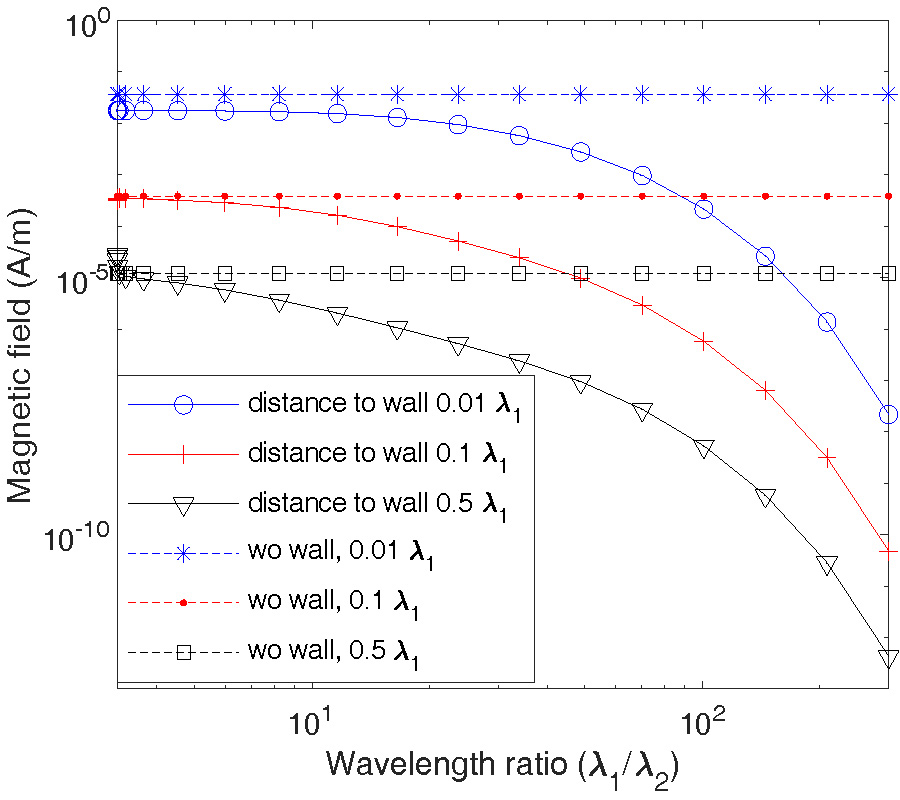
Shielding of a Perfectly Conducting Circular Disk: Exact and Static Analytical Solution
Giampiero Lovat , Paolo Burghignoli , Rodolfo Araneo , Salvatore Celozzi , Amedeo Andreotti , Dario Assante and Luigi Verolino
The problem of the shielding evaluation of an infinitesimally thin perfectly conducting circular disk against a vertical magnetic dipole is here addressed. The problem is reduced to a set of dual integral equations and solved in an exact form through the application of the Galerkin method in the Hankel transform domain. It is shown that a second-kind Fredholm infinite matrix-operator equation can be obtained by selecting a complete set of orthogonal eigenfunctions of the static part of the integral operator as expansion basis. A static solution is finally extracted in a closed form which is shown to be accurate up to remarkably high frequencies.
SHIELDING OF A PERFECTLY CONDUCTING CIRCULAR DISK: EXACT AND STATIC ANALYTICAL SOLUTION
2019-09-05
PIER Letters
Vol. 87, 51-57
Validation of Shielded Cable Modeling in Xyce Based on Transmission-Line Theory
Salvatore Campione , Aaron J. Pung , Larry Kevin Warne , William L. Langston , Ting Mei and Howard Gerald Hudson
Cables and electronic devices typically employ electromagnetic shields to prevent coupling from external radiation. The imperfect nature of these shields allows external electric and magnetic fields to induce unwanted currents and voltages on the inner conductor by penetrating into the interior regions of the cable. In this paper, we verify a circuit model tool using a previously proposed analytic model [1], by evaluating induced currents and voltages on the inner conductor of the shielded cable. Comparisons with experiments are also provided, aimed to validate the proposed circuit model. We foresee that this circuit model will enable coupling between electromagnetic and circuit simulations.
VALIDATION OF SHIELDED CABLE MODELING IN XYCE BASED ON TRANSMISSION-LINE THEORY
2019-09-05
PIER M
Vol. 85, 11-20
Research on Control of Permanent Magnet Synchronous Motor Based on Second-Order Sliding Mode
Yukun Sun , Qiang Cui and Ye Yuan
In this paper, a control strategy based on second-order sliding mode is proposed for a permanent magnet synchronous motor (PMSM) drive system applying direct torque control with space vector modulation (DTC-SVM). This control strategy combines the principles of super-twisting algorithms, direct torque control, and space vector modulation, designed to overcome some obvious shortcomings, such as the large ripple of flux linkage and torque in traditional DTC, the poor robustness of traditional PI controllers, and the chattering of traditional sliding mode control. It gives the system good steady state and dynamic performance. The results show that the proposed method effectively solves the above shortcomings. Meanwhile, the control strategy effectively accelerates the dynamic response ability of the system and improves the robustness to parameter perturbation.
RESEARCH ON CONTROL OF PERMANENT MAGNET SYNCHRONOUS MOTOR BASED ON SECOND-ORDER SLIDING MODE
2019-09-03
PIER C
Vol. 95, 153-166
Simulations of Ionospheric Behavior Driven by HF Radio Waves at the Initial Stage
Jing Chen , Qingliang Li , Yubo Yan , Haiqin Che , Guanglin Ma and Guang Yuan
This study explores the variability in the electric field, plasma number density, and plasma velocity driven by high-frequency (HF) radio wave injected into the vertically stratified ionosphere at a millisecond time scale after switch-on of the radio transmitter. It was found that the modeconversion process of electromagnetic (EM) waves took place at the reflection heights of both the R-X (right-circularly polarized extraordinary wave, R-X) and L-O (left-circularly polarized ordinary wave, L-O) modes. The ionospheric electron number density was remarkably oscillatory. A depletion of ionospheric ion number density at the L-O mode turning point and two ion number density peaks on each side of the O-mode reflection region were discovered. The turbulent layer of the ion density peak at the bottom of the critical height shifted downwards, which qualitatively conforms to the observations made at the Areciboand the EISCAT. The vertical electron velocity oscillated near the L-O mode reflection point. The vertical ion velocity remained positive above the reflection height of the L-O mode and remained negative below this height. These results, which were derived using realistic length scales, ion masses, pump waves, and other plasma parameters, are consistent with theoretical predictions and prior experimental observations, and should thus be useful for understanding the linear and nonlinear interactions between the HF EM wave and the ionospheric plasma at the initial stage.
SIMULATIONS OF IONOSPHERIC BEHAVIOR DRIVEN BY HF RADIO WAVES AT THE INITIAL STAGE
2019-09-03
PIER C
Vol. 95, 141-152
Electrically Small ACS-Fed Flipped MIMO Antenna for USB Portable Applications
Muhammad Idrees Magray , Gulur Sadananda Karthikeya , Khalid Muzaffar and Shiban Kishen Koul
An electrically small Asymmetric Co-planar Strip (ACS)-fed MIMO antenna for USB wireless applications is proposed. MIMO antenna consists of two electrically small antennas inserted inside a 3D-printed USB prototype. Electrically small ACS-fed antenna consists of an F-shaped monopole radiator with a U-shaped slot inserted into it. The proposed antenna is compact with dimensions 11 × 20 × 0.508 mm3. The proposed MIMO antenna has dual bands which caters to WiMAX-3.5/5.5 GHz, WLAN-5.8 GHz, and C-band-6.3 GHz. The proposed architecture attains reasonable gain for the available aperture. Also, ACS-fed antenna achieves fractional bandwidth of 22% and 20% in the lower and upper bands respectively complying with the theoretical bandwidth as defined by Chu's limit. Isolation between the radiators is greater than 15 dB in both the operating bands. Radiation patterns have high integrity, and actual USB deployment is presented. Simulation and measurement results are presented.
ELECTRICALLY SMALL ACS-FED FLIPPED MIMO ANTENNA FOR USB PORTABLE APPLICATIONS