Search Results(13790)

2018-09-25
PIER C
Vol. 87, 97-106
Reflective Metasurface for Vortex Wave Generating and Divergence Reducing in X-Band
Xiaohang Dong , Hengyi Sun , Chang Qing Gu , Zhuo Li , Xinlei Chen and Baijie Xu
In this paper, a novel and simple solution for generating vortex electromagnetic wave and reducing divergence simultaneously in a wideband is presented. Based on phase gradient metasurface, we design a metasurface that can convert an ordinary electromagnetic wave into a vortex one and focus the vortex wave in X-band. Double layer rectangular metal patch units of different sizes are arranged in a certain order to compose the metasurface. The phase introduced by the metasurface is superimposed by the vortex phase and focusing phase. Compared to a general vortex wave metasurface, the simulation results show that the divergence of the reflected vortex wave generated by our designed metasurface is dramatically reduced in the frequency range from 8 GHz to 12 GHz. It is indicated that the designed metasurface has a highly efficient focusing effect, and it is also in a good agreement with the theoretical analysis. The proposed reflective metasurface paves an effective way to reduce the divergence of vortex electromagnetic wave for OAM-based system in microwave and radio frequency.
REFLECTIVE METASURFACE FOR VORTEX WAVE GENERATING AND DIVERGENCE REDUCING IN X-BAND
2018-09-25
PIER B
Vol. 82, 31-48
Dielectric Slab Reflection/Transmission as a Self-Consistent Radiation Phenomenon
Jan Alexander Grzesik
We revisit the standard electromagnetic problem wherein wave propagation within a uniform, lossless dielectric is interrupted by a dissipative slab of finite thickness. While such a problem is easily solved on the basis of interface field continuity, we proceed to treat it here under the viewpoint of radiative self-consistency, with effective current sources resident only within the slab interior and gauged by ohmic/polarization parameter comparisons against those of the reference, exterior medium. Radiative self-consistency finds its natural expression as an integral equation over the slab interior field which, once solved, permits a direct, fully constructive buildup, both up and down, of the reflected/transmitted field contributions, without any need for ascertaining such quantities implicitly via the enforcement of boundary conditions. The persistent cadence of solution steps in such integral-equation problems asserts itself here, too, in the sense that it leads, first, to an exact cancellation, left and right, of that interior, unknown field, and second, that it brings in still other contributions of a reference medium variety, of which it is required that they, and only they, balance the incoming excitation. Balancing of this latter sort provides indeed the linear conditions for slab field determination. The two-step solution pattern thus described may be regarded as a manifestation at some remove of Ewald-Oseen extinction, even though the analytic framework now on view differs fundamentally from proofs elsewhere available. We go on to solve the several balancing equations by direct, vector manipulation avoiding all recourse to large, unwieldy determinants, and then offer a partial confirmation by exhibiting a canonical, boundary value counterpart in the special case of perpendicular incidence. Following all of this, in an appendix, we allow the receptor, downstream half space to differ from that wherein the excitation had been launched and which continues to serve as the reference medium. Effective currents are now found not only within the slab proper, but also throughout an entire half space, necessitating a suitable generalization of the underlying integral equation, and a provision, during its solution, of cross-talk, both up and down, between slab and the half space now contributing as a radiation source. We provide in this appendix a fairly accelerated presentation of these generalized features, but with all logical details nevertheless fully displayed in plain view. The integral equation radiative self-consistency method is, to our way of thinking, physically far more satisfying than the prevailing method of scattered fields guessed as to their structure and then fixed by boundary conditions. Its analytic themes, moreover, are far, far more elegant.
2018-09-25
PIER M
Vol. 73, 163-171
An Improved ESP Algorithm for Main Lobe Interference in SLF Communication
Ning Zhang , Yu-Zhong Jiang and Yang Liu
Because traditional eigen-subspace projection (ESP) methods cannot cancel the main lobe interference, an improved ESP algorithm and an orthogonal array of antenna are proposed to overcome this problem. Based on the orthogonal antenna array, the proposed algorithm combines ESP with ICA and signal blocking methods, which implements the extraction of part of the main lobe interference and optimized the estimation of the interference subspace. Both simulation and experiment results show that the improved ESP algorithm provides robust cancellation capability of main lobe and sidelobe interference for super low frequency (SLF) communication.
AN IMPROVED ESP ALGORITHM FOR MAIN LOBE INTERFERENCE IN SLF COMMUNICATION
2018-09-24
PIER
Vol. 163, 107-117
Subarray Design for C-Band Circularly-Polarized Synthetic Aperture Radar Antenna Onboard Airborne
Cahya Edi Santosa , Josaphat Tetuko Sri Sumantyo , Chua Ming Yam , Katia Urata , Koichi Ito and Steven Gao
This paper presents the design and realization of a 4 × 4 broadband circularly polarized microstrip antenna as subarray element for airborne C-band circularly polarized synthetic aperture radar (CP-SAR). The main objective of this work is to optimize impedance bandwidth, axial-ratio bandwidth, gain, and radiation pattern of a CP-SAR array antenna due to the limitation in the available space for a large array antenna installation on airborne platform. Various patch separations in uniformly 2 × 2 subarray configuration have been simulated to investigate characteristics of impedance bandwidth, axial-ratio bandwidth, gain, and radiation pattern. In order to broaden the impedance bandwidth, the proposed antenna is constructed by stacking two thick substrates with low dielectric constant and dissipation factor. The measured 10-dB impedance bandwidth is 0.91 GHz (17.2%), spanning from 4.83 GHz to 6.01 GHz. A simple square patch with curve corner-truncation is applied as the main radiating patch for circularly-polarized wave generation. The radiating patch is excited by single-fed proximity coupled strip-line feeding. The improvement of axial-ratio bandwidth in 2 × 2 and 4 × 4 subarray is employed by a feeding network with serial-sequential-rotation configuration. Experimental result shows the 3-dB axial-ratio bandwidth achieved 1.18 GHz (22.17%) from 4.8 GHz to 5.71 GHz. Other characteristic parameters such as gain and radiation pattern of the 4 × 4 subarray antenna are also presented and discussed.
SUBARRAY DESIGN FOR C-BAND CIRCULARLY-POLARIZED SYNTHETIC APERTURE RADAR ANTENNA ONBOARD AIRBORNE
2018-09-23
PIER Letters
Vol. 78, 135-139
A Miniature h-Shaped Patch Antenna Loaded with Mushroom Metamaterials
Yefang Wang , Xiaofei Xu and Xiao Deng
A miniature patch antenna for handset mobile communication is studied by loading an H-shaped patch associated with fashionable mushroom structures. The mushroom structures work as effective high index metamaterials while the H-shape can lengthen the current path on the patch. They both contribute to reduce the patch length. To verify the conceptual method, an H-shaped patch meta-antenna is demonstrated in full wave simulations and experiments. Good agreement has been observed. A compact patch is achieved for the antenna with a size of 0.15λ0×0.15λ0. The measured antenna gain is acceptably high as 4.2 dBi.
A MINIATURE H-SHAPED PATCH ANTENNA LOADED WITH MUSHROOM METAMATERIALS
2018-09-23
PIER Letters
Vol. 78, 129-134
HTS Multi-Mode Ring Resonator UWB Filter with Cross-Shaped Stepped-Impedance Stubs
Zhihe Long , Mingen Tian , Liguo Zhou , Shuangshuang Cao , Man Qiao and Tianliang Zhang
This paper presents an ultra-wideband (UWB) high temperature superconducting (HTS) bandpass filter (BPF) based on a ring resonator loaded with a pair of symmetrical cross-shaped stepped-impedance open stubs. The main advantages are that two transmission zeros are introduced to improve passband selectivity, and high mode suppression is achieved by adjusting the impedance ratio of the cross-shaped stubs and using a pair of parallel-coupled lines. The filter is designed on double-sided YBCO/MgO/YBCO HTS films with a thickness of 0.5 mm and dielectric constant of 9.8. At 77 K, the measured 3-dB bandwidth of the filter covers 1.63 GHz~6.03 GHz. Due to the use of superconducting material, the insertion loss at the center frequency of 3.83 GHz is 0.12 dB, and the rejection is greater than 36 dB in the lower stopband, and the upper stopband with 20 dB attenuation level is extended to at least 8.5 GHz.
HTS MULTI-MODE RING RESONATOR UWB FILTER WITH CROSS-SHAPED STEPPED-IMPEDANCE STUBS
2018-09-22
PIER C
Vol. 87, 87-96
Compact Dual Band-Notched UWB MIMO Antenna for USB Dongle Application with Pattern Diversity Characteristics
Deepika Sipal , Mahesh Pandurang Abegaonkar and Shiban Kishen Koul
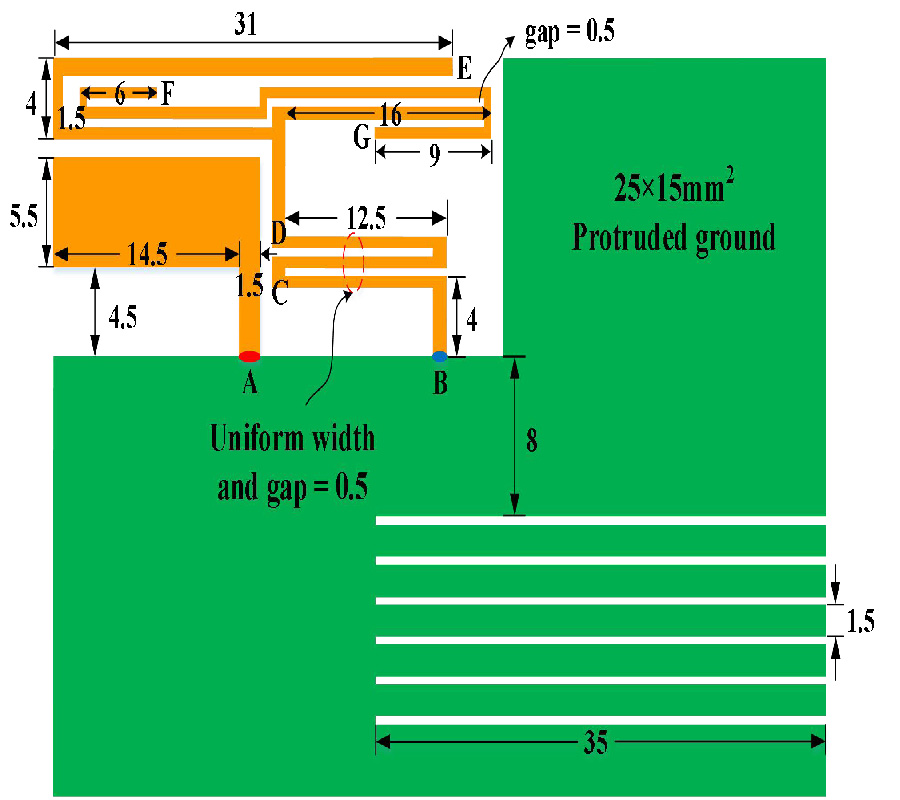
In this paper a compact planar dual band-notched ultra-wideband (UWB) multiple input multiple output (MIMO) antenna is presented for universal synchronous bus (USB) dongle application with pattern diversity characteristic. The MIMO configuration has orthogonally placed elements with overall size of 16×37.6 mm2, and the common ground plane of the MIMO antenna is further extended by 20 mm for its practical use. The measured and simulated reflection coefficients of the antenna show good impedance bandwidth matching over the range from 3 GHz to 12 GHz excluding the dual notched bands. Both elements show good band-reject property at the notched bands. The simulated results are verified through measurements and calculations. Moreover, absence of decoupling network makes circuit less complex and very compact. Radiation pattern of the MIMO antenna is almost omnidirectional. Furthermore, diversity performance of MIMO antenna is validated with its envelope correlation coefficient (ECC) and pattern diversity characteristic. These characteristics demonstrate its candidacy as a compact dual band-notched UWB MIMO antenna for USB dongle application.
COMPACT DUAL BAND-NOTCHED UWB MIMO ANTENNA FOR USB DONGLE APPLICATION WITH PATTERN DIVERSITY CHARACTERISTICS
2018-09-22
PIER C
Vol. 87, 73-85
A New Synthesis Algorithm for Minimization of Coplanar Distributed Antenna Arrays in WSNs
Heba Soliman Dawood , Amr H. Hussein , Entesar Gemeay and Mohmoud Ahmed Attia Ali
Distributed antenna arrays are arbitrarily large groups of neighboring nodes which are controlled to form virtual antenna arrays for both transmission and reception. Distributed beamforming (DBF) is widely used in wireless sensor networks (WSNs) and distributed massive Multi-Input Multi-Output (MIMO) systems. The research in DBF has been divided into four major research trends: radiation pattern analysis, optimization of power and lifetime, nodes synchronization, and array design. In this paper, a new algorithm is introduced to synthesize the radiation pattern of an arbitrarily distributed array using reduced number of distributed nodes. In this context, the reduction in the number of nodes results in minimizing the synchronization complexity between the synthesized array nodes and in minimizing the number of RF front ends. Thus, the overall system cost is reduced. In this algorithm, the three antenna array parameters (number of nodes, nodes locations, and nodes excitations) are properly adjusted to construct a close copy of the original array pattern. Different nodes selection ways are utilized to select the nodes required to synthesize the array for a desired radiation pattern. Also, uniform feeding and non-uniform feeding scenarios are introduced. In simulations, the proposed algorithm is applied to the synthesis of pencil-beam patterns. The simulation results reveal that the synthesized radiation patterns highly agree with the ordinary distributed array pattern in the case of non-uniform feeding. Also, the proposed algorithm can be applied to the synthesis of shaped-beam patterns via controlling the three aforementioned antenna array parameters and taking the shaped-beam pattern as the desired pattern in the algorithm.
A NEW SYNTHESIS ALGORITHM FOR MINIMIZATION OF COPLANAR DISTRIBUTED ANTENNA ARRAYS IN WSNS
2018-09-22
PIER M
Vol. 73, 153-162
Low Loss High Power Air Suspended Stripline Power Divider for High Power Division Sub-Systems Applications
Ahmed F. Elshafey and Mahmoud Abdalla
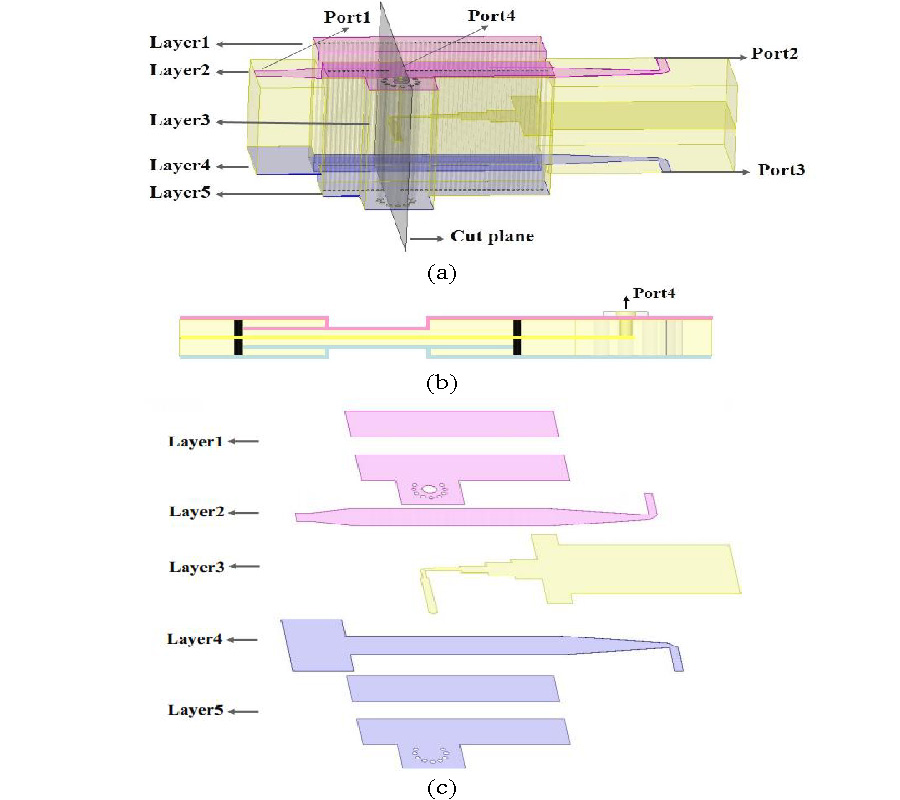
In this paper, a high power, air suspended stripline (SSL) T junction power divider at L band microwave frequencies is introduced. The power divider operating frequency is centered at 1.3 GHz. In this new configuration, the only dielectric used is air to have maximum power handling capability. An excitation transition from coaxial cable to the SSL transmission line is explained. The SSL was fabricated using alumi-num sheets to gain the advantage of low cost. The power divider design was validated using circuit and 3D full wave simulations and confirmed using experimental measurements with all agreements. It has been proved that the power divider attenuation has sharp rejection characteristic at the designed frequency (-20 dB at 1.3 GHz). The power divider can be used as a feeder for devices used in high power applications.
LOW LOSS HIGH POWER AIR SUSPENDED STRIPLINE POWER DIVIDER FOR HIGH POWER DIVISION SUB-SYSTEMS APPLICATIONS
2018-09-22
PIER M
Vol. 73, 141-151
New Formulas for Calculating Torque Between Filamentary Circular Coil and Thin Wall Solenoid with Inclined Axis Whose Axes Are at the Same Plane
Slobodan Babic and Cevdet Akyel
In this paper we present a novel approach for calculating the torque between two filamentary circular coils with inclined axes whose centers are at the same plane. In this approach we use Grover's formula for the mutual inductance between two filamentary circular coils with inclined axes whose centers are at the same plane. The filament method is applied to the combination comprising a filamentary circular coil and a thin wall solenoid. As the comparative method we give the new formula for this coil's combination which is derived from Chester Snow's formula for two solenoids with inclined axes.
NEW FORMULAS FOR CALCULATING TORQUE BETWEEN FILAMENTARY CIRCULAR COIL AND THIN WALL SOLENOID WITH INCLINED AXIS WHOSE AXES ARE AT THE SAME PLANE
2018-09-19
PIER B
Vol. 82, 17-30
Synthesis of Dolph-Chebyshev Like Patterns from Non-Uniform, Non-Linear and Randomized Arrays
Edmund K. Miller
A pattern-synthesis approach previously described by the author is used here to develop Dolph-Chebyshev-like patterns for some unconventional array geometries. The approach is briefly summarized and then demonstrated for various non-uniformly spaced arrays and nonlinear geometries. Geometries discussed include a V-shaped array, and x-aligned arrays having non-uniform element spacing as well as having elements located off the x-axis in the x-y plane. Arrays having randomly located elements are also exploted. The goal is to show that patterns having equipple sidelobes can be produced by a variety of array geometries.
SYNTHESIS OF DOLPH-CHEBYSHEV LIKE PATTERNS FROM NON-UNIFORM, NON-LINEAR AND RANDOMIZED ARRAYS
2018-09-19
PIER Letters
Vol. 79, 1-7
A Cavity-Backed Wideband Circularly Polarized Crossed Bowtie Dipole Antenna with Sequentially Rotated Parasitic Elements
Yapeng Li , Zhipeng Zhao , Jinhai Liu and Ying-Zeng Yin
A cavity-backed crossed bowtie dipole antenna for wideband circularly polarization (CP) is proposed in this letter. By introducing four inverted L-shaped parasitic elements with sequentially rotated angles, two extra CP modes areexcited, thus greatly broadening the 3-dB Axial-ratio (AR) bandwidth (BW) of the antenna. The proposed antenna is simulated, fabricated and measured. Results show that the antenna generates a 10-dB impedance bandwidth (IBW) of 91.4% (1.2-3.22 GHz) and a 3-dB AR bandwidth of 74.1% (1.37-2.95 GHz). In addition, the antenna achieves a unidirectional radiation pattern with a stable gain of 6.52-9.27 dBi over the whole CP operating band.
A CAVITY-BACKED WIDEBAND CIRCULARLY POLARIZED CROSSED BOWTIE DIPOLE ANTENNA WITH SEQUENTIALLY ROTATED PARASITIC ELEMENTS
2018-09-19
PIER Letters
Vol. 78, 119-127
Miniaturized UWB Stepped Open-Slot Antenna
Junho Yeo
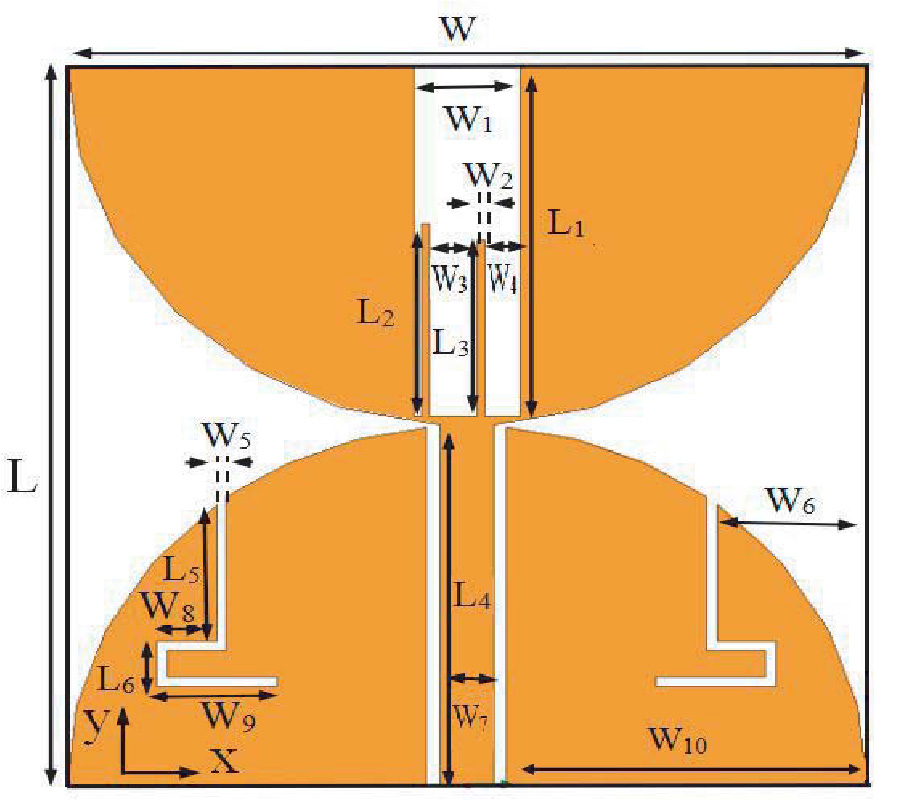
In this paper, a method to miniaturize a stepped open-slot antenna (SOSA) for ultra-wideband (UWB) applications is proposed. The antenna consists of a stepped open slot, J-shaped slots, and two strip directors. A broadband microstrip-to-slotline transition with circular stubs is applied to feed the antenna. J-shaped slots are inserted on the ground plane of the antenna to create a new resonance in the low-frequency region, thereby miniaturizing the size of the antenna. Finally, two strip directors are appended above the stepped open slot in order to increase the gain in the middle- and high-frequency regions, as well as to enhance input impedance matching in the high-frequency region. A prototype of the miniaturized SOSA is fabricated on an FR4 substrate with dimensions of 30 mm×32 mm. It shows a measured frequency band of 2.99-10.87 GHz for a voltage standing wave ratio < 2, which ensures UWB operation, and the measured gain range is 3.2-7.3 dBi in the band with a front-to-back ratio > 8.7 dB.
MINIATURIZED UWB STEPPED OPEN-SLOT ANTENNA
2018-09-19
PIER Letters
Vol. 78, 111-117
A New Compact Microstrip UWB Power Divider with Triple Notched Bands
Hai Zhang and Junding Zhao
In this paper, a novel compact ultra-wideband (UWB) power divider with triple-notched bands is investigated. Firstly, the initial UWB power divider is studied using a couple of square ring quad-mode resonators. Then, by embedding a pair of coupled triple-mode stepped impedance resonators (TMSIRs) into the initial UWB power divider, three desired notched bands are achieved. The central frequencies of the notched bands can be easily controlled by the electrical length of the TMSIRs. To validate the design theory, a novel compact UWB power divider with triple notched bands centered at frequencies of 3.7 GHz, 5.2 GHz and 7.8 GHz is designed and measured. The simulated and measured results indicate that it has a low insertion loss and good return loss performance at all the three ports and a high isolation between the two output ports across the UWB bandwidth from 3.1 to 10.6 GHz.
A NEW COMPACT MICROSTRIP UWB POWER DIVIDER WITH TRIPLE NOTCHED BANDS
2018-09-19
PIER M
Vol. 73, 119-129
A New Adaptive Tracking Algorithm for Near-Space Hypersonic Target
Xiangke Guo , Changyun Liu , Qiang Fu and Gang Wang
Because of the maneuvering of hypersonic target, the tracking of near space hypersonic target is difficult. In this paper, a new adaptive tracking algorithm based on aerodynamic model and improved square root cubature kalman filter is proposed. The adaptive piecewise constant Jerk model, gives the acceleration recursive process based on the dynamic model. Considering the non-linear characteristic of the target state model and the observation model, the improved square-root cubature kalman filter is applied to estimate target state. The simulation results under different maneuvers conditions indicate that the proposed method has higher accuracy than original aerodynamic model. The research provides a feasible solution to the further improvement of the real time tracking accuracy of near space hypersonic target.
A NEW ADAPTIVE TRACKING ALGORITHM FOR NEAR-SPACE HYPERSONIC TARGET
2018-09-18
PIER C
Vol. 87, 63-71
A Frequency Reconfigurable U-Shaped Antenna for Dual-Band WiMAX/WLAN Systems
Youcef Braham Chaouche , Farid Bouttout , Mourad Nedil , Idris Messaoudene and Ismail Ben Mabrouk
A novel frequency reconfigurable antenna is proposed for WiMAX and WLAN applications. It has a simple structure and compact size of 0.44λg×0.37λg. The proposed approach is based on combining of double planar U-shaped antenna. Furthermore, to achieve a reconfigurable function, a PIN diode switch is introduced across the slot between the two U-shaped patches. By controlling the PIN diode, the antenna resonates at two modes of single and dual band (WiMAX 3.2/3.5 GHz, and WLAN 5.2/5.8 GHz). The obtained gain ranges from 2.3 to 3.9 dBi within the whole operating bands. The simple configuration and low profile nature of the proposed antenna is suitable for Wireless communication systems.
A FREQUENCY RECONFIGURABLE U-SHAPED ANTENNA FOR DUAL-BAND WIMAX/WLAN SYSTEMS
2018-09-18
PIER M
Vol. 73, 111-118
Compact Triple-Band Metamaterial Inspired Bandpass Filter with Controllable Transmission Zero Position
Dilip Kumar Choudhary and Raghvendra Kumar Chaudhary
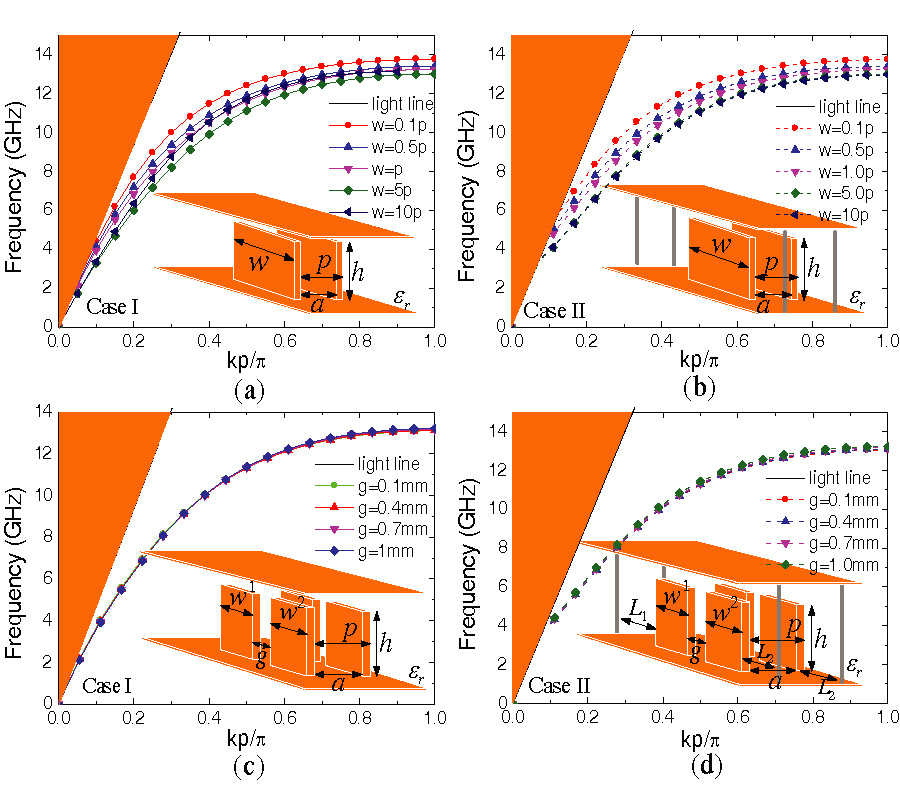
In this paper, a compact triple-band bandpass filter using metamaterial (MTM) inspired structure with controllable transmission zero (TZ) position has been proposed. The gap between feed lines develops electrical coupling and provides series capacitance. An open loop rectangular ring resonator with meander line and rectangular stub develops electric and magnetic couplings separately. Defected ground structure (DGS) provides proper impedance matching and increases the passband. In order to validate metamaterial (MTM) behaviour of designed filter dispersion diagram has been plotted. The position of transmission zero can be controlled by electric and magnetic coupling. The measured operating frequency ranges of three passbands are 1.85-2.15 GHz, 3.55-3.73 GHz and 3.85-4.0 GHz with the 3 dB fractional bandwidth of 15.63, 4.94 and 3.82 percent, respectively. It has minimum insertion loss of 0.7 dB, 0.5 dB and 0.5 dB at the 1st, 2nd, and 3rd passbands, respectively. The electrical size of the proposed filter is 0.16λg×0.15λg, where λg is the guided wavelength at zeroth order resonance (ZOR) frequency of 1.92 GHz.
COMPACT TRIPLE-BAND METAMATERIAL INSPIRED BANDPASS FILTER WITH CONTROLLABLE TRANSMISSION ZERO POSITION
2018-09-17
PIER C
Vol. 87, 51-62
Investigating the Performance of a Fully Laminated Flux-Focusing Magnetic Gearbox
Kang Li , Krishna Kiran Uppalapati , Jason Wright , Joshua Kadel , Jonathan Bird and Wesley Willimas
This paper presents the design investigation and experimental testing of a flux-focusing magnetic gearbox with a fully laminated rotor structure. The unique feature of this flux-focusing magnetic gearbox design is that the three rotors are each made of a single lamination stack, and the central modulation structure is retained in place without the use of a resin filler such as epoxy. Ferromagnetic bridges are used to connect individual pole pieces together. It is shown that the use of the ferromagnetic bridges reduces the calculated torque density from 156 Nm/L to 139 Nm/L (a reduction of 11%). The experimentally measured torque density is, however, only 97 Nm/L. The reason for this discrepancy is associated with the demagnetization of the magnets.
INVESTIGATING THE PERFORMANCE OF A FULLY LAMINATED FLUX-FOCUSING MAGNETIC GEARBOX
2018-09-17
PIER Letters
Vol. 78, 105-110
A Phase Diversity Printed-Dipole Antenna Element for Patterns Selectivity Array Application
Fu-Kun Sun , Fu-Shun Zhang and Chao-Qiang Feng
A phase diversity printed-dipole antenna element for patterns selectivity array application is designed in this paper. The antenna element consists of a printed dipole structure and two varactors. By changing the control voltage of each element, various radiation phases in the far field of each element is realized, that is, the peak gain direction of the array is changed. With this method, the structure designed is simple, and only two varactors are loaded. To verify the feasibility, an antenna prototype is experimentally characterized, which validates the proposed concept. The impedance bandwidth of array is 22.2% (3.2~4.0 GHz), in which the peak gain direction can be scanned during angles from -θ to +θ across broadside (θ = 13°~18° at different frequencies). It can be applied to phased antenna system.
A PHASE DIVERSITY PRINTED-DIPOLE ANTENNA ELEMENT FOR PATTERNS SELECTIVITY ARRAY APPLICATION
2018-09-17
PIER M
Vol. 73, 101-109
Propagation Losses of UWB Antenna for on-Body to in-Body Signal Propagation
Anumuthu Priya , Sulthan Kaja Mohideen and Packirisamy Thirumaraiselvan
To provide better care to the people, who are living in rural areas and whoever in need of emergency medical care, it becomes essential to develop remote monitoring health care applications. Body Area Networks (BAN) that are formed with wearable or implanted wireless sensor devices will play an important role to achieve the above task. Since the communication in BAN is of short communication distance and higher data rate, the Ultra-Wideband (UWB) radio signals make themselves as the right candidates due to their inherent characteristics. This requires more research in design and development of UWB transceivers, especially for implantable biomedical devices. This paper proposes a UWB antenna design and a numerical channel model to predetermine the path loss characteristics of an on-body to in-body channel in UWB. The proposed model has been developed using ray tracing procedures and includes the antenna polarization and radiation pattern. In addition, the predicted results have been validated by measurements conducted with honey based liquid phantoms.
PROPAGATION LOSSES OF UWB ANTENNA FOR ON-BODY TO IN-BODY SIGNAL PROPAGATION