Search Results(13790)

2018-09-16
PIER
Vol. 163, 89-106
Coarse-to-Fine Accurate Registration for Airborne SAR Images Using SAR-Fast and DSP-LATCH
Huai Yu , Wen Yang and Yan Liu
Synthetic Aperture Radar (SAR) image registration is to establish reliable correspondences among the images of the same scene. It is a challenging problem to register the airborne SAR images for the instability of airborne SAR systems and the lack of appropriate geo-reference data. Besides, techniques for registering satellite-based SAR images relying on rigorous SAR geocoding cannot be directly applied to airborne SAR images. To address this problem, we present a coarse-to-fine registration method for airborne SAR images by combining SAR-FAST (Features from Accelerated Segment Test) feature detector and DSP-LATCH (Domain-Size Pooling of Learned Arrangements of Three patCH) feature descriptor, which only relies on the gray level intensity of SAR data. More precisely, we first apply SAR-FAST, which is an adapted version of FAST for analyzing SAR images, to detect corners with high accuracy and low computational complexity. To reduce the disturbance of speckle noise as well as to achieve efficient and discriminative feature description, we further propose an improved descriptor named DSP-LATCH to describe the features, which combines the Domain-size Pooling scheme of DSP-SIFT (Scale-Invariant Feature Transform) and the idea of comparing triplets of patches rather than individual pixel values of LATCH. Finally, we conduct a coarse-to-fine strategy for SAR image registration by employing binary feature matching and the Powell algorithm. Compared with the existing feature based SAR image registration methods, e.g., SIFT and its variants, our method yields more reliable matched feature points and achieves higher registration accuracy. The experimental results on different scenes of airborne SAR images demonstrate the superiority of the proposed method in terms of robustness and accuracy.
COARSE-TO-FINE ACCURATE REGISTRATION FOR AIRBORNE SAR IMAGES USING SAR-FAST AND DSP-LATCH
2018-09-15
PIER C
Vol. 87, 39-49
Compact Flat Dipole Rectenna for IoT Applications
Abderrahim Okba , Alexandru Takacs and Herve Aubert
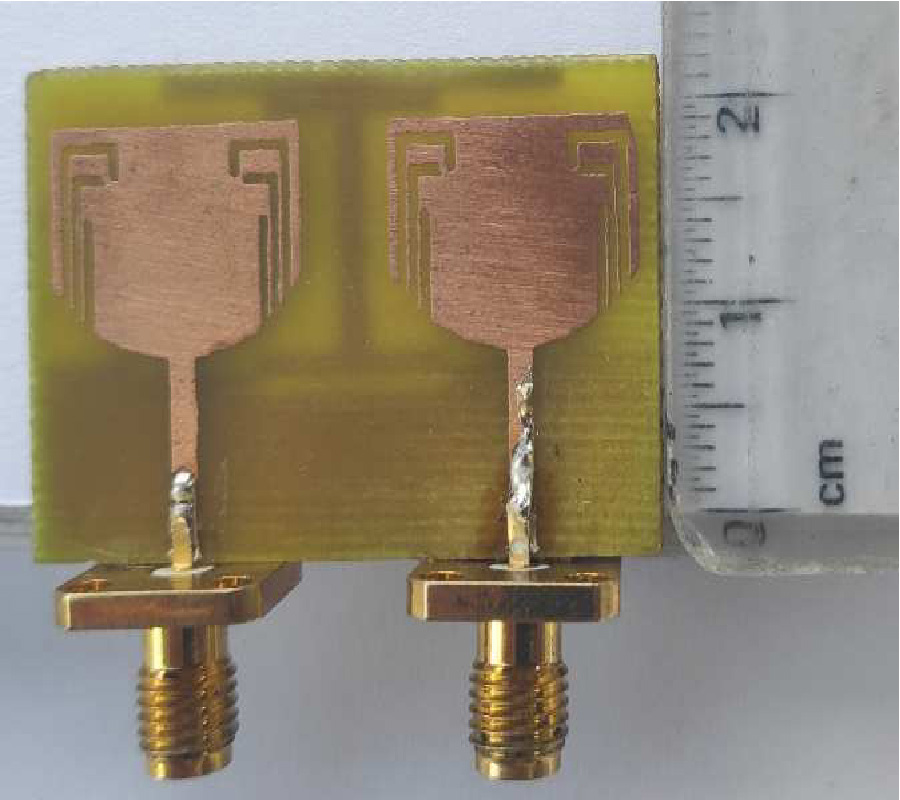
A new compact topology of rectenna, which combines a miniaturized wideband printed antenna and a rectifier integrated on the radiating surface, is reported in this paper. The rectenna is designed for ISM 900 MHz band and applied to wireless power transmission and energy harvesting to supply Ultra-Wideband tags for 3D indoor localization. The rectenna allows activating a DC-DC boost converter that supplies power to the tags. It exhibits a minimum conversion efficiency of 25% for very low microwave power densities (>0.18 μW/cm2) on the non-optimal loading impedance (of about 10 kΩ) of a commercial DC-to-DC boost converter and power management unit. The harvested DC voltage obtained from this novel rectenna exceeds 330 mV for microwave power density of 0.22 μW/cm2. This measured DC voltage is in the range of the cold turn-on/start-up voltage of nowadays commercial off-the-shelf DC-to-DC boost converters and power management units. The proposed rectenna is also very compact, as its surface (10.5x6 cm2) is of 0.05λ2 at the operating frequency (860 MHz).
COMPACT FLAT DIPOLE RECTENNA FOR IOT APPLICATIONS
2018-09-13
PIER M
Vol. 73, 91-100
Design of a New Broad Stop Band (BSB) Lowpass Filter Using Compensated Capacitor and П-h-П DGS Resonator for Radar Applications
Ahmed Boutejdar , Mouloud Challal and Soumia El Hani
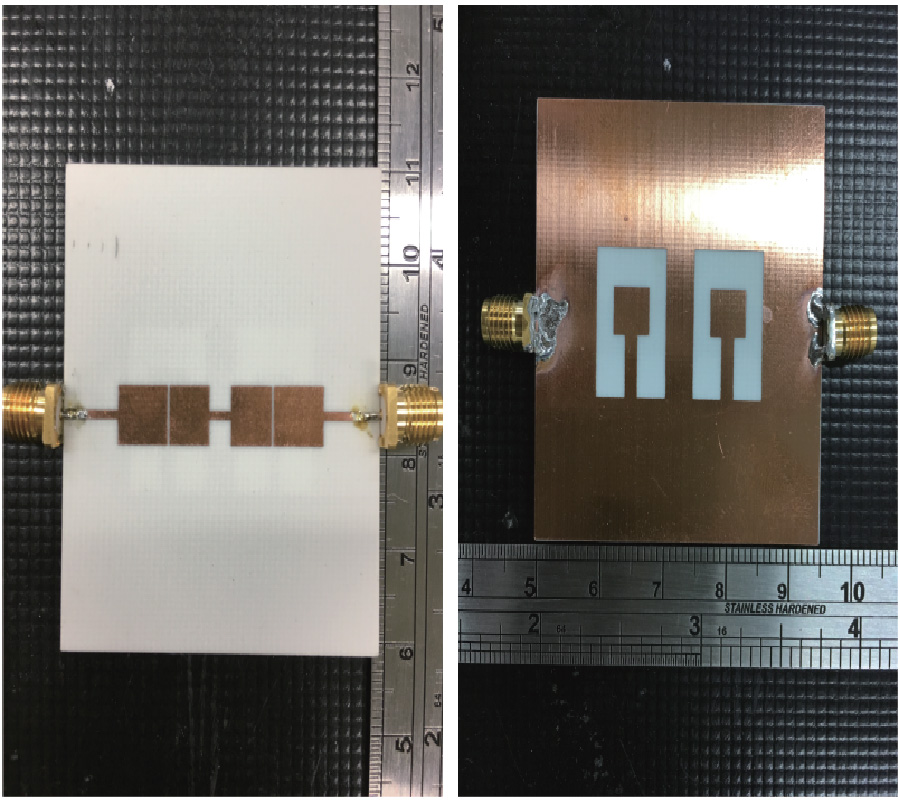
In this paper we present a new compact microstrip lowpass filter using a П-H-П-DGS resonator etched in the ground plane and two patches compensated capacitors placed on the top layer. Two DGS shapes are electromagnetically coupled. The proposed lowpass filter has shown improvement by adding a square microstrip to the single DGS resonator. The design procedure is validated using the commercial full-wave EM MoM simulator Microwave Office. Simulated as well as measured results exhibit sharp roll-off (ξ) of 34 dB/GHz and create a transmission zero at around 4 GHz with attenuation level -34 dB near the passband. On the other hand, the proposed LPF has shown wide stopband bandwidth with rejection better than -20 dB from 3.5 GHz up to 11.5 GHz, while the size of the whole structure is smaller (20 mm x 20 mm). Finally, the proposed filter structure was fabricated and measured. The measurements are in a good agreement with the simulated results.
DESIGN OF A NEW BROAD STOP BAND (BSB) LOWPASS FILTER USING COMPENSATED CAPACITOR AND П-H-П DGS RESONATOR FOR RADAR APPLICATIONS
2018-09-13
PIER M
Vol. 73, 81-90
Salient Pole Synchronous Generator Optimization by Combined Application of Slot Skew and Damper Winding Pitch Methods
Ante Elez , Marijan Petrinic , Miroslav Petrinic , Babak Vaseghi and Alireza Abasian
Slot skew is applied as a method to increase the armature winding voltage waveform quality of synchronous hydro generators. Skew that matches the region of one slot pitch can effectively damp stator slot harmonics. However, achieving this condition can be difficult I some manufacturing cases, especially for the machines with greater axial length. That is why other methods are commonly used to increase the voltage waveform quality of large hydro generators. One such method is based on the damper winding slot pitch choice which ensures reduction of stator slot harmonics from the main magnetic field. Appropriate placement of damper bars over the pole shoe does not represent a significant technological problem and is much simpler to manufacture in compare with the slot skew or the fractional armature winding methods. The downside of damper slot pitch adjustment method is the damper bar currents incensement in steady state condition of the generator, which increases damper winding losses and also the rotor temperature. In order to decrease damper winding current for long term operating and enable the generator pole shoe design with smaller cross section damper bars, a combination of damper slot pitch and partial slot skew can be utilized. This paper gives insight on consequences that can occur for voltage waveform if slot skew does not not fully match the stator slot pitch and the advantages of above mentioned combined method for the design optimization of salient pole synchronous generator.
SALIENT POLE SYNCHRONOUS GENERATOR OPTIMIZATION BY COMBINED APPLICATION OF SLOT SKEW AND DAMPER WINDING PITCH METHODS
2018-09-12
PIER
Vol. 163, 79-87
Design of Two Ku-Band Orthomode Transducers for Radio Astronomy Applications
Renzo Nesti , Elia Orsi , Giuseppe Pelosi and Stefano Selleri
Two different designs of orthomode transducers for the coming Ku-band receiver of the Italian radio telescope in Medicina are presented and compared, showing design details, describing numerical simulations and discussing manufacturing and test results. Such orthomode transducers provide a tradeoff between low-loss and phase-matching, according to different initial requirements where the final receiver architecture has to be frozen. Both designs show high performance over the operative 13.5-18.1 GHz Ku-band. One of the OMT designs has been fabricated and tested, showing results in very good agreement with simulations.
DESIGN OF TWO KU-BAND ORTHOMODE TRANSDUCERS FOR RADIO ASTRONOMY APPLICATIONS
2018-09-11
PIER C
Vol. 87, 25-38
Channel Estimation Method for Subarray Based Hybrid Beamforming Systems Employing Sparse Arrays
Joerg Eisenbeis , Tobias Mahler , Pablo Ramos Lopez and Thomas Zwick
Hybrid beamforming systems are a cost and energy efficient architectural approach for large-scale antenna arrays operating at millimetre-wave frequencies. The separation of the beamforming process into an analogue beamforming network and a digital precoding part enables the reduction of digital channels, while preserving a precise beam steering capability. Especially subarray-based hybrid beamforming systems distinguish them due to a low complex analogue beamforming network. However, to determine the ideal analogue and digital precoding matrices the channel state information has to be estimated. This estimation process is hampered by the electrical interconnection of different antenna elements within the analogue beamforming network. Hence, a separation of the antenna elements of the subarrays in the digital domain is not possible. Furthermore, actual channel estimation methods for hybrid beamforming systems are based on beam training techniques, which suffer from long estimation times. To overcome these problems we developed a two-stage channel estimation method for subarraybased hybrid beamforming systems using sparse array estimations. In the first stage, only one antenna element of each subarray at the transmitter is active during the channel estimation, resulting in a sparse array estimation. To distinguish the transmitters at the receiver side the transmitters are separated in the frequency domain using different orthogonal frequency division multiplexing subcarriers. For recovering the full-dimensional channel matrix we present two algorithms. The first algorithm is based on a two-dimensional interpolation of the channel matrix, while the second algorithm uses multiple subsequent channel measurements. The presented estimation method enables thereby a direct determination of the channel matrix with only one or a few measurements.
CHANNEL ESTIMATION METHOD FOR SUBARRAY BASED HYBRID BEAMFORMING SYSTEMS EMPLOYING SPARSE ARRAYS
2018-09-09
PIER C
Vol. 87, 13-23
An Ultrathin Five-Band Polarization Insensitive Metamaterial Absorber Having Hexagonal Array of 2D-Bravais-Lattice
Prakash Ranjan , Arvind Choubey , Santosh Kumar Mahto and Rashmi Sinha
In this paper, a novel ultrathin five-band polarization insensitive Metamaterial Absorber (MA) is proposed. The proposed structure consists of a periodic array of six arrows with two concentric hexagonal rings, having novel hexagonal 2D-bravais lattices on a grounded FR-4 dielectric substrate (εr = 4.25, loss-tangent tanδ = 0.02). The simulated result shows five discrete absorption peaks. The near unity absorption occurs at 2.7, 6.9, 7.3, 13.6 and 16.9 GHz with peak absorptivity of 88.99, 94.45, 87.58, 93.06 and 90.42% respectively. The proposed absorber is ultrathin with thickness of 0.056λ0 corresponding to the highest frequency of absorption. In order to analyze the absorption mechanism of the structure electromagnetic parameters such as effective permittivity (εeff) and effective permeability μeff) are retrieved and plotted. Wave absorption phenomena are explained by comparative tabulation of real and imaginary parts of electromagnetic parameters. Absorption is further explained by the characteristics impedance and surface current distribution. The structure, being a six-fold symmetric, has been found to be polarization-insensitive under normal incidence. For the oblique incidence of waves, it also achieves high values of absorption for both TE and TM polarizations. The proposed absorber is fabricated, and scattering parameters are measured. Simulated and measured results are in close agreement. Performance of the proposed MA is further investigated by calculating Fractional Bandwidth (FBW). This absorber can find its applications in phase imaging, photo-detector, hyper-spectral imaging, micro-bolometer, spectroscopic detection, surveillance radar and other defence applications.
AN ULTRATHIN FIVE-BAND POLARIZATION INSENSITIVE METAMATERIAL ABSORBER HAVING HEXAGONAL ARRAY OF 2D-BRAVAIS-LATTICE
2018-09-09
PIER B
Vol. 82, 1-16
Wedge Diffraction as an Instance of Radiative Shielding
Jan Alexander Grzesik
The celebrated Sommerfeld wedge diffraction solution is reexamined from a null interior field perspective. Exact surface currents provided by that solution, when considered as disembodied half-plane laminae radiating into an ambient, uniform space both inside and outside the wedge proper, do succeed in reconstituting both a specular, mirror field above the exposed face, and a shielding plane-wave field of a sign opposite to that of the incoming excitation which, under superposition, creates both the classical, geometric-optics shadow, and a strictly null interior field at the dominant, plane-wave level. Both mirror and shadow radiated fields are controlled by the residue at just one simple pole encountered during a spectral radiative field assembly, fixed in place by incidence direction φ0 as measured from the exposed face. The radiated fields further provide diffractive contributions drawn from two saddle points that track observation angle φ: Even these, more or less asymptotic contributions, are found to cancel exactly within the wedge interior, while, on the outside, they recover in its every detail the canonical structure lying at the base of GTD (geometric theory of diffraction). It is earnestly hoped that this revised scattering viewpoint, while leaving intact all details of the existing solution, will impart to it a fresh, physically robust meaning. Moreover, inasmuch as this viewpoint confirms, admittedly in an extreme limit, the concept of field self-consistency (known in rather more picturesque language as Ewald-Oseen extinction), perhaps such explicit vindication may yet encourage efforts to seek exact solutions to scattering/diffraction by electromagnetically permeable (i.e., dielectric) wedges, efforts that harness integral equations with polarization/ohmic currents distributed throughout wedge volumes as sources radiating into an ambient, uniform reference medium.
WEDGE DIFFRACTION AS AN INSTANCE OF RADIATIVE SHIELDING
2018-09-08
PIER C
Vol. 87, 1-11
Diffraction Radiation Oscillator with Frequency Tuning on Mutual Coupled Modes in an Open Resonant System
Ievgen O. Kovalov , Vladimir Miroshnichenko and Yelena B. Senkevich
The results of experimental research and development of the diffraction radiation oscillator with a periodic structure in form of a reflective double comb and with frequency tuning on mutual coupled modes in its open resonant system were presented. As an operating mode we chose the mutual coupled modes TEM002 → TEM101, which arise in the open resonant system with the shift between mirrors symmetry planes. To analyse its features, a rigorous electrodynamical 2-D model of the open resonant system was used, and the optimal shift width was established. As a result, the operation on the mutual coupled modes allowed to extend the frequency tuning range without failures in output power and to exclude the influence of higher-order modes (TEM20q, TEM30q etc.) on the output characteristics of the oscillator. The research has been carried out in Ka band.
DIFFRACTION RADIATION OSCILLATOR WITH FREQUENCY TUNING ON MUTUAL COUPLED MODES IN AN OPEN RESONANT SYSTEM
2018-09-08
PIER C
Vol. 86, 257-267
A Broadband Negative Epsilon Fractal Metamaterial Unit Cell for Coaxial Notch Filter Applications
Kathryn Smith and Ryan S. Adams
Herein is presented a two-dimensional negative permittivity unit cell for coaxial notch filter applications. This novel unit cell is developed through simulation in the context of an ideal infinite parallel plate waveguide, and preliminary implementation is demonstrated through simulation and measurement in a finite parallel plate waveguide. Finally, the unit cells are incorporated as an in-line notch filter in a coaxial transmission line, and their efficacy is demonstrated through simulation and measurement. The unit cell developed for this application was formed as a broadband fractal expansion of the traditional capacitively loaded strip. A partial repetition of the basic CLS I-shape was inserted in the capacitive gap on either side of the structure. This new unit cell was developed and simulated in HFSS using an incident TEM wave excitation in a parallel plate waveguide, and was shown to have two resonant frequencies of interest. The first resonance produces a wide bandwidth of negative permittivity (29.5%) from 1.3 GHz to 1.75 GHz; the second produces a region of negative permeability from 2.05 GHz to 2.45 GHz, a bandwidth of 17.8%. The current on the structure at each of these frequencies is presented, along with the pertinent fields in the waveguide. The effects of various alterations to the basic shape of the unit cell are also presented.
A BROADBAND NEGATIVE EPSILON FRACTAL METAMATERIAL UNIT CELL FOR COAXIAL NOTCH FILTER APPLICATIONS
2018-09-08
PIER Letters
Vol. 78, 97-104
Compact Triband Dual F-Shaped Antenna for DCS/WiMAX/WLAN Applications
Chandramma Viswambharan Anil Kumar , Binu Paul and Pezholil Mohanan
A novel and compact triband planar antenna geometry suitable for DCS/WLAN/WiMAX services is reported. The multiple metal strip geometry in dual F shape is printed on a substrate of dielectric permittivity 4.4 and thickness 1.6 mm. A truncated and asymmetrically placed ground structure is used for improved impedance matching. Feed position is also optimized for good antenna radiation performance. The geometry is simulated using High Frequency Structure Simulator. All the radiation characteristics of the antenna are validated experimentally and found in good agreement with simulation results. Performance of the proposed antenna is compared with other triband antennas reported in the literature. Measured radiation patterns and gain are also presented in this paper. The radiation patterns are validated by EMSCAN Corporation's RFxpertTM application tool also.
COMPACT TRIBAND DUAL F-SHAPED ANTENNA FOR DCS/WIMAX/WLAN APPLICATIONS
2018-09-07
PIER Letters
Vol. 78, 89-95
Self Complementary Frequency Independent Triple Band Sinuous Antenna Array for Wireless Applications
Ganesan Indumathi , Kaliyappan Kavitha and Paulkani Iyampalam
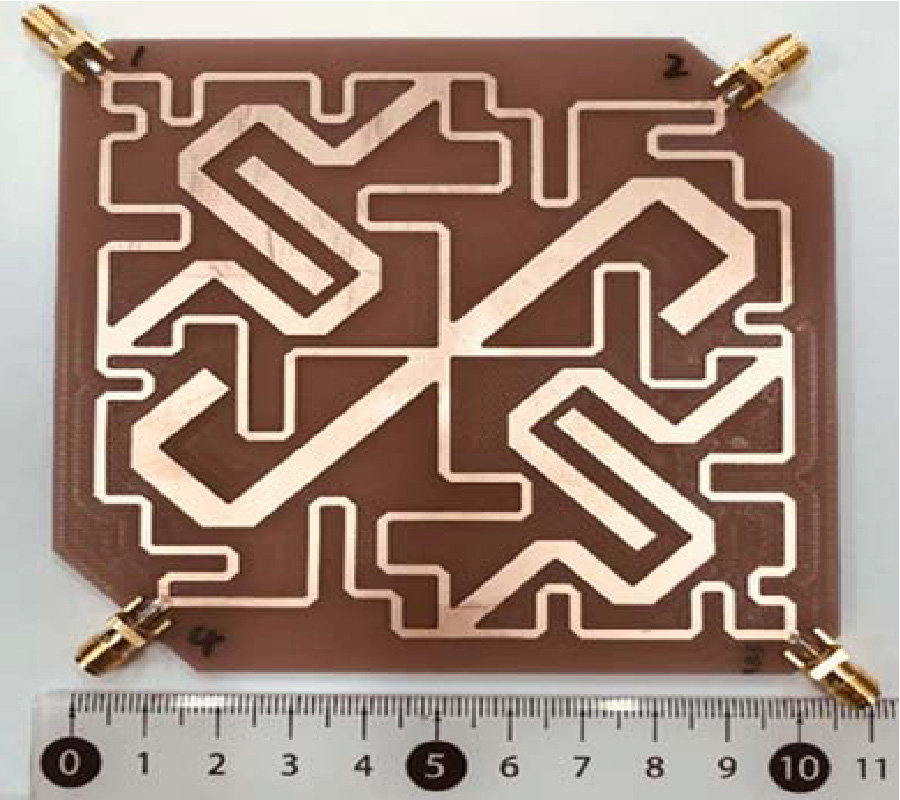
In this article, a self complementary frequency independent triple band Sinuous Antenna Array (SAA) is designed for wireless applications such as Mobile- Satellite Service (MSS), Global Positioning System (GPS) and Global System for Mobile communications (GSM) application. Four Sinuous elements are connected to the nearest one in such a way to form an array structure. A prototype of a Sinuous Antenna Array (SAA) is embedded into a flame retardant-4 (FR-4) dielectric material. The performance of the proposed antenna array has been analyzed by using Ansys High Frequency Structure Simulator (HFSS). The suggested antenna is fabricated and tested. The measured results are shown that the proposed antenna array operated at the frequencies of 1.5 GHz for GPS, 1.8 GHz for GSM and 2 GHz for MSS with a reflection coefficient of below -10 dB. It has good reflection coefficient characteristics, Voltage Standing Wave Ratio, impedance bandwidth and radiation characteristics.
SELF COMPLEMENTARY FREQUENCY INDEPENDENT TRIPLE BAND SINUOUS ANTENNA ARRAY FOR WIRELESS APPLICATIONS
2018-09-07
PIER Letters
Vol. 78, 81-88
Fast Root-MUSIC Algorithm Based on Nystrom Method and Spectral Factorization
Xiaoyu Liu , Junli Chen and Lveqiu Xu
A fast Root-MUSIC algorithm based on Nystrom method and spectral factorization is proposed. By using Nystrom method, only two sub-matrices of the sample covariance matrix are calculated, which avoids its complete calculation and has the advantage of low computational complexity. At the same time, the polynomial coefficients of the Root-MUSIC based on the Nystrom method are conjugated, and the order of the polynomial is reduced by half when using iterative operations. Finally, the root algorithm is used to estimate the DOA. The performance of the proposed algorithm is demonstrated by simulation results.
FAST ROOT-MUSIC ALGORITHM BASED ON NYSTROM METHOD AND SPECTRAL FACTORIZATION
2018-09-07
PIER M
Vol. 73, 71-79
Electromagnetic Wave Reflectance, Transmittance, and Absorption in a Graphene-Covered Uniaxial Crystal Slab
Muhammad Azam , Irfan Toqeer , Abdul Ghaffar , Muhammad Yasin Naz , Majeed Alkanhal and Yasin Khan
A theoretical investigation of the interaction of electromagnetic plane waves with a uniaxial crystal slab, bounded by two graphene layers from both sides, placed in free space is presented in this paper. An 8×8 matrix method is developed using boundary conditions at a graphene-uniaxial anisotropic crystal interface and a uniaxial anisotropic crystal-graphene interface. The developed matrix is used to find reflection and transmission coefficients by Crammer's rule. Numerical results are presented to demonstrate the effect of frequency of the incident wave, thickness of the uniaxial crystal slab, and Fermi energy of the graphene on the reflected and transmitted energies. The presented formulations and results are confirmed by published results of some limited cases.
ELECTROMAGNETIC WAVE REFLECTANCE, TRANSMITTANCE, AND ABSORPTION IN A GRAPHENE-COVERED UNIAXIAL CRYSTAL SLAB
2018-09-07
PIER
Vol. 163, 51-77
Broadband Point Source Green's Function in a One-Dimensional Infinite Periodic Lossless Medium Based on BBGFL with Modal Method
Leung Tsang , Kung-Hau Ding and Shurun Tan
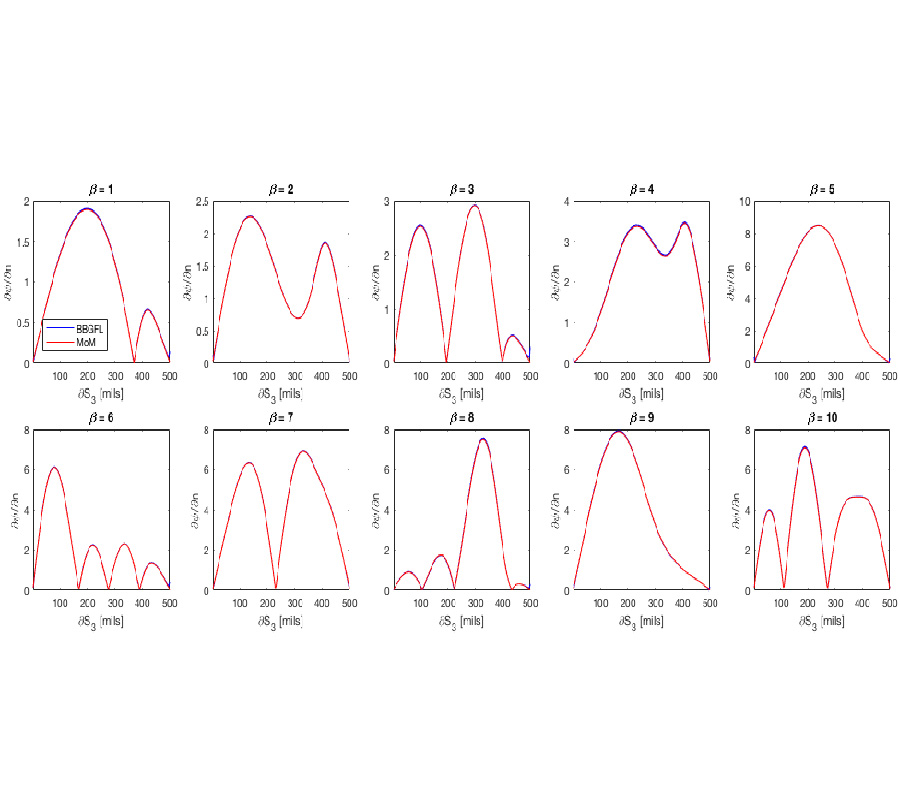
In this paper we calculate Green's function of a single point source in a one-dimensional infinite periodic lossless medium. The method is based on Broadband Green's Functions with Low Wavenumber Extractions (BBGFL) that express the Green's functions in terms of band solutions that are wavenumber independent. The converegnce of the band expansions are accelerated by a low wavenumber extraction with the wavenumber chosen at the mid-bandgap. The choice of mid-bandgap means that the extracted low wavenumber Green's function can be calculated with very few number of layers. The broadband Green's functions are illustrated for stopband, passband and close to the bandedge. For the case of passband and close to band edge, a modal method is used with first order and second order pole extractions respectively. The modal terms are extracted and integrated analytically. The calculated solutions of single point source Green's functions are compared with the scattering solutions of multilayers using as many as 200,000 layers for the case of passband and near bandedge. The BBGFL computed solutions are in good agreement with those of scattering solutions for stopband, passband, and close to the bandedge.
BROADBAND POINT SOURCE GREEN'S FUNCTION IN A ONE-DIMENSIONAL INFINITE PERIODIC LOSSLESS MEDIUM BASED ON BBGFL WITH MODAL METHOD
2018-09-06
PIER C
Vol. 86, 247-256
Novel Broadband High Gain Antenna Designed by Suspended Cylinder and Shorting PIN
Subash Chandra Yadav and Siddhartha P. Duttagupta
Desire for a broadband, high gain, unidirectional and low cost antenna in the field of communications is everlasting. In this paper, a novel broadband high gain antenna is presented using a suspended cylinder and a ground connected cylinder geometry. The bandwidth of the proposed antenna is enhanced by shorting these two cylinders with a pin in the direction orthogonal to the plane of coaxial probe. This low profile antenna structure is simple and easy to fabricate. The cylinders, shorting pin and ground plane are fabricated by a copper sheet of thickness 0.4 mm. Shorting pin and SMA connector provide mechanical support to the suspended cylinder. Simulations are done to analyze the radiation performance of the antenna. Prototype of the antenna is fabricated, and the measured results show good agreement with the simulated ones to confirm the enhanced bandwidth offered by the proposed antenna. We achieve impedance bandwidth of 63% (2.6-5 GHz) with the peak broadside gain of 9.87 dB. The bandwidth of the proposed antenna can be tuned by changing the radius of the shorting pin. The designed antenna possesses broadband high gain with stable broadside unidirectional radiation pattern which is suitable for Base station antenna such as WiMax (Worldwide Interoperability for Microwave Access) and LTE (Long Term Evolution). The metallic antenna has high power handling capacity as compared to microstrip and dielectric antennas.Therefore, this antenna can also be used for high power transfer application.
NOVEL BROADBAND HIGH GAIN ANTENNA DESIGNED BY SUSPENDED CYLINDER AND SHORTING PIN
2018-09-06
PIER C
Vol. 86, 233-245
Evaluation of a New Dual-Rotor Hybrid Excitation Brushless Motor
Libing Jing , Jia Cheng , Qixing Gao , Ting Zhang and Ying Lin
This paper presents a novel topology of a dual-rotor hybrid excitation motor (DRHEM), which combines outer permanent magnet synchronous motor (PMSM) and inner doubly salient electromagnetic motor (DSEM). The structure and combination criterion of the DRHEM are introduced and studied. A new type of intermediate stator structure has been adopted and fixed in the form of stator fasteners. The electromagnetic field of the motor is analyzed, and optimization methods are proposed for reducing the cogging torque and superimposing the back electromotive force. Furthermore, to verify the theoretical analysis, experimental tests are conducted, and the torque-speed and output power-speed characteristics are compared under various speeds conditions. The results verify the electromagnetic design well.
EVALUATION OF A NEW DUAL-ROTOR HYBRID EXCITATION BRUSHLESS MOTOR
2018-09-06
PIER M
Vol. 73, 61-70
Phased Array Calibration by Binary Compressed Sensing
Galina Babur , Diego Caratelli and Arman Barlykovich Mirmanov
This paper presents a calibration technique for phased array radars. The real embedded patterns of the array elements are measured independently in operating mode, while taking antenna coupling and other parasitic effects into account. The proposed technique does not affect the operation of the antenna array. The use of suitable switches integrated in the beamforming network of the array allows introducing sparsity into the measured summed signal. This enables the extraction of the angular dependent calibration coefficients by means of a dedicated compressed sensing approach.
PHASED ARRAY CALIBRATION BY BINARY COMPRESSED SENSING
2018-09-06
PIER M
Vol. 73, 47-59
SAR Calculation & Temperature Response of Human Body Exposure to Electromagnetic Radiations at 28, 40 and 60 GHz mmWave Frequencies
Tooba Hamed and Moazam Maqsood
The fast development of millimeter wave (mmWave) wireless communications and the associated concerns of potential negative impact on human health instigates the study on effects of mmWave frequency on the human body after exposure to electromagnetic field in terms of specific absorption rate (SAR) and temperature rise in computer simulation technology (CST). SAR distributions due to radiating source antenna were investigated using the finite difference time domain (FDTD) method in single and layered human tissues by examining the 1 g SAR (gram mass averaging) and point SAR (without mass averaging) at mmWave frequencies of 28, 40 and 60 GHz. The bioheat equation was used to find the temperature elevation in tissues. The FDTD grid size used in the computation was 1.00, 0.75, and 0.50 mm at 28, 40 and 60 GHz, respectively. The results concluded that at the radiated power of 20 and 24 dBm, SAR levels (without mass averaging) in the tissues at 28 GHz were less than 40 and 60 GHz. It was found that the temperature increase in the three layer model was 2-3 times higher than that in the single layer model. However, the temperature elevation never exceeded 1˚C in all the determined cases which was well below the threshold value for the generation of any adverse thermal effects in the tissues. Moreover, the effect of distance between the source and tissue model was investigated. It was found that the SAR decreased as the distance increased from the radiating source. The results presented here will assist researchers in examining and simulating the performance of upcoming mmWave wireless networks in terms of exposure to human tissues.
SAR CALCULATION & TEMPERATURE RESPONSE OF HUMAN BODY EXPOSURE TO ELECTROMAGNETIC RADIATIONS AT 28, 40 AND 60 GHZ MMWAVE FREQUENCIES
2018-09-05
PIER C
Vol. 86, 217-232
Influence of Geometric Simplifications on High-Intensity Radiated Field Simulations
Guadalupe Gutierrez Gutierrez , Sergio Fernandez Romero , Monica Gonzaga , Enrique Pascual-Gil , Luis Diaz Angulo , Miguel David Ruiz Cabello N. and Salvador Gonzalez Garcia
This paper analyzes the influence of simplifications in electromagnetic models used in the design of protections against High-Intensity Radiated Field (HIRF) threats. Both conductive and radiated effects are evaluated, covering the wide frequency range between 1 MHz and 6 GHz. A real and complex test case such as the power plant of an A400M aircraft was simulated using FDTD method so as to analyse the impact of different simplification approaches. The parameters studied are the inclusion/removal of installations, modification of electrical contacts, material properties, and changes in the cable features. In consequence, we can conclude that for the frequency range around tens or hundreds of megahertzs every detail is important (all the pieces of the model, accurate bundle routes and cable properties), while for higher frequencies only the details nearby the analyzed point are relevant for the results and it is not necessary to distinguish between different materials which are good conductors at this frequency range.
INFLUENCE OF GEOMETRIC SIMPLIFICATIONS ON HIGH-INTENSITY RADIATED FIELD SIMULATIONS