Search Results(13792)

2018-01-31
PIER C
Vol. 81, 41-52
An Inset-Fed Rectangular Microstrip Patch Antenna with Multiple Split Ring Resonator Loading for WLAN and RF-ID Applications
Nambiyappan Thamil Selvi , Ramasamy Pandeeswari and Palavesa Nadar Thiruvalar Selvan
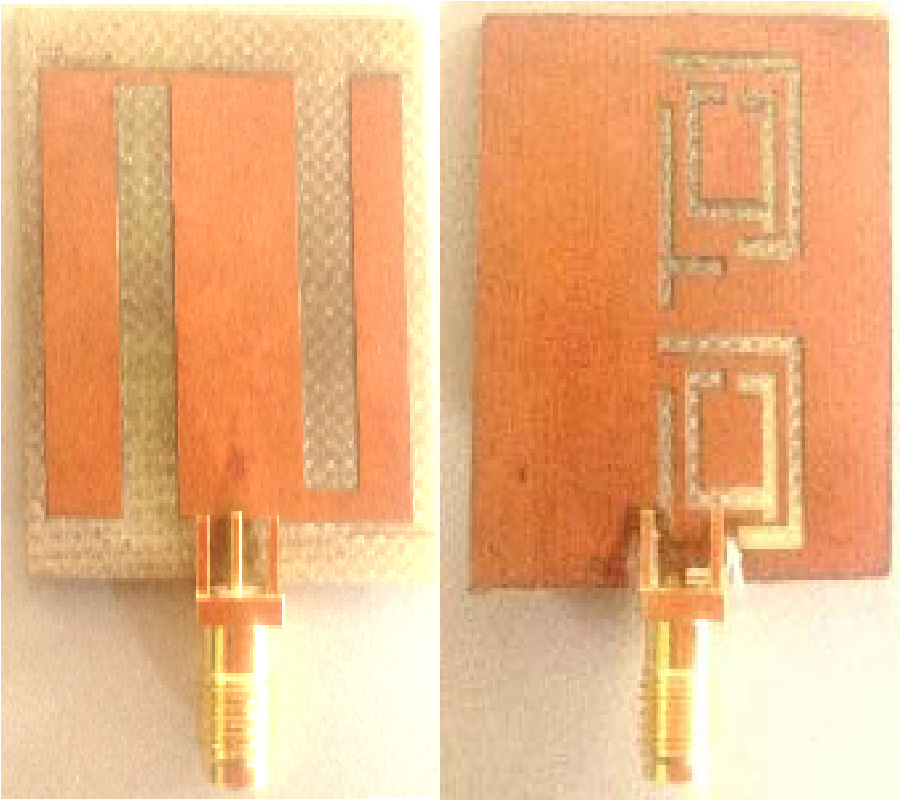
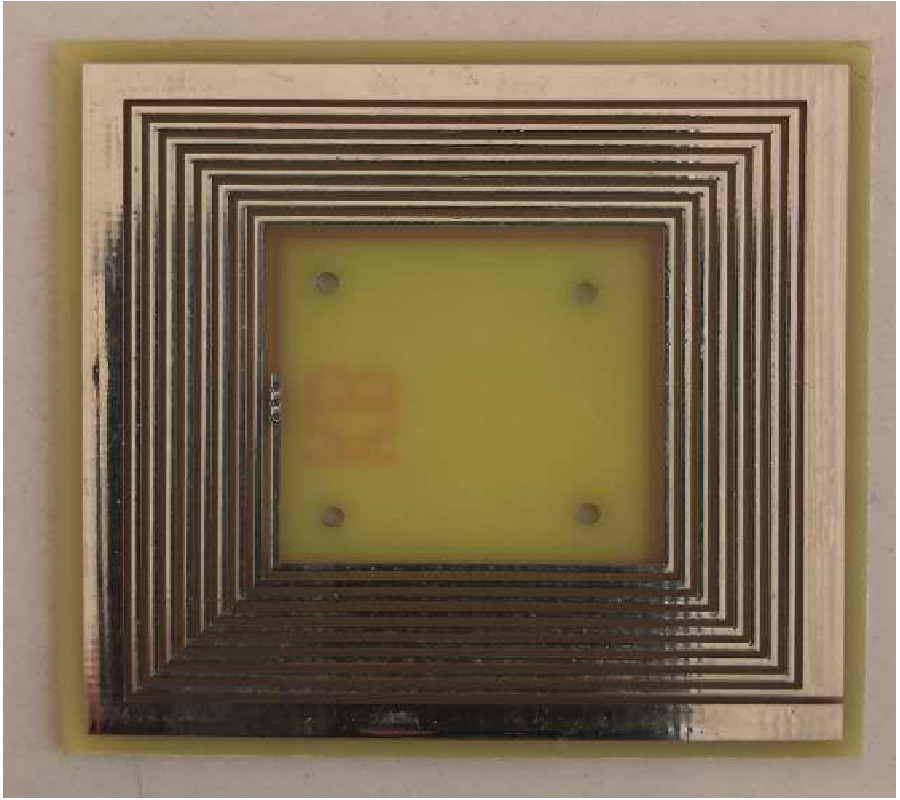
In this paper, the analysis and design of a compact Multiple Split Ring Resonator (MSRR) inspired microstrip rectangular patch antenna is presented. The MSRR is used with four rings. The size of the antenna is 25 × 31 × 1.6 mm3 realized on a low cost FR4 substrate. The proposed rectangular microstrip patch antenna operates at the resonant frequency of 5.88 GHz prior to MSRR inclusion. The antenna characteristics are studied before and after inclusion of metamaterial. After including MSRRs at appropriate places, the proposed MSRR antenna induces a new resonant frequency of 2.78 GHz. In addition to rectangular patch's fundamental resonance, the additional resonance is obtained at 2.78 GHz, thus, exhibits dual bands. Hence, MSRR loading antenna attains a bandwidth of 197 MHz at 2.78 GHz and 703 MHz at 5.88 GHz. The prototype of the proposed antenna is fabricated and measured. Simulated results are verified with the measured ones. This proposed antenna can be effectively utilized for WLAN and RF-ID applications. Parametric studies are illustrated to yield the desired frequency bands. Equivalent circuit model analysis of the MSRR loading is determined. Band characteristics of split ring structure are used to determine the negative permeability characteristics.
AN INSET-FED RECTANGULAR MICROSTRIP PATCH ANTENNA WITH MULTIPLE SPLIT RING RESONATOR LOADING FOR WLAN AND RF-ID APPLICATIONS
2018-01-30
PIER C
Vol. 81, 31-40
Improved Frequency Response of Microstrip Lowpass Filter Using Defected Ground Structures
Thulaseedharan Rekha , Parambil Abdulla , Puthenveetil Muhammed Jasmine and Paruthikkal Mohammed Raphika
The frequency response characteristics of a basic microstrip lowpass filter improved using H-shaped defected ground structures are presented. The proposed defected ground structures behave as a resonant element at high frequency and thus eliminate the stopband frequencies to achieve wide stopband rejection. The 3 dB cutoff frequency of the filter is 1.935 GHz. Due to the defects etched in the ground plane of the basic structure, the harmonic rejection is improved from 5th to 10th order along with low insertion loss and voltage standing wave ratio together with good selectivity. The compact filter has a size of 0.0338λg2, with λg = 85.18 mm being the guided wavelength at cutoff frequency. The characteristics of the lowpass filter are verified through simulation and measurement. Consistent and stable results are obtained.
IMPROVED FREQUENCY RESPONSE OF MICROSTRIP LOWPASS FILTER USING DEFECTED GROUND STRUCTURES
2018-01-30
PIER M
Vol. 64, 77-86
Statistical Modeling of Low-Latitude Long-Distance HF Ionospheric Multi-Mode Channels
Indah Kurniawati , Gamantyo Hendrantoro , Wirawan and Muhammad Taufik
Studies have been reported in the literature on High Frequency (HF) radio channels in mid-latitude areas more frequently than in low-latitude areas. Ionosphere as a reflector of HF radio waves in low-latitude areas might behave differently from that in mid-latitude. This paper reports a statistical model of sky wave HF channel complex impulse response and its parameters, such as channel gain, path gain, phase shift, and delay spread statistics, derived from both simulation and measurement of a 3044 km link in Indonesia. From the evaluations it can be concluded that the multipaths observed with respect to their propagation delays form multiple clusters corresponding to their propagation modes. The channel gain is found to follow Rayleigh distribution, whereas the rms and maximum delay spread exhibit Rayleigh and Gaussian distributions, respectively. This model can be used in performance evaluation of digital communication schemes in low-latitude HF channels.
STATISTICAL MODELING OF LOW-LATITUDE LONG-DISTANCE HF IONOSPHERIC MULTI-MODE CHANNELS
2018-01-29
PIER C
Vol. 81, 21-30
Compact Dual-Wideband Bandpass Filter Using CSRR Based Extended Right/Left-Handed Transmission Line
Parya Fathi , Zahra Atlasbaf and Keyvan Forooraghi
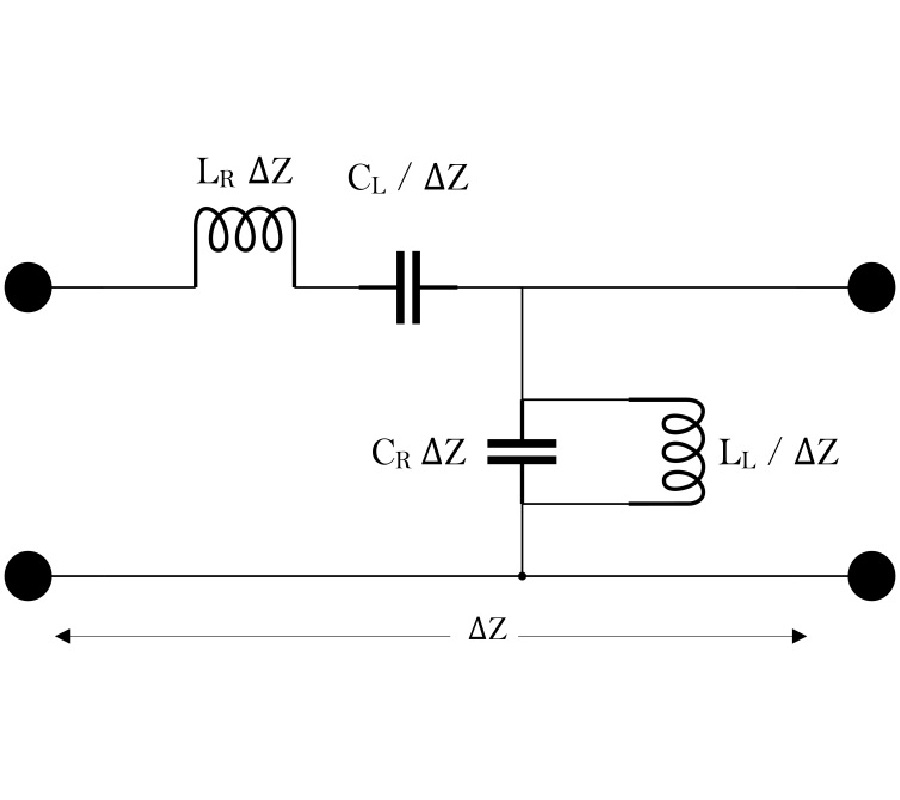
In this paper a miniaturized dual wideband bandpass filter is designed by the modified extended composite right/left-handed transmission line (ECRLH-TL) under balanced conditions in each right/left-hand passbands. A novel equivalent circuit is proposed to provide the design and an implementation of ECRLH unit-cell by means of the complementary, split ring resonator (CSRR) on the ground plane. Since CSRR is utilized as an alternative to implementing one of the resonators of ECRLH unit-cell, the size and complexity of the structure can be consequently reduced. An example of a dual band pass filter with 3 dB frequency bands from 3.2 to 4.8 GHz and from 6 to 7 GHz is investigated. There is a good agreement among circuit, electromagnetic simulations and measured results in both passbands. The measured insertion loss is better than 0.5 and 1 dB in first and second bands central frequency, respectively. The group delay which is an important factor in wideband communications is about 0.62 ns and 0.71 ns, respectively, in the first and second band central frequencies. The final dimensions of the miniaturized filter are reduced to 8.88 mm X 8.18 mm.
COMPACT DUAL-WIDEBAND BANDPASS FILTER USING CSRR BASED EXTENDED RIGHT/LEFT-HANDED TRANSMISSION LINE
2018-01-29
PIER Letters
Vol. 73, 37-44
Compact Broadband End-Fire Antenna with Metamaterial Transmission Line
Liang-Yuan Liu and Jing-Qi Lu
A broadband end-fire antenna loaded with magneto-electro-dielectric metamaterial (MED-MTM) is presented in this paper. Based on a planar printed structure, many periodic structures are investigated in antenna design. The metal patch is embedded with a C-shaped complementary split-ring resonator (CSRR) array, and many cross slots are etched on the ground plane. The zeroth-order resonance (ZOR) and first-order resonance (FOR) can be excited. As a result of electromagnetic coupling effect, the C-shaped patch and ground plane compose metamaterial transmission line (MTL). For potential applications, the broadband and end-fire antenna can work with a 53.5% (3.81-6.59 GHz) impedance bandwidth. The proposed antenna achieves size reduction, gain improvement and bandwidth enhancement.
COMPACT BROADBAND END-FIRE ANTENNA WITH METAMATERIAL TRANSMISSION LINE
2018-01-29
PIER M
Vol. 64, 65-76
A Matching-Pursuit Based Approach for Detecting and Imaging Breast Cancer Tumor
Mustafa Berkan Bicer , Ali Akdagli and Caner Özdemir
In this study, the scattering map of the breast is reconstructed by applying the matching-pursuit algorithm (MPA) to the simulation data obtained by the monostatic inverse synthetic aperture radar (ISAR) principle, and the locations of the tumors are determined by considering the peaks on the scattering map. The MPA iteratively searches the true solution by assuming every discrete point in the solution space to be a scattering center by dividing the imaging region onto a discrete grid. In order to obtain images with better resolution, the fine granularity of the grid for accurate solutions is provided at the expense of increased processing times. First, our approach based on MPA is tested on simulated data generated by MATLAB for breast tumor detection and imaging. Perfect reconstruction for the locations of the hypothetical breast tumor points is attained. Then, a full-wave electromagnetic simulation software named CST Microwave Studio (CST MWS) is used to generate backscattered electric field data from a constructed scenario in which a tumor is located in a breast model. Next, we use the collected data from the defined scenarios as an input to our algorithm. Resultant images provide successful detection and imaging of the tumor region within the breast model. The accuracy of the MATLAB and the CST MWS simulation results demonstrate the availability of our MPA-based focusing algorithm to be used effectively in medical imaging.
A MATCHING-PURSUIT BASED APPROACH FOR DETECTING AND IMAGING BREAST CANCER TUMOR
2018-01-27
PIER Letters
Vol. 73, 31-36
Filter with Selectable Passband Based on a Miniaturized Resonator
Jose Roberto Reyes-Ayona , Tejinder Kaur Kataria and Alonso Corona-Chavez
A passband filter where the central frequency can be one of seven selectable frequencies is presented. Its operation region ranges from 325 to 455 MHz, and each bandwidth is about 20 MHz. The filter is based on a highly miniaturized ring resonator with a size reduction from about 77% to 83% compared to a conventional closed ring. The reconfiguration of its resonant frequency is implemented by shifting a short location, thus changing its effective inductance. This is opposed to the conventional capacitance change of other reconfigurable filters. Simulated and experimental results are in good agreement. Reflections are below -10 dB at central bandpass frequencies for all selectable bands.
FILTER WITH SELECTABLE PASSBAND BASED ON A MINIATURIZED RESONATOR
2018-01-27
PIER M
Vol. 64, 55-63
Beamforming of Frequency Diverse Array Radar with Nonlinear Frequency Offset Based on Logistic Map
Zhonghan Wang , Tong Mu , Yaoliang Song and Zeeshan Ahmad
In this paper, a multi-carrier nonlinear frequency modulation system based on pseudo-random frequency offset is designed. The reduction of the main lobe 3\,dB width and the side-lobe peaks cannot be realized simultaneously in conventional beamforming schemes, especially when the number of array elements remains unchanged. The proposed system can reduce the main-lobe 3 dB width and suppressing the side-lobe peaks simultaneously. This is done by adjusting the number of sub-signals, frequency offset coefficient and the inter-element spacing. Then, through time slot processing, signal power is focused on different targets. Numerical simulation experiments are implemented to validate the theoretical analysis of the proposed methodology, and comparisons with other techniques are made.
BEAMFORMING OF FREQUENCY DIVERSE ARRAY RADAR WITH NONLINEAR FREQUENCY OFFSET BASED ON LOGISTIC MAP
2018-01-25
PIER C
Vol. 81, 11-19
SRR-Loaded Metamaterial-Inspired Electrically-Small Monopole Antenna
Divya Chaturvedi and Singaravelu Raghavan
In this paper, a CPW-fed compact metamaterial-inspired monopole antenna is proposed for Industrial, Scientific and Medical radio band (ISM, 2.4-2.483 GHz). The proposed antenna consists of a T-shaped patch and a set of split ring resonators (SRRs). The miniaturization is attained after loading SRRs in proximity to the T-shaped radiator, which makes the antenna structure electrically small. The measured fractional bandwidth of the antenna is 4% (2.42-2.52 GHz), and its size is 0.22λo× 0.098λo×0.013λo. In addition, the electrically equivalent circuit of the proposed antenna is modeled, and the resonant frequency is calculated by using an analytical approach. Also, the permeability plot of SRRs is extracted using Nicolson Ross weir method. The measured peak gain and radiation efficiency of the antenna are obtained as 1.76 dBi and 78.5%. The simulated results and measured results are found in a good agreement.
SRR-LOADED METAMATERIAL-INSPIRED ELECTRICALLY-SMALL MONOPOLE ANTENNA
2018-01-25
PIER C
Vol. 81, 1-10
A Simple Broadband Flat-Gain Circularly Polarized Aperture Antenna with Multiple Radiation Modes
Yi-Xuan Zhang , Yong-Chang Jiao , Huan Zhang and Yang Gao
A simple broadband circularly polarized (CP) aperture antenna is proposed in this letter. The antenna is composed of an L-shaped feed line and a circular aperture. With the newly introduced perturbation slots, a new resonant mode TE31 is generated, which can widen the CP bandwidth without increasing the antenna size. Measured results of the fabricated antenna shows 93.5% (2.9-8 GHz) impedance bandwidth (|S11|<-10 dB) and 66.6% (3-6 GHz) 3 dB axial-ratio bandwidth. The overlapped CP working band covers the entire WiMAX, WLAN and lower frequency 5G bands. Its peak gain is 4.9 dBic at 3.5 GHz, and its gain variation is less than 1 dBic within 3-5.8 GHz band. Design considerations, empirical formulas and surface current analysis are also presented and discussed.
A SIMPLE BROADBAND FLAT-GAIN CIRCULARLY POLARIZED APERTURE ANTENNA WITH MULTIPLE RADIATION MODES
2018-01-25
PIER C
Vol. 80, 233-247
Determination of Surface and Sub-Surface Cracks Location in Beams Using Rayleigh-Waves
Atef Eraky , Rania Samir , Walid Saber El-Deeb and Abdallah Salama
Structural buildings are vulnerable to many types of damages that can occur through their life period. These damages may cause structure failure or at least decrease its efficiency. Dangerous damages occurring in concrete structures are surface opening cracks or sub-surface cracks. So, the determination of location of these cracks is very important, because the crack location is one of the important factors that affect the degree of danger of the damage. The Rayleigh waves have many advantages, as they can be easily recognized due to the maximum energy of the wave components. So, it was used to determine the crack location in the previous works. In this paper, two different techniques are used to determine the crack location; one of them depends on the healthy case, and the other deals only with the cracked case. Common finite element software (Abaqus) is used to model the numerical simulation, and the experimental test is also performed to verify the obtained numerical results. Good agreement between the simulated and experimental results is obtained by employing both techniques to find the crack location.
DETERMINATION OF SURFACE AND SUB-SURFACE CRACKS LOCATION IN BEAMS USING RAYLEIGH-WAVES
2018-01-25
PIER C
Vol. 80, 221-231
A Broad-Side Coupled SRR Inspired CPW Fed Dual Band Antenna for WiMAX and Wave Applications
Nambiyappan Thamil Selvi , Palavesa Nadar Thiruvalar Selvan , Shanmugaih P. Babu , Ramasamy Pandeeswari and Raphael Samson Daniel
In present scenario, this paper intends to demonstrate the practicality of a miniaturized coplanar waveguide fed metamaterial inspired antenna that can be effectively operated at dual bands. A broad-side coupled Split Ring Resonator is used to obtain dual bands with an impedance bandwidth (-10 dB) of 840 MHz (3.00-3.84 GHz) and 310 MHz (5.94-6.25 GHz), which resonates at dual bands, viz., 3.42 GHz and 6.07 GHz. The impedance bandwidth (S11<-10 dB) is 25% for the first band and 5.1% for the second band. The size of the antenna is 31 × 25 × 1.6 mm3 realized on a low-cost FR-4 Epoxy substrate. This antenna can be effectively utilized in worldwide interoperability for microwave access (WiMAX) and wireless access in vehicular environments (WAVE) applications. The prototype of the proposed antenna is fabricated and measured. Simulated and measured results are in agreeing nature. Experimental and simulated analyses of the antenna including parametric and dispersion characteristics are dealt in this communication.
A BROAD-SIDE COUPLED SRR INSPIRED CPW FED DUAL BAND ANTENNA FOR WIMAX AND WAVE APPLICATIONS
2018-01-25
PIER B
Vol. 79, 167-190
Fuzzy Logic Biased Optimal Dipole-Linear Antenna Array: an Improved Array with Better Tradeoff Between Performance Parameters
Saumendra Kumar Mohanty and Biswa Binayak Mangaraj
Linear antenna array design is a multi-parameter, multi-objective, and nonlinear problem which requires optimal design parameters to get desired performance. To achieve desired performance through multi-objective optimization process, a compromise among desired objectives is essential. In such a situation to make a rational decision on global optimization to avoid arbitrary compromise to any objective, we introduced two fuzzy logic biased/fuzzy biased optimization techniques. We proposed fuzzy logic biased biogeography based optimization algorithm and fuzzy biased gravitational search optimization algorithm to solve M-element nonlinear linear antenna array design problem. In our design problem, we have considered a 16-element dipole-linear antenna array. The optimal design problem incudes thirty one design parameters (sixteen lengths, and fifteen spacings) and four performance parameters such as directivity, front to maximum side-lobe level, half power beamwidth, and front to back ratio. The result shows that applications of fuzzy biased optimizations are more efficient for solving multi objective problem. While analysing the linear antenna array, mutual coupling is taken into account for numerical analysis using method of moment.
FUZZY LOGIC BIASED OPTIMAL DIPOLE-LINEAR ANTENNA ARRAY: AN IMPROVED ARRAY WITH BETTER TRADEOFF BETWEEN PERFORMANCE PARAMETERS
2018-01-25
PIER Letters
Vol. 73, 23-30
A Broadband Planar Modified Quasi-Yagi Using Log-Periodic Antenna
Hemant Kumar and Girish Kumar
In this paper, a broadband planar modified quasi-Yagi antenna using a two-element log-periodic dipole array as a driven element is proposed. To feed the two-element log-periodic dipole array, a simple microstrip to stripline transition as a balun is designed, which converts the unbalanced input to balanced output. The antenna is fabricated on a low cost glass epoxy FR4 substrate with dielectric constant = 4.4, substrate thickness = 1.6 mm, and loss tangent = 0.02. The overall size of the antenna is 84 mm×111 mm, which is 0.41λo×0.54λo at the center frequency of 1.45 GHz. Measured results show a bandwidth of 41.4% for VSWR≤2. A gain of 6.5 dBi±0.5 dB and front to back ratio (F/B) of better than 20 dB are achieved over the bandwidth. Measured results are in good agreement with the simulated ones. This antenna is useful for RFID, portable direction finding, spectrum monitoring systems, etc.
A BROADBAND PLANAR MODIFIED QUASI-YAGI USING LOG-PERIODIC ANTENNA
2018-01-23
PIER C
Vol. 80, 211-219
Experimentally Validated, Wideband, Compact, OAM Antennas Based on Circular Vivaldi Antenna Array
Tianming Yang , Deqiang Yang , Boning Wang and Jianzhong Hu
The bandwidth of OAM antennas, which have a great potential for multiple-input multiple-output (MIMO) communication, must be wide enough. Unfortunately, most of researchers only care about the generation and characteristics of vortex beams carrying orbital angular momentum (OAM) but ignore the bandwidth of OAM antennas. To develop OAM antenna suitable for MIMO communication, Vivaldi antenna is used as the element of circular array because of its wide bandwidth. Three compact wideband circular Vivaldi antenna arrays that can generate vortex beams carrying OAM with numbers of modes l=0, -2, +2 are proposed and experimentally validated in this paper. Measured results show that the proposed antennas can radiate vortex beams with different numbers of modes over a frequency range of 2.7-2.9 GHz.
EXPERIMENTALLY VALIDATED, WIDEBAND, COMPACT, OAM ANTENNAS BASED ON CIRCULAR VIVALDI ANTENNA ARRAY
2018-01-23
PIER Letters
Vol. 73, 17-22
A Broadband Low-Loss WR10 Waveguide to Microstrip Line Transition with T-Shaped Probe
Gerhard F. Hamberger , Uwe Siart and Thomas F. Eibert
A novel W-band WR 10 waveguide to microstrip line transition is designed, simulated in a 3D full-wave EM simulation software, fabricated, and evaluated by measurements. The main advantages of this transition are frequency-flat transmission, low reflection, and uncomplicated fabrication. Simulation shows a reflection coefficient of better than -23 dB from 75 to 90 GHz for one hollow waveguide to microstrip line transition. The port reflections increase for a fabricted prototype with two transitions and a connecting microstrip line to a level of about -14 dB. This is mainly caused by fabrication tolerances. The overall transmission of the dual transition prototype is found at a very satisfactory level of about -4.8 dB at 90 GHz for a connecting microstrip line with a length of 45 mm corresponding to an estimated loss of approximately 0.6 dB for a single transition.
A BROADBAND LOW-LOSS WR10 WAVEGUIDE TO MICROSTRIP LINE TRANSITION WITH T-SHAPED PROBE
2018-01-23
PIER Letters
Vol. 73, 9-16
Characterization and Modeling of Vegetation Effects on UHF Propagation through a Long Forested Channel
Adebayo Segun Adewumi and Olusegun Olabisi
In this paper, measurement, modeling and validation of existing models on the effect of nonhomogeneous vegetation on UHF radio-wave propagation through a long forested channel at frequency of 1835 MHz are reported. The paper focuses on vegetation attenuation measurement through a long forested channel of about 8 km long with mixed vegetation of different density. The measured data were fitted using exponential decay function, and a new model was proposed from the fitted curve. The new proposed model will take care of the limitation in vegetation depth posted by some existing models. Generic models, mainly modified exponential decay and analytical models were also fitted to the data and validated, while RMSE was used to determine the best model that describes the data. The evaluated data results show that all the models tested give significant errors which show that they are not suitable for long forested channel scenario. Though COST 235 has the least error (17.05 dB), the error is still significant because COST 235 could only account for vegetation attenuation of short distance scenario. Attenuation shows corresponding increase with increase in leaves thickness in the forested channel considered, which was due to complex permittivity of the leaves moisture content and the dielectric properties of the leaves saline water. The developed model and other results obtained in this study will help to improve prediction accuracy of the effects of vegetation attenuation in nonhomogeneous vegetation along forested channels and also help in establishing efficient UHF radio link budget for long forested channel scenario.
CHARACTERIZATION AND MODELING OF VEGETATION EFFECTS ON UHF PROPAGATION THROUGH A LONG FORESTED CHANNEL
2018-01-22
PIER C
Vol. 80, 199-209
Feasibility Study of Frequency Selective Surfaces for Structural Health Monitoring System
Syaiful Anas Suhaimi , Saidatul Norlyana Azemi and Ping Jack Soh
A new type of three-dimensional (3D) Frequency Selective Surfaces (FSS) applied to passive sensing in Structural Health Monitoring (SHM) is presented. Such passive FSS sensors are proposed as an alternative to conventional sensors to eliminate the need of DC/AC power. Moreover, these FSSs are modified in a 3D form to feature enhanced performance compared to conventional FSSs and sensors. More specifically, the proposed 3D FSS is able to control its sensitivity |S21| in either TE or TM incident waves. In this project, incident angle characteristics are evaluated for SHM applications to obtain angular responses of up to 80 degrees. The resonant behavior of the TE-incident wave is shown to be sensitive towards the incident angle and is suitable to be used for monitoring any building tilting and damage. This is due to the significant 3D length changes of the conductor elements. Meanwhile, the TM-incident wave is found to be insensitive towards the incident angle.
FEASIBILITY STUDY OF FREQUENCY SELECTIVE SURFACES FOR STRUCTURAL HEALTH MONITORING SYSTEM
2018-01-22
PIER C
Vol. 80, 181-198
A Novel High Directive Willis-Sinha Tapered Slot Antenna for GPR Application in Detecting Landmine
Mohammed Mahmoud Mohanna , Esmat A. F. Abdallah , Hadia El-Hennawy and Magdy Ahmed Attia
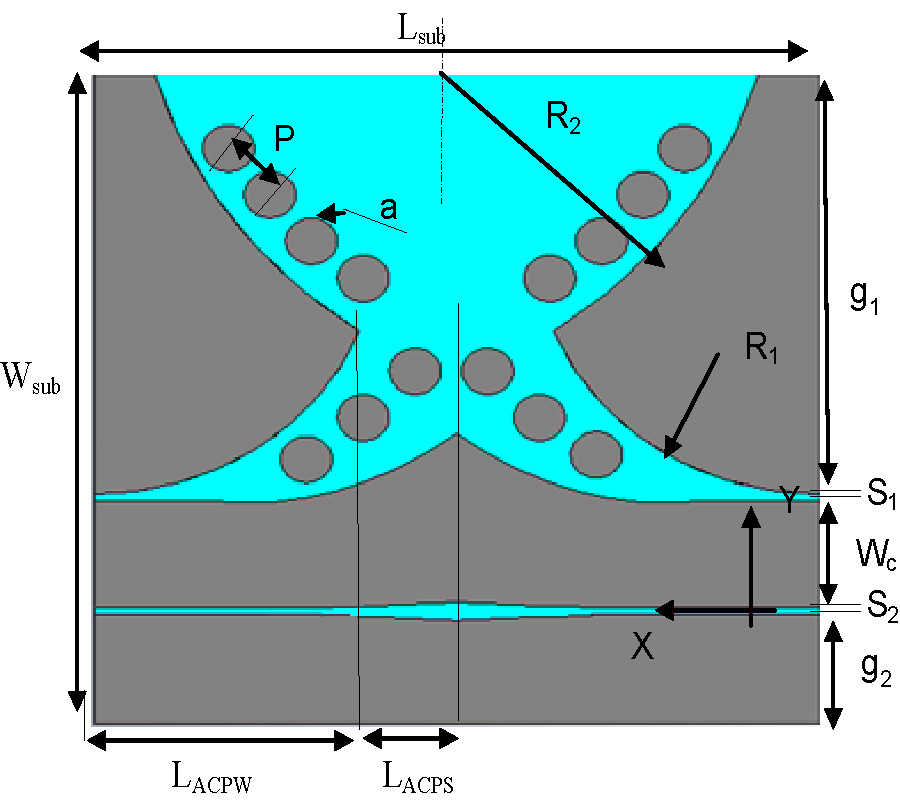
novel Ultra-wideband Willis-Sinha Tapered Slot antenna for landmine detection using Ground Penetrating Radar (GPR) system with enhanced gain and directivity is presented. The structure is constructed on a 235x270 mm2 FR4 dielectric substrate. The antenna is fed by a novel tapered coplanar waveguide (CPW) to coplanar stripline (CPS) transition feed. The antenna's impedance bandwidth is extended by adding an antenna arm constructing parabola shape with the antenna element. The antenna has a corrugated structure along the antenna outer edges to improve radiation efficiency and get higher directivity. Also, a mushroom-like circular EBG structure is used in the lower side of the antenna arm to reduce interference and enhance front-to-back ratio (F/B ratio). A partial substrate removal, like circular cylinders inside the substrate, is aligned with the antenna tapered profile to obtain better radiation efficiency and enhance antenna gain. The operational bandwidth of this antenna extends from 0.18 to 6.2 GHz. The minimum return loss reaches 60 dB. The average directivity reaches 12.2 dBi while the gain and radiation efficiency are 11.8 dBi and 92%, respectively with gain enhancement of 195% due to using corrugated structure and air cavities. The front-to-back ratio (F/B ratio) is 23 dB. Also, a size reduction of 48% is achieved due to using extended arm. The antenna performance was simulated and measured. Good agreement was found between numerical and experimental results. The proposed antenna is suitable for various ultra-wideband applications especially in landmine detection. The design of the proposed antenna is given in very simple five design steps.
A NOVEL HIGH DIRECTIVE WILLIS-SINHA TAPERED SLOT ANTENNA FOR GPR APPLICATION IN DETECTING LANDMINE
2018-01-22
PIER Letters
Vol. 73, 1-8
Design of Compact Wideband Meandering Loop Antenna with a Monopole Feed for Wireless Applications
Yibo Wang , Lijia Zhu , Hongwei Wang and Guangli Yang
A novel compact wideband printed loop antenna is presented for wireless applications. The wideband characteristic is achieved by combining three di erent loop resonant modes of the antenna. The antenna geometry is simple and consists of a rectangular meandering loop, a coplanar waveguide (CPW) structure, and a monopole feed. This proposed antenna has a dimension of only 27×20×1 mm3 while operates at a wideband from 2.4 GHz to 5.9 GHz (84.3%) with stable gain, radiation pattern and vertical linear polarization. This antenna is suitable for WLAN and future 5G sub-6 GHz spectrum communications. Good agreement between the simulation and measurement is obtained.
DESIGN OF COMPACT WIDEBAND MEANDERING LOOP ANTENNA WITH A MONOPOLE FEED FOR WIRELESS APPLICATIONS