Search Results(13792)

2018-02-12
PIER C
Vol. 81, 101-113
A Comparative Study of Quasi-FEA Technique on Iron Losses Prediction for Permanent Magnet Synchronous Machines
Pedram Asef , Ramon Bargallo Perpina , M. R. Barzegaran , Jianning Dong , Andrew Lapthorn and Osama A. Mohammed
The paper presents an advanced quasi-FEA technique on the iron losses prediction using Bertotti's iron loss separation models, in which a curve fitting is taken into account for coefficients calculation of each model. Moreover, the skin effect and saturation consideration are applied in order to check the accuracy through the relative error distribution in the frequency domain of each model from low up to high frequencies 50 to 700 (Hz). Additionally, this comparative study presents a torque-speed-flux density computation that is discussed and presented. The iron loss characteristics of a radial flux permanent magnet synchronous machine (PMSM) with closed-slots and outer rotor topology are also discussed. The quasi-finite-element (FE) analysis was performed using a 2-D and 3-D FEA, where the employed quasi-2-D FEA is proposed and compared with 3-D FEA, and along with experimental verifications. Finally, all the iron-loss models under realistic and non-ideal magnetization conditions are verified experimentally on a surface-mounted PMSG for wind generation application.
A COMPARATIVE STUDY OF QUASI-FEA TECHNIQUE ON IRON LOSSES PREDICTION FOR PERMANENT MAGNET SYNCHRONOUS MACHINES
2018-02-12
PIER Letters
Vol. 73, 83-89
A Miniaturized Filtering 3-DB Branch-Line Hybrid Coupler with Wide Suppression Band
Ruo-Nan Du , Zibin Weng and Chi Zhang
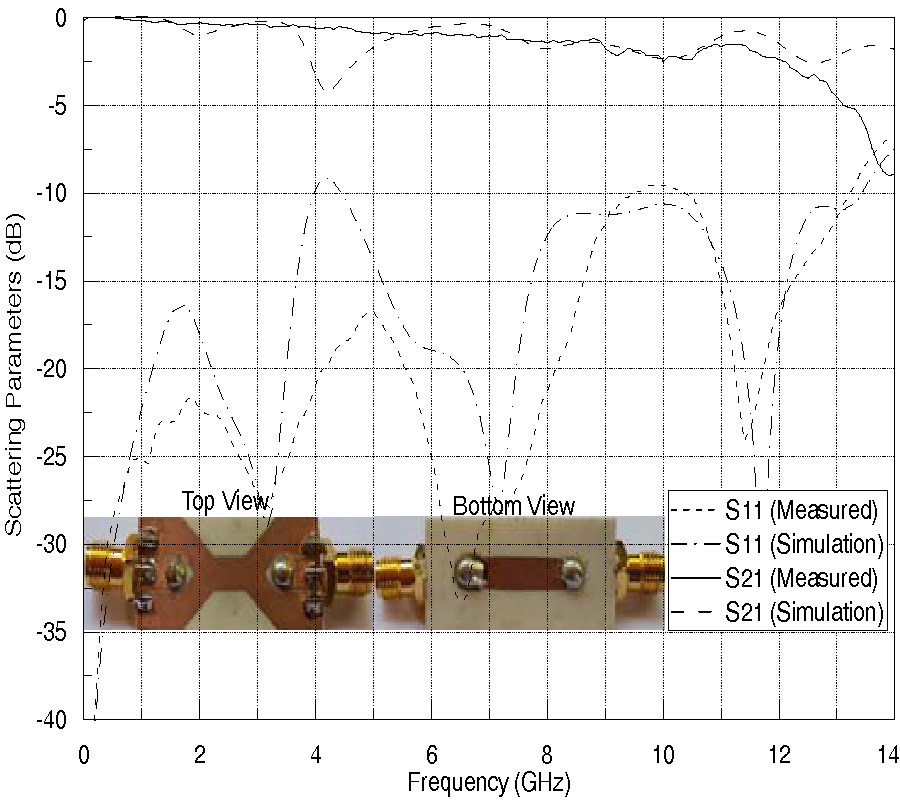
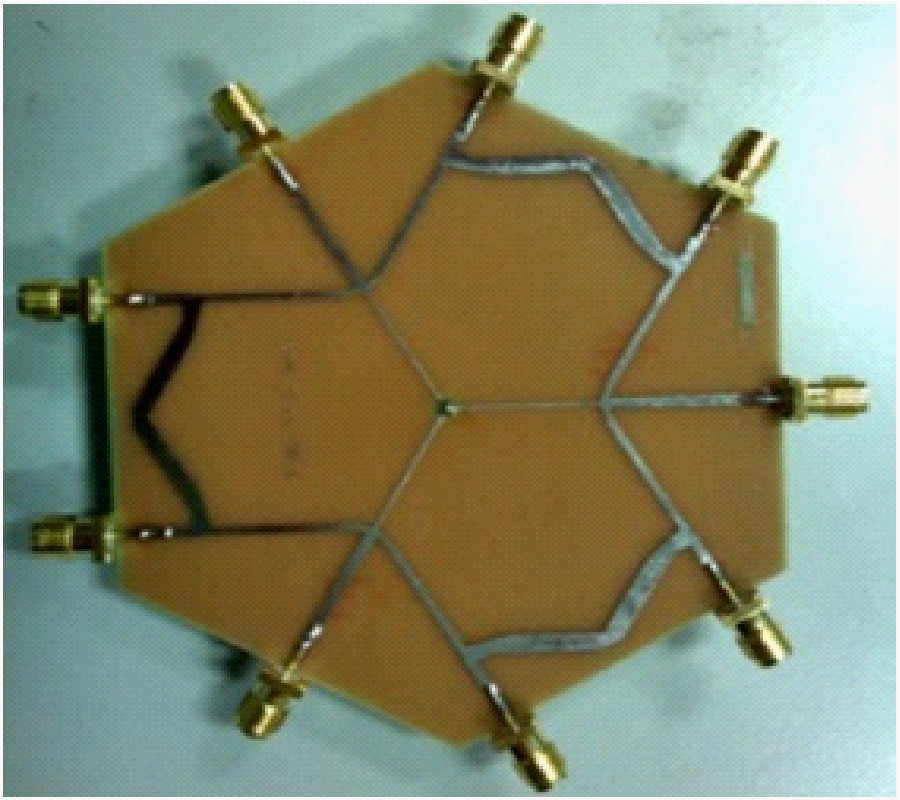
A 3-dB branch-line hybrid coupler with wide stopband responses is presented in this letter. An equivalent K-inverter with bandpass function is used instead of one quarter-wavelength transmission line, which will realize size reduction and wide stopband characteristic of the coupler. Prototype of a branch-line hybrid coupler, which divides the power equally with 90° phase difference between the output ports, is also fabricated and tested. Both the simulation and measurement results show that such a hybrid coupler exhibits an 83.2% size reduction and has transmission suppression of -20 dB or less within five-fold bandwidth.
A MINIATURIZED FILTERING 3-DB BRANCH-LINE HYBRID COUPLER WITH WIDE SUPPRESSION BAND
2018-02-12
PIER Letters
Vol. 73, 77-82
A Dual Band Orthomode Transducer in k/Ka Bands for Satellite Communications Applications
Abdellah El Kamili , Abdelwahed Tribak , Jaouad Terhzaz and Angel Mediavilla Sanchez
This article presents the design, simulation and machining of a dual Orthomode Transducer for feeding antenna using waveguide technology. Linear orthogonal polarizations in common port are separated to single linear polarizations in other ports. This device is developed to work in K and Ka bands and could be exploited in satellite communications applications. Also, it is designed to provide good scattering parameters results experienced with simulation tools and real load laboratory measurement. The designed circuit exhibits important results with return losses less than 25 dB, insertion losses in theory of about 0.05 dB as well as a good isolation of 40 dB in both frequency bands of interest (19.4 GHz-21.8 GHz) and (27 GHz-32 GHz).
A DUAL BAND ORTHOMODE TRANSDUCER IN K/KA BANDS FOR SATELLITE COMMUNICATIONS APPLICATIONS
2018-02-11
PIER C
Vol. 81, 89-99
Design of Circularly Polarized Tag Antenna with Artificial Magnetic Conductor for on-Body Applications
Jhih Han Hong , Chien-Wen Chiu and Hwang-Cheng Wang
This paper presents a circularly polarized tag on a 3×3 AMC structure to obtain longer read range for UHF RFID on-body applications. A modified T-matching transformer is employed to achieve conjugate matching with the Monza 4 microchip. To overcome the influence of lossy human body, a cross-dipole tag antenna is directly implemented on the phase-dependent AMC structure to achieve high gain and isolate the influence of the human body. Then, the tag is pasted on a lossy human model to investigate its performance. The study finds that the AMC can increase the antenna gain by 3.34 dB and help generate circularly polarized (CP) wave. The measured fractional bandwidth of impedance is 3.2% which can cover the UHF RFID bands of North America and Taiwan. The measured read range of the tag pasted on a human body reaches 15.7 meters when the reader has 4 W EIRP, and the sensitivity of the microchip is -16.7 dBm.
DESIGN OF CIRCULARLY POLARIZED TAG ANTENNA WITH ARTIFICIAL MAGNETIC CONDUCTOR FOR ON-BODY APPLICATIONS
2018-02-10
PIER M
Vol. 64, 181-192
Efficacy of Magnetic and Capacitive Hyperthermia on Hepatocellular Carcinoma
Chien-Chang Chen and Jean-Fu Kiang
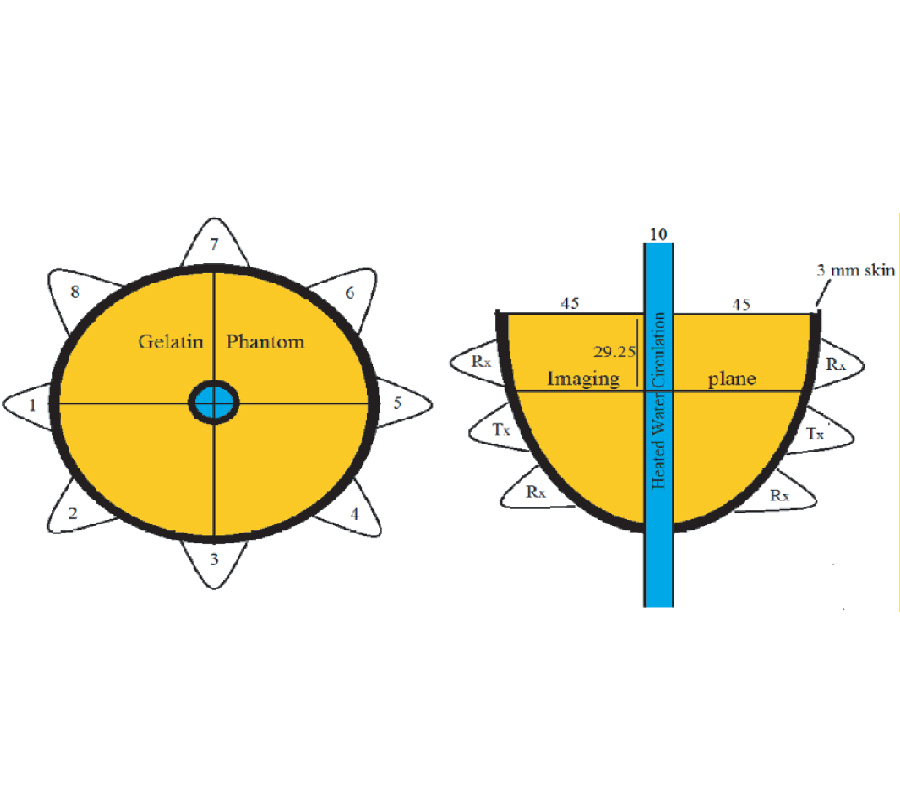
The efficacy of applying magnetic hyperthermia (MHT) and capacitive hyperthermia (CHT) to treat hepatocellular carcinoma (HCC) is studied. Magnetoquasistatic (MQS) and electroquasistatic (EQS) formulations are develpoed to compute the magnetic field and electric field dirtributions, respectively, which are numerically solved by using finite element method. The heat transport equation is applied to compute the temperature distribution in the treated area. Simulation results of temperature distribution are used to compare the efficacy of MHT and CHT.
EFFICACY OF MAGNETIC AND CAPACITIVE HYPERTHERMIA ON HEPATOCELLULAR CARCINOMA
2018-02-09
PIER M
Vol. 64, 167-179
Compatible Finite Element Discretization of Generalized Lorenz Gauged Charge-Free a Formulation with Diagonal Lumping in Frequency and Time Domains
Peng Jiang , Guozhong Zhao , Qun Zhang and Zhenqun Guan
The finite element implement of the generalized Lorenz gauged A formulation has been proposed for low-frequency modeling. However, the inverse of mass matrix of intermediate scalar in the finite element implement leads to additional computation cost and dense coefficient matrix. In this paper we propose to adopt a diagonal lumping mass matrix in the finite element discretization of the generalized Lorenz gauged double-curl operator in charge-free electromagnetic problems. Consequently, a sparser discrete system with improved condition number is thus obtained which is more favourable for low-frequency modeling in frequency-domain analysis. Furthermore, we apply the diagonal lumping formulation in time-domain analysis, showing that it can remedy spurious linear growth problem. Numerical examples are used to demonstrate the validity.
COMPATIBLE FINITE ELEMENT DISCRETIZATION OF GENERALIZED LORENZ GAUGED CHARGE-FREE A FORMULATION WITH DIAGONAL LUMPING IN FREQUENCY AND TIME DOMAINS
2018-02-09
PIER M
Vol. 64, 157-166
Modeling of Dispersive Chiral Media Using the ADE-TLM Method
Khalid Mounirh , Soufiane El Adraoui , Yasser Ekdiha , Mohamed Iben Yaich and Mohsine Khalladi
In this paper, an efficient Transmission Line Matrix (TLM) algorithm for modeling chiral media is presented. The formulation is based on auxiliary differential equations (ADE) of electric and magnetic current densities. Permittivity and permeability are assumed to follow the Lorentz model while chirality is assumed to follow the Condon model. The proposed method models the dispersive nature of permittivity, permeability, and chirality by adding both voltage and current sources in supplementary stubs to the conventional symmetrical condensed node (SCN) of the TLM method. The electromagnetic coupling appears explicitly in the update equations of the voltage and current sources. The algorithm is developed to simulate electromagnetic wave propagation in a chiral medium. The co-polarized and cross-polarized transmitted and reflected waves from a chiral slab due to a normal incident plane wave are calculated. Validation is performed by comparing the results obtained from the proposed method with those obtained analytically.
MODELING OF DISPERSIVE CHIRAL MEDIA USING THE ADE-TLM METHOD
2018-02-09
PIER M
Vol. 64, 147-156
A P-Variable Higher-Order Finite Volume Time Domain Method for Electromagnetic Scattering
Avijit Chatterjee and Subodh Joshi
A higher-order accurate solution to electromagnetic scattering problems is obtained at reduced computational cost in a p-variable finite volume time domain method in a scattered field formulation. Spatial operators of lower order, including first-order accuracy, are employed locally in substantial parts of the computational domain during the solution process. The use of computationally cheaper and lower order spatial operators does not affect the overall higher-order accuracy of the solution. The order of the spatial operator at a candidate cell during numerical simulation can vary in space and time and is dynamically chosen based on an order of magnitude comparison of scattered and incident fields at the cell centre. Numerical results are presented for electromagnetic scattering from perfectly conducting two-dimensional scatterers subject to transverse magnetic and transverse electric illumination.
A p-VARIABLE HIGHER-ORDER FINITE VOLUME TIME DOMAIN METHOD FOR ELECTROMAGNETIC SCATTERING
2018-02-08
PIER M
Vol. 64, 135-146
Dual-Function MIMO Radar-Communications Employing Frequency-Hopping Chirp Waveforms
Shaddrack Yaw Nusenu , Wen-Qin Wang and Hui Chen
A dual-function radar-communication system is a technology equipped with a joint platform that enables performing a radar function (primary function) and a communication function (secondary function) simultaneously. This duality has become increasingly necessary, since it alleviates congestion and ease competition over frequency spectrum. In this paper, we put forward a technique for information embedding, specifically to multiple-input multiple-output (MIMO) radar employing frequency-hopping chirp (FHC) waveforms. We use FHC codes to implement the primary function (i.e., MIMO radar operation), while embedding communication symbol, for example, phase shift keying (PSK), in each FHC code for secondary function (i.e., communication operation). We show that the communication operation does not interfere with the MIMO radar function. In addition, standard ratio testing is used at the communication receiver to detect the embedded PSK symbols. Furthermore, the waveform designed has the superiorities of high range resolution, constant time domain and almost constant frequency-domain modulus, large time-bandwidth product, and low time-delay and frequency-shift correlation peaks. Numerical results show that: 1) data rates can be accurately detected, and thus, several Mbps are achieved in the system; 2) the SER performance characteristics are significantly improved; 3) the orthogonal frequency-hopping chirp waveforms achieve better range and Doppler resolution with reduced sidelobes levels compared to that of conventional frequency hopping waveforms.
DUAL-FUNCTION MIMO RADAR-COMMUNICATIONS EMPLOYING FREQUENCY-HOPPING CHIRP WAVEFORMS
2018-02-08
PIER M
Vol. 64, 123-133
Breast Tumor Detection System Based on a Compact UWB Antenna Design
Ibtisam Amdaouch , Otman Aghzout , Azzeddin Naghar , Ana Vazquez Alejos and Francisco J. Falcone
This paper presents a novel breast model system based on a UWB antenna for locating a tumor cancer. The antenna with overall size of 35 mm×20 mm×1.6 mm is characterized with an ultra-wideband of 120% and frequency range of 3 GHz-12 GHz for the FCC band. The proposed antenna exhibits good impedance matching, high gain and omnidirectional radiation patterns. The measurment results are presented to illustrate the performances of the proposed antenna. This antenna has been implemented in a designed system model with dielectric properties of a human breast capable to detect strange objects. The size and localization coordinates of the tumor are studied in detail for better tumor detection. The coordinates of the corresponding maximum value of SAR are identified in order to accurately detect different locations of tumor inside the breast. The results show that the localization of the tumor can be detected with high precision which demonstrates the performance of the proposed antenna and the entire system. The proposed breast model system was developed using the commercial CST Microwave studio simulator.
BREAST TUMOR DETECTION SYSTEM BASED ON A COMPACT UWB ANTENNA DESIGN
2018-02-06
PIER C
Vol. 81, 77-88
Development of a Low Profile Wide-Bandwidth Circularly Polarized Microstrip Antenna for C-Band Airborne CP-SAR Sensor
Cahya Edi Santosa , Josaphat Tetuko Sri Sumantyo , Katia Urata , Chua Ming Yam , Koichi Ito and Steven Gao
In this paper, a low-profile wide bandwidth circularly polarized microstrip antenna is proposed as element for a C-band airborne circularly polarized synthetic aperture radar sensor. Several bandwidth improvement techniques were proposed and implemented. In order to increase impedance bandwidth, the antenna is constructed using double-stacked substrate with low dielectric constant, modified radiating shape for multi-resonant frequency, and a circle-slotted parasitic patch. Generation of the circularly polarized wave employs a simple square patch with curve corner-truncation as radiating element. The asymmetric position of the feeding is attempted to improve the axial-ratio bandwidth. To avoid a complicated feed network, the antenna is fed by single-feed proximity-coupled microstrip line. The effect of copper-covering on the upper layer for decrease undesired radiation wave emitted by the feeding is also studied and presented. Measurement results show that the impedance bandwidth and axial ratio bandwidth are 20.9% (1,100 MHz) and 4.7% (250 MHz), respectively. Meanwhile the measured gain is 7 dBic at the frequency of 5.3 GHz.
DEVELOPMENT OF A LOW PROFILE WIDE-BANDWIDTH CIRCULARLY POLARIZED MICROSTRIP ANTENNA FOR C-BAND AIRBORNE CP-SAR SENSOR
2018-02-06
PIER Letters
Vol. 73, 69-75
Wide Stopband Compact Microstrip Quadruplexer Using Common Crossed Resonator
Jian-Feng Qian and Fu-Chang Chen
A compact size and wide stopband microstrip quadruplexer with a common crossed resonator is proposed in this paper. The resonator mentioned is theoretically analyzed and proved to be able to resonance at three different frequencies, which can be easily modified by changing the length of the corresponding stub of the resonator. This tri-mode resonator is proved to have the capacity of being shared by three different bandpass filters in a quadruplexer in this paper. Then an additional channel is designed to be coupled to the other side of the feed line of the common input port. Compared to conventional ones, the proposed quadruplexer has a more compact structure, cause no extra matching network is needed, and the number of resonators is reduced effectively. Moreover, a wide stopband is obtained by making the resonators work at the same fundamental frequencies but different higher order frequencies. Besides, open circuit stubs are also used to suppress the harmonic frequencies. To demonstrate the design procedure, a quadruplexer with a third order Chebyshev response in each channel is fabricated and measured. The measured result is in good agreement with the simulated one, showing an attenuation of 20 dB up to 10.16 times of the first channel frequency.
WIDE STOPBAND COMPACT MICROSTRIP QUADRUPLEXER USING COMMON CROSSED RESONATOR
2018-02-06
PIER Letters
Vol. 73, 61-67
Super Compact Microstrip UWB BPF with Triple-Notched Bands
Jiewen Liu , Jing Lu , Zhouyan He , Ting Luo , Xinyang Ying and Junding Zhao
A new super compact ultra-wideband (UWB) bandpass filter (BPF) with triple-notched bands is presented in this paper. Firstly, a new square ring quad-mode resonator (SRQMR) is employed to obtain the initial UWB BPF. Then, a triple-mode stepped impedance resonator (SIR) is inserted into the initial UWB BPF to achieve three desired notched bands. The proposed triple-mode SIR is found to have the advantages of introducing triple-notched bands and provide a higher degree of freedom to adjust the resonant frequencies. To validate the design concept, a new super compact UWB BPF with triple-notched bands respectively centered at frequencies of 3.7 GHz, 5.2 GHz and 7.8 GHz is designed and measured. The predicted results are compared with measured data, and good agreement is reported.
SUPER COMPACT MICROSTRIP UWB BPF WITH TRIPLE-NOTCHED BANDS
2018-02-06
PIER Letters
Vol. 73, 53-60
Compact and Performance Evaluation of Branch-Line Hybrid Coupler Microstrip for Long Term Evolution Applications
Mahmoud Moubadir , Hicham Aziz , Naima Amar Touhami and Mohamed Aghoutane
This paper presents a study and analysis of a high performance microstrip branch-line 3dB hybrid coupler (BLHC) operating at 2.2 GHz for Long Term Evolution (LTE) application. High and low impedance meander lines are used to miniaturize the conventional Branch Line Hybrid Coupler. A prototype of the proposed coupler is fabricated and tested using a Rohde and Schwarz ZVB 20 vector network analyzer. The measured results agree well with the simulated ones.
COMPACT AND PERFORMANCE EVALUATION OF BRANCH-LINE HYBRID COUPLER MICROSTRIP FOR LONG TERM EVOLUTION APPLICATIONS
2018-02-05
PIER Letters
Vol. 73, 45-51
Triple-Band, Dual-Mode and Dual-Polarization Antenna
Guo Ping Lei and Sheng Hao Li
A low-profile triple-band, dual-mode and dual-polarization antenna is proposed in this paper. An annular interdigital slot etched on the top conductor layer of the antenna is employed as a radiator. Through adjusting the location of coaxial probe, three operating modes TM11, TM02, and TM12 of the antenna are excited simultaneously. Two patch-like radiation patterns and one monopolar radiation pattern at three different frequencies are obtained. In addition, circularly polarized (CP) property for TM11 and TM12 modes is achieved by employing a 45° inclined rectangular slot at the center of the antenna. To validate the properties, a prototype is fabricated and measured. The results illustrate that this antenna is attractive in wireless communication systems for its simple structure and multifunction.
TRIPLE-BAND, DUAL-MODE AND DUAL-POLARIZATION ANTENNA
2018-02-05
PIER M
Vol. 64, 109-121
Investigation of the Effects of Different Magnetization Patterns on the Performance of Series Hybrid Excitation Synchronous Machines
Alireza Hoseinpour , Mohamed Mardaneh and Akbar Rahideh
In this paper, the effects of magnetization patterns on the performance of series hybrid excitation synchronous machines (SHESMs) are investigated. SHESMs have three magnetic field sources: armature winding currents, permanent magnets and auxiliary winding current. To initiate the investigation, the magnetic field distributions produced by these three sources are obtained. Using the magnetic field distributions, the machine is analyzed under no-load and on-load conditions. Furthermore, the operational indices, such as inductance, torque, and unbalance magnetic force, are calculated. Various magnetization patterns are considered to investigate their influences on the performance of the machine.
INVESTIGATION OF THE EFFECTS OF DIFFERENT MAGNETIZATION PATTERNS ON THE PERFORMANCE OF SERIES HYBRID EXCITATION SYNCHRONOUS MACHINES
2018-02-04
PIER C
Vol. 81, 63-75
A High Return Loss of Microwave Bandpass Filter Using Superconducting Electrospun YBCO Nanostructures
Saleh Eesaa Jasim , Mohamad Ashry Jusoh , You Kok Yeow and Jose Rajan
A high return loss (-30 dB), small size (100 mm2) and broad bandwidth (1.5 GHz) microwave bandpass filter has been designed using finite element modelling and developed using the superconducting YBa2Cu3O7-δ (YBCO) thin films deposited on a (10 × 10 mm2) LaAlO3 substrate by spin coating. The thin films have been prepared by electrospinning and solid-state techniques. The microwave properties of filter circuits were experimentally determined using the vector network analyser (VNA) at room temperature (300 K) and in the presence of liquid nitrogen (77 K). The solid-state filter showed high return loss (i.e. -22 dB) at operating frequency of 9.7 GHz and broad bandwidth of 1.5 GHz, which is consistent with the simulation results. The insertion losses for YBCO filters are ~-2, ~-1.5 and ~-3 dB for the normal, nanoparticle and nanorod respectively. However, the electrospun filters exhibited lower performance due to the nano-structural properties of YBCO samples at nanoscale which make these sample have a large band gap compared to solid-state sample. The results indicate that the filter design and simulation result are reliable. Hence, HTS YBCO could be a potential microwave bandpass filter in industry.
A HIGH RETURN LOSS OF MICROWAVE BANDPASS FILTER USING SUPERCONDUCTING ELECTROSPUN YBCO NANOSTRUCTURES
2018-02-04
PIER C
Vol. 81, 53-62
A Planar Extended Monopulse DOA Estimation Antenna Integrating an RF Multiplier
Rimi Rashid , Eisuke Nishiyama and Ichihiko Toyoda
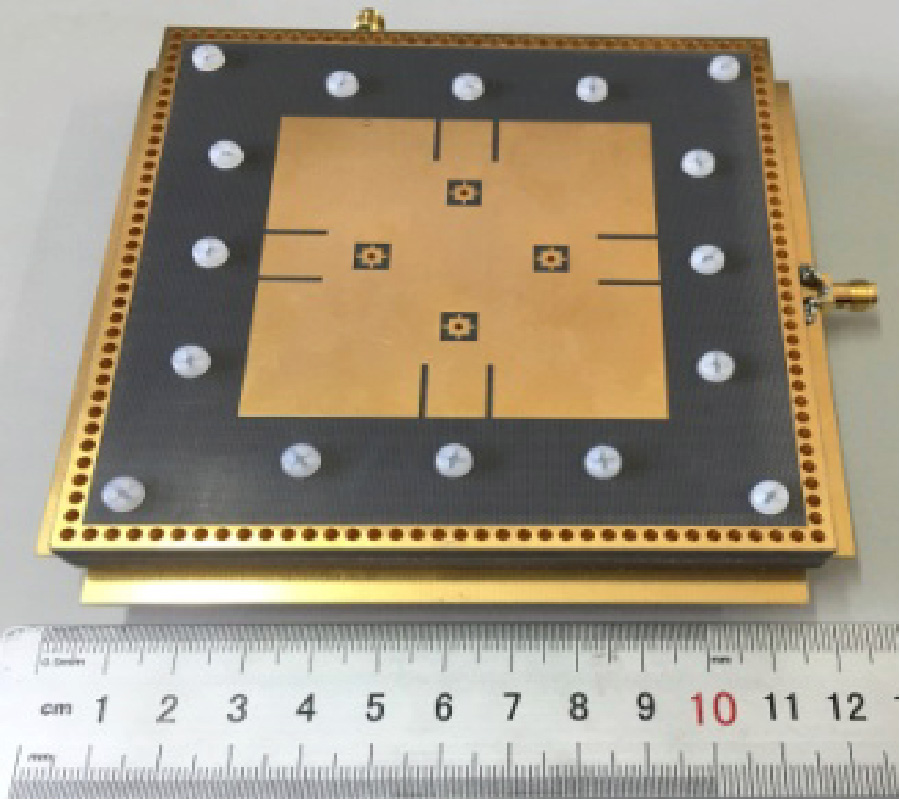
This paper proposes a novel planar direction-of-arrival (DOA) estimation antenna. The estimation capability of phase monopulse DOA estimation antennas is enhanced by integrating an RF multiplier that detects the phase relation between the sum and difference of the two received signals. So the proposed antenna provides a wide range of estimation whereas the conventional monopulse DOA estimation antennas determine the angles of half space. A prototype antenna has been fabricated, and the proposed concept was successfully confirmed.
A PLANAR EXTENDED MONOPULSE DOA ESTIMATION ANTENNA INTEGRATING AN RF MULTIPLIER
2018-02-04
PIER M
Vol. 64, 99-107
Antenna Array Using Non-Identical Truncated Circular Elements for FSLL Reduction
Bharati Singh , Nisha P. Sarwade and Kamla Prasan Ray
Resonance frequency of a Circular Microstrip Antenna (CMSA) depends on its diameter. Hence when CMSA is truncated or sectored into smaller elements, keeping the diameter same, it resonates at almost the same frequency. An analysis of the new antenna arrays designed using these truncated non-identical CMSA elements, to realize an amplitude distribution over pedestals leading to a desired first side lobe level (FSLL) has been presented. Truncated elements are designed as non-identical elements based on their gain variation with respect to the standard normalized aperture distribution coefficients. Experimental verification to validate the proposed concept and simulated results has been carried out using an antenna array with eight non-identical elements. There is good agreement between simulated and measured results at 1.76 GHz.
ANTENNA ARRAY USING NON-IDENTICAL TRUNCATED CIRCULAR ELEMENTS FOR FSLL REDUCTION
2018-02-02
PIER M
Vol. 64, 87-97
Design of a Novel UWB Microstrip Antenna with SIW Feed
Abbas Ebrahimi and Hamid Khodabakhshi
Antenna miniaturization, which is a requirement of modern wireless communication systems, is usually concomitant with the reduction of impedance bandwidth. On the other hand, small antennas should also possess stable radiation patterns across a broad frequency band, such as in UWB systems. In this paper, we propose a UWB antenna structure with a novel feeding system composed of an open cavity resonator. It has a wide relative bandwidth (of about 120%) particularly at the lower frequency limits. The variation of radiation pattern across its operating bandwidth is also negligible. The proposed antenna with the novel feed system is smaller and has a wider frequency bandwidth than other available UWB antennas in the literature. Furthermore, another antenna is proposed, which has a feeding system composed of a surface integrated resonator cavity, fabricated on a two-layer microstrip structure. It has achieved better miniaturization and bandwidth, albeit somewhat lower gain. Three prototype models of the proposed antennas are fabricated and measured, of which the frequency response is in excellent agreement with computer simulation results.
DESIGN OF A NOVEL UWB MICROSTRIP ANTENNA WITH SIW FEED