Search Results(13794)

2017-04-18
PIER Letters
Vol. 67, 75-79
A Compact Perpendicular Microscopy and Imaging System for the Detection of Fluorescent Solution Flow
Fuhong Cai , Meng Zhao and Dan Wang
Light sheet microscope is a versatile imaging tool for high imaging speed and signal to noise ratio (SNR). In this type of system, the illumination is perpendicular to the direction of detection. Due to its structural feature of perpendicular detection, the SNR is comparable to total internal reflection fluorescence (TIRF) microscopy. Therefore, the perpendicular detection system is of great application prospect. In this paper, we develope a compact optical perpendicular detection system, which can not only be utilized to measure fluorescence with high SNR, but also capture a fluorescent image of flow fluorophore.
A COMPACT PERPENDICULAR MICROSCOPY AND IMAGING SYSTEM FOR THE DETECTION OF FLUORESCENT SOLUTION FLOW
2017-04-18
PIER M
Vol. 56, 33-41
Electromagnetic Shielding Characterization of Conductive Knitted Fabrics
A. Oguz KIZILCAY , Ediz Delihasanlar , Fidan Gamze Kizilcay Abdulla and Ahmet Hayrettin Yuzer
This paper examines the electromagnetic shielding characteristics of milano, cardigan and lacoste with respect to weft and rib type composite knitted fabrics. All of these fabrics, made of hybrid yarns containing 50µm diameter metal fibres such as copper, silver and stainless steel, were produced for electromagnetic shielding purposes. The shielding e effectiveness (SE) of the fabrics was measured by reading S parameters from the signal when the sample was placed in the path of signal at the frequency range 1.7 to 2.6 GHz inside the WR430 waveguide system. After which S parameters was converted to SE values. The variation in electromagnetic shielding eff effectiveness (EMSE) with the factors, such as radiant frequency, metal type, course density and geometry, were discussed. Experimental results show that all factors, especially the geometry of the fabric, have signifi cant effect on SE. The best EMSE values were obtained by milano type knitted fabrics which was above 20dB. It was found that milano, cardigan and lacoste composite fabrics, uncommon in EMSE experiments found in literature, give better shielding performances than rib and weft composite fabrics, under the same conditions.
ELECTROMAGNETIC SHIELDING CHARACTERIZATION OF CONDUCTIVE KNITTED FABRICS
2017-04-16
PIER Letters
Vol. 67, 67-73
A Simple V-Shaped Slot Antenna with Broadband Circular Polarization
Hui-Fen Huang and Bin Wang
In this paper, a simple broadband circular polarization (CP) V-shaped slot antenna is developed. The CP antenna consists of Z-shaped feedline with a stub and a patch, and symmetrically etched two rightangled V-shaped slots (an open slot and a closed slot) along the center line. The stub is introduced for multi-resonances to obtain broadband. The broad CP and impedance bandwidths overlap by the symmetrically etched right-angled V-shaped closed slot along the center line and the Z-shaped feedline placed in a proper position. The measured results show that the proposed antenna has a broad overlapped 3-dB axial ratio (AR) bandwidth and -10 dB impedance bandwidth of 71% (2.19-4.6 GHz).
A SIMPLE V-SHAPED SLOT ANTENNA WITH BROADBAND CIRCULAR POLARIZATION
2017-04-16
PIER M
Vol. 56, 25-32
A Rank-(L, L, 1) BCD Based AOA-Polarization Joint Estimation Algorithm for Electromagnetic Vector Sensor Array
Yu-Fei Gao and Qun Wan
This paper investigates an angle of arrival (AOA) and polarization joint estimation algorithm for an L-shaped electromagnetic vector sensor array based on rank-(L, L, 1) block component decomposition (BCD) tensor modeling. The proposed algorithm can take full advantage of the multidimensional information of electromagnetic signal to obtain the parameter estimation more accurately than the matrix-based method and the existing tensor decomposition method. In addition, the algorithm can accomplish pair-matching of estimated parameters automatically. The numerical experiments demonstrate that even under the conditions of low SNR and limited snapshots, the proposed algorithm can still steadily achieve high detection probability with low estimation error, which is important for practical applications.
A RANK-(<I>L</I>, <I>L</I>, 1) BCD BASED AOA-POLARIZATION JOINT ESTIMATION ALGORITHM FOR ELECTROMAGNETIC VECTOR SENSOR ARRAY
2017-04-15
PIER B
Vol. 75, 1-12
A Review of Photonic Generation of Arbitrary Microwave Waveforms
Lam Anh Bui
This paper presents a tutorial on photonic techniques for arbitrary RF waveform generation, highlights some key results and reviews the recent developments in this area. It also predicts that photonic integration of the entire system as compact photonic chip will be the major research focus and holds the key role for future developments.
A REVIEW OF PHOTONIC GENERATION OF ARBITRARY MICROWAVE WAVEFORMS
2017-04-15
PIER C
Vol. 73, 115-126
Magnetic Field Generated by Double-Circuit Twisted Three-Phase Cable Lines
Giovanni Mazzanti , Marco Landini , Effrosyni Kandia , Andrea Bernabei and Marco Cavallina
The evaluation of the magnetic field from double-circuit twisted three-phase power cable lines misses a sound and exhaustive theoretical and experimental treatment in the literature. This paper presents a rigorous approach to the calculation of the magnetic field from double-circuit twisted three-phase cables, whereby the magnetic field generated by such cables is computed as the vector sum of the two individual fields generated by each twisted three-phase cable. This approach is validated by means of extensive measurements of the magnetic field from single- and double-circuit twisted three-phase power cables - provided by Italian utilities - identical to those installed in the field.
MAGNETIC FIELD GENERATED BY DOUBLE-CIRCUIT TWISTED THREE-PHASE CABLE LINES
2017-04-15
PIER Letters
Vol. 67, 61-66
A New Miniaturized Microstrip Branch-Line Coupler with Good Harmonic Suppression
Guowei Lian , Zhang Wang , Zhouyan He , Zhiguang Zhong , Leming Sun and Mudan Yu
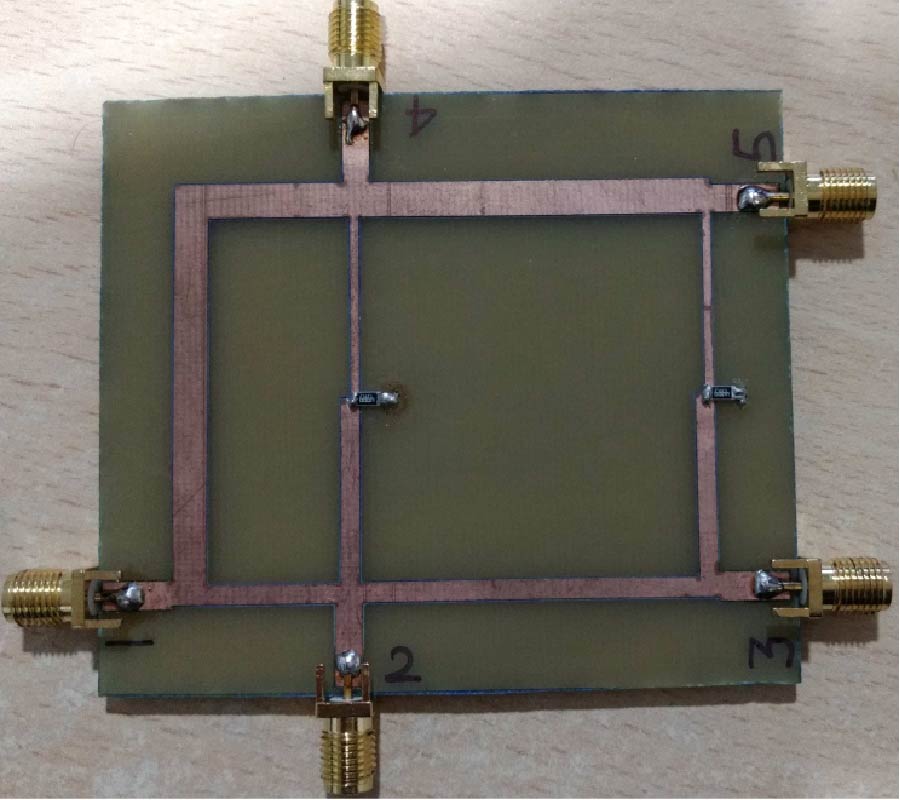
A new miniaturized microstrip branch-line coupler with good harmonic suppression is proposed in this paper. The new structure has two significant advantages, which not only effectively reduces the occupied area to 20.4% of the conventional branch-line coupler at 0.96 GHz, but also has high 6th harmonic suppression performance. The measured results indicate that a bandwidth of more than 120 MHz has been achieved while the phase difference between S21 and S31 is within 90° ± 1°. The measured bandwidth of |S21| and |S31| within 3 ± 0.3 dB are 145 MHz and 150 MHz, respectively. Furthermore, the measured insertion loss is comparable to that of a conventional branch-line coupler. The new coupler can be easily implemented by using the standard printed-circuit-board etching processes and is very useful for wireless communication systems.
A NEW MINIATURIZED MICROSTRIP BRANCH-LINE COUPLER WITH GOOD HARMONIC SUPPRESSION
2017-04-14
PIER C
Vol. 73, 105-113
Microstrip Magnetic Dipole Yagi Antenna with Enhanced Impedance Bandwidth and Reduced Size for Wideband Wireless Applications
Tian Li , Fu-Shun Zhang , Fei Gao , Qi Zhang and Yan-Li Guo
A microstrip magnetic dipole Yagi antenna with the feasibility of obtaining a wider bandwidth and relatively smaller size is proposed and demonstrated. The proposed antenna, consisting of a reflector, a driver with backed soldered SMA connector, a coupling microstrip line with three rectangular slots and three modified directors, is designed and fabricated. Good agreement between simulated and measured results is observed. Simulated and measured results reveal that the proposed antenna can provide an impedance bandwidth of 19.2% (4.95-6 GHz). Meanwhile, within the impedance bandwidth, the radiation pattern of the proposed antenna has front-to-back (F/B) ratios ranging from 10.1 dB to 26.1 dB, cross-polarization levels in the endfire direction from 47.1 dB to 73.0 dB, peak gains from 6.4 dBi to 10.4 dBi with an average peak gain of 9.6 dBi and endfire gains from 2.2 dBi to 4.3 dBi with an average endfire gain of 3.1 dBi. Additionally, the measured bandwidth of 19.2% (4.95-6 GHz) not only meets the need for certain Wi-Fi (5.2/5.8 GHz) or WiMAX (5.5 GHz) band communication application, but also provides the potential to implement multiservice transmission.
MICROSTRIP MAGNETIC DIPOLE YAGI ANTENNA WITH ENHANCED IMPEDANCE BANDWIDTH AND REDUCED SIZE FOR WIDEBAND WIRELESS APPLICATIONS
2017-04-14
PIER Letters
Vol. 67, 53-59
A Low-Cost Wideband Quasi-Yagi SIW-Based Textile Antenna
Mir Emad Lajevardi and Manouchehr Kamyab
A low-cost wideband textile antenna based on the substrate integrated waveguide (SIW) technology is proposed, and a pure copper taffeta fabric etched on a woolen felt substrate is used to realize the presented antenna. The impedance matching frequency band for the designed structure is from 2.27 GHz to 3.61 GHz, which is significantly improved compared with previous studies. The operational principle of the proposedquasi-Yagi textile antenna is also described in this paper. The antenna is fabricated and measured, and a good agreement is achieved between the simulation and experimental results. The designed antenna has themaximum gain and efficiency of 4.2dB and 84%, respectively. According to its compactness, low-cost and low-weight specifications, the proposed antenna is a good candidate for being utilizedin wearable communication devices.
A LOW-COST WIDEBAND QUASI-YAGI SIW-BASED TEXTILE ANTENNA
2017-04-14
PIER M
Vol. 56, 11-23
Multiphysics Model of Iron Powder Compacts for Efficient Microwave Processing
Jutika Devi , Mohammad Jaleel Akhtar and Pranayee Datta
A generalized multiphysics model using COMSOL Multiphysics software for optimizing the sintering process of iron powders having various green densities is developed. The modeling is facilitated by designing a 30 GHz multimode applicator, where the test sample is placed for the microwave processing. The effective dielectric and magnetic properties of the resultant metal powder compact is estimated using the effective electromagnetic model considering the idea of core - shell particle approach followed by the Lichtenecker's mixture formula. A theoretical approach relating the penetration depth, proper impedance matching and volume fraction of different density powder compacts is also discussed here. From the study, it is clear that the effective dielectric, magnetic, and thermal properties all contribute to the microwave sintering process of metal powders.
MULTIPHYSICS MODEL OF IRON POWDER COMPACTS FOR EFFICIENT MICROWAVE PROCESSING
2017-04-14
PIER
Vol. 158, 99-108
Non-Coil, Optimal Sources for Wireless Powering of Sub-Millimeter Implantable Devices
Sanghoek Kim , John S. Ho and Ada S. Y. Poon
This paper presents non-coil sources to improve the wireless power transfer efficiency for implantable device used in various medical applications --- cardiovascular devices, endoscope in the small intestine, and neurostimulator in the brain. For each application, a bound on the power transfer efficiency and the optimal source achieving such bound are analytically solved. The results reveal that depending on the depth of the implantable devices, power can be transferred to a sub-millimeter scaled receiver with the efficiency ranging from -57 dB to -33 dB, which is up to 6.6 times higher than the performance of existing coil-based source systems. The technique introduced in this paper can be broadly applied to other medical applications.
NON-COIL, OPTIMAL SOURCES FOR WIRELESS POWERING OF SUB-MILLIMETER IMPLANTABLE DEVICES
2017-04-13
PIER B
Vol. 74, 141-153
Image Formation Using Fast Factorized Backprojection Based on Sub-Aperture and Sub-Image for General Bistatic Forward-Looking SAR with Arbitrary Motion
Dong Feng , Dao Xiang An and Xiao-Tao Huang
In this paper, a fast time domain imaging algorithm called bistatic forward-looking fast factorized backprojection algorithm (BF-FFBPA) based on sub-aperture and sub-image is proposed for general bistatic forward-looking synthetic aperture radar (BFSAR) with arbitrary motion. It can not only accurately dispose the large spatial variant range cell migrations and complicated motion errors, but also achieve high imaging efficiency. First, the imaging geometry and signal model are established, and the implementation of backprojection algorithm (BPA) in the BFSAR imaging is given to provide a basis for the proposed BF-FFBPA. Then, considering motion errors, the more accurate requirements of splitting sub-aperture and sub-image in the BF-FFBPA is introduced based on the range error analysis to offer the tradeoff between the imaging quality and efficiency. Finally, the implementation and computational burden of the BF-FFBPA is provided and analyzed. Simulated results and evaluations are given to prove the correctness of the theory analysis and the validity of the proposed approach.
IMAGE FORMATION USING FAST FACTORIZED BACKPROJECTION BASED ON SUB-APERTURE AND SUB-IMAGE FOR GENERAL BISTATIC FORWARD-LOOKING SAR WITH ARBITRARY MOTION
2017-04-13
PIER B
Vol. 74, 123-139
A Hybrid Model for Electromagnetic Leakage from an Apetured Complex Metallic Enclosures
Yan-Fei Gong , Jian-Hong Hao , Lu-Hang Jiang and Jie-Qing Fan
An efficient and accurate hybrid model has been developed for the electromagnetic leakage from two apertured cascaded metallic rectangular enclosures connected by a metallic plate with an aperture covered by a non-magnetic conductive sheet excited by an electric dipole located in the enclosure. The leakage fields through the covered aperture are derived by using the dyadic Green's function and employing the approximate boundary conditions at both sides of the sheet which is regarded as an infinite conductive plate. Then, the leakage fields into the external space through the aperture regardless of its thickness at the end of the enclosure are derived based on a generalization of the method of moments (MoM). Finally, the shielding effectiveness (SE) at the target points outside the enclosure is calculated for the intermediate analysis of the leakage fields. Comparison with the full wave simulation software CST has verified the model over a wide frequency band. The hybrid model then is employed to analyze the effect of different factors including the thickness and the conductivity of the conductive sheet on the SE, and the corresponding physical mechanisms of the leakage fields are also illuminated. The hybrid model can also be extended to deal with other cases, including the whole plate made of non-magnetic conductive material without apertures, the infinite thickness of the aperture at the end of the enclosure, and the aperture at the end of the enclosure is also covered by a non-magnetic conductive sheet.
A HYBRID MODEL FOR ELECTROMAGNETIC LEAKAGE FROM AN APETURED COMPLEX METALLIC ENCLOSURES
2017-04-13
PIER B
Vol. 74, 109-121
Fast Converging CFIE-MoM Analysis of Electromagnetic Scattering from PEC Polygonal Cross-Section Closed Cylinders
Mario Lucido , Francesca Di Murro , Gaetano Panariello and Chiara Santomassimo
The analysis of the electromagnetic scattering from perfectly electrically conducting (PEC) objects with edges and corners performed by means of surface integral equation formulations has drawbacks due to the interior resonances and divergence of the fields on geometrical singularities. The aim of this paper is to show a fast converging method for the analysis of the scattering from PEC polygonal cross-section closed cylinders immune from the interior resonance problems. The problem, formulated as combined field integral equation (CFIE) in the spectral domain, is discretized by means of Galerkin method with expansion functions reconstructing the behaviour of the fields on the wedges with a closed-form spectral domain counterpart. Hence, the elements of the coefficients' matrix are reduced to single improper integrals of oscillating functions efficiently evaluated by means of an analytical asymptotic acceleration technique.
FAST CONVERGING CFIE-MOM ANALYSIS OF ELECTROMAGNETIC SCATTERING FROM PEC POLYGONAL CROSS-SECTION CLOSED CYLINDERS
2017-04-13
PIER M
Vol. 56, 1-10
Diagonal Factorization of Integral Equation Matrices via Localizing Sources and Orthogonally Matched Receivers
Robert Adams and John C. Young
A procedure is reported to determine accurate, invertible, block-diagonal factorizations for matrices obtained by discretizing integral equation formulations of electromagnetic interaction problems. The algorithm is based on the combination of localizing source/receiver transformations with orthogonally matched receiver/source transformations. The resulting factorization provides a single, sparse data structure for the system matrix and its inverse, and no approximation is required to convert between the two. Numerical examples illustrate the performance of the factorization for electromagnetic scattering from perfectly conducting elliptical cylinders of different electrical size.
DIAGONAL FACTORIZATION OF INTEGRAL EQUATION MATRICES VIA LOCALIZING SOURCES AND ORTHOGONALLY MATCHED RECEIVERS
2017-04-13
PIER M
Vol. 55, 211-219
Fast and Stable Integration Method for the Aperture Admittance of an Open-Ended Coaxial Probe Terminated into Low-Loss Dielectrics
Licheng Zhou , Yang Ju , Peiyu Wang and Yongmao Pei
The utilization of an open-ended coaxial probe for characterization of dielectric properties or quantitative nondestructive detection of defects in materials firstly requires evaluating the aperture admittance. For the case that the probe is terminated into low-loss dielectrics backed by a conducting sheet, however, the admittance expression encounters poles in the vicinity of the path of integration, resulting in low convergence rate or even overflow in numerical quadrature. In this study, locations and properties of the singularities of the integral formulation for generally lossy, low-loss, and lossless dielectric slabs backed by a perfectly conducting sheet are investigated above all. Subsequently, making use of the contour integral technique, a fast and stable integration method is put forward to calculate the admittance integral formulation. Finally, numerical experiments are conducted to justify the validity and efficiency of the proposed integration method for low-loss dielectric cases by comparison with the traditional integration method as well as commercial FEM software.
FAST AND STABLE INTEGRATION METHOD FOR THE APERTURE ADMITTANCE OF AN OPEN-ENDED COAXIAL PROBE TERMINATED INTO LOW-LOSS DIELECTRICS
2017-04-12
PIER B
Vol. 74, 93-107
Inversion of an Inductive Loss Convolution Integral for Conductivity Imaging
Joe R. Feldkamp
Electrical conductivity imaging in the human body is usually pursued by either electrical impedance tomography or magnetic induction tomography (MIT). In the latter case, multiple coils are almost always used, so that nonlinear reconstruction is preferred. Recent work has shown that single-coil, scanning MIT is feasible through an analytical 3D convolution integral that relates measured coil loss to an arbitrary conductivity distribution. Because this relationship is linear, image reconstruction may proceed by any number of linear methods. Here, a direct method is developed that combines several strategies that are particularly well suited for inverting the convolution integral. These include use of a diagonal regularization matrix that leverages kernel behavior; transformation of the minimization problem to standard form, avoiding the need for generalized singular value decomposition (SVD); centering the quadratic penalty norm on the uniform solution that best explains loss data; use of KKT multipliers to enforce non-negativity and manage the rather small active set; and, assignment of the global regularization parameter via the discrepancy principle. The entire process is efficient, requiring only one SVD, and provides ample controls to promote proper localization of structural features. Two virtual phantoms were created to test the algorithm on systems comprised of ~11,000 degrees of freedom.
INVERSION OF AN INDUCTIVE LOSS CONVOLUTION INTEGRAL FOR CONDUCTIVITY IMAGING
2017-04-12
PIER C
Vol. 73, 97-104
Novel Circularly Polarized SIW Cavity-Backed Antenna with Wide CP Beamwidth by Using Dual Orthogonal Slot Split Rings
Jian-Quan Huang , Dajun Lei , Chunzhi Jiang , Zhenhua Tang , Feng Qiu , Ming Yao and Qing-Xin Chu
A circularly polarized (CP) substrate integrated waveguide (SIW) cavity-backed antenna based on dual concentric, orthogonal slot split ring resonators is proposed and experimentally studied. The circularly polarized wave is generated by two split ring-slots etched in the upper metal layer of the SIW cavity resonator. These two slots are excited by a coaxial probe located in the gap of the external slot split ring to radiate the right-handed circularly polarized (RHCP) wave. By rotating the dual split slot ring resonators and the probe by 45 degreesrelative to the backed cavity, a better match characteristic and a slightly higher radiation gain are obtained. Because of theconcentricity of radiant split ring slots, the beamwidth of the circular polarization is obviously increased.From the experimental results, the impedance bandwidth was 10.8% for the reflection coefficient less than -10 dB, the axial ratio (AR) bandwidth was 1.54% for the AR less than 3 dB, and the RHCP gain was 4.44 dBi. Moreover, the 3-dB axial ratio beamwidth at the centre frequency of 10.40 GHz has been extended to 142° in the angular range from -78° to +64°.
NOVEL CIRCULARLY POLARIZED SIW CAVITY-BACKED ANTENNA WITH WIDE CP BEAMWIDTH BY USING DUAL ORTHOGONAL SLOT SPLIT RINGS
2017-04-12
PIER M
Vol. 55, 203-209
The Effect of Carbon Nanotubes Concentration on Complex Permittivity of Nanocomposites
Patrizia Savi , Muhammad Yasir , Mauro Giorcelli and Alberto Tagliaferro
There is growing interest in the use of nanocomposites based on carbon nanotubes (CNT) due to their excellent mechanical, thermal and electrical properties. The electromagnetic characteristics of nanocomposites with different types of multi-walled carbon nanotubes were investigated. CNTs with different geometries (length and diameter) were chosen in order to analyze the effect of the geometrical parameters on the electromagnetic properties. Nanocomposites with various percentages of CNT were made and the number of CNTs per cm3 in the composite was computed. CNTs were characterized by Field Emission Scanning Electron Miscroscopy (FESEM) and Raman spectroscopy. The complex permittivity of the NCs was measured with two different techniques, and the variation of the permittivity with the number of CNT per cm3 was investigated.
THE EFFECT OF CARBON NANOTUBES CONCENTRATION ON COMPLEX PERMITTIVITY OF NANOCOMPOSITES
2017-04-11
PIER C
Vol. 73, 87-95
Inkjet Printing of a 20 GHz Coplanar Waveguide Monopole Antenna Using Copper Oxide Nanoparticles on Flexible Substrates: Effect of DROP Spacing on Antenna Performance
Shaimaa Mohassieb , Khaled Kirah , Edgar Dorsam , Ahmed Saad G. Khalil and Hadia El-Hennawy
Coplanar monopole antennas printed using copper oxide nanoparticles on flexible substrates are characterized in order to study the effect of the ink drop spacing on the antenna parameters. Polyethylene Terephthalate and Epson paper were the chosen flexible substrates, and the antennas were designed to operate at 20 GHz. A maximum conductivity of 2.8×10⁷ Ω−1m−1 was obtained for the films printed on Polyethylene Terephthalate using a drop spacing of 20 μm. The corresponding antenna achieved a gain and an efficiency of 1.82 dB and 97.6%, respectively. Experiments showed that smaller drop spacings lead to bulging of the printed lines while the antenna performance worsens for longer ones. At the same drop spacing, antennas printed on Epson paper substrate showed a -10 dB return loss bandwidth which extended from 17.9 GHz to 23.3 GHz, leading to a fractional bandwidth of 26.0%.
INKJET PRINTING OF A 20 GHZ COPLANAR WAVEGUIDE MONOPOLE ANTENNA USING COPPER OXIDE NANOPARTICLES ON FLEXIBLE SUBSTRATES: EFFECT OF DROP SPACING ON ANTENNA PERFORMANCE