Search Results(13794)

2017-04-30
PIER Letters
Vol. 67, 97-102
Compact and Low Profile MIMO Antenna for Dual-WLAN-Band Access Points
Xinyao Luo , Jiade Yuan and Kan Chen
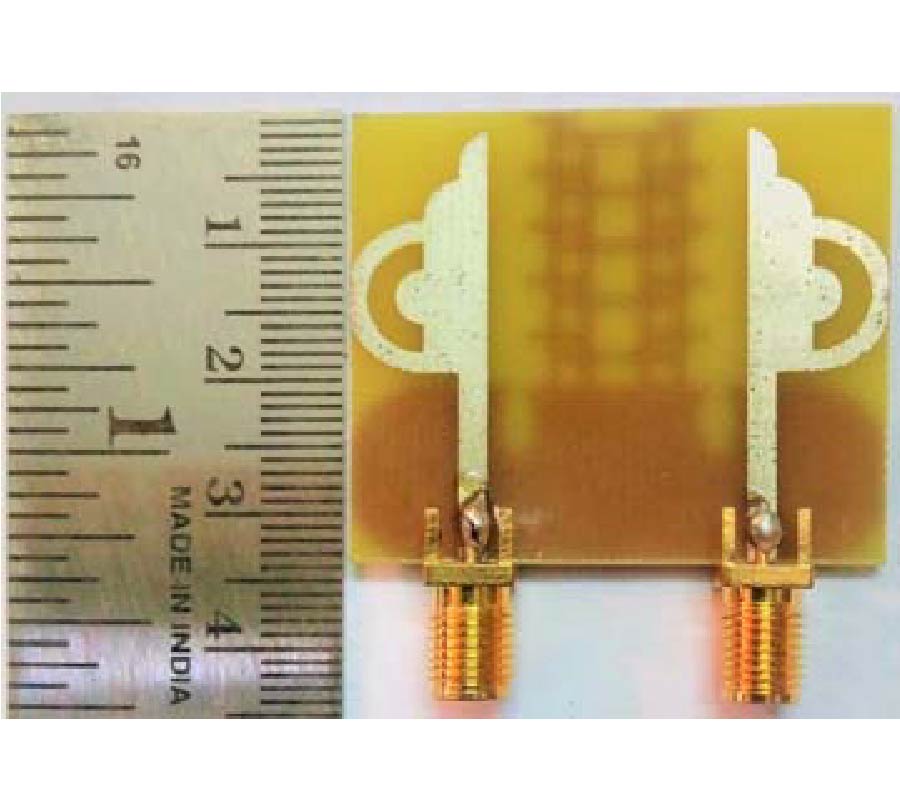
A compact directional MIMO antenna operating in 2.4 and 5 GHz wireless local area network (WLAN) bands is presented. The compactness of the proposed multiple-input multiple-output (MIMO) antenna can be attained through using miniaturized antenna elements and meanwhile employing an extremely narrow edge-to-edge inter-element space (3 mm). Two novel miniaturized planar inverted-F antenna (PIFA) elements which share a common ground are designed, and each element has a dimension of 31 mm × 17 mm and a profile of 4.2 mm. By etching three slots on the ground, the port isolation can be significantly enhanced, which can even reach a maximum of 54 dB at 2.45 GHz. A desirable directional radiation pattern is obtained, and the calculated envelope correlation coefficient is better than 0.01.
COMPACT AND LOW PROFILE MIMO ANTENNA FOR DUAL-WLAN-BAND ACCESS POINTS
2017-04-29
PIER C
Vol. 73, 177-185
Dynamic Selection of Relay Node Based on Channel Fading Coefficient for Reentry Hypersonic Vehicles
Lei Shi , Jinxin Wei , Xiaoping Li , Bo Yao and Bowen Bai
The development of near-space hypersonic vehicles is confronted with the ``blackout'' problem of the plasma sheath. As electronic density on the leeward surface is lower than that on the windward surface during the reentry process, a low Earth orbit (LEO) satellite may be used to mitigate this problem. In this study, the Iridium system, as a low-orbit relay satellite system, is utilized to evaluate the feasibility of using a LEO satellite. First, the incident angle of the electromagnetic waves radiating from the vehicles to various potential relay satellites is calculated by the STK software. Second, the transmission coefficient of the electromagnetic wave in the plasma is obtained by using the equivalent wave impedance method to present the attenuation effect of the plasma sheath channel. Finally, the attenuation coefficients of each channel between the aircraft and the potential satellite are used as a parameter to select the best relay in the reentry process of the vehicles. Simulation results show that the use of LEO satellites for relay can significantly reduce the communication interruption time during the reentry process by 32.6% for typical scenarios.
DYNAMIC SELECTION OF RELAY NODE BASED ON CHANNEL FADING COEFFICIENT FOR REENTRY HYPERSONIC VEHICLES
2017-04-28
PIER C
Vol. 74, 1-8
A Circularly Polarized Antenna for Dual Band Operation at 2.45 GHz and 5.10 GHz
Stefano Maddio , Giuseppe Pelosi , Monica Righini and Stefano Selleri
This paper describes the design and experimental characterization of a circular polarized printed antenna for dual-band WiFi operation at 2.45 GHz and 5.10 GHz. The patch design is based on a combination of slits loading and gap-coupling applied to a disc patch in order to enhance the radiation performances in terms of polarization purity and bandwidth at the two operation frequencies. Experimental validations confirm a maximum gain around 6.0 dB for both 2.45 and 5.10 GHz, as well as an axial ratio as low as 0.5 dB and a return loss exceeding 15 dB on the operating frequencies. These characteristics are suitable for operationing in IEEE802.11x networks.
A CIRCULARLY POLARIZED ANTENNA FOR DUAL BAND OPERATION AT 2.45 GHZ AND 5.10 GHZ
2017-04-27
PIER M
Vol. 56, 101-109
Estimation of Specific Absorption Rate Using Infrared Thermography for the Biocompatibility of Wearable Wireless Devices
Karthik Varshini and Thipparaju Rama Rao
Wearable wireless technology has developed as an exciting topic over the last couple of years. With the extensive use of Wearable Wireless Devices (WWD) in greater proximity to the body for various wireless applications, the concern about biological effects due to the interaction of human tissues with the radiations is growing. In this research, we investigate the application of Infrared Thermography (IRT) to obtain temperature dynamics and reconstruct Specific Absorption Rate (SAR) to evaluate the exposure amenability of WWDs. A microstrip monopole antenna on a wearable substrate is used to determine the biological effects of the interaction of electromagnetic (EM) waves on the body. SAR is obtained using EM field simulations and by reconstruction from thermal measurements with the use of Bio-heat equationsfor a continuous exposure of 300 s. Validation of IRT to reconstruct SAR is demonstrated by comparison with EM computations. The maximum SAR was 32 mW/kg, for simulations and 35 mW/kg, from reconstruction after IRT experiments. The maximum temperature change in both cases was always less than 1˚C. The difference between the SAR obtained through IRT and simulation tools accounted for an average of 8.7%. Information acquired using IR temperature dynamics can yield SAR values which can assess radio frequency exposure compliance for WWD at frequencies used for modern wireless technologies, with reliability.
ESTIMATION OF SPECIFIC ABSORPTION RATE USING INFRARED THERMOGRAPHY FOR THE BIOCOMPATIBILITY OF WEARABLE WIRELESS DEVICES
2017-04-27
PIER M
Vol. 56, 91-100
Analysis of Post-Wall Waveguides and Circuits Using a Model of Two-Dimensional Photonic Crystals
Vakhtang Jandieri , Hiroshi Maeda , Kiyotoshi Yasumoto and Daniel Erni
A semi-analytical method to analyze post-wall waveguides and circuits based on the model of two-dimensional photonic crystals formed by layered periodic arrays of circular cylinders is presented. The propagation constant of the fundamental TE mode, the attenuation constant due to the leakage loss and the effective width of an equivalent rectangular waveguide are calculated. Using the concept of the effective width, the original structure is replaced by an equivalent rectangular structure. When additional metallic posts are loaded in the rectangular waveguide, functional post-wall waveguide-based passive circuits are formed. The S-parameters of the post-wall circuits, which act as bandpass filters, are calculated using the image theory combined with the lattice sums technique.
ANALYSIS OF POST-WALL WAVEGUIDES AND CIRCUITS USING A MODEL OF TWO-DIMENSIONAL PHOTONIC CRYSTALS
2017-04-26
PIER Letters
Vol. 67, 89-95
Flexible and Conformal Printed Monopoles Antennas
Asmae Hachi , Hassan Lebbar and Mohamed Himdi
This paper presents the development and design of flexible and conformal printed monopoles antennas. The main objective is to control the level of radiation in broadside antenna from zero to a maximum by changing the curvature of printed board. Two printed antennas types are considered: thin wire and disk monopole. Furthermore, with the curving radius R increasing, the classical null on the broadside radiation pattern disappears gradually for both wire and disk. Increasing the curvature radius of conformal flexible antenna, and keeping all other parameter's value, wire monopole antenna becomes mismatched while the disk monopole antenna remains matched for all radius of curvature. The simulated results of various monopoles are compared successfully with measurements.
FLEXIBLE AND CONFORMAL PRINTED MONOPOLES ANTENNAS
2017-04-24
PIER C
Vol. 73, 167-176
Dual-Band Omnidirectional Circularly Polarized Patch Antenna with Etched Slots and Shorting Vias
Hong-Yin Zhang , Fu-Shun Zhang , Can Wang and Tian Li
A dual-band omnidirectional circularly polarized (CP) patch antenna with conical radiation patterns is presented in this paper. The antenna consists of a patch with inclined slots, a ground plane with L-shaped slots and a coaxial probe. In addition, by loading shorting vias between the patch and the ground plane, the vertical polarizations of the proposed antenna at TM01 and TM02 modes can be obtained. Two sets of slots etched on the ground and the patch contribute to the horizontal polarizations for the two modes, respectively. Omnidirectional CP fields can be achieved at both resonant modes when the two orthogonal polarizations are equal in amplitude and different in phase by 90°. To verify the design, a prototype operating at 2.4 GHz WLAN and 3.5 GHz WiMAX bands has been fabricated and measured. The measured average axial ratios (ARs) at two resonant modes in the azimuth plane are 1.1 and 1.5 dB, respectively. Experimental results show good agreement with the simulated data.
DUAL-BAND OMNIDIRECTIONAL CIRCULARLY POLARIZED PATCH ANTENNA WITH ETCHED SLOTS AND SHORTING VIAS
2017-04-23
PIER M
Vol. 56, 81-90
Rough Surface Scattering via Two-Way Parabolic Integral Equation
Mark Spivack and Orsola Rath Spivack
This paper extends the parabolic integral equation method, which is very effective for forward scattering from one-dimensional rough surfaces, to include backscatter. This is done by applying left-right splitting to a modi ed two-way governing integral operator, to express the solution as a series of Volterra operators; this series describes successively higher-order surface interactions between forward and backward going components, and allows highly efficient numerical evaluation. This and equivalent methods such as ordered multiple interactions have been developed for the full Helmholtz integral equations, but not previously applied to the parabolic Green's function. Equations are derived for both Dirichlet and Neumann boundary conditions (TE and TM).
ROUGH SURFACE SCATTERING VIA TWO-WAY PARABOLIC INTEGRAL EQUATION
2017-04-22
PIER B
Vol. 74, 155-171
A Novel DNG Medium Formed by Ferromagnetic Microwire Grid
Tarun Kumar and Natarajan Kalyansundaram
Effective permittivity and permeability of a medium consisting of an infinite number of ferromagnetic microwires are evaluated in this paper. Analysis is carried out with the help of local and average fields inside a unit cell. In the literature, effective permittivity of the microwire grid is obtained by assuming the grid as an impedance loaded surface. The analysis is applicable only for the case of TMz polarized normally incident wave. Proposed analysis enable us to evaluate all the three diagonal components of effective permittivity and permeability for arbitrarily incident uniform plane wave having arbitrary polarization angle. Numerical results are obtained through MATLAB, and a comparison is done with the results available in the literature for validation. Numerical results have shown a DNG like behaviour of the medium for a TMz polarized incident wave.
A NOVEL DNG MEDIUM FORMED BY FERROMAGNETIC MICROWIRE GRID
2017-04-21
PIER C
Vol. 73, 157-165
A Low-Profile, Wideband, Dual-Polarized Patch Dipole with Unidirectional Radiation Patterns
Ruina Lian and Ying-Zeng Yin
A low-profile, wideband dual-polarized antenna with unidirectional radiation patterns is the design goal of this paper. To obtain such antenna characteristics, the design is divided into two steps. First, a coax-feed wideband antenna element with a simple geometry is proposed. The antenna element consists mainly of a quasi-square patch-dipole, a coupling E-shaped feeding structure and a shorting pin. The electromagnetic coupling between the feeding structure and the non-contact quasi-square patch can be flexibly controlled by a pair of fan-shaped stubs. Secondly, two pairs of the proposed antenna elements are selected to construct a dual-polarized antenna. To further reduce the profile of the antenna, two techniques are utilized. One is the mutual coupling distributing among the elements while the other is to add four rectangular stubs within the inner region. A prototype of the dual-polarized antenna is fabricated and measured. Measurement results demonstrate that the prototype antenna obtains an overlapped fractional bandwidth of 38.9% from 1.7 to 2.52 GHz with a good isolation higher than 32 dB. Both unidirectional radiation patterns with front-to-back ratios better than 20 dB across the whole frequency band and cross polarization levels lower than -22 dB in most operating frequency band are obtained. Additionally, the dual-polarized antenna achieves average gains about 9.9 dBi and 10.1 dBi for Port 1 and Port 2, respectively.
A LOW-PROFILE, WIDEBAND, DUAL-POLARIZED PATCH DIPOLE WITH UNIDIRECTIONAL RADIATION PATTERNS
2017-04-21
PIER C
Vol. 73, 145-156
Slot Loaded Compact Microstrip Patch Antenna for Dual Band Operation
Avisankar Roy , Sunandan Bhunia , Debasree Chanda Sarkar and Partha Pratim Sarkar
A novel design of a compact microstrip patch antenna using meandering technique is proposed in this paper where the designed antenna seems to behave as a microstrip patch loaded with conducting strips. A rectangular microstrip patch antenna with addition of conducting strip radiates at much lower frequency than a conventional rectangular microstrip antenna, due to increase of resonant length, but it also causes the increase in total size of the antenna. In this article, the resonant frequency has been lowered significantly by loading a regular rectangular microstrip patch antenna with rectangular slot in a proper position in such a way that the whole structure looks like a strip loaded radiator. About 86.5% size reduction has been achieved experimentally with very good agreement of simulated and measured results. The equivalent circuit and approximate resonant frequency calculation have been discussed in this paper.
SLOT LOADED COMPACT MICROSTRIP PATCH ANTENNA FOR DUAL BAND OPERATION
2017-04-21
PIER Letters
Vol. 67, 81-88
Novel Smart Noise Jamming Suppression Method Based on Smeared Spectrum
Jiaqi Ren and Pan Wang
This study proposes an anti-jamming scheme for linear frequency modulated (LFM) radars to combat smart noise jamming, which is a newly proposed pattern that is very effective against LFM radars. First, by utilizing the smeared spectrum technique, the chirp rates of the target return and jamming signal can be changed. The target return and jamming signal then exhibit different characteristics after the application of matched filters. Finally, the true target can be distinguished from the smart noise jamming, which is suppressed by the reconstruction and subtraction in the receiving signal. Numerical experiments demonstrate the feasibility and practicability of the proposed anti-jamming device, which is also verified as having a superior performance over existing jamming suppression schemes.
NOVEL SMART NOISE JAMMING SUPPRESSION METHOD BASED ON SMEARED SPECTRUM
2017-04-21
PIER M
Vol. 56, 71-79
Dual-Band Composite Wideband Absorbing Material for Broadband Antenna in-Band Radar Cross Section Reduction
Mao Long , Wen Jiang and Shu-Xi Gong
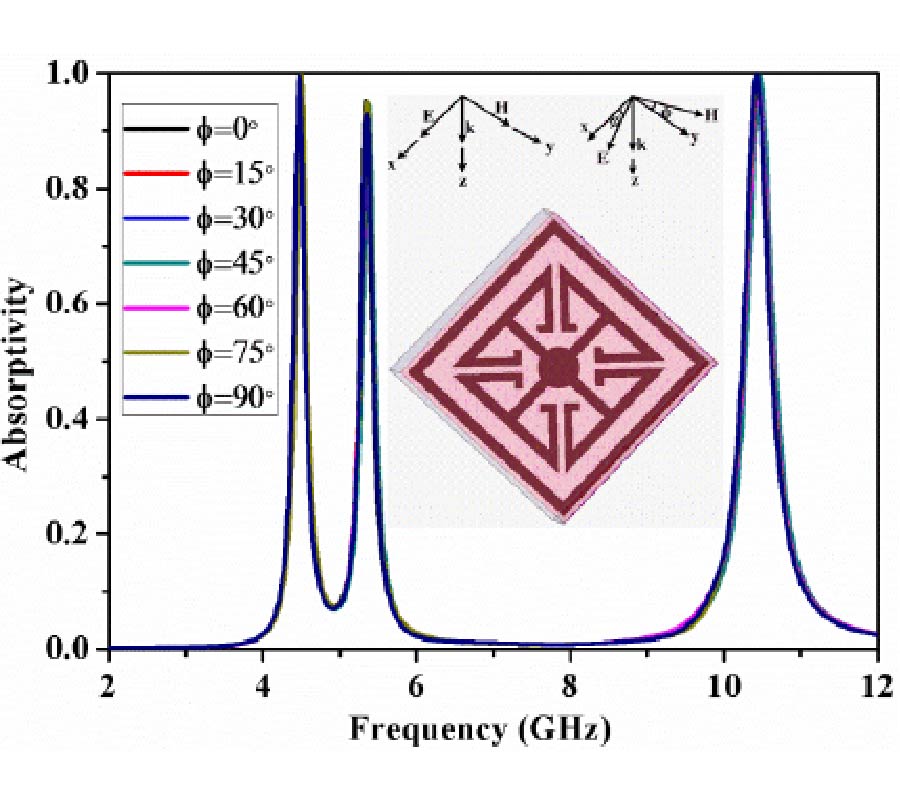
A composite wideband absorbing material (WAM) covering dual bands is designed, to reduce the in-band radar cross section (RCS) for broadband antenna in this paper. The upper layer is a traditional absorber while the lower one is a dual-band frequency selective surface (FSS), which is formed by a square ring and an improved Jerusalem cross structure. The absorbing band has been broadened to 112% compared with the magnetic sheet without FSS. Over C and X bands, the absorption rate is over 90%. By using the FSS-based WAM as the ground plane of a Vivaldi antenna, substantial RCS reduction is obtained from 2-18 GHz. Moreover, the RCS is reduced remarkably over -80°-80° incident angles except for minority angles, with the radiation performance preserved at the same time. The experimental results are in good agreement with the simulated ones.
DUAL-BAND COMPOSITE WIDEBAND ABSORBING MATERIAL FOR BROADBAND ANTENNA IN-BAND RADAR CROSS SECTION REDUCTION
2017-04-20
PIER M
Vol. 56, 63-70
Magnetically Tuned Two-Component Microwave Metamaterial
Oleg Rybin and Sergey Shulga
In this study, the effective magnetic response of magnetic metamaterial is considered in the microwave frequency range. The metamaterial is an infinite isotropic dielectric host medium with periodically embedded ferric cylindrical inclusions. It is assumed that the inclusions are partially magnetized by a dc bias magnetic field. The electromagnetic wave propagation is considered in the direction of bias magnetic field and transverse to it. It is shown that the real part of effective relative permeability can have Re(μeff)<0 or 0< Re(μeff)<1 or Re(μeff)>1 subject to the value of bias field.
MAGNETICALLY TUNED TWO-COMPONENT MICROWAVE METAMATERIAL
2017-04-20
PIER
Vol. 159, 1-13
Multilayered Broadband Antenna for Compact Embedded Implantable Medical Devices: Design and Characterization
Aleix Garcia-Miquel , Sergio Curto , Neus Vidal , Jose Maria Lopez-Villegas , Francisco Manuel Ramos and Punit Prakash
Design and characterization of a multilayered compact implantable broadband antenna for wireless biotelemetry applications is presented in this paper. The main features of this novel design are miniaturized size, structure that allows integration of electronic circuits of the implantable medical device inside the antenna, and enhanced bandwidth that mitigates possible frequency detuning caused by heterogeneity of biological tissues. Using electromagnetic simulations based on the finite-difference time-domain method, the antenna geometry was optimized to operate in the 401-406 MHz Medical Device Radio communications service band. The proposed design was simulated implanted in a muscle tissue cuboid phantom and implanted in the arm, head, and chest of a high-resolution whole-body anatomical numerical model of an adult human male. The antenna was fabricated using low-temperature co-fired ceramic technology. Measurements validated simulation results for the antenna implanted in muscle tissue cuboid phantom. The proposed compact antenna, with dimensions of 14 mm × 16 mm × 2 mm, presented a -10 dB bandwidth of 103 MHz and 92 MHz for simulations and measurements, respectively. The proposed antenna allows integration of electronic circuit up to 10 mm × 10 mm × 0.5 mm. Specific absorption rate distributions, antenna input power, radiation pattern and the transmission channel between the proposed antenna and a half-wavelength dipole were evaluated.
MULTILAYERED BROADBAND ANTENNA FOR COMPACT EMBEDDED IMPLANTABLE MEDICAL DEVICES: DESIGN AND CHARACTERIZATION
2017-04-19
PIER C
Vol. 73, 137-144
A Broadband Modified T-Shaped Planar Dipole Antenna for UHF RFID Tag Applications
Ikram Aznabet , Mohammed Ali Ennasar , Otman El Mrabet , Gianfranco Andia-Vera , Mohsine Khalladi and Smail Tedjini
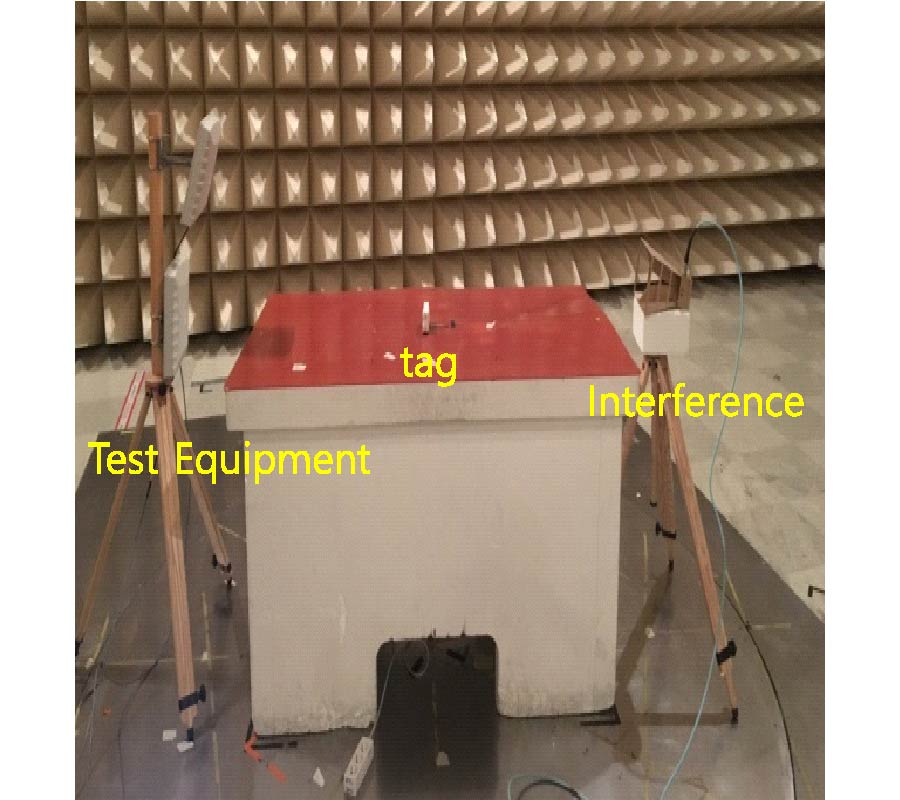
In this paper, we report a single layer modified T-shaped dipole antenna for UHF-RFID tag applications. The designed RFID tag antenna consists of a pair of T-shaped dipole strips loaded with four half discs patches and a tag chip placed in the center. The antenna's size is 80×40×1.6 mm3. Performance of the proposed design was investigated with simulations and measurements. The main feature of this design is that the RFID tag antenna can operate effectively at 868 MHz and 915 MHz frequency bands which make it broadband. The maximum reading range measured in an anechoic chamber is 4.25 m and 5.27 m at 915 MHz and 867.5 MHz, respectively. Furthermore, the RFID tag antenna can work on metallic plates when inserting a foam spacer between them. The final result has a simple configuration, low profile and can be suitable for practical applications dealing with free-space and metallic objects.
A BROADBAND MODIFIED T-SHAPED PLANAR DIPOLE ANTENNA FOR UHF RFID TAG APPLICATIONS
2017-04-19
PIER C
Vol. 73, 127-136
A Broadband Dual-Polarized Magneto-Electric Dipole Antenna for 2G/3G/LTE/WiMAX Applications
Zuming Li , Yufa Sun , Ming Yang , Zhifeng Wu and Peiquan Tang
A novel broadband dual-polarized magneto-electric (ME) dipole antenna is proposed for 2G/3G/LTE/WiMAX applications. The proposed antenna has stair-shaped feeding strips to impart a wide impedance bandwidth to it and a rectangular box-shaped reflector to enhance its stability in radiation patterns and high gain over the operating frequencies. The measured results show that a common impedance bandwidth is 80% with standing-wave ratio (SWR) ≤ 1.5 from 1.68 to 3.92 GHz and port-to-port isolation larger than 25 dB within the bandwidth. The measured antenna gains vary from 9.2 to 12 dBi and from 9.2 to 11.8 dBi for port 1 and port 2, respectively. The antenna has nearly symmetrical radiation patterns with low back-lobe radiation both in horizontal and vertical planes, and broadside radiation patterns with narrow beam can also be obtained.
A BROADBAND DUAL-POLARIZED MAGNETO-ELECTRIC DIPOLE ANTENNA FOR 2G/3G/LTE/WIMAX APPLICATIONS
2017-04-19
PIER M
Vol. 56, 53-61
A Novel Non-Coherent Micro-Doppler Imaging Method Using Hybrid Optimization
Mahdi Safari and Ali Abdolali
Conventional radar imaging methods use coherent analysis which highlights the necessity of signal phase measurement setups and complex inverse algorithms. To mitigate these drawbacks, this paper proposes a novel phase-less imaging algorithm. A nonlinear over-determined system of equations based on signal Doppler shift is developed, and a new error function originated from least square method is introduced. To obtain the exact position of targets, hybrid optimization is applied to the achieved error function. Simulation results demonstrate that the proposed method is well capable of detecting the targets containing strong point scatterers, even with the distance of 1cm. Also, the resolution of imaging algorithm for point scatterer circumstances is obtained in the order of millimeter. Concurrent with the priory imaging algorithms with the same imaging setups using proposed method reduces complexity and increases imaging swiftness.
A NOVEL NON-COHERENT MICRO-DOPPLER IMAGING METHOD USING HYBRID OPTIMIZATION
2017-04-19
PIER M
Vol. 56, 43-52
A New GE/PSO Antenna Arrays Synthesis Technique and Its Application to DOA Estimation
Amr H. Hussein
Direction of arrival estimation has a noteworthy significance in numerous applications, such as radar systems, smart antennas, sonar, mobile communications, and space communications. The algorithms used to estimate the direction of arrival are to some degree complex and time consuming. Also, the number of antenna elements is a discriminating parameter for assessing the performance of the DoA technique. For real time systems, quick and savvy techniques are required. Along these lines, decreasing the estimation time and also reducing the system cost while keeping a generally high precision are crucial issues. In this paper, a new technique for linear antenna arrays synthesis using optimized number of antenna elements and its application to direction of arrival estimation is introduced. The synthesized arrays exhibit approximately the same radiation pattern as the original arrays. The optimized antenna arrays are synthesized using reduced number of antenna elements. In this case, the number of antenna elements reduction will minimize the system cost and decrease the number of picked samples from the different signal sources. As the number of samples decreases, the dimensions of the steering matrix and data correlation matrix are reduced. In this context, the computational burden, estimation time, and system cost are optimized. The proposed technique can be applied to single or multi-snapshot DoA estimation techniques.
A NEW GE/PSO ANTENNA ARRAYS SYNTHESIS TECHNIQUE AND ITS APPLICATION TO DOA ESTIMATION
2017-04-19
PIER
Vol. 158, 109-119
An Efficient Numerical Contour Deformation Method for Calculating Electromagnetic Scattered Fields from 3-D Convex Scatterers
Yu Mao Wu , Weng Cho Chew , Ya-Qiu Jin , Tie-Jun Cui and Li Jun Jiang
We consider the accuracy improvement of the high frequency scattered fields from 3-D convex scatterers. The Fock currents from the convex scatterers are carefully studied. Furthermore, we propose the numerical contour deformation method to calculate the Fock currents with frequency independent workload and error controllable accuracy. Then, by adopting the Fock currents and the incremental length diffraction coefficient (ILDC) technique, the scattered fields are clearly formulated. Compared to physical optics (PO) scattered fields from 3-D convex sphere, numerical results demonstrate significant accuracy enhancement of the scattered field via the Fock current approach.
AN EFFICIENT NUMERICAL CONTOUR DEFORMATION METHOD FOR CALCULATING ELECTROMAGNETIC SCATTERED FIELDS FROM 3-D CONVEX SCATTERERS