Robust and Flexible Synthesis of Equi-Ripple Multiband Filtering Functions in the Pole-Zero Form
Sai Peng ,
Jiyuan Fan ,
Ping Zhao ,
Nan Shen ,
Jinzhu Zhou and
Qingqiang Wu
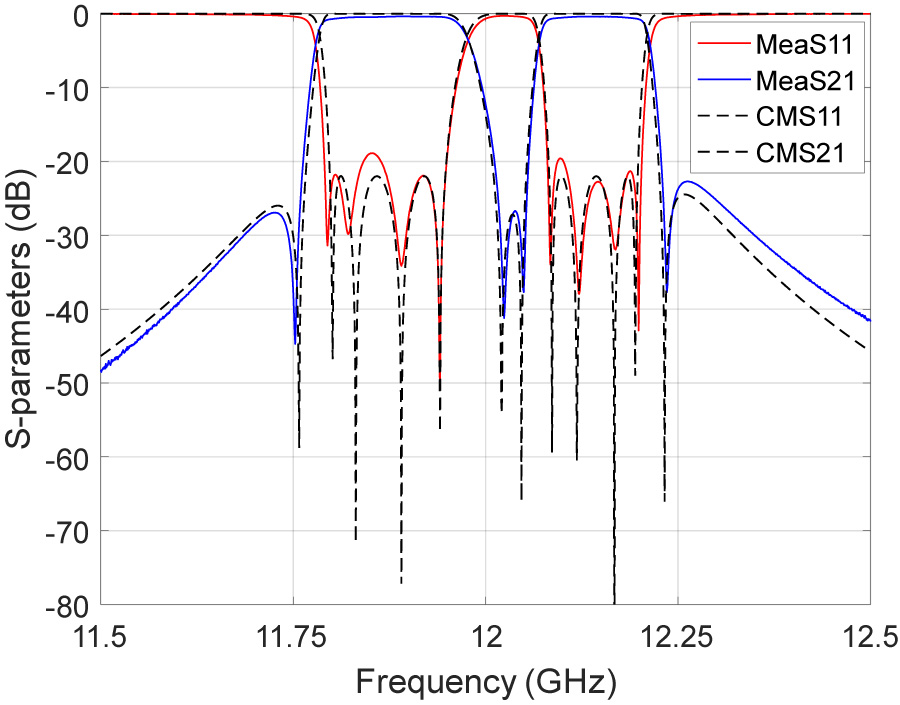
This paper presents a numerical iterative approach to synthesizing multiband filtering functions that can realize equi-ripple in-band responses and enforce the same return loss (RL) level across all passbands. By iteratively updating the reflection zeros (RZs) and some additional transmission zeros (TZs), the multiband filtering function can be constructed to give an equi-ripple characteristic and ensure the same RL levels in all passbands. The advantages of the proposed method include that equal RL level in all passbands can be enforced, and the numerical stability is improved over existing methods. The proposed method can be used to synthesize symmetric or asymmetric multiband filter (MBF) responses with an arbitrary number of passbands. Two synthesis examples are provided. The first example is a tri-band filter (TBF) with an RL level of 23 dB. Its passband frequency ranges are (-1, -0.7), (-0.15, 0.15), (0.7, 1) rad/s, in the normalized frequency domain, and the numbers of poles in the three passbands are 5, 4, and 5, respectively. In the second example, a dual-band waveguide filter (DBF) with four poles in each passband is synthesized and designed. The frequency ranges of the two passbands are (11.8, 11.95), (12.085, 12.2) GHz. Both simulated and measured RL levels of the filter are 22 dB. The measured insertion loss 0.73 dB in the lower passband and 0.75 dB in the upper passband. The simulated and measured results are in excellent agreement with the theoretical response, thus verifying the proposed synthesis method.