Search Results(13785)

2025-01-31
PIER C
Vol. 152, 111-120
On Selecting Activation Functions for Neural Network-Based Digital Predistortion Models
Mostapha Ouadefli , Mohamed Et-tolba , Abdelwahed Tribak and Tomas Fernandez Ibanez
Neural networks have become a focal point for their ability to effectively capture the complex nonlinear characteristics of power amplifiers (PAs) and facilitate the design of digital predistortion (DPD) circuits. This is accomplished through the utilization of nonlinear activation functions (AFs) that are the cornerstone in a neural network architecture. In this paper, we delve into the influence of eight carefully selected AFs on the performance of the neural network–based DPD. We particularly explore their interaction with both the depth and width of the neural network. In addition, we provide an extensive performance analysis using two crucial metrics: the normalized mean square error (NMSE) and the adjacent channel power ratio (ACPR). Our findings highlight the superiority of the exponential linear unit activation function (ELU AF), particularly within deep neural network (DNN) frameworks, among the AFs under consideration.
2025-01-31
PIER M
Vol. 132, 21-30
Ultra-Miniaturized Spiral Antenna for Loop Recorder Implantable Device
Marwah Malik Hassooni , Jabir S. Aziz and Ashwaq Q. Hameed
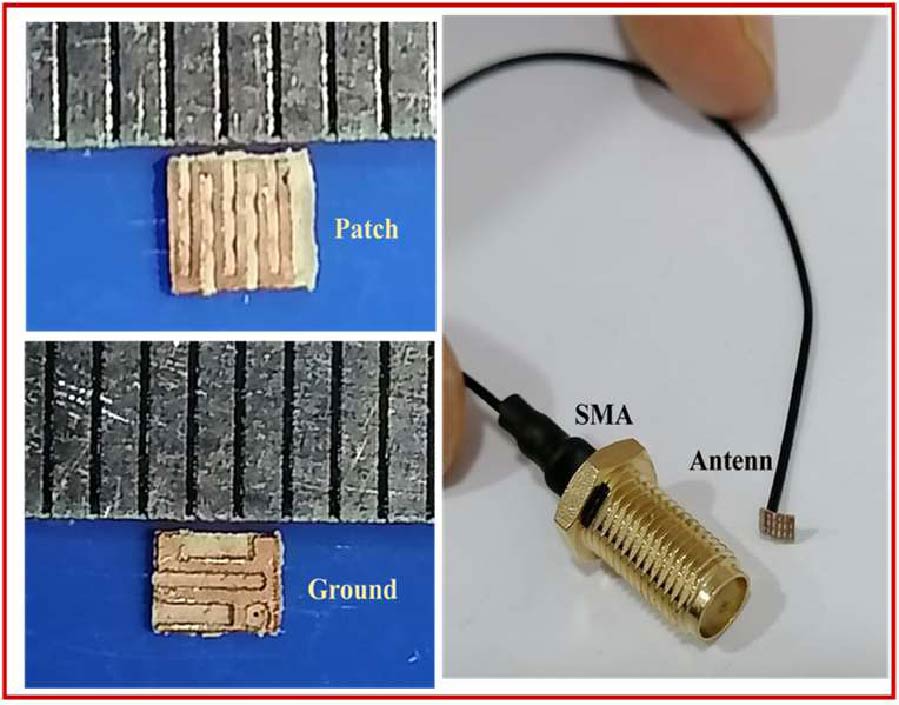
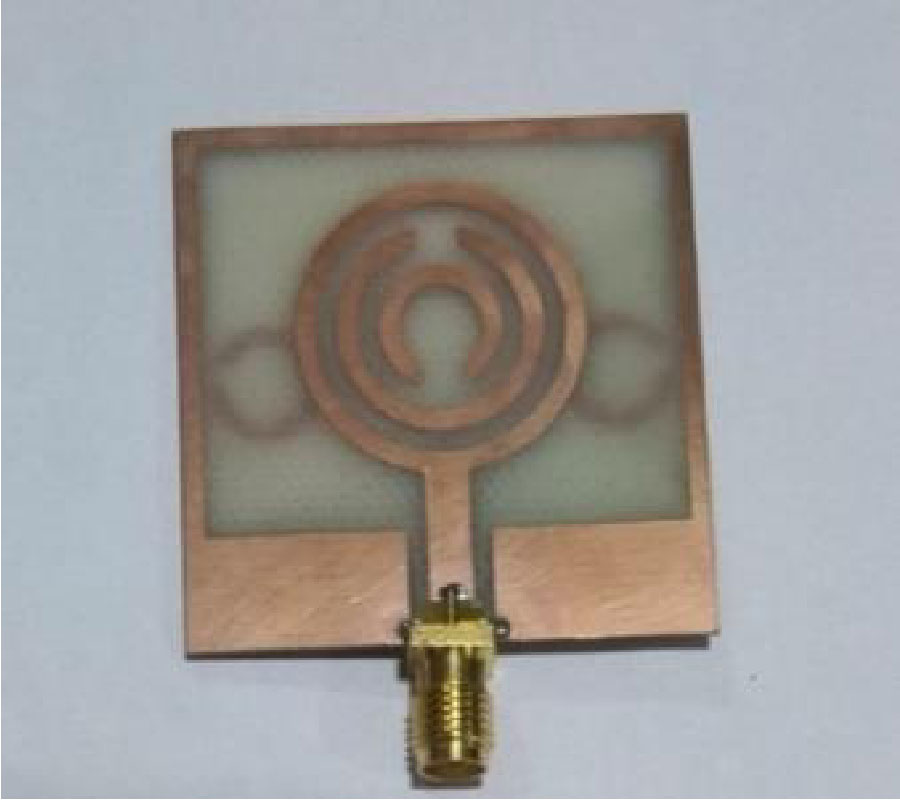
The miniaturization of implantable antenna is one of the significant requirements, especially for those devices implanted under the skin, as it reduces prominent appearance and invasiveness. In this paper, we design, simulate, and implement a spiral resonator-based microstrip antenna utilizing the ISM band (2.4-2.48 GHz). A small size, light weight, and flat type are required for under-skin implantation. The proposed antenna dimensions were optimized for a miniaturized volume of (3 × 2.5 × 0.12) mm3, representing the smallest size for under-skin biomedical applications. This miniaturization is achieved using a spiral-shaped radiator and creating slots in the ground layer. In-vivo measurement parameters, including reflection coefficient, are measured on the suggested antenna, showing a gain of -19.9 dBi and a bandwidth of 90 MHz. Specific Absorption Rate (SAR) is evaluated at 316 W/kg, confirming that the proposed antenna meets the necessary human-use safety criteria.
Ultra-miniaturized Spiral Antenna for Loop Recorder Implantable Device
2025-01-30
PIER C
Vol. 152, 103-110
Switchable/Tunable Dual-Band BPF for Bluetooth and 5G NR Applications
Areeg F. Hussein , Malik Jasim Farhan and Jawad K. Ali
This article presents a dual-band switchable and tunable band-pass filter for Bluetooth and 5G NR applications. The filter functions at 2.41 GHz for Bluetooth and 3.55 GHz for 5G, utilizing independent switching and tuning methods facilitated by PIN and varactor diodes. The suggested design exhibits compact dimensions of 0.177λg x 0.096λg, a minimal insertion loss of 0.35 dB, and a substantial return loss of 30 dB. Advanced design methodologies, including defective ground structures (DGS) and eigenmode analysis, were utilized to attain precise selectivity and exceptional out-of-band rejection. The engineered filter demonstrates superior performance, with outcomes closely aligning with models, and guarantees little interference with suppression up to 10 GHz. The tuning mechanism provides versatility by independently modifying the operating frequencies of the second band, rendering the design very flexible for dynamic wireless communication settings. This study emphasizes a robust and effective answer for contemporary mobile communication systems.
Switchable/Tunable Dual-band BPF for Bluetooth and 5G NR Applications
2025-01-28
PIER Letters
Vol. 125, 17-23
A Novel Wideband Reflectionless Filtering Patch Antenna
Shuai Gao , Zhongbao Wang , Hongmei Liu and Shao-Jun Fang
In this paper, a novel wideband reflectionless filtering patch antenna is proposed. The antenna consists of a filtering patch and an absorption network. The filtering patch includes an E-shaped radiator and two T-shaped radiators. The E-shaped radiator introduces a radiation null, which greatly improves lower-band edge selectivity. The T-shaped radiators introduce an additional radiation null, effectively increasing the filtering performance in the upper stopband. For the absorption network, a quarter-wavelength coupled-line section with two 200-ohm resistors and four short-circuited three-quarter-wavelength transmission lines are used to achieve reflectionless characteristics. To demonstrate the design, an antenna prototype with a center frequency of 3.5 GHz is fabricated and measured. Measurement results manifest that the input reflectionless bandwidth is 63.5% from 2.56 to 4.94 GHz with an antenna gain of 5.8 dBi. At 3.02 and 3.91 GHz, two radiation nulls are also obtained. The lower and upper stopband suppression levels are 18.1 and 14.5 dB, respectively.
A Novel Wideband Reflectionless Filtering Patch Antenna
2025-01-27
PIER M
Vol. 132, 11-19
A Low-Profile EBG Based Corrugated 5G Antenna Design for WLAN Communication
Hema Raut , Saffrine Kingsly , Sangeetha Subbaraj and Rajeshwari Malekar
The paper introduces a corrugated antenna structure suitable for 5G WLAN application and operates at a frequency of 5.52 GHz. Further, a periodic structure made up of square unit cells is combined with the antenna design, and improvement in gain and impedance bandwidth is observed. The antenna gain without periodic structure is 3.48 dB whereas with periodic structure it is noted as 4.09 dB. The antenna dimensions are 16 mm × 16 mm × 3 mm. Also, the measured bandwidth of the antenna structure without periodic structure is observed to be 210 MHz, and that with periodic structure is 310 MHz.
A Low-profile EBG Based Corrugated 5G Antenna Design for WLAN Communication
2025-01-27
PIER B
Vol. 110, 107-129
Low-Frequency Excitation of a Stratified Conducting Sphere by Point Charges or Electric Dipoles
Mykola Bogomolov , Gregory B. Gajda and Mykola Zhuk
This paper investigates the low-frequency excitation of a non-magnetic stratified conducting sphere by external sources, using a classical quasi-static approach. We focus on point-impressed sources represented by charges or electric dipoles, which predominantly generate electric fields. The findings have implications for low-frequency scattering theory and can potentially support the assessment of localized human exposure to low-frequency electric fields, such as those from Wireless Power Transfer using capacitive coupling technology. For a sphere with an arbitrary number of homogeneous layers, we develop a numerical-analytical solution inspired by the Exact Difference Scheme. This approach yields a tridiagonal discretized representation of the continuous problem, ensuring uniqueness and computational stability, and allowing for efficient solution via the Thomas algorithm. For a sphere with general radial inhomogeneity, we apply the Finite Difference method. Computational experiments show a strong agreement between these two approaches. We also examine the physical aspects of electric field interaction with a four-layer model of the human head, using the concept of coupling coefficients for the electric field and the generated heat. Our results show that these coupling coefficients increase with the separation between the point sources and the sphere, converging in certain cases to those for a uniform incident electric field. A comparison with the relevant ICNIRP reference levels for the incident electric field is also provided. The comprehensive Wolfram Mathematica code, consisting of multiple modules and including theoretical definitions and explanations of the computed quantities, is available as a supplement to the paper.
Low-frequency Excitation of a Stratified Conducting Sphere by Point Charges or Electric Dipoles
2025-01-26
PIER M
Vol. 132, 1-10
A Spiral Cavity Backed 4 X 4 MIMO SIW Antenna at Ku Band for Radio Telescopes
Suryansh Saxena , Nidhi Tewari and Shweta Srivastava
A compact spiral cavity backed substrate integrated waveguide (SIW) multiple input multiple output (MIMO) antenna is presented in this paper. The edge-shaped spiral on top of the SIW cavity acts as a dipole antenna. The dual spiral arms are excited from their symmetrical connecting center. The single antenna element in MIMO is rotated such that unit cells are orthogonal to each other forming a compact 2 × 2 and 4 × 4 MIMO SIW antenna. The proposed design shows a wide bandwidth of 930 MHz (13.74 GHz to 14.67 GHz) and 67.68% impedance bandwidth. The overall size of proposed MIMO SIW antenna is 0.9λo × 0.9λo × 0.024λo, where λo is the operating wavelength. A return loss of 18.4 dB at 14.17 GHz is achieved. The series of metal pins (in plus shape) at the center of 4 × 4 MIMO improves the isolation to 19.6 dB at resonant frequency. A pattern diversity in broadside direction is achieved by the top spiral arms and its complementary spiral arms at the bottom. The beamwidth of the proposed antenna is 90˚ varying from -45 deg to +45 deg, useful for reliable signal transmission and reception. Thus, the proposed antenna is a symmetrical compact design working at Ku band suitable for radio telescope application.
A Spiral Cavity Backed 4 x 4 MIMO SIW Antenna at Ku Band for Radio Telescopes
2025-01-26
PIER M
Vol. 131, 71-79
Design of Metamaterial Absorber Independent in Incident Angle for Solar Cell Applications
Asmaa El-Sayed Mohammed , Ayad Shohdy , Shazly Abdo Mohammed and Ahmed Mohamed Montaser
This study proposes designing and developing a metamaterial absorber that improves the efficiency of solar cells. The design includes circular forms with rectangle gaps etched on the upper surface of an FR-4 substrate, with a copper sheet serving as an isolating substrate for the ground beneath. The structure operates in the tera frequency ranges to accommodate all infrared wavelengths of the sun's spectrum. Furthermore, the constructed metamaterial unit cell is used to build a metamaterial array absorber, which increases the rate of energy harvest from the sun spectrum. The two designs showed absorption rates of approximately 96.75% and 99.85% at 94.85 THz and 109.08 THz resonant frequencies respectively. In addition, a top surface of microwave cross-polarization conversion (CPC) is also generated and simulated. The structure of the proposed microwave unit cell consists of the same metamaterial absorber design. Efficient cross-conversion is achieved across a wide frequency band (9 GHz to 15 GHz), with polarization conversion effectiveness exceeding 99%. The suggested CPC design has three resonance bands with 50% fractional bandwidth (FBW) and achieves a stable polarization response at oblique incidence angles up to 35˚.
Design of Metamaterial Absorber Independent in Incident Angle for Solar Cell Applications
2025-01-26
PIER Letters
Vol. 125, 9-15
CPW-Fed Minkowski Island Fractal Slot Antenna for Wideband Application
Vanilakshmi Venugopal , Achari P. Abhilash , Rohith K. Raj and Thomaskutty Mathew
This paper proposes a CPW-fed wideband slot antenna with a modified Minkowski fractal island geometry. The antenna comprises a CPW-fed monopole placed within a modified Minkowski fractal island slot. The resonance introduced by the fractal slot combines with the monopole's resonance, resulting in an expanded operational frequency range. The interaction between the monopole and the fractal slot significantly broadens the bandwidth. Return loss measurements confirm a wide bandwidth extending from 2.27 GHz to 7.91 GHz, achieving a fractional bandwidth of 111% covering WLAN, WiMAX, Wi-Fi, and 5G sub-6 GHz bands.
CPW-fed Minkowski Island Fractal Slot Antenna for Wideband Application
2025-01-26
PIER B
Vol. 110, 91-105
Maximally Flat Negative Group Delay Prototype Filter Based on Capped Reciprocal Transfer Function of Classical Bessel Filter
Miodrag Kandic and Greg E. Bridges
A prototype filter design exhibiting Negative Group Delay (NGD) is presented, based on the ratio of two low-pass classical Bessel filter transfer functions of the same order, but with different 3dB-bandwidths. The resulting design is a reciprocal-Bessel filter transfer function, capped at a finite out-of-band gain. The proposed capped reciprocal-Bessel design is based on a similar concept applied to previously reported capped reciprocal-Butterworth and reciprocal-Chebyshev NGD designs, which use ratios of corresponding classical low-pass filter transfer functions. It is shown that within the in-band frequency range, the synthesized NGD transfer function exhibits a maximally flat group delay characteristic (Bessel-like property). Due to its near-flat in-band group delay characteristic, the design is suitable for constant phase shifter applications. For high design orders, it is shown that the achieved NGD-bandwidth product has an upper asymptotic limit, given by the square root of the out-of-band gain in decibels. When the prototype baseband transfer function is translated to a non-zero center frequency, it is demonstrated that resonator-based implementations are feasible via Sallen-Key, as well as all-passive ladder topologies. A combined in-band magnitude/phase distortion metric is evaluated for selected design examples and applied Gaussian and sinc input waveforms, and it is shown to be proportional to the design order and out-of-band gain. The proposed design's distortion metric is also shown to be generally lower than the previously reported capped reciprocal-Butterworth and reciprocal-Chebyshev designs.
Maximally Flat Negative Group Delay Prototype Filter Based on Capped Reciprocal Transfer Function of Classical Bessel Filter
2025-01-25
PIER C
Vol. 152, 91-101
Design of a High-Gain Millimeter Wave Array MIMO Antenna for 5G
Wenhui Liu and Xinchun Li
To deal with the problems of low gain and low data transmission rate of millimeter wave antenna during long-distance transmission, a high-gain millimeter wave array multiple-input-multiple-output (MIMO) antenna with series-parallel hybrid feed is proposed. The radiating structure consists of a combination of multiple rectangular patches, to make the proposed design resonate within the desired frequency band of 39 GHz. The antenna line array consists of eight radiating patches connected in series via transmission lines, providing an operating bandwidth of 1.02 GHz and a peak gain of 15.9 dB, and utilizing the Chebyshev synthesis method to control the side lobe level below -20 dB. In order to obtain higher gain, two antenna line arrays are connected through a Y-shaped feeding network, which utilizes the mutual coupling between the antennas to increase the bandwidth of the antenna to 1.25 GHz and provide a simulated gain of 17.6 dBi. Furthermore, the proposed array antennas are placed side-by-side to form a four-port MIMO antenna, which does not require any decoupling structure and has the isolation of more than 25 dB. The radiation efficiency is as high as 99%, the Envelope Correlation Coefficient (ECC) less than 0.003, and the Diversity Gain (DG) greater than 9.98. The measured results show that the operating frequency band of the antenna is 38.0∼39.6 GHz, and the operating bandwidth is 1.6 GHz. In the operating frequency band, the peak gain of the antenna is 17.45 dBi, Finally, the frequency characteristics and radiation characteristics of the antenna when bending are analyzed. The results show that the bending of the antenna leads to a slight shift in the resonant frequency, but the relative bandwidth remains unchanged. The gain has decreased, indicating that the antenna is able to work normally after bending and has a wider range of application scenarios.
Design of a High-gain Millimeter Wave Array MIMO Antenna for 5G
2025-01-25
PIER M
Vol. 131, 61-70
A Low-Cost Wideband SIW Antenna with Bilateral Slots on FR4 Epoxy for Ku-Band Applications
Dounia Chrij , Asma Khabba , Zakaria El Ouadi , Lahcen Sellak , Jamal Amadid , Omaima Benkhadda , Saïda Ibnyaich , Abdelouhab Zeroual and Ahmed Jamal Abdullah Al-Gburi
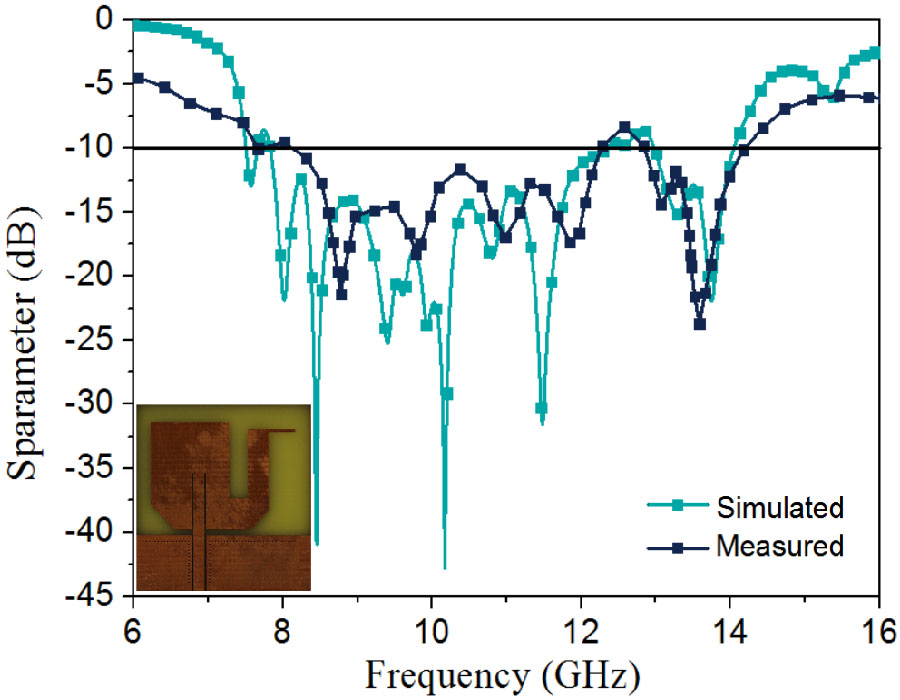
This article presents an approach to expanding the impedance bandwidth of a bilateral slotted antenna backed by a substrate-integrated waveguide (SIW) cavity using high-order radiation modes. By trimming a section of the conductive ground plane and connecting one side of the bottom long slot with a via, the three hybrid modes of the cavity are perturbed and merged to achieve a broad bandwidth. The optimized antenna is fed by a microstrip transmission line for Ku-band applications, demonstrating an impressive impedance bandwidth of 6.68 GHz (a fractional bandwidth of 41%) ranging from 12.82 GHz to 19.5 GHz, with a peak gain of 6.6 dBi. Compared to previous studies, the proposed antenna offers not only a wide bandwidth but also a compact size, with dimensions of 29.7 × 22 mm², and its electrical dimensions are 1.6λ0 × 1.19λ0, where λ0 is the free space wavelength at the center frequency fcenter = 16.16 GHz. Additionally, it has low production costs due to fabrication on an inexpensive FR4 substrate. The antenna was initially simulated using HFSS software, and to validate the accuracy of the results, it was also analyzed with CST Microwave Studio. Moreover, a prototype was constructed for experimental testing, with measured results showing strong agreement with the simulations.
A Low-Cost Wideband SIW Antenna with Bilateral Slots on FR4 Epoxy for Ku-Band Applications
2025-01-24
PIER M
Vol. 131, 51-59
A Compact Wideband Two-Port mm-Wave Antenna for 5G Application
Rajeshwari Malekar , Saffrine Kingsly , Sangeetha Subbaraj and Hema Raut
This study presents the design of a MIMO (multiple inputs, multiple outputs) antenna for the 5G application. This is an inexpensive, low-profile antenna with a dimension of 9 x 18 x 1 mm3. The highest gain of the antenna in the operating frequency range is 7.79 dBi. This antenna structure provides a minimum isolation of less than -20 dB for the working bandwidth. The antenna's operational bandwidth covers the 26 GHz band mm-wave (millimeter-wave) spectrum, from 26.86 to 31.11 GHz. Its salient features make it appropriate for 5G applications.
A Compact Wideband Two-port mm-Wave Antenna for 5G Application
2025-01-23
PIER Letters
Vol. 125, 1-7
High Gain Dual-Frequency Dual-Circularly Polarized Fabry Perot Resonant Cavity Antenna for Ku Band
Wei Luo , Xiaoxue Wang , Xin He and Yuqi Yang
To explore higher-performance satellite communication antennas, a dual-frequency dual-circularly polarized antenna based on a Fabry-Perot (F-P) resonant cavity is proposed in this letter. An artificial magnetic conductor (AMC) is loaded onto the resonant cavity as a partial reflection surface (PRS) to reduce the profile. The electromagnetic (EM) waves from the feeder are reflected multiple times within the cavity and subsequently superimposed in phase, thereby enabling dual-frequency operation and high gain. Right-handed circularly polarized (RHCP) and left-handed circularly polarized (LHCP) waves are respectively generated in the lower and higher frequency bands by incorporating a dual-frequency polarization conversion surface (PCS). Two rectangular microstrip patch antennas with a simple feeding network are employed as the feeder for RHCP and LHCP, respectively. The measurement results show that the operating bandwidth is 4.77% (12.47-13.08 GHz) for the low-frequency band and 5.36% (16.51-17.42 GHz) for the high-frequency band. The maximum gains of 14.91 dBi and 14.33 dBi are achieved for the lower and higher frequency bands, respectively. The proposed antenna fulfills the requirements of the frequency division duplex satellite communication system, providing a promising candidate for ground equipment in high-speed satellite Internet applications.
High Gain Dual-frequency Dual-circularly Polarized Fabry Perot Resonant Cavity Antenna for Ku Band
2025-01-22
PIER
Vol. 182, 27-54
High Harmonic Generation in Integrated Nonlinear Platforms (Invited)
Yuhua Li , Shao Hao Wang , Brent E. Little and Sai Tak Chu
Lasers emitting visible light based on high harmonic generation (HHG) have significantly enhanced measurement capabilities, enabling new applications across precision metrology, attosecond science, and ultrafast time-resolved spectroscopy. This paper discusses the theoretical framework of HHG with a focus on nonlinear effects, examining in depth second-harmonic generation (SHG) and third-harmonic generation (THG) mechanisms, as well as a thermal nonlinear model for pump stability analysis. The current state of HHG within integrated optical circuits is reviewed, with a particular emphasis on its implementation in high-index doped silica glass micro-ring resonators (HDSG MRRs). We conclude by addressing future directions for optimizing these systems to expand their applicability in advanced photonic technologies, highlighting their potential for innovation in both applied and fundamental sciences.
High Harmonic Generation in Integrated Nonlinear Platforms (Invited)
2025-01-22
PIER C
Vol. 152, 81-89
Direction-of-Arrival Estimation Method of Single Snapshot Coherent Source Based on Hyperbolic Tangent Kernel Correntropy
Hongyuan Gao , Kailong Liu and Ying Guo
To solve the problem of low accuracy and real-time performance of direction of arrival (DOA) estimation in an impulsive noise environment, this paper proposes a single-snapshot DOA estimation method based on the median deviation correntropy of hyperbolic tangent kerne and designs an intelligent optimization algorithm for the segmentation and hunting mechanism of gold long-nosed raccoon to obtain accurate DOA estimation angle. The DOA estimation method proposed in this paper uses spatial smoothing technology to process the median deviation correntropy of single snapshot data, and then uses the hyperbolic tangent kernel to remove impulse noise from the pseudo-covariance matrix. The weighted signal subspace fitting method is used to obtain the accurate DOA estimation angle. The Monte Carlo analysis experiments of different schemes are verified, especially in the case of a single snapshot, low generalized signal-to-noise ratio (GSNR), and strong impulse noise.
Direction-of-arrival Estimation Method of Single Snapshot Coherent Source Based on Hyperbolic Tangent Kernel Correntropy
2025-01-21
PIER Letters
Vol. 124, 69-75
Improved Bandwidth of Patch Antenna Using Dual-Layer Metasurface
Kangling Yang , Mingjiang Wang and Xiao Jia
A method for significantly improving the bandwidth of microstrip patch antennas is proposed, utilizing dual-layer metasurface (MS). The antenna employs coaxial probe feeding and consists of a truncated patch, an upper layer of 4 x 4 periodic N-shaped MS and a lower layer of 3×4 rectangular MS. By introducing multiple resonances via the dual-layer MSs, impedance matching of the patch antenna is greatly enhanced. Its overall geometric dimensions are 1.09λ0 x 1.09λ0 x 0.14λ0 (f0 = 5.5 GHz), and compared with patch antennas and single-layer metasurface antennas of the same size, it can substantially enhance the bandwidth and gain without significant cost and size increase. The proposed MS antenna operates from 4.7 to 6.66 GHz (39.8% fractional bandwidth), covering two-thirds of the C-band, with a peak realized gain of 9.3 dBi. Within 4.47-5.56 GHz, the realized gain of the antenna remains above 7.5 dBi, and the average gain across the entire operating band is 7 dBi.
Improved Bandwidth of Patch Antenna Using Dual-layer Metasurface
2025-01-21
PIER B
Vol. 110, 73-90
Reconfigurable Designs of Sectoral Microstrip Antennas for Single Band and Tunable Circular Polarized Response
Amit A. Deshmukh , Heet Mistry , Venkata A. P. Chavali , Aniruddh Viswanathan and Prasanna Nadkarni
The circularly polarized design of a 350° sectoral microstrip antenna is proposed. Orthogonal surface current components at TM10 mode on the sectoral patch provide circularly polarized characteristics. With the substrate thickness of 0.087λcAR, it yields the simulated axial ratio bandwidth of 18 MHz (1.9%) that lies inside the reflection coefficient bandwidth of 487 MHz (44.66%). A reduction in the substrate thickness by 0.012λcAR in the 350° Sectoral design is achieved by employing an H-shape ground plane profile. This design yields the axial ratio bandwidth of 13 MHz (1.45%), which is present inside the reflection coefficient bandwidth of 386 MHz (36.9%). The antenna using modified ground plane offers peak broadside gain of larger than 6 dBi. On conventional and H-shape ground plane design, reconfigurable design of 350° Sectoral patch is presented that offers switching between the wideband and circularly polarized characteristics. For operation at TM30 mode in the Sectoral patch, circularly polarized reconfigurable configuration for sectoral angle decreasing from 340° to 280° is presented. Over this angle variation, antenna offers tuning in the center frequency of axial ratio bandwidth by 367 MHz (20.6%) with a broadside gain of larger than 5 dBi. A design methodology for circularly polarized antennas functioning at TM10 and TM30 modes is proposed. It helps in realizing similar configuration as per specific wireless application. Experimental verifications for all the obtained results are carried out which show close agreement with the simulated results.
Reconfigurable Designs of Sectoral Microstrip Antennas for Single Band and Tunable Circular Polarized Response
2025-01-20
PIER C
Vol. 152, 73-80
Dual-Band Filters with Adjustable Bandwidth and Wide Stopband Using CRLH Transmission Line Theory
Chen Li , Minquan Li , Zhonghui Li , Shuangqing Cao and Rongxian Bai
In response to the growing demands of modern communication systems for miniaturized devices, high selectivity, and multi-band characteristics, this paper proposes a design methodology for a dual-band filter based on a planar interdigital structure. Two dual-band filters are developed utilizing transmission zeros and cascading techniques. The filters exhibit high selectivity and wide stopband performance. They are also tunable through parameter adjustments while maintaining a compact form factor. By incorporating composite right/left-handed (CRLH) theory, the proposed filters demonstrate left-handed characteristics. Simulation and experimental results indicate that the designed filters achieve low insertion loss, a wide stopband, and excellent out-of-band rejection within the target frequency bands. Additionally, compared to existing designs in the literature, this approach offers notable advantages in terms of both size and performance. The findings of this study show significant potential for applications in RF and communication systems.
Dual-band Filters with Adjustable Bandwidth and Wide Stopband Using CRLH Transmission Line Theory
2025-01-20
PIER M
Vol. 131, 45-50
A Unified Approach for the Design and Analysis of Fabry-Perot Antennas with Nonuniform PRS
Akshar Tripathi and Mahesh Pandurang Abegaonkar
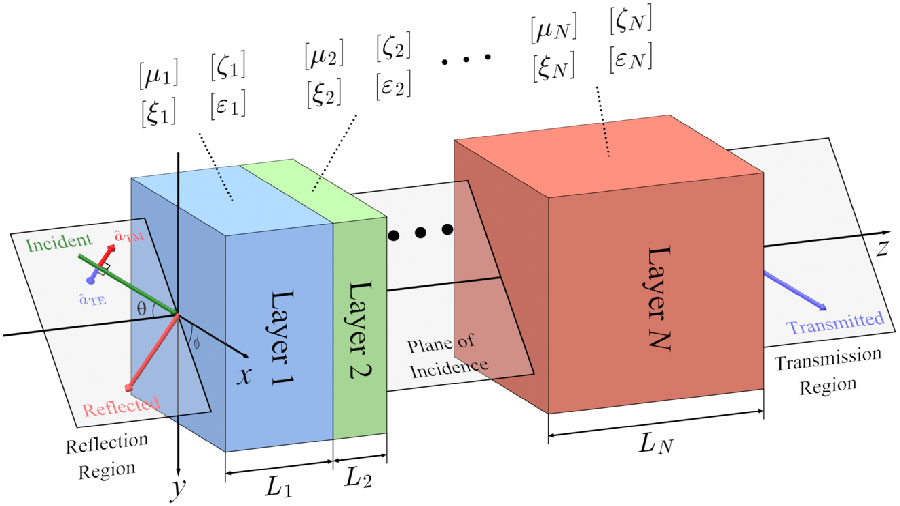
In this paper, a ray-tracing based mathematical model is proposed for the analysis and design of Fabry-Perot antennas with a nonuniform Partially Reflecting Surface (PRS). The use of nonuniform PRS in FPA's has recently gained attention due to its immense applications such as directivity enhancement and beam-steering. A spatially varying phase profile of the PRS is achieved by the arrangement of various distinct unit cells throughout the surface. The PRS phase and magnitude variation enables the alteration of wavefronts to achieve beam steering along a desired polar and azimuth angle (θ, Φ). Thus, a simple, robust and computationally efficient model to find the optimal FPA parameters and phase profiles for beam-steering has been developed in this paper. FPAs were designed using a square PRS for 1-D and 2-D beam steering with gains of up to 17 dBi. The model has been verified with the simulated results at 8 GHz and 8.5 GHz, demonstrating consistent field patterns with the full-wave simulations.
A Unified Approach for the Design and Analysis of Fabry-Perot Antennas with Nonuniform PRS