Search Results(13784)

2025-02-27
PIER C
Vol. 153, 51-59
Optimization Design for Bionic-Bamboo FPs of Coaxial Magnetic Gear Under Multi-Field Coupling
Yufeng Zhou , Heng Yang , Shuai Luo and Xiuhong Hao
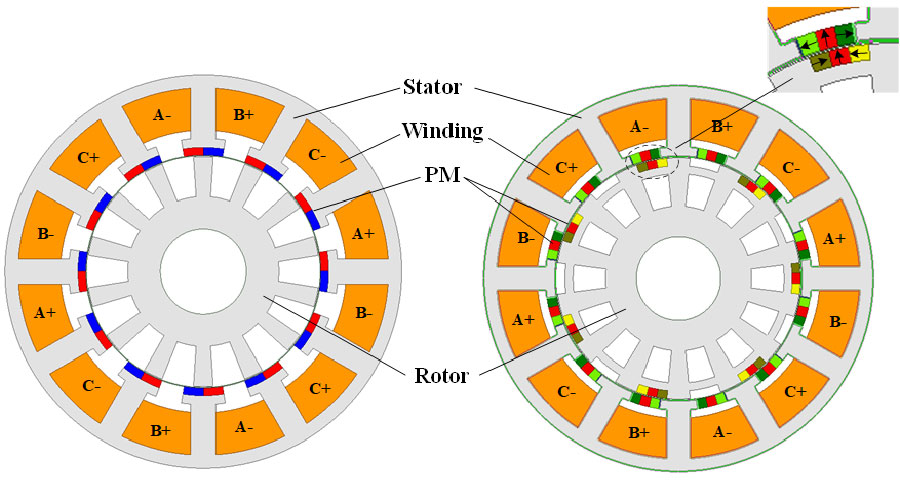
Coaxial magnetic gear (CMG) with magnetic field modulation mechanism features high torque density, non-contact transmis-sion, and overload automatic protection, making it an optimal substitute for mechanical gears. Considering the unbalanced mag-netic pull caused by the modulation effect of magnetic field and the component eccentricities, the deformations of the key fer-romagnetic pole-pieces (FPs) are analyzed with and without magnetic-force-structure multi-field coupling. Then, the segmenta-tion and reinforcement ideas based on bionic-bamboo are proposed in order to reduce the deformation of FPs. The functional relationships among FPs structural parameters, the output torque of CMG and the deformation of FPs are established with the orthogonal test method and response surface method. Based on NSGA-Ⅲ, the optimal parameters of FPs are obtained, and the corresponding deformation is greatly reduced. Finally, it is proved that the bionic-bamboo FPs can effectively reduce its defor-mation by the experiment and finite element simulation.
Optimization Design for Bionic-bamboo FPs of Coaxial Magnetic Gear under Multi-field Coupling
2025-02-27
PIER C
Vol. 153, 45-50
Design and Performance Evaluation of Ku-Band Positive Feedback Push-Push Oscillator Using Square Split-Ring Bandpass Filter
Elton Nascimento Lima , Takayuki Tanaka and Ichihiko Toyoda
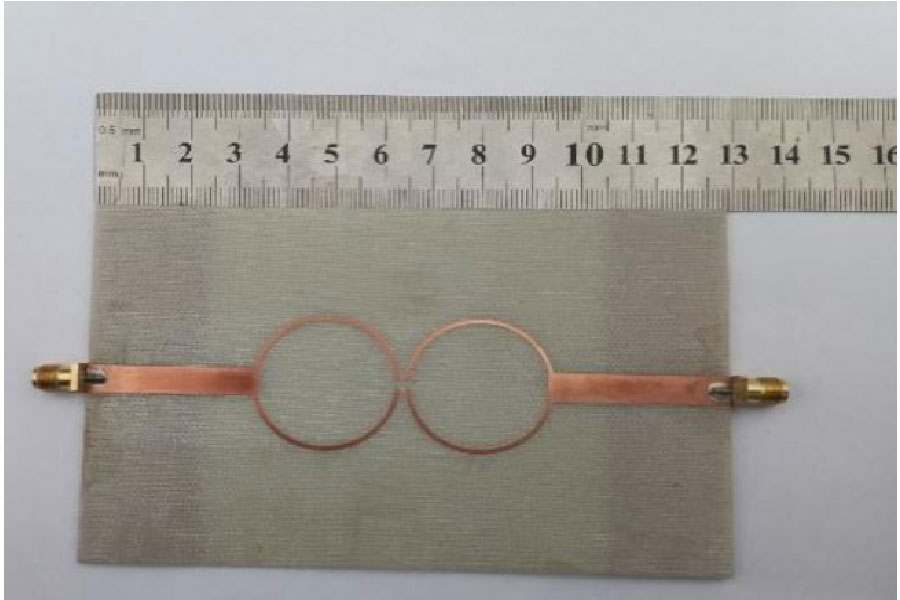
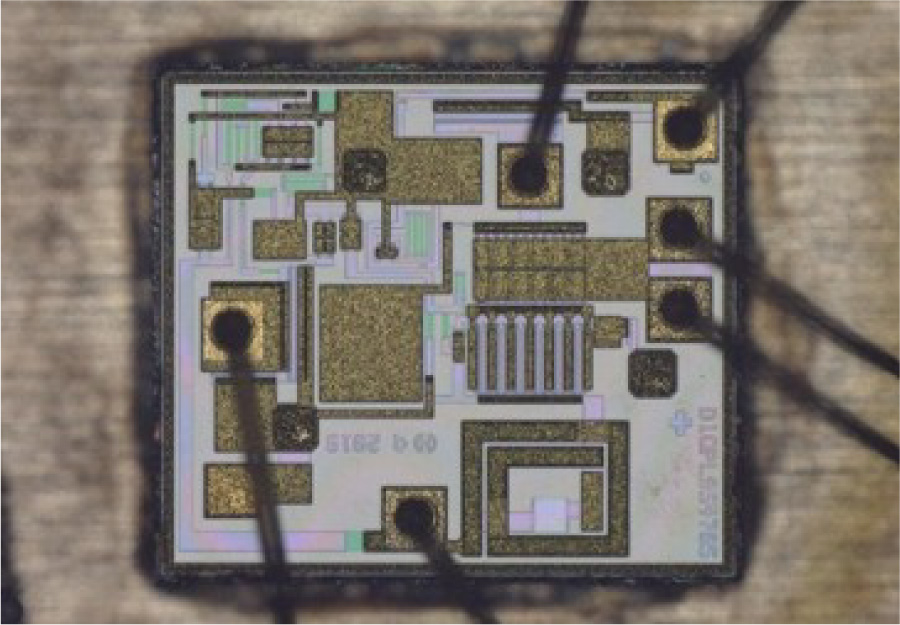
This paper presents a low phase noise positive feedback type Push-Push oscillator employing a balanced bandpass filter (BPF). The BPF consists of an array of split-ring resonators and functions as a frequency selective element in the common feedback loop of the oscillator. Two positive feedback oscillators are coupled to create the 180-degree differential signals required for the implementation of a Push-Push oscillator. The proposed oscillator is analyzed and fabricated. The measured results show that the oscillator works at 15.15 GHz of the second harmonic frequency with an output power of -5.6 dBm. Furthermore, the suppression of fundamental frequency signal is 25.2 dB. Excellent phase noise performance of -100.37 dBc/Hz at 100-kHz offset frequency and -127.13 dBc/Hz at 1-MHz offset frequency is obtained.
Design and Performance Evaluation of Ku-band Positive Feedback Push-push Oscillator Using Square Split-ring Bandpass Filter
2025-02-27
PIER M
Vol. 132, 73-84
High Performance 5G FR-2 Millimeter-Wave Antenna Array for Point-to-Point and Point-to-Multipoint Operation: Design and OTA Measurements Using a Compact Antenna Test Range
Abdul Jabbar , Jalil Ur Rehman Kazim , Mahmoud A. Shawky , Muhammad Ali Imran , Qammer Hussain Abbasi , Muhammad Usman and Masood Ur-Rehman
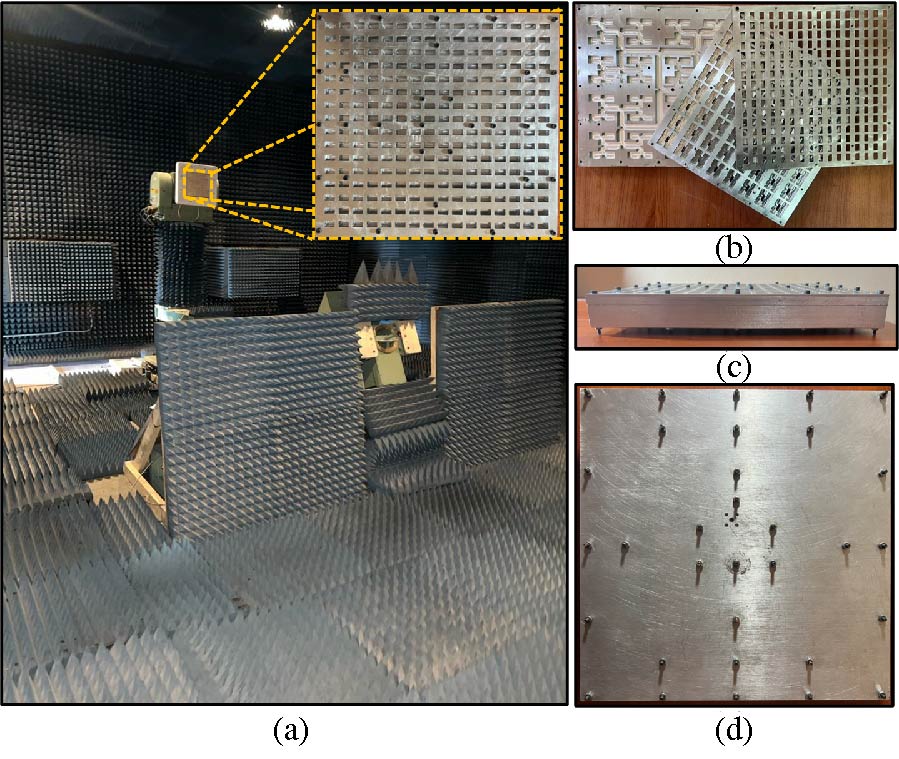
This paper presents the design and comprehensive measurements of a high-performance 8-element linear and a compact high-gain 32-element planar antenna array covering the n257 (26.5-29.5 GHz) FR-2 millimeter-wave (mmWave) band. First, an 8-element series-fed linear array is designed offering a fan-shaped pattern for 5G point-to-multipoint connectivity. Then a 4-way corporate-series feed network is designed for a high-gain 32-element compact and directive array for point-to-point mmWave connectivity. Comprehensive over-the-air (OTA) measurements are conducted using a state-of-the-art compact antenna test range (CATR) system, enabling precise characterization of radiation patterns across a 180° span in the azimuth and elevation planes. The planar array achieves a peak measured gain of 18.45 dBi at 28.5 GHz, with half-power beamwidths ranging from 11°-13° (elevation) and 23°-27° (azimuth) across the band of interest. The measured results match closely with the simulation results. The measurement results match well with the simulations. The designed antenna array is versatile, applicable to various emerging 5G and beyond mmWave applications such as outdoor fixed wireless access, mmWave near-field focusing, high-resolution indoor radar systems, 28 GHz Local Multipoint Distribution Service (LMDS) as well as the characterization of mmWave path loss and channel sounding in diverse indoor environments.
High Performance 5G FR-2 Millimeter-wave Antenna Array for Point-to-Point and Point-to-Multipoint Operation: Design and OTA Measurements Using a Compact Antenna Test Range
2025-02-25
PIER
Vol. 182, 85-94
Anomalous Reflection from Hyperbolic Media
Ilya Deriy , Kseniia Lezhennikova , Stanislav B. Glybovski , Ivan Iorsh , Oleh Y. Yermakov , Mingzhao Song , Redha Abdeddaim , Stefan Enoch , Pavel A. Belov and Andrey A. Bogdanov
Despite the apparent simplicity, the problem of refraction of electromagnetic waves at the planar interface between two media has an incredibly rich spectrum of unusual phenomena. An example is the paradox when an electromagnetic wave impinges on the interface between a hyperbolic medium and an isotropic dielectric. At specific orientations of the optical axis of the hyperbolic medium relative to the interface, the reflected and transmitted waves can can disappear entirely, which contradicts reciprocity. In this paper, we analyze the above mentioned paradox and present its resolution by introducing infinitesimal losses in the hyperbolic medium. We show that the reflected wave exists but becomes ultimately localized at the interface when the losses become vanishing. Consequently, all the energy scattered into the reflected channel is absorbed near the interface. We support our reasoning with analytical calculations, numerical simulations, and an experiment with self-complementary metasurfaces in the microwave range.
Anomalous Reflection from Hyperbolic Media
2025-02-24
PIER C
Vol. 153, 33-43
Design and Fabrication of SRR Loaded Cantor Fractal Slotted DGS Antenna Using Quarter Wave Transformer Fed for Microwave C-Band Communication
Anuj Kumar Sharma , Vipul Sharma and Sanjay Singh
The design, fabrication, and measurement of a 70 mm × 60 mm × 1.6 mm high-bandwidth Cantor fractal slotted defected ground surface (DGS) antenna for the microwave C-band (4-8 GHz) are presented in this study. This multiband antenna has the best performance ever because it combines a Cantor-inverted Cantor fractal slot with a microstrip quarter-wave transformer feeding network. With simulated operating bands spanning 3.37-3.48 GHz, 4.22-5.67 GHz, and 6.74-8.25 GHz, this antenna demonstrates exceptional simulated impedance bandwidths of 110 MHz, 1.43 GHz, and 1.51 GHz with simulated reflection coefficients of -27.22 dB, -28.23 dB, and -14.71 dB at resonance frequencies of 3.44 GHz, 5.03 GHz, and 7.17 GHz, respectively. Furthermore, the antenna exhibits simulated high gains of 5.6 dB, at 5.03 GHz resonating frequency. The introduction of a split ring resonator (SRR) at the ground surface unlocks the complete simulated bandwidth of 4.13-8.14 GHz and boosts the simulated gain to 6.1 dB. The design of this SRR at 5.03 GHz shifts one band from 3.44 GHz to 2.97 GHz with simulated bandwidth of 60 MHz. The VSWR value of this design is very close to 1. Consequently, its good impedance matching enhances the antenna's wideband performance. This is beneficial because patch antennas usually have a limited bandwidth. In addition, the antenna simulation displays an exactly symmetrical radiation pattern with current densities of 268 A/m and 155 A/m at 5.03 GHz with and without SRR, respectively.
Design and Fabrication of SRR Loaded Cantor Fractal Slotted DGS Antenna using Quarter Wave Transformer Fed for Microwave C-band Communication
2025-02-23
PIER C
Vol. 153, 25-32
Wideband Tunable Filter of Dual-Path Microstrip Coupled-Lines with Varactor Tuned Circuit
Siti Aminah Nordin , Muhammad Asraf Hairuddin , Zakiah Mohd Yusoff , Gaetan Prigent and Nur Dalila Khirul Ashar
This study presents a compact and tunable microstrip of a dual-path wideband filter that employs coupled-lines and varactors to address the needs of 4G/sub-6 GHz 5G communication systems. This work integrates tunable methods inspired by wideband parallel coupled line-based topologies to realize a reconfigurable solution achieving a 34% frequency tuning range (1.13-1.51 GHz) while maintaining a low insertion loss of approximately below 1 dB. Specifically, the proposed microstrip-based filter, which is designed, uses parallel coupled-line resonators with a quarter-wavelength length, enabling a broad tuning range between 1.27 and 1.54 GHz. Adjusting the coupling strengths of both adjacent and non-adjacent resonators, the filter can be shifted within this frequency band without compromising performance. Therefore, to achieve the desired level of control, two identical varactor diodes and biasing circuitry are meticulously selected for their stable and repeatable capacitance-voltage characteristics to adjust the filter's resonant frequency. The optimal positions for these tuning circuits are determined based on the resulting capacitance, which is crucial for achieving a wide tuning range. Simulation and measurement confirm that this reconfigurable microstrip filter, implemented on a 60.7 x 35.4 mm² footprint, benefits not only from a reduced footprint but also from the ability to target multiple frequency bands with minimal hardware modifications, delivering the intended performance for modern wireless front ends.
Wideband Tunable Filter of Dual-path Microstrip Coupled-Lines with Varactor Tuned Circuit
2025-02-23
PIER Letters
Vol. 125, 37-41
Novel Compact Wideband Bandpass Filters with High Upper Stopband Rejection Featuring a Quadruple-Mode Resonator
Chuan Shao , Rong Cai , Xinnai Zhang and Kai Xu
In this letter, a novel, compact bandpass filter architecture that leverages a quadruple-mode stepped impedance resonator (SIR) is introduced. This design is predicated on the principles of odd-even-mode analysis, which has been meticulously applied twice to elucidate the resonator's operational dynamics. The distinct boundary conditions inherent to the odd-odd and even-odd degenerate modes result in their splitting, a phenomenon that is pivotal to the filter's performance characteristics. The equivalent circuits representing the quadruple modes function as quarter-wavelength SIRs, a design choice that inherently confers a compact form factor upon the resonator. This is achieved without compromising the filter's functionality, as each mode contributes to the overall filtering response in a manner that is both efficient and space-saving. Furthermore, the filter is characterized by a 20-dB stopband rejection that extends up to 6.9 GHz, which corresponds to 3.8 times of the fundamental frequency (f0). This outstanding stopband performance is a testament to the design's effectiveness in attenuating unwanted signals while maintaining a compact footprint.
Novel Compact Wideband Bandpass Filters with High Upper Stopband Rejection Featuring a Quadruple-mode Resonator
2025-02-22
PIER C
Vol. 153, 13-23
High Accurate PMSM Computation Model Based on Strongly Coupled Magnetic Field and Multi-Turns Electric Winding Circuits Using the Time-Stepping Finite Element
Tarik Merzouki and M'hemed Rachek
The work presented in this paper has great significance in improving electromagnetic models based on the strong coupling between the magnetic and electric fields transient equations while considering a realistic random multi-turn stranded winding where eddy currents, proximity and skin effects occur. The space-time partial differential equations of electromagnetic field expressed in terms of magnetic vector potential under nonlinear (B-H) magnetic materials curves handled by the iterative Newton-Raphson (NR) algorithm are simultaneously coupled with the voltage fed multi-turns electric circuits equations based on Kirchhoff's voltage law for each turn coil current loop. The magnetic field-multi-turn electric circuit coupled model solved using the time-stepping finite element method (FEM) formulation is dedicated to highly accurate computation of electromagnetic-mechanical devices. The developed FEM tools implemented under Matlab software are used to the modeling of the permanent magnet synchronous motor (PMSM) behavior through the physical quantities such as magnetic flux density, electric current, electromagnetic torque, and angular velocity.
High Accurate PMSM Computation Model Based on Strongly Coupled Magnetic Field and Multi-turns Electric Winding Circuits Using the Time-stepping Finite Element
2025-02-22
PIER M
Vol. 132, 61-71
Recent Advances of Intelligent Metasurfaces in Wireless Communications
Hui Jin
Emerging technologies in future 6G mobile systems are expected to achieve unprecedented access rates and network capacity, but are hindered by high hardware cost and complexity, especially in terms of RF chain requirements. The wireless communication paradigm enabled by programmable metasurfaces, which leverages their ability to precisely manipulate electromagnetic waves, facilitates RF chain-free transmitters and spatial down-conversion receivers, revolutionizing wireless transceiver architectures by simplifying hardware complexity and reducing costs. In this review, we provide the recent advances of intelligent metasurfaces in the applications of wireless communication. We firstly summarize the mainstream realizations of reconfigurable metasurfaces at microwave and then focus on the advances of intelligent metasurfaces with spatial/spatiotemporal modulations. We conclude by analysing the challenges in this research area and surveying new possible directions.
Recent Advances of Intelligent Metasurfaces in Wireless Communications
2025-02-21
PIER C
Vol. 153, 1-12
A Miniaturized UWB MIMO Antenna Design for 5G Multi-Band Applications
Shanhua Yao , Xiaorong Qiu and Tianchu Yang
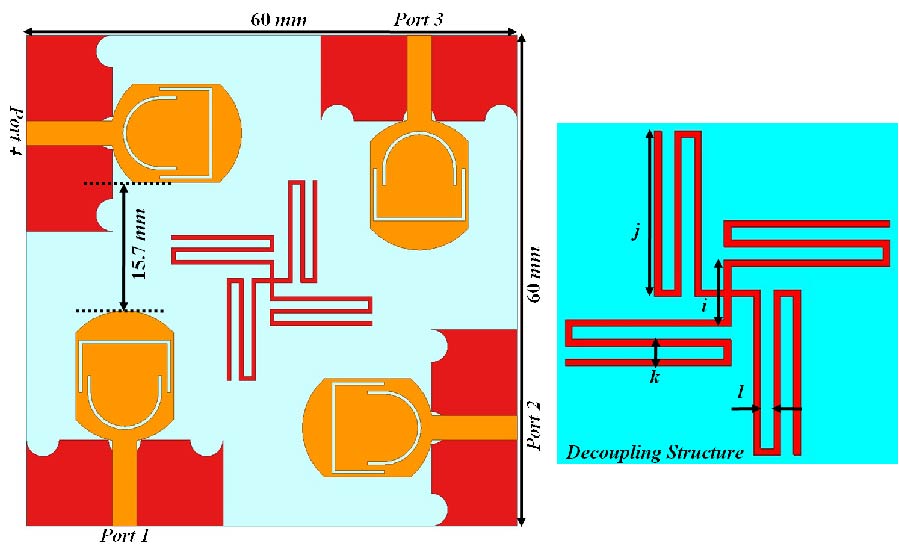
In this paper, an ultra-wideband (UWB) multiple-input multiple-output (MIMO) antenna covering the n77, n78, n79, and 6 GHz bands is proposed for 5G applications, which achieves the full coverage of the 5G NR (New Radio) band with a compact geometry. The antenna is fabricated from low-cost printed circuit boards, with the dimensions of 36 mm x 53 mm x 1.6 mm. The MIMO antenna has been designed with two positive octagonal antenna monopole elements, which feature triangular fractal slots and a defected ground plane. Each of these elements is excited by a microstrip feed, and the antenna operates within a bandwidth of 2.92-16.97 GHz, which encompasses the entire UWB frequency range. The utilization of a floor with T-shaped slots and T-shaped stubs serves to minimize the generation of coupling currents between the antenna elements, thereby achieving an isolation of in excess of 19 dB across the entire operating band and a figure in excess of 20 dB in multiple 5G bands. In addition, simulations and measurements show that the antenna has an envelope correlation coefficient (ECC) less than 0.005, a diversity gain (DG) more than 9.98, a total active reflection coefficient (TARC) less than -30 dB, and a channel capacity loss (CCL) less than 0.3 bit/s/Hz in the operating frequency band, with good gain and stable radiation characteristics. The designed antenna has the potential for significant applications in 5G wireless communications.
A Miniaturized UWB MIMO Antenna Design for 5G Multi-band Applications
2025-02-20
PIER M
Vol. 132, 49-59
Research on the Simulation Method of the Security Check Scene Based on Passive Millimeter-Wave Imaging
Chuan Yin , Siyi Zhang , Pengpeng Xu and Hong Kuan
Current research on passive millimeter wave (PMMW) human security imaging mainly focuses on system optimization and image processing algorithms, with limited attention on simulation studies. This paper addresses this gap by developing a PMMW imaging simulation for human security screening. The study proposes a Multi-layer Brightness Temperature Tracing Method (MBTTM) to accurately calculate brightness temperature values across various scattering directions. The paper proposes a simulation model for microrough surfaces based on the rough characteristics of human skin in security check scenarios. It also presents a PMMW brightness simulation model for detecting hidden dangerous goods in hierarchical media. The model incorporates diffuse ray tracking and accounts for transmission phenomena when rays interact with penetrable surfaces. Finally, both simulation and experimental validation are conducted for human security scenes.Experimental results demonstrate the effectiveness of the proposed method in detecting concealed objects, with a detailed analysis of the impact of surface roughness, ray spacing, and concealment depth on imaging quality.
Research on the Simulation Method of the Security Check Scene Based on Passive Millimeter-wave Imaging
2025-02-19
PIER C
Vol. 152, 271-277
Antenna Designs Using Kriging Assisted Taguchi Method
Jianing Ma , Xingning Jia , Ruidong Wang and Liao Ma
Taguchi method has been extensively applied in electromagnetic optimization. To further enhance the optimization efficiency of the Taguchi method, a surrogate-assisted Taguchi method employing dynamic reduced rates is proposed. The reduced rate of each design variable is proportional to its contribution percentage. Variables with higher contributions exhibit a larger reduction rate, which subsequently decreases the search step and enhances the exploitation and convergence of the Taguchi method. The Kriging model serves as a substitute for the real fitness evaluation in predicting the result of each experiment, with its feasible state determined by the average relative error of its predictions. This ensures the prediction accuracy while reducing the number of real fitness evaluations. The proposed algorithm is validated by the fact that the efficiency has increased at least twofold through four benchmark function tests. In the end, this algorithm is employed to synthesize the radiation pattern of an asymmetrical dipole array with 16 elements and to optimize the front-to-back ratio of the Yagi-Uda antenna.
Antenna Designs Using Kriging Assisted Taguchi Method
2025-02-19
PIER C
Vol. 152, 263-270
Polarization-Insensitive, Integrally Rectifying Metasurface Array for Ambient Energy Harvesting
Congcong Xia , Hongmei Zhao , Yunfei Wang and Mingxing Ren
In this paper, an integrated rectifying metasurface harvester with small dimensions, wide-angle incidence, and polarization insensitive characteristics is proposed. The proposed structure is assembled from a periodic unit cell, diodes, and loads, which makes the structure simple and less expensive to manufacture. The centrosymmetric design concept of the unit cell structure enables the proposed metasurface harvester to capture incident waves with arbitrary polarization angles and over a wide incident angle range of 60°. A 5 x 5 metasurface array was fabricated for real measurements. The results show that the measured efficiency is 62.07% near the operating band 5.8 GHz when the incident power is 15 dBm. When the polarization angle of the incident wave is changed, the efficiency remains essentially constant. As the angle of incidence changes, the efficiency shows a certain decrease, but it can still maintain an efficiency close to 50% near the operating frequency band. The proposed harvester can supply energy to low power devices as well as sensor nodes in IoT.
Polarization-insensitive, Integrally Rectifying Metasurface Array for Ambient Energy Harvesting
2025-02-19
PIER C
Vol. 152, 259-262
Extinction Efficiency of Copper Nano Fibers in the Infrared
Sharhabeel Alyones and Michael Granado
This article presents experimental measurements and theoretical calculations of the mass normalized extinction cross section (extinction efficiency) of hydrothermally synthesized copper nanofibers in the infrared spectral region (2-14) µm. The synthesized copper nanofibers have an average diameter of 40 nm, and the length of the fibers has been ultrasonically reduced to achieve the highest possible efficiency in the targeted IR spectral region. A peak extinction efficiency of ~30 M2/g is achieved with an overall efficiency greater than 10 M2/g across the remainder of the infrared window. Such high efficiency fibers make them of high interest for applications that require attenuation of electromagnetic radiation. To the best of our knowledge, this efficiency is the highest that has been reported in literature, and the synthesis procedure is simple and can be scaled-up for mass production of copper nanofibers.
Extinction Efficiency of Copper Nano Fibers in the Infrared
2025-02-18
PIER C
Vol. 152, 253-258
Novel Hexagonal Cross-Coupled Dielectric Waveguide Filter
Xiao Tao Yao , Yun Xiu Wang , Yang Gao and Jiankang Zhang
In this paper, a six-order cross-coupled ceramic dielectric waveguide filter (CDWF) based on equilateral triangle resonators is introduced. It is composed of a regular hexagonal cavity, which is divided into six equilateral triangular blocks. The filter exhibits two transmission zeros outside the passband that ensure its out-of-band suppression greater than 45 dB. Measured results show that the insertion loss is less than 1 dB and the return loss more than 16 dB within the operating frequency range of 3.4-3.6 GHz. The ceramic dielectric used here has a dielectric constant of 20.3 and a thickness of 5 mm. Thus, it has the advantages of compact size and excellent frequency selectivity.
Novel Hexagonal Cross-coupled Dielectric Waveguide Filter
2025-02-18
PIER C
Vol. 152, 245-251
An Optimized Phase-Only Trapezoid Taper Window for Array Pattern Shaping
Jafar Ramadhan Mohammed
Generally, the array pattern synthesizing can be shaped by controlling the excitation amplitude and phase of the individual elements of the antenna array which they could be controlled either separately or jointly to provide most flexible solutions for the desired pattern shaping. In this paper, a new controllable trapezoid phase-only taper is proposed. In practical applications, phase-only tapers are more preferable than amplitude-only tapers due to their desirable advantages. The required pattern shaping with fulfilled user-defined constraints on the sidelobe peaks, beam widths, and steered nulls can be achieved by optimizing only the excitation phases of the trapezoidal taper. More importantly, the proposed trapezoidal taper offers the best tradeoff between the array directivity and undesirable sidelobe pattern. In addition, the element excitation amplitudes of the proposed phase-only trapezoid taper are made constant and equal to that of the original trapezoid taper function. Thus, it enjoys low array complexity. Moreover, the manipulated phases are assumed to be symmetric to further simplify the array feeding network. The genetic algorithm was used to optimize only the half number of the elements' phases. The results show that the phase-only trapezoid taper yields identical main beam shape to that of the amplitude-only trapezoid taper and much better than the other conventional tapers. Furthermore, it is found that the trapezoid phase-only method needs more variable elements than the trapezoid amplitude-only method to achieve almost the same performance. Thus, the complexity reduction percentage of the phase-only method is lower than that of the amplitude-only method.
An Optimized Phase-only Trapezoid Taper Window for Array Pattern Shaping
2025-02-17
PIER C
Vol. 152, 233-243
A High Isolation Four-Element MIMO Antenna for 5G n256-Band Satellite Communication and 6G Applications
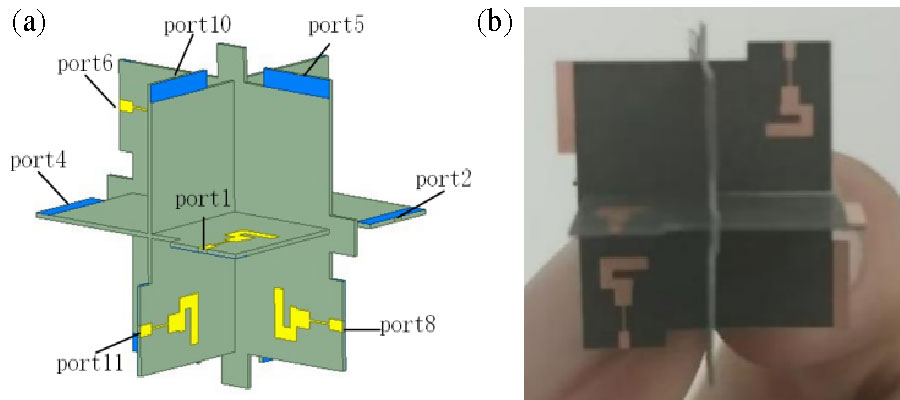
Fanran Zhang , Chengzhu Du and Xu Wu
In the present work, a dual-band four-port multiple-input multiple-output (MIMO) antenna based on an FR4 substrate is designed, which can work in the frequency bands of 5G n256/n77/n78/n79 and 6G system. The MIMO antenna is composed of four orthogonally placed monopole antennas. Multiple sets of L-shaped branches and cross-shaped branches are added to improve the isolation among the antenna elements. The measured isolation is below -20 dB, and most of them can reach -30 dB within the operational frequency spectrum. The actual measurement results reveal that the two impedance bandwidths of the antenna are 420 MHz (1.95-2.37 GHz) and 4050 MHz (3.2-7.25 GHz), respectively, which can encompass the n256 band for 5G-6G satellite technologies (1.98-2.01 and 2.17-2.2 GHz), 5G n77/n78/n79 (3.3-4.2/3.3-3.8/4.4-5.0 GHz) and 6G band (6.425-7.125 GHz). At the same time, the antenna features a peak gain of 7.4 dB. The ECC value is below 0.0015, while the DG value exceeds 9.9999, showing good diversity performance. The data reveal that the designed dual-band quaternary MIMO antenna has good applications in the fields of 5G satellite communication and 6G systems.
A High Isolation Four-element MIMO Antenna for 5G n256-band Satellite Communication and 6G Applications
2025-02-17
PIER M
Vol. 131, 81-93
A Review of DOA Estimation Technology Based on Programmable Metasurfaces
Zhicheng Pei , Tong An , Peixuan Zhu and Huan Lu
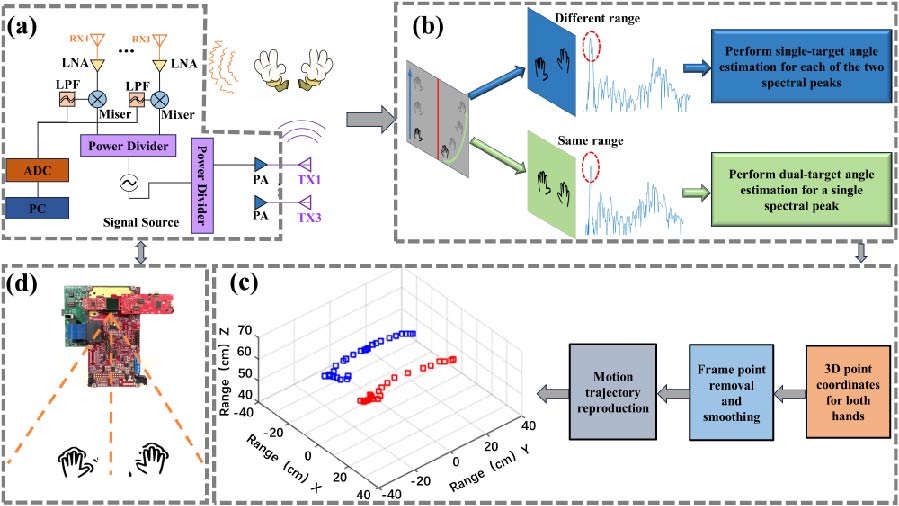
High-precision Direction of Arrival (DOA) estimation requires the use of a large-scale antenna array to achieve accurate results. However, the increasing number of antennas brings substantial challenges that hinder the practical implementation of DOA estimation in real-world engineering applications. The complexity and cost associated with deploying extensive antenna systems can be prohibitive. In contrast, digital metasurfaces offer a promising solution by dynamically manipulating electromagnetic waves. These advanced surfaces enable precise control over wavefronts while utilizing significantly fewer elements, leading to a more compact and cost-effective approach without sacrificing the high-resolution capabilities necessary for effective DOA estimation. This innovative technology not only simplifies the design but also enhances performance. To provide insights for future advancements in this field, this paper reviews the current research status of various DOA estimation techniques that integrate metasurfaces with conventional wave-direction estimation systems, highlighting their potential and applications in improving DOA estimation accuracy.
A Review of DOA Estimation Technology Based on Programmable Metasurfaces
2025-02-16
PIER
Vol. 182, 77-83
Ultra-Compact Photonic Isolator Based on Bias-Free Magneto-Optical Thin Films
Gianni Portela , Yisheng Ni , Kotaro Sato , Yuya Shoji and Hugo Enrique Hernandez-Figueroa
An ultra-compact isolator based on the integration of aluminum-substituted cobalt ferrite films with magneto-optical activity to a silicon microring resonator is suggested. The strong remanent magnetization of the employed magneto-optical material allows the operation of the device without any external magnetizing elements, and the device footprint is only 150 μm2. A prototype chip has been fabricated using conventional processes compatible with the silicon on an insulator platform, and a maximum isolation ratio of 7 dB at the 1557.6 nm wavelength has been achieved. To the best of our knowledge, this is the most compact photonic isolator demonstrated to date, and it is suitable for all-optical circuits with extremely high integration density.
Ultra-compact Photonic Isolator Based on Bias-free Magneto-optical Thin Films
2025-02-16
PIER C
Vol. 152, 221-231
Impact of Quantum Conductivity on a Reconfigurable Single Wall Carbon Nanotube Dipole Performance at Optical Frequency Bands
Muhanad Musa Jameel and Jawad A. K. Hasan
The proposed antenna system integrates advanced materials electromagnetic properties tuning to allow real-time steering to the antenna main beam direction. We explore a tuning mechanism based on changing the chemical potential differences (μc), through including a chiral single wall carbon nanotube (SWCNT) structure with a plasmonic resonance effect at the optical regime. Such change in the value of μc realizes a manipulation in the angular emission pattern change to enhance the beamforming capabilities to the desired requirements. This steerability provides substantial benefits for applications such as optical communication systems. The obtained results validate that the proposed nano-dipole antenna shows significant improvements over other traditional antennas in terms of size reduction with acceptable radiation efficiency, directivity, and tunability. The integration of the proposed design within next optoelectronic generations can floor the way to the compact, high-performance systems with enhanced capabilities for optical communication systems and photonic circuitry. This study presents a steerable plasmonic nano-dipole antenna with dynamic electromagnetic radiation control, designed for modern communication. The antenna operates across a wide frequency range, with a primary focus on the visible spectra 300 THz to 700 THz. By utilizing resonant plasmonic effects, the antenna achieves a radiation efficiency of 57% and a directivity of 4.5 dBi. We introduce a beam-steering mechanism that enables angular radiation steering up to ±25° from the central axis. Control mechanisms include electrical tuning via applied μc voltage from 0 V up to 1 V and optical tuning using laser excitation around 600 THz. Simulations confirm that beamwidth narrows from 30° to 10° at resonance, enhancing spatial precision. The validated results show a tunability of 200 THz in the operational wavelength, with a response S11 below -10 dB. These features demonstrate that the antenna operation has a potential for integration into next-generation optoelectronic devices, offering compact and efficient solutions for wireless communication, remote sensing, and optical imaging systems. This is achieved by leveraging the resonant interaction between surface plasmon polaritons and nano-dipole geometry, and we demonstrate the ability to achieve highly directional and tunable radiation across a wide range of frequencies, including visible and near-infrared spectra.
Impact of Quantum Conductivity on a Reconfigurable Single Wall Carbon Nanotube Dipole  Performance at Optical Frequency Bands