Search Results(13797)

2015-05-26
PIER C
Vol. 57, 149-158
Thin Profile Wideband Printed Monopole Antenna for Slim Mobile Handsets Applications
Pradutt Kumar Bharti , Hari Shankar Singh , Gaurav Kumar Pandey and Manoj Kumar Meshram
In this paper, a compact wideband planar monopole antenna suitable for slim mobile handsets applications is presented. The proposed antenna operates over LTE700/GSM800/900 (0.742 GHz-1.36 GHz), GPS L1/GSM1800/1900/UMTS/IMT2100/Wi-Fi/LTE2300/2500 (1.475 GHz-2.7 GHz), and WiMAX (3.4 GHz-3.72 GHz) based on reflection coefficient better than -6 dB. It consists of coupling strip, shorted radiating strip, and parasitic meandered lines. The wider impedance bandwidth is achieved by placing the meandered line as parasitic element on the back side of the coupling and shorted radiating elements. With this configuration, the antenna gives extremely wide impedance bandwidth which covers all the required frequency bands of the smart mobile phones. To investigate the proposed antenna, S-parameters, surface current distributions, and radiation performances are studied. To check the robustness of the proposed antenna, investigation is also carried out in the vicinity of the mobile environment. Further, specific absorption rate (SAR) is calculated on the human head and found to be below 0.535 W/kg. The simulated and measured results are found in close agreement.
THIN PROFILE WIDEBAND PRINTED MONOPOLE ANTENNA FOR SLIM MOBILE HANDSETS APPLICATIONS
2015-05-24
PIER
Vol. 151, 151-167
Lossy Spherical Cavity Resonators for Stress-Testing Arbitrary 3D Eigenmode Solvers
Stergios Papantonis and Stepan Lucyszyn
A lossy metal-wall cavity resonator that extends well beyond perturbation theory limits is studied. An exact analytical solution is employed for the spherical cavity resonator, having walls transformed from being a perfect electrical conductor (PEC) to free space. This model then acts as an ideal benchmark reference standard. A plane-wave approximation is then derived. Independent full-wave numerical modeling of the spherical cavity resonator is undertaken using eigenmode solvers within two well-known commercial, industry-standard, simulation software packages (HFSS™ and COMSOL). It has been found that the plane-wave approximation model accurately characterizes the results generated by these solvers when equivalent finite conductivity boundary (FCB) and layered impedance boundary (LIB) conditions are used. However, the impedance boundary (IB) condition is accurately characterized by the exact model, but the precise value of complex wave impedance at the wall boundary for the specific resonance mode must first be known a priori. Our stress-testing results have profound implications on the usefulness of these commercial solvers for accurately predicting eigenfrequencies of lossy arbitrary 3D structures. For completeness, an exact series RLC equivalent circuit model is given specifically for a spherical cavity resonator having arbitrary wall losses, resulting in the derivation of an extended perturbation model.
LOSSY SPHERICAL CAVITY RESONATORS FOR STRESS-TESTING ARBITRARY 3D EIGENMODE SOLVERS
2015-05-22
PIER C
Vol. 57, 137-148
Compact Dielectric Resonator Antenna with Band-Notched Characteristics for Ultra-Wideband Applications
Asmaa H. Majeed , Abdulkareem S. Abdullah , Khalil Hassan Sayidmarie , Raed A. Abd-Alhameed , Fauzi Elmegri and James M. Noras
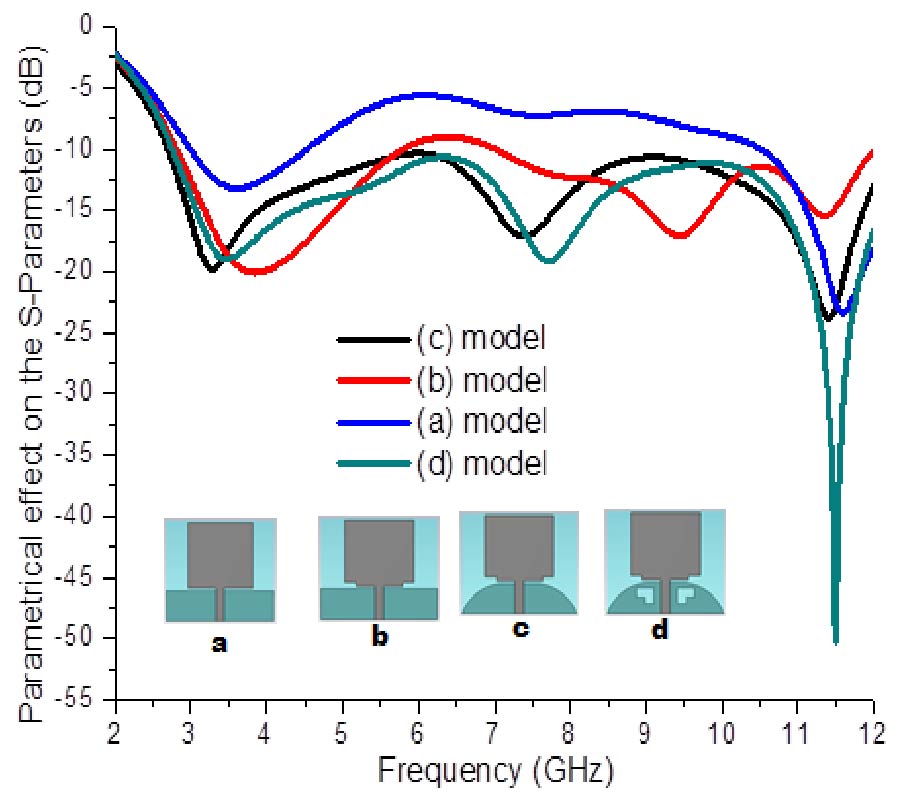
In this paper, a compact dielectric resonator antenna (DRA) with bandnotched characteristics for ultra-wideband applications is presented. A comprehensive parametric study was carried out using CST Microwave Studio suite TM 2011 to analyze and optimize the characteristics of the proposed antenna. Three shapes for the coupling slot were investigated. Simulation results show that the proposed DRA had a -10 dB impedance bandwidth of 23% from 9.97 GHz to 12.558 GHz, and a maximum gain of 7.23 dBi. The antenna had a notched band centered at 10.57 GHz, which increased the reflection coefficient by 23.5 dB, and reduced the gain by 6.12 dB. The optimized designs were verified by experimental tests on fabricated samples.
COMPACT DIELECTRIC RESONATOR ANTENNA WITH BAND-NOTCHED CHARACTERISTICS FOR ULTRA-WIDEBAND APPLICATIONS
2015-05-22
PIER C
Vol. 57, 127-135
Compact Multi-Band Filter Based on Multi-Ring Complementary Split Ring Resonators
Imene Sassi , Larbi Talbi and Khelifa Hettak
A novel multi-band band-reject filter based on multi-ring complementary split-ring resonators (multi-ring CSRRs) is presented. The proposed filter is realized by etching the multi-ring CSRRs in the ground plane beneath a microstrip line. The multi-ring CSRR offers the possibility of designing multi-band filters with a small size and simple structure. To validate the proposed prototype of the multi-band filter, a dual-band and tri-band filters were fabricated and tested. The proposed filters show a good multi-band property to satisfy the requirement of WLAN in the 2.4/5.8 GHz bands and WiMAX in the 2.5/3.4 GHz bands. A good agreement between experimental and simulated results is obtained.
COMPACT MULTI-BAND FILTER BASED ON MULTI-RING COMPLEMENTARY SPLIT RING RESONATORS
2015-05-22
PIER Letters
Vol. 53, 89-94
High Selectivity Differential Bandpass Filter Using Dual-Behavior Resonators
Xin Gao , Wenjie Feng and Wenquan Che
A high selectivity differential bandpass filter (BPF) using two pairs of dual-behavior resonators (DBRs) is proposed in this letter. A high selectivity passband for the differential mode with second harmonic suppression is achieved, by utilizing shorted coupled lines with two short stubs. For the common-mode (CM) circuit, the CM responses can be suppressed over a wide frequency band by the loaded open/shorted stubs. To validate the feasibility of the proposed filter, a planar differential BPF (3-dB fractional bandwidth 4.9%) with good CM suppression is designed and fabricated. The theoretical and measured results agree well and show good in-band filtering performances and out-of-band harmonic suppression performances.
HIGH SELECTIVITY DIFFERENTIAL BANDPASS FILTER USING DUAL-BEHAVIOR RESONATORS
2015-05-22
PIER Letters
Vol. 53, 83-88
A Compact Antenna Design for UHF RFID Applications
Bing Wang
This paper presents a new compact end-fire antenna for ultra-high frequency (UHF) radio frequency identification (RFID) applications. The antenna has two meandered dipole drivers. A folded reflector and a rectangular reflector are demonstrated. The advantage of the end-fire antenna with meander dipole drivers compared to the conventional quasi-Yagi antenna is a reduction in the length of the driver, which allows closer space for RFID reader. The end-fire antenna is fabricated on a FR4 printed circuit board (PCB), the dimension of the antenna is 81×58 mm2. The measured bandwidth is around 25 MHz (905-930 MHz) under the condition of VSWR less than 2. The maximum gain of the end-fire antenna is 3.2 dB. The advantages of the new antenna element are that it is more compact than conventional design and it is suitable for fabrication on low-cost, low dielectric constant materials. The antenna configuration, design, simulated and measured results have been well discussed. A good agreement is obtained between the simulated and experimental results. This new compact end-fire antenna is desirable for RFID reader applications.
A COMPACT ANTENNA DESIGN FOR UHF RFID APPLICATIONS
2015-05-22
PIER Letters
Vol. 53, 77-82
An Ultra-Wideband Twin-Patch Monopole Antenna with Band-Rejection Characteristic
Chao-Ming Wu and Yi-Hong Liu
To suppress electromagnetic interference at 5.5-GHz WLAN (5.15-5.825 GHz) band operation, a novel ultra-wideband (UWB) design of a slotted twin-patch monopole antenna with a band-rejection characteristic is presented. The proposed antenna with a simple structure has a large impedance bandwidth, defined by 10-dB return loss, covering the range from 2.95 to 10.85 GHz, and a tunable cutoff band from 5.18 to 6 GHz for band-operation suppression. Measured monopole-like radiation pattern and in-band average gain of about 2.3 dBi have also been obtained, simultaneously, with good agreement to the simulated results.
AN ULTRA-WIDEBAND TWIN-PATCH MONOPOLE ANTENNA WITH BAND-REJECTION CHARACTERISTIC
2015-05-22
PIER M
Vol. 42, 85-93
A Hybrid Method for Electromagnetic Coupling Problems of Transmission Lines in Cavity Based on FDTD Method and Transmission Line Equation
Zhihong Ye , Xiang-Zheng Xiong , Cheng Liao and Yong Li
A time domain hybrid method is presented for efficiently solving the electromagnetic coupling problems of transmission lines in cavity. The proposed method is based on the finite-difference time-domain (FDTD) method and transmission line (TL) equations (FDTD-TL), which can achieve a strong synergism on the computations of field and circuit. The FDTD method with an auto mesh generation technique is employed to obtain the electric fields of transmission lines excited by an incident wave from the outside of the cavity. The electric fields are introduced into the TL equations as additional voltage sources at each time step of FDTD method. The current and voltage responses of terminal loads can be obtained by the TL equations. Two examples are presented to demonstrate the correctness of this method. The high efficiency of this hybrid method is verified by comparing the computation time with the traditional method.
A HYBRID METHOD FOR ELECTROMAGNETIC COUPLING PROBLEMS OF TRANSMISSION LINES IN CAVITY BASED ON FDTD METHOD AND TRANSMISSION LINE EQUATION
2015-05-20
PIER B
Vol. 63, 1-15
Wide-Band Chaotic Noise Signal for Velocity Estimation and Imaging of High-Speed Moving Targets
Qilun Yang , Yunhua Zhang and Xiang Gu
This paper proposes a burst model of chaotic noise signals with randomly stepped carrier frequencies for velocity estimation and high-resolution range imaging of high-speed moving targets. The random stepping of carrier frequencies is controlled by a combination chaotic map (CCM), which is generated by embedding a Logistic map into a Bernoulli map. The baseband noise signal adopts the CCM based frequency-modulation (CCM-FM) signal, which has good randomness and a thumbtack ambiguity function as well. The velocity estimation includes a coarse search where the coarse search is conducted with a fixed step to makes the velocity deviation less than the velocity resolution, while the precise search adopts the Golden Section Search (GSS) algorithm to get an accurate estimation of velocity. What should be emphasized is that the velocity estimation process can be completed with just a burst of subpulses. Then the spectra are coherently synthesized to obtain ultra-wide bandwidth and high-resolution range imaging. Finally, numerical simulations demonstrate a good performance of the proposed signal model and the processing algorithm.
WIDE-BAND CHAOTIC NOISE SIGNAL FOR VELOCITY ESTIMATION AND IMAGING OF HIGH-SPEED MOVING TARGETS
2015-05-19
PIER Letters
Vol. 53, 71-76
Electromagnetically-Coupled Millimeter-Wave Antenna Array with Non-Uniform Distribution for 60 GHz ISM Applications
Osama Mohamed Haraz Ahmed
In this article, the design of an electromagnetically-coupled millimeter-wave elliptical patch array antenna prepared to work in the 56-65 GHz (14.8%) frequency band is presented. The introduced antenna array is designed for low-loss, high-gain and low cross-polarization levels. The proposed antenna exhibits a measured gain of 8 dBi and good linear polarization across the desired frequency range. It has a good side lobe suppression better than 17 dB in both E- and H-planes. Measured and simulated results confirm that this antenna is a good candidate for short-range wireless communication applications at millimeter-wave frequencies.
ELECTROMAGNETICALLY-COUPLED MILLIMETER-WAVE ANTENNA ARRAY WITH NON-UNIFORM DISTRIBUTION FOR 60 GHZ ISM APPLICATIONS
2015-05-18
PIER
Vol. 151, 127-150
Electromagnetic Field Transformations for Measurements and Simulations (Invited Paper)
Thomas F. Eibert , Emre Kilic , Carlos Lopez , Raimund A. M. Mauermayer , Ole Neitz and Georg Schnattinger
Electromagnetic field transformations are important for electromagnetic simulations and for measurements. Especially for field measurements, the influence of the measurement probe must be considered, and this can be achieved by working with weighted field transformations. This paper is a review paper on weighted field transformations, where new information on algorithmic properties and new results are also included. Starting from the spatial domain weighted radiation integral involving free space Green's functions, properties such as uniqueness and the meaning of the weighting function are discussed. Several spectral domain formulations of the weighted field transformation integrals are reviewed. The focus of the paper is on hierarchical multilevel representations of irregular field transformations with propagating plane waves on the Ewald sphere. The resulting Fast Irregular Antenna Field Transformation Algorithm (FIAFTA) is a versatile and efficient transformation technique for arbitrary antenna and scattering fields. The fields can be sampled at arbitrary irregular locations and with arbitrary measurement probes without compromising the accuracy and the efficiency of the algorithm. FIAFTA supports different equivalent sources representations of the radiation or scattering object: 1) equivalent surface current densities discretized on triangular meshes, 2) plane wave representations, 3) spherical harmonics representations. The current densities provide for excellent spatial localization and deliver most diagnostics information about the test object. A priori information about the test object can easily be incorporated, too. Using plane wave and spherical harmonics representations, the spatial localization is not as good as with spatial current densities, but still much better than in the case of conventional modal expansions. Both far-field based expansions lead to faster transformations than the equivalent currents and in particular the orthogonal spherical harmonics expansion is a very attractive and robust choice. All three expansions are well-suited for efficient echo suppression by spatial filtering. Various new field transformation and new computational performance results are shown in order to illustrate some capabilities of the algorithm.
ELECTROMAGNETIC FIELD TRANSFORMATIONS FOR MEASUREMENTS AND SIMULATIONS (Invited Paper)
2015-05-15
PIER C
Vol. 57, 117-125
Triple Band-Notched UWB Planar Monopole Antenna Using Triple-Mode Resonator
Huaxia Peng , Yufeng Luo and Zhi-Xin Shi
In this paper, a novel printed microstrip-fed monopole ultra-wideband (UWB) antenna with triple-notched bands using triple-mode stepped impedance resonator (SIR) is presented. The proposed triple-mode SIR is found to have the advantages of introducing triple-notched bands and providing higher degree of freedom to adjust the resonant frequencies. By coupling the triple-mode SIR beside the microstrip feedline, band-rejected filtering properties around the 5.2 GHz WLAN band, the 6.8 GHz RFID band, and the X-band satellite communication band, are generated. To validate the design concept, a novel compact UWB antenna with three notched bands is designed and measured. Results indicate that the proposed compact antenna not only retains triple band-rejections capability but also owns omni directional radiation patterns across nearly whole operating bandwidth for UWB communications.
TRIPLE BAND-NOTCHED UWB PLANAR MONOPOLE ANTENNA USING TRIPLE-MODE RESONATOR
2015-05-15
PIER Letters
Vol. 53, 65-70
A Dual-Band Bandpass Filter for 2.4 GHz Bluetooth and 5.2 GHz WLAN Applications
Lakhindar Murmu and Sushrut Das
In this paper a dual-band bandpass filter using loaded stub in the ring resonator and etched nested C-shape defected ground structure (DGS) on ground plane is reported. The operating frequencies of the bandpass filter are selected for applications in Bluetooth (2.4 GHz-2.484 GHz) and WLAN (5.15 GHz-5.35 GHz) systems. Due to its applications in WLAN and Bluetooth system the filter will be subjected to high EM radiation from the antenna and nearby sources. Therefore, susceptibility study of such filter is very important. The susceptibility study of the filter has been carried out by subjecting the structure to an interference source. Experimental results are presented and analyzed.
A DUAL-BAND BANDPASS FILTER FOR 2.4 GHZ BLUETOOTH AND 5.2 GHZ WLAN APPLICATIONS
2015-05-15
PIER Letters
Vol. 53, 57-63
A Simple Dual-Band Circularly Polarized Rectangular Dielectric Resonator Antenna
Meng Zou and Jin Pan
A simple slot coupled dual-band circularly polarized (CP) rectangular dielectric resonator antenna (DRA) is presented. The TE111 and TE113 modes of the rectangular DRA are excited by a modified annular slot. Working principle of the proposed antenna is explained in this paper. Design guideline of the proposed antenna is also devised based on the parameter study. The simple feeding and radiating structures of the proposed antenna make it easy to be designed and fabricated. A prototype antenna was designed, fabricated and measured. The simulated and measured results confirm the dual-band CP performance of the proposed antenna.
A SIMPLE DUAL-BAND CIRCULARLY POLARIZED RECTANGULAR DIELECTRIC RESONATOR ANTENNA
2015-05-15
PIER
Vol. 151, 119-125
Magnetized Plasma as a Versatile Platform for Switching
Lian Shen , Runren Zhang , Zuojia Wang , Shahram Dehdashti , Shi Sheng Lin and Hongsheng Chen
We study the magneto-permittivity effect in a magnetized plasma with appropriately designed parameters. We show that at frequency near the plasma frequency, magneto-optical activity plays an important role to manipulate and control the wave propagations in the magnetized plasma. Such a unique feature can be utilized to establish sensitive magnetic field switching mechanism, which is confirmed by detailed numerical investigations. Switching by magnetic field based on magnetized plasma is flexible and compatible with other optical system; moreover it is applicable to any frequency by tuning the plasma density. For these reason, our work shows the possibility for developing a new family of high frequency and ultrasensitive switching applications.
MAGNETIZED PLASMA AS A VERSATILE PLATFORM FOR SWITCHING
2015-05-13
PIER C
Vol. 57, 109-116
Reconfigurable Stepped-Impedance Slotline Power Dividers
Sheng-Loke Lim , Eng Hock Lim and Fook-Loong Lo
For the first time, the higher-ordered modes of a stepped-impedance slotline resonator are closely combined for designing the broadband in-phase andout-of-phase power dividers. It was found that the output phases of the two modes can be easily reversed at the same time by changing the direction of their feeding currents. For this configuration, interestingly, a multifunctional power divider which is reconfigurable to produce either in-phase or out-of-phase signals can be easily designed from its passive counterparts by incorporating multiple RF diodes into the output feedlines, leading to significant cost saving and high compactness. The design procedure and equations of the power-dividing structures are discussed.
RECONFIGURABLE STEPPED-IMPEDANCE SLOTLINE POWER DIVIDERS
2015-05-11
PIER C
Vol. 57, 99-107
A Joint Parameter Estimation Method with Conical Conformal CLD Pair Array
Guibao Wang
A novel direction of arrival (DOA) and polarization estimation method with sparse conical conformal array consisting of concentred loop and dipole (CLD) pairs along the z-axis direction is proposed in this paper. In the algorithm, the DOA and polarization information of incident signals are decoupled through transformation to array steering vectors. According to the array manifold vector relationship between electric dipoles and magnetic loops, the signal polarization parameters are given. The phase differences between reference element and elements on upper circular ring are acquired from the steering vectors of upper circular ring, it can be used to give rough but unambiguous estimates of DOA. The phase differences are also used as coarse references to disambiguate the cyclic phase ambiguities in phase differences between two array elements on lower circular ring. Without spectral peak searching and parameter matching, this method has the advantage of small amount of calculation. Finally, simulation results verify the effectiveness of the algorithm.
A JOINT PARAMETER ESTIMATION METHOD WITH CONICAL CONFORMAL CLD PAIR ARRAY
2015-05-11
PIER
Vol. 151, 109-117
Exact Analytical Solution for Fields in a Lossy Cylindrical Structure with Linear Gradient Index Metamaterials
Mariana Dalarsson , Martin Norgren and Zoran Jaksic
We investigate the electromagnetic wave propagation across a finite inhomogeneous and anisotropic cylindrical metamaterial composite containing both positive and negative effective refractive index parts with linear spatial gradient. Exact analytical solutions for the electric and magnetic field distributions are obtained for a linear variation of effective refractive index across the structure. The model allows for general temporal dispersion and uniform losses within the composite.
EXACT ANALYTICAL SOLUTION FOR FIELDS IN A LOSSY CYLINDRICAL STRUCTURE WITH LINEAR GRADIENT INDEX METAMATERIALS
2015-05-08
PIER M
Vol. 42, 71-83
Matrix Method for Antenna Plane Wave Spectrum Calculation Using Irregularly Distributed Near-Field Data : Application to Far-Field Assessment
Mohamed Farouq , Mohammed Serhir and Dominique Picard
The matrix method for the calculation of antenna far-field using irregularly distributed near-field measurement data is presented. The matrix method is based on the determination of the plane wave expansion (PWE) coefficients from the irregular near-field samples using a matrix form that connects the radiated field with the corresponding plane wave spectrum. The plane wave spectrum is used to determine the far-field of the antenna under test (AUT). The matrix method has been implemented, and its potentialities are presented. The validations using analytical radiating model (dipoles array) and experimental measurement (X band standard gain horn antenna) results have demonstrated the efficiency and stability of the proposed method.
MATRIX METHOD FOR ANTENNA PLANE WAVE SPECTRUM CALCULATION USING IRREGULARLY DISTRIBUTED NEAR-FIELD DATA : APPLICATION TO FAR-FIELD ASSESSMENT
2015-05-06
PIER B
Vol. 62, 319-331
Gridded Parasitic Patch Stacked Microstrip Antenna with Beam Shift Capability for 60 GHz Band
Alexander Bondarik and Daniel Sjöberg
A microstrip antenna design is introduced in which aperture coupled rectangular microstrip patch is coupled electromagnetically with a parasitic gridded rectangular patch placed above. The gridded patch consists of nine identical rectangular parts separated by a distance which is much smaller than a free space wavelength for a central frequency. The antenna is designed to operate in the 60 GHz band and is fabricated on a conventional PTFE (polytetrafluoroethylene) thin substrate. Different published arrangements for parasitic patches are studied. For the same substrate and central frequency the proposed antenna has improved return loss bandwidth and gain bandwidth for approximately the same maximum gain. Measurement results are in good agreement with simulation. Measured 10 dB return loss bandwidth is from 54 GHz up to 67 GHz. It fully covers the unlicensed band around 60 GHz. The measured antenna realized gain at 60 GHz is close to 8 dB, while the simulated antenna radiation efficiency is 85%. A simple beam shifting method is possible for this antenna structure by connecting adjacent outside parts in the gridded patch. The designed antenna is suitable for a high speed wireless communication system in particular for a user terminal in a fifth generation (5G) cellular network.
GRIDDED PARASITIC PATCH STACKED MICROSTRIP ANTENNA WITH BEAM SHIFT CAPABILITY FOR 60 GHZ BAND