Search Results(13802)

2011-03-06
PIER Letters
Vol. 21, 99-107
Novel Design of Triple Band Rectangular Patch Antenna Loaded with Metamaterial
M. R. C. Mahdy , Md. Rashedul Alam Zuboraj , Abdullah Al Noman Ovi and Md. Abdul Matin
In this letter, for the very first time, triple band rectangular patch antenna loaded with metamaterial has been reported. Maximum directivities demonstrated here for all the three bands are quite high in comparison with previously reported any kind of rectangular patch antenna. This unique triple band performance has been achieved with the help of newly produced TM0δ0 (3<δ<4) mode, symmetric slot loading and parasitic patch adjustment. Application of etched slot and parasitic patch in DPS (double positive)-metamaterial juxtaposed layer loaded antenna has been also demonstrated for the first time. Considering the quite satisfactory performance (S-parameter, radiation pattern and radiation efficiency) of this novel design, we expect that our proposed ideas will be very effective to design all these metamaterial loaded novel rectangular patch antennas.
NOVEL DESIGN OF TRIPLE BAND RECTANGULAR PATCH ANTENNA LOADED WITH METAMATERIAL
2011-03-05
PIER C
Vol. 20, 139-153
A New Frequency Selective Window for Constructing Waveguide Bandpass Filters with Multiple Attenuation Poles
Mikio Tsuji , Hiroyuki Deguchi and Masataka Ohira
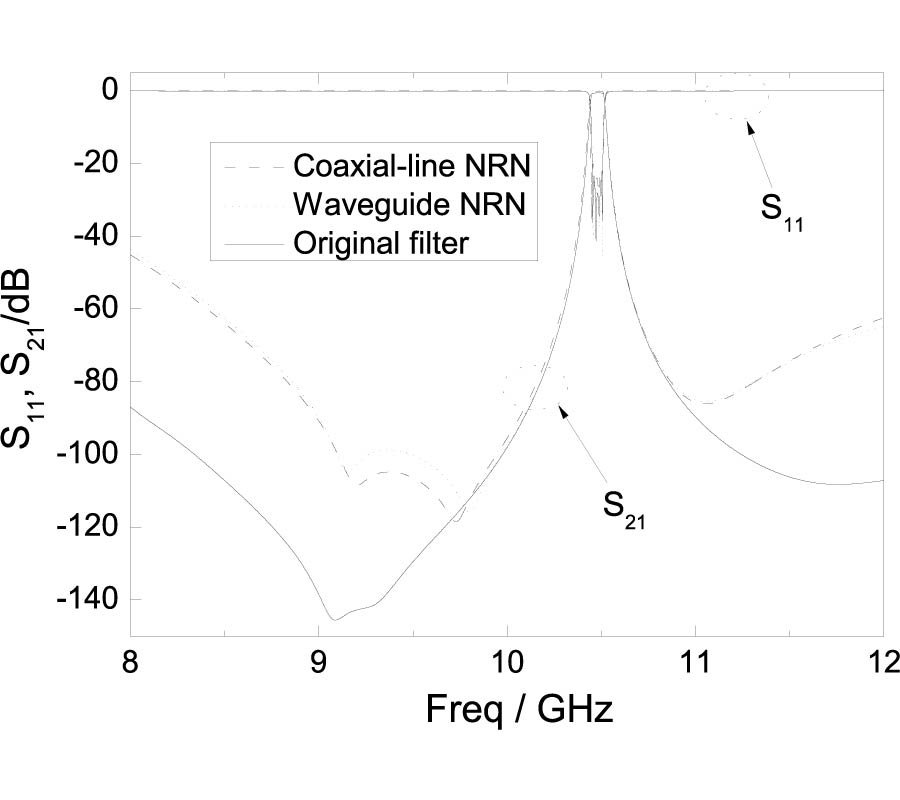
This paper presents a novel frequency selective window for waveguide filters. It has a resonant characteristic with two attenuation poles on both sides of a passband, that is, a dual-behavior resonance. Such frequency selective windows make it possible to construct a compact bandpass filter having multiple attenuation poles without any additional coupling structures. As design examples, we show 3-pole Chebyshev waveguide filters with six attenuation poles in both the microwave and the millimeter-wave regions. The validity of the present filters is proven by the comparison of the frequency characteristics between the calculated and the measured results.
A NEW FREQUENCY SELECTIVE WINDOW FOR CONSTRUCTING WAVEGUIDE BANDPASS FILTERS WITH MULTIPLE ATTENUATION POLES
2011-03-05
PIER
Vol. 114, 383-393
Seven Ports Power Divider with Various Power Division Ratios
Ayman Sulaiman Al-Zayed and Samir Mahmoud
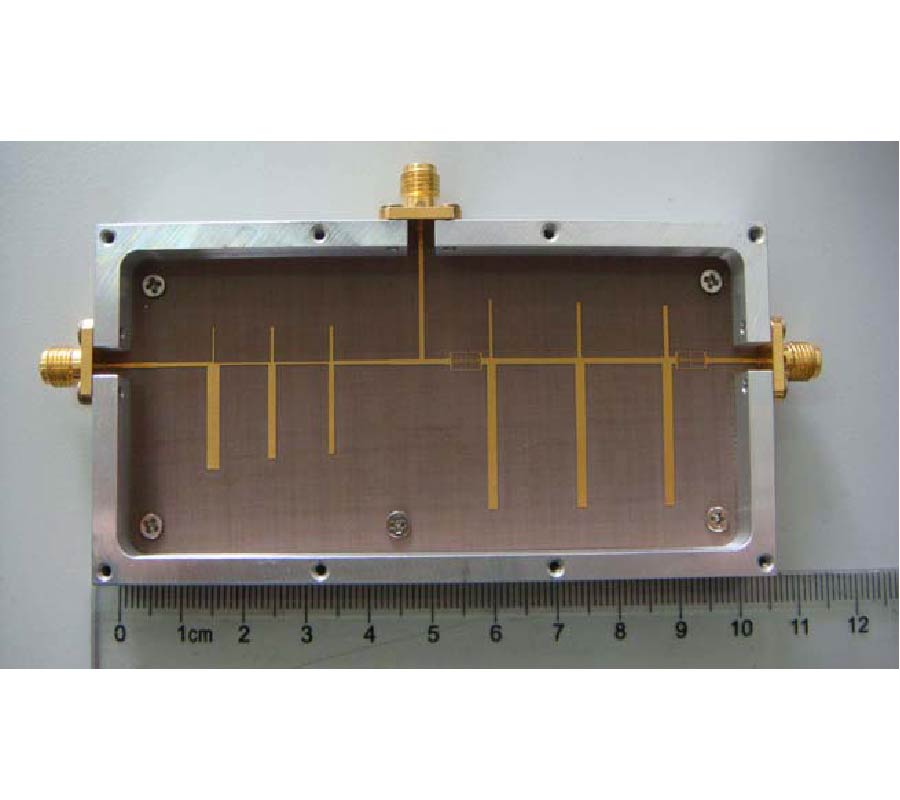
A seven ports network is proposed to act as a six-way power divider/combiner. The proposed network structure consists of a set of λ/4 planar transmission lines at the design frequency and does not require any isolating resistor. The power divider is capable of providing various power ratios by judicious choice of the transmission lines characteristic impedances. Design equations are derived for arbitrary power ratios. Simulation results obtained from the ADS software proved the possibility of achieving preset power ratios with fairly linear phase response over a certain bandwidth. The latter depends on the chosen power ratios. Measured results of manufactured power dividers agree well with simulations and theory.
SEVEN PORTS POWER DIVIDER WITH VARIOUS POWER DIVISION RATIOS
2011-03-04
PIER C
Vol. 20, 125-138
Plastic Optical Fiber Coupler with High Index Contrast Waveguide Taper
Abang Annuar Ehsan , Sahbudin Shaari and Mohd Kamil Abd-Rahman
A simple low-cost Y-branch plastic optical fiber (POF) coupler which can be assembled easily by the end users has been developed. The acrylic-based Y-Branch POF coupler consists of input POF fiber, a middle high index contrast waveguide taper and output POF fibers. The optical device is based on a 1x2 Y-branch coupler design with a middle high index contrast waveguide taper. Non-sequential ray tracing has been performed on the device giving an insertion loss of 4.68 dB and coupling ratio of 50:50. The middle waveguide taper region is constructed on the acrylic block itself without using any additional optical waveguiding medium injected into the engraved taper region. Fabrication of the devices is done by producing the device structures on an acrylic block using high speed CNC machining tool. Input and output POF fibers are inserted in to this device structure in such a way that they are passively aligned to the middle waveguide taper structure. The first prototype device shows an insertion loss of 7.5 dB and a splitting ratio of 50:50. A second prototype device which includes additional U-groove slots for the jacketed fibers shows an insertion loss of 5.9 dB and a splitting ratio of 50:50.
PLASTIC OPTICAL FIBER COUPLER WITH HIGH INDEX CONTRAST WAVEGUIDE TAPER
2011-03-04
PIER C
Vol. 20, 111-123
An "F-Gain" Antenna for UWB-RFID
Antoine Diet and Nicolas Ribiere-Tharaud
This paper presents an UWB antenna concept adapted for a potential application of RFID in a severe multi-paths environment for European regulation (UWB-LDR 6--8.5 GHz). The UWB provides theoretically the signal integrity and designing the UWB antenna is compatible with low size, cost and low complexity consideration. Under the hypothesis of using the same antenna at both transmitting or receiving states, the 1/f2 effect of free space attenuation can be minimised by a pre-emphasis included in the antenna design, that is to say an ``f-gain" antennas at both transmitting (Tx) and receiving (Rx) parts. As a result, the printed antennas described are neither constant aperture nor constant gain type.
AN
2011-03-03
PIER B
Vol. 28, 307-323
Spectral Domain Analysis of a Circular Nano-Aperture Illuminating a Planar Layered Sample
Krzysztof A. Michalski
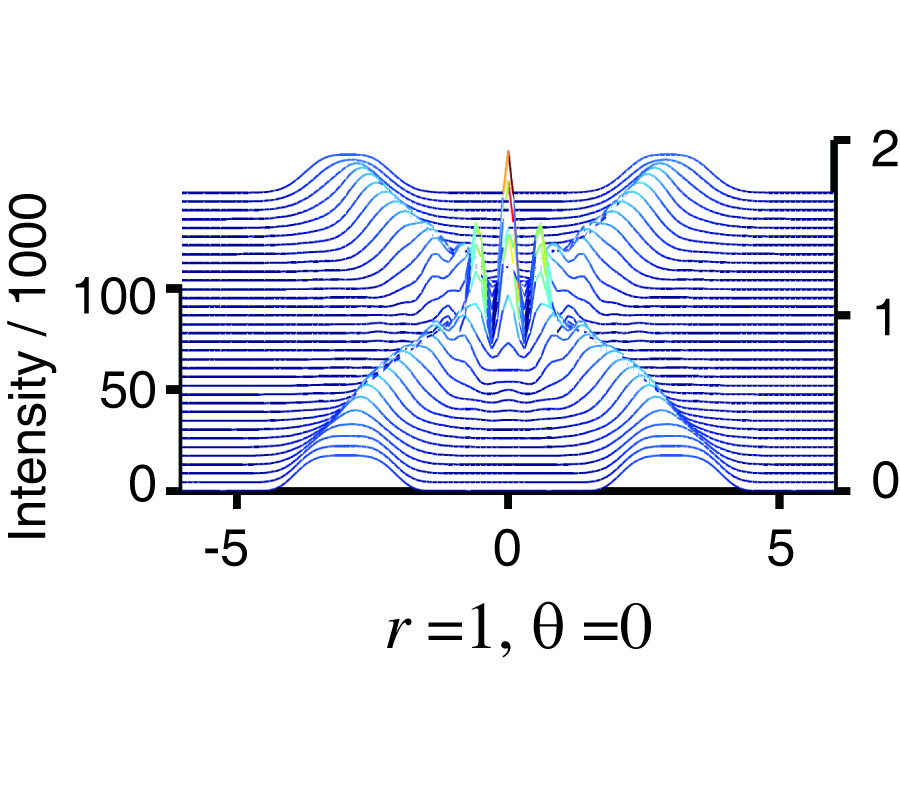
A rigorous and efficient spectral domain formalism is presented of a plane wave-excited subwavelength circular aperture in a planar perfectly conducting metallic screen of infinitesimal thickness, based on the Bethe-Bouwkamp quasi-static model. The formulation utilizes a transmission line analogue of the medium, which facilitates the inclusion of planar multilayered material samples, where the latter may exhibit uniaxial anisotropy. The transmitted field components are expressed in terms of one-dimensional Hankel transform integrals, which can be evaluated by efficient numerical procedures. Sample results are presented showing the intensity profiles and polarization states of transmitted light penetrating into a semiconductor layer.
SPECTRAL DOMAIN ANALYSIS OF A CIRCULAR NANO-APERTURE ILLUMINATING A PLANAR LAYERED SAMPLE
2011-03-03
PIER B
Vol. 28, 289-306
Single-Feed Planar Antenna for Suppressing the Change in Received Signal Level Due to Standing Waves in Mobile Communication
Herman Hideyuki Uchida , Hiroyasu Matsui , Osamu Mikami and Toshio Wakabayashi
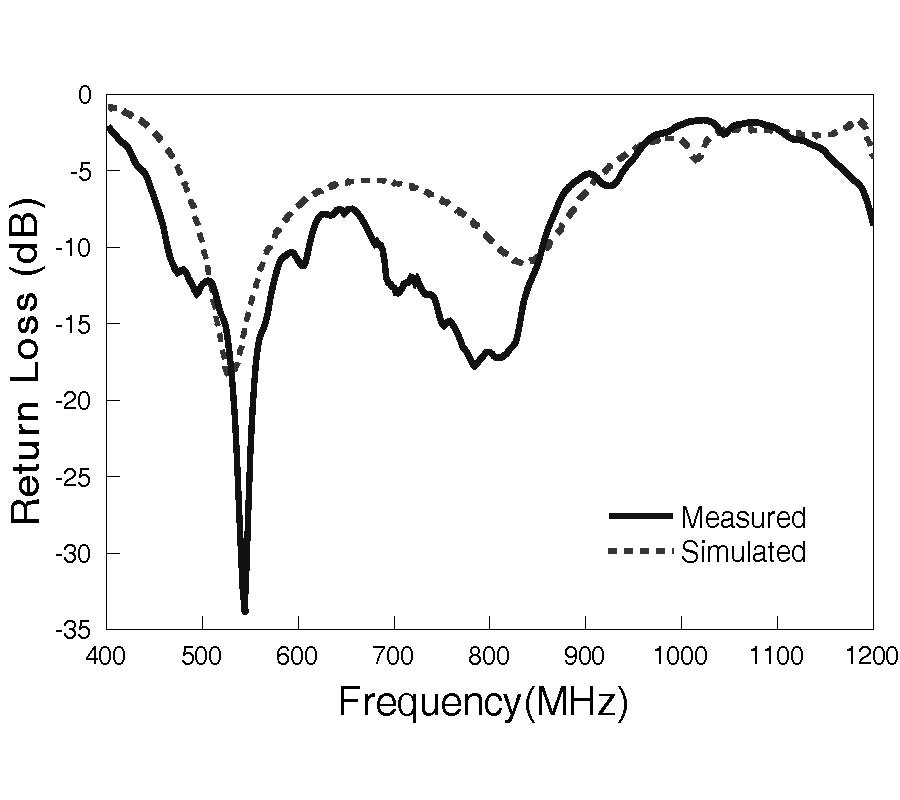
The fading phenomenon resulting from standing waves is a factor in quality deterioration in mobile communication technologies (e.g., cellular phones and television receivers). Suppression of this fading phenomenon is needed for many kinds of technologies. A single-feed planar antenna composed of two antenna components, a Planar Monopole Antenna (PMA) and a Planar Slot Antenna (PSA), is proposed for reducing deterioration of reception due to the fading phenomenon. Reflection coefficient and radiation patterns are analyzed by the Finite Difference Time Domain (FDTD) method and compared with measured results. Results indicate that the proposed antenna has a resonant frequency with functions of the PMA and the PSA. The results of a field experiment at 583.76MHz in the Ultra High Frequency (UHF) band indicate that the proposed antenna efficiently suppresses the fading phenomenon resulting from multipath propagation.
SINGLE-FEED PLANAR ANTENNA FOR SUPPRESSING THE CHANGE IN RECEIVED SIGNAL LEVEL DUE TO STANDING WAVES IN MOBILE COMMUNICATION
2011-03-03
PIER C
Vol. 20, 95-109
A Circularly Polarized Aperture Stacked Patch Microstrip Antenna for L Band
Fei Zhao , Tingting Liu and Zuping Qian
The design and manufacture of a circular polarized aperture stacked patch circular microstrip patch antenna (CPASPA) at L-band is presented. The Wilkinson power divider is used to excite the stacked circular patches by two orthogonal $H$-shape slots, which can improve the operation bandwidth and circularly polarized performance. The design is optimized by a series of parametric study of the input impedance for the antenna. The measurements show that the CPASPA has a 3-dB axial ratio (AR) bandwidth of 55.0% and a 10-dB return loss (RL) bandwidth of 47.0%. The measured gain is more than 0 dBic over the bandwidth of 42.5%, in which the maximum is 9.4 dBic. The measurements agree very well with the simulation results.
A CIRCULARLY POLARIZED APERTURE STACKED PATCH MICROSTRIP ANTENNA FOR L BAND
2011-03-03
PIER M
Vol. 17, 113-133
Analysis of a Quadruple Corner-Cut Ridged/Vane-Loaded Circular Waveguide Using Scaled Boundary Finite Element Method
Jun Liu and Gao Lin
This paper presents an extension of the recently-developed efficient semi-analytical method, namely scaled boundary finite element method (SBFEM) to analyze quadruple corner-cut ridged circular waveguide. Owing to its symmetry, only a quarter of its cross-section needs to be considered. The entire computational domain is divided into several sub-domains. Only the boundaries of each sub-domain are discretized with line elements leading to great flexibility in mesh generation, and a variational approach is used to derive the scaled boundary finite element equations. SBFEM solution converges in the finite element sense in the circumferential direction, and more significantly, is analytical in the radial direction. Consequently, singularities around re-entrant corners can be represented exactly and automatically. By introducing the "dynamic stiffness" of waveguide, using the continued fraction solution and introducing auxiliary variables, a generalized eigenvalue equation with respect to cutoff wave number is obtained without introducing an internal mesh. Numerical results illustrate the accuracy and efficiency of the method with very few elements and much less consumed time. Influences of corner-cut ridge dimensions on the cutoff wave numbers of modes are examined in detail. The single mode bandwidth of the waveguide is also discussed. Therefore, these results provide an extension to the existing design data for ridge waveguide and are considered helpful in practical applications.
ANALYSIS OF A QUADRUPLE CORNER-CUT RIDGED/VANE-LOADED CIRCULAR WAVEGUIDE USING SCALED BOUNDARY FINITE ELEMENT METHOD
2011-03-03
PIER
Vol. 114, 333-352
A High Order Integral SPM for the Conducting Rough Surface Scattering with the Tapered Wave Incidence-TE Case
Li-Xin Guo , Yu Liang , Jie Li and Zhen-Sen Wu
Based on the Helmholtz integral equation and series expansion theory, a high order integral small perturbation method (HISPM) for studying electromagnetic wave scattering from the finite conducting rough surface with tapered transverse electric (TE) wave incidence is presented. The high order scattering coefficients are obtained by the series expansion, the validity and accuracy of HISPM is verified through numerical evaluation with classical small perturbation method (CSPM) and the method of moments (MOM). By comparing with CSPM for the infinite rough surface case with plane wave incidence, the presented HISPM can greatly reduce the edge diffraction effect. HISPM also shows advantages in the memory requirement and computational time, especially in calculating scattering coefficients with low grazing angle incidence. Numerical examples are given to show that with the increasing of the length of the rough surface, the memory requirements and the computation time of HISPM are dramatically reduced compared to those of MOM.
A HIGH ORDER INTEGRAL SPM FOR THE CONDUCTING ROUGH SURFACE SCATTERING WITH THE TAPERED WAVE INCIDENCE-TE CASE
2011-03-02
PIER B
Vol. 28, 273-287
Mutual Inductance for an Explicitly Finite Number of Turns
John Thomas Conway
Non coaxial mutual inductance calculations, based on a Bessel function formulation, are presented for coils modelled by an explicitly finite number of circular turns. The mutual inductance of two such turns can be expressed as an integral of a product of three Bessel functions and an exponential factor, and it is shown that the exponential factors can be analytically summed as a simple geometric progression, or other related sums. This allows the mutual inductance of two thin solenoids to be expressed as an integral of a single analytical expression. Sample numerical results are given for some representative cases and the approach to the limit where the turns are considered to be smeared out over the solenoid windings is explored.
MUTUAL INDUCTANCE FOR AN EXPLICITLY FINITE NUMBER OF TURNS
2011-03-02
PIER C
Vol. 20, 83-93
Design of n-Way Power Divider Similar to the Bagley Polygon Divider with an Even Number of Output Ports
Khair Ayman Al Shamaileh , Abdullah Mazen Qaroot and Nihad I. Dib
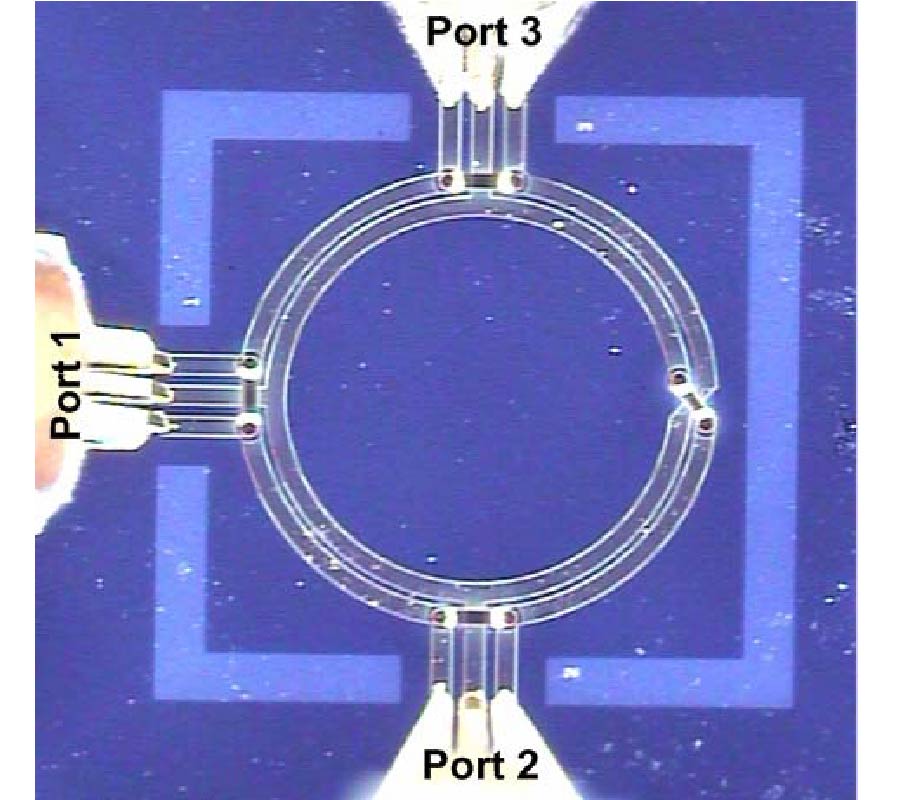
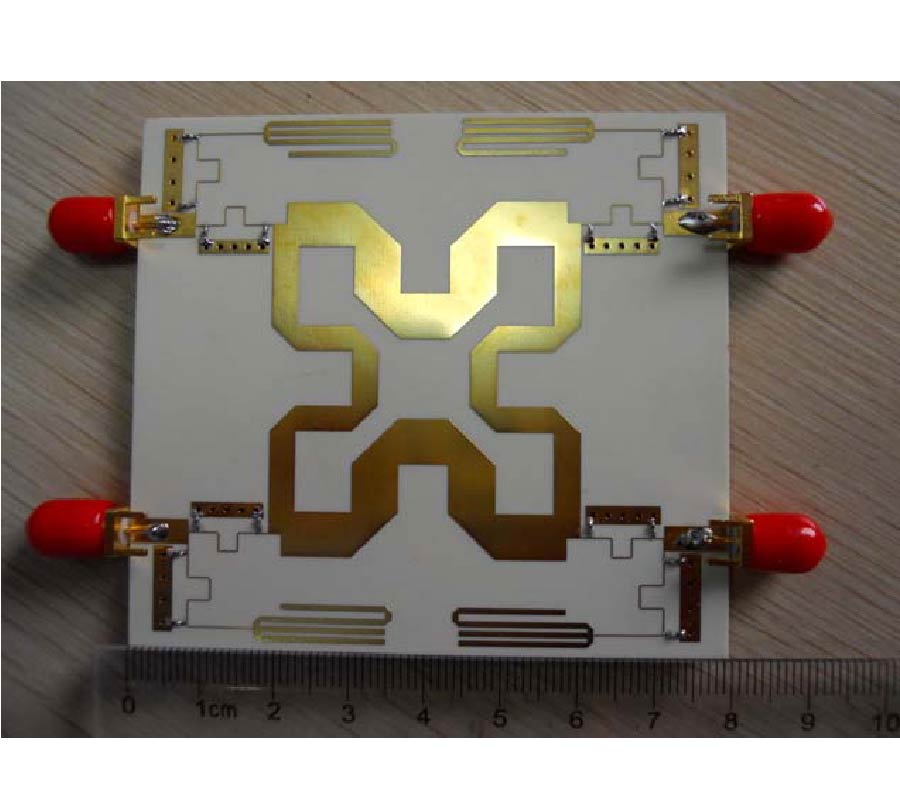
In this paper, a general design of an equal-split N-way power divider, similar to Bagley polygon power divider, but with an even number of output ports is proposed. A circularshaped 4-way divider is designed and simulated using two different full-wave simulators. Very good matching at the input port is achieved, and good transmission parameters are obtained. After that, the same circular-shaped divider is redrawn in a rectangular form to save more circuit area, and to align the four output ports together. For verification purposes, the 4-way rectangular-shaped Bagley power divider is simulated, fabricated and measured. Both simulation and measurement results prove the validity of the design.
DESIGN OF N-WAY POWER DIVIDER SIMILAR TO THE BAGLEY POLYGON DIVIDER WITH AN EVEN NUMBER OF OUTPUT PORTS
2011-03-02
PIER C
Vol. 20, 67-81
Design and Analysis of Dual-Frequency Modified 3-Way Bagley Power Dividers
Abdullah Mazen Qaroot , Khair Ayman Al Shamaileh and Nihad I. Dib
In this paper, different topologies of dual-frequency modified 3-way Bagley polygon power dividers are designed and analyzed. Equal split power division is achieved at arbitrary design frequencies. In the first structure, two-section transmission line transformer is used to realize the dual-frequency operation. In the second and third structures, dual-frequency T-shaped and π-shaped matching networks are used. For the sake of simplicity, closed form design equations are presented for each matching network. To validate the design procedure, three examples are designed, simulated, and fabricated. The three matching networks are explored through these three examples. The design frequencies are chosen to be 0.5 GHz and 1 GHz.
DESIGN AND ANALYSIS OF DUAL-FREQUENCY MODIFIED 3-WAY BAGLEY POWER DIVIDERS
2011-03-02
PIER
Vol. 114, 317-332
Pulsed Beam Expansion of Electromagnetic Aperture Fields
Timor Melamed
The present contribution is concerned with an exact frame-based pulsed-beams expansion of planar aperture time-dependent electromagnetic fields. The propagating field is described as a discrete superposition of tilted, shifted and delayed electromagnetic pulsed-beam waveobjects over the frame spectral lattice. Explicit asymptotic expressions for the electromagnetic pulsed-beam propagators are obtained for the commonly used pulsed-quadratic windows.
PULSED BEAM EXPANSION OF ELECTROMAGNETIC APERTURE FIELDS
2011-03-02
PIER
Vol. 114, 301-315
An Efficient Hybrid Technique for Analysis of the Electromagnetic Field Distribution Inside a Closed Environment
Viet Phuong Bui , Xing-Chang Wei , Er Ping Li and Wei-Jiang Zhao
This paper presents an efficient hybrid simulation technique for analysis of the electromagnetic field interactions between multi-transmitters and receivers located within a closed environment. The Method of Moments/circuit method is first used for modeling of the transceivers and their nearby surrounding to obtain the equivalent sources/receivers. Then, an approach that combines the asymptotic method and the ray tracing technique is deployed to calculate the long-distance coupling between a pair of transmitter and receiver. The acceleration algorithms for ray tracing have been developed to deal with more complex scenarios. The seamless combination between the circuit, numerical, and asymptotic approaches is the key to get accurate simulation results. Several numerical examples and experimental results are presented to demonstrate the efficiency of the proposed technique.
AN EFFICIENT HYBRID TECHNIQUE FOR ANALYSIS OF THE ELECTROMAGNETIC FIELD DISTRIBUTION INSIDE A CLOSED ENVIRONMENT
2011-03-02
PIER
Vol. 114, 285-299
Model Order Reduction for Peec Modeling Based on Moment Matching
Zhenfei Song , Donglin Su , Fabrice Duval and Anne Louis
Accurate and effective system-level modeling has become necessary to address electromagnetic compatibility (EMC) issues in modern circuit and system design. Model order reduction (MOR) techniques provide a feasibility to approximate complex circuit models with compact reduced-order models. In this paper, an effective MOR technique entitled multi-point moment matching (MMM) is implemented for the partial element equivalent circuit (PEEC) modeling. Moment information at multiple frequency points is used in this method in order to accurately estimate a given system over an entire frequency range of interest, and for each frequency an enhanced asymptotic waveform evaluation (AWE) is applied to obtain a reduced-order model by constructing a pole-residue representation of the original transfer function. The improvements of conventional AWE in aspects of both moment computation and moment matching can avoid ill-conditioned moment matrices and unstable dominant poles. The complex frequency hopping (CFH) technique is employed to select the multiple expansion points by using a newly developed upwardsearch algorithm. Numerical simulations of coupled microstrip lines in both frequency and time domain indicate the effectiveness of the proposed method.
MODEL ORDER REDUCTION FOR PEEC MODELING BASED ON MOMENT MATCHING
2011-03-01
PIER Letters
Vol. 21, 89-98
WCIP Applied to Active Plasma Circuits
Nathalie Raveu , Gaetan Prigent , Thierry Callegari and Henri Baudrand
The Wave Concept Iterative Procedure is validated for multi-layered substrate with frequency dependent and negative index media. By shifting the plasma frequency, reconfigurable filter design is proposed with a center frequency tunability of 25%. Sensitivity to collisional plasma is proposed.
WCIP APPLIED TO ACTIVE PLASMA CIRCUITS
2011-03-01
PIER C
Vol. 20, 55-65
Broadband Shorted Sectoral Microstrip Antenna
Amit A. Deshmukh and Kamla Prasan Ray
The broadband microstrip antenna is realized by cutting the slot inside the patch. The slot introduces a resonant mode near the fundamental resonance frequency of the antenna and realizes broadband response. The compact variations of circular microstrip antenna are realized by placing the shorting posts along the zero field line at the fundamental mode. These shortened antennas have narrower bandwidth. In this paper, a compact half U-slot cut shorted sectoral microstrip antenna is proposed. The detailed analysis has been carried out to study the effect of the slot on various modes of the Sectoral patch. It has been observed that the half U-slot does not introduce any additional mode, but reduces the resonance frequency of the higher order mode of the shorted Sectoral patch and along with its fundamental mode realizes broader bandwidth. The bandwidth of more than 700 MHz, at the center frequency of approximately 2700 MHz, has been realized.
BROADBAND SHORTED SECTORAL MICROSTRIP ANTENNA
2011-03-01
PIER
Vol. 114, 271-283
Tunable Photonic Band Gap in a Doped Semiconductor Photonic Crystal in Near Infrared Region
Chien-Jang Wu , Ya-Chang Hsieh and Heng-Tung Hsu
In this work, we theoretically investigate the tunable photonic band gap (PBG) in a semiconductor-dielectric photonic crystal made of highly doped n-type silicon (Si) layers alternating with silicon oxide layers. The tunable characteristic is studied by changing the donor impurity concentration in Si layer. The PBG is numerically analyzed in the near infrared frequency region from the reflectance calculated by the transfer matrix method. The effect of filling factor in Si layer on the photonic band gap is also illustrated. These tunable properties in such a photonic crystal provide some information that could be of technical use to the semiconductor optoelectronics, especially in communication applications.
TUNABLE PHOTONIC BAND GAP IN A DOPED SEMICONDUCTOR PHOTONIC CRYSTAL IN NEAR INFRARED REGION
2011-03-01
PIER
Vol. 114, 255-269
Differential Electromagnetic Equations in Fractional Space
Muhammad Zubair , Muhammad Junaid Mughal , Qaisar Abbas Naqvi and Azhar Abbas Rizvi
The present study deals with a novel approach for fractional space generalization of the differential electromagnetic equations. These equations can describe the behavior of electric and magnetic fields in any fractal media. A new form of vector differential operator Del, and its related differential operators, is formulated in fractional space. Using these modified vector differential operators, the classical Maxwell equations have been worked out for fractal media. The Laplace, Poisson and Helmholtz equations in fractional space are derived by using modified vector differential operators. Also a new fractional space generalization of the potentials for static and time varying fields is presented.