Search Results(13802)

2011-03-15
PIER Letters
Vol. 21, 187-193
An Effective Analysis Method for EBG Reducing Patch Antenna Coupling
Huan-Huan Xie , Yong-Chang Jiao , Li-Na Chen and Fu-Shun Zhang
This paper presents an effective analysis method for EBG reducing patch antenna coupling. A couple of coaxial probes are used to analyze the mutual coupling reduction range of patch antenna arrays loaded with EBG in this method. Conventional FDTD/PBC algorithm for EBG structures is appropriate only in infinite ground plane and substrate. The gained frequency band-gap by using the algorithm can not be directly used in finite ground plane because of the edge effects. While the proposed coaxial probe method is valid not only in infinite ground plane and substrate, but also for finite ground plane. The method is more suitable for real environments. In order to validate the described method, a two-element microstrip patch antenna array is fabricated and measured. The experimental results are in good agreement with the theoretical data obtained by using the proposed method.
AN EFFECTIVE ANALYSIS METHOD FOR EBG REDUCING PATCH ANTENNA COUPLING
2011-03-15
PIER
Vol. 115, 1-10
Negative Permittivity Media Able to Propagate a Surface Wave
Luca Petrillo , Florent Jangal , Muriel Darces , Jean-Louis Montmagnon and Marc Hélier
In the field of High Frequency Surface Wave Radar (HFSWR), this paper deals with a study which determines the electric permittivity and conductivity values that a medium must hold to propagate a sole surface wave at its interface with air. Firstly, we demonstrate clearly the reason why the Zenneck Wave cannot be excited on sea surface. Kistovich decomposition is used for this purpose. Secondly, the reasoning is extended to identify electric permittivity and conductivity values that permit to excite a surface wave on an homogeneous medium. Finally, numerical validation is obtained by comparison with the analytic formulation of the field radiated by a vertical Hertzian dipole as it has been established by Norton.
NEGATIVE PERMITTIVITY MEDIA ABLE TO PROPAGATE A SURFACE WAVE
2011-03-15
PIER
Vol. 114, 481-493
Eye-Shaped Segmented Reader Antenna for Near-Field UHF RFID Applications
Xiuping Li , Jiankun Liao , Yong Yuan and Dan Yu
An eye-shaped segmented (ESS) antenna is presented for ultra-high frequency (UHF) near-field radio frequency identification (RFID) applications. The proposed antenna shows in-phase current even though the perimeter of the eye-shaped loop is comparable to the operating wavelength. The ESS antenna is fabricated on a FR4 printed circuit board (PCB) and embedded in a metal cavity with an overall size of 250×180×50 mm3. The measured bandwidth is around 11MHz (860-871 MHz) under the condition of VSWR less than 2.0, which covers the Europe standard (865MHz-868MHz) and agrees well with the simulated results. Finally, as a reader antenna in the RFID system, the measured read distance and read width can achieve 16.1 cm and 8 cm, respectively. The ESS antenna is desirable for UHF near-field RFID reader applications.
EYE-SHAPED SEGMENTED READER ANTENNA FOR NEAR-FIELD UHF RFID APPLICATIONS
2011-03-14
PIER B
Vol. 29, 1-22
Symmetrical Pyramidal Horn Antennas Based on EBG Structures
Irina Khromova , Inigo Ederra , Ramon Gonzalo and Bastiaan P. de Hon
This paper presents a novel pyramidal (EH) horn antenna based on Electromagnetic Band Gap structures (EBGs). The reported pyramidal woodpile-based horn antenna possesses a symmetrical radiation pattern and a wide operating frequency range. Such antennas can substitute metallic horns in certain circumstances, which is especially valuable for millimetre and THz devices. The principle of creating EH-horn antennas in the woodpile structure is explained in detail. In particular, this paper presents the design of a symmetrical woodpile EH-horn antenna operating at frequencies around 110 GHz. The reported antenna exhibits a wide operating bandwidth (more than 10%), while possessing high directivity and radiation efficiency equal to 16.35dBi and -0.55dB (88%) respectively.
SYMMETRICAL PYRAMIDAL HORN ANTENNAS BASED ON EBG STRUCTURES
2011-03-14
PIER B
Vol. 28, 325-350
Genetic Algorithm Approach and Experimental Confirmation of a Laser-Based Diagnostic Technique for the Local Thermal Turbulence in a Hot Wind Tunnel Jet
Elkana Pemha and Elisabeth Ngo Nyobe
This paper is devoted to a laser --- based diagnostic technique described as a method for solving an applied inverse problem in turbulent media using laser beam propagation. This problem consists of extracting local information about temperature fluctuations inside a hot turbulent jet of air, from the luminous photodiode trace produced by a laser beam, after having traversed the jet. A genetic algorithm is implemented in order to calculate the optimized laser beam directions corresponding to the whole luminous trace. An approximated ray equation which is proved from the geometrical optics is solved numerically by using those directions and enables to determine the variance of temperature fluctuations along the whole path of the laser beam. A good agreement coming from the comparison between the results obtained and the published experimental data proves the validity of the method.
GENETIC ALGORITHM APPROACH AND EXPERIMENTAL CONFIRMATION OF A LASER-BASED DIAGNOSTIC TECHNIQUE FOR THE LOCAL THERMAL TURBULENCE IN A HOT WIND TUNNEL JET
2011-03-14
PIER Letters
Vol. 21, 177-186
Nonreciprocal Properties of Surface Plasmon-Polaritons at the Interface Between Two Magnetized Media: Exact Analytical Solutions
Victor A. Dmitriev and Anderson Oliveira Silva
In this paper, we investigate surface plasmon-polariton propagation at the interface of metal and magnetooptic dielectric semiinfinite layers where both layers are magnetized. Using magnetic group theory, we calculate scattering matrices for the waveguide sections with three orientations of dc magnetic field. Solving analytically the wave equation for the Voigt configuration, we obtain exact dispersion relation for this waveguide. Numerical examples show that the nonreciprocal phase shift between forward and backward waves can be increased significantly as compared with the case where only the magnetooptic dielectric layer is magnetized.
NONRECIPROCAL PROPERTIES OF SURFACE PLASMON-POLARITONS AT THE INTERFACE BETWEEN TWO MAGNETIZED MEDIA: EXACT ANALYTICAL SOLUTIONS
2011-03-14
PIER Letters
Vol. 21, 169-176
A Stub-Loaded Triple-Mode SIR for Novel High Selectivity Dual-Wideband Micostrip BPF Design
Hong-Wei Deng , Bin Liu , Yong-Jiu Zhao , Xue-Shun Zhang and Wen Chen
In this paper, a novel high selectivity dual-wideband microstrip bandpass filter (BPF) is proposed using two stub-loaded triple-mode stepped-impedance resonators (SIR) which are the same type but with different sizes. The SIR is formed by attaching one T-type open stub at the center plane and two identical short-circuited stubs symmetrically to stepped-impedance open microstrip line. And it can generate one odd mode approximatively determined by the stepped-impedance microstrip line and two even modes flexibly controlled by the loaded stubs. Either of the SIRs in this filter can not only separately generate one passband but also control the passband performance. Due to the intrinsic characteristics of the SIR, four transmission zeros can be created to improve the selectivity. A dual-wideband filter with the fractional bandwidth 14.9% for the first band from 3.09 GHz to 3.58 GHz and 10.2% for the second band from 4.99 GHz to 5.53 GHz is designed and fabricated. The filter is evaluated by experiment and simulation with good agreement.
A STUB-LOADED TRIPLE-MODE SIR FOR NOVEL HIGH SELECTIVITY DUAL-WIDEBAND MICOSTRIP BPF DESIGN
2011-03-14
PIER M
Vol. 17, 135-150
GPU Approach for Hertzian Potential Formulation Tool Oriented on Electromagnetic Nanodevices
Daniele Tartarini and Alessandro Massaro
The time domain modeling and simulation of electromagnetic (EM) waves interaction with nanodevices, at high spatial and time resolution, requires high computational power. For the first time, in this paper we present an effective implementation of the Hertzian Potential Formulation (HPF) on the Graphics Processing Units (GPUs), through the NVIDIA's CUDA (Compute Unified Device Architecture) programming model. It accelerates the nanodevice EM simulations at nanometer scale harnessing the massive parallelism of the GPU based systems. This study is useful for similar electromagnetic codes including the Finite Difference approaches. The results demonstrate that this GPU tool outperforms the CPU based HPF implementation, reaching a speedup from 30× to 70×.
GPU APPROACH FOR HERTZIAN POTENTIAL FORMULATION TOOL ORIENTED ON ELECTROMAGNETIC NANODEVICES
2011-03-14
PIER
Vol. 114, 469-479
Detection of Gas Concentration by Correlation Spectroscopy Using a Multi-Wavelength Fiber Laser
Binhao Wang , Gabriel Somesfalean , Liang Mei , Haojiang Zhou , Chunsheng Yan and Sailing He
A correlation spectroscopy (COSPEC) based on a multi-wavelength fiber laser is first proposed for the detection of gas concentration. The lasing wavelengths are selected to match several characteristic absorption peaks of the gas under test, and the gas concentration is easily measured by correlating it with the reference gas. The present method is immune from the instability of the light source and the influence of other gases. The concentration measurement of C2H2 is demonstrated in the experiment in its near-infrared dominant absorption region. The technique has prospects for simultaneous detection of multiple gases, and the measurement of mixed gases of C2H2 and CO2 is also analyzed.
DETECTION OF GAS CONCENTRATION BY CORRELATION SPECTROSCOPY USING A MULTI-WAVELENGTH FIBER LASER
2011-03-12
PIER
Vol. 114, 457-468
Design and Fabrication of a Quad-Band Bandpass Filter Using Multi-Layered SIR Structure
Ru-Yuan Yang , Cheng-Yuan Hung and Jia-Sheng Lin
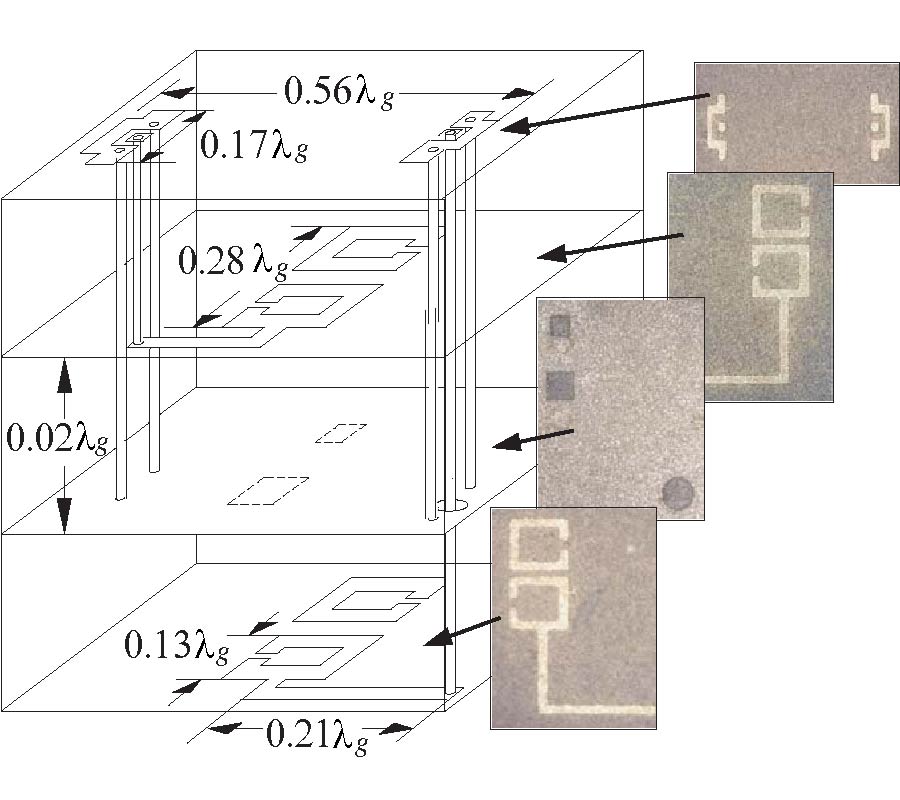
In this paper, design and fabrication of a quad-band microstrip bandpass filter (BPF) using multi-layered stepped impedance resonators (SIRs) structure is proposed. One pair of SIR on the top layer is designed to operate at the 1st and 3rd passbands (1.56/3.57 GHz), and the other pair is at 2nd and 4th passbands (2.42/5.23 GHz) by tuning the impedance and length ratios of the SIRs. In order to find the desired coupling location between the SIRs located on different layers and the input/output (I/O) lines, the voltage, current and power wave on the I/O lines are analyzed. It is verified that the proposed quad-band filter has good passband performances with an excellent isolation between adjacent bands for GPS, WLAN, and WiMAX applications.
DESIGN AND FABRICATION OF A QUAD-BAND BANDPASS FILTER USING MULTI-LAYERED SIR STRUCTURE
2011-03-12
PIER
Vol. 114, 443-455
An Exact Solution of the Cylindrical Wave Equation for Electromagnetic Field in Fractional Dimensional Space
Muhammad Zubair , Muhammad Junaid Mughal and Qaisar Abbas Naqvi
This work deals with an exact solution of cylindrical wave equation for electromagnetic field in fractional dimensional space. The obtained fractional solution is a generalization of the cylindrical wave equation from integer dimensional space to a fractional dimensional space. The resulting theoretical framework can be used to study the phenomenon of electromagnetic wave propagation in any fractal media because fractal media can be described as an ordinary media in a fractional dimensional space. The classical results are recovered from fractional solution when integer dimensional space is considered.
AN EXACT SOLUTION OF THE CYLINDRICAL WAVE EQUATION FOR ELECTROMAGNETIC FIELD IN FRACTIONAL DIMENSIONAL SPACE
2011-03-10
PIER
Vol. 114, 429-441
Subwavelength Array of Planar Triangle Monopoles with Cross Slots Based on Far-Field Time Reversal
Guang-Ding Ge , Duo Wang and Bing-Zhong Wang
A subwavelength array of planar triangle monopole antennas is proposed and discussed in this paper. Each element of the array is etched with many cross slots which bring no effects to the element's performances of voltage standing wave ratio and far-field radiation patterns. An important property of this antenna is that if multiple such planar antennas are placed face to face, the proposed array can perform time-reversal far-field focusing with a super-resolution as small as one twentieth of a wavelength. The proposed subwavelength array is easy to design and convenient for integration.
SUBWAVELENGTH ARRAY OF PLANAR TRIANGLE MONOPOLES WITH CROSS SLOTS BASED ON FAR-FIELD TIME REVERSAL
2011-03-10
PIER
Vol. 114, 407-428
Extension of Winding Function Theory for Radial and Axial Nonuniform Air Gap in Salient Pole Synchronous Machines
Hamidreza Akbari , H. Meshgin-Kelk and Jafar Milimonfared
In this paper, to calculate the salient pole machine inductances under radial and axial non-uniformity, a new method is developed. The method, an extension of the modified winding function theory to 3D, allows studying salient pole machines with radial and axial non-uniform air gap considering more realistic mean radius of the air gap. By using the developed method and a precise geometrical model, inductances of a salient pole machine with inclined rotor are calculated. Inductances are evaluated and effects of several asymmetries on inductances are shown. Calculated inductances are used in a coupled electromagnetic model, for simulation of a salient pole machine under healthy and different inclined eccentricity conditions. Simulation results show that the 19th stator current harmonic can be detected to alarm for inclined rotors. Experimental results that validate the theoretical and simulation results are presented.
EXTENSION OF WINDING FUNCTION THEORY FOR RADIAL AND AXIAL NONUNIFORM AIR GAP IN SALIENT POLE SYNCHRONOUS MACHINES
2011-03-09
PIER Letters
Vol. 21, 159-167
Size Reduction of Rectangular Dielectric Resonator Antenna with Symmetric Radiation Patterns and Low Cross Polarization
Xiao-Ming Wang , Zibin Weng , Zheng Zhang , Yong-Chang Jiao , Yang Zhu and Fu-Shun Zhang
A 50% size reduction of the rectangular dielectric resonator antenna (DRA) is achieved by introducing shorting posts at the edge of the DRA in this paper. By choosing proper height of the shorting posts, the radiation pattern in E-plane maintains almost the same shape as the conventional rectangular DRA. The cross polarization can also be controlled to be a relative low level. By adding an open stub in the feed line, the proposed antenna has almost the same resonant frequency with the conventional rectangular DRA. The measured results for the constructed prototype are also exhibited and discussed.
SIZE REDUCTION OF RECTANGULAR DIELECTRIC RESONATOR ANTENNA WITH SYMMETRIC RADIATION PATTERNS AND LOW CROSS POLARIZATION
2011-03-09
PIER Letters
Vol. 21, 147-157
Electromagnetic Cylindrical Concentrators in Initially Homogeneous or Inhomogeneous Dielectric Core Media Designed by the Coordinate Transformation Method
Eva Cojocaru
Reflectionless cylindrical concentrators have been designed up to now in an initially empty core space by applying forminvariant, spatial coordinate transformations of Maxwell's equations. We show that the reflectionless cylindrical concentrators in initially homogeneous and isotropic dielectric core media allow an enhanced concentration of the incident field. Designs of more complex reflectionless concentrators in initially inhomogeneous dielectric media represented by empty or dielectric-filled circular containers are also presented. The transformation equations are given explicitly, and the fields are expressed analytically. The functionality of these devices is illustrated by several examples.
ELECTROMAGNETIC CYLINDRICAL CONCENTRATORS IN INITIALLY HOMOGENEOUS OR INHOMOGENEOUS DIELECTRIC CORE MEDIA DESIGNED BY THE COORDINATE TRANSFORMATION METHOD
2011-03-09
PIER Letters
Vol. 21, 139-146
High Rejection Broadband BPF with Triple-Mode Stub-Loaded Resonator
Hong-Wei Deng , Bin Liu , Yong-Jiu Zhao , Xue-Shun Zhang and Wen Chen
In this letter, a novel compact broadband and high rejection bandpass filter (BPF) with the source-load coupling is proposed using the triple-mode stub-loaded resonator. The resonator is formed by attaching one T-type open stub at the center plane and two identical short-circuited stubs symmetrical to high impedance microstrip line. It can generate one odd-mode resonant frequency fm2 and two even-mode fm1, fm3 in the desired band. The fm2 can be approximately determined by the high impedance microstrip line. The short-circuited stubs and T-type open stub can be applied not only to separately adjust the fm1 and fm3 while the two other ones keep relatively stationary, but also to separately create transmission zero near the lower and upper cut-off frequencies, leading to a high rejection skirt. As a result of the source-load coupling, two transmission zeros in the upper-stopband are generated to deepen and widen the upper-stopband. A high rejection BPF with the fractional bandwidth 76% is simulated, fabricated and measured. The measured results agree well with the EM simulations.
HIGH REJECTION BROADBAND BPF WITH TRIPLE-MODE STUB-LOADED RESONATOR
2011-03-08
PIER Letters
Vol. 21, 129-137
A New Dual-Polarized Horn Antenna Excited by a Gap-Fed Square Patch
Sodnomtseren Ononchimeg , G. Otgonbaatar , Jae-Hoon Bang and Bierng-Chearl Ahn
A new dual-polarized horn antenna fed by a microstrip patch is proposed. The patch is excited in two orthogonal polarizations by small gaps between the patch edge and the microstrip open end. A horn antenna operating at 14.9 GHz is designed, fabricated and tested. Measurements show that the horn has a reflection coefficient of less than -10 dB, and a port isolation greater than 30 dB, over 14.6--15.2 GHz, and a gain of 12.34 dBi and 10-dB beamwidths of 87° and 88° at 14.9 GHz.
A NEW DUAL-POLARIZED HORN ANTENNA EXCITED BY A GAP-FED SQUARE PATCH
2011-03-08
PIER
Vol. 114, 395-405
Quasi-Elliptic Function Bandpass Filter with Upper Stopband Extension and High Rejection Level Using Cross-Coupled Stepped-Impedance Resonators
Jen-Tsai Kuo , Shao-Chan Tang and Shu-Hsien Lin
Planar microstrip filters are designed to have a quasi-elliptic function passband and extended upper stopband with a rejection level of 40 or 50 dB. The design employs stepped-impedance resonators in a compact 2×2 cross coupled configuration. The geometric parameters of the resonators are planned to shift the third resonance as high as possible, and then the transmission zeros created by the structure are devised to suppress the second resonance, so that a wide upper stopband up to more than 4.5 times the passband frequency can be achieved. By employing the skew-symmetric input/output feeds, three transmission zeros in the frequency band of interest can be created. The leading two zeros are allocated on the both sides of the passband, generating a quasi-elliptic function response with enhanced roll-off rate in the transition bands, and the last zero incorporating with a zero created by anti-coupled-line at higher frequencies are employed to extend the rejection bandwidth. The measurement data agree very well with the simulation responses.
QUASI-ELLIPTIC FUNCTION BANDPASS FILTER WITH UPPER STOPBAND EXTENSION AND HIGH REJECTION LEVEL USING CROSS-COUPLED STEPPED-IMPEDANCE RESONATORS
2011-03-06
PIER Letters
Vol. 21, 119-128
Simplifying the Feeding Network for Multibeam Circular Antenna Arrays by Using Corps
Marco A. Panduro and Carlos del Rio-Bocio
An innovative way to analyze the design of beam-forming networks (BFN) for scannable multi-beam circular antenna arrays using the CORPS (Coherently Radiating Periodic Structures) concept is introduced. This design of CORPS-BFN considers the optimization of the complex inputs of the feeding network by using the Differential Evolution (DE) method. Simulation results for different configurations of CORPS-BFN for a scannable circular array are presented. The results shown in this paper illustrate certain interesting characteristics in the behavior of the array factor for the scannable circular array. The most significant aspect that is unique to this proposal is the simplification of the feeding network based on CORPS.
SIMPLIFYING THE FEEDING NETWORK FOR MULTIBEAM CIRCULAR ANTENNA ARRAYS BY USING CORPS
2011-03-06
PIER Letters
Vol. 21, 109-117
An Ultra-Compact Dual-Band Antenna with Tuning Arms for WLAN Applications
Hong-Sha Ding , Zhi-Qiang Li and Peng Gao
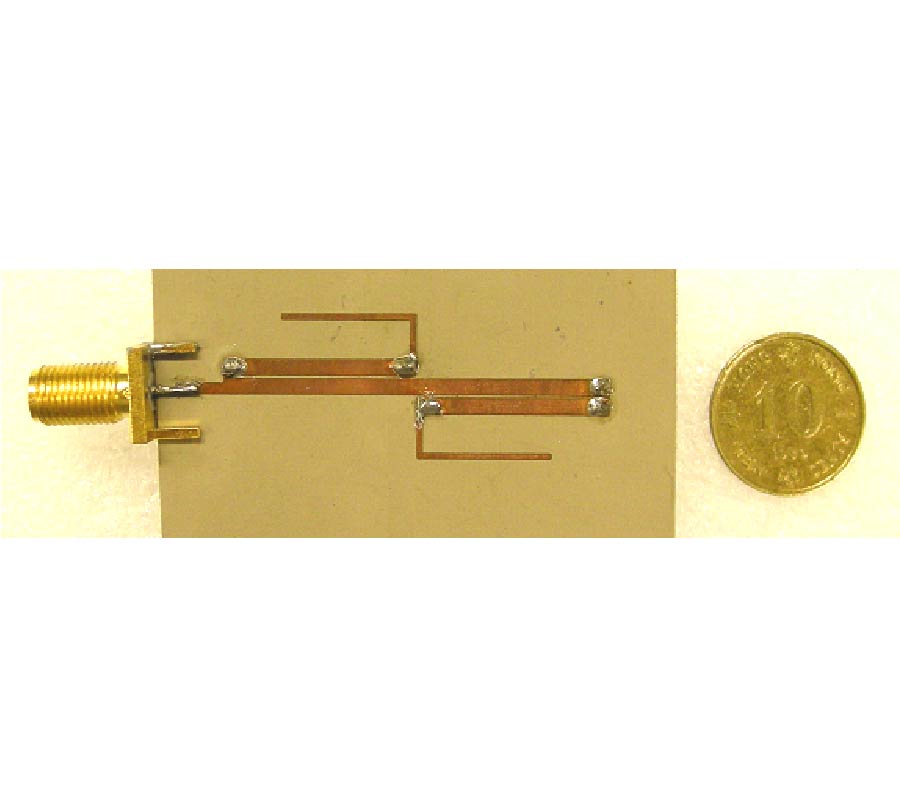
An ultra-compact dual-band printed antenna is proposed. Connective and concentric double split rings (CCDSR) are used to generate two resonant frequencies in wireless local area network (WLAN) frequency bands. Tuning arms are added to the microstrip fed line, which can be used to tune the upper frequency band. The dimension of this antenna is only 9×24×1mm3, much smaller than those reported antennas. The measured -10 dB bandwidth in the 2.44GHz band is 140MHz (2.37-2.51GHz) and in 5.34GHz is 1.23GHz (4.86-6.09GHz), covering the 2.4/5.2/5.8GHz WLAN operating bands. Good radiations at these bands are also observed.
AN ULTRA-COMPACT DUAL-BAND ANTENNA WITH TUNING ARMS FOR WLAN APPLICATIONS