Search Results(13802)

2010-11-03
PIER B
Vol. 26, 383-399
Retrieval of Soil Moisture Content from Microwave Backscattering Using a Modified Iem Model
Kaijun Song , Xiaobing Zhou and Yong Fan
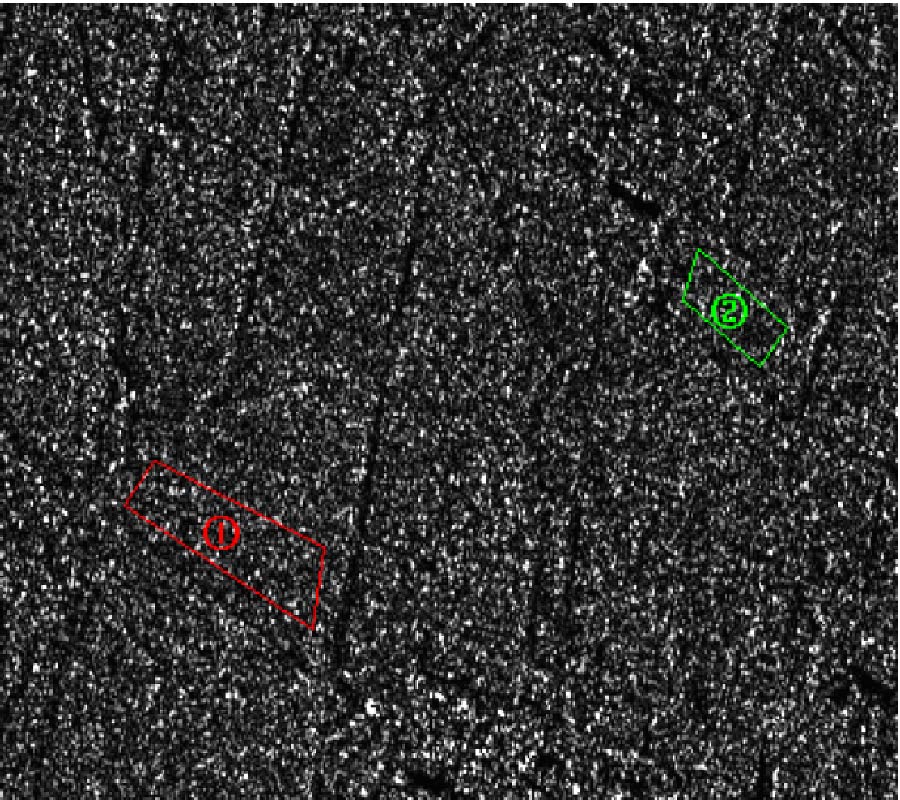
A multilayer soil model for retrieving soil moisture content using the Integral Equation Method (IEM) is investigated in this paper. The total reflection coefficients of the natural soil are obtained using the multilayer model, and volumetric scattering is approximated by the internal reflections between layers. The surface reflection terms in IEM model are replaced by the total reflection coefficients from the multi-layer soil surface in retrieving the soil moisture content. The original IEM model includes only the surface scattering of the natural bare soil, while the multilayer soil - IEM model (MS-IEM) includes both the surface scattering and the volumetric scattering within the soil. Both the MS-IEM model and the original IEM model are compared in soil moisture retrieval using the experimental Synthetic Aperture Radar (SAR) backscattering coefficient data in the literature. It is noted that the mean square error between the measurement data and the values estimated by the modified IEM model is about 7.7%, while that between the measured and the estimated by the original IEM model is about 12%. The accuracy of estimating soil moisture by the IEM model is improved by 4.3%. In addition, the regression analysis between the measured and model-predicted soil moistures has been done.
RETRIEVAL OF SOIL MOISTURE CONTENT FROM MICROWAVE BACKSCATTERING USING A MODIFIED IEM MODEL
2010-11-03
PIER C
Vol. 18, 87-101
Inductive Tri-Band Double Element FSS for Space Applications
Davide Ramaccia , Alessandro Toscano , Alessia Colasante , Giancarlo Bellaveglia and Raimondo Lo Forti
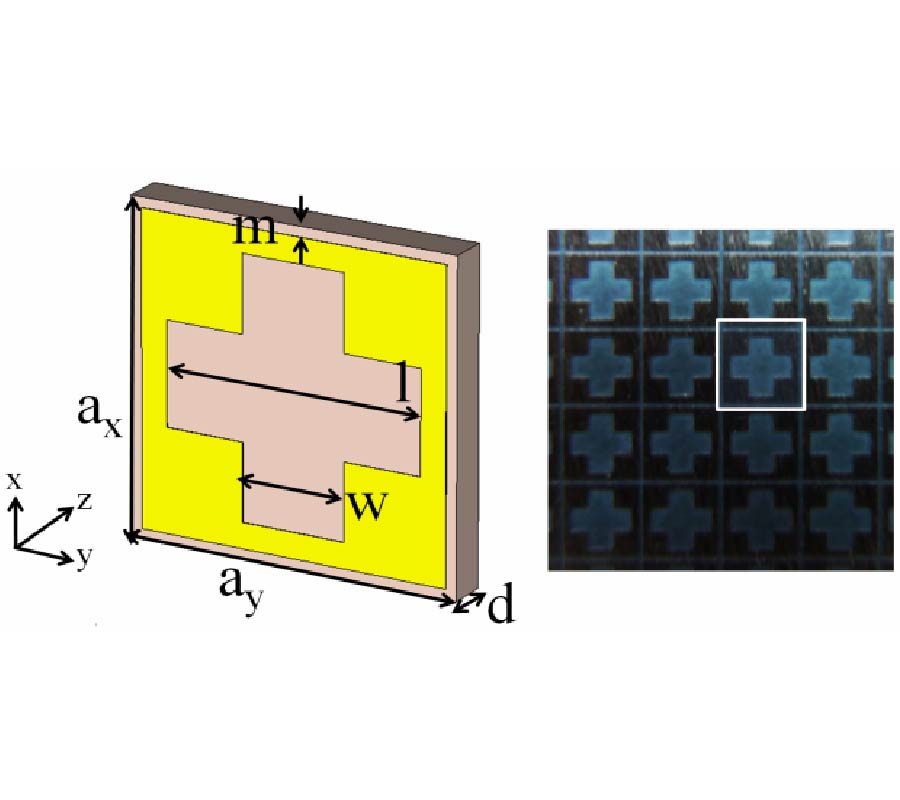
In this contribution we propose the design of an inductive Frequency Selective Surface (FSS) with double resonant elements aimed at the achievement of a simple well-performing, dielectric-free, space filter screen able to separate the Ku band from the Ka band. The FSS performance is compared to that of a typical double ring FSS which major drawback is the use of a dielectric substrate that leads to unavoidable additional transmission losses and makes the dichroic mirror more complex with respect to a simple single perforated screen. For all applications in which the FSS is asked to be as simple as possible and the transmission losses specifications are severe, the Inductive FSS Double Resonant Elements here proposed turns out to be an interesting alternative to typical Double Ring FSS.
INDUCTIVE TRI-BAND DOUBLE ELEMENT FSS FOR SPACE APPLICATIONS
2010-11-03
PIER C
Vol. 17, 55-65
Microwave Studies of Ferrite-Ferroelectric Composites Prepared through Self Propagating Auto Combustion Route
Mahesh Babaso Shelar , Rupali N. Jadhav and Vijaya Puri
The structural and microwave properties of (y) Ni1-xCdxFe2O4 and (1-y) Ba0.8Sr0.2TiO3 (x = 0.2, 0.4, 0.6 and y = 0.15, 0.30 and 0.45) composites synthesized by self propagating auto combustion route was studied. X-ray diffraction patterns reveal this method can produce two phases simultaneously. The porosity increases with increase in ferrite content in the composite. The SEM morphologies show the growth of cadmium substituted nickel ferrite grains which are well dispersed in barium strontium titanate (BST) matrix. The composite material shows microwave absorption of about 0.575 in a broad band from 8-12GHz. The permittivity varied from 7 to around 43 with increase in ferrite content .The microwave conductivity measurements reveal the loss of polaron conduction which supports the dielectric loss in the microwave region.
MICROWAVE  STUDIES  OF  FERRITE-FERROELECTRIC COMPOSITES  PREPARED  THROUGH   SELF  PROPAGATING  AUTO COMBUSTION  ROUTE
2010-11-03
PIER C
Vol. 17, 39-53
Experimental Verification of Ultra-Wideband Pulse Radiation from Monopole Array Antennas
Karumudi Rambabu , Adrian Eng Choon Tan , Kevin K.-M. Chan and Michael Yan Wah Chia
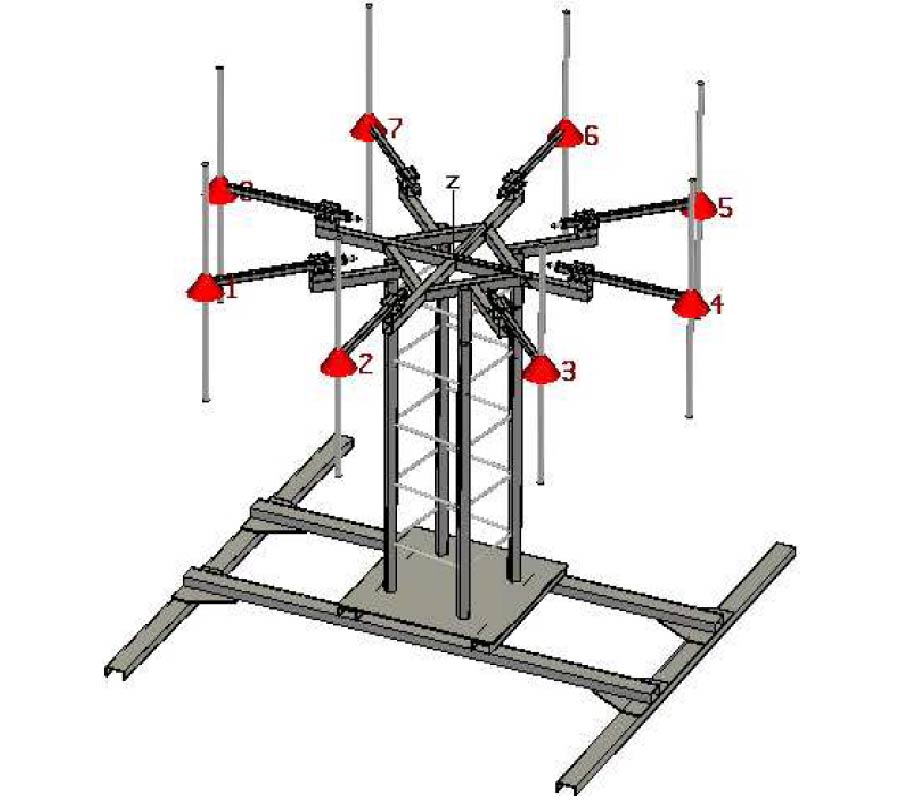
In this paper, a time domain analysis for ultra-wideband short pulse radiation from wire monopole antennas and their arrays is presented. The pulse travels along the monopole antenna and reflects from the open end; during the pulse reflection, the pulse gets compressed. The analysis presented in this paper accounts for the pulse compression and the radiated pulse is compared with the measured pulse. Measured energy patterns for different pulse excitations of the monopole and monopole arrays are presented and compared with theoretical patterns.
EXPERIMENTAL VERIFICATION OF ULTRA-WIDEBAND PULSE RADIATION FROM MONOPOLE ARRAY ANTENNAS
2010-11-03
PIER
Vol. 109, 399-424
Semi-Analytical Solutions of 2-d Homogeneous Helmholtz Equation by the Method of Connected Local Fields
Hung-Wen Chang and Sin-Yuan Mu
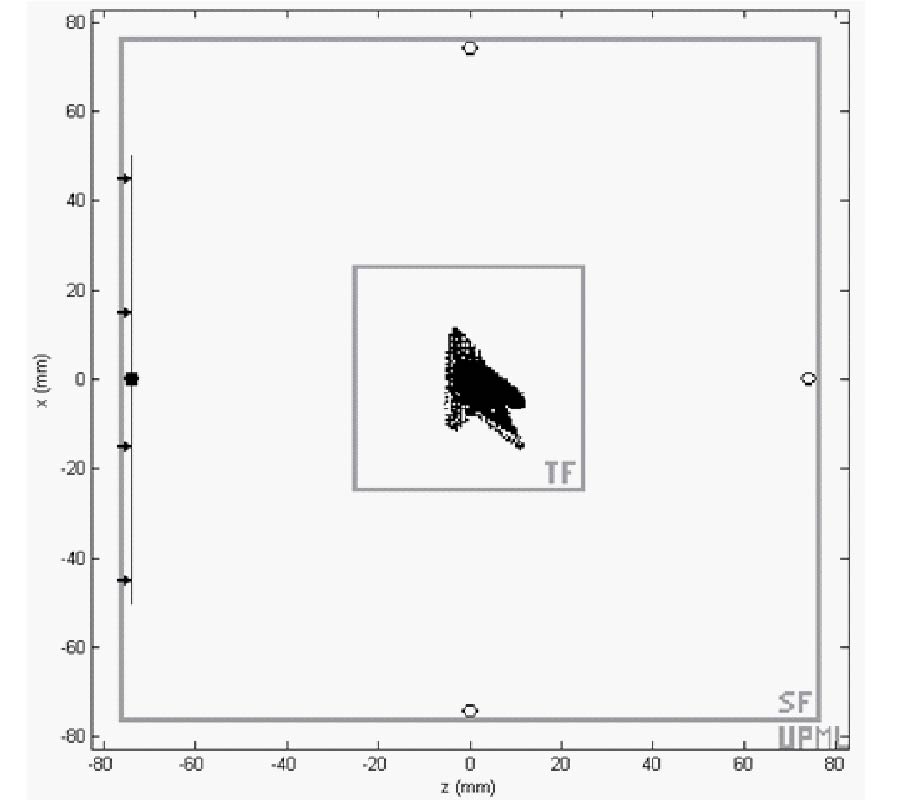
The frequency-domain finite-difference (FD-FD) methods have been successfully used to obtain numerical solutions of two-dimensional (2-D) Helmholtz equation. The standard second-order accurate FD-FD scheme is known to produce unwanted numerical spatial and temporal dispersions when the sampling is inadequate. Recently compact higher-order accurate FD-FD methods have been proposed to reduce the spatial sampling density. We present a semi-analytical solution of 2-D homogeneous Helmholtz equation by connecting overlapping square patches of local fields where each patch is expanded in a set of Fourier-Bessel (FB) series. These local FB coefficients are related to total eight points, four on the sides and four on the corners, on the square patch. The local field expansion (LFE) analysis leads to an improved, compact FD-like, nine-point stencil for the 2-D homogeneous Helmholtz equation. We show that LFE formulation possesses superior numerical properties of being low dispersive and nearly isotropic because this method of connecting local fields merely ties these overlapping EM field patches already satisfy the Helmholtz equation.
SEMI-ANALYTICAL SOLUTIONS OF 2-D HOMOGENEOUS HELMHOLTZ EQUATION BY THE METHOD OF CONNECTED LOCAL FIELDS
2010-11-02
PIER B
Vol. 26, 361-382
Reliable Simulation-Driven Design Optimization of Microwave Structures Using Manifold Mapping
Slawomir Koziel and David Echeverría Ciaurri
A computationally efficient surrogate-based framework for reliable simulation-driven design optimization of microwave structures is described. The key component of our algorithm is manifold mapping, a response correction technique that aligns the coarse model (computationally cheap representation of the structure under consideration) with the accurate but CPU-intensive (fine) model of the optimized device. The parameters of the manifold mapping surrogate are explicitly calculated based on the fine model data accumulated during the optimization process. Also, manifold mapping does not use any extractable parameters, which makes it easy to implement. Robustness and excellent convergence properties of the proposed algorithm are demonstrated through the design of several microwave devices including microstrip filters and a planar antenna.
RELIABLE SIMULATION-DRIVEN DESIGN OPTIMIZATION OF MICROWAVE STRUCTURES USING MANIFOLD MAPPING
2010-11-02
PIER Letters
Vol. 18, 145-154
Highly Integrated Miniature-Sized Single Sideband Subharmonic Ka-Band Up-Converter
Pramod K. Singh , Sarbani Basu , Wei-Chih Chien and Yeong-Her Wang
A highly integrated up-converter MMIC is presented for low cost and high performance Ka-band transmitter module application. The multiple functions of the up-converter, such as local oscillator (LO) amplifier, single sideband subharmonic mixer, LO bandstop filter, and three-stage RF amplifier, are integrated into a single chip. A proper circuit topology for the complete integrated circuit is selected to achieve the miniature chip size. The combination of lumped and microstrip lines are used to realize the compact sub-circuits. The layout of the circuit is optimized using electromagnetic (EM) simulations. The chip is fabricated in WIN 0.15 μm PHEMT technology on 4-mil GaAs substrate with a layout area of only 2.8 mm×0.8 mm (2.24 mm2). Measured conversion gain is 12±1 dB over 28-37 GHz for the LO pumping power of 0 dBm. The sideband and 2×LO suppressions are above 20 dBc. The 1 dB gain compression output power (P-1dB) is 12 dBm. LO to RF isolation is about 35 dB.
HIGHLY INTEGRATED MINIATURE-SIZED SINGLE SIDEBAND SUBHARMONIC KA-BAND UP-CONVERTER
2010-11-02
PIER Letters
Vol. 18, 135-143
Wide-Band High Isolation Subharmonically Pumped Resistive Mixer with Active Quasi-Circulator
Wei-Chih Chien , Chih-Ming Lin , Chien-Hung Liu , Shih-Han Hung and Yeong-Her Wang
A novel subharmonically pumped resistive mixer (SHPRM) with a chip dimension of 0.8×0.81 mm2 is fabricated through a standard 0.18-μm CMOS process. An impedance-transforming active quasi-circulator is monolithically integrated with an nMOS field-effect transistor (FET) to perform up-converter mixing while simultaneously enhancing all port isolation through a broadband operation. The design analysis of impedance-transforming active quasi-circulator is also presented for matching between circulator and resistive transistor. As shown in the measured results, the mixer exhibits a 9-14.5 dB conversion loss. All port-to-port isolations better than 16.5\,dB over a radio frequency (RF) of 10-20 GHz can be achieved.
WIDE-BAND HIGH ISOLATION SUBHARMONICALLY PUMPED RESISTIVE MIXER WITH ACTIVE QUASI-CIRCULATOR
2010-11-01
PIER B
Vol. 26, 335-359
Realistic Model of Dispersive Soils Using PLRC-FDTD with Applications to GPR Systems
Ghada Atteia and Khalid Fawzy Ahmed Hussein
A realistic model of ground soil is developed for the electromagnetic simulation of Ground Penetrating Radar (GPR) systems. A three dimensional Finite Difference Time Domain (FDTD) algorithm is formulated to model dispersive media using N-term Debye permittivity function with static conductivity. The formulation of the algorithm is based on the concept of the Piecewise Linear Recursive Convolution (PLRC) in order to simulate the dispersion properties of soil as a two-term Debye medium. This approach of ground modeling enhances the accuracy and reliability of results obtained for GPR problems. The developed algorithm is validated when simulating practical GPR Systems used to detect different objects buried in Puerto-Rico and San Antonio clay loams. The proposed algorithm is employed to compare the impact of using two-term Debye model to simulate real soil on the coupling coefficient between transmitting and receiving antennas due to the absence and presence of buried targets to that of using non-dispersive soil model. The effect of soil moisture content on the performance of GPR system in detecting buried objects such as metallic and plastic pipes is investigated.
REALISTIC MODEL OF DISPERSIVE SOILS USING PLRC-FDTD WITH APPLICATIONS TO GPR SYSTEMS
2010-10-29
PIER C
Vol. 17, 29-38
Linearity Improvement of Cascode CMOS LNA Using a Diode Connected Nmos Transistor with a Parallel RC Circuit
Chieh-Pin Chang , Wei-Chih Chien , Chun-Chi Su , Yeong-Her Wang and Ja-Hao Chen
A fully integrated 5.5 GHz high-linearity low noise amplifier (LNA) using post-linearization technique, implemented in a 0.18 μm RF CMOS technology, is demonstrated. The proposed technique adopts an additional folded diode with a parallel RC circuit as an intermodulation distortion (IMD) sinker. The proposed LNA not only achieves high linearity, but also minimizes the degradation of gain, noise figure (NF) and power consumption. The LNA achieves an input third-order intercept point (IIP3) of +8.33 dBm, a power gain of 10.02 dB, and a NF of 3.05 dB at 5.5 GHz biased at 6 mA from a 1.8 V power supply.
LINEARITY IMPROVEMENT OF CASCODE CMOS LNA USING A DIODE CONNECTED NMOS TRANSISTOR WITH A PARALLEL RC CIRCUIT
2010-10-29
PIER
Vol. 109, 381-398
Hybrid Method of Higher-Order MoM and NystrÖm Disretization PO for 3D PEC Problems
Ben Lai , Nan Wang , Hao-Bo Yuan and Chang-Hong Liang
This paper presents an efficient and accurate hybrid approach of method of moments (MoM) and physical optics (PO) for radiation problems such as antennas mounted on a large platform. The new method employs higher-order hierarchical Legendre basis functions in the MoM region and higher-order Nyström scheme in the PO region. The two regions are both discretized with large domains. The unknowns can be much less than those in the small-domain MoM-PO solutions, which will lead to a great reduction in computation complexity. Furthermore, with the Nyström scheme in the PO region, the higher-order accuracy is maintained, and the calculation of the impedances can be more efficient than that in the existing higher-order MoM-PO procedure. Numerical results show the validity of the proposed method.
HYBRID METHOD OF HIGHER-ORDER MOM AND NYSTRÖM DISRETIZATION PO FOR 3D PEC PROBLEMS
2010-10-28
PIER B
Vol. 26, 321-334
Zero Reflection from Anisotropic Metamaterial Stratified Structures
Hossein Mirzaei and Jalil Rashed-Mohassel
A method of solving the scattering problem for general multilayer anisotropic structures composed of conventional materials and metamaterial is presented. The analysis is based on calculation of the hybrid matrix of layers by means of a recursive algorithm. The method does not have the complexity and instability problems of other methods and is reliable in all cases. The zero reflection from stratified structures of conventional materials and metamaterials has then been introduced Various aspects of such a structure from the viewpoints of frequency and incident angle are presented and a rule for zero reflection from anisotropic medium is addressed. An interesting special case of total transparency is observed.
ZERO REFLECTION FROM ANISOTROPIC METAMATERIAL STRATIFIED STRUCTURES
2010-10-28
PIER C
Vol. 17, 17-27
Design and Development of CPW-Fed Microstrip Antenna for WLAN/WiMAX Applications
Davinder Parkash and Rajesh Khanna
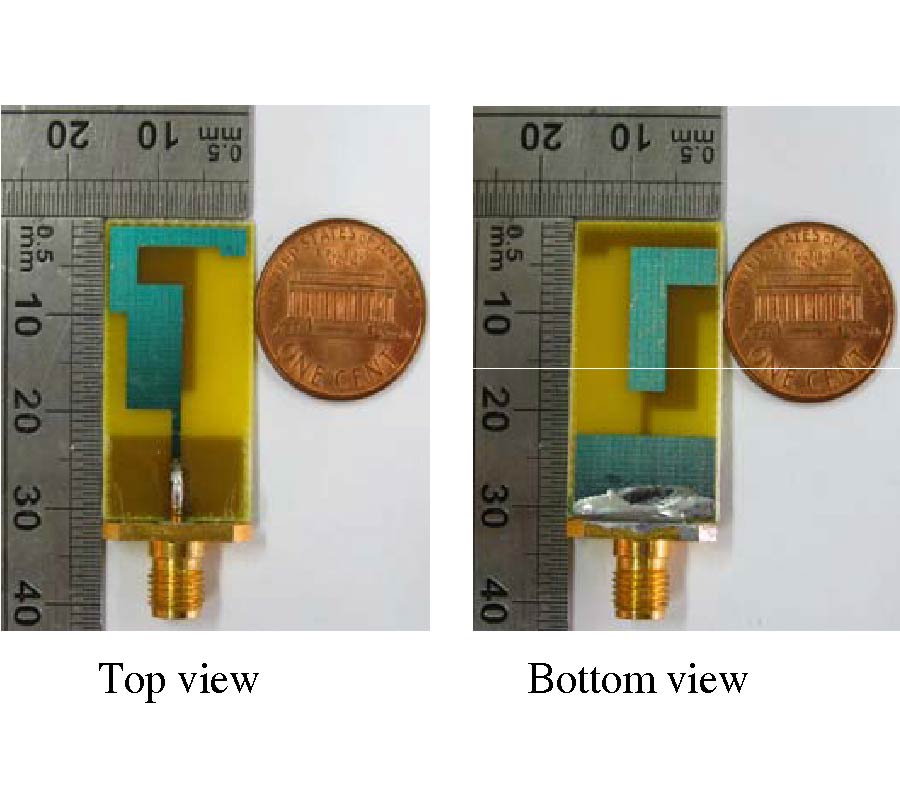
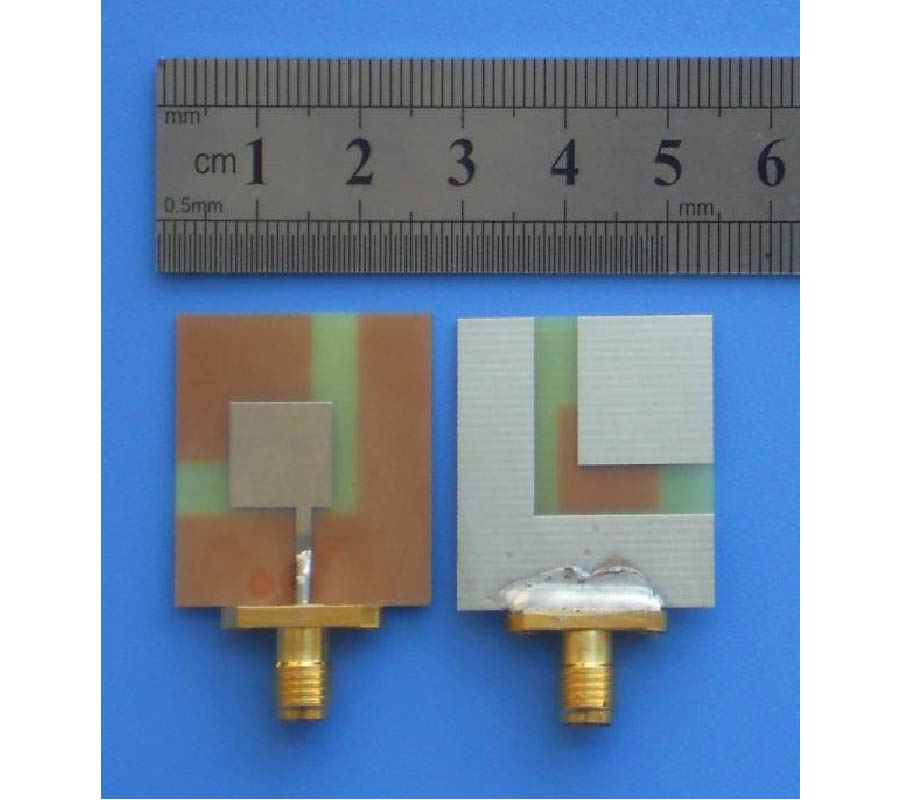
In this paper, a novel broadband monopole antenna with an extended rectangular shaped slot based on coplanar waveguide (CPW)-fed is designed and presented. The antenna composed of a planar rectangular patch element embedded with a slots, capable of generating two separate resonant modes with good impedance matching. The parametric study is performed to understand the characteristics of the proposed antenna. To verify the simulated design concept, a prototype antenna is designed and fabricated on the FR4 substrate, and characterized experimentally. The overall size of the antenna is 35.24 mm×26.4 mm×1.6 mm including the finite ground CPW feeding mechanism and total volume of the antenna is 1.49 cm3. The antenna operates in broad frequency bands from 3.424 GHz to 6.274 GHz covering wireless local area network (WLAN) and worldwide interoperability for microwave access (WiMAX) bands. The maximum gain of the proposed antenna is 5.51 dBi at 4.78 GHz frequency band. The proposed antenna‟s radiation characteristics are also observed.
DESIGN AND DEVELOPMENT OF CPW-FED MICROSTRIP ANTENNA FOR WLAN/WIMAX APPLICATIONS
2010-10-27
PIER B
Vol. 26, 291-319
Optimization of Antenna Configuration with a Fitness-Adaptive Differential Evolution Algorithm
Aritra Chowdhury , Arnob Ghosh , Ritwik Giri and Swagatam Das
In this article a novel numerical technique, called Fitness Adaptive Differential Evolution (FiADE) for optimizing certain pre-defined antenna configuration to attain best possible radiation characteristics is presented. Differential Evolution (DE), inspired by the natural phenomenon of theory of evolution of life on earth, employs the similar computational steps as by any other Evolutionary Algorithm (EA). Scale Factor and Crossover Probability are two very important control parameter of DE .This article describes a very competitive yet very simple form of adaptation technique for tuning the scale factor, on the run, without any user intervention. The adaptation strategy is based on the fitness function value of individuals in DE population. The feasibility, efficiency and effectiveness of the proposed algorithm in the field of electromagnetism are examined over a set of well-known antenna configurations optimization problems. Comparison with the some very popular and powerful metaheuristics reflects the superiority of this simple parameter automation strategy in terms of accuracy, convergence speed, and robustness.
OPTIMIZATION OF ANTENNA CONFIGURATION WITH A FITNESS-ADAPTIVE DIFFERENTIAL EVOLUTION ALGORITHM
2010-10-27
PIER Letters
Vol. 18, 125-134
New Dual-Band Bandpass Filter with Compact SIR Structure
Jian-Kang Xiao and Hui-Fen Huang
New dual-band bandpass filters with compact coupling and sizes reduction are proposed by using split ring stepped-impedance resonators and two paths coupling. In the new design, split ring SIR and defected ground structure are applied not only to reduce filter size but also to improve the filter performances. The presented filters have advantages of compact and novel structures, miniaturization and dual-band with nicer performances such as high selectivity, low passband insertion losses and so on, and these performances are demonstrated by measurement. The new design may be quite useful in wireless communication systems.
NEW DUAL-BAND BANDPASS FILTER WITH COMPACT SIR STRUCTURE
2010-10-27
PIER
Vol. 109, 361-379
Electrodynamical Characteristic Particularity of Open Metamaterial Square and Circular Waveguides
Tatjana Gric , Liudmila Nickelson and Steponas Asmontas
We present here the solution of the eigenvalue problems for the open metamaterial square and circular rod waveguides. The Maxwell's equations for the electrodynamical analsis of the open waveguides were solved by the Singular Integral Equations' (SIE) method and partial area method. Our SIE method is pretty universal and let us rigorously analyze open waveguides electrodynamically with any arbitrary cross-sections taking into account of the edge condition. The false roots did not occur applying the SIE method. The waveguide media can be of strongly lossy materials. The signs of the complex permittivity and permeability can be positive or negative in different combinations. We used our computer algorithms based on the two mentioned methods with 3D graphical visualization in the MATLAB language. We present here our numerical calculations of the metamaterial square waveguide with sides equal to 5×10⁻³m and the metamaterial circular waveguide with the diameter equal to 5×10⁻³m. We present dependences of phase constant and attenuation constant of metamaterial waveguides at the frequency range from 75 GHz till 115 GHz. We have compared the three dimension (3D) electric field distributions of the main mode and the first higher mode propagating in the square and circular metamaterial waveguides. The calculations of the electric fields were fulfilled at approximately 10000 points in every cross-section. We discovered that the electric field is concentrated at the waveguide boundary. The distribution of the electric field along the perimeter of the waveguide is not uniform. There are two areas on the perimeter of the square and circular waveguides where the electric field has maximum values. These areas are shifted relative to each other on π radians.
ELECTRODYNAMICAL CHARACTERISTIC PARTICULARITY OF OPEN METAMATERIAL SQUARE AND CIRCULAR WAVEGUIDES
2010-10-26
PIER Letters
Vol. 18, 115-124
Tamm States of a Nonlinear Slab Sandwiched Between a Uniform Medium and a One-Dimensional Photonic Crystal
Zahra Eyni , Samad Roshan Entezar , Abdolrahman Namdar and Habib Tajalli
In this paper, the surface states (or so called Tamm states) of a nonlinear self-focusing slab sandwiched between a uniform medium and a one-dimensional photonic crystal has been investigated based on the first integral of nonlinear Helmholtz wave equation. The consider slabs can be a left-handed metamaterial or a conventional material. It is shown that the structure can support the Tamm states with two different transverse electric structure. In one kind, the surface waves has a hump at the surface of photonic crystal, and the other one has two humps. We reveal that in the case of self-focusing left-handed metamaterial slab, there is possibility for change of total flow's direction of surface waves by adjusting of the intensity of exciting electromagnetic field.
TAMM STATES OF A NONLINEAR SLAB SANDWICHED BETWEEN A UNIFORM MEDIUM AND A ONE-DIMENSIONAL PHOTONIC CRYSTAL
2010-10-26
PIER C
Vol. 17, 1-15
Performance Measurements of a DVB-T System Affected by 5-MHz Generic Adjacent Channel Interference
Vasilis P. Kalogirou , Terpsihori-Helen N. Velivasaki and Christos N. Capsalis
With the advent of DVB-T in most European countries, the European Union has decided to end all analogue television broadcasts in its member countries until 2012. This analogue switch-off, as well as the increased spectral efficiency of the DVB-T protocol will create a surplus of spectrum in the UHF band, part of which is to be used by mobile communications systems. In order for this "digital dividend" to be shared efficiently, the coexistence and interference parameters between DVB-T and other services (designated as IMT-Advanced by the International Telecommunications Union) have to be studied. In this paper a generic 5 MHz interfering signal is broadcasted in close proximity to a stationary DVB-T receiver. Various DVB-T parameters are then measured and analyzed for different frequency values and power levels of the interfering signal.
PERFORMANCE MEASUREMENTS OF A DVB-T SYSTEM AFFECTED BY 5-MHZ GENERIC ADJACENT CHANNEL INTERFERENCE
2010-10-26
PIER C
Vol. 16, 241-249
New Bandpass Filters Using Half-Wavelength and Branch-Line Resonators
Pu-Hua Deng and Pin-Tang Chiu
New cross-coupled bandpass filters using half-wavelength (λ/2) and branch-line resonators are proposed. The branch-line resonators are made of two quarter-wavelength (λ/4) resonators in which a shorted circuit is realized by one open stub. In the first case, a non-0°feed structure at the input and output resonators is used to produce one pair of transmission zeros near the passband to improve the selectivity. In the second case, good selectivity and improved stopband rejection can be achieved at the same time by utilizing a 0° feed structure. Specifically, the proposed filters can simplify the manufacturing process of the conventional cross-coupled filters using λ/2 and λ/4 resonators without increasing circuit area significantly.
NEW BANDPASS FILTERS USING HALF-WAVELENGTH AND BRANCH-LINE RESONATORS
2010-10-26
PIER
Vol. 109, 345-360
Phased-Array Near Field Radiometry for Brain Intracranial Applications
A. Oikonomou , Irene Karanasiou and Nikolaos Uzunoglu
During the past decades there has been a tremendous increase throughout the scientific community for developing methods of understanding human brain functionality, as diagnosis and treatment of diseases and malfunctions, could be effectively developed through understanding of how the brain works. In parallel, research effort is driven on minimizing drawbacks of existing imaging techniques including potential risks from radiation and invasive attributes of the imaging methodologies. Towards that direction a new near field radiometry imaging system has been theoretically studied, developed and experimentally tested and all of the aforementioned research phases are herein presented. The system operation principle is based on the fact that human tissues emit chaotic thermal type radiation at temperatures above the absolute zero. Using a phase shifted antenna array system, spatial resolution, detection depth and sensitivity are increased. Combining previous research results, as well as new findings, the capabilities of the constructed system, as well as the possibility of using it as a complementary method for brain imaging are discussed in this paper.
PHASED-ARRAY NEAR FIELD RADIOMETRY FOR BRAIN INTRACRANIAL APPLICATIONS