Search Results(13804)

2010-02-25
PIER
Vol. 102, 159-180
Application of Taguchi's Optimization Method and Self-Adaptive Differential Evolution to the Synthesis of Linear Antenna Arrays
Nihad I. Dib , Sotirios K. Goudos and Hani Muhsen
In this paper, the problem of designing linear antenna arrays for specific radiation properties is dealt with. The design problem is modeled as a single optimization problem. The objectives of this work are to minimize the maximum side lobe level (SLL) and perform null steering for isotropic linear antenna arrays by controlling different parameters of the array elements (position, amplitude, and phase). The optimization is performed using two techniques: Taguchi's optimization method and the self-adaptive differential evolution (SADE) technique. The advantage of Taguchi's optimization technique is the ability of solving problems with a high degree of complexity using a small number of experiments in the optimization process. Taguchi's method is easy to implement and converges to the desired goal quickly in comparison with gradient-based methods and particle swarm optimization (PSO). Results obtained using Taguchi's method are in very good agreement with those obtained using the SADE technique.
APPLICATION OF TAGUCHI'S OPTIMIZATION METHOD AND SELF-ADAPTIVE DIFFERENTIAL EVOLUTION TO THE SYNTHESIS OF LINEAR ANTENNA ARRAYS
2010-02-25
PIER
Vol. 102, 143-157
A New Type of the Quasi-TEM Eigenmodes in a Rectangular Waveguide with One Corrugated Hard Wall
Sergei P. Skobelev and Per-Simon Kildal
The problem of determining the eigenmodes of a rectangular waveguide with one hard wall formed by longitudinal corrugations with grooves filled with dielectric is considered. The characteristic equation is derived by using the asymptotic boundary conditions for corrugated surfaces. It is shown analytically that if the groove depth is equal to the value 0.25λ/(ε-1)1/2 corresponding to the hard wall condition, the TE eigenmode spectrum of the waveguide contains an infinite set of new non-uniform quasi-TEM modes with different transverse propagation constants in the empty part and identical longitudinal propagation constants equal to the wavenumber k. Analytical solution for the case of excitation of the waveguide by a specified source is given, and an example of forming local quasi-TEM waves is considered and discussed.
A NEW TYPE OF THE QUASI-TEM EIGENMODES IN A RECTANGULAR WAVEGUIDE WITH ONE CORRUGATED HARD WALL
2010-02-24
PIER M
Vol. 11, 165-176
A Wideband Slotted Waveguide Antenna Array for SAR Systems
Stanislav Sekretarov and Dmytro M. Vavriv
Possibilities for the extension of the operational frequency band of slotted waveguide antennas are studied. It is shown that by using both conventional longitudinal slots and subarraying techniques it is possible to reach the relative bandwidth of about 15%. This result is illustrated by the development of a novel slotted waveguide antenna for high-resolution SAR applications. The antenna operates in the X-band and forms the beam of 4°×6° with the gain of about 30 dB.
A WIDEBAND SLOTTED WAVEGUIDE ANTENNA ARRAY FOR SAR SYSTEMS
2010-02-24
PIER M
Vol. 11, 153-164
The Numerical Analyses of the Planar Rectangular Waveguide Having Alterable Single Mode's Working Band Width
Zhi-Yuan Yu
By inserting a dielectric layer, covered by a grounded metal plane, into a hollow rectangular waveguide (HRWG), a planar rectangular waveguide (PRWG) is structured. It is a new candidate solution for both MMIC and hybrid planar RF circuit applications. An intensive numerical analysis of the PRWG is conducted by a 2-D FDTD method. The propagation characteristics of the PRWG with different physical dimensions and electrical parameters are presented. This analysis shows that the PRWG can give an alterable single mode working bandwidth for dominant mode compared with the HRWG, and the size of the transverse section of the PRWG is smaller than the HRWG under the same cutoff frequency of dominant mode.
THE NUMERICAL ANALYSES OF THE PLANAR RECTANGULAR WAVEGUIDE HAVING ALTERABLE SINGLE MODE'S WORKING BAND WIDTH
2010-02-24
PIER
Vol. 102, 125-141
Optimal Constrained Field Focusing for Hyperthermia Cancer Therapy: A Feasibility Assessment on Realistic Phantoms
Domenica A. M. Iero , Tommaso Isernia , Andrea Francesco Morabito , Ilaria Catapano and Lorenzo Crocco
Microwave hyperthermia is a non-invasive treatment for cancer which exploits a selective heating of tissues induced through focused electromagnetic fields. In order to improve the treatment's efficiency, while minimizing side effects, it is necessary to achieve a constrained focusing of the field radiated by the sources. To address this issue, in this paper we present an innovative and computationally effective approach to the field focusing for hyperthermia. The proposed method, after establishing the number of sources to be used, determines the excitations of the given set of sources such to produce a maximum field in a given region of space subject to a completely arbitrary mask for the field amplitude in all other regions. As the approach relies on a formulation of the problem in terms of convex programming, it is able to achieve the globally optimal solution without the adoption of computationally intensive global optimization procedures. A preliminary assessment of the feasibility is given on hyperthermia therapy of breast cancer by means of numerical examples run on realistic 2D phantoms of female breast.
OPTIMAL CONSTRAINED FIELD FOCUSING FOR HYPERTHERMIA CANCER THERAPY: A FEASIBILITY ASSESSMENT ON REALISTIC PHANTOMS
2010-02-22
PIER B
Vol. 20, 1-17
Application of Artificial Immune System Algorithm to Electromagnetics Problems
Ozlem Kilic and Quang M. Nguyen
This paper investigates the use of clonal selection principles based on our immune system for optimization applications in electromagnetics. This concept is based on our immune system's ability to respond to an antigen and produce a pool of anti-body secreting cells. In addition to the common implementations of this algorithm where the affinity maturation and cloning principles of clonal selection principles are used, we utilize memory and the cross-over concepts that are common to other bio-inspired methods. The performance of the algorithm is investigated for well known mathematical test functions and its potential is demonstrated in the context of the design of a radar absorbing material and a planar phased array antenna with specific radiation and null characteristics.
APPLICATION OF ARTIFICIAL IMMUNE SYSTEM ALGORITHM TO ELECTROMAGNETICS PROBLEMS
2010-02-22
PIER B
Vol. 19, 405-425
Improved Cfo Algorithm for Antenna Optimization
Richard Formato
An improved Central Force Optimization (CFO) algorithm for antenna optimization is presented. CFO locates the global extrema an objective function to be maximized, in this case antenna directivity, by flying "probes" through the decision space (DS). The new implementation includes variable initial probe distribution and decision space adaptation. CFO's performance is assessed against a recognized antenna benchmark problem specifically designed to evaluate optimization evolutionary algorithms for antenna applications. In addition, summary results also are presented for a standard twenty-three function suite of analytic benchmarks. The improved CFO implementation exhibits excellent performance.
IMPROVED CFO ALGORITHM FOR ANTENNA OPTIMIZATION
2010-02-22
PIER Letters
Vol. 13, 131-138
A New Miniaturized Fractal Frequency Selective Surface with Excellent Angular Stability
Jin-Yuan Xue , Shu-Xi Gong , Peng-Fei Zhang , Wei Wang and Fei-Fei Zhang
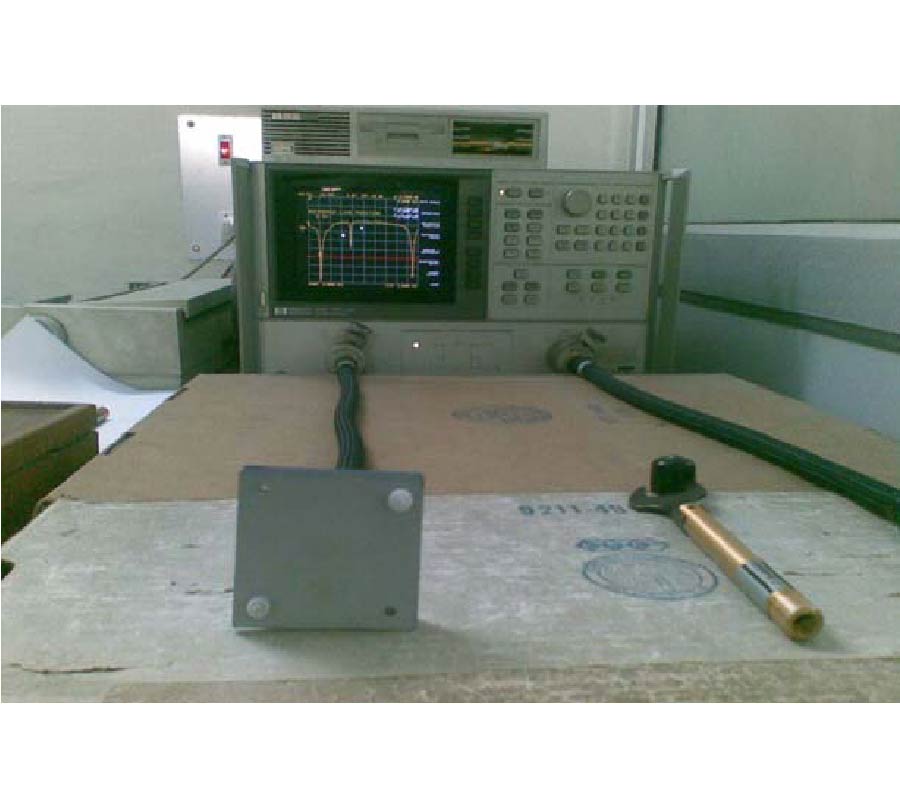
A new miniaturized bandpass fractal frequency selective surface (FSS) with excellent angular stability performa nce is proposed. The minia turization has been achieved by scheming out a symmetric fractal pattern of continuous slots from the surface of a square-shaped patch, in which each periodic cell consists of incurved slot resonator for reducing the cell size. Reduction in FSS size of up to 74% with respect to the conventional square loop aperture FSS operating at the same frequency of 3.3 GHz is obtained. Furthermore, results show excellent angular stability for both vertica land horizontal polarization at different incidence angles because of its fractal configuration. A prototype is fabricated and the FSS measurement, and simulation results are presented and discussed.
A NEW MINIATURIZED FRACTAL FREQUENCY SELECTIVE SURFACE WITH EXCELLENT ANGULAR STABILITY
2010-02-18
PIER Letters
Vol. 13, 121-129
Fast and Accurate Radar Cross Section Computation Using Chebyshev Approximation in Both Broad Frequency Band and Angular Domains Simultaneously
Jin Ling , Shu-Xi Gong , Bao Lu , Xing Wang and Wen-Tao Wang
To predict the three-dimensional radar cross section (RCS) pattern of an arbitrary shaped perfectly electric conductor objects in both a broad frequency band and angular domains simultaneously, the method of moments (MoM) combined with the Chebyshev polynomial approximation is presented. The induced current is expanded by a bivariate Chebyshev series. Using this function, the induced current can be obtained at any frequency and angle within the desired frequency band and angular domains. Numerical results show that the proposed method is found to be superior in terms of the CPU time to obtain the three-dimensional RCS pattern compared with the direct solution by MoM repeating the calculations at each frequency and angle. Good agreement between the presented method and the direct MoM is observed.
FAST AND ACCURATE RADAR CROSS SECTION COMPUTATION USING CHEBYSHEV APPROXIMATION IN BOTH BROAD FREQUENCY BAND AND ANGULAR DOMAINS SIMULTANEOUSLY
2010-02-18
PIER M
Vol. 11, 137-151
Pattern Optimization in an UWB Spiral Array Antenna
Amir Jafargholi and Manouchehr Kamyab
We have proposed a new architecture for an array in which the elements are placed on a spiral curve in order to obtain an ultra wideband (UWB) radiation pattern. In addition, array factor and bandwidth of the proposed spiral array are calculated. Simulated results obtained by SuperNEC and CST software have shown good agreement with the analytic calculations. Although the proposed antenna array is wideband in nature, it lacks desirable efficiency, due to poor front to back ratio (FBR) and sidelobe level (SLL). In this paper, we have chosen three different approaches in order to improve the e±ciency of proposed array. First, the effect of length and thickness tapering of elements has been studied. Second, we have used Genetic Algorithm (GA) to optimized pattern shape. Finally, the influence of metamaterial cover on array performance has been investigated. Although the first and second methods improve the radiation pattern, the array bandwidth is reduced. It is shown that the third method improves array directivity and FBR by 5-7 dB and 15-17 dB respectively within the frequency band of operation.
PATTERN OPTIMIZATION IN AN UWB SPIRAL ARRAY ANTENNA
2010-02-16
PIER B
Vol. 19, 385-403
Effects of Geometry on Amplification Property of Erbium Doped Holey Fiber Amplifiers Using Scalar Effective Index Method
Maryam Karimi and Faramarz E. Seraji
Holey fibers (HF) with their peculiar properties have been used in fabrication of Erbium doped holey fiber amplifiers (EDHFA) for third optical communication window. In this paper, by using scalar effective index method, the analyses are presented to investigate the effects of HF geometrical parameters on the gain performance of the EDHFAs. The hierarchical variations of the parameters, including the air-hole sizes (AHS), propagating modes of the core and cladding, mode field diameter of the signal and pump, would cause alterations in the maximum gain and the optimum lengths of the EDHFAs. By determining the normalized frequency of the HF in wide range variations of the air-hole diameter, air-hole spacing, and air-filling factor (AFF), the single-mode regions for signal and pump wavelengths are obtained, where the maximum gain and the optimum lengths are evaluated. In addition, the influence of pump power and the dopant concentration in terms of the AFF are investigated. It is shown that by using suitable AHS and AFF, one can obtain a higher gain for a shorter optimum length in the EDHFAs. The obtained results can be a useful tool for design of HF-based optical amplifiers with lesser effects of amplified spontaneous emission and nonlinearities because of shorter optimized length.
EFFECTS OF GEOMETRY ON AMPLIFICATION PROPERTY OF ERBIUM DOPED HOLEY FIBER AMPLIFIERS USING SCALAR EFFECTIVE INDEX METHOD
2010-02-16
PIER
Vol. 102, 107-124
Application of Stub Loaded Folded Stepped Impedance Resonators to Dual Band Filters
Maria Velazquez-Ahumada , Jesus Martel-Villagran , Francisco Medina and Francisco Mesa
In this paper, a folded stepped impedance resonator (SIR), modified by adding an inner quasi-lumped SIR stub, is used as a basis block for a new implementation of dual-band bandpass filters. The main advantage of the proposed filter is to make it possible to independently control the electrical features of the first and second bands. The behavior of the first band basically depends on the geometry of the outer folded SIR. The second band, however, is strongly influenced by the presence of the inner stub. Additional design flexibility is achieved by allowing the inner stub to be located at an arbitrary position along the high impedance line section of the main SIR. The position of the tapped input and output lines can be optimized in order to reach a reasonable matching of the filter at the central frequencies of both passbands. Some designs are reported to illustrate the possibilities of the proposed structure. Experimental verification has been included.
APPLICATION OF STUB LOADED FOLDED STEPPED IMPEDANCE RESONATORS TO DUAL BAND FILTERS
2010-02-15
PIER Letters
Vol. 13, 113-119
Frequency Response Comparison of Two Common Active Inductors
Carlos E. Saavedra and You Zheng
The frequency responses of two widely used active inductor topologies are analyzed and compared using a generalized circuit model for the active devices in the circuits. A very wideband active inductor in CMOS was subsequently fabricated and tested and the inductor exhibits a measured self-resonant frequency of 9.7 GHz.
FREQUENCY RESPONSE COMPARISON OF TWO COMMON ACTIVE INDUCTORS
2010-02-15
PIER Letters
Vol. 13, 103-112
Evaluation of a Ni-Zn Ferrite for Use in Temperature Sensors
Vera Lucia Othero de Brito , Luiz Fernando Alves De Almeida , Anderson Kenji Hirata and Antonio Carlos da Cunha Migliano
This work investigates the variation of the real part of the complex magnetic permeability of a Ni-Zn ferrite for application to temperature sensors. Ferrite samples were fabricated by means of the conventional ceramic method. Zinc, nickel and iron oxides were used as raw materials. The samples were sintered at 1200, 1300, and 1400oC. The complex magnetic permeability of the samples was measured at temperatures ranging from -40oC to +50oC. The complex magnetic permeability of the samples was analyzed in the 100 kHz--100 MHz frequency range, and the temperature sensitivity of the magnetic permeability (μr'/T) was analyzed at 100 kHz. The magnetic permeability variation of the ferrite permits to use it as a temperature transducer with a maximum temperature sensitivity of about -119oC-1. The highest magnitudes of temperature sensitivity occurred between +30oC and +50oC. Therefore, the ferrite could be sensitive enough to allow temperature measurements at the human body temperature level. The results indicate that the temperature range of maximum temperature sensitivity of the ferrite may be adjusted by means of appropriate selection of the fabrication parameters.
EVALUATION OF A Ni-Zn FERRITE FOR USE IN TEMPERATURE SENSORS
2010-02-15
PIER C
Vol. 12, 139-148
Crosstalk Reduction Using Step Shaped Transmission Line
Ali Reza Mallahzadeh , Amir Ghasemi , S. Akhlaghi , Bahman Rahmati and Reza Bayderkhani
In this paper a novel method for crosstalk reduction is proposed. This is achieved through using the step shaped transmission line, which basically attempts to create steps along the transmission lines to decrease the crosstalk, while having negligible variation in return loss. To this end, various simulations are carried out to get an intuition regarding the underlying processes conducted to the far-end crosstalk, thereby enabling to optimize the far-end crosstalk, and simultaneously to yield a small variation in the return loss. Accordingly, a conventional coupled transmission line is employed as a benchmark, enabling to have an idea regarding the impact of the proposed method in terms of the ability to decrease the far-end cross talk. Furthermore, the proposed transmission line and the benchmark structure are fabricated and then evaluated to verify the experimental results to that of the simulation. In addition, comprehensive parametric studies have been carried out to get insight on the effect of various adjustable parameters over the crosstalk. The obtained results show that the crosstalk is decreased more than 4 dB over the entire operating bandwidth. Some advantages such as ease of design and fabrication have made the proposed technique an advisable method when dealing with low crosstalk.
CROSSTALK REDUCTION USING STEP SHAPED TRANSMISSION LINE
2010-02-15
PIER C
Vol. 12, 125-137
New Heuristic Diffraction Coefficient for Modeling of Wireless Channel
Sanjay Kumar Soni and Amitabha Bhattacharya
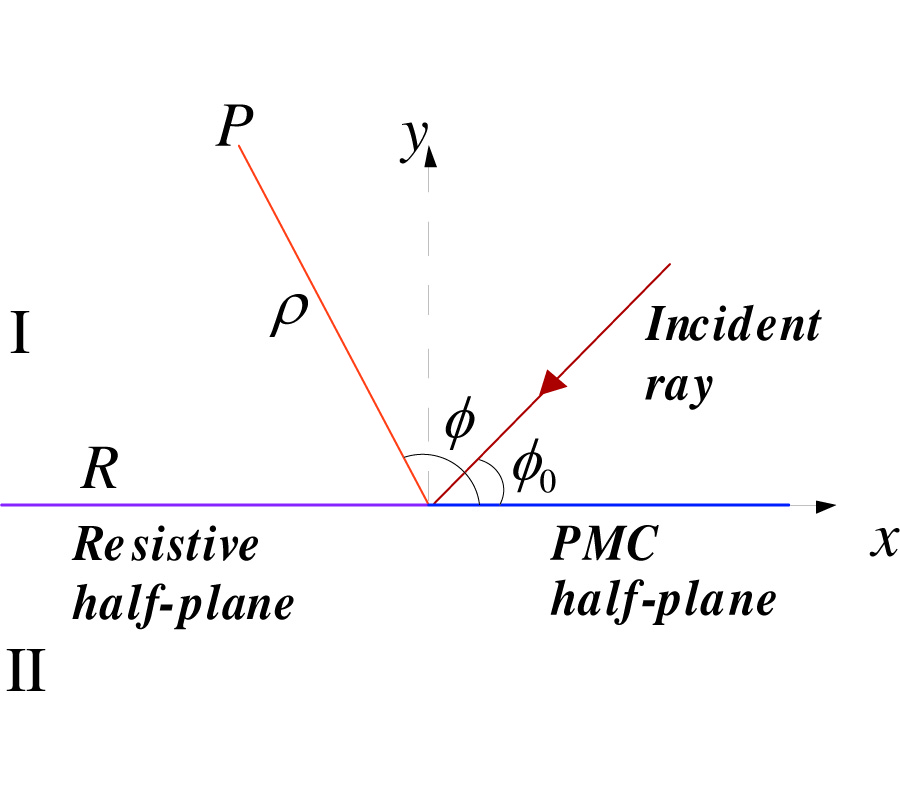
A new reciprocal heuristic diffraction coefficient for lossy dielectric wedge is presented which is applicable to arbitrary positions of transmitter and receiver in a complex channel environment. The prediction obtained using proposed coefficient is compared with those obtained using rigorous Maliuzhinets'solution. The comparison shows significant improvement over available heuristic coefficients. The coefficient is valid for both parallel and perpendicular polarizations. Further, the measurement of the electric field in the vicinity of edge of the building is carried out, and the measurement result, thus obtained, is compared with predictions using the proposed coefficient.
NEW HEURISTIC DIFFRACTION COEFFICIENT FOR MODELING OF WIRELESS CHANNEL
2010-02-15
PIER C
Vol. 12, 113-123
Design of a Band-Notched Microstrip Circular Slot Antenna for UWB Communication
Abdol Aziz Kalteh , Rajab Fallahi and Mahdi Roozbahani
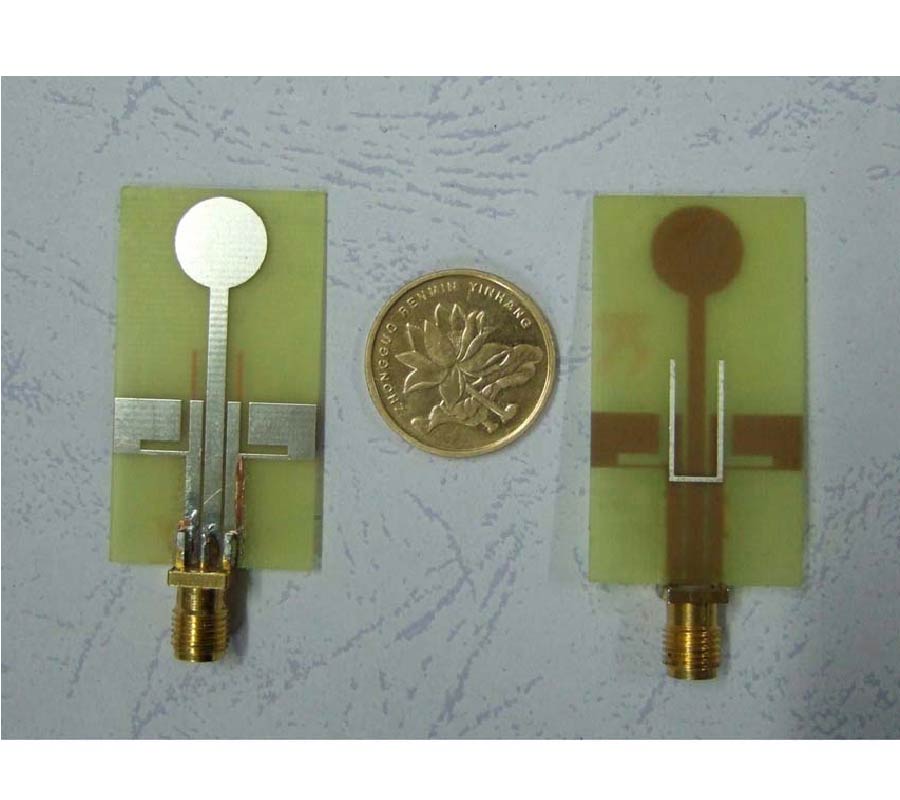
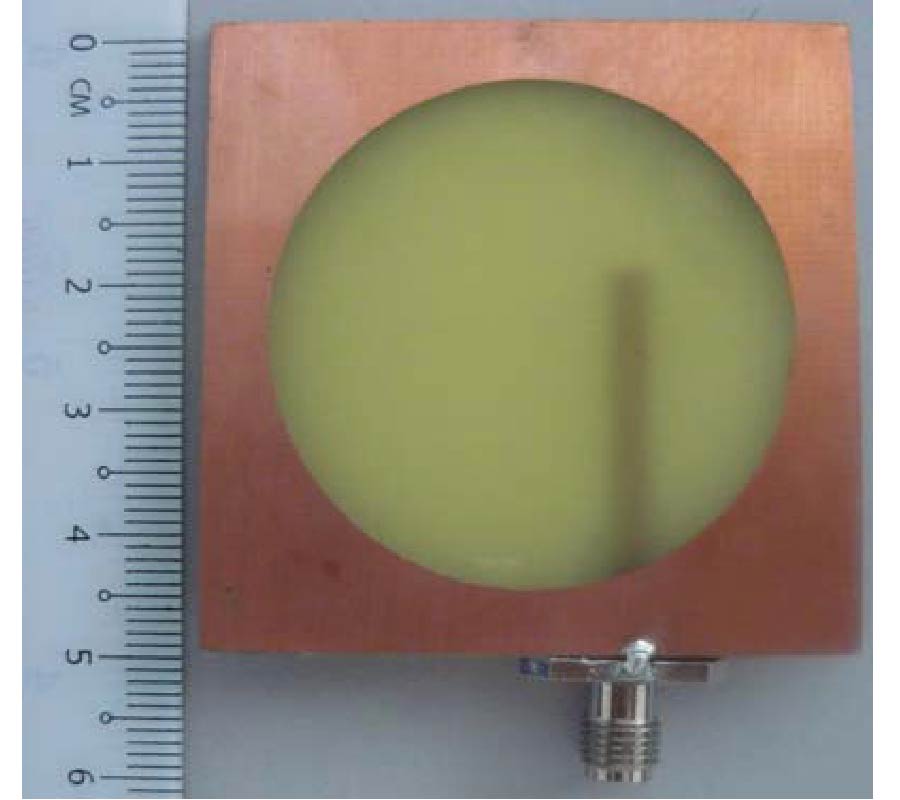
In this paper, a novel band-notched circular slot (BNCS) antenna for ultra-wideband (UWB) communication is proposed. This antenna is comprised of a circular stub that excite similar-shaped slot aperture. The proposed antenna is designed on the RO4350B substrate with thickness of 500 μm and relative permittivity (εr) of 3.4 to operate in UWB band released by the US's Federal Communications Commission (FCC) in 2002 (i.e., 3.1-10.6 GHz). To reject the frequency band of 5.15-5.825 GHz, which is limited by IEEE 802.11a and HIPERLAN/2, an inverted-cup strip is parasitically attached to the feed layer. The size of our proposed antenna is 50×50 mm2, and this antenna has good radiation characteristics. Effects of varying the parameters of parasitic inverted-cup strip on performance of the proposed antenna have been studied. The antenna with optimal parameters obtained from parametric study is fabricated and measured. It is observed that the simulated and experimental results have good agreement with each other.
DESIGN OF A BAND-NOTCHED MICROSTRIP CIRCULAR SLOT ANTENNA FOR UWB COMMUNICATION
2010-02-15
PIER M
Vol. 11, 123-135
Study on the Properties of Surface Waves in Coated RAM Layers and Monostatic Rcsr Performances of the Coated Slab
Haiyan Chen , Pei-Heng Zhou , Liang Chen and Long-Jiang Deng
Relationships between the properties of surface waves in radar absorbing materials (RAM) layers and mono-static radar cross section reduction (RCSR) performances of a coated slab are studied. In this paper, two kinds of RAM were employed for double-layer coating. By changing the thickness of each layer and the order of RAMs, mono-static RCSR performances of the coated slab are studied. Simultaneously mono-static RCSR performances of a slab coated with equivalent medium of the considered RAMs in situ are calculated and compared with the previous ones in regard to the properties of surface waves. It is found that surface waves in between layers for various coated projects can be evaluated. Our results suggest that the optimal coated order for RAMs exists, and the method may be efficient for coating strategy with various kinds of RAMs. Electromagnetic scatterings of the equivalent medium exclude the effect of surface waves in between layers. Therefore, the equivalent medium theory is not appropriated for the research of electromagnetic scattering on lossy mediums.
STUDY ON THE PROPERTIES OF SURFACE WAVES IN COATED RAM LAYERS AND MONOSTATIC RCSR PERFORMANCES OF THE COATED SLAB
2010-02-15
PIER M
Vol. 11, 111-122
Electromagnetic Band Gap Structures Incorporate with Dual Band Microstrip Antenna Array
Thelaha Masri , Mohamad Kamal Abd Rahim , Osman Ayop , Farid Zubir , Noor Asmawati Binti Samsuri and Huda Abdul Majid
A Dual band Microstrip Antenna Arrays (DbMSAA) incorporated with Mushroom Electromagnetic band Gap (MEBG) and modified Minkowski Electromagnetic Band Gap structures to further improve its radiation characteristics is reported in this work. The two different types of EBG structures work like a Band Rejecter (BR), separating the branch of feed line feeding two different groups of patch antenna arrays operating at 2.4 GHz and 5.8 GHz, thus making them operate individually at their particular frequencies, simultaneously. Initially, the possibilities of having a uniform and controlled radiation patterns are quite complicated to achieve due to the single port feeding technique used and developments of grating lobes at the higher band frequency, but, through the incorporation of the EBG structures, the problems could be solved immediately. The antenna's performance is improved where the grating lobes at 5.8 GHz are diminished, and the radiation patterns of the dual band antenna at both frequencies become more symmetrical with increased gain.
ELECTROMAGNETIC BAND GAP STRUCTURES INCORPORATE WITH DUAL BAND MICROSTRIP ANTENNA ARRAY
2010-02-15
PIER
Vol. 102, 95-106
Compact, Broad-Stopband Lowpass Filters Using SIRs-Loaded Circular Hairpin Resonators
Maohui Yang , Jun Xu , Qing Zhao , Lin Peng and Guiping Li
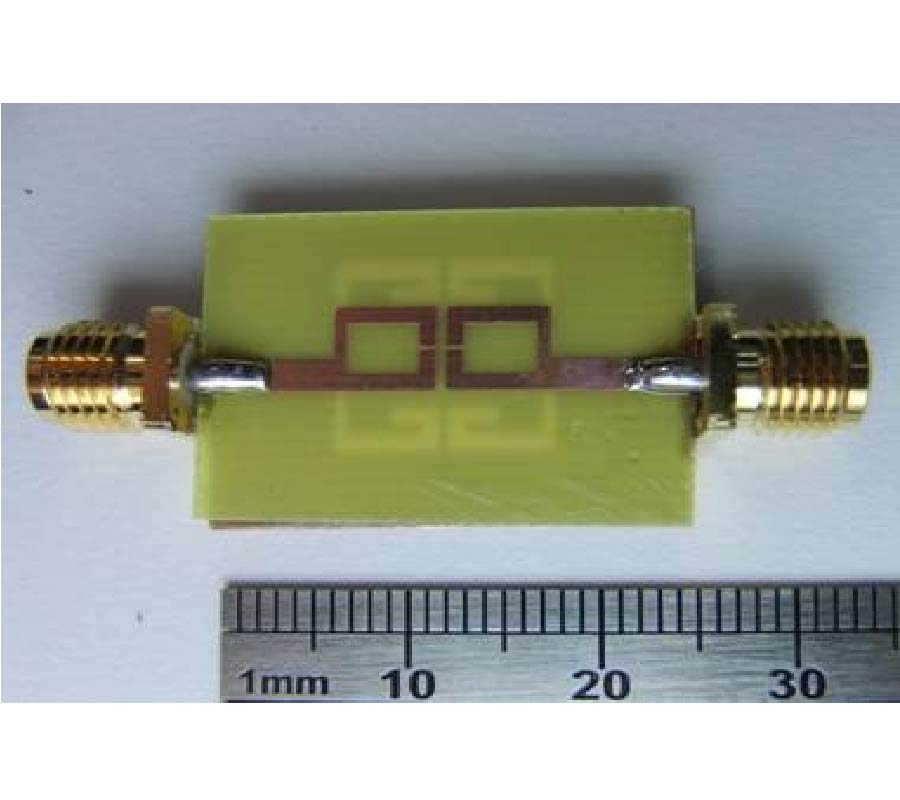
A novel compact resonator for LPF is proposed in this paper. It is composed of a circular hairpin resonator and a pair of coupled parallel stepped impedance resonators (SIRs) inside. With the loaded SIRs, additional two transmission zeros can be introduced and adjusted easily to cancel the spurious responses for stopband extending, while do not change the filter size. Filters using one and two of the new cells were designed and measured. The two-cell LPF has an insertion loss less than 0.6 dB from DC to 1.6 GHz, including attenuation of double SMA transitions at both sides of the circuit which is about 0.3 dB, and a wide -10 dB stopband from 2.5 to 13 GHz (corresponding to 146% normalized 10 dB stopband), but has a size of only 0.129 λg × 0.073 λg.
COMPACT, BROAD-STOPBAND LOWPASS FILTERS USING SIRS-LOADED CIRCULAR HAIRPIN RESONATORS