Search Results(13805)

2010-02-09
PIER
Vol. 101, 291-306
Effect of High-Order Modes on Tunneling Characteristics
Hsin-Yu Yao and Tsun-Hun Chang
Most tunneling effects are investigated using a one-dimensional model, but such an approach fails to explain the phenomena of the propagation of wave in a system with geometric discontinuities. This work studies the tunneling characteristics in a waveguide system that consists of a middle section with a distinct cutoff frequency, which is controlled by the cross-sectional geometry. Unlike in the one-dimensional case, in which only the fundamental mode is considered, in a virtually three-dimensional system, multiple modes have to be taken into consideration. High-order modes (HOMs) modify the amplitude and the phase of the fundamental mode (TE10), thus subsequently affecting the transmission and group delay of a wave. The effect of the high-order evanescent modes is calculated, and the results are compared with the simulated ones using a full-wave solver. Both oversized and undersized waveguides reveal the necessity of considering the HOMs. The underlying physics is manifested using a multiple-reflection model. This study indicates that the high-order evanescent modes are essential to the explanation of the phenomena in a tunneling system with geometrical discontinuities.
EFFECT OF HIGH-ORDER MODES ON TUNNELING CHARACTERISTICS
2010-02-09
PIER
Vol. 101, 277-290
Effect of Atmospheric Propagation in RCS Predictions
Aris Alexopoulos
We consider how an electromagnetic field propagating to a target alters the radar cross section of the target relative to an observer. We derive the optimum high-frequency path for the fields using the calculus of variations and by using a realistic refractive index profile for the atmosphere obtain closed form solutions. It is found that the predicted nulls and peaks in the radar cross section of a scattering object relative to an observer are shifted from those normally expected from just the isolated object. Hence, for predictive purposes at least, radar cross section results need to incorporate the effects of atmospheric propagation.
EFFECT OF ATMOSPHERIC PROPAGATION IN RCS PREDICTIONS
2010-02-09
PIER
Vol. 101, 257-275
Engineering Approach to Modelling Frequency Dispersion Within Normal Metals at Room Temperature for THz Applications
Stepan Lucyszyn and Yun Zhou
When compared to the over-simplified classical skin-effect model, the accurate classical relaxation-effect modelling approach for THz structures at room temperature can be mathematically cumbersome and not insightful. This paper introduces various interrelated engineering concepts as tools for characterizing the intrinsic frequency dispersive nature of normal metals at room temperature. This engineering approach dramatically simplifies otherwise complex analysis and allows for a much deeper insight to be gained into the classical relaxation-effect model. For example, it explains simply how wavelength increases with frequency at higher terahertz frequencies. This is the first time that such an approach has been applied for the modelling of intrinsic frequency dispersion within a metal. While the focus has been on the characterization of normal metals (magnetic and non-magnetic) at room temperature, it is believed that the same methodology may be applied to metals operating in anomalous frequency-temperature regions, semiconductors, semiconductors, carbon nanotubes and metamaterials.
ENGINEERING APPROACH TO MODELLING FREQUENCY DISPERSION WITHIN NORMAL METALS AT ROOM TEMPERATURE FOR THZ APPLICATIONS
2010-02-08
PIER C
Vol. 12, 79-92
Modified W-Type Single-Mode Optical Fiber Design with Ultra-Low, Flattened Chromatic Dispersion and Ultra-High Effective Area for High Bit Rate Long Haul Communications
Ali Rostami and Somayeh Makouei
A proposal for the new modified W type optical fiber structure with ultra high effective area and small dispersion as well as dispersion slope is presented. For the proposed structure, all these features are achieved due to placing extra depressed cladding layers, which is the key to achieve higher effective area and flat dispersion curve compared with the conventional W structures. Meanwhile, the suggested design method is based on the Genetic Algorithm optimization technique to choose optimal value for the structural parameters. Also, our calculation for extracting optical properties of the proposed structure is evaluated analytically. The designed dispersion flattened single mode fiber has dispersion and its slope respectively within [0.1741-0.9282] ps/km/nm and [(-0.011)-(0.0035)] ps/km/nm2 in the spectral range of [1.46-1.625] μm (S+C+L bands) which are noticeably smaller than the reported value for ultra-low dispersion slope fibers [5]. The designed fiber has ultrahigh effective area from 103.56 to 232.26 μm2 in the above wavelength interval. Meanwhile, we show that there is a breakthrough in the quality factor of the ultra-low, ultra-flattened chromatic dispersion single mode optical fiber.
MODIFIED W-TYPE SINGLE-MODE OPTICAL FIBER DESIGN WITH ULTRA-LOW, FLATTENED CHROMATIC DISPERSION AND ULTRA-HIGH EFFECTIVE AREA FOR HIGH BIT RATE LONG HAUL COMMUNICATIONS
2010-02-08
PIER
Vol. 101, 241-256
Supercomputer Aware Approach for the Solution of Challenging Electromagnetic Problems
Marta Gomez Araujo , Jose Taboada , Fernando Obelleiro , Jose Manuel Bertolo , Luis Landesa , Javier Rivero and Jose Luis Rodriguez
It is a proven fact that The Fast Fourier Transform (FFT) extension of the conventional Fast Multipole Method (FMM) reduces the matrix vector product (MVP) complexity and preserves the propensity for parallel scaling of the single level FMM. In this paper, an efficient parallel strategy of a nested variation of the FMMFFT algorithm that reduces the memory requirements is presented. The solution provided by this parallel implementation for a challenging problem with more than 0.5 billion unknowns has constituted the world record in computational electromagnetics (CEM) at the beginning of 2009.
SUPERCOMPUTER AWARE APPROACH FOR THE SOLUTION OF CHALLENGING ELECTROMAGNETIC PROBLEMS
2010-02-04
PIER B
Vol. 19, 367-383
Minimum Usage of Ferrite Tiles in Anechoic Chambers
Sayed Razavi , Mohammad Khalaj-Amirhosseini and Ahmad Cheldavi
Anechoic chambers which are used for emission and immunity testing require expensive ferrite tiles on their inner surfaces. This paper describes a method to reduce the number of required ferrite tiles, whilst ensuring a reliable and specified test region. In this method, the positions of some ferrite tiles are found optimally to keep the performance of the anechoic chamber as high as possible. An optimum ray-tracing method is presented to predict the electric field in the anechoic chamber. The performance of the proposed method is verified by a comprehensive example simulated by the CST software, which is a full-wave simulator based on time difference method.
MINIMUM USAGE OF FERRITE TILES IN ANECHOIC CHAMBERS
2010-02-04
PIER
Vol. 101, 231-239
Polarization Insensitive Metamaterial Absorber with Wide Incident Angle
Bo Zhu , Zhengbin Wang , Ci Huang , Yijun Feng , Junming Zhao and Tian Jiang
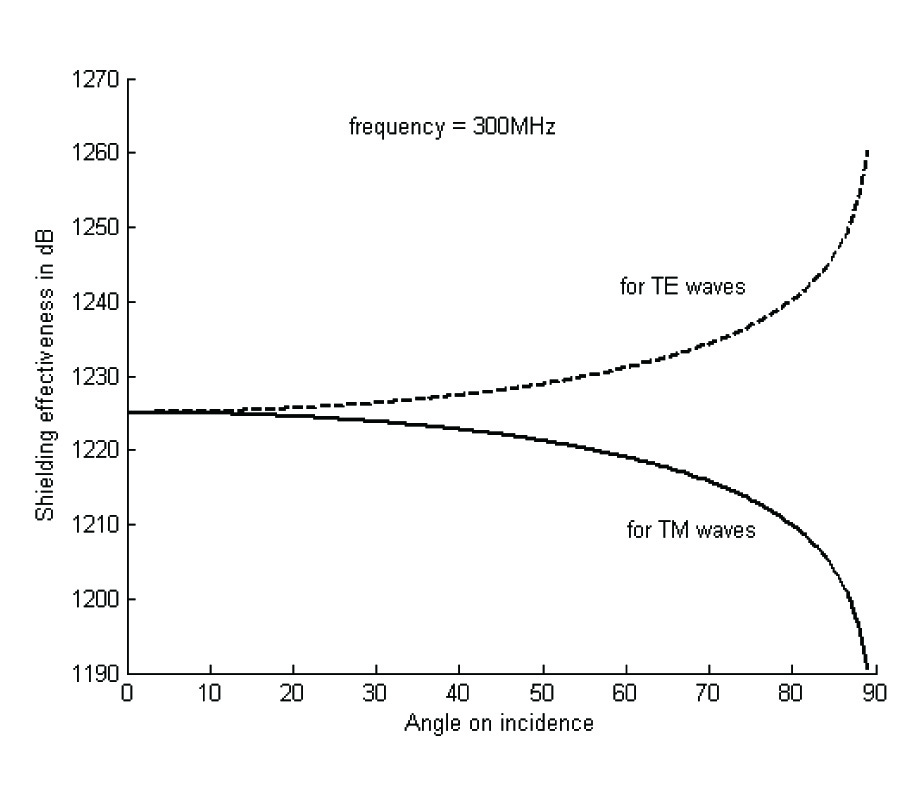
This paper presents the design, fabrication and measurement of a polarization insensitive microwave absorber based on metamaterial. The unit cell of the metamaterial consists of four-fold rotational symmetric electric resonator and cross structure printed on each side of a print circuit board to realize both electric and magnetic resonances to achieve efficient absorption of the incident microwave energy. Both the full wave electromagnetic simulation and the measurement on the fabricated absorber demonstrate high microwave absorption up to 97% for different polarized incident electromagnetic waves. To understand the mechanism, analysis is carried out for the electromagnetic field distribution at the resonance frequency which reveals the working mode of the metamaterial absorber. Moreover, it is verified by experiment that the absorption of this kind of metamaterial absorber remains over 90% with wide incident angle ranging from 0° to 60° for both transverse electric wave and transverse magnetic wave.
POLARIZATION INSENSITIVE METAMATERIAL ABSORBER WITH WIDE INCIDENT ANGLE
2010-02-03
PIER M
Vol. 11, 37-52
Analysis of Annular Ring Microstrip Patch on Uniaxial Medium via Hankel Transform Domain Immittance Approach
Çiğdem Seçkin Gürel and Erdem Yazgan
In this study, annular-ring microstrip patch on uniaxial medium is analysed in Hankel Transform Domain. Equivalent models of the structure are obtained depending on the TE and TM mode decomposition in this domain. For the simplification of the tensor form formulations, equivalent matrix operators are defined in cylindrical coordinates instead of the differential ones. Then, resonant characteristics of the structure is determined via the application of the moment method and compared with the isotropic case for different anisotropy ratio values and structural parameters. Equivalent circuit models for the case of multilayered substrates and superstrates are given in order to be used in the following studies on annular-ring microstrip patch.
ANALYSIS OF ANNULAR RING MICROSTRIP PATCH ON UNIAXIAL MEDIUM VIA HANKEL TRANSFORM DOMAIN IMMITTANCE APPROACH
2010-02-03
PIER
Vol. 101, 217-230
A Deterministic Approach to the Synthesis of Pencil Beams through Planar Thinned Arrays
Ovidio Mario Bucci , Tommaso Isernia and Andrea Francesco Morabito
This paper presents a simple and innovative deterministic approach to the synthesis of uniformly excited thinned arrays able to fulfill constraints concerning both the sidelobe level and the value of the radiated far field (and/or of the directivity) in a set of given directions. Starting from a reference regular (periodic or even aperiodic) lattice and from an optimal continuous reference source fulfilling at best the required specifications, the proposed approach finds out both the number and the location of the isophoric (i.e., equi-amplitude) radiating elements to withdraw in a fast and effective fashion. In fact, it is based on a deterministic best-fitting procedure which takes inspiration from existing density taper techniques. Examples are provided with reference to the synthesis of large circular arrays and confirm the interest of the proposed procedure.
A DETERMINISTIC APPROACH TO THE SYNTHESIS OF PENCIL BEAMS THROUGH PLANAR THINNED ARRAYS
2010-02-02
PIER
Vol. 101, 203-216
Half Mode Substrate Integrated Folded Waveguide (Hmsifw) and Partial h-Plane Bandpass Filter
Zhigang Wang , Xiaqin Li , Shuiping Zhou , Bo Yan , Rui-Min Xu and Weigan Lin
In this paper, a half mode substrate integrated with folded waveguide (HMSIFW) and a HMSIFW partial H-plane bandpass filter are proposed. The proposed filter employs H-plane slot of open-ended evanescent waveguide and H-plane septa of short-ended evanescent waveguide as admittance inverter and impedance inverter, respectively. The filter has advantages of convenient integration, compact size, low cost, mass-producibility and ease in fabrication. In order to validate the new proposed topology, a four-pole ultra-narrowband bandpass filter, with quarter wavelength resonators, is designed and fabricated using standard printed circuit board process. The tapered line is used as transition between HMSIFW and microstrip-line for easy integration and measurement. The measured results are in good agreement with simulated ones, and good selectivity is achieved.
HALF MODE SUBSTRATE INTEGRATED FOLDED WAVEGUIDE (HMSIFW) AND PARTIAL H-PLANE BANDPASS FILTER
2010-02-01
PIER C
Vol. 12, 65-77
Parametric Studies on the Circularly Polarized Stacked Annular-Ring Microstrip Antenna
Xi Chen , Guang Fu , Shu-Xi Gong , Ya-Li Yan and Jin Chen
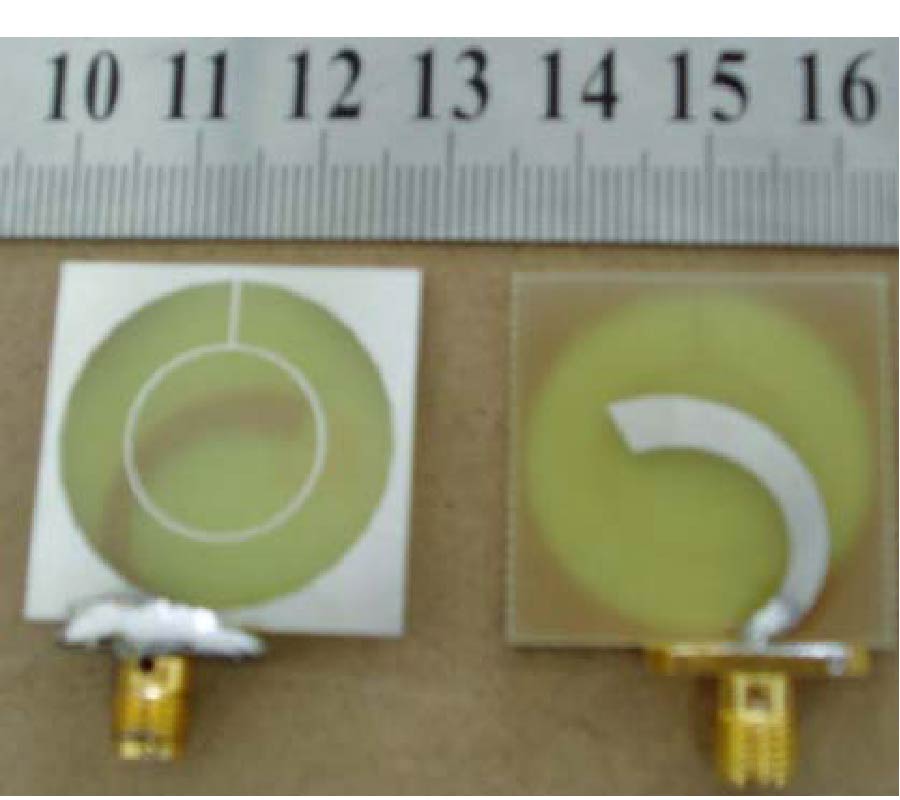
In this paper, we propose a circularly polarized (CP) stacked annular-ring microstrip antenna (SARMSA) with an integrated feeding network in the UHF RFID band. A circular parasitic patch is suspended above the annular ring to improve the impedance matching and bandwidth. Through the parametric studies on SARMSA, the CP characters of the entire antenna are well understood,and an optimized CP character is obtained. Prototypes are fabricated to confirm the theoretical results. The experimental results indicate the impedance bandwidth for S11<-10 dB is 870-967 MHz (10.6% at 915 MHz),and the 3 dB AR bandwidth is 893-948 MHz (6%). Meanwhile, the measured CP gain reaches 8.9 dBic at 915 MHz.
PARAMETRIC STUDIES ON THE CIRCULARLY POLARIZED STACKED ANNULAR-RING MICROSTRIP ANTENNA
2010-02-01
PIER
Vol. 101, 189-202
Simulation and Experimental Verification of W-Band Finite Frequency Selective Surfaces on Infinite Background with 3D Full Wave Solver Nspwmlfma
Saiful Islam , Johan Stiens , G. Poesen , Roger Vounckx , Joris Peeters , Ignace Bogaert , Daniel De Zutter and Walter De Raedt
We present the design, processing and testing of a W-band finite by infinite and a finite by finite Grounded Frequency Selective Surfaces (FSSs) on infinite background. The 3D full wave solver Nondirective Stable Plane Wave Multilevel Fast Multipole Algorithm (NSPWMLFMA) is used to simulate the FSSs. As NSPWMLFMA solver improves the complexity matrix-vector product in an iterative solver from O(N2) to O(N log N) which enables the solver to simulate finite arrays with faster execution time and manageable memory requirements. The simulation results were verified by comparing them with the experimental results. The comparisons demonstrate the accuracy of the NSPWMLFMA solver. We fabricated the corresponding FSS arrays on quartz substrate with photolithographic etching techniques and characterized the vector S-parameters with the free space Millimeter Wave Vector Network Analyzer (MVNA).
SIMULATION AND EXPERIMENTAL VERIFICATION OF W-BAND FINITE FREQUENCY SELECTIVE SURFACES ON INFINITE BACKGROUND WITH 3D FULL WAVE SOLVER NSPWMLFMA
2010-02-01
PIER
Vol. 101, 173-188
FDTD Method Investigation on the Polarimetric Scattering from 2-d Rough Surface
Juan Li , Li-Xin Guo and Hao Zeng
A polarimetric scattering from two-dimensional (2-D) rough surface is presented by the finite-difference time-domain (FDTD) algorithm. The FDTD calculations with sinusoidal and pulsed plane wave excitations are performed. As the sinusoidal FDTD is concerned, it is convenient to obtain the scattered angular distribution of normalized radar cross section (NRCS) from rough surface for a single frequency. And the advantage of pulsed FDTD is to calculate the frequency distribution of NRCS from rough surface in a scattered direction of interest. A single frequency scattering from rough surface by sinusoidal FDTD is validated by the result of Kirchhoff Approximation (KA). And the frequency response of rough surface by pulsed FDTD is verified by that of sinusoidal FDTD, which requires an individual FDTD run for every frequency. To save computation time, the MPI-based parallel FDTD method is adopted. And the computation time of parallel FDTD algorithm is dramatically reduced compared to a single-process implementation. Finally, the polarimetric scattering of rough surface with the sinusoidal and pulsed FDTD illumination are presented and analyzed for different polarizations.
FDTD METHOD INVESTIGATION ON THE POLARIMETRIC SCATTERING FROM 2-D ROUGH SURFACE
2010-02-01
PIER
Vol. 101, 157-171
Design and Experiments of the Gw High-Power Microwave Feed Horn
Chao Chang , Xiaoxin Zhu , Guozhi Liu , Jinyong Fang , Renzhen Xiao , Changhua Chen , Hao Shao , Jiawei Li , Huijun Huang , Qinyuan Zhang and Zhi-Qiang Zhang
Design and optimization of high-power microwave (HPM) feed horn by combining the aperture field with radiation patterns are presented in the paper. The optimized feed horn in C band satisfies relatively uniform aperture field, power capacity higher than 3 GW, symmetric radiation patterns, low sidelobes, and compact length. Cold tests and HPM experiments were conducted to investigate the radiation patterns and power capacity of the horn. The theoretical radiation patterns are consistent with the cold test and HPM experimental results. The power capacity of the compact HPM horn has been demonstrated by HPM experiments to be higher than 3 GW.
DESIGN AND EXPERIMENTS OF THE GW HIGH-POWER MICROWAVE FEED HORN
2010-01-29
PIER
Vol. 101, 139-155
An Efficient Model-Order Reduction Approach to Low-Frequency Transmission Line Modeling
Rob F. Remis
In this paper we present a Lanczos-type reduction method to simulate the low-frequency response of multiconductor transmission lines. Reduced-order models are constructed in such a way that low frequencies are approximated first. The inverse of the transmission line system matrix is then required and an explicit expression for this inverse is presented. No matrix factorization needs to be computed numerically. Furthermore, computing the action of the inverse on a vector requires an O(N) amount of work, where N is the total number of unknowns, and the inverse satisfies a particular reciprocityrelated symmetry relation as well. These two properties are exploited in a Lanczos-type algorithm to efficiently construct the low-frequency reduced-order models. Numerical examples illustrate the performance of the method.
AN EFFICIENT MODEL-ORDER REDUCTION APPROACH TO LOW-FREQUENCY TRANSMISSION LINE MODELING
2010-01-29
PIER
Vol. 101, 125-138
An Hybrid Model for the Evaluation of the Full-Wave Far-Field Radiated Emission from PCB Traces
Andrea Gaetano Chiariello , Giovanni Miano and Antonio Maffucci
The paper deals with the evaluation of the far-field radiated emissions from high-speed interconnects when the frequencies are such that the distribution of the currents along the traces is no longer of TEM-type. Instead of a computationally expensive numerical full-wave model, here a generalized transmission line model is used to obtain the current distributions. This full-wave transmission line model is derived from an integral formulation and is here extended to include in efficient way the layered media Green's Functions. The proposed tool is successfully benchmarked to references given in literature and case-studies of practical interest are carried out, referring to a coupled microstrip, driven either by differential and common mode currents. This analysis highlights the existence of a transition range where the error made by evaluating the emission using the classical transmission line current distribution is still negligible. Here a rule of thumb is derived which provides a simple criterion to estimate this extension of the range of validity of the classical transmission line.
AN HYBRID MODEL FOR THE EVALUATION OF THE FULL-WAVE FAR-FIELD RADIATED EMISSION FROM PCB TRACES
2010-01-29
PIER
Vol. 101, 115-123
Tunable Trapped Mode in Symmetric Resonator Designed for Metamaterials
Abdelwaheb Ourir , Redha Abdeddaim and Julien de Rosny
The excitation of an antisymmetric trapped mode on a symmetric metamaterial resonator is experimentally demonstrated. We use an active electronic device to break the electrical symmetry and therefore to generate this trapped mode on a symmetric spilt ring resonator. Even more, with such a tunable mode coupling resonator, we can precisely tune the resonant mode frequency. In this way, a shift of up to 15 percent is observed.
TUNABLE TRAPPED MODE IN SYMMETRIC RESONATOR DESIGNED FOR METAMATERIALS
2010-01-27
PIER B
Vol. 19, 329-366
Weakly Conditionally Stable and Unconditionally Stable FDTD Schemes for 3D Maxwell's Equations
Juan Chen and Jianguo Wang
To overcome the Courant limit on the time step size of the conventional finite-difference time-domain (FDTD) method, some weakly conditionally stable and unconditionally stable FDTD methods have been developed recently. To analyze the relations between these methods theoretically, they are all viewed as approximations of the conventional FDTD scheme in present discussion. The errors between these methods and the conventional FDTD method are presented analytically, and the numerical performances, including computation accuracy, efficiency, and memory requirements, are discussed, by comparing with those of the conventional FDTD method.
WEAKLY CONDITIONALLY STABLE AND UNCONDITIONALLY STABLE FDTD SCHEMES FOR 3D MAXWELL'S EQUATIONS
2010-01-27
PIER B
Vol. 19, 305-327
Planar Antennas for Passive UHF RFID Tag
Arun Kumar , Davinder Parkash and Machavaram Kartikeyan
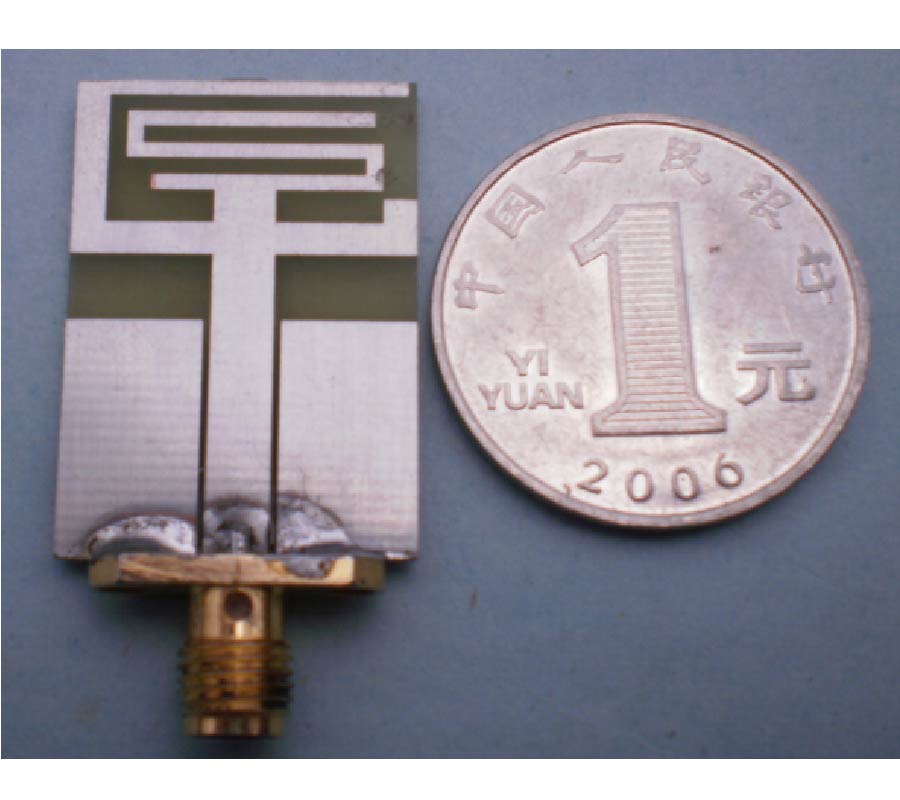
In this paper, design, fabrication, and testing of Radio Frequency Identification (RFID) antennas for the European Telecommunications Standards Institute (ETSI) and Federal Communications Commission (FCC) bands are discussed. The designs proposed in this paper are for UHF RFID tag that conforms to EPCglobal C1G2 1.2.0. The exceptional characteristics of the RFID are investigated in terms of antenna-IC matching and radiation efficiency. The proposed RFID antennas have been fabricated on 5 mil thick Flexible Copper Clad Laminate and the read range of the proposed RFID antennas is experimentally tested. Measured free air read range of all proposed designs is over 4 m. The performance of the tag antenna design affixed to various objects is also tested with read range measurements. The results show that the antenna designs can be used for tagging cardboard and plastic objects.
PLANAR ANTENNAS FOR PASSIVE UHF RFID TAG
2010-01-27
PIER
Vol. 101, 97-114
Closed-Form Design Method of an n-Way Dual-Band Wilkinson Hybrid Power Divider
Yongle Wu , Yuan'an Liu , Shulan Li , Cuiping Yu and Xin Liu
In this paper, the closed-form design method of an N-way dual-band Wilkinson hybrid power divider is proposed. This symmetric structure including N groups of two sections of transmission lines and two isolated resistors is described which can split a signal into N equiphase equiamplitude parts at two arbitrary frequencies (dual-band) simultaneously, where N can be odd or even. Based on the rigorous even- and odd- mode analysis, the closed-form design equations are derived. For verification, various numerical examples are designed, calculated and compared while two practical examples including two ways and three ways dual-band microstrip power dividers are fabricated and measured. It is very interesting that this generalized power divider with analytical design equations can be designed for wideband applications when the frequency-ratio is relatively small. In addition, it is found that the conventional N-way hybrid Wilkinson power divider for single-band applications is a special case (the frequency-ratio equals to 3) of this generalized power divider.
CLOSED-FORM DESIGN METHOD OF AN N-WAY DUAL-BAND WILKINSON HYBRID POWER DIVIDER