Search Results(13794)

2017-02-17
PIER M
Vol. 54, 137-144
Monte-Carlo-Based Impulse Response Modeling for Underwater Wireless Optical Communication
Feibiao Dong , Limei Xu , Dagang Jiang and Tianhong Zhang
In underwater wireless optical communication links, the suspended particles in the water can lead to multi-path transmission of the light, causing the temporal dispersion and attenuation of beam pulse. The scattering phase function is a key parameter to model angle scattering in the Monte Carlo simulation and can be approximated by the commonly used Henyey-Greenstein (HG) phase function, but in turbid sea water environment, the HG phase function cannot match well with the measured value of the particle phase function. In this work, instead of using the HG phase function, we make use of the Petzold's measured data value of the scattering phase function in turbid sea water. We propose a numerical solution for the computing of the scattering angle based on the measured particle phase function and present the difference of effect on temporal dispersion between the measurement and HG phase function. Numerical results show that our model is more accurate than the widely used HG model. An analytic double Gamma function is used to fit the Monte Carlo simulation results, and a good fit is found between the double Gamma function and the Monte Carlo simulations.
MONTE-CARLO-BASED IMPULSE RESPONSE MODELING FOR UNDERWATER WIRELESS OPTICAL COMMUNICATION
2017-02-17
PIER M
Vol. 54, 125-135
Profile Reconstruction Utilizing Forward-Backward Time-Stepping with the Integration of Automated Edge-Preserving Regularization Technique for Object Detection Applications
Guang Yong , Kismet Anak Hong Ping , Shafrida Sahrani , Mohamad Hamiruce Marhaban , Mohd Iqbal Sariphn , Toshifumi Moriyama and Takashi Takenaka
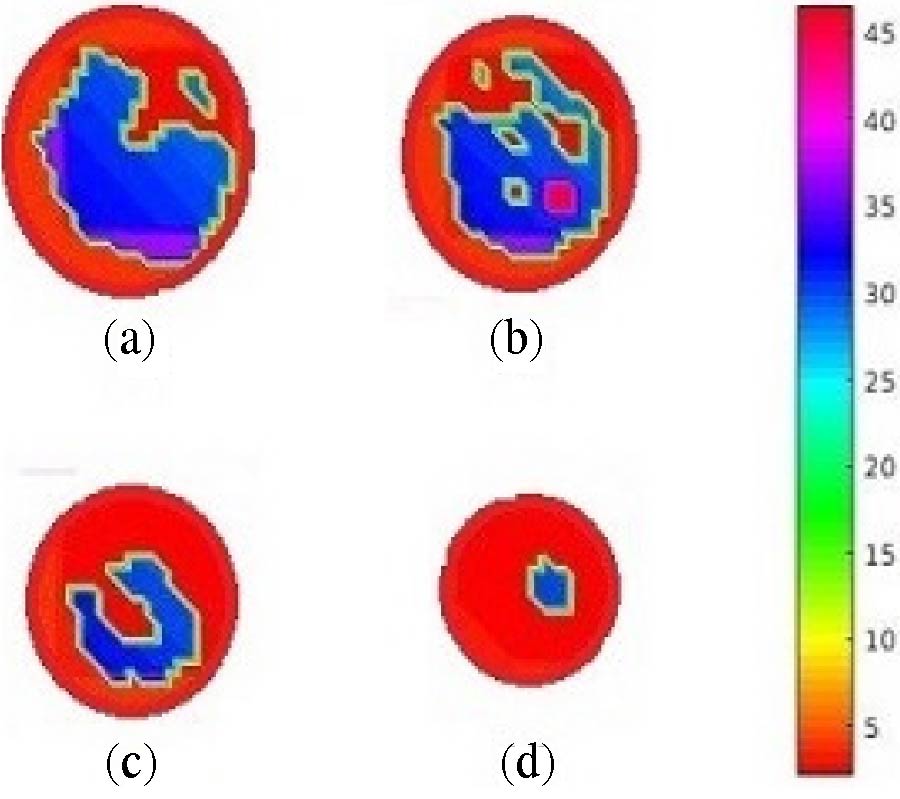
A regularization is integrated with Forward-Backward Time-Stepping (FBTS) method which is formulated in time-domain utilizing Finite-Difference Time-Domain (FDTD) method to solve the nonlinear and ill-posed problem arisen in the microwave inverse scattering problem. FBTS method based on a Polak-Ribiète-Polyak conjugate gradient method is easily trapped in the local minima. Thus, we extend our work with the integration of edge-preserving regularization technique due to its ability to smooth and preserve the edges containing important information for reconstructing the dielectric profiles of the targeted object. In this paper, we propose a deterministic relaxation with Mean Square Error algorithm known as DrMSE in FBTS and integrate it with the automated edge-preserving regularization technique. Numerical simulations are carried out and prove that the reconstructed results are more accurate by calculating the edge-preserving parameter automatically.
PROFILE RECONSTRUCTION UTILIZING FORWARD-BACKWARD TIME-STEPPING WITH THE INTEGRATION OF AUTOMATED EDGE-PRESERVING REGULARIZATION TECHNIQUE FOR OBJECT DETECTION APPLICATIONS
2017-02-13
PIER C
Vol. 71, 133-140
Triple-Band Composite Right/Left Handed Bandpass Filter Using a New Circular Inter-Digital Capacitor for Wireless Applications
Ashish Kumar , Dilip Kumar Choudhary and Raghvendra Kumar Chaudhary
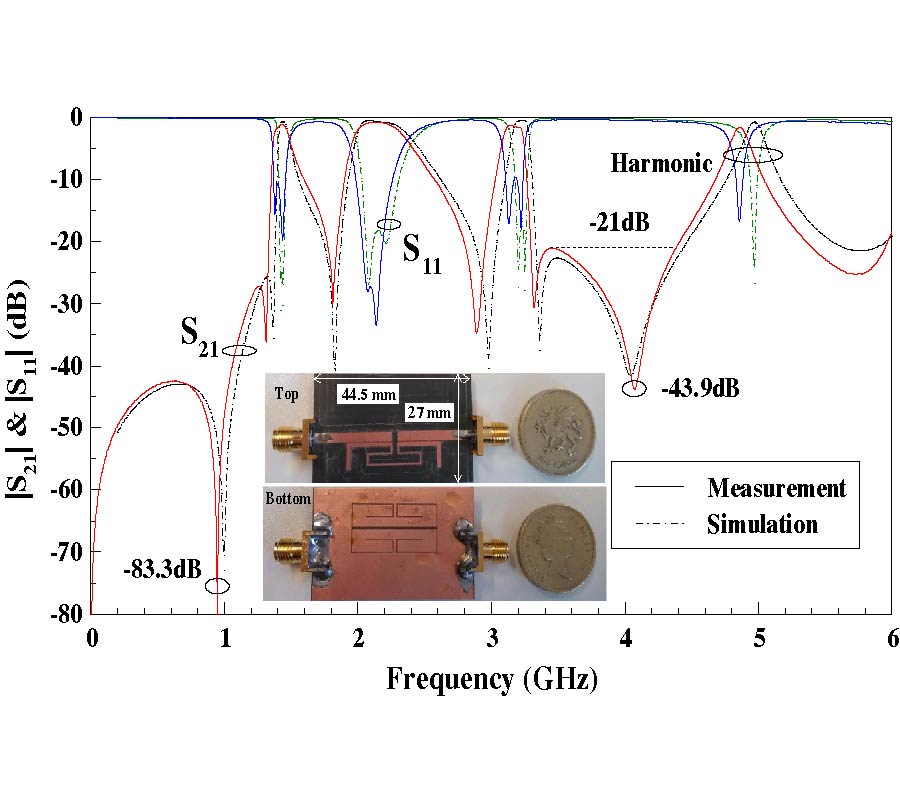
In this paper, a compact triple-band bandpass filter based on composite right/left handed (CRLH) approach has been proposed. The zeroth order resonance (ZOR) frequency of the designed filter can be controlled effectively by varying the series parameters. A new circular interdigital capacitor is integrated to provide series capacitance. The number of passbands depends on number of rings of circular interdigital capacitor (C-IDC). In order to validate metamaterial behavior, a dispersion diagram has been plotted for the designed filter. The proposed filter offers measured 3dB fractional bandwidth of 71% at 1.7 GHz, 24% at 2.9 GHz and 12% at 4.1 GHz as center frequencies. The designed filter will be suitable for different wireless applications such as global navigation satellite systems (1.559-1.610 GHz), GSM1800, indoor femtocells (2.5-2.7 GHz), air traffic surveillance (2.7-2.9 GHz) and fixed satellite services (3.8-4.2 GHz). The size of the proposed filter is 0.13λ0 × 0.11λ0, where λ0 is the free space wavelength at ZOR frequency of 1.7 GHz.
TRIPLE-BAND COMPOSITE RIGHT/LEFT HANDED BANDPASS FILTER USING A NEW CIRCULAR INTER-DIGITAL CAPACITOR FOR WIRELESS APPLICATIONS
2017-02-13
PIER Letters
Vol. 66, 33-38
A Compact UWB BPF with Sharp Roll-off Using CPW to Microstrip Transition Structure
Xinlin Xia , Yu Liu , Hao Peng , Minghuan Ni , Haodong Lin and Tao Yang
In this letter, a compact ultra-wideband (UWB) bandpass filter based on CPW-to-microstrip transition structure is proposed. Compared with traditional UWB BPF using hybrid structures, the proposed filter has a more sharp selectivity due to a transmission zero located at the lower edge of the passband generated by the combined effect of both CPW-MS-CPW and interdigital coupling line (ICL). Moreover, to further improve its selectivity, the CPW open stubs (CPWOS) are introduced to produce two extra transmission zeros at high frequency. The measured results show that the proposed filter has some good characteristics such as sharp roll-off, compact size (0.54λg × 0.38λg) and a very wide fractional bandwidth of 130%, which is a significant improvement to what has been reported for UWB BPF with similar structures.
A COMPACT UWB BPF WITH SHARP ROLL-OFF USING CPW TO MICROSTRIP TRANSITION STRUCTURE
2017-02-13
PIER M
Vol. 54, 113-123
Hybrid FDTD/FETD Technique Using Parametric Quadratic Programming for Nonlinear Maxwell's Equations
Hongxia Li , Bao Zhu and Jiefu Chen
A nonlinear hybrid FDTD/FETD technique based on the parametric quadratic programming method is developed for Maxwell's equations with nonlinear media. The proposed technique allows nonconforming meshes between nonlinear FETD and linear FDTD subdomains. The coarse structured cells of FDTD are used in relatively simple structures with linear media, whereas fine unstructured elements of FETD based on the parametric quadratic programming method are used to simulate complicated structures with nonlinear media. This hybrid technique is particularly suitable for structures with small nonlinear regions in an otherwise linear medium. Numerical results demonstrate the validity of the proposed method.
HYBRID FDTD/FETD TECHNIQUE USING PARAMETRIC QUADRATIC PROGRAMMING FOR NONLINEAR MAXWELL'S EQUATIONS
2017-02-13
PIER M
Vol. 54, 103-111
Dual Band-Notched UWB MIMO Antenna with Uniform Rejection Performance
Jian-Feng Li , Duo-Long Wu and Yan-Jie Wu
A compact dual band-notched ultra-wideband (UWB) multiple-input multiple-output (MIMO) antenna with uniform rejection performance is designed on an FR4 substrate (35×23×1.6 mm3). Compared with the existing UWB MIMO antennas, a second-order notched band with uniform performance for 5.15-5.825 GHz is achieved, which results from the interplay between a 1/3λ open-end slot and a 1/2λ parasitic strip. A 1/4λ open-end slot is also applied to the 3.3-3.7 GHz reject band. The two slots are connected at their open ends, that can help to get the uniform reject performance for 5.15-5.825 GHz and make the high cutoff frequency of the impedance matching band go toward the higher frequencies. Excluding the two rejected bands, a band with |S11|≤-10 dB, |S21|≤-17 dB and frequency ranged from 3.1 to 10.9 GHz is achieved, and results show that a uniform performance for 5.15-5.825 GHz is obtained.
DUAL BAND-NOTCHED UWB MIMO ANTENNA WITH UNIFORM REJECTION PERFORMANCE
2017-02-12
PIER C
Vol. 71, 123-131
Wideband Metamaterial Solar Cell Antenna for 5 GHz Wi-Fi Communication
Michael Elsdon , Okan Yurduseven and Xuewu Dai
In this paper, a novel design for a wideband integrated photovoltaic (PV) solar cell patch antenna for 5 GHz Wi-Fi communication is presented and discussed. The design consists of a slot loaded patch antenna with an array of complimentary split ring resonators (cSRR) etched in the ground plane. This is then integrated with a solar cell element placed above the patch, where the ground plane of the solar cell acts as a stacked antenna element from an RF perspective. The design is simulated on CST Microwave Studio and fabricated. The results indicate that an impedance bandwidth of 1 GHz is achieved to cover the 5 GHz Wi-Fi band with a gain of between 7.73 dBi and 8.18 dBi across this band. It is also demonstrated that size reduction of up to 25% can be achieved. Moreover, it is noted that using a metamaterial loaded ground plane acts as an impedance transformer, therefore the antenna can be fed directly with a 50 Ω microstrip feed line, hence further reducing the overall size.
WIDEBAND METAMATERIAL SOLAR CELL ANTENNA FOR 5 GHZ WI-FI COMMUNICATION
2017-02-12
PIER M
Vol. 54, 91-102
Calculation of Passive Magnetic Force in a Radial Magnetic Bearing Using General Division Approach
Tapan Santra , Debabrata Roy and Amalendu Bikash Choudhury
This paper represents the force calculation in a radial passive magnetic bearing using Monte Carlo technique with general division approach (s-MC). The expression of magnetic force is obtained using magnetic surface charge density method which incurs a multidimensional integration with complicated integrand. This integration is solved using Monte Carlo technique with 1-division (1-MC) and 2-division (2-MC) approaches with a MATLAB programming. Analysis using established methods such as finite element method (FEM), semi-analytical method, and adaptive Monte Carlo (AMC) method has been carried out to support the proposed technique. Laboratory experiment has been conducted to validate the proposed method. 2-MC gives better result than 1-MC. The computation time of the proposed method is compared with the quadrature method, FEM and AMC. It is observed that the proposed method invites less computational burden than those methods as the algorithm adaptively traverses the domain for promising parts of the domain only, and all the elementary regions are not considered with equal importance.
CALCULATION OF PASSIVE MAGNETIC FORCE IN A RADIAL MAGNETIC BEARING USING GENERAL DIVISION APPROACH
2017-02-09
PIER C
Vol. 71, 111-122
Ultra-Compact Microstrip Antenna Array and Miniaturized Feeding Network
Wei Qiao , Xi Gao , Xingyang Yu , Si Min Li , Yan-Nan Jiang and Hui-Feng Ma
In this paper, an interdigital resonator that can greatly decrease mutual coupling between adjacent patches is proposed to realize an ultra-compact microstrip antenna array operating in 2.4 GHz wireless communication system. Due to its remarkable performance of decoupling, the edge to edge distance between adjacent patches can be reduced to 0.08λ0 and even less. Meanwhile, a miniaturized feeding network, which is composed of a CRLH-TL-based phase shifter and T-junction-based power divider, is used to feedthe compact antenna array. The simulation results show that the proposed antenna array has an impedance bandwidth of 8.34%. We fabricate the antenna array to verify its performance. The experimental results are in good agreements with the simulations. Compared to the published designs, the proposed antenna array hasanultra-compact structure and hence can be used in space limited communication systems.
ULTRA-COMPACT MICROSTRIP ANTENNA ARRAY AND MINIATURIZED FEEDING NETWORK
2017-02-09
PIER M
Vol. 54, 83-90
Scattering Analysis of Buried Objects by Using FDTD with Nonuniform Meshes
Min Zhang , Cheng Liao , Xiang-Zheng Xiong and Xiaomin Xu
This paper presents a finite-difference time-domain (FDTD) method of the infinite half-space with nonuniform meshes, aiming to speed up the FDTD calculation of scattering of buried objects. Two 1-D modified FDTD equations are employed to set plane wave excitation of the infinite half-space scattering problems. In order to reduce calculation time and meshes, a method with nonuniform meshes is applied. Fine grids are used for the buried objects and underground while coarse grids are applied for other regions. The 1-D modified FDTD equations with nouniform meshes are derived, and the settings of total-field/scattering-field (TF-SF) boundary are given. Finally, the proposed method is applied to calculate the transient scattering field of a buried mine. Numerical results demonstrate the validity of the method and the simulation time is significantly reduced when compared with uniform meshes FDTD.
SCATTERING ANALYSIS OF BURIED OBJECTS BY USING FDTD WITH NONUNIFORM MESHES
2017-02-09
PIER M
Vol. 54, 75-82
The Two-Slit Interference of Vector Optical Fields with Both Radially and Azimuthally Variant States of Polarization
Tengyue Gao , Chaoyang Qian , Xiaoyu Zhang and Rui Pin Chen
The interference behaviors of a vector optical field with both radially and azimuthally variant states of polarization (SoP) through the Young's two-slits are theoretically studied. The optical field distribution with periodic stripes in the far field results from the interference of the vector optical field through the Young's two-slits with different initial SoP distributions. It is found that the far-field distribution can be manipulated by the incident vector optical field with the initial phase and SoP distributions. Particularly, the distribution of radially-variant SoP in the cross-section of the incident optical field provides an additional freedom to control the interference patterns of the x-component, y-component and total intensity distribution in far field. This approach provides a new method to further expand the functionality of an optical system by considering the distribution of SoP in field cross-section.
THE TWO-SLIT INTERFERENCE OF VECTOR OPTICAL FIELDS WITH BOTH RADIALLY AND AZIMUTHALLY VARIANT STATES OF POLARIZATION
2017-02-08
PIER C
Vol. 71, 101-109
A Novel Tunable Microstrip Patch Antenna Using Liquid Crystal
Jia-Wei Dai , Hong-Li Peng , Yao-Ping Zhang and Jun-Fa Mao
This paper presents a novel tunable microstrip patch antenna using liquid crystal. It adopts a differentially-driven, aperture-coupled, and stacked-patch structure. Compared with the conventional design, this novel antenna achieves a larger frequency tuning range, much wider impedance bandwidth, higher radiation efficiency and gain. Besides, the novel antenna facilitates the bias design as the bias signal is naturally isolated from the RF signal. Both the conventional and novel antennas are designed to operate at 28 GHz using an RT/Duroid 5880 substrate and K15 liquid crystal. Results show that the novel antenna has a tuning range of 3.1%, an impedance bandwidth of 6.43%, a peak radiation efficiency of 70%, and a peak realized gain of 6.5 dBi, while the conventional antenna has the tuning range of 2.7%, impedance bandwidth of 3.57%, peak radiation efficiency of 45%, and peak realized peak gain of 4.5 dBi.
A NOVEL TUNABLE MICROSTRIP PATCH ANTENNA USING LIQUID CRYSTAL
2017-02-08
PIER M
Vol. 54, 67-74
Feed Matching Improvement for Center Fed Reflectarray
Muhammad M. Tahseen and Ahmed A. Kishk
Standing wave between the feed and the reflectarray (RA) deteriorates the matching and antenna gain. A phase perturbation method is investigated to improve the matching of the antenna. The proposed method requires a change or deformation of the RA area facing the feed. A small circularly polarized reflectarray (CPRA) is used as an example. The reflectarray size is 6.25λ×6.25λ, which is corresponding to 25×25 elements. The feed is circularly polarized (CP) with aperture diameter 1.2×λ. The proposed method provides an acceptable compromise between achieving the matching and gain reduction. The field distribution on the symmetric line between the RA center and the feed is observed to show the behavior of the standing wave before and after implementing the proposed technique. The measured return loss becomes better than 10 dB, and a gain reduction is 0.2 dB. A measured maximum aperture efficiency of 55.4%, a 1-dB gain bandwidth of better than 33%, and the 1.5-dB axial ratio bandwidth of 33.2% are achieved.
FEED MATCHING IMPROVEMENT FOR CENTER FED REFLECTARRAY
2017-02-08
PIER M
Vol. 54, 55-65
Improving the Torque Characteristics of Interior PM Synchronous Motor Using an Asymmetric on-off Method on the Rotor Surface
Mohammad Adib Ghadamyari , Mehdi Moallem and Babak Fahimi
In this paper, a novel technique for improving the torque characteristics of the Interior Permanent Magnet Synchronous Motor is proposed using rotor shape optimization. The main objective is to decrease the torque ripple while increasing average torque. The improvement process is performed for the maximum torque-angle operating point, and then studies are carried out for other currents and angles. Defining a multi-element grid on rotor surface regions in which each element could be either iron or air, the best practical rotor surface topology could be obtained to improve the overall torque characteristics of IPMSM. The best motor performance is achieved using practical rotor shapes obtained from a cluster of points in average torque versus torque ripple plane. Finally, for torque ripple cancellation, two or three alternate rotor configurations with optimized average torque and out of phase torque pulsation have been selected. This selection will guarantee improved average torque while mitigating torque pulsation by a significant margin. Using this method, a rotor topology obtained in which torque ripple is reduced by 80% with slightly improved average torque.
IMPROVING THE TORQUE CHARACTERISTICS OF INTERIOR PM SYNCHRONOUS MOTOR USING AN ASYMMETRIC ON-OFF METHOD ON THE ROTOR SURFACE
2017-02-08
PIER M
Vol. 54, 47-54
Efficient Bayesian Multifidelity Approach in Metamodeling of an Electromagnetic Simulator Response
Tarek Bdour , Christopher Guiffaut and Alain Reineix
Several computer codes with varying accuracy from rigorous full-wave methods (highfidelity models) to less accurate Transmission Line (TL) approaches (low-fidelity model) have been proposed to solve EMC problems of interference between parasitic waves and wired communication systems. For solving engineering tasks, with a limited computational budget, we need to build surrogate models of high-fidelity (HF) computer codes. However, one of their main limitations is their expensive computational time. Rather than using only the computationally costly HF simulations, we apply another type of surrogate models, called Multifidelity (MF) metamodel which efficiently combines, within a Bayesian framework, high and low-fidelity (LF) evaluations to speed up the surrogate model building. The numerical results of combination of an expensive EMC simulator and a cheap TL code to solve a plane wave illumination problem, show that, compared to Kriging, a reliable Bayesian MF metamodel of equivalent or higher predictivity can be obtained within less simulation time.
EFFICIENT BAYESIAN MULTIFIDELITY APPROACH IN METAMODELING OF AN ELECTROMAGNETIC SIMULATOR RESPONSE
2017-02-07
PIER Letters
Vol. 66, 25-31
A Wideband Circularly Polarized Slot-Loaded Dipole Antenna with L-Shaped Arms and Parasitic Patches
Wei Hu , Le-Hu Wen , Zhaoyang Tang , Min Zhang and Wen-Chao Xiao
In this paper, a broadband circularly polarized (CP) antenna based on slot-loaded dipole with L-shaped arms and parasitic patches is proposed and investigated. Circular polarization is initially obtained at the lower frequency by bending the dipole arms into L-shape. To extend the axial ratio (AR) bandwidth, two pairs of parasitic patches are introduced along the orthogonal sections of the L-shaped arms, so that the modified dipole can yield two additional minimum AR points at the center and higher frequency respectively. Meanwhile, to further extend impedance bandwidth and improve CP performance, circular slots are symmetrically embedded into the tapered-end of each arm design. The measured results of the antenna exhibit a 3-dB AR bandwidth of 61.3% within 10-dB return loss bandwidth of 64.0%. Besides, desirable gains across the wide operation band are also demonstrated.
A WIDEBAND CIRCULARLY POLARIZED SLOT-LOADED DIPOLE ANTENNA WITH L-SHAPED ARMS AND PARASITIC PATCHES
2017-02-07
PIER M
Vol. 54, 37-46
Cross Section Equivalence Between Photons and Non-Relativistic Massive Particles for Targets with Complex Geometries
Matthew J. Brandsema , Ram M. Narayanan and Marco Lanzagorta
The quantum radar cross section (QRCS) is a concept that gives information on the amount of returns (or scattered energy towards the detector) one can expect from a particular target when being illuminated with a small number of photons. This cross section is highly dependent on the target's geometry, as well as the illumination angle and the scattering angle from the target. The expression for the quantum radar cross section equation has been derived in the context of photon scattering. In this paper, it will be shown that an equivalent cross section expression, including the alternate form written in terms of Fourier transforms, can be derived using quantum scattering theory applied to non-relativistic, massive particles. Both single particle and multiple particle illumination are considered. Although this approach is formulated based upon massive, non-relativistic particle scattering, its equivalence to the expression based upon photon scattering provide many valuable insights of representing and interpreting these equations in the context of quantum radar. This includes an improved algorithm to simulate the QRCS response of an object illuminated with any number of photons desired.
CROSS SECTION EQUIVALENCE BETWEEN PHOTONS AND NON-RELATIVISTIC MASSIVE PARTICLES FOR TARGETS WITH COMPLEX GEOMETRIES
2017-02-06
PIER Letters
Vol. 66, 15-23
Highly Selective Lossy Dual-Band Bandstop Filter Synthesis and Design Based on Predistortion Hybrid Dual-Band Elliptic Refection Function
Socheatra Soeung , Peng Wen Wong and Sovuthy Cheab
This paper demonstrates a new class of highly selective bandstop filter based on cascading two identical lossy hybrid dual-band bandstop filters of low resonator Q factor. Each filter is synthesized based on multi-stage predistortion reflection mode technique. To demonstrate the approach, 4th order hybrid dual-band elliptic filter network which is a product of elliptic lowpass and highpass network functions has been predistorted and synthesized with low calculated Q factor. The lossy dual-band bandstop filters are fabricated and realized on microstrip planar structure. Both theoretical and experimental results clearly show good agreements with two stopband rejections up to 35 dB for one stage and 50 dB for two stages with passband loss of more than 10 dB.
HIGHLY SELECTIVE LOSSY DUAL-BAND BANDSTOP FILTER SYNTHESIS AND DESIGN BASED ON PREDISTORTION HYBRID DUAL-BAND ELLIPTIC REFECTION FUNCTION
2017-02-06
PIER M
Vol. 54, 29-36
Capturing Surface Electromagnetic Energy into a DC through Single-Conductor Transmission Line at Microwave Frequencies
Louis Wai Yip Liu , Shangkun Ge , Qingfeng Zhang and Yifan Chen
This communication demonstrates the feasibility of rectifying microwave energy through one-wire with no earth return. In the proposed transmission system, a novel coaxial to Goubau line transition (referred thereafter as coaxial/G-line transition) was employed to transfer microwave power from TEM modes in a coaxial line to TM modes in a Goubau line. The captured signal at the receiving end of the Goubau line can be either directly used for communication or rectified into a DC. The proposed system can be used as an emergency source of power supply for cable cars, escalators and window cleaning gondolas in the event of accidents. According to our experimental results, a 0 dBm microwave signal can be transmitted through a single conductor of 13 cm in length with an insertion loss of less than 3 dB. When the input power was raised to 15 dBm, the electromagnetic energy at the receiving end can be rectified at 1.36 GHz into a DC with the efficiency at approximately 12.7%.
CAPTURING SURFACE ELECTROMAGNETIC ENERGY INTO A DC THROUGH SINGLE-CONDUCTOR TRANSMISSION LINE AT MICROWAVE FREQUENCIES
2017-02-03
PIER C
Vol. 71, 91-100
Design of Compact Reconfigurable Broadband Band-Stop Filter Based on a Low-Pass Filter Using Half Circle DGS Resonator and Multi-Layer Technique
Ahmed Boutejdar
This paper describes the design of a two-pole low-pass and band-stop filters. The low-pass structure is designed at the cutoff frequency of 2 GHz for the L-band applications. This architecture uses half circle defected ground structure HCDGS instead full circle DGS resonator. Both the HCDGS shapes are etched in the ground plane and coupled via a substrate with a compensated capacitor. The rejection bandwidth of the LPF covers a large wideband spectrum. Therefore, the band suppression reaches more than 3fc. The filter is simulated and fabricated. The measured results are in good agreement with the full-wave simulated ones, showing the merits of compact size and sharp roll-off. The multi-layer technique has been used, In order to realize a transformation from low-pass behaviours to band-stop characteristics, keeping the same passband features. The new extracted band-stop topology is simulated and optimized using an RO4003 substrate with dielectric constant of 3.38 and thickness of h = 0.813 mm. The structure has a wide stopband with over 20 dB rejection from 11 to 20 GHz. Such filters can be used for L-band and military applications.
DESIGN OF COMPACT RECONFIGURABLE BROADBAND BAND-STOP FILTER BASED ON A LOW-PASS FILTER USING HALF CIRCLE DGS RESONATOR AND MULTI-LAYER TECHNIQUE