Search Results(13794)

2017-03-10
PIER Letters
Vol. 66, 113-119
E-Plane Five-Port Two-Way Waveguide Power Divider/Combiner with High Amplitude and Phase Consistency
Jinyi Ding , Liang Wu , Wei Shen and Xiao-Wei Sun
This paper proposes a compact E-Plane five-port waveguide power combining and splitting structure in the V-band. The symmetrical five-port structure guarantees excellent amplitude and phase consistency between the input/output ports. Two isolation ports guarantee high isolation between the input/output ports. Meanwhile, the E-plane waveguide structure is more compact than H-plane structure. A two-way power combing structure working from 59 GHz to 64 GHz is designed, fabricated and measured for validating our structure. The measured results show that the phase and amplitude differences between the input ports are smaller than ±1.0 degree and ±0.1 dB, isolation between the input ports higher than 18 dB, the insertion loss and return loss lower than 0.2 dB and better than 17 dB, respectively.
E-PLANE FIVE-PORT TWO-WAY WAVEGUIDE POWER DIVIDER/COMBINER WITH HIGH AMPLITUDE AND PHASE CONSISTENCY
2017-03-08
PIER C
Vol. 72, 81-89
Low-Profile Wideband Circularly Polarized Microstrip Antenna with Conical Radiation Pattern
Dan Yu , Yang-Tao Wan and Hao-Bin Zhang
A low-profile wideband circularly polarized (CP) microstrip antenna with conical radiation pattern is designed in this paper. Based on the center-fed circular microstrip patch structure, the proposed antenna symmetrically employs 5 shorting vias connecting the patch and the ground plane to provide the θ-polarization and 11 slant sector branches at the edge of circular patch to generate the φ-polarization. With the phase difference of 90° between the two orthogonal polarizations, the design radiates right-handed circularly polarized (RHCP) waves. The proposed antenna works at three resonant modes. To realize broad operating bandwidth, the slant sector branches should be carefully adjusted to make the second resonant mode couple the first mode (TM01 mode) and third mode (TM02 mode) together. The measured results show that the proposed antenna has a low profile of 0.025λ, impedance bandwidth of 35.4% (3.74-5.35 GHz), and axial ratio (AR) bandwidth of 38% (3.7-5.45 GHz). To further verify the characteristics of the proposed antenna, the studies on several important parameters are carried out by HFSS simulation, and a simple design guideline is provided.
LOW-PROFILE WIDEBAND CIRCULARLY POLARIZED MICROSTRIP ANTENNA WITH CONICAL RADIATION PATTERN
2017-03-08
PIER M
Vol. 55, 51-61
System Electromagnetic Loss Analysis and Temperature Field Estimate of a Magnetically Suspended Motor
Xiaojun Ren , Yun Le and Bangcheng Han
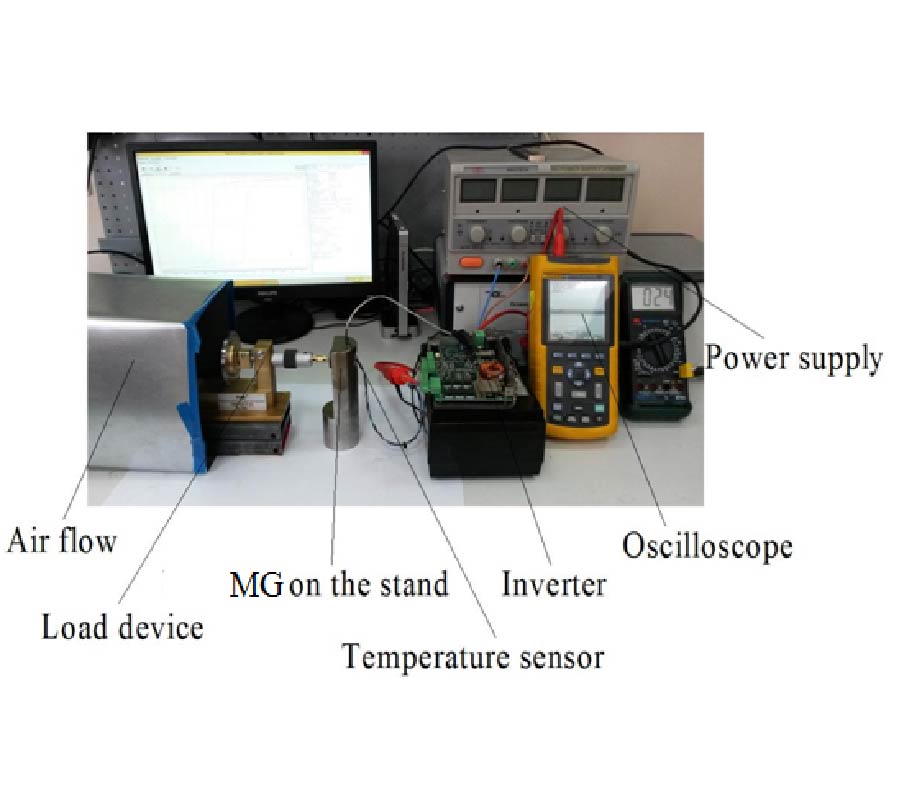
A magnetically suspended permanent-magnet motor (MSPMM) system mainly consists of magnetic bearings(MBs), a motor and a rotor assembly. This paper focuses on the system analysis of an MSPMM used for a vacuum turbo-molecular pump (TMP). To ensure a normal levitation and rotation, characteristics of electromagnetic field of MBs and motor are studied. For MSPMM, loss is the main heat source. To ensure the safe and steady operation of MSPMM, loss of the MB and motor are calculated and analyzed by finite element method (FEM). For thermal aspects, temperature field is estimated. Based on these analyses, the system performance can be predictive. Considering the poor heat dissipation conditions in a vacuum environment, this system analysis including loss and temperature field is of great value for MSPMM design.
SYSTEM ELECTROMAGNETIC LOSS ANALYSIS AND TEMPERATURE FIELD ESTIMATE OF A MAGNETICALLY SUSPENDED MOTOR
2017-03-07
PIER Letters
Vol. 66, 105-111
A New Single-Layer Reflectarray Using Circular Patch with Semicircular Ring Slots
Yang Liu , Hongjian Wang , Fei Xue and Xingchao Dong
A single-layer reflectarray antenna using circular patch with four semicircular ring slots is proposed in this paper. By changing the diameter of the circular patch, the proposed phasing element can realize phase range about 500 degrees with relatively stable reflection magnitude. Besides, the reflection phase curve with smooth slope is almost linear. Based on the good phase response, a 421-element reflectarray is designed, simulated and fabricated. The measured results show that 1.5-dB gain bandwidth can attain 24% at the center frequency of 15 GHz.
A NEW SINGLE-LAYER REFLECTARRAY USING CIRCULAR PATCH WITH SEMICIRCULAR RING SLOTS
2017-03-04
PIER C
Vol. 72, 73-79
Waveguide Coupled Microstrip Patch Antenna a New Approach for Broad Band Antenna
Sahana K and Nandakumar M. Shetti
A new technique is developed to couple the advantages of both the microstrip patch antenna and rectangular waveguide. An equilateral triangle is used as a radiating patch. This patch is fabricated on one face of a single-layer dielectric substrate with double-sided copper clad coated with tin, and on the other face an iris is fabricated and coupled to the waveguide. Antenna parameters such as return loss and bandwidth are studied for a circular patch. The results obtained are discussed in detail and explained. Matlab PDE toolbox is used to generate two-dimensional meshes. These meshes are converted into a three-dimensional form using subdomain numbers. RWG basis functions are used for MoM to calculate impedances. Reection coefcient and 2D current are obtained using the complex impedances.
WAVEGUIDE COUPLED MICROSTRIP PATCH ANTENNA A NEW APPROACH FOR BROAD BAND ANTENNA
2017-03-03
PIER Letters
Vol. 66, 99-104
An Asymmetrical Bulk CMOS Switch for 2.4 GHz Application
Lang Chen and Ye-Bing Gan
A novel asymmetrical single-pole double-throw (SPDT) switch for 2.4 GHz application with high power handle ability is developed. The novel asymmetrical topology is discussed. To increase the power capacity, ac-floating and dc-bias techniques are used. Using these techniques, a switch achieves a measured P1 dB of 20.5 dBm, an insertion loss (IL) of 1.16 dB and isolation loss of 20.8 dB in TX mode; an insertion loss of 1.57 dB and an isolation of 21.6 dB in RX mode. The circuit is fabricated using 3.3-V 0.35-μm DNW NMOS transistors in 0.18-μm bulk CMOS process.
AN ASYMMETRICAL BULK CMOS SWITCH FOR 2.4 GHZ APPLICATION
2017-03-03
PIER Letters
Vol. 66, 93-98
A Compact Wideband Short-Ended Metamaterial Antenna for Wireless Applications
Naveen Mishra and Raghvendra Kumar Chaudhary
In this article, design and analysis of a compact wideband short-ended metamaterial antenna based on composite right and left handed transmission line (CRLH-TL) is presented. The proposed antenna is configured with two different shapes (Half ring and simple gap) of series gaps and short ended boundary condition. It offers wide bandwidth by placing two different shapes of series gaps in such a manner, so that the first resonance frequency, i.e., zeroth order resonance (ZOR), second resonance frequency and third resonance frequency occur near each other, and hence combination offers wide bandwidth. Because of the applied boundary conditions, resonant modes can be controlled by series parameters of the proposed antenna structure. Further, coplanar waveguide feeding technique is used which replaces the requirement of via and allows the fabrication of a single layer antenna prototype. The proposed antenna is modeled by using ANSYS HFSS 14.0, and simulated results are verified with experimental ones of the prototype. The simulated fractional bandwidth of the proposed antenna is 52.38% centered at 3.57 GHz. Furthermore, the proposed antenna provides an average broadside gain of 2.30 dBi with average radiation efficiency of 94.95% in the entire working band of antenna.
A COMPACT WIDEBAND SHORT-ENDED METAMATERIAL ANTENNA FOR WIRELESS APPLICATIONS
2017-03-03
PIER Letters
Vol. 66, 85-91
A New Approach to Design of Dual-Band Power Divider Using Admittance Matrix
Yinong Yan , Ting Luo , Ruifang Su and Jing Lu
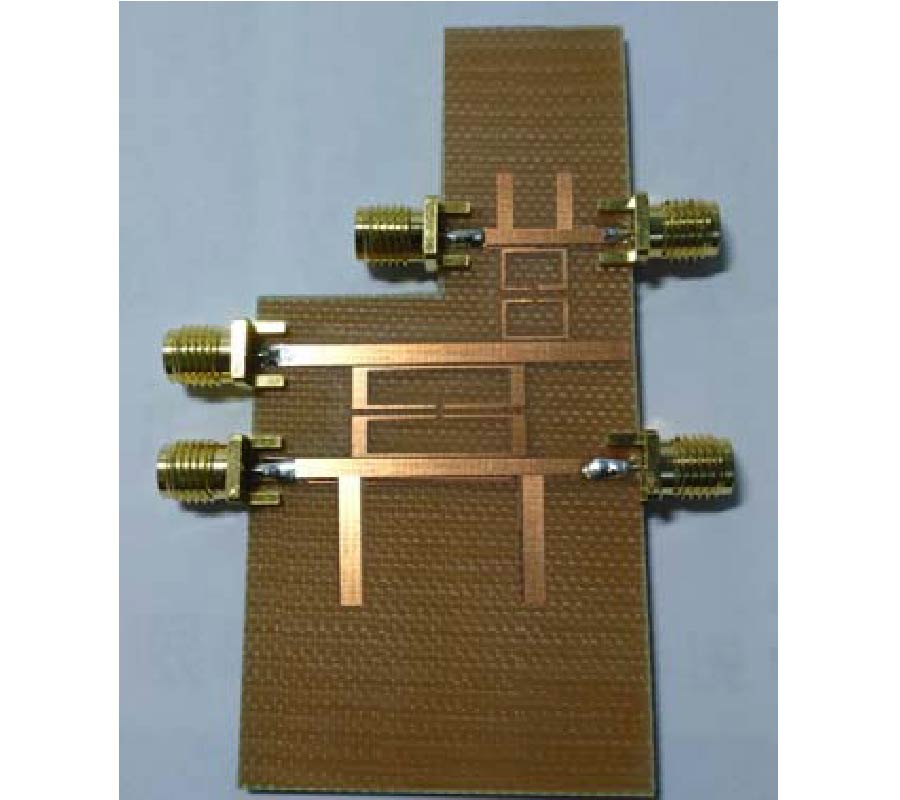
A new approach to design of a dual-band power divider with only one section transmission line is proposed. Apart from the isolation resistor, admittance matrix is used to synthesize the dual-band divider. According to the required admittance matrixes at two frequencies, a modified configuration with shunting open/short stubs at each port is presented. A new compact dual-band (operating at 1.0 GHz and 4.5 GHz) is developed to validate this proposal. Experimental results demonstrate that the return loss is better than -19.2 dB, insertion loss less than 0.59 dB, and isolation better than 23.61 dB at two operation frequencies. The measured relative bandwidths of 15 dB return loss are 35.9% and 12.4% for the lower and higher bands, respectively.
A NEW APPROACH TO DESIGN OF DUAL-BAND POWER DIVIDER USING ADMITTANCE MATRIX
2017-03-03
PIER Letters
Vol. 66, 79-84
Side Lobe Level Reduction of Any Type of Linear Equally Spaced Array Using the Method of Convolution
Mohammad G. H. Alijani , Mohammad Hassan Neshati and Mahdi Boozari
In most applications of antenna arrays, side lobe levels (SLLs) are commonly unwanted. Especially, the first side lobe level which determines maximum SLL is the main source of electromagnetic interference (EMI), and hence, it should be lowered. A procedure of finding the optimum side lobe-minimizing weights for an arbitrary linear equally spaced array is derived, which holds for any scan direction, beam width, and type of antenna element used. In this science article, the use of convolution procedure and the time scaling property reduces the side lobe level for any type of linear equally spaced array. Results show that by this procedure, the side lobe level is reduced about two times or even more.
SIDE LOBE LEVEL REDUCTION OF ANY TYPE OF LINEAR EQUALLY SPACED ARRAY USING THE METHOD OF CONVOLUTION
2017-03-03
PIER
Vol. 158, 49-61
Characterization and Optimization of Cylindrical Polarimetric Array Antenna Patterns for Multi-Mission Applications
Hadi Saeidi-Manesh and Guifu Zhang
The radiation characteristics of a cylindrical array antenna for Multifunction Phased Array Radar (MPAR) and Terminal MPAR (TMPAR) applications are presented. A probe-fed stacked microstrip patch antenna is used for array elements. In calculations, the embedded element pattern of the patch antenna is obtained by simulation of a 5×5 element planar array. The radiation pattern of the TMPAR- and MPAR-sized cylindrical array antenna is calculated using the coherent addition method which is veri ed with full-wave simulation. For cross-polarization suppression, the array elements are arranged with identical 2×2 element subarrays. The radiation patterns of MPAR and TMPAR cylindrical array antennas with and without image con guration are calculated and compared. It is shown that the low cross-polarization level and azimuthally scan invariant beam characteristics can be achieved by the cylindrical array with image arrangement.
CHARACTERIZATION AND OPTIMIZATION OF CYLINDRICAL POLARIMETRIC ARRAY ANTENNA PATTERNS FOR MULTI-MISSION APPLICATIONS
2017-03-02
PIER C
Vol. 72, 65-72
Wideband Circularly Polaried Cross Bowtie Dipole Antenna with Axial-Ratio Bandwidth Enhancement
Dan Wu , Zhi-Ya Zhang , Luyang Ji , Long Yang , Guang Fu and Xiao-Wei Shi
A wideband circularly polarized (CP) cross-dipole antenna is proposed for wireless applications. In this design, four parasitic square patches are utilized around the radiation patch to enhance the Axial-ratio (AR) bandwidth. By employing the bowtie-shape dipoles, the proposed antenna can achieve a wide impedance bandwidth. Meanwhile, by integrating with a curved-delay line which provides a 90° phase difference, the proposed antenna can radiate a CP pattern. A prototype is calculated, fabricated, and measured. Good agreement between the simulated and measured results is achieved. The measured results show an impedance bandwidth for VSWR≤2 of 47.73% (1.93-3.14 GHz) and a 3-dB AR bandwidth of 42.8% (2.00-3.09 GHz).
WIDEBAND CIRCULARLY POLARIED CROSS BOWTIE DIPOLE ANTENNA WITH AXIAL-RATIO BANDWIDTH ENHANCEMENT
2017-03-02
PIER Letters
Vol. 66, 71-77
Doubly-Periodic Photonic Crystals: Spectral Problems Analysis
Seil S. Sautbekov , Yuriy Sirenko and Hanna Sliusarenko
The present work is devoted to the clarification of the conditions necessary for step-by-step justification of the possibility of reduction of the homogeneous system of linear algebraic equations for the spectral problems of 2-D photonic crystals by the plane waves method. The issues related to the algorithms and the numerical solutions of these spectral problems are analyzed. The possibility of analytical regularization is investigated, and the ways to improve the convergence of the obtained results are identified.
DOUBLY-PERIODIC PHOTONIC CRYSTALS: SPECTRAL PROBLEMS ANALYSIS
2017-03-02
PIER M
Vol. 55, 37-49
Mixed Signal-Based GLR Detector for FM Passive Bistatic Radar Target Detection
Mohammad Zamani and Abbas Sheikhi
This paper addresses the CFAR target detection in FM-based passive bistatic radars as a composite hypothesis testing problem, using the mixed signal model. The corresponding generalized likelihood ratio test (GLRT) is derived. It has less computational requirements with respect to the conventional GLRT-based detector, previously developed in the literature, due to the decrease in the row dimension of the interference matrix. The proposed detector is computationally efficient for tracking or short-range-radar applications in which a few range cells are surveyed. The theoretical and simulation-based analysis of detection performances and a thorough discussion on the computational complexity compared with that of the existing detectors are also provided.
MIXED SIGNAL-BASED GLR DETECTOR FOR FM PASSIVE BISTATIC RADAR TARGET DETECTION
2017-03-01
PIER B
Vol. 73, 49-60
H-Field Contribution to the Electromagnetic Energy Deposition in Tissues Similar to the Brain But Containing Ferrimagnetic Particles, During Use of Face-Held Radio Transceivers
Simona Miclaus , Mihaela Racuciu and Paul Bechet
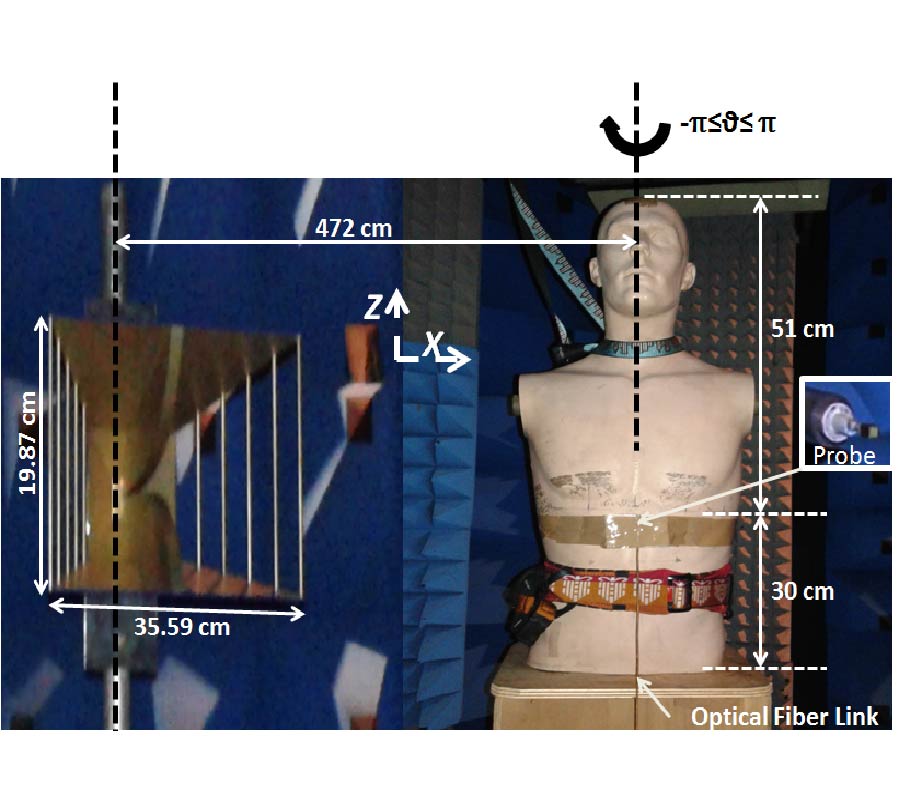
A portable radio transceiver with rubber ducky antenna emitting at 446 MHz with an output power of 5 W was considered as near-field source of electric (E) and magnetic (H) field components when being used in the proximity of the user's face. By taking into account the significant content of ferromagnetic nanoparticles recently identified to reside in the human brain, we assessed the specific absorption rate (SAR) of energy deposition due to H-component penetrating a presumptive forebrain. H-component SAR contribution to the total SAR is for the first time estimated in such a case, based on an original idea inspired from knowledge on magnetic fluids hyperthermia.
H-FIELD CONTRIBUTION TO THE ELECTROMAGNETIC ENERGY DEPOSITION IN TISSUES SIMILAR TO THE BRAIN BUT CONTAINING FERRIMAGNETIC PARTICLES, DURING USE OF FACE-HELD RADIO TRANSCEIVERS
2017-03-01
PIER C
Vol. 72, 55-63
Spiral Photon Sieves Apodized by a Bessel-Like Window
Jian Yu , Shali Xiao , Tao Yi , Jin Li , Zhiwen Yang and Shenye Liu
In order to improve the focusing and imaging effects of conventional spiral zone plates (SZPs), we design a new type of spiral photon sieve (SPSs) apodized by a robust Bessel-like window. The design principle and numerical simulation results show that the Bessel-like window has a better modulation effect on the main lobe compression and side suppression of the point spread function (PSF) than other traditional window. Taking advantage of the robustness of Bessel-like windows, the proposed SPS can achieve a higher spatial resolution and lower side lobe noise than the conventional SPS and SZP. The practical effects have also been demonstrated by image experiments on the micropore. Our work may find some potential applications in laser alignment, optical trapping, optical communication and edge enhancement imaging fields.
SPIRAL PHOTON SIEVES APODIZED BY A BESSEL-LIKE WINDOW
2017-02-28
PIER C
Vol. 72, 43-54
W-Band SIW Power Combiner/Divider Based on the Antipodal Fin-Line SIW-RW Transition and Longitudinal-Slot Coupling Techniques
Zhenbing Li , Jian Li , Yongjun Huang and Guangjun Wen
In this paper, a novel W-band substrate integrated waveguide (SIW) power combiner/divider is analyzed theoretically and demonstrated experimentally/numerically, based on the antipodal fin-line SIW-rectangular waveguide (SIW-RW) transition and longitudinal slot coupling techniques. This antipodal fin-line SIW-RW transition can work at the frequency band of 86.4 GHz-106.1 GHz with return loss larger than 15 dB and inserting loss less than 2 dB. By combining the antipodal fin-line SIW-RW into the four-way longitudinal-slot SIW coupling structure, a novel back-to-back power dividing/combining system is achieved, which can operate at the frequency band of 92.8 GHz-93.8 GHz with return loss more than 10 dB and insertion loss less than 3.9 dB. Such a design can be used in future for spatial power amplifier applications.
W-BAND SIW POWER COMBINER/DIVIDER BASED ON THE ANTIPODAL FIN-LINE SIW-RW TRANSITION AND LONGITUDINAL-SLOT COUPLING TECHNIQUES
2017-02-27
PIER C
Vol. 72, 29-41
A Miniaturized Volkswagen Logo UWB Antenna with Slotted Ground Structure and Metamaterial for GPS, WiMAX and WLAN Applications
Tanweer Ali and Rajashekhar Chandrashekhar Biradar
A novel concept of using slotted ground structure and a single circular split ring resonator (SRR) to achieve multiband operation from a miniaturized UWB antenna is presented in this paper. Initially a miniaturized volkswagen logo ultawideband (UWB) antenna having -10 dB impedance bandwidth of about 124% (2.9-12.4 GHz) in simulation and 116.7% (3.1-11.8 GHz) under measurement is designed. This miniaturization leads to about 10% increment in -10 dB reflection coefficient bandwidth and about 66.71% reduction in volume of the proposed UWB antenna as compared to the conventional circular antenna. In order to reconfigure the proposed UWB antenna to operate it at 1.5 (GPS), 3.5 (WiMAX), 5.2 and 5.8 GHz (WLAN) frequency bands, slotted ground structure with metamaterial is used. The proposed metamaterial is a circular split ring resonator (SRR) consisting of single circular ring and is placed on the slotted ground structure of the proposed antenna to achieve 1.5 GHz band. The proposed configuration has a volume of 0.290λ0×0.290λ0×0.015λ0 (30×30×1.6 mm3) at lower resonating band of 2.9 GHz and is fabricated on a widely available FR4 substrate with a loss tangent of 0.02 and dielectric constant of 4.4. Simulated and experimental results shows that the proposed design yields S11<-10 dB at the targeted frequencies. Good impedance matching, stable radiation characteristics with cross-polarization level less than -15 dB (both in E and H planes), VSWR<2, average gain of 3.09 dBi and radiation efficiency of more than 85% are observed at the designed band when the antenna is fabricated and tested.
A MINIATURIZED VOLKSWAGEN LOGO UWB ANTENNA WITH SLOTTED GROUND STRUCTURE AND METAMATERIAL FOR GPS, WIMAX AND WLAN APPLICATIONS
2017-02-27
PIER C
Vol. 72, 15-28
Compact Microstrip Lowpass Filter with Ultra-Wide Stopband Using Patch Resonators and Open Stubs
Thulaseedharan Rekha , Parambil Abdulla , Paruthikkal Mohammed Raphika and Puthenveetil Muhammed Jasmine
A compact microstrip lowpass filter with ultra-wide stopband characteristics and high suppression level is presented. To achieve compact size and wide stopband suppression along with improved impedance matching, symmetrically loaded resonant patches, open stubs and stair shaped high impedance stub is introduced in the filter. The measurement results show good agreement with the simulations. The 3 dB cutoff frequency of the filter is 2.44 GHz. The stopband with attenuation level better than 22 dB is extended from 2.84 GHz to 16 GHz, hence an ultra wide stopband with 6th harmonic suppression is achieved. The proposed filter has low insertion loss and high return loss in the passband, together with compact size of 0.257λgx0.148λg, where λg is the guided wavelength at cutoff frequency. The relative stop bandwidth of the proposed design is identified to be 139.5%.
COMPACT MICROSTRIP LOWPASS FILTER WITH ULTRA-WIDE STOPBAND USING PATCH RESONATORS AND OPEN STUBS
2017-02-27
PIER C
Vol. 72, 1-13
A Novel Cavity Backed Monopole Antenna with UWB Unidirectional Radiation
Arezou Edalati , Wenyi Shao , Todd McCollough and William McCollough
A novel compact unidirectional UWB antenna is presented in this paper. First a novel planar omnidirectional UWB antenna with CPW-feed is designed. The antenna is composed of a half-elliptical disc with a small ground plane. A slot is inserted on the patch as a novel technique to improve the gain bandwidth of the antenna at higher frequencies is presented. The omnidirectional antenna shows UWB matching and gain bandwidth of 2 GHz to 6.5 GHz. Furthermore, to make the radiation pattern of the omnidirectional antenna unidirectional, a rectangular shape metallic reflector without bottom wall is used on the backside of the antenna. The unidirectional antenna with a total dimension of 0.52λm x 0.33λm x 0.18λmm wavelength of the minimum operating frequency) has a matching bandwidth of 1.5 GHz to 7.7 GHz with a gain of 5 dBi to 10.2 dBi over 1.7 GHz to 6.5 GHz, and flat group delays of less than 1 nsec. To validate the proposed design, the antenna is fabricated, and measured results are compared with simulations.
A NOVEL CAVITY BACKED MONOPOLE ANTENNA WITH UWB UNIDIRECTIONAL RADIATION
2017-02-27
PIER C
Vol. 71, 177-187
Compact Dual-Mode Microstrip Bandpass Filters with Transmission Zeros Using Modified Star Shaped Resonator
Kenganahalli Gowdra Avinash and Inabathini Srinivasa Rao
A modified star-shaped dual-mode microstrip loop resonator with a triangular patch is proposed to design compact narrow band bandpass filters with transmission zeros. The triangular patch is used as perturbation element to couple degenerated modes. The position of transmission zeros can be tuned by varying the size and location of the perturbation element. The coupling mechanism (inductive or capacitive) and the type of input/output feed (orthogonal or non-orthogonal) determine the type of filter response like symmetric or asymmetric. Three highly selective two-pole narrow band bandpass filters are designed using a modified star-shaped resonator with tunable transmission zeros. First, two filters with non-orthogonal feed lines have an asymmetric response with transmission zeros on one side of the passband, whereas the third filter with orthogonal feed lines exhibits symmetric frequency response with transmission zeros on both sides of the passband. Even and odd mode analysis is applied to the dual mode filters to calculate the position of transmission zeros. Filters are realized using a low loss dielectric substrate, and measured results are in good agreement with the theoretical and simulated ones.
COMPACT DUAL-MODE MICROSTRIP BANDPASS FILTERS WITH TRANSMISSION ZEROS USING MODIFIED STAR SHAPED RESONATOR