Search Results(13794)

2017-06-20
PIER B
Vol. 76, 87-96
Advanced Multi-Pass InSAR Imaging for Surface Deformation Studies
Sui Ping Lee , Yee Kit Chan and Tien Sze Lim
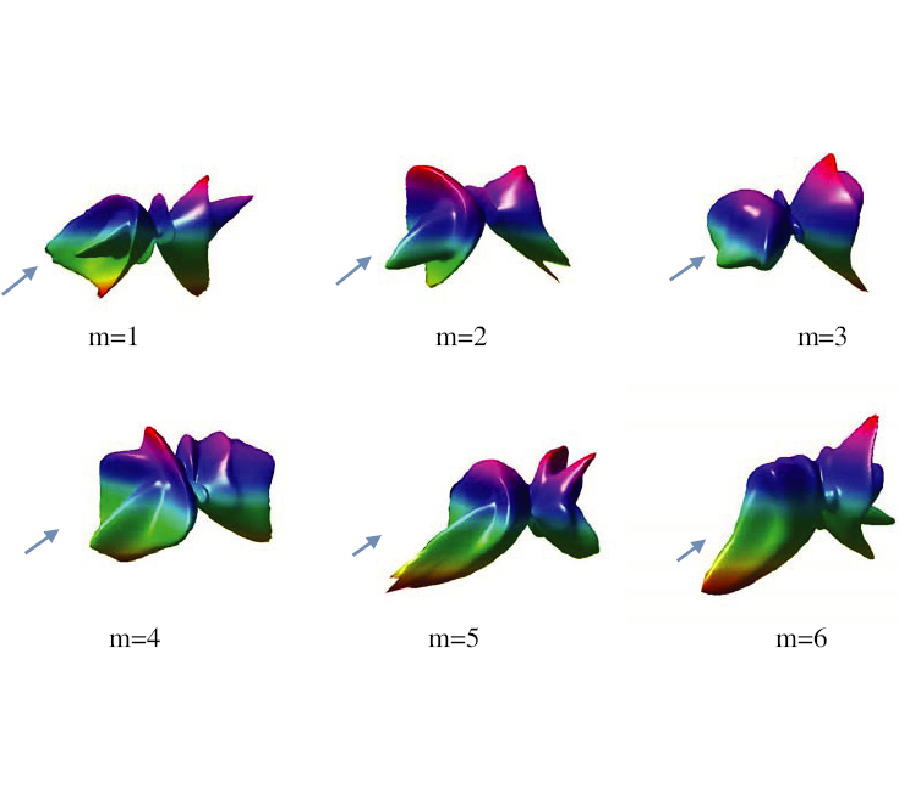
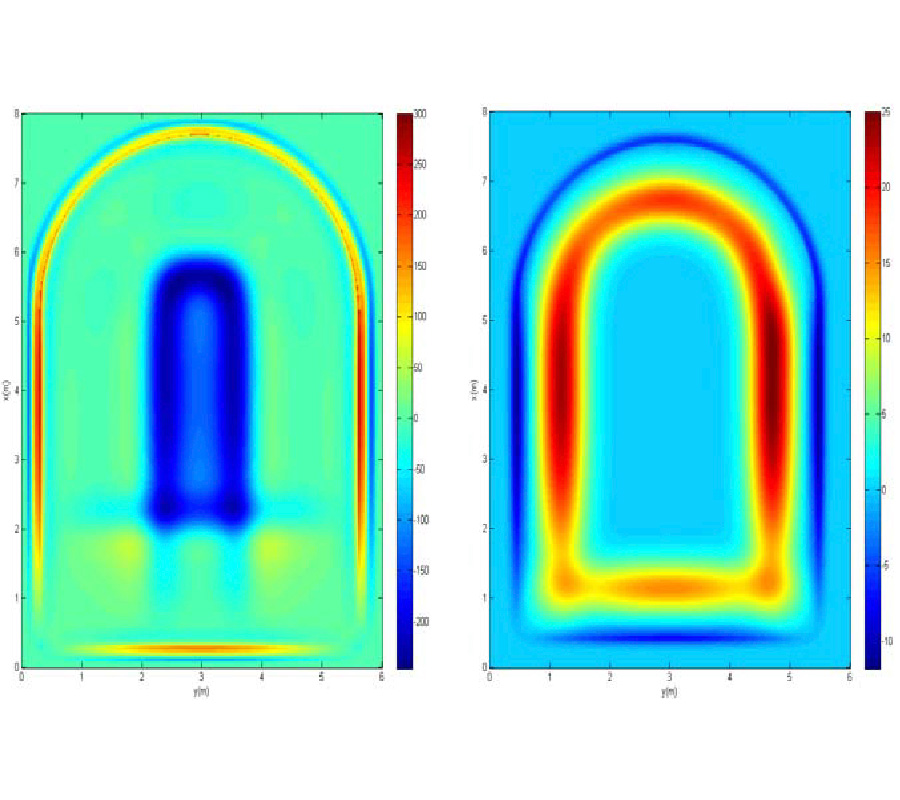
This paper describes a multi-pass InSAR imaging approach for surface deformation studies. Such a technique extends concept of SAR tomography (TomoSAR) based on multi-pass InSAR data, in order to produce deformation map in elevation domain and velocity domain, respectively. Compared to conventional InSAR method, multi-pass InSAR imaging technique acquires multi-baseline information and allows reconstruction of multiple scattering sources in Tomo-Doppler plane (Elevation-Velocity plane). This technique offers a solution to layover issue over conventional InSAR method, but it suffers from double-scattering problem. This paper simulates a phenomenon where double-scattering impairs the imaging process and an improved solution method to separate single and double scatters from inferring pixels. In real circumstance, there are still other interferometric issues such as phase ambiguities of noise and phase discontinuity. Thus, a phase-unwrapping method associated with an improved ordered-statistical lter is included for interferometry processing. An experiment based on real SAR data is set up to demonstrate this technique.
ADVANCED MULTI-PASS INSAR IMAGING FOR SURFACE DEFORMATION STUDIES
2017-06-20
PIER C
Vol. 75, 99-109
Radiation Forces on a Cluster of Spherical Nanoparticles in Visible Light Spectrum
Aslan Nouri Moqadam , Ali Pourziad and Saeid Nikmehr
The scattering of the electromagnetic waves by the spherical particles is discussed. Nanometer-sized dielectric spheres confined in a cluster are devoted to investigate the effect of the EM radiation on them. Incident wave is considered to be in visible light spectrum which facilitates multiple scattering calculation for nanoparticles. Radiation forces are discussed in terms of scattering pressure and Lorentz force, hence Discrete Dipole Approximation (DDA) and classical Mie theory is employed in radiation force computation and electromagnetic random multiple scattering analysis. Electric momentum of dipoles is defined in the term of A-1 term method. The radiation forces on particles are accurately calculated with computer codes. Extracted results can be applied to conscious deviation of spherical nanoparticles in clean rooms or similar mediums. The effect of the incident wave parameters and the orientation of spherical profile and particles in the cluster are predicted through various simulations.
RADIATION FORCES ON A CLUSTER OF SPHERICAL NANOPARTICLES IN VISIBLE LIGHT SPECTRUM
2017-06-20
PIER M
Vol. 58, 1-10
Fast and Accurate Determination of the Complex Resonant Frequency of a Multilayer Circular Cavity Using Chebyshev's Root-Finder
David Marques-Villarroya , Felipe Penaranda-Foix , Beatriz Garcia-Banos , Jose Manuel Cataia-Civera and Jose Daniel Gutierrez-Cano
In this paper, a general multilayer circular cavity with N slabs is analyzed analytically, obtaining characteristic equations for TE and TM modes to compute the complex resonant frequency efficiently using an algorithm based on Chebyshev's root finder. The accuracy of the solutions is compared with full-wave circuit method, and the computational speed to achieve the roots of the characteristic equations is also compared with Cauchy Integral Method, which is commonly used to obtain complex roots. Furthermore, the relationship between the amplitudes of the different regions is obtained, whereby the whole structure can be analyzed as a single one from now on.
FAST AND ACCURATE DETERMINATION OF THE COMPLEX RESONANT FREQUENCY OF A MULTILAYER CIRCULAR CAVITY USING CHEBYSHEV'S ROOT-FINDER
2017-06-20
PIER M
Vol. 57, 197-203
Joint Azimuth and Elevation Angle Estimation Using Matrix Completion Method
Peixiang Tan , Yuntao Wu , Ge Yan and Jieyi Deng
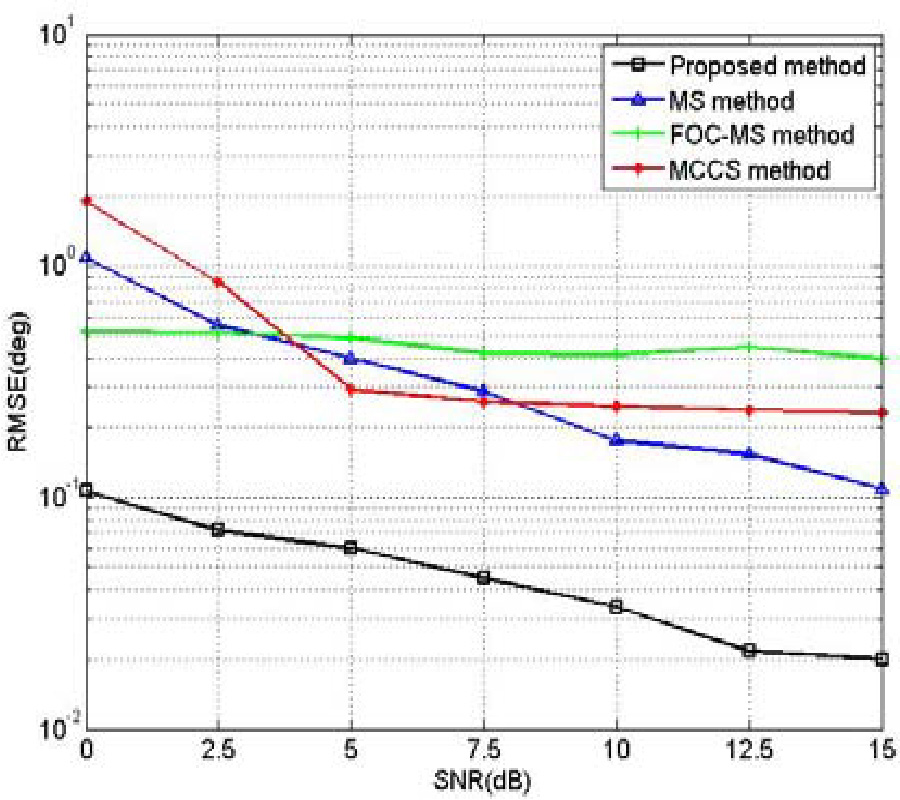
Two-Dimensional Direction of Arrival (2D-DOA) estimation is increasingly important in recent years. In this paper, a new method is proposed to estimate the 2D-DOAs of multiple spatial sources using a three-parallel uniform linear array assuming that some of the sensors happen to be out-of-order. Firstly, a Matrix Completion (MC) algorithm is applied to recover the observed incomplete data, and then an improved joint azimuth and elevation angle estimation algorithm using the recovered data is proposed to obtain the correct parameter estimation. Finally, computer simulation results show that the proposed algorithm has a great performance improvement compared to those based on incomplete data in terms of Signal-to-Noise Ratio (SNR) and the sample rate of sensors.
JOINT AZIMUTH AND ELEVATION ANGLE ESTIMATION USING MATRIX COMPLETION METHOD
2017-06-19
PIER B
Vol. 76, 73-85
SRR Superstrate for Gain and Bandwidth Enhancement of Microstrip Patch Antenna Array
Chirag Arora , Shyam Sundar Pattnaik and Rudra Narayan Baral
This article presents a microstrip fed patch antenna array, loaded with metamaterial superstrate. An unloaded antenna array resonates at IEEE 802.16a 5.8 GHz Wi-MAX band with gain of 4.3 dBi and bandwidth of 425 MHz whereas when the same array is loaded with a metamaterial superstrate, composed of the pair of Split Ring Resonators (SRR), there is simultaneous gain and bandwidth improvement to 8 dBi and 680 MHz, respectively, which corresponds to gain improvement by 86% and bandwidth enhancement of 60%. The fabrication of this proposed antenna array is done, and its simulated and measured results compared. Equivalent circuit model of this composite structure has been developed and analyzed. The electrical dimension of the patch is 0.23λx0.3λ.
SRR SUPERSTRATE FOR GAIN AND BANDWIDTH ENHANCEMENT OF MICROSTRIP PATCH ANTENNA ARRAY
2017-06-19
PIER Letters
Vol. 68, 121-126
A Compact Microstrip Crossover Based on Capacitively-Loaded Artificial Transmission Lines Branch-Line Sections
Jordi Verdú Tirado , Endika Bernaola and Pedro de Paco
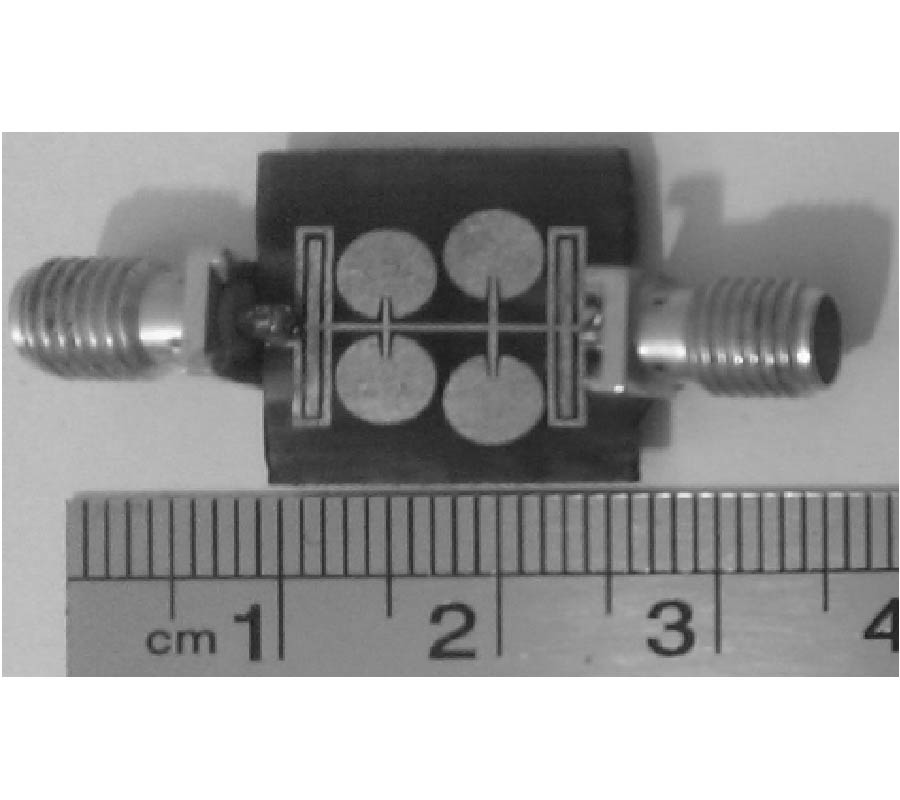
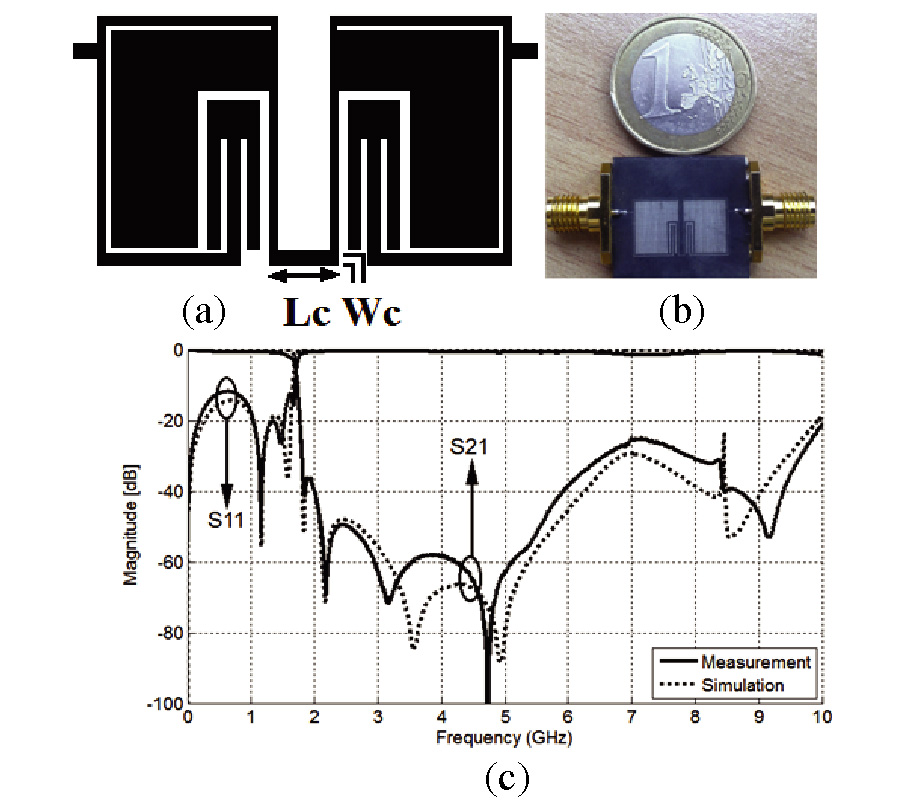
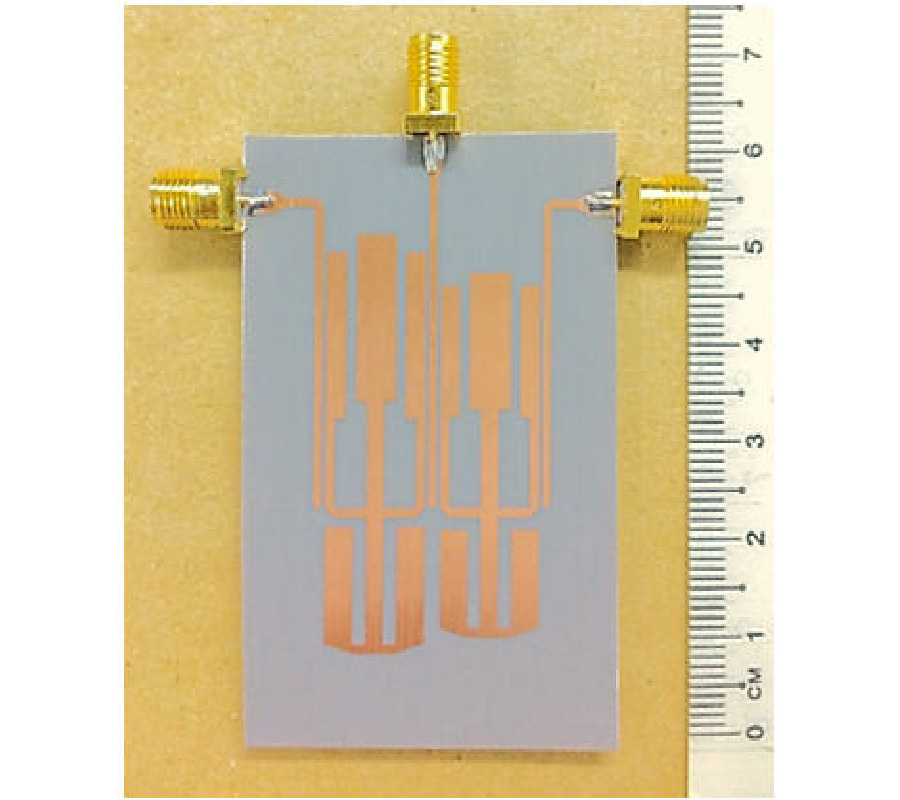
This paper presents a compact size crossover device based on the cascade of branch-line sections. With the aim of reducing its size, some of the transmission lines of the structure have been replaced by its equivalent artificial transmission line (ATL). The obtained size reduction is above 30%, and the electrical performance of the proposed structure presents an isolation better than 20 dB in a FBW=34.5% and a crossover bandwidth better than 2 dB of FBW=51.5%. Also the good magnitude and phase balance performance must be highlighted.
A COMPACT MICROSTRIP CROSSOVER BASED ON CAPACITIVELY-LOADED ARTIFICIAL TRANSMISSION LINES BRANCH-LINE SECTIONS
2017-06-19
PIER M
Vol. 57, 185-196
Cotton Crop Biophysical Parameter Study Using Hybrid/Compact Polarimetric RISAT-1 SAR Data
Viral A. Dave , Dipanwita Haldar , Rucha Dave , Arundhati Misra and Vyas Pandey
A hybrid-polarity architecture, consisting of transmitting circular polarisation and receiving two orthogonal linear polarisation and also their relative phase, was used to calculate four Stokes parameters. Different parameters like Degree of Polarisation, Alpha angle, Entropy, Anisotropy, Radar vegetation Index and decompositions like Raney decomposition (m-δ), Freeman-2 and 3 component decompositions were derived from these hybrid data. Crop biophysical parameters viz. plant height, plant age and plant biomass of cotton crops grown under two different environments, i.e., rainfed and irrigated in Guajrat, India were studied with respect to derived polarimetric parameters. Right circular transmitted and horizontally (RH) and vertically (RV) received backscatter values show good relation with the plant height, age and biomass. RH backscatter -13 dB to -7 dB and RV backscatter from -13 to -10dB were observed for crop biophysical parameters. Volume component of all decomposition showed strong response to the increase in height, age and biomass of the plant. Radar Vegetation index (RVI) values have also shown significant increase from 0.6 to 0.7 with increasing age of the crop. The rate of growth was slow in the initial phase, but fast post mid-July for both early and late sown cases. The polarimetric parameters were found significantly correlated to the above plant biophysical parameters.
COTTON CROP BIOPHYSICAL PARAMETER STUDY USING HYBRID/COMPACT POLARIMETRIC RISAT-1 SAR DATA
2017-06-18
PIER M
Vol. 57, 175-183
Comparison of Time-Domain Finite-Difference, Finite-Integration, and Integral-Equation Methods for Dipole Radiation in Half-Space Environments
Craig Warren , Silvestar Sesnic , Alessio Ventura , Lara Pajewski , Dragan Poljak and Antonios Giannopoulos
In this paper we compare current implementations of commonly used numerical techniques - the Finite-Difference Time-Domain (FDTD) method, the Finite-Integration Technique (FIT), and Time-Domain Integral Equations (TDIE) - to solve the canonical problem of a horizontal dipole antenna radiating over lossless and lossy half-spaces. These types of environment are important starting points for simulating many Ground Penetrating Radar (GPR applications which operate in the near-field of the antenna, where the interaction among the antenna, the ground, and targets is important. We analysed the simulated current at the centre of the dipole antenna, as well as the electric field at different distances from the centre of the antenna inside the half-space. We observed that the results from the simulations using the FDTD and FIT methods agreed well with each other in all of the environments. Comparisons of the electric field showed that the TDIE technique agreed with the FDTD and FIT methods when observation distances were towards the far-field of the antenna but degraded closer to the antenna. These results provide evidence necessary to develop a hybridisation of current implementations of the FDTD and TDIE methods to capitalise on the strengths of each technique.
COMPARISON OF TIME-DOMAIN FINITE-DIFFERENCE, FINITE-INTEGRATION, AND INTEGRAL-EQUATION METHODS FOR DIPOLE RADIATION IN HALF-SPACE ENVIRONMENTS
2017-06-17
PIER C
Vol. 75, 87-97
Sensitivity Modeling of a Strain-Sensing Antenna
Lan Chen , Tao Geng , Guochun Wan , Ling Yi Tang and Mei Song Tong
A quarter-wavelength folded patch antenna is adopted as the passive wireless strain sensor for structural health monitoring (SHM) of bridges. It can be used for continuous surveillance and damage detection. According to theoretical formulations, strain simulation and experiments, it is found that a good linearity relationship can be achieved between normalized resonance frequency shift and the strain both in longitudinal and transverse directions. And the sensing sensitivity in longitudinal strain is better than that in transverse strain. Through conducting tensile experiments, we find that many factors can influence the strain sensitivity. To address this fundamental issue in antenna sensors for strain sensing, a new strain sensitivity experiment is proposed to take the influence of strain transfer ratio change under strain. The linear relationship of strain transfer ratio and deformation is obtained by sensitivity experiment. The corrected sensitivity in longitudinal and transverse strains is calculated based on the linearity. Furthermore, the Possion effect is taken into consideration to explain the opposite effects of experimental and simulated sensitivities in transverse strain.
SENSITIVITY MODELING OF A STRAIN-SENSING ANTENNA
2017-06-16
PIER Letters
Vol. 68, 113-119
Analysis of Tuning Channel Filter Based on Ternary Lossy Defective Metallo-Dielectric Nano Photonic Crystal
Hadis Azarshab and Abdolrasoul Gharaati
In this paper, we design an optical filter by using one-dimensional (1D) ternary metallo-dielectric photonic crystal (PC). We use a dielectric defect layer between ternary asymmetric cells with this structure (ABC)NDM(ABC)N and also increase the number of dielectric defect layers. Then, we plot transmission spectra in terms of wavelength and different angles of incidence in transverse electric (TE) and transverse magnetic (TM) polarizations. We show defect modes and photonic band gap (PBG) on the plane of wavelength and incident angles in both TE and TM polarizations. We also plot transmission in the lossless structure and compared loss and lossless structures. Furthermore, we compare dielectric defect layer with metallic defect layer in both TE and TM polarizations. Moreover, we plot symmetric structure (ABC)NDM(CBA)N in TE and TM waves. The theoretical analysis shows that there is one defect mode which moves to the shorter wavelength by increasing angles of incidence in asymmetric structure. There are also two defect modes in symmetric structure, and by tuning angle of incidence this structure can be used as single channel filter in asymmetric structure and multichannel filter in symmetric structure.
ANALYSIS OF TUNING CHANNEL FILTER BASED ON TERNARY LOSSY DEFECTIVE METALLO-DIELECTRIC NANO PHOTONIC CRYSTAL
2017-06-16
PIER M
Vol. 57, 163-174
Electromagnetic Interference Shielding Efficiency Enhancement of the PANI-CSA Films at Broad Band Frequencies
Sreekala P. Sasikumar , Vadakkekalathil Libi Mol , Dibin Mary George , Arimpoorpallan Lindo , Neeraj Kavalparambil Pushkaran , Honey John and Chandroth K. Aanandan
A material sample of Camphour Sulphonic Acid doped Polyaniline (PANI-CSA) is contemplated towards its conceivable use as a microwave shield. Shielding towards electromagnetic interferences (EMI) is measured over various frequency bands by the waveguide method. Plane wave electromagnetic theory is used to generalize the overall reflection and transmission coefficients of the polymer. EMI shielding of the polymer, in the form of Shielding Efficiency (SE), is analyzed over the microwave frequency range from 2 to 18 GHz, demonstrating the potential value of the polymer as an electromagnetic interference (EMI) shield for commercial purposes. The shielding film is fabricated using standard procedure with CSA as the dopant and m-cresol as the solvent. The shielding effectiveness as high as 45 dB for the sample of PANI doped with CSA is observed.
ELECTROMAGNETIC INTERFERENCE SHIELDING EFFICIENCY ENHANCEMENT OF THE PANI-CSA FILMS AT BROAD BAND FREQUENCIES
2017-06-15
PIER C
Vol. 75, 75-86
Multi-Band Omnidirectional Antenna with Hexagonal Prism Shape for MIMO Applications
Jiang-Yu Wang , Tao Tang and Run-Lin Zhang
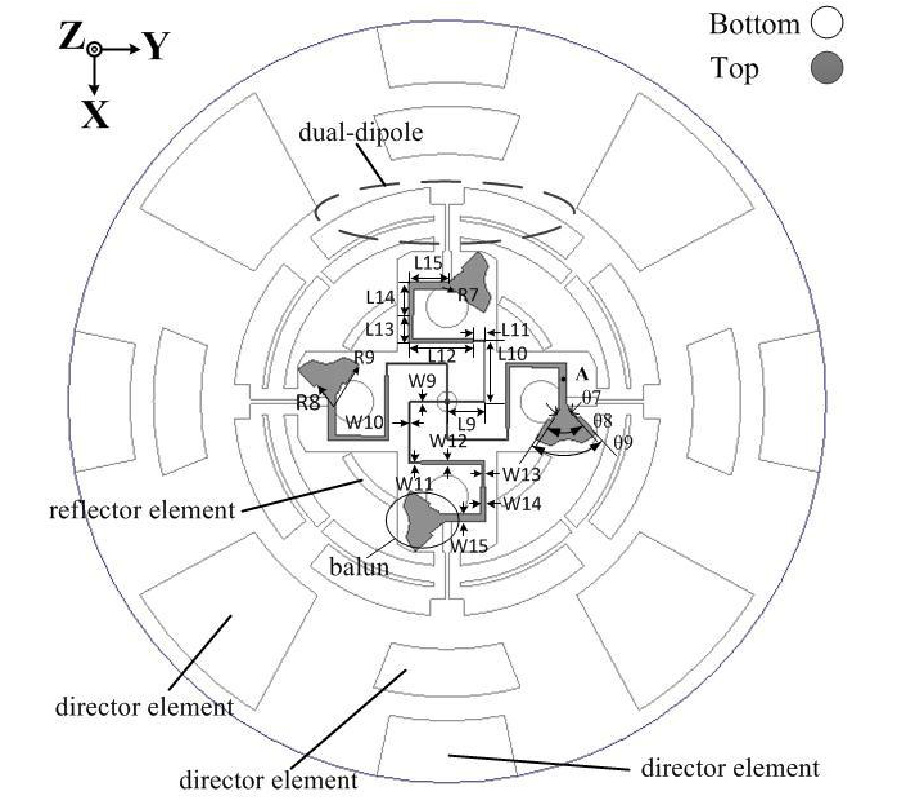
A multi-band antenna with omnidirectional radiation performance is proposed, which consists of 9 elements to form the structure of hexagonal prism. According to the placement rule, the antenna elements can be divided into two groups, one of which is placed in parallel on spaced three surfaces of the prism and the other placed vertically on the remaining spaced three faces of the prism. Each parallel element consists of two coplanar microstrip radiating patches which are nested within each other for miniaturization. Two parallel microstrips connected by a grounded disc with shorting pin are placed between the two patches to optimize the isolations. Each vertical element consists of two improved dipoles with four arms and a BALUN located at the back of the substrate plate which constitutes the quasi-Yagi structure. The resonant frequencies of the proposed prismatic antenna are 3.45 GHz, 4.9 GHz, 5.8 GHz and15.2 GHz which can be used for low frequency bands of the fifth generation (5G) wireless communications and wireless local area networks (WLAN) as well as satellite communication applications.
MULTI-BAND OMNIDIRECTIONAL ANTENNA WITH HEXAGONAL PRISM SHAPE FOR MIMO APPLICATIONS
2017-06-15
PIER C
Vol. 75, 63-73
Compact 2×1 MIMO Antenna System for LTE Band
Andrews Christina Malathi and Dhanasingh Thiripurasundari
A compact 2×1 multiple input multiple output (MIMO) antenna system is designed to operate in the LTE band 40 (2.3-2.4) GHz. The proposed antenna consists of two circular patches fed using microstrip line. The antenna was initially designed to resonate at 5 GHz. Size reduction of 55.17% compared to conventional patch antenna is obtained after the inclusion of circular complementary split ring resonator (CSRR) in the ground plane. The resonating frequency was shifted to 2.34 GHz, there by the board size is compact (50×25×1.6 mm3). The designed antenna covers a bandwidth of 2.3 to 2.374 GHz with a maximum return loss of -27 dB at 2.34 GHz and isolation of -33.5 dB between the ports. The simulated correlation coefficient is approximately zero, and the total active reflection coefficient is 0.142 at the resonating frequency which are within the acceptable limits. The realized gain for the antenna is -8.9 dB.
COMPACT 2×1 MIMO ANTENNA SYSTEM FOR LTE BAND
2017-06-14
PIER B
Vol. 76, 59-71
Data-Driven Strategies for Cross-Track Motion Compensation in Synthetic Aperture Radar Imaging
Po-Chih Chen and Jean-Fu Kiang
Nine different strategies are proposed to compensate the cross-track motion errors in synthetic aperture radar (SAR) imaging, based on estimating the phase coefficients of the phase history. A spline interpolation method and a subaperture reconstuction method are used to derive the phase history over the whole aperture, based on the phase coefficients previously estimated. Four different scenarios are designed to compare the performance of these nine strategies.
DATA-DRIVEN STRATEGIES FOR CROSS-TRACK MOTION COMPENSATION IN SYNTHETIC APERTURE RADAR IMAGING
2017-06-14
PIER B
Vol. 76, 37-57
Study of the Conducted Electromagnetic Interference in the Converter Station of an UHVDC Transmission System
Jian Le , Cao Wang , Hanwu Luo , Tao Mao and Yinge Wang
The Conducted Electromagnetic Interference (CEI) characteristics in the primary circuit and at the ports of the secondary devices of the converter station of a UHVDC transmission system are researched comprehensively and systematically in this paper, by taking the Zhalute-Qingzhou ±800kV/10000MW UHVDC project in East Inner Mongolia of China as an example. The primary circuit equipment parameters of the target system are designed systematically at first, and the overall broadband equivalent model of the main circuit of the UHVDC system, which is composed of converter valve, converter transformer, filter banks and smoothing reactor, is developed. The CEI characteristics in the primary circuit under various conditions of the UHVDC system are analyzed based on the simulations carried out on the built BEC, and the influences of several primary circuit elements on the propagation of the CEI characteristics are researched. To improve the accuracy of the analysis of the CEI characteristics in the secondary device circuit, accurate BECs of the Capacitor Voltage Transformer (CVT), Current Transformer (CT) and secondary signal cable are established. The CEI characteristics at the ports of secondary devices under different operation modes are studied, and the influences of the cable length and burden rate on the CEI characteristics are analyzed. This paper provides a comprehensive and thorough understanding of the CEI characteristics of an UHVDC system.
STUDY OF THE CONDUCTED ELECTROMAGNETIC INTERFERENCE IN THE CONVERTER STATION OF AN UHVDC TRANSMISSION SYSTEM
2017-06-14
PIER C
Vol. 75, 53-61
Tunable Plasmonic Induced Transparency in Graphene Nanoribbon Resonators
Huawei Zhuang , Hongkui Xu , Shulan Gong and Yuling Wang
A plasmonic induced transparency (PIT) structure is proposed and numerically investigated using the finite difference time domain (FDTD) method, which is achieved by the destructive interference between two graphene nano ribbon resonators and the bus waveguide. The common three-level atom system is used to explore the physical origin of the PIT behavior. The simulation results show that the PIT at different modes can be excited or suppressed by choosing the proper coupling position of the resonators. The peak and bandwidth of the transparent window are controlled by the coupling distance between the resonators and the bus waveguide, and the transparent window can be freely tuned by adjusting the chemical potential of graphene. The tunable PIT effect may offer a new avenue for novel integrated optical switching and slow-light devices in THz and mid-infrared frequencies.
TUNABLE PLASMONIC INDUCED TRANSPARENCY IN GRAPHENE NANORIBBON RESONATORS
2017-06-14
PIER C
Vol. 75, 43-52
Out-of-Phase Power Divider with Harmonic Suppression
Lulu Bei , Lei Chen , Wenjing Zhao , Xulong Zhang , Wen Ji and Kai Huang
In this paper, a three-layer circuit structure based on double-sided parallel-strip lines (DSPSLs) is proposed to design one out-of-phase power divider (PD) with equal power division and harmonic suppression. This PD, which is composed of four DSPSLs, one middle conductor, and two grounded resistors, features transmission suppression at two specified frequencies and all the even-order harmonics. Closed-form design equations are derived based on the traditional even- and odd-mode methods, and the circuit scattering parameters are also given. Finally, a practical PD operating at 0.92 GHz is designed and fabricated. The measured results show that this PD has equal power division with out of phase, harmonic suppression, good ports matching, and high outputs isolation.
OUT-OF-PHASE POWER DIVIDER WITH HARMONIC SUPPRESSION
2017-06-13
PIER Letters
Vol. 68, 105-111
A Reconfigurable Dual-Broadband Circularly Polarized Antenna by Orthogonal Slot Technique for RFID Reader
Hui-Fen Huang and Bin Wang
A dual-broadband circularly polarized (CP) antenna with compact structure 97 × 97 × 0.8 mm3 is proposed. The measured -10 dB return loss bandwidth is 0.38 GHz (0.75-1.13 GHz) for UHF band and 0.81 GHz (2.32-3.13 GHz) for ISM 2.4 GHz band. The measured 3 dB axial ratio bandwidth is about 0.235 GHz (0.83-1.065 GHz) for UHF band and 0.34 GHz (2.36-2.7 GHz) for ISM band. The antenna consists of a feedline, patch, Stepped slot-1 and -2, a pair of orthogonal rectangular slots (H/V slot), and L-slot. There are two advantages for the proposed antenna: broadband and independent adjusting for UHF and ISM 2.4 GHz bands. The proposed antenna is a good candidate for worldwide RFID reader antenna.
A RECONFIGURABLE DUAL-BROADBAND CIRCULARLY POLARIZED ANTENNA BY ORTHOGONAL SLOT TECHNIQUE FOR RFID READER
2017-06-13
PIER M
Vol. 57, 151-162
Design and Analysis of a Bearingless Permanent-Magnet Machine with Improved Torque Density for Stirred Tank Bioreactor
Ying Zhang , Yonghong Huang , Ye Yuan , Jianhua Luo and Xiaodong Chen
A novel bearingless stirring permanent-magnet (PM) (BSPM) machine is proposed in this paper, which can offer high torque density, high efficiency, simple structure, and low cost. The novelty of the proposed machine is to provide a clean environment and no pinch-off areas in a stirred tank bioreactor and integrate appropriate magnetization directions of the PMs in the rotor. Firstly, the topology and operational principle of the proposed machine are described in detail. Then, the machine is designed for a given set of specifications, and its electromagnetic performances are analyzed by time-stepped transient finite-element method (FEM). Next, after the analysis of loss, a thermal simulation is established, complying with the design requirements. Finally, the efficiency and power factor map of the proposed BSPM machine are simulated for validation.
DESIGN AND ANALYSIS OF A BEARINGLESS PERMANENT-MAGNET MACHINE WITH IMPROVED TORQUE DENSITY FOR STIRRED TANK BIOREACTOR
2017-06-12
PIER C
Vol. 75, 31-42
A Flexible Planar Antenna on Multilayer Rubber Composite for Wearable Devices
Abdullah Al-Sehemi , Ahmed Al-Ghamdi , Nikolay Dishovsky , Gabriela Atanasova and Nikolay Atanasov
This paper presents the design of a flexible antenna using planar dipole with a reflector to achieve optimal radiation efficiency and low specific absorption rate (SAR) when the antenna is placed directly over the skin of body model. The antenna is designed for the 2.45 GHz frequency band. The parametric analysis of the proposed antenna is carried out. The proposed antenna achieves stable on-body performance: |S11| varies from -16.05 dB (on skin) at 2.47 GHz resonant frequency to -16.40 dB (on skin) at 2.47 GHz resonant frequency to -16.40 dB (in free space) at 2.44 GHz resonant frequency. It was found that the maximum 1 g average SAR value is only 0.23 W/kg for an input power of 100 mW when the antenna is placed directly over the skin of a three-layer body model, and radiation efficiency is 20.5%. The measured results are presented to demonstrate the validity of the proposed antenna.
A FLEXIBLE PLANAR ANTENNA ON MULTILAYER RUBBER COMPOSITE FOR WEARABLE DEVICES