Search Results(13798)

2014-02-19
PIER C
Vol. 47, 139-146
UWB/Omni-Directional Microstrip Monopole Antenna for Microwave Imaging Applications
Naser Ojaroudi Parchin , Mouhammad Ojaroudi and Yasser Ebazadeh
In this paper, we present a new design of multi-resonance monopole antenna for use in microwave imaging systems is presented. The antenna configuration consists of an ordinary square radiating patch, a feed-line, and a modified ground plane with pairs of L-shaped slits and parasitic structures which provides a wide usable fractional bandwidth of more than 130% (2.95-14.27 GHz). In the presented design, by cutting a pair of L-shaped slits and also by embedding a pair of inverted L-shaped parasitic structures in the ground plane additional resonances at 9.5 GHz and 13.7 GHz can be achieved. By using these structures, the usable upper frequency of the antenna is extended from 10.3 GHz to 14.27 GHz. The proposed antenna has a symmetrical structure with ordinary square radiating patch, therefore displays a good omni-directional radiation patterns even at higher frequencies. The antenna has sufficient and acceptable gain level and also its radiation efficiency is greater than 86% across the entire radiating band. The designed antenna has a small dimension.
UWB/OMNI-DIRECTIONAL MICROSTRIP MONOPOLE ANTENNA FOR MICROWAVE IMAGING APPLICATIONS
2014-02-19
PIER C
Vol. 47, 131-138
A Compact Triband ACS-Fed Monopole Antenna Employing Inverted-L Branches for WLAN/WiMAX Applications
Yuan-Fu Liu , Peng Wang and Hao Qin
A compact triband asymmetric coplanar strip (ACS)-fed monopole antenna for WLAN/WiMAX applications is proposed and investigated in this paper. The proposed antenna is composed of an ACS-fed folded monopole and two inverted-L branches, which occupies a very compact size of 26.5×12 mm2 including the ground plane. By carefully adjusting the lengths and positions of these branches, three desired resonant frequencies can be achieved and adjusted independently. The antenna exhibits three resonances covering the 2.4/5.8 GHz WLAN bands and 3.5 GHz WiMAX band. Details of the antenna design, simulation, and experimental results are presented and discussed. The proposed antenna shows nearly omnidirectional radiation characteristics and moderate gains in the operating bands. The compactness, simple feeding technique and uniplanar design make it easy to be integrated within the portable device for wireless communication.
A COMPACT TRIBAND ACS-FED MONOPOLE ANTENNA EMPLOYING INVERTED-L BRANCHES FOR WLAN/WIMAX APPLICATIONS
2014-02-19
PIER C
Vol. 47, 119-129
Some Aspects of Sidelobe Reduction in Pulse Compression Radars Using Nlfm Signal Processing
Iulian Constantin Vizitiu
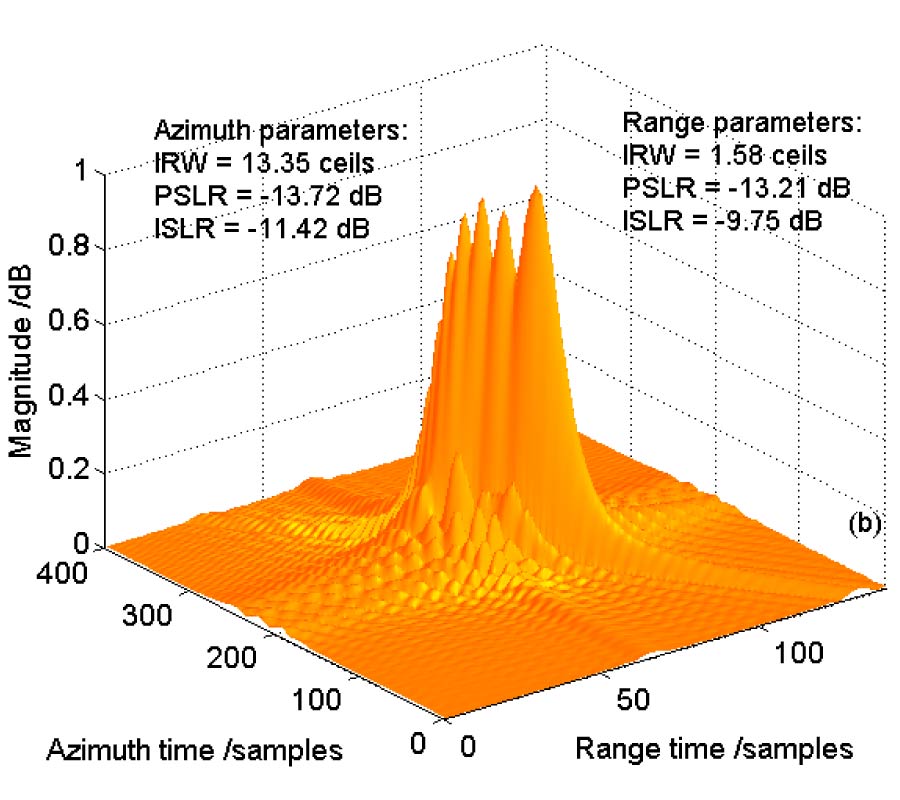
It is well known that in the pulse compression radar theory, the sidelobe reduction using nonlinear frequency modulation (NLFM) signal processing represents a major and present research direction. Accordingly, the main objective of this paper is to propose an interesting approach related to the design of efficient NLFM waveforms namely, a temporal predistortioning method of LFM signals by suitable nonlinear frequency laws. Some aspects concerning the optimization of the specific parameters involved into analyzed NLFM processing procedure are also included. The achieved experimental results confirm the significant sidelobe suppression related to other NLFM processing techniques.
SOME ASPECTS OF SIDELOBE REDUCTION IN PULSE COMPRESSION RADARS USING NLFM SIGNAL PROCESSING
2014-02-19
PIER Letters
Vol. 45, 57-61
A Folded Printed Quadrifilar Helical Antenna Employing a Compact Feeding Network
Ping Xu , Ze-Hong Yan , Xiao-Qiang Yang and Tian-Ling Zhang
A folded printed quadrifilar helical antenna (FPQHA) with an integrated and compact feeding network is proposed. The axial length of the proposed antenna is miniaturized of about 54.7% than the conventional PQHA by folding the helix arms into several elements. A T-junction power divider combining with two Wilkinson power dividers is utilized to feed the antenna. A fabricated prototype of the FPQHA using the compact feeding network is presented. The measured positive gain bandwidth covers 380-430 MHz with the reflection coefficient below -20 dB, axial ratio below 1.5 dB and a half-power beamwidth of about 120˚. Details of the proposed antenna design and experimental results are presented and discussed.
A FOLDED PRINTED QUADRIFILAR HELICAL ANTENNA EMPLOYING A COMPACT FEEDING NETWORK
2014-02-19
PIER Letters
Vol. 45, 51-56
Quad-Band Planar Inverted-F Antenna (PIFA) for Wireless Communication Systems
Naser Ojaroudi Parchin , Hamed Ojaroudi and Noradin Ghadimi
In this paper, a compact quad-band planar inverted-F antenna (PIFA) for wireless communication systems is presented. The proposed PIFA consists of a radiating patch with a hook-shaped slot and a modified ground plane with pair of square-ring and rotated I-shaped slots. The antenna is fabricated on an FR4 substrate with dielectric constant of 4.4. By cutting a hook-shaped slit at radiating patch, good dual-band property can be achieved which covers 3.5 GHz worldwide interoperability for microwave access (WiMAX) and 5.2 GHz wireless local area network (WLAN) frequencies. In addition, by using a modified ground plane with a rotated I-shaped an the pair of square-ring slot, additional resonances at the higher frequencies are generated which suitable for 7.25-7.75 GHz downlink of X-band satellite communication systems and 8.02-8.4 GHz international telecommunication union (ITU) applications. Good return loss, antenna gain and radiation pattern characteristics are obtained in the frequency band of interest. The proposed antenna has a small dimension of 24×3×1.6 mm3.
QUAD-BAND PLANAR INVERTED-F ANTENNA (PIFA) FOR WIRELESS COMMUNICATION SYSTEMS
2014-02-18
PIER Letters
Vol. 45, 45-50
A Spiral Antenna with Integrated Parallel-Plane Feeding Structure
Hui-Fen Huang and Zonglin Lv
In practical applications, the low-profile spiral antennas suffer from the lack of proper planar feeding ways. The vertical balun always has a significantly long length, inconsistent with the requirements of the low profile spiral antenna geometry. A spiral antenna with integrated parallel-plane feeding structure is proposed in this paper. The antenna used has obviously improved axial ratio compared to the equiangular spiral antenna at low frequencies. And the traditional balun in the third dimension is moved to the planar plane. The antenna and Dyson-style balun have been integrated into a multi-layer structure. The resulting structure maintains the typical radiation behavior and broadband operation of spiral antennas, but the vertical balun is integrated at the same plane with the antenna. The overall size of the spiral antenna is largely reduced.
A SPIRAL ANTENNA WITH INTEGRATED PARALLEL-PLANE FEEDING STRUCTURE
2014-02-18
PIER Letters
Vol. 45, 39-44
Compact Tri-Band Bandpass Filter for WLAN and WiMAX Using Tri-Section Stepped-Impedance Resonators
Bo Liu and Yimin Zhao
In this paper, a compact tri-band microstrip bandpass filter (BPF) using tri-section stepped-impedance resonators (TSSIRs) with open stub line and zero-degree feed line is presented. Three tunable passbands are achieved by changing the ratio of impedance. By adding the open stub line, the frequency responses of tri-band at 2.4 GHz/3.5 GHz/5.2 GHz can be obtained precisely. With a proper length of the cone-shaped zero-degree feed structure, we can obtain transmission zeros in stopbands and better return loss in passbands. The proposed tri-band BPF has high selectivity and is simple in fabrication.
COMPACT TRI-BAND BANDPASS FILTER FOR WLAN AND WIMAX USING TRI-SECTION STEPPED-IMPEDANCE RESONATORS
2014-02-18
PIER
Vol. 145, 59-67
Design of Filtering Microstrip Antenna Using Filter Synthesis Approach
Ghaith Mansour , Michael J. Lancaster , Peter S. Hall , Peter Gardner and Ekasit Nugoolcharoenlap
Design, simulation, and measurement of a compact filtering microstrip antenna is presented. A coupled line, two hairpin resonators, and a rectangular patch are integrated to form the filtering antenna. The elements together function as a third order bandpass filter with Chebyshev equal ripple response of 0.043 dB at midband frequency of 2.0 GHz. The rectangular patch acts not only as a radiating element, but also as the last resonator of the bandpass filter. The proposed filtering antenna exhibits good out-of-band gain suppression, flat in-band gain response, good selectivity at the band edges, and well-shaped radiation pattern.
DESIGN OF FILTERING MICROSTRIP ANTENNA USING FILTER SYNTHESIS APPROACH
2014-02-18
PIER
Vol. 145, 49-57
Analytical, Simulation and Measurement Studies of a Dual-Band Open-Sleeve Curved Meander Line Antenna on a Flexible Substrate
Elodie Georget , Redha Abdeddaim and Pierre Sabouroux
An innovative antenna on flexible substrate with two resonators is presented. The antenna is composed of a metallic wire sewn on the substrate. Two dipolar modes in far field are radiated. To understand the interaction of the resonators with the principal antenna, studies with and without the sleeves are done in near field and far field.
ANALYTICAL, SIMULATION AND MEASUREMENT STUDIES OF A DUAL-BAND OPEN-SLEEVE CURVED MEANDER LINE ANTENNA ON A FLEXIBLE SUBSTRATE
2014-02-18
PIER
Vol. 145, 39-48
Optimal Design of Graded Refractive Index Profile for Broadband Omnidirectional Antireflection Coatings Using Genetic Programming
Yongxiang Zhao , Fei Chen , Qiang Shen and Lianmeng Zhang
To eliminate the average reflectance of antireflection coatings to the greatest extent, a Genetic Programming (GP) algorithm is proposed to design and optimize the graded refractive index distribution profile for broadband omnidirectional antireflection coatings. The proposed GP-index profile in this paper can obtain an extremely low average reflectance of 4.61×10⁻⁷% over a wide range of incident angles and wavelengths which is obviously superior to the average reflectance of 8.09×10⁻³%, 3.29×10⁻⁴% and 4.35×10⁻⁵% for linear profile, cubic profile and quintic profile. That means, Fresnel reflection almost can be eliminated by the optimal GP-index profile for omnidirectional incidence over a broad wavelength range. Moreover, it is demonstrated the proposed GP-index profile has better robustness, and it still has the best broadband and omnidirectional antireflection characteristics for the TiO2/SiO2 graded-index AR coating. Therefore, the proposed GP-index profile is obviously superior to the conventional linear profile, cubic profile and quintic profile, and the design methodology presented in this paper that uses a genetic programming technique is a quite convenient means to pursue an optimal nonlinear refractive index profile with broadband and omnidirectional antireflection characteristics.
OPTIMAL DESIGN OF GRADED REFRACTIVE INDEX PROFILE FOR BROADBAND OMNIDIRECTIONAL ANTIREFLECTION COATINGS USING GENETIC PROGRAMMING
2014-02-18
PIER
Vol. 145, 31-38
Two-Strip Narrow-Frame Monopole Antenna with a Capacitor Loaded for Hepta-Band Smartphone Applications
Zhong-Xiang Chen , Yong-Ling Ban , Zhi Chen , Kai Kang and Joshua Le-Wei Li
A two-strip narrow-frame monopole antenna for hepta-band WWAN/LTE smartphone applications is proposed. The brightest point of the proposed antenna is that its narrow edge has a width of only 5mm, which is very practical for current smartphone applications with larger touch-screens. In addition, the proposed narrow-frame antenna has a small volume of 60×5×5 mm3 and a simple structure, which comprises of a two-strip monopole loaded with a chip capacitor and an L-shape high-pass filter. Meanwhile, the propose antenna can cover the GSM850/900/1800/1900/UMTS2100/LTE2300/2500 bands. Finally, the operating principle of the proposed antenna is investigated and both simulated and measured results are presented and discussed.
TWO-STRIP NARROW-FRAME MONOPOLE ANTENNA WITH A CAPACITOR LOADED FOR HEPTA-BAND SMARTPHONE APPLICATIONS
2014-02-17
PIER Letters
Vol. 45, 35-38
Wideband Patch Antenna with Stable High Gain and Low Cross-Polarization Characteristics
Jia-Yue Zhao , Zhi-Ya Zhang , Yang Li , Guang Fu and Shu-Xi Gong
A wideband unidirectional patch antenna with two meandering strips and a Г-shaped feeding structure is designed. The investigation shows that the antenna achieves an impedance bandwidth of 54.2% for VSWR ≤ 2 and a stable gain of around 9 dBi. The far field radiation patterns with low cross polarization which levels are less than -27 dB, low back radiation and symmetrical E-and H-plane patterns are obtained over the whole operating frequency range.
WIDEBAND PATCH ANTENNA WITH STABLE HIGH GAIN AND LOW CROSS-POLARIZATION CHARACTERISTICS
2014-02-16
PIER B
Vol. 58, 167-180
Geometrical and Physical Parameters Affecting Distant Electric Fields Radiated by Lightning Return Strokes.
Carlo Petrarca
In this paper detailed numerical results are presented for the estimation of the electric field generated by the first return stroke, in order to reproduce the main characteristics of field waveforms measured at distances beyond 50 km. The effect of parameters such as the lightning channel geometry, distance from the source, return-stroke current speed, its attenuation along the channel is discussed by comparing numerical and experimental results.
GEOMETRICAL AND PHYSICAL PARAMETERS AFFECTING DISTANT ELECTRIC FIELDS RADIATED BY LIGHTNING RETURN STROKES.
2014-02-16
PIER C
Vol. 47, 65-74
Reconfigurable Antenna for RFID Reader and Notched UWB Applications Using Dto Algorithm
Ahmed Mohamed Montaser
In this article, the approach involving Dynamic Threshold Optimization (DTO) algorithm is considered to optimize a new compact reconfigurable antenna to be applied to triple band Radio Frequency Identification (RFID) and to ultra wideband (UWB) antenna with multiple bands notched. The antenna is implemented by using the existing techniques, such as loading an L-type band-stop filter, inserting a split ring resonator (SRR) as well as connecting L branches to the radiation disk proposed by us. In case of RFID applications, triple-band RFID 915/2450/5800 MHz are achieved separately. The results prove that this kind of antenna can be applied in RFID reader to avoid interference with other wireless systems. RF MEMS switches are used to reconfigure the antenna to be suitable for the application in the notched UWB communication systems. The DTO algorithm program is implemented using MATLAB-software and linked to the CST Microwave studio software to simulate the antenna. In addition, the optimized antenna is assessed using the Finite Difference Time Domain (FDTD) program written with MATLAB to validate the results. The experimental results for the RFID and UWB antennas show good agreement with simulated ones. The radiation patterns are satisfactorily omnidirectional across the antenna's operation bands.
RECONFIGURABLE ANTENNA FOR RFID READER AND NOTCHED UWB APPLICATIONS USING DTO ALGORITHM
2014-02-16
PIER M
Vol. 35, 31-38
Quasi Optical Effects of Non-Ionizing Radiation Inside Pregnant Woman Abdomen
Md. Faruk Ali and Sudhabindu Ray
Investigations have been carried out on the convex lens effect of non-ionizing radiation inside the abdomen of a pregnant woman. Focusing property for a plano-convex lens, which is thicker than twice of its focal length and filled with water, is studied for electric and magnetic fields at different microwave frequencies. It is observed that real image of electromagnetic fields are formed inside the lens itself at the focal plane when a microwave source is placed at a distance much greater than the twice the focal length. A three dimensional homogeneous electrical model of pregnant woman abdomen model behaves like plano-convex lens and creates real image of the microwave source inside the abdomen.
QUASI OPTICAL EFFECTS OF NON-IONIZING RADIATION INSIDE PREGNANT WOMAN ABDOMEN
2014-02-16
PIER
Vol. 145, 19-29
Miniaturization of Antenna for Wireless Application with Difference Metamaterial Structures
Maryam Rahimi , Ferdows B. Zarrabi , Rahele Ahmadian , Zahra Mansouri and Asghar Keshtkar
In this paper, periodic structures are investigated in antenna design for wireless applications. These antennas were compared with CRLH miniaturization method. Three different models of patch antenna with coaxial feed on EBG ground, metamaterial substrate or EBG/AMC structure have been presented here. Also two compact dual-band antennas have been designed and fabricated based on CRLH techniques for wireless and GSM applications. The first antenna has directional pattern and operates at 1760, 2550 and 3850 MHz (three-band antenna) with gain 2.1, -3.9 and 2.5 dBi, and it is dual polarized. The size of prototype patch antenna is 20×20 mm2 which is reduced about %47 in comparison to conventional patch antenna at 2.5 GHz. The second antenna is designed by the use of interdigital capacitor and spiral inductor. Dimensions of antenna are 15.5×12 mm2, so the size is reduced about %69 in comparison to conventional microstrip patch antennas at 1.8 GHz. The second tri-band antenna operates at 1060 MHz, 1800 MHz and 2500 MHz in which two frequencies (1.8 and 2.5 GHz) are suitable for GMS and WLAN applications. Both structures have been designed and fabricated on FR4 low cost substrate with εr=4.4 and thickness of 1.6mm. All simulations are done with CST and HFSS. Equivalent circuit and experimental results are also presented and compared.
MINIATURIZATION OF ANTENNA FOR WIRELESS APPLICATION WITH DIFFERENCE METAMATERIAL STRUCTURES
2014-02-15
PIER Letters
Vol. 45, 31-34
A Novel Uni-Planar Compact EBG Structure
Peng Chen , Xiao Dong Yang , Chao Yang Chen and Yu Ning Zhao
The radiation and propagation characteristic can be improved by the microstrip structure of the electromagnetic band-gap, which is becoming miniaturized today. In order to reduce the influence to the width of the band-gap brought by the miniaturization of the UC-EBG structure, a novel UC EBG structure is brought out. The band-gap width is guaranteed, meanwhile, the unit length is reduced to 0.1λg. Results of measurement indicate that this structure is effectively miniaturized, has an excellent performance, and can be used in the antenna or microwave circuit fields.
A NOVEL UNI-PLANAR COMPACT EBG STRUCTURE
2014-02-15
PIER M
Vol. 35, 21-30
Substrate Integrated Waveguide Design Using the Two Dimentionnal Finite Element Method
Amine Mohammed Rabah , Mehadji Abri , Junwu Tao and Tan Hoa Vuong
In this paper, a rigorous and accurate numerical two-dimensional modeling finite element method 2D-FEM is applied to the analysis and design of substrate integrated waveguide components. The finite element method represents an excellent tool for the analysis and design since it easily allows taking into account all details of each device. The advantages of this method have been proved with the successful design of two SIW waveguide topologies operating in [8-12] GHz and [10.7-12.75] GHz respectively for X-band and Ku-band applications employed in satellite communications. In order to validate the proposed method, a comparison is made between the FEM method implemented in Matlab and CST Microwave Studio® software. Agreements between the finite element method data and the CST software results were achieved. The obtained results show the effectiveness of this method to analyze such types of guides.
SUBSTRATE INTEGRATED WAVEGUIDE DESIGN USING THE TWO DIMENTIONNAL FINITE ELEMENT METHOD
2014-02-13
PIER Letters
Vol. 45, 25-30
Compact Microstrip UWB Bandpass Filter with Two Band-Notches for UWB Applications
Huaxia Peng , Yufeng Luo and Junding Zhao
A new microstrip ultra-wideband (UWB) bandpass filter (BPF) with dual sharply rejected notched bands based on E-shaped resonator is proposed in this paper. The basic UWB BPF is designed using two microstrip interdigital coupled lines and one rectangular patch multiple-mode resonator (MMR). Then, to achieve dual band-notched performance, the proposed dual-mode E-shaped resonator is investigated and coupled to the rectangular patch multiple-mode resonator of the basic UWB BPF. To validate the design theory, a microstrip UWB BPF with two notch-bands centered at the frequencies of 5.8 GHz and 8.0 GHz, respectively, is designed and fabricated. Both simulation and experimental results are provided with good agreement.
COMPACT MICROSTRIP UWB BANDPASS FILTER WITH TWO BAND-NOTCHES FOR UWB APPLICATIONS
2014-02-12
PIER B
Vol. 58, 151-166
On the Suitability of Using Halbach Arrays as Potential Energy Storage Media
Daniel Mansson
In the work presented here, the suitability of an unusual energy storage medium is investigated. The energy storage system is based on the forceful compression of two magnetic Halbach arrays. The mass and volume energy density is obtained and compared to existing common energy storage systems. The charge and discharge times and depths are also discussed. In addition, limits and considerations, which are needed for practical implementation, e.g., risk of demagnetization, internal mechanical stresses, heating of the magnetic structure and financial efficiency are investigated.
ON THE SUITABILITY OF USING HALBACH ARRAYS AS POTENTIAL ENERGY STORAGE MEDIA