SMS Optical Fiber Laser Sensor for Transformer Oil Temperature Monitoring-Based IoT
of AI Control
Jawad Kadhim Raham,
Maather Alshaibi and
Taha Ahmed Elwi
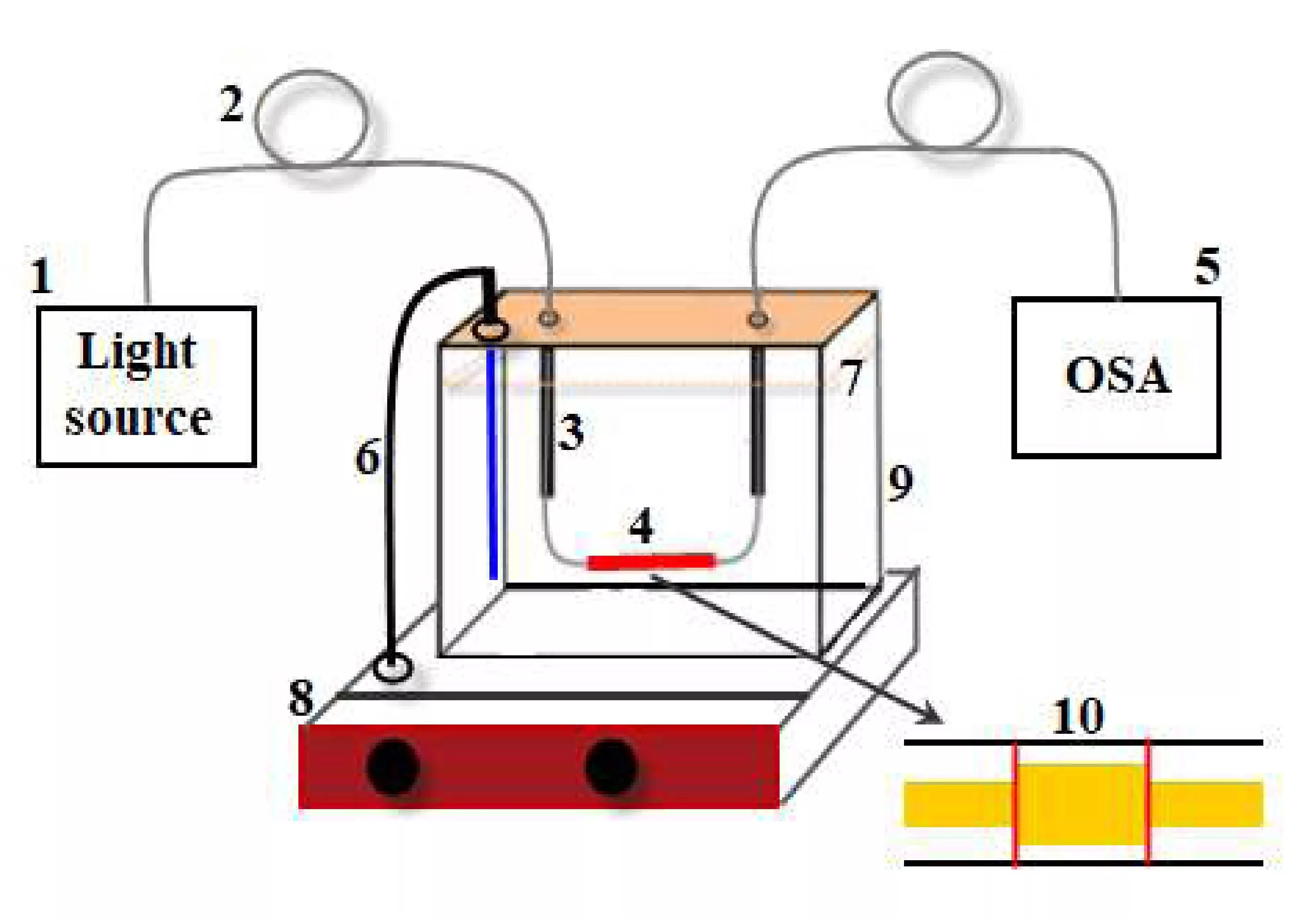
This paper presents the design, fabrication, and characterization of a novel optical fiber temperature sensor based on a single-mode-multimode-single-mode (SMS) structure for real-time monitoring of transformer oil temperature in high-voltage environments, addressing the limitations of conventional electronic sensors such as electromagnetic interference, electrical safety hazards, and restricted spatial coverage. The sensor, fabricated with corning single mode fiber (SMF)-28e+ single-mode and Thorlabs FG050UGA multimode fibers (5 cm active section), operates on the Mach-Zehnder interferometer principle, where temperature-induced refractive index changes in transformer oil modulate light propagation. Systematic experiments over a 30-90 °C range using a 1550 nm tunable laser, temperature‑controlled oil bath, Pt100 reference, and optical spectrum analyzer yielded a wavelength sensitivity of 4.17 × 10⁻³ nm/°C with excellent linearity (R2 = 0.9646), a standard error of 4.45 °C, repeatability better than 0.5 % coefficient of variation, and progressive OSNR improvement from 0 dBm at 30°C to 2.26 dBm at 90 °C. The wavelength-based calibration method significantly outperformed the power-based approach, offering 1.36× lower error (4.45 °C vs. 6.04 °C) and higher correlation, with expanded uncertainty (95 % confidence, k = 2) calculated as 6.14°C. Compared to fiber Bragg grating and fiber-loop mirror sensors, the proposed SMS sensor provides electromagnetic immunity, cost-effective fabrication, high stability, and a simple all-fiber configuration, making it a reliable and practical solution for continuous thermal monitoring in power transformers and laying the foundation for comprehensive fiber-optic sensing networks in high-voltage power systems.