SDF-Net: A
Space-Frequency Dynamic Fusion Network for SARATR
Xinlin He,
Chao Li,
Kaiming Li and
Ying Luo
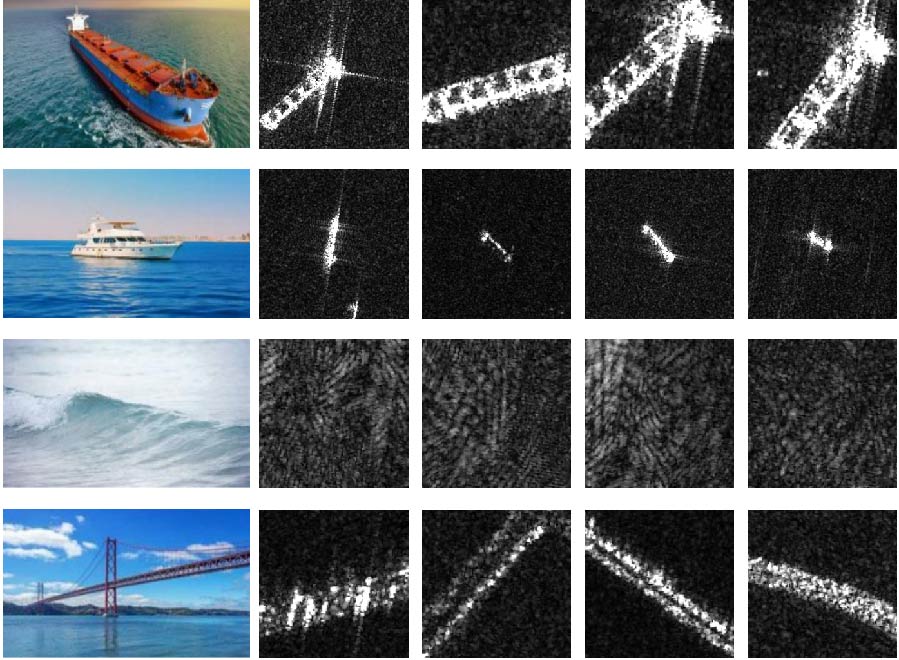
With the development of deep learning networks, convolutional neural network (CNN) and other techniques provide effective detection methods for synthetic aperture radar automatic target recognition (SAR ATR), and have been widely used. However, due to the objective factors such as complex scene interference inherent in SAR images, the recognition rate of traditional time-domain processing of SAR images is not high enough, which is still a key problem to be solved urgently. To solve this problem, we propose a space-frequency dynamic fusion network (SDF-Net). The network consists of four space-frequency joint processing (SJP) modules connected in series, each comprising convolutional layers and unbiased fast fourier convolution (UFFC) units at different scales to achieve joint feature extraction in the spatial and frequency domains. Building on a four-level series structure, residual paths from the original image features are introduced into the inputs of SJP2, SJP3, and SJP4. Additionally, residual paths from the features output by SJP1 are introduced into the inputs of SJP3 and SJP4, and from SJP2 into the input of SJP4. By incorporating residual paths of features from different stages, the network facilitates cross-stage information interaction, effectively integrating long-distance contextual information. At each fusion node, dynamically generated weights are used for feature fusion, followed by sequential progressive processing through spatial-frequency joint processing, ultimately leading to classification and recognition results. Experimental results on the MSTAR dataset and the FUSAR-Ship1.0 dataset show that compared to traditional methods, this network algorithm achieves a higher recognition rate.