2009-09-11
Computational Modeling of Induction Heating Process
By
Progress In Electromagnetics Research Letters, Vol. 11, 93-102, 2009
Abstract
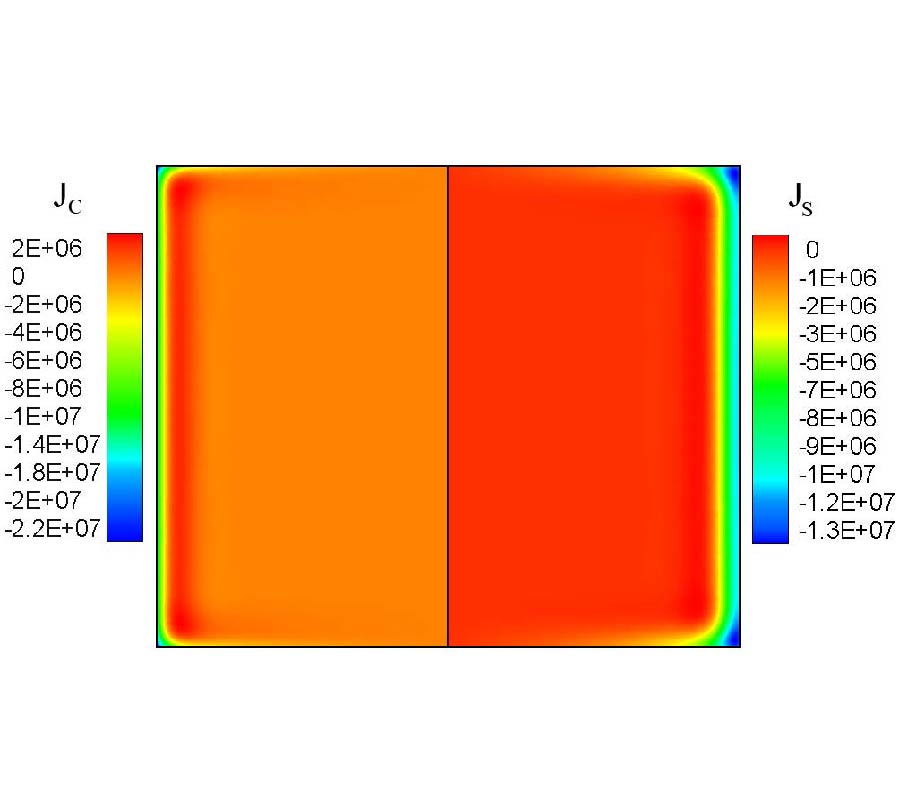
An accurate 2D steady state mathematical model for induction heating process is described and additional results of electromagnetic field, eddy currents distribution and volumetric heat generation have been computed for a sample setup using a finite element method. For the calculations, the input voltage of induction coil is set to be 200 ν with a frequency of 10 kHz. It was shown that for the case considered here, the distribution of eddy currents density along the radius/thickness of the workpiece has a damped sinusoidal wave-shaped form.
Citation
Mohammad Hossein Tavakoli, Hossein Karbaschi, and Feridoun Samavat, "Computational Modeling of Induction Heating Process," Progress In Electromagnetics Research Letters, Vol. 11, 93-102, 2009.
doi:10.2528/PIERL09071509
References

1. Leatherman, A. F. and D. E. Stutz, Induction Heating Advances, National Aeronautics and Space Administration, 1969.

2. Rudnev, V., D. Loveles, R. Cook, and M. Black, Handbook of Induction Heating, New York, NY, 2003.

3. Zinn, S. and S. L. Semiatin, Elements of Induction Heating, ASM International, 1988.

4. Gresho, P. M. and J. J. Derby, "A finite element model for induction heating of a metal crucible," J. Crystal Growth, Vol. 85, No. 1-2, 40-48, 1987.
doi:10.1016/0022-0248(87)90202-8        Google Scholar

5. Tavakoli, M. H., "Modeling of induction heating in oxide Czochralski systems --- Advantages and problems," Cryst. Growth Des., Vol. 8, No. 2, 483-488, 2007.
doi:10.1021/cg070378+        Google Scholar

6. Reitz, J. R., F. J. Milford, and R. W. Christy, "Foundations of Electromagnetic Theory," Addison-Wesley, 1993.        Google Scholar