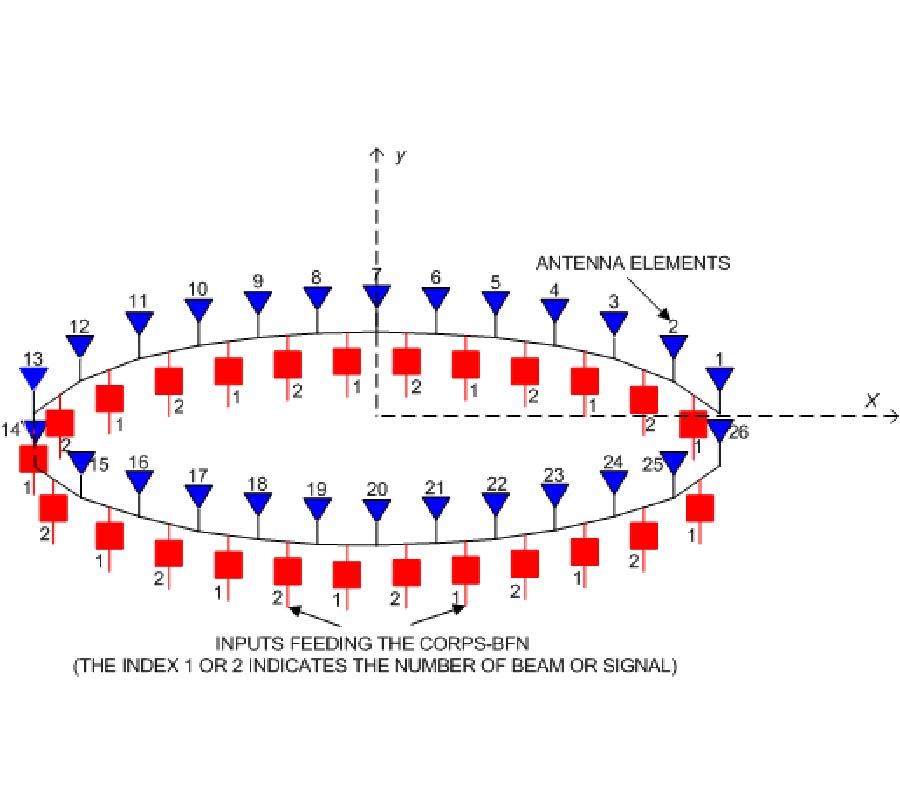
1. Panduro, M. A. and C. del Rio-Bocio, "Design of beam-forming network using CORPS and evolutionary optimization," Int. J. Electron. Commun. (AEU), Vol. 63, 353-365, 2009.
doi:10.1016/j.aeue.2008.02.009 Google Scholar
2. Betancourt, D., A. Ibanez, and C. del Rio-Bocio, "A novel methodology to feed phased array antennas," IEEE Trans. Antennas Propagation, Vol. 55, 2489-2494, 2007.
doi:10.1109/TAP.2007.904133 Google Scholar
3. Panduro, M. A. and C. del Rio-Bocio, "Design of beam-forming network for scannable multi-beam antenna arrays using CORPS," Progress In Electromagnetics Research, Vol. 84, 173-188, 2008.
doi:10.2528/PIER08070403 Google Scholar
4. Betancourt, D., A. Ibanez, and C. del Rio-Bocio, "Coherently radiating periodic structures (CORPS): A step towards high-resolution radiations systems," IEEE AP-S 2005 Washington, DC, 2005. Google Scholar
5. Feortisov, V. and S. Janaqui, "Generalization of the strategies in differential evolution," Proceedings of the IEEE Conference Evolutionary Computation, 1996. Google Scholar
6. Yang, S., A. Qing, and Y. B. Gan, "Synthesis of low side lobe antenna arrays using the differential evolution algorithm," IEEE Transactions on Antennas and Propagation Conference, 1-22, 2003. Google Scholar
7. Panduro, M. A., C. A. Brizuela, L. I. Balderas, and D. A. Acosta, "A comparison of genetic algorithms, particle swarm optimization and the differential evolution method for the design of scannable circular antenna arrays," Progress In Electromagnetics Research B, Vol. 13, 171-186, 2009.
doi:10.2528/PIERB09011308 Google Scholar
8. Kurup, D., M. Himdi, and A. Rydberg, "Synthesis of uniform amplitude unequally spaced antenna arrays using the differential algorithm," IEEE Trans. Antennas Propagation, Vol. 51, 2210-2217, 2003.
doi:10.1109/TAP.2003.816361 Google Scholar
9. Parsopoulos, K. E., D. K. Tasoulis, N. G. Pavlidis, V. P. Plagianakos, and M. N. Vrahatis, "Vector evaluated differential evolution for multi-objective optimization," IEEE Congress on Evolutionay Computation, 19-23, 2004. Google Scholar
10. Storn, R. and K. Price, "Minimizing the real functions of the ICEC'96 contest by differential evolution," IEEE Congress on Evolutionay Computation, 1996. Google Scholar
11. Balanis, C., Antenna Theory --- Analysis and Design, 2nd Edition, Wiley, 1997.
12. Rahmat-Samii, Y. and E. Michielsen, Electromagnetic Optimization by Genetic Algorithms, Wiley & Sons, 1999.
13. Haupt, R., "Thinned arrays using genetic algorithms," IEEE Transactions on Antennas and Propagation, Vol. 42, 993-999, 1994.
doi:10.1109/8.299602 Google Scholar
14. Goldberg, D. E., Genetic Algorithms in Search, Optimization and Machine Learning, Addison-Wesley, 1989.