2012-02-07
A Novel Four Layer Metallization for Microwave Integrated Circuits
By
Progress In Electromagnetics Research Letters, Vol. 29, 175-184, 2012
Abstract
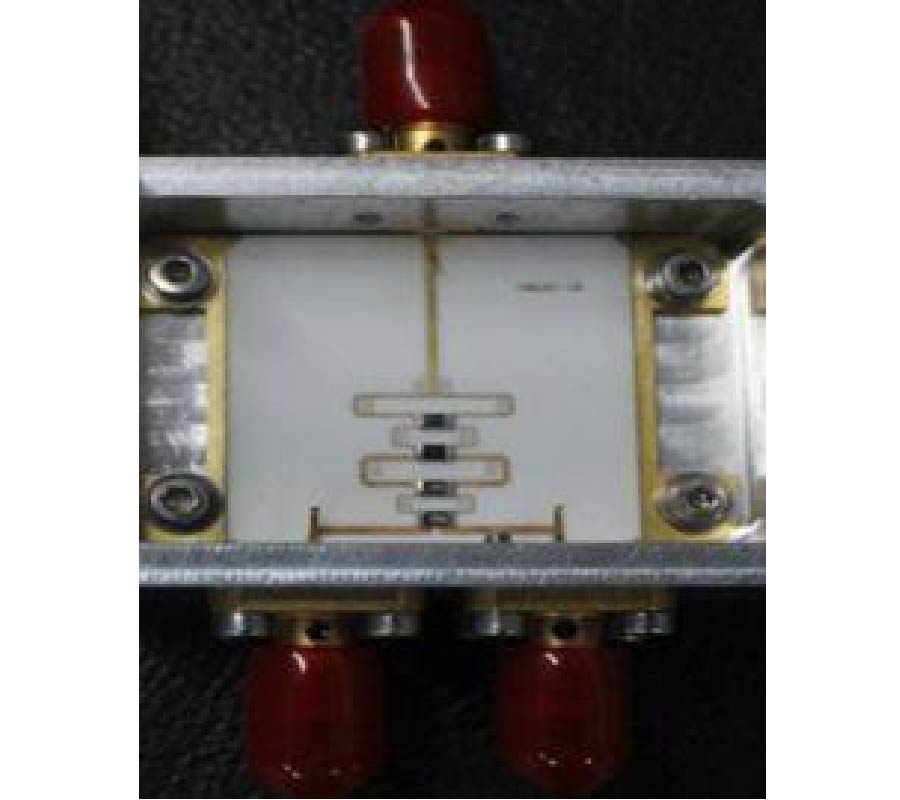
In order to overcome the problems facing Cr-Cu-Au metallization, such as discoloration, diffusion of Cu into Au, a four-layer metallization Cr-Cu-NiP-Au is demonstrated on alumina substrate for microwave integrated circuit (MICs). A amorphous and nonmagnetic NiP barrier layer is used to avoid the diffusion of Cu into Au through the grain boundaries, which are the low activation energy path for diffusion at moderate temperature. In this view, properties of Cr-Cu-NiP-Au metallization, such as sheet resistance, solderability, bondability and adhesion strength, are evaluated. Further integrity of Cr-Cu-NiP-Au structure is evaluated by subjecting to this structure to multiple temperature cycles test. Visual observation is carried our before and after the thermal cycling test. No degradation is observed as the consequence of thermal cycling test. Test and evaluation are carried out for a multi-section broadband power divider (1 : 2) on this metallization (metal thickness 12-12.5 microns) in the 0-6 GHz frequency range. Insertion loss, return loss and isolation are comparable with Cr-Cu-Au (metal thickness 5.0-6.0 microns). Performance of the power divider and properties of this metallization system reveal its novelty over the existing.
Citation
Rakesh Kumar Sharma, Sandeep Patel, Arun Bindal, and Kamlesh C. Pargaien, "A Novel Four Layer Metallization for Microwave Integrated Circuits," Progress In Electromagnetics Research Letters, Vol. 29, 175-184, 2012.
doi:10.2528/PIERL11120607
References

1. Puri, V., Effect of metallization process on the performance of passive microstripline circuits Technology Letters, Vol. 5, No. 11, 585-590, 1992.

2. Abel, L., et al. "Electronic Materials Handbook,", Vol. 1, Packaging, ASM International, 1989.        Google Scholar

3. Plummet, J. D., M. D. Deal, and P. B. Griffin, Silicon VLSI Technology, 695, Upper Saddle River, Prentice Hall, NJ, 2000.

. Alternative Board Finishes A Publication of the National Electronic Manufacturing Center of Excellence, Electronic Manufacturing Productivity Facility (EMPF), 49, 2000.

5. Diamand, Y. S., et al. Proc. 9 Bienn. Univ. Gov. Ind. Microelectron. Symp., 210-215, IEEE, Piscataway, NJ, 1991.

6. Mahapatra, S. and S. N. Prasad, "A new electroless method for low loss microwave integrated circuits," IEEE Trans. Components, Hybrids Manuj. Technol., Vol. 1, No. 4, Dec. 1978.        Google Scholar

7. Coombs Jr., C. F., Printed Circuit Handbook, No. 5th, 1400, McGraw-Hill, New York, United States, 2001.

8. Kishihara, M., et al. "A design of multi-stage, multi-way microstrip power dividers with broadband properties," IEEE MTT-S Digest, 2004.        Google Scholar