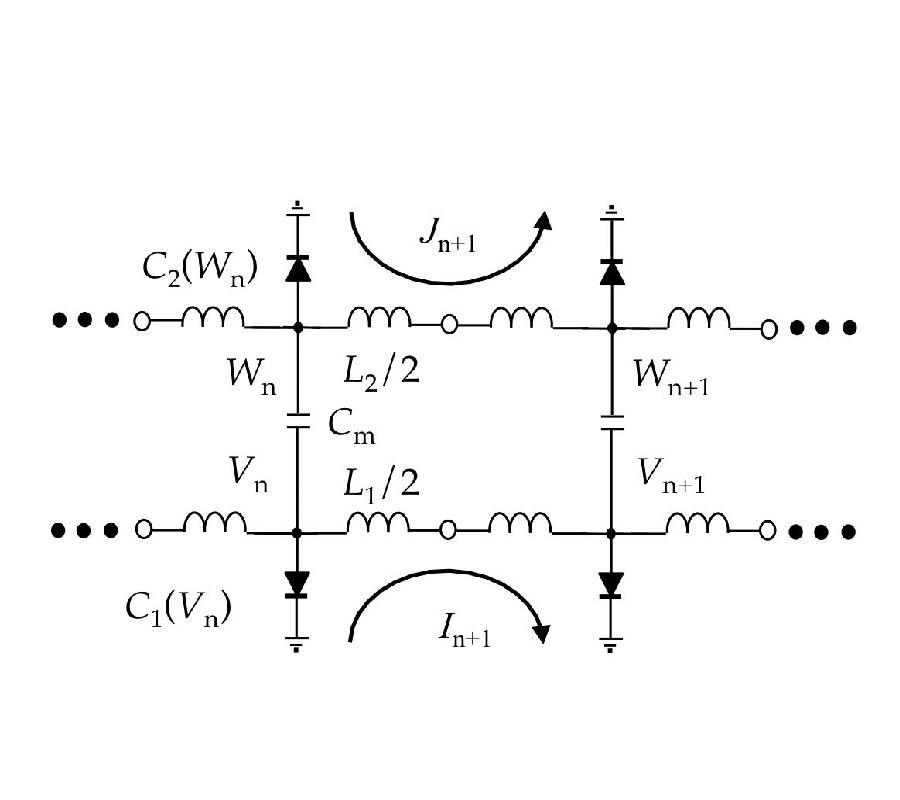
1. Hirota, R. and K. Suzuki, "Studies on lattice solitons by using electrical networks," J. Phys. Soc. Jpn., Vol. 28, 1366-1367, 1970.
doi:10.1143/JPSJ.28.1366 Google Scholar
2. Rodwell, M. J. W., S. T. Allen, R. Y. Yu, M. G. Case, U. Bhattacharya, M. Reddy, E. Carman, M. Kamegawa, Y. Konishi, J. Pusl, and R. Pullela , "Active and nonlinear wave propagation devices in ultrafast electronics and optoelectronics," Proc. IEEE, Vol. 82, 1037-1059, 1994.
doi:10.1109/5.293161 Google Scholar
3. Kintis, M., X. Lan, and F. Fong, "An MMIC pulse generator using dual nonlinear transmission lines," IEEE Microwave Wireless Compo. Lett., Vol. 17, No. 6, 454-456, 2007.
doi:10.1109/LMWC.2007.897799 Google Scholar
4. Yildirim, O. O., D. S. Ricketts, and D. Ham, "Reflection soliton oscillator," IEEE Trans. Microwave Theory Tech., Vol. 57, No. 10, 2344-2353, 2009.
doi:10.1109/TMTT.2009.2029025 Google Scholar
5. Ndzana, F., A. Mohamadou, and T. C. Kofane, "Dynamics of modulated waves in electrical lines with dissipative elements," Phys. Rev. E, Vol. 79, 047201-047204, 2009.
doi:10.1103/PhysRevE.79.047201 Google Scholar
6. Kengne, E., S. T. Chui, and W. M. Liu, "Modulational instability criteria for coupled nonlinear transmission lines with dispersive elements," Phys. Rev. E, Vol. 74, 036614, 2006.
doi:10.1103/PhysRevE.74.036614 Google Scholar
7. Gupta, K. C., R. Garg, and I. J. Bahl, Microstrip Lines and Slotlines, Artech, 1979.
8. Taniuti, T., "Reductive perturbation method and far fields of wave equations," Prog. Theor. Phys. Suppl., Vol. 55, 1-35, 1974.
doi:10.1143/PTPS.55.1 Google Scholar
9. Narahara, K. and T. Otsuji, "Compression of electrical pulses using traveling-wave field effect transistors," Jpn. J. Appl. Phys., Vol. 38, 4688-4695, 1999.
doi:10.1143/JJAP.38.4688 Google Scholar