Search Results(13789)

2021-02-13
PIER B
Vol. 90, 187-205
An Overview of Rainfall Fading Prediction Models for Satellite Links in Southern Africa
Djuma Sumbiri and Thomas Joachim Odhiambo Afullo
This work presents an overview of rainfall fading models over satellite links in South Africa using three years of rainfall data collected by the Joss-Waldvogel RD-80 disdrometer in Durban, South Africa (29˚52'S, 30˚58'E), alongside a colocated Ku-band satellite TV link. Different drop size distribution models, such as Lognormal, Gamma, Weibull, and the Optimised drop size distribution model for Equatorial Africa, are used to formulate the rainfall attenuation models used in this study. Thereafter, the formulated attenuation models are used to convert rainfall rate time series data to predicted rainfall attenuation time series. In addition, both the ITU-R model and the Synthetic Storm Techniques are applied for comparison with the above rainfall attenuation models alongside experimental measurements over the 12.6 GHz satellite TV link from Intelsat-20 (IS-20) located at 68.5˚E on the azimuth angle of 57.5˚ with respect to Durban.
AN OVERVIEW OF RAINFALL FADING PREDICTION MODELS FOR SATELLITE LINKS IN SOUTHERN AFRICA
2021-02-13
PIER C
Vol. 109, 227-241
Design and Analysis of a Compact High Gain Wideband Monopole Patch Antenna for Future Handheld Gadgets
Abhishek Kumar Chaudhary and Murli Manohar
In this article, a compact super wideband (SWB) monopole antenna with a wide-frequency is designed and analyzed for future handheld gadgets. The designed antenna is made by etching four slots on a round cornered rectangular patch which are connected through a 50-Ω triangular tapered microstrip transmission feedline (TTMTF) for broadband impedance matching. A triangular slot is etched on the semicircular partial ground plane, which helps to shift the lower frequency edge of 1.07 GHz to 1 GHz. The experimental results show that the proposed antenna operates over a wide frequency range of 1-30 GHz with a reflection coefficient of less than -10 dB. The antenna acquires a compact dimension of 25 x 16 x 0.787 mm3. Further, an equivalent circuit method is used to analyze the proposed structure, and its outcome is compared with the simulated and experimental results. The peak gain of the designed antenna is about 5.5 dBi. The proposed antenna has low cross-polarization even at higher frequencies. Finally, the time domain analysis is also carried out to see the distortion between transmitting and receiving modes. The designed antenna can be used for various wireless applications such as NB-IoT, GPS, Wi-BRO, ISM band, IRNSS, WiMAX, X-band, Ku-band, and K-band.
DESIGN AND ANALYSIS OF A COMPACT HIGH GAIN WIDEBAND MONOPOLE PATCH ANTENNA FOR FUTURE HANDHELD GADGETS
2021-02-11
PIER C
Vol. 110, 1-14
Applicability Analysis of the Phase Scanning in Antenna Arrays of Chirp Pulse Radars
Volodymyr G. Galushko and Dmytro M. Vavriv
In this paper, the space-and-time structure of the output signal of the antenna array (AA) of a chirp pulse radar is investigated in dependence on the frequency sweep range of the probe signal. Expressions are derived for calculating the output signals of the AA of a chirp pulse radar after optimal filtering in the case of beamforming using phase shifters and/or time-delay lines. Distortions of the space-time power pattern pertaining to the phase scanning method are analyzed in dependence on the frequency chirp range and scan angle. It is shown that these distortions are similar to the effects observed in the case of using taper windows for sidelobe suppression in the time and space (angular) domains. Based on the results obtained an applicability condition is suggested for the phase scanning in AAs of chirp pulse radars. It is shown that minor violations of this condition result in decreasing the amplitude and broadening of the main lobe and sidelobes in the AA space-time power pattern. In the case of strong violations of the applicability condition for the phase scanning the sidelobes of the angular directional pattern degrade, merging with the main one into a single quite broad maximum. The considered effects lead to deterioration of the range and azimuth resolution capabilities of radars and should be taken into account when selecting the taper window parameters.
APPLICABILITY ANALYSIS OF THE PHASE SCANNING IN ANTENNA ARRAYS OF CHIRP PULSE RADARS
2021-02-09
PIER Letters
Vol. 96, 81-90
Wideband Harmonic Suppressed Compact Rat-Race Coupler Using Triple Stub m-Shape Unit
Vuppuloori Ravi Reddy , Vamsi Krishna Velidi and Bhima Prabhakara Rao
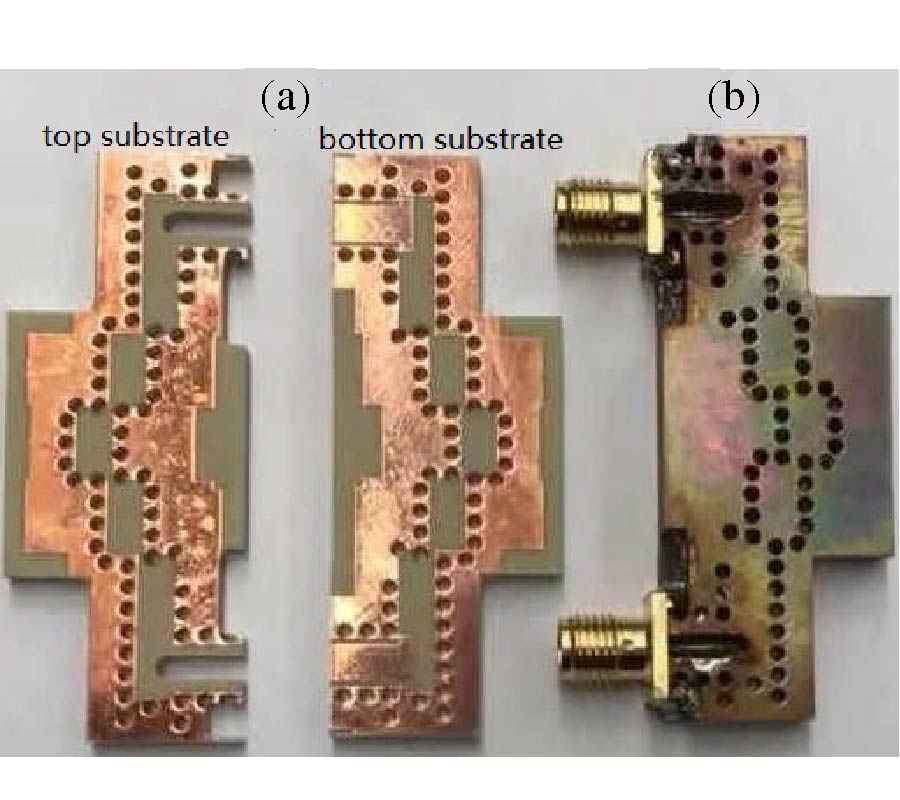
A design of a compact wideband harmonic suppressed rat-race coupler (RRC) is presented in this paper. The present coupler is obtained by replacing each quarter wave length transmission line of a conventional double section rat-race coupler with a triple stub M-shape unit. The M-shape unit with 3 stubs is used to enhance the bandwidth, suppress the harmonics, and reduce the size of the coupler. Design guidelines are established using the lossless transmission line model. Theoretical predictions are verified by fabricating a prototype coupler. The proposed double section RRC provides harmonic suppression up to seventh of operating frequency and 62.4% size reduction with wide bandwidth, which is useful for wireless communication systems.
WIDEBAND HARMONIC SUPPRESSED COMPACT RAT-RACE COUPLER USING TRIPLE STUB M-SHAPE UNIT
2021-02-09
PIER B
Vol. 91, 1-8
Diffraction Radiation Generated by a Density-Modulated Electron Beam Flying Over the Periodic Boundary of the Medium Section. I. Analytical Basis
Yuriy Sirenko , Seil S. Sautbekov , Nataliya Yashina and Kostyantyn Sirenko
The paper is focused on reliable modeling of the effects associated with the resonant transformation of the field of a plane, density modulated electron beam, flying over the periodically uneven boundary of a natural or artificial medium, in the field of volume outgoing waves. Here, the general information (analytical basis) is presented on the peculiarities and principal characteristics of electromagnetic fields arising in the situations under consideration, on the procedures for regularization of model boundary value problems describing these situations, and on possible eigenmodes of periodic structures. Without relying on this information, it is impossible to advance considerably effectively in solving numerous urgent physical problems(establishing the conditions providing anomalously high levels of Vavilov-Cherenkov and/or Smith-Purcell radiation; diagnostics of beams of charged particles, artificial materials and media) and in practical implementation of new knowledge aboutthe effects of diffraction radiation and their wave analogues in new devices and instruments of optoelectronics, high-power electronics, antenna, and accelerator technology.
DIFFRACTION RADIATION GENERATED BY A DENSITY-MODULATED ELECTRON BEAM FLYING OVER THE PERIODIC BOUNDARY OF THE MEDIUM SECTION. I. ANALYTICAL BASIS
2021-02-09
PIER C
Vol. 109, 217-225
An Improved Conversion Efficiency of 1.975 to 4.744 GHz Rectenna for Wireless Sensor Applications
Rashmi Pandey , Ashok Kumar Shankhwar and Ashutosh Singh
This article discusses the design analysis of a wideband rectenna (Antenna + Rectifier). It empowers low power devices, battery-less power sensors, and many Internet of Things (IoT) devices. The main focus of this work is divided into two parts. First, to develop the power to operate the wideband frequency of operation without system complexity. To obtain rectifier bandwidth sufficiently, L-section impedance matching with dual Schottky diode HSMS270B is proposed. Second, to improve the rectenna efficiency and output DC power. Wideband rectenna harvests the maximum RF power of 30.590 dBm, 1145.51 mW, 10.703 Volts at 3.2 GHz. The harvested power is easily available to power up the low powered sensor such as gas sensor (500-800 mW), pressure sensor (10-15 mW), and temperature sensor (0.5-5 mW). The peak conversion efficiency of the rectenna is 88.58% at 0 dBm, 34.70% at 10 dBm, and 53.52% at 20 dBm under the load resistance of 100 KΩ. The proposed work shows a 20-25% improvement in conversion efficiency with this approach. For efficient RF energy harvesting applications, the proposed rectenna is capable of covering a wideband application from 1.975 to 4.744 GHz with a single radiation patch. This shows that the novel approach of the considered work and the proposed rectenna has the specialty to capture more energy from a wide area at once.
AN IMPROVED CONVERSION EFFICIENCY OF 1.975 TO 4.744 GHZ RECTENNA FOR WIRELESS SENSOR APPLICATIONS
2021-02-09
PIER M
Vol. 101, 25-35
Spoof Surface Plasmon Polaritons and Half-Mode Substrate Integrated Waveguide Based Compact Band-Pass Filter for Radar Application
Keyur Mahant , Hiren Mewada , Amit Patel , Alpesh D. Vala and Jitendra P. Chaudhari
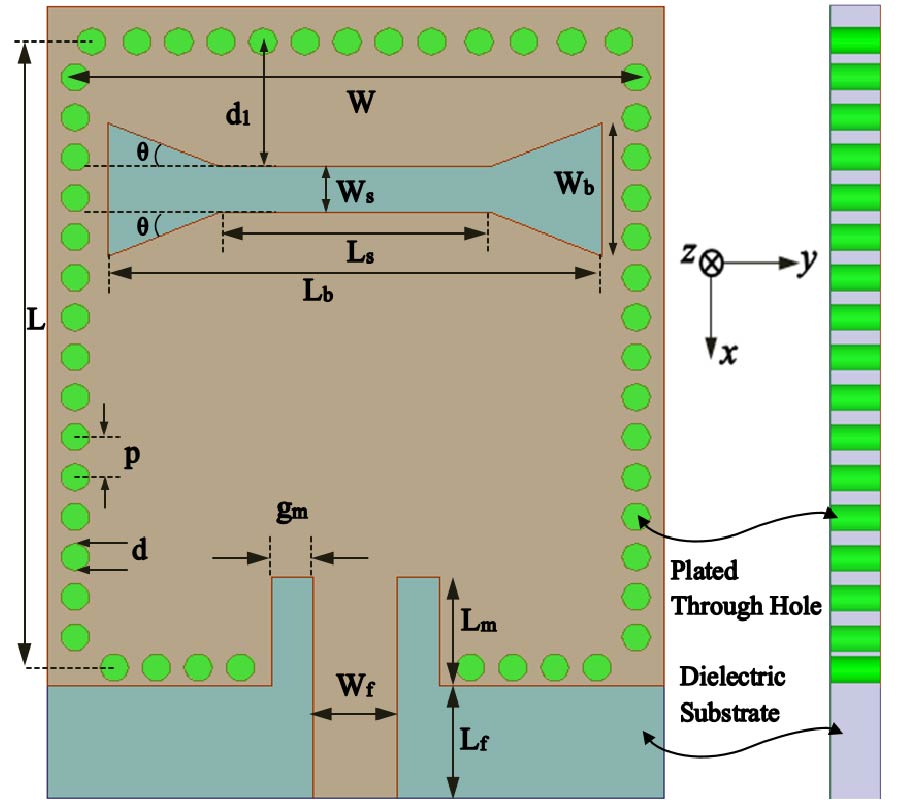
A band-pass filter using spoof surface plasmon polaritons (SSPPs) and half-mode substrate integrated waveguide (HMSIW) for Ka-band RADAR application is proposed. In order to achieve the band-pass response, an HMSIW structure with high pass response and SSPPs with band-stop response are combined. Moreover, to investigate effects of geometric dimensions on the frequency characteristics of the proposed band-pass filter are examined by parametric analysis. It has been observed that lower cut-off and upper frequencies can be individually controlled just by changing the structural parameters. High Frequency Structure Simulator (HFSS) software was utilized to simulate the proposed structure. HFSS is the simulation tool for complex 3-D geometries and uses the finite element method (FEM). To validate the functionality, the proposed band-pass filter is fabricated on the dielectric material RT duroid 5880 with the dielectric constant εr = 2.2, height h = 0.508 mm, and dissipation factor tanδ = 4 × 10⁻⁴. The measured result shows return loss better than -10 dB and insertion loss less than 1.25 dB with the 3 dB fractional bandwidth (FBW) of 44.02% at the center frequency of 7.95 GHz.
SPOOF SURFACE PLASMON POLARITONS AND HALF-MODE SUBSTRATE INTEGRATED WAVEGUIDE BASED COMPACT BAND-PASS FILTER FOR RADAR APPLICATION
2021-02-08
PIER Letters
Vol. 96, 73-80
Extremely Close Integration of Dual Band Sub-6 GHz 4G Antenna with Unidirectional mmWave 5G Antenna
Shakeel Ahmad Malik , Khalid Muzaffar , Ajaz Hussain Mir and Ayaz Hassan Moon
An extremely close integration of a dual band sub-6 GHz 4G antenna with a 28 GHz 5G antenna is proposed in this article. Firstly, a dual band 4G LTE (Long term Evolution) antenna is designed on an inexpensive substrate. The proposed antenna operates in the 2.5 GHz and 3.5 GHz LTE bands. The antenna has dimensions of 63 x 5.6 x 0.5 mm3, indicating an electrically small design. As the width of the antenna is less than 7 mm, it could be easily mounted on commercial mobile devices. The patterns for both the bands are almost omnidirectional as desired by the low frequency antennas. The proposed antennas do not carry any additional miniaturization or tuning circuitry hence simplifying fabrication process. Secondly, an angled dipole with Yagi topology is proposed, which works in the 28 GHz mmWave 5G band. The angled dipole has dimensions 28.3 x 5.6 x 0.5 mm3, which is also electrically compact and has a high front to back ratio. The microwave and millimetre wave antennas are placed orthogonally for minimal mutual coupling. The characteristics of both the antennas are not affected by the presence of the other element. Detailed results are shown in this article.
EXTREMELY CLOSE INTEGRATION OF DUAL BAND SUB-6 GHZ 4G ANTENNA WITH UNIDIRECTIONAL MMWAVE 5G ANTENNA
2021-02-07
PIER C
Vol. 109, 205-216
System of Material Objects in Electrodynamic Volumes
Mikhail Nesterenko , Viktor A. Katrich , Sergey L. Berdnik and Victor I. Kijko
In general, the problem of the excitation (radiation, scattering) of electromagnetic fields by a system of finite-dimensional material objects in arbitrary electrodynamic volumes is formulated. On the basis of the impedance concept, the problem is reduced to solving two-dimensional integral equations for electric surface currents on material objects. A physically correct transition from the obtained integral equations to a system of one-dimensional equations for currents on electrically thin impedance vibrators (monopoles) with electrophysical and geometric parameters that can be irregular along their length is made. As an example, a system of two monopoles with a variable surface impedance located in a rectangular waveguide is considered. The problem was solved by the generalized method of induced electromotive forces (EMF). A distinctive feature of this method is that the current distribution functions found by the asymptotic averaging method are used to solve integral equations for currents. The numerical and experimental results concerning electrodynamic characteristics of the structure under consideration are presented.
SYSTEM OF MATERIAL OBJECTS IN ELECTRODYNAMIC VOLUMES
2021-02-07
PIER C
Vol. 109, 187-203
Innovative Microwave Design of Frequency-Independent Passive Phase Shifter with LCL-Network and Bandpass NGD Circuit
Jamel Nebhen and Blaise Ravelo
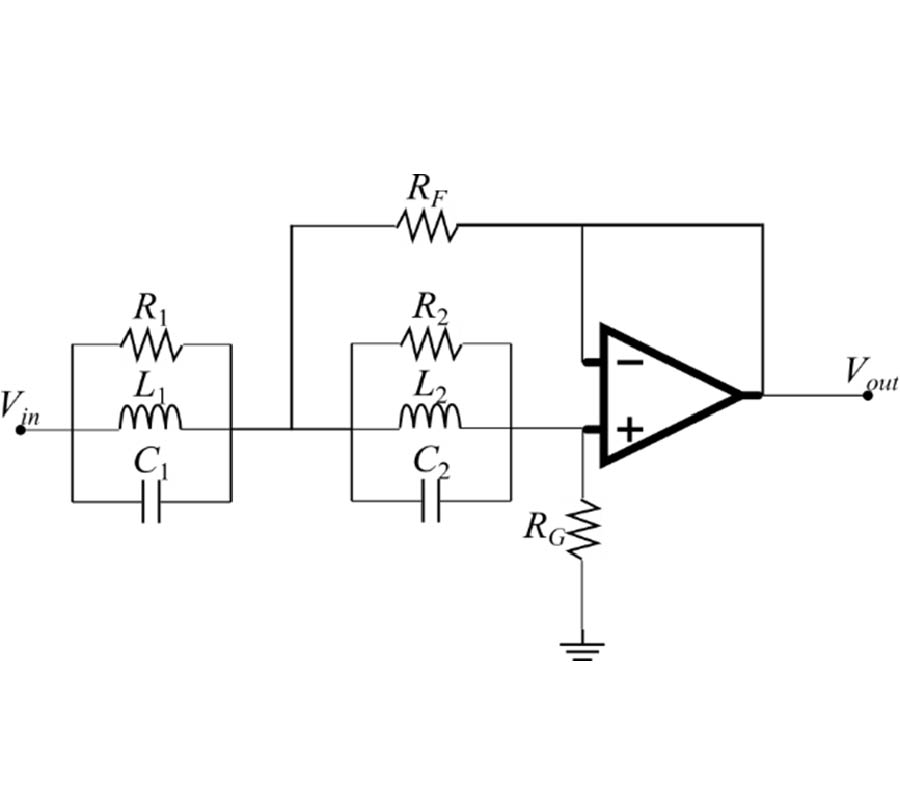
The present paper develops an application of the bandpass (BP) negative group delay (NGD) circuit for the design of an independent frequency phase shifter (PS). The design principle of the innovative PS is constituted by an inductor-capacitor-inductor (LCL) T-shape passive cell in cascade with RLC-network series-based BP NGD circuits. The S-matrix analytical model of the LCL-NGD PS is established in function of the circuit elements. Then, the design equations of the PS elements in the function of the expected PS value and center frequency are formulated. The NGD PS topology is validated with a comparison between the calculated and simulated results of phase, transmission coefficient, and reflection coefficients. As expected, a very good correlation between the analytical model and the simulation is confirmed by the obtained results. It is found that the LCL-NGD PS presents an outstandingly flat phase shift of -120°±5° with 1.2 GHz center frequency. The LCL-NGD PS operates with about 18% relative bandwidth. The PS reflection coefficient presents a magnitude flatness around -3±1.5 dB. Moreover, the reflection coefficient is kept better than -15 dB. The sensitivity of the LCL-NGD PS performances over the NGD circuit element ±5% relative variation is studied. It is found how the PS value and center frequencychange with the R, L, and C components of the NGD circuit.
INNOVATIVE MICROWAVE DESIGN OF FREQUENCY-INDEPENDENT PASSIVE PHASE SHIFTER WITH LCL-NETWORK AND BANDPASS NGD CIRCUIT
2021-02-07
PIER M
Vol. 101, 9-23
Spatial Magnetic Field Calculations for Coreless Circular Coils with Rectangular Cross-Section of Arbitrary Turn Numbers
Yiming Wang , Xu Xie and Hengfeng Wang
In a wireless magnetic induction communication system, the magnetic field distribution of the current-carrying coil affects the communication effect between the communication transceiver and receiver. In the study of magnetic field distribution, it was found that magnetic induction intensity and magnetic flux were important parameters to measure the effectiveness of communication. Aiming at the circular coils with rectangular cross-section of any turn numbers, this paper proposed an improved algorithm to calculate the magnetic induction intensity at any spatial position based on Biot-Savart law. At the same time, the calculation formula of the magnetic flux at the receiving point was also given. The coils were modeled and simulated with COMSOL software. The correctness of the improved algorithm was verified and compared with the traditional formula and simulation results, especially in the near field, which provided an important theoretical support for the further study of mutual inductance in the wireless magnetic induction communication system.
SPATIAL MAGNETIC FIELD CALCULATIONS FOR CORELESS CIRCULAR COILS WITH RECTANGULAR CROSS-SECTION OF ARBITRARY TURN NUMBERS
2021-02-06
PIER B
Vol. 91, 9-17
Diffraction Radiation Generated by a Density-Modulated Electron Beam Flying Over the Periodic Boundary of the Medium Section. II. Impact of True Eigen Waves
Yuriy Sirenko , Seil S. Sautbekov , Nataliya Yashina and Kostyantyn Sirenko
This paper is the continuation and development of the discussion started in our previous work with the same title. For the first time, eigen waves of the plane boundary separating vacuum and an artificial plasma-like medium are considered in reasonably substantiated way and in a sufficiently extensive and profound volume. The possibility of extending the results obtained for a plane boundary to the case of a weakly profiled periodically uneven boundary is shown. This paper demonstrates the potential and urge to use the analytical results in the studies of the resonant transformation of the field of a plane, density modulated electron beam flying over a periodically uneven boundary of a natural or artificial medium in the field of bulk outgoing waves.
DIFFRACTION RADIATION GENERATED BY A DENSITY-MODULATED ELECTRON BEAM FLYING OVER THE PERIODIC BOUNDARY OF THE MEDIUM SECTION. II. IMPACT OF TRUE EIGEN WAVES
2021-02-05
PIER Letters
Vol. 96, 65-72
A Compact Dual Band Dual Polarized Monopole Antenna with Enhanced Bandwidth for C, X, and Ku Band Applications
Reshmi Dhara
This article presents a compact, single feed dual-band dual-polarized (DBDP) microstrip antenna. The proposed design involves an inverted Y-shaped radiating patch and a rectangular open-loop positioned near its right corner that creates mutual coupling to attain wideband circular polarization (CP). To achieve enhanced axial ratio bandwidth (ARBW), a semi-rectangular ground plane with two asymmetric truncated L-shaped slots has been used. An L-shaped slotted quarter wave microstrip line feed is used here for broader ARBW and proper impedance matching. The measured dual impedance bandwidths (IBW) in the range 5.85-6.52 GHz (centre resonance frequency frc1 = 6.19 GHz, 10.66%) in lower frequency region and 7.25-13.64 GHz (frc2 = 10.445 GHz, 61.18% bandwidth) in higher frequency region. The two ARBW bands span over 7.22-10.99 GHz (fc1 = 9.105 GHz, 41.41%) and 11.67 GHz-12.25 GHz (fc2 = 11.96 GHz, 4.85%). The measured peak gains between 3.20 and 4.96 dBi over the entire IBW range makes the LP and CP bands suitable for ITS (5.9 GHz), U-NII-5 of 6 GHz band, some C-band, ITU-8 GHz, some X-band, and Ku-band applications.
A COMPACT DUAL BAND DUAL POLARIZED MONOPOLE ANTENNA WITH ENHANCED BANDWIDTH FOR C, X, AND KU BAND APPLICATIONS
2021-02-05
PIER
Vol. 170, 97-128
A Fine Scale Partially Coherent Patch Model Including Topographical Effects for GNSS-R DDM Simulations
Haokui Xu , Jiyue Zhu , Leung Tsang and Seung Bum Kim
In this paper, we propose a fine scale partially coherent patch model (FPCP) for GNSS-R land applications for soil moisture retrieval. The land surface is divided into coherent planar patches on which microwave roughness is superimposed. The scattered waves of the coherent patch are decomposed into the coherent specular reflection and diffuse incoherent scattering. A fine scale of 2 meter patch size is chosen for the coherent patch to be applicable to complex terrain with large varieties of topographical elevations and with small to large topographical slopes. The summation of scattered fields over patches is carried out using physical optics. The phase term of the scattered wave of each patch is kept so that correlation scattering effects among patches are accounted for. Results are illustrated for power ratio for areas near the specular point and areas far away from the specular point. Comparisons are made with the radiative transfer geometric optics model. DDM simulations are performed with good agreement with CYGNSS data.
A FINE SCALE PARTIALLY COHERENT PATCH MODEL INCLUDING TOPOGRAPHICAL EFFECTS FOR GNSS-R DDM SIMULATIONS
2021-02-05
PIER C
Vol. 109, 169-186
Compact UWB Slotted Monopole Antenna with Diplexer for Simultaneous Microwave Energy Harvesting and Data Communication Applications
Geriki Polaiah , Krishnamoorthy Kandasamy and Muralidhar Kulkarni
This paper proposes a new integration of compact ultra-wideband (UWB) slotted monopole antenna with a diplexer and rectifier for simultaneous energy harvesting and data communication applications. The antenna is composed of four symmetrical circularly slotted patches, a feed line, and a ground plane. A slotline open loop resonator based diplexer is implemented to separate the required signal from the antenna without extra matching circuit. A microwave rectifier based on the voltage doubler topology is designed for RF energy harvesting. The prototypes of the proposed antenna, diplexer, and rectifier are fabricated, measured, and compared with the simulation results. The measurement results show that the fractional impedance bandwidth of proposed UWB antenna reaches 149.7% (2.1GHz-14.6 GHz); the diplexer minimum insertion losses (|S21|, |S31|) are 1.37 dB and 1.42 dB at passband frequencies; the output isolation (|S23|) is better than 30 dB from 1 GHz to 5 GHz; and the peak RF-DC conversion efficiency of the rectifier is 32.8% at an input power of -5 dBm. The overall performance of the antenna with a diplexer and rectifier is also studied, and it is found that the proposed new configuration is suitable for simultaneous microwave energy harvesting and data communication applications.
COMPACT UWB SLOTTED MONOPOLE ANTENNA WITH DIPLEXER FOR SIMULTANEOUS MICROWAVE ENERGY HARVESTING AND DATA COMMUNICATION APPLICATIONS
2021-02-03
PIER Letters
Vol. 96, 59-64
Conductor Backed Co-Planar Waveguide Inspired S-Band Filter Using Multi-Ring Resonators
Souprayen Oudaya Coumar
A conductor backed CPW-based S-band filter using Multiple Ring Resonators (MRR) is presented. The resonator is coupled with the feed line through inter-digital coupling. Square resonator structure joined with inter-digital coupling on both sides on conductor plane and multiple ring resonators implemented with equal spacing at the ground plane forms a conductor backed CPW filter model. Adjusting the size and gap factor of MRR, the wide tuning ranges of desired frequencies are achieved. The filter has an outstanding bandwidth range from (2-4) GHz which fits for Satellite S-Band applications. The S-Band has low insertion loss (-0.95 dB), lower return loss (-35 dB), wide bandwidth (fractional bandwidth 66.6%) at the center frequency 3 GHz are obtained. The size of the filter performance characteristics are investigated and compared with measured results. The complete measurement of filter is (39×7.2×1.6) mm. The measured values of S11 and S21 are about -25 dB and -1.92 dB respectively.
CONDUCTOR BACKED CO-PLANAR WAVEGUIDE INSPIRED S-BAND FILTER USING MULTI-RING RESONATORS
2021-02-03
PIER C
Vol. 109, 153-168
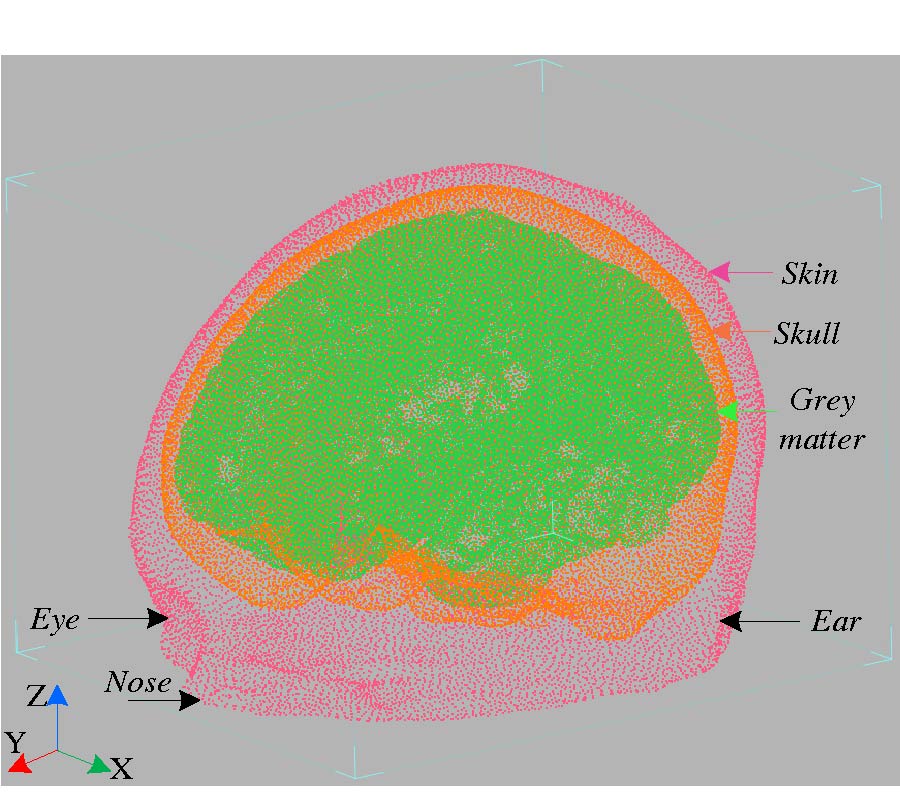
A Preclinical System for Enhancing the Efficiency of Microwave Breast Cancer Hyperthermia Therapy Using Dielectric Matched Layer and Convex Lenses
Maha Raof Abdel-Haleem , Tamer Gaber Mohammed Abouelnaga , Mohammed Abo-Zahhad and Sabah M. Ahmed
Convex lenses can be used in adjuvant with microwave sources to produce appropriate focus spots for breast cancer hyperthermia therapy. A preclinical system was assessed using a horn antenna together with a convex lens. The horn antenna was built to accommodate the lens size so as to minimize wave spillover. Here, a modified hyperthermia system was tested on a hemisphere phantom of scattered fibro glandular breast tissue with cancer stages I & II. The focus spots were at different locations and depths (up to 2.7 cm) under the skin layer. Transmission and reflection coefficients at the air-breast phantom interface were calculated to determine the best operating frequency (2.45 GHz) for efficient power absorption. Based on these computations, an external dielectric matched layer was added onto the skin of the breast phantom to decrease reflection that would occur between water and skin. This arrangement increased wave transmission inside the breast without increasing applicator input feed. The system could heat regions of tumor at various locations independently using only one applicator. The whole system was fabricated, and measurements were taken to validate the simulated and analytical results.
A PRECLINICAL SYSTEM FOR ENHANCING THE EFFICIENCY OF MICROWAVE BREAST CANCER HYPERTHERMIA THERAPY USING DIELECTRIC MATCHED LAYER AND CONVEX LENSES
2021-02-03
PIER C
Vol. 109, 139-152
A Bidirectional LSTM-Based Prognostication of Electrolytic Capacitor
Delanyo Kwame Bensah Kulevome , Hong Wang and Xuegang Wang
Knowing the state-of-health (SOH) of equipment, device or component is very essential for the secure and dependable operation of a system. Electrolytic capacitors are undoubtedly one of the essential components of power supply modules used in aerial and underwater vehicles, and every equipment requires a conversion of voltage from one level to another. This has encouraged research into the components of the power supply used in such systems of which electrolytic capacitor is of interest in this study. In this paper, we explore a new approach to implementing prognostics and health management (PHM) for electrolytic capacitors and propose a method of estimating the SOH leading to the prediction of the remaining useful life (RUL). This is accomplished by using a bidirectional long short-term memory (BLSTM) network to capture the degradation trends. We demonstrate the power and leverage that this method brings to bear in encoding time-domain dependencies in accurately estimating the SOH bereft of state models as employed in traditional methods. We validate the proposed approach using capacitor data recorded at different electrical over-stress accelerated aging conditions. The proposed method surpasses other existing methods in RUL prediction as indicated by the error and relative accuracy.
A BIDIRECTIONAL LSTM-BASED PROGNOSTICATION OF ELECTROLYTIC CAPACITOR
2021-02-02
PIER
Vol. 170, 79-95
High Efficiency Multi-Functional All-Optical Logic Gates Based on MIM Plasmonic Waveguide Structure with the Kerr-Type Nonlinear Nano-Ring Resonators
Yaw-Dong Wu
In this paper, high efficiency multi-functional all-optical logic gates based on a metal-insulator-metal (MIM) plasmonic waveguide structure with Kerr-type nonlinear nano-ring resonators are proposed. The proposed structure consists of three straight input ports, eight nano-ring resonators filled with the Kerr-type nonlinear medium, and one straight output port. By fixing the input signal power and properly changing the control power, it can be used to design high efficiency multi-functional all-optical logic gates. The numerical results show that the proposed Kerr-type nonlinear plasmonic waveguide structures could really function as all-optical XOR/NXOR, AND/NAND, and OR/NOR logic gates in the optical communication spectral region. The transmission efficiency of the high logic state is higher than 95%, and that of the low logic state is about 0% at the wavelength 1310nm. The performance of the proposed logic gates was analyzed and simulated by the finite element method (FEM).
HIGH EFFICIENCY MULTI-FUNCTIONAL ALL-OPTICAL LOGIC GATES BASED ON MIM PLASMONIC WAVEGUIDE STRUCTURE WITH THE KERR-TYPE NONLINEAR NANO-RING RESONATORS
2021-02-01
PIER C
Vol. 109, 111-123
A Novel Wideband Beam Reconfigurable Magneto-Electric Dipole Patch Antenna
Min Wang , Huifeng Yang , Nan Hu , Wenqing Xie , Yuxin Mo , Zhenghan Chen , Zhongyuan Liu and Zhengchuan Chen
A novel wideband beam reconfigurable magneto-electric dipole patch antenna is presented in this paper. The proposed antenna consists of two H-shaped patches, two folded patches, an E-shaped feeding structure, a side-slotted ground, and a large reflective ground. Two H-shaped patches are horizontally placed on both sides of the feed structure, and two folded patches are assembled vertically to the upper ground, which are designed as the magneto-electric dipole structure. Two symmetrically sided slots are etched on the upper ground to reduce the profile, and an E-shaped strip is employed in the feeding structure to broaden the bandwidth. To suppress the backward radiation, a lower ground with large size is designed as a reflector. Four binary switches are symmetrically integrated on the stubs of H-shaped patches. By switching them ON or OFF simultaneously, the current distribution is changed to achieve beam reconfigurability. Finally, a set of antenna prototype with four configurations is fabricated and measured. The measured results show that maximum impedance bandwidth achieves up to 77.8% at 2.7 GHz from 2.0 GHz to 4.1 GHz. At 2.7 GHz, the measured peak gains are 8.4 dBi, 9.3 dBi, 8.1 dBi, and 8.7 dBi, where the beams point to -21˚, 0˚, 21˚, and 34˚, respectively in E-plane.
A NOVEL WIDEBAND BEAM RECONFIGURABLE MAGNETO-ELECTRIC DIPOLE PATCH ANTENNA