Search Results(13789)

2021-02-20
PIER C
Vol. 110, 81-89
Gain Flattening of Wideband FPC Antenna Using Elliptical and Rectangular Slotted AMC Layers
Nayana Chaskar , Shishir Jagtap , Rajashree Thakare and Rajiv Kumar Gupta
In this paper, the gain flattening of a wideband Fabry-Perot cavity (FPC) antenna, using truncated partially reflecting surface (PRS) and slotted elliptical and rectangular shape artificial magnetic conductor (AMC) layers is proposed. FPC is fed using a metal plated microstrip antenna (MSA) which comprises three layers-elliptical slotted rectangular AMC-I layer, truncated PRS layer, and rectangular slotted elliptical AMC-II layer. AMC-II layer is designed complementary to AMC-I layer to obtain gain variation < 1dB over wide frequency band. Elliptical shaped AMC-II and truncated PRS reduce the reflected fields towards ground and thus improve front to back lobe ratio (F/B) and side lobe level (SLL). These layers resonate at higher frequency and thus reduce gain variation and couple electromagnetically with MSA and AMC-I layer to provide wide bandwidth (BW). The proposed antenna provides S11 < -10 dB, 17.2 dBi peak gain with gain variation < 1.2 dB over 5.7-6.4 GHz frequency band, which covers 5.725-5.875 GHz ISM and 5.9-6.4 GHz satellite uplink C band. Broadside radiation patterns have SLL < -19 dB, cross polarization (CPL) < -17 dB, and F/B > 20 dB with wide 3 dB gain BW of 15.2%. The overall antenna dimensions are 2.3λ0x2.75λ0x0.5λ0, where λ0 is the free space wavelength corresponding to 5.8 GHz, central frequency of ISM frequency band. The measured results of the prototype fabricated structure agree with simulation ones.
GAIN FLATTENING OF WIDEBAND FPC ANTENNA USING ELLIPTICAL AND RECTANGULAR SLOTTED AMC LAYERS
2021-02-19
PIER C
Vol. 110, 67-80
Dual Coaxial Probes in Transmission Inserted by Dielectric with Two Different Thicknesses to Extract the Material Complex Relative Permittivity: Discontinuity Impacts
Franck Moukanda Mbango , Fabien Ndagijimana and Aubin Lauril Lomanga Okana
After a thorough investigation, this paper introduces a novel and simple radiofrequency material characterization technique. For this study's purposes, two probes were developed and separated by the sample under test (SUT) with an inhomogeneous test cell. Furthermore, the discontinuity impacts at the probe, SUT interfaces, were also studied. The investigation uses the transmission process through the principle of two different SUT thicknesses to measure its relative permittivity and loss tangent. The technique is based on using the lumped elements of an equivalent circuit of the entire test cell and covers 1 MHz-2 GHz. With the SUT, placed between two metal probes and another metallization, placed under its thickness on an opposite side to improve the loss tangent acquisition level, the cascading chain matrix (CCM) is used to get the final parameters. The thickness changing makes it possible to overcome the contact interface effects probe-sample. A mathematical model has also been presented through the fitting procedure. The new technique has been validated with three materials: Rogers RO4003C, FR-4 HTG-175, and Alumina 99.6%. The SUT complex relative permittivity extraction makes the new approach suitable for the telecommunication industry and many others. The method is also ideal for materials with thickness sizing up to 3 mm around.
DUAL COAXIAL PROBES IN TRANSMISSION INSERTED BY DIELECTRIC WITH TWO DIFFERENT THICKNESSES TO EXTRACT THE MATERIAL COMPLEX RELATIVE PERMITTIVITY: DISCONTINUITY IMPACTS
2021-02-18
PIER Letters
Vol. 96, 129-136
CRLH LWA Using Mushroom-Like Structures for Improved Radiation Performances
Huan Zhang
A composite right/left-handed (CRLH) leaky wave antenna (LWA) using double mushroom-like structures is proposed. With a proper arrangement of the left-handed structures, desirable cross-polarization performance in two orthogonal planes can be obtained based on the differential excitation principle. The CRLH performance of the cascaded LWA is demonstrated, and its improved radiation performance is clarified. Measured results indicate that the proposed antenna operates in 9.7-16.4 GHz with a beam scanning range from -71° to +31°. The cross-polarization levels are less than -30 dB and -20 dB in the beam scanning plane and non-beam-scanning plane, respectively.
CRLH LWA USING MUSHROOM-LIKE STRUCTURES FOR IMPROVED RADIATION PERFORMANCES
2021-02-18
PIER Letters
Vol. 96, 121-128
Ultraviolet Vortex Generation through All-Dielectric Nano-Antennas for Free Space Optical Communication
Arslan Asim
Metamaterials have revolutionized the research in conventional electromagnetics. They display unique properties which can be used for the manipulation of electromagnetic waves in unexpected ways. In this research, a diamond nano-antenna is designed and optimized using the CST Microwave Studio, which uses Finite Difference Time Domain (FDTD) method. The designed unit cell shows high polarization conversion rates (PCR) for ultraviolet (UV) frequencies (especially the UV-B band) whilst covering Panchatram-Berry (PB) phase. The unit cell is then used to design metasurfaces that generate light beams carrying Orbital Angular Momentum (OAM) of different orders. Through the design of two dimensional metamaterial surfaces, the behavior of electromagnetic beams can be changed on sub-wavelength scale. This has led to a number of applications related to nanotechnology. A vortex beam carries Orbital Angular Momentum (OAM) which has played a vital role in increasing the bandwidth and data rate of optical communication systems. Therefore, OAM beams having different topological charges have been generated at 294 nm to propose an improvement in Free Space Optical (FSO) communication. Optical links also function as a suitable substitute for applications where Radio Frequency (RF) communications may not be effective. The proposed theoretical model is expected to open new horizons in optical communication by incorporating the use of nanoscale devices with high efficiencies in the ultraviolet regime.
ULTRAVIOLET VORTEX GENERATION THROUGH ALL-DIELECTRIC NANO-ANTENNAS FOR FREE SPACE OPTICAL COMMUNICATION
2021-02-18
PIER M
Vol. 101, 69-78
Millimeter-Wave Frequency-Diverse Imaging with Phased Array Intended for Communications
Mikko K. Leino , Jan Bergman , Juha Ala-Laurinaho and Ville Viikari
This paper presents a recent progress in a millimeter-wave imaging done with a potential 5G base-station phased-array antenna exhibiting frequency-diverse, non-focused beams. The presented imaging system operates in 24-32 GHz band and is the first realization where phased arrays primarily developed for 5G communications are utilized in a frequency-diverse imaging application. The image reconstruction method solves the linear inverse problem with an iterative algorithm, and several images have been reconstructed based on the measurement data. Currently, a metallic sphere can be successfully located in the target space. However, future work is still required, and the paper further discusses the possibilities and restrictions of the current imaging setup.
MILLIMETER-WAVE FREQUENCY-DIVERSE IMAGING WITH PHASED ARRAY INTENDED FOR COMMUNICATIONS
2021-02-18
PIER M
Vol. 101, 59-68
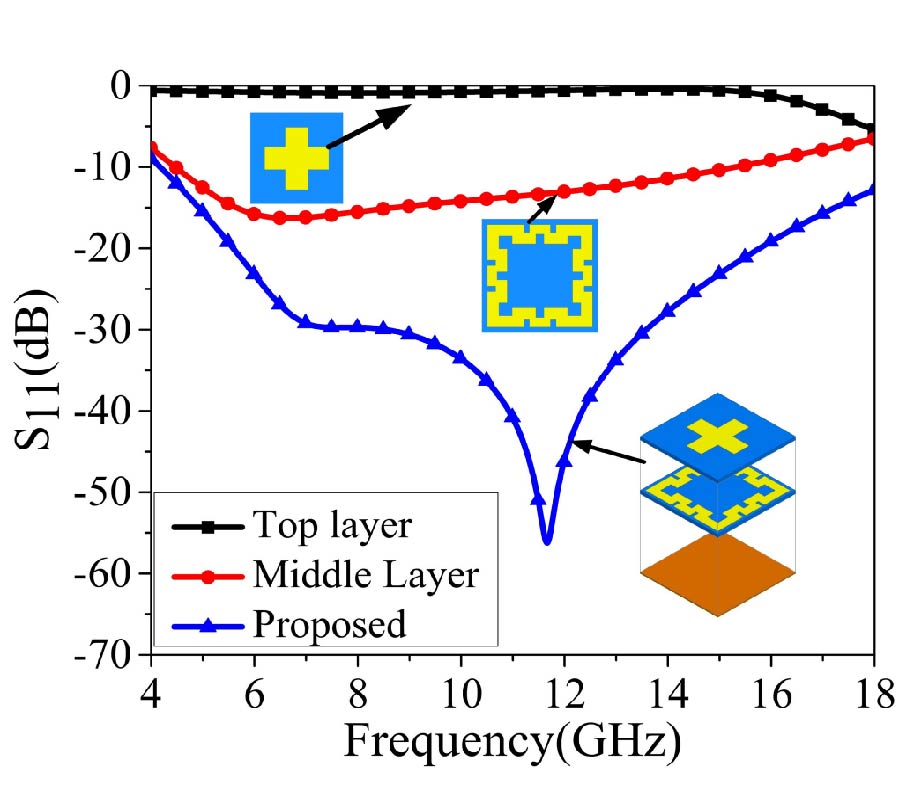
Broadband and High-Aperture Efficiency Fabry-Perot Antenna with Low RCS Based on Nonuniform Metamaterial Superstrate
Hui-Fen Huang and Qi-Sheng Fan
Due to the nonuniform Electromagnetic (EM) field distribution over the superstrate, a Fabry-Perot Resonant Antenna is normally with high directivity but relatively low aperture efficiency when its aperture size is electrically large. In this paper, a Fabry-Perot resonator cavity antenna (FPCA) with a nonuniform metamaterial superstrate is proposed. The nonuniform metamaterial superstrate is a nonuniform double-sided printed dielectric, in which the upper surface is used for wideband RCS reduction, and the bottom surface is the nonuniform partially reflective surface (PRS) of FPRA for wideband and high aperture efficiency performances. Wideband RCS reduction is realized by designing the phase differences 90˚ in turn among three adjacent frequency-selective surfaces. The wideband 3 dB gain bandwidth and high aperture efficiency performances are obtained by designing the PRS with a positive reflection phase gradient vs frequency and a negative transverse-reflection magnitude gradient, respectively. The measured results show that the gain of the proposed antenna is 11.5 dBi greater than that of the primary source antenna with a peak value 15.5 dBi at 9.2 GHz. The aperture efficiency is 73.3%. The 3-dB gain bandwidth is from 8.75 to 11.47 GHz (26.9%), and the RCS reduction can be obtained effectively from 8.2 to 20 GHz (83.7%).
BROADBAND AND HIGH-APERTURE EFFICIENCY FABRY-PEROT ANTENNA WITH LOW RCS BASED ON NONUNIFORM METAMATERIAL SUPERSTRATE
2021-02-17
PIER Letters
Vol. 96, 113-119
A Compact Broadband Folded Dipole Antenna Element with Ball Grid Array Packaging for New 5G Application
Xiubo Liu , Wei Zhang , Dongning Hao and Yanyan Liu
A compact broadband folded dipole antenna element with a ball grid array packaging is proposed in this letter. The compact antenna element is fabricated on a low-cost FR4 substrate consisting of only one dielectric layer. The solder balls are mounted on the square ground metal plane of the antenna element to form the ball grid array (BGA) packaging, which allows the antenna element to be surface mounted with other surface-mount devices (SMDs). Furthermore, ball grid array packaging has great potential for minimizing the size of antenna elements. The dimension of the proposed antenna element is only 6 mm × 6 mm × 1.6 mm. Parameter analysis shows that the solder balls have little effect on antenna performance. The proposed folded dipole antenna element is fed by a 50 Ω grounded coplanar waveguide (GCPW) transmission line on the evaluation board. The antenna prototype has been designed, analyzed, and manufactured. Measured results of the prototype show that the -10 dB impedance bandwidth is 45.4 % (22.3-35.4 GHz), and the peak gain achieves 6.62 dBi at 35 GHz. The measurement results show that the proposed antenna element has great potential for the 5G millimeter wave application.
A COMPACT BROADBAND FOLDED DIPOLE ANTENNA ELEMENT WITH BALL GRID ARRAY PACKAGING FOR NEW 5G APPLICATION
2021-02-17
PIER C
Vol. 110, 55-66
Miniature Folded Dipole in Rotational Symmetry for Metal Tag Design
Shao-Ming Chiang , Tong-Lin Lee , Eng Hock Lim , Pei-Song Chee , Yong Hong Lee , Fwee-Leong Bong , Yeong-Nan Phua and Boon-Kuan Chung
In this paper, a miniature folded dipole is proposed for designing a metal-mountable UHF RFID tag. The proposed tag antenna is low in profile and it has a compact size of 40 mm × 40 mm ×3.1 mm (0.12λ × 0.12λ × 0.009λ). Folding the dipole arms into a two-fold rotational symmetrical style can miniaturize the tag footprint for achieving high compactness. It has been found that the capacitive coupling mechanism between the rotational symmetrical radiating arms is effective in enhancing the vertical radiation, which subsequently improves the achievable read distance in the boresight direction. Also, an incorporated circular loop can provide additional inductance for achieving good impedance matching with the RFID chip. For the proposed tag antenna, a full ground plane is inserted underneath the radiator for isolating it from the backing metal, making the tag tolerant to the metallic platform. The proposed tag antenna is able to achieve a maximum read distance of 7 m at 4 W EIRP when it is tested on metal.
MINIATURE FOLDED DIPOLE IN ROTATIONAL SYMMETRY FOR METAL TAG DESIGN
2021-02-17
PIER M
Vol. 101, 47-58
Contact ECG Recording Using Copper and E-Textile Based Flexible Dry Electrodes
Kai Ren , Ruyu Ma , Mohammad Ranjbar Nikkhah , Steve Eggleston , Yu-Jiun Ren and Nader Behdad
We present experiments of contact electrocardiograms (ECG) recording using copper and e-textile-based flexible dry electrodes. In this work, dry electrodes with different shapes, sizes, and materials were designed and fabricated. In cardiac monitoring using these flexible dry electrodes, three different conditions were considered, which are sitting, standing, and walking. To evaluate the performances of the fabricated dry electrodes, average-to-variation ratios (AVR) of the recorded ECG signals measured using the flexible dry electrodes were calculated and compared with those measured using the commercially-available wet electrodes in all three conditions. The AVR results demonstrate that the dry electrodes have a similar performance as the commercially-available wet electrodes in the sitting and standing conditions and a better performance in the walking condition. These results suggest that it is possible to weave dry e-textile-based electrodes in normal clothing and use them for continuous monitoring of ECG signals in different conditions.
CONTACT ECG RECORDING USING COPPER AND E-TEXTILE BASED FLEXIBLE DRY ELECTRODES
2021-02-16
PIER C
Vol. 110, 39-54
Split Ring Slot Loaded Compact CPW-Fed Printed Monopole Antennas for Ultra-Wideband Applications with Band Notch Characteristics
Kavneet Kaur , Ashwani Kumar and Narinder Sharma
A compact CPW-fed ultra-wideband monopole antennas with band notch characteristics using Split Ring Slots (SRSs) are proposed in this manuscript. Initially, the antenna is designed by using a rectangular shaped patch, and it has been modified to obtain enhanced impedance bandwidth (VSWR ≤ 2) throughout the entire UWB frequency range. Further, the notch band element (split ring slot) has been introduced in the geometry of proposed antenna to generate the band rejection at WLAN frequency centered at 5.3 GHz (5.15-5.81 GHz). Another antenna has been designed by varying the dimensions of SRS to get the rejection of frequency at an X-band satellite communication system centered at 7.4 GHz (7.16-7.71 GHz). The overall size of proposed UWB antennas is compact (18 × 18 mm2), and it is designed on a low cost FR4 glass epoxy substrate with 1.6 mm thickness and 4.4 dielectric constant. The proposed antennas with and without a notch filter are designed by using HFSS V13 simulator and fabricated for the validation of simulated results. Experimental and simulated results are compared and found in reasonable agreement with each other.
SPLIT RING SLOT LOADED COMPACT CPW-FED PRINTED MONOPOLE ANTENNAS FOR ULTRA-WIDEBAND APPLICATIONS WITH BAND NOTCH CHARACTERISTICS
2021-02-16
PIER C
Vol. 110, 27-38
A Permittivity Measurement Method Based on Back Propagation Neural Network by Microwave Resonator
Honggang Hao , De-Xu Wang and Zhu Wang
In order to solve the problem of the poor performance of the traditional microwave resonance method in multi-parameter fitting data processing, a permittivity measurement method based on Back Propagation (BP) Neural Network algorithm is proposed, which introduces the Neural Network algorithm in data processing of microwave resonance method for the first time. In order to verify the effectiveness of this method in measuring permittivity, a microstrip line structure is used as a microwave resonator. It achieves high sensitivity (4.62%) by loading periodically arranged open resonant rings. On this structure, the reflection coefficients S11 of different material samples are simulated as the data of neural network. The amplitude and phase of S11 and resonant frequency f are taken as the input layer of the neural network, respectively. The dielectric constant and dielectric loss are taken as the output to establish the neural network model. The simulated and measured results show that the dielectric constant and dielectric loss calculated by the model are basically consistent with the data provided by the manufacturer. The relative error of the dielectric constant is less than 0.6%, and the error of the dielectric loss is less than 0.0005. Compared with the traditional data processing of microwave resonance method, the introduction of BP neural network algorithm can significantly improve the accuracy of dielectric constant measurement.
A PERMITTIVITY MEASUREMENT METHOD BASED ON BACK PROPAGATION NEURAL NETWORK BY MICROWAVE RESONATOR
2021-02-16
PIER C
Vol. 110, 15-26
Analysis of a Nonlinear Magnetic Coupling Wireless Power Transfer System
Meng Wang , Li Ren , Yanyan Shi , Weina Liu and Hao Ran Wang
In near-field energy transmission, it has been proved that magnetic coupling wireless power transfer (MC-WPT) is a promising energy transmission method. Traditionally, the MC-WPT system is established based on a linear resonant circuit. Recently, it has been reported that nonlinear MC-WPT system shows more advantages. However, nonlinear characteristics of the nonlinear MC-WPT system are not fully recovered. In this paper, a nonlinear MC-WPT system which can be described by Duffing equation is presented. The mathematical model of the equivalent circuit is developed. The related nonlinear characteristics under the impact of driving force are investigated. It is found that the driving force has a direct impact on the system performance. The operation of the nonlinear MC-WPT system varies from periodic sinusoidal state to periodic non-sinusoidal state even to chaotic state when the driving force increases. It should be mentioned that the chaotic state should be avoided. Generally, the MC-WPT system should be operated in periodic sinusoidal state which only covers a small range of driving force. For the system operated in periodic non-sinusoidal state, a waveform correcting circuit is designed. The simulated and experimental results show that the restriction of the driving force on the operation of the system is eliminated with a waveform correcting circuit added. It is possible for the nonlinear MC-WPT system to be operated in a much wider range.
ANALYSIS OF A NONLINEAR MAGNETIC COUPLING WIRELESS POWER TRANSFER SYSTEM
2021-02-16
PIER C
Vol. 109, 275-287
A Triple-Band Antenna with a Metamaterial Slab for Gain Enhancement and Specific Absorption Rate (SAR) Reduction
Selvaraj Imaculate Rosaline
A compact triple-band antenna of size 20×13×1.6 mm3 for WLAN (2.4/5 GHz) and WiMAX (3.5 GHz) applications and a metamaterial slab for Specific Absorption Rate (SAR) reduction are proposed in this paper. The antenna comprises a rectangular patch with two conjoint square split rings, attached along its top edge, to excite two resonances in the 2.5 GHz and 5.5 GHz range. The antenna is also backed with a slotted ground plane structure to achieve miniaturization. The radiator is subsequently slotted to yield the third tone around 3.5 GHz. Several parameters are tuned independently to achieve the desired bands of resonance around (2.2-2.6) GHz, (3.40-3.60) GHz, and (5.0-6.9) GHz with impedance bandwidths of 17%, 5.5%, and 46%, respectively. To validate the simulated results, the designed antenna is fabricated and measured experimentally. Later, a metamaterial slab composed of a 5×3 array of pentagonal split-rings printed on a 20×13×1.6 mm3 FR-4 substrate is placed above the antenna at a suitable distance to increase the gain as well as to reduce the SAR. Inclusion of this slab improved the maximum radiation efficiency and gain of the proposed antenna from 65% and 2.7 dB to 80% and 3 dB. A cubical tissue model is designed and used for simulation. SAR reduction of 84.5% is inferred with the metamaterial slab. This paper has taken a cubical tissue model for SAR calculation, which can be further enhanced by taking a human phantom model in future.
A TRIPLE-BAND ANTENNA WITH A METAMATERIAL SLAB FOR GAIN ENHANCEMENT AND SPECIFIC ABSORPTION RATE (SAR) REDUCTION
2021-02-15
PIER Letters
Vol. 96, 105-111
A Dual Band-Notched Antenna for UWB Applications
Xiao-Yan Zhang , Huihui Xu , Yan Xie and Qiutong Wu
An ultra-wideband (UWB) flexible antenna with a dual band-notched property is designed in this letter. This antenna is fed by a coplanar waveguide (CPW) tapered transmission line to achieve an impedance bandwidth of 1.95-35 GHz for VSWR<3. A double C-shaped slot within the monopole radiation patch and two L-shaped slots etched on the ground are introduced to reject the bands of 3.5 GHz (3.1-3.9 GHz) and 5.5 GHz (4.7-5.74 GHz) respectively, which are assigned to WiMax and WLAN applications. A Rogers4350 substrate is used to realize a low profile (0.29λL×0.22λL×0.00065λL, where λL is the free-space wavelength of the lowest operating frequency). The measured results show that the antenna has a UWB omnidirectional radiation characteristic that is suitable for UWB wireless communications.
A DUAL BAND-NOTCHED ANTENNA FOR UWB APPLICATIONS
2021-02-15
PIER M
Vol. 101, 37-45
Laser Monitor for Studying the Combustion of Thin Layers of Metal Nanopowders
Fedor Alexandrovich Gubarev , Andrei Vladimirovich Mostovshchikov , Anatoliy Ignatievich Fedorov and Lin Li
In this paper, we propose a laser monitor with a horizontally located observation area for studying laser initiation and combustion of thin layers of metal nanopowders. Three configurations of the optical scheme with different inputs of igniting laser radiation and different magnifications are considered. Visualization of combustion of a 0.4 mm layer of aluminum nanopowder demonstrated the possibility of studying the surface of a nanopowder thin layer during combustion using a laser monitor. The bright glowing of the sample and the bright radiation of the igniting laser do not interfere with the imaging of the surface. The proposed system allows us to study surface changes caused by the propagation of combustion waves. It is demonstrated that in the region of laser initiation, combustion proceeds in one-stage, and combustion products are formed during laser action. Outside the initiation area, combustion proceeds in two stages. The results reveal the prospects for designing a laser monitor for studying the combustion of thinner layers of metal nanopowders.
LASER MONITOR FOR STUDYING THE COMBUSTION OF THIN LAYERS OF METAL NANOPOWDERS
2021-02-14
PIER Letters
Vol. 96, 97-103
Multi-Mode Substrate Integrated Waveguide Wideband Filter Design with Wide Stopband Rejection Using Complementary Split Ring Resonators and Defected Ground Structures
Halima Ammari , Farouk Grine , Mohamed Lahdi Riabi and Mohamed Toufik Benhabiles
This paper proposes a novel wideband filter based on a quintuple-mode substrate integrated waveguide (SIW) resonator. Two metallic vias loading a rectangular SIW cavity diagonal line are used to excite five resonant modes. A pair of the complementary split ring resonators (CSRRs) etched on the top plane to further control the degenerating modes. A quintuple-mode filter is implemented based on this resonator. One transmission zero (TZ) at the lower frequency side and three TZs at the upper frequency side were obtained to improve the filter selectivity. A seven-order filter with wide stopband rejection is investigated under the use of a pair of microstrip low-pass filters (LPFs). The proposed SIW cavity filter has been designed, manufactured, and measured as an experimental example to verify the proposed concept. Simulation and measurement results agree with 49.8% of fractional bandwidth at 5.3 GHz central frequency.
MULTI-MODE SUBSTRATE INTEGRATED WAVEGUIDE WIDEBAND FILTER DESIGN WITH WIDE STOPBAND REJECTION USING COMPLEMENTARY SPLIT RING RESONATORS AND DEFECTED GROUND STRUCTURES
2021-02-14
PIER B
Vol. 91, 19-37
Isolation Improvement Using Asymmetric Radiators and Ground Plane Diversity Mechanism in a Six-Element UWB MIMO Antenna Design
Aicha Mchbal , Naima Amar Touhami , Hanae Elftouh and Aziz Dkiouak
A compact six elements MIMO antenna is presented for UWB applications. The proposed MIMO array consists of non-identical monopole antennas with distinctive ground planes so as to nullify mutual coupling amid side-by-side elements. Also, by properly placing the antenna elements exploiting cross polarization diversity, a good isolation throughout the operating bandwidth is achieved. Moreover, two parasitic inverted L stubs in combination with small rectangular stubs are employed near the middle-placed radiators and corner placed radiators, respectively, in order to extend the frequency band and enhance the impedance matching. Results show a good reflection coefficient about -10 dB, a high isolation >20 dB, an envelope correlation coefficients <0.15, a high diversity gain equal to 9.3, and finally, a maximum value of efficiency for both used antenna elements which is about 78% and 60% with 6 and 5 dBi of gain, respectively. They validate the proposed MIMO antenna efficiency for UWB diversity applications.
ISOLATION IMPROVEMENT USING ASYMMETRIC RADIATORS AND GROUND PLANE DIVERSITY MECHANISM IN A SIX-ELEMENT UWB MIMO ANTENNA DESIGN
2021-02-14
PIER C
Vol. 109, 257-273
Wide Bandwidth Low Profile PIFA Antenna for Vehicular Sub-6 GHz 5G and V2X Wireless Systems
Ahmad Yacoub , Mohamed Khalifa and Daniel N. Aloi
This paper introduces a low profile wideband Planar Inverted-F antenna (PIFA) for vehicular applications in the 5G systems (below 6 GHz) and Vehicle-to-Everything (V2X) communications. The antenna covers a wide range of bandwidth which operates from 617 MHz to 6 GHz while having an acceptable filtering on the GNSS bands. This design's physical dimensions and electrical performance make it suitable for low profile wireless applications in the automotive field. Measurement data on Ground plane (GND) and on vehicle are presented from a properly cut metal sheet prototype along with simulated results of the model design. Simulation and measurement results are discussed in terms of VSWR, surface current distribution, radiation patterns, antenna efficiency, and linear average gain (LAG).
WIDE BANDWIDTH LOW PROFILE PIFA ANTENNA FOR VEHICULAR SUB-6 GHZ 5G AND V2X WIRELESS SYSTEMS
2021-02-14
PIER C
Vol. 109, 243-256
Research on Three-Dimensional Imaging Method Using Tensor for Electrical Impedance Tomography (EIT)
Qi Wang , Lei Yu , Xiuyan Li , Xiaojie Duan , Xiaojie Li , Huimei Ma , Jixuan Lu , Jianming Wang and Huaxiang Wang
Electrical impedance tomography (EIT) is a technique for reconstructing the conductivity distribution by injecting currents at the boundary of a subject and measuring the resulting changes in voltage. Many algorithms have been proposed for two-dimensional EIT reconstruction. However, since the human thorax has the characteristic of three-dimensions, EIT is a truly three-dimensional imaging problem. In this paper, we propose a three-dimensional imaging method using tensors for EIT. A tensor EIT model is established by EIT data and the Tucker decomposition is used to obtain the tensor basis. The tensor basis can form a new way to reconstruct image in three-dimensional space. Experiment results revealed that the data structural information of image can be fully used by the tensor method. A comparison of the peak signal to noise ratio (PSNR) shows that the newly proposed method performs better than other methods, i.e. the Dynamic Group Sparse TV algorithm and Tikhonov algorithm. The newly proposed method is closer to the ground truth, thus it can more accurately reflect the state of a lung than two-dimensional EIT. Finally, the EIT experiment is carried out to evaluate the proposed method. The experimental results show that the accuracy of reconstruction based on the new method is efficiently improved.
RESEARCH ON THREE-DIMENSIONAL IMAGING METHOD USING TENSOR FOR ELECTRICAL IMPEDANCE TOMOGRAPHY (EIT)
2021-02-13
PIER Letters
Vol. 96, 91-96
Memory Reduced Half Hierarchal Matrix (h-Matrix) for Electrodynamic Electric Field Integral Equation
Yoginder Kumar Negi
This letter shows 50 percent memory saving for a regular Hierarchal Matrix (H-matrix) by converting it to symmetric H-matrix for large electrodynamic problems. Only the upper diagonal near-field and compressed far-field matrix blocks of the H-matrix are stored. Far-field memory saving is achieved by computing and keeping the upper diagonal far-field blocks leading to compressed column block U and row block V at a level. Due to symmetry, the lower diagonal far-field H-matrix compressed column is the transpose of V, and the compressed row block is the transpose of U. Storage and computation of lower diagonal blocks are not required. Similarly, in the case of near-field, only the upper diagonal near-field blocks are computed and stored. Numerical results show that the proposed memory reduction procedure retains the accuracy and cost of regular H-matrix.
MEMORY REDUCED HALF HIERARCHAL MATRIX (H-MATRIX) FOR ELECTRODYNAMIC ELECTRIC FIELD INTEGRAL EQUATION