Search Results(13787)

2022-12-17
PIER C
Vol. 127, 207-225
Effect of Stator on Core Loss of the Embedded Combined Magnetic Pole Drive Motor for New Energy Vehicles
Shilong Yan , Mingling Gao , Jun Zhang , Mingjun Xu , Yufeng Zhang and Wei Wang
To reduce the loss of a drive motor and improve the output efficiency of the drive motor, this paper explores the influencing factors of core loss of an embedded combined magnetic pole drive motor (ECMPDM) for new energy vehicles. The mathematical model of the core loss of the drive motor is established. The monitoring points are selected in different areas of the stator to analyze the distribution of magnetic density, and the correctness of the model is preliminarily verified. Taking the motor core loss as the primary objective of optimization, the multi-objective optimization of the stator slot structure size is carried out by the response surface analysis method. The average value of the stator core loss and the radial magnetic density amplitude of the B point is taken as the two optimization objectives, and the optimal solution of the model is selected by the Pareto frontier distribution diagram. The optimal stator structure is analyzed, and the core loss value is calculated by three methods and compared with the simulation value. The prototype experiments of the optimized motor are carried out, and the no-load core loss experiment, the rated voltage characteristic experiment, and the peak power characteristic experiment are carried out, which verify the rationality of the optimized size and structure of the embedded combined magnetic pole drive motor for new energy vehicles and provide a possibility for the analysis of the temperature field of the embedded combined magnetic pole drive motor for new energy vehicles.
Effect of Stator on Core Loss of the Embedded Combined Magnetic Pole Drive Motor for New Energy Vehicles
2022-12-16
PIER C
Vol. 127, 195-205
3D Printed Low Profile Strip-Based Helical Antenna
Purno Ghosh and Frances Harackiewicz
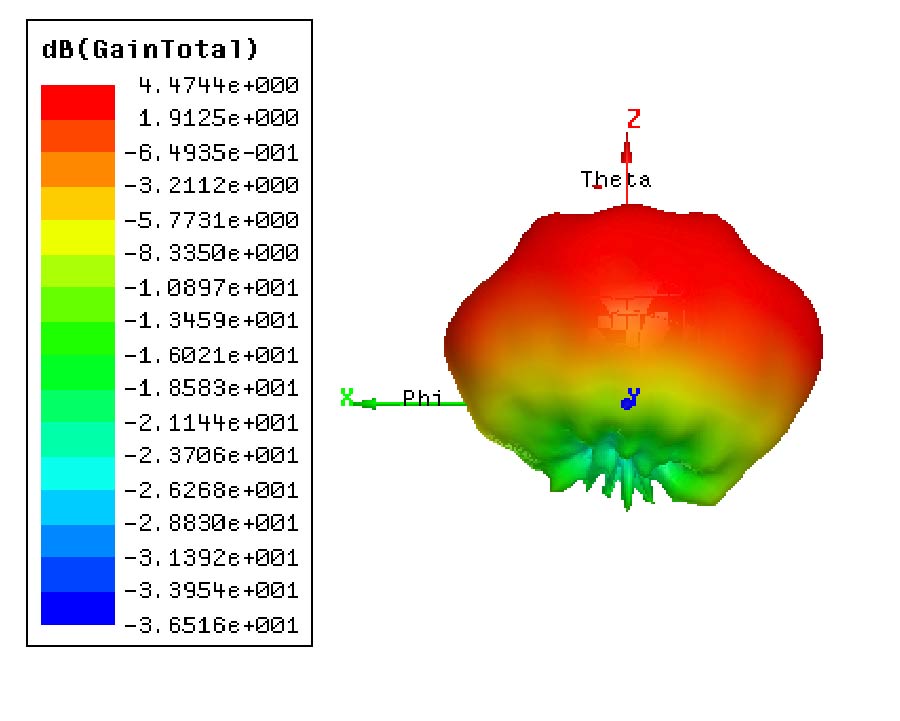
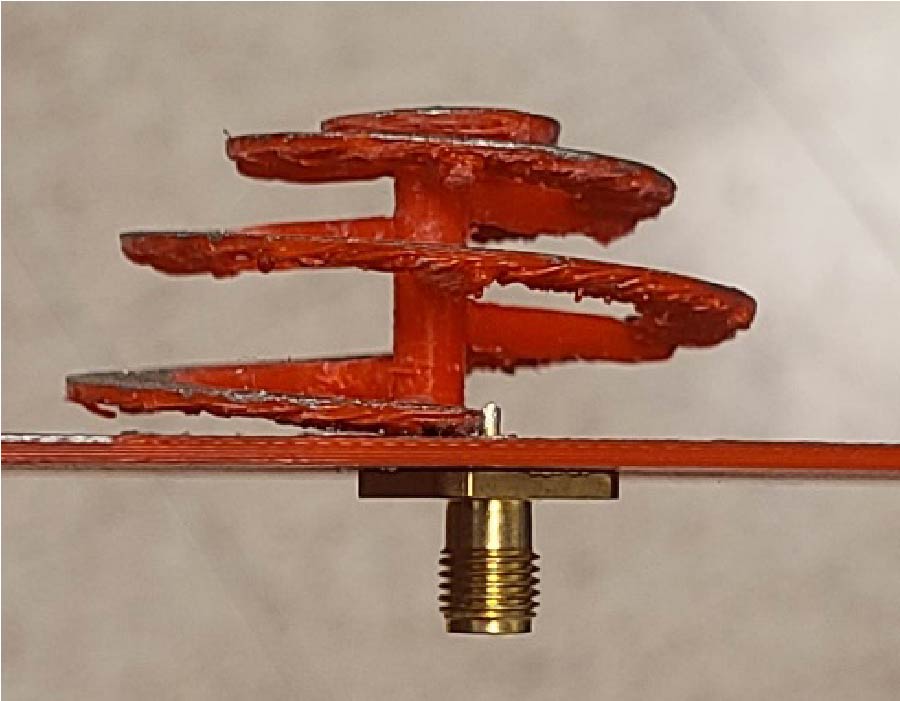
A copper strip and conductive paint-based low profile stripped helical antenna for circular polarization over wide axial-ratio (AR) bandwidth are presented. Impacts of strip widths and geometric parameters of the helix on antenna performance (impedance bandwidth, reflection coefficient, AR, gain) are analyzed thoroughly. In terms of performance parameters, the proposed design is also compared with traditional designs of wire and strip-based helical antennas. Proper impedance matching in the proposed design is achieved by the non-conformal placement of the strip. For easing the fabrication complexity, the antenna is again simulated with a dielectric-based supportive structure, and the impact of this additional support is discussed. The antenna is then constructed on a 3D printed polylactic acid (PLA) based structure. Finally, the 1.3-turn strip-based helical antenna with a radius of 18 mm provided impedance and 3-dB AR bandwidths of 99% and 82.52%, respectively. The maximum gain of 9.40 dBi was found at 2.05 GHz in 3-dB AR bandwidth. The height of the presented antenna is 0.35 λ0, where λ0 is the free space wavelength at the frequency of 2.65 GHz. Low profile and wide AR bandwidth facilitate the use of this antenna in space communication.
3D Printed Low Profile Strip-based Helical Antenna
2022-12-16
PIER Letters
Vol. 108, 59-64
Compact CRLH-SIW Based LWA Array with Periodical Loading for Ku-Band Applications
Huan Zhang , Jin Yao and Tao Ni
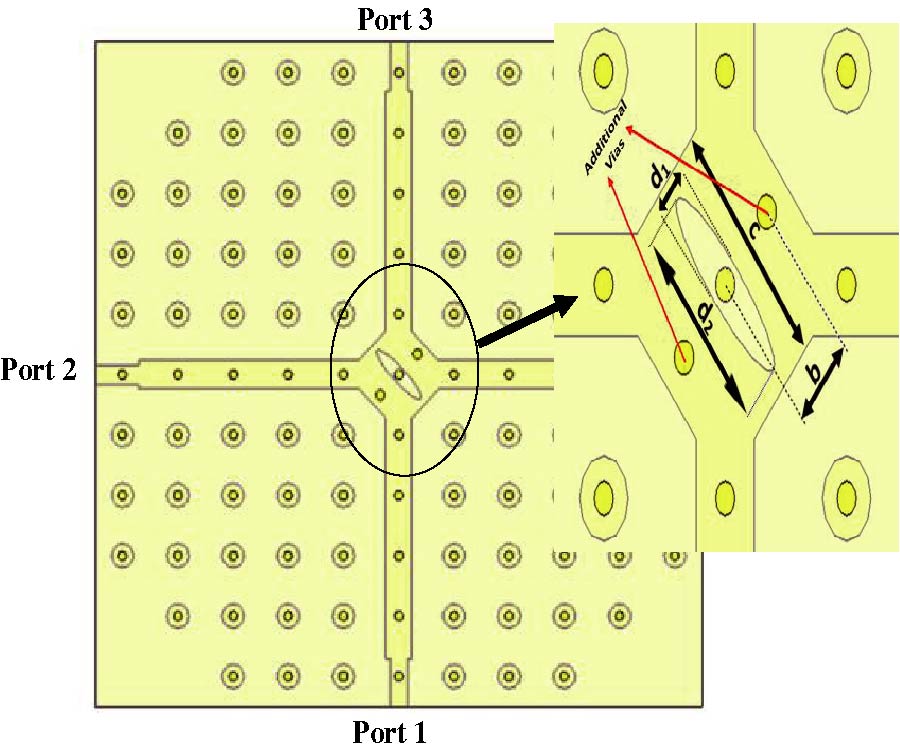
A novel compact composite right/left-handed (CRLH) substrate integrated waveguide (SIW) based leaky wave antenna (LWA) is proposed. Mushroom-inspired unit cell is utilized to achieve CRLH transmission property as well as energy leakage. Periodically loaded metallic vias, which act as an internal 1:2 power divider, are along the center line of the SIW structure, leading to a compact antenna size. The LWA can be regarded as an antenna array whose two elements are excited by two newly produced quasi-TE10 modes, respectively, and therefore, the antenna peak gains are enhanced. Good agreements are obtained between the simulated and measured results. Continuous beam scanning feature indicates that the proposed design is a balanced frequency scanning work operating in Ku-band.
Compact CRLH-SIW Based LWA Array With Periodical Loading for Ku-Band Applications
2022-12-15
PIER B
Vol. 98, 1-19
Gain-Bandwidth Enhancement of Tapered Fed Ellipsoid Antenna for EWB (23.16-776.59 GHz) Applications Using EBG
Naineri Suguna and Senthil Revathi
A compact extreme wide band (EWB) modified ellipsoid monopole antenna utilising electromagnetic band gap (EBG) technology is developed on a Rogers RT/Duroid 5880 substrate for high frequency millimetre (mm) wave applications including cellular, satellite, radar, and medical imaging. The proposed antenna design has an overall dimension of 40 mm x 30 mm x 0.787 mm and achieves EWB characteristics with a frequency range of 23.16 GHz to 776.59 GHz, a fractional impedance bandwidth (FBW) of 188.41%, and a bandwidth ratio (BR) of 33.53 by using a tapered feed and an EBG technique. The proposed antenna design attained a maximum peak gain of 17.91 dB and a peak radiation efficiency of 99.4%. On the basis of its high impedance wide bandwidth (IBW), FBW, BR, peak gain, and peak radiation efficiency, as well as its omnidirectional radiation properties at resonant frequencies, this compact antenna has the potential to be utilised for EWB applications. The HFSS 3-D solver is applied to characterize and analyse antenna performance.
Gain-bandwidth Enhancement of Tapered Fed Ellipsoid Antenna for EWB (23.16-776.59 GHz) Applications Using EBG
2022-12-14
PIER
Vol. 176, 55-65
Inverse-Designed Metamaterials for on-Chip Combinational Optical Logic Circuit
Qingze Tan , Chao Qian and Hongsheng Chen
Optical analog computing has recently sparked growing interest due to the appealing characteristics of low energy consumption, parallel processing, and ultrafast speed, spawning it complementary to conventional electronic computing. As the basic computing unit, optical logic operation plays a pivotal role for integrated photonics. However, the reported optical logic operations are volumetric and single-functional, which considerably hinders the practical cascadability and complex computing requirement. Here, we propose an on-chip combinational optical logic circuit using inverse design. By precisely engineering the scattering matrix of each small-footprint logic gate, all basic optical logic gates (OR, XOR, NOT, AND, XNOR, NAND, and NOR) are realized. On this foundation, we explore the assembly of these basic logic gates for general-purpose combinational logic circuits, including optical half-adder and code converter. Our work provides a path for the development of integrated, miniaturized, and cascadable photonic processor for future optical computing technologies.
Inverse-designed Metamaterials for On-chip Combinational Optical Logic Circuit
2022-12-13
PIER C
Vol. 127, 183-193
An Embroidered Slot-Loaded Patch Antenna for Characterization of Dielectric Materials
Michael Elsdon , Shahrzad Zahertar , Hamdi Torun and Linzi E. Dodd
Embroidery has been recently introduced as a new method to realize sensors especially for wearables. In this paper, we present a slot-loaded embroidered patch antenna to provide a simplified setup which allows the antenna to act as a stand-alone resonator. The design procedure, simulation and implementation of an embroidered sensor are presented and discussed. It is demonstrated that this structure can be used without any need for external antennas as a wireless sensor. To demonstrate the feasibility of this technique, the design process using a slot-loaded antenna to achieve a high Q antenna, fabricated on an FR4 substrate, is presented and discussed. This structure is then manufactured, with practical results shown to agree with simulated results. Using this as a basis for subsequent designs, an embroidered slot-loaded patch is presented and discussed. We demonstrate this capability in an experiment where a set of solvents inside plastic bottles were interrogated using the embroidered antennas.
An Embroidered Slot-loaded Patch Antenna for Characterization of Dielectric Materials
2022-12-13
PIER M
Vol. 114, 219-232
Cantor-Square Fractal Reconfigurable Circular Patch Antenna with Low Cross-Polarization for X Band Applications
Iqra Masroor , Shadman Aslam , Jamshed Ansari and Amrees Pandey
This work proposes a novel probe-fed circular patch antenna which has been fractaled and reconfigured to deliver enhanced performance. The circular ground plane is made defected using Cantor-square fractal geometry which reduces the cross-polarization level by about 12 dB. Further, by appropriate positioning of a PIN diode switch in the ground slot, the fractal Circular Microstrip Patch Antenna (CMPA) is enabled to achieve frequency reconfiguration. A prototype of the proposed antenna is fabricated and tested for the assessment of various parameters. The proposed fractal reconfigurable antenna has a peak gain well above 6 dB, high radiation efficiency, and a maximum bandwidth of about 700 MHz in the X-band (8-12 GHz). The present work aims to focus on the huge potential of fractal reconfigurable antennas in modern dynamic wireless communication systems.
Cantor-square Fractal Reconfigurable Circular Patch Antenna with Low Cross-polarization for X Band Applications
2022-12-13
PIER Letters
Vol. 108, 49-57
A Conformal Multi-Band MIMO Antenna for Vehicular Communications
Vanka Saritha and Chakali Chandrasekhar
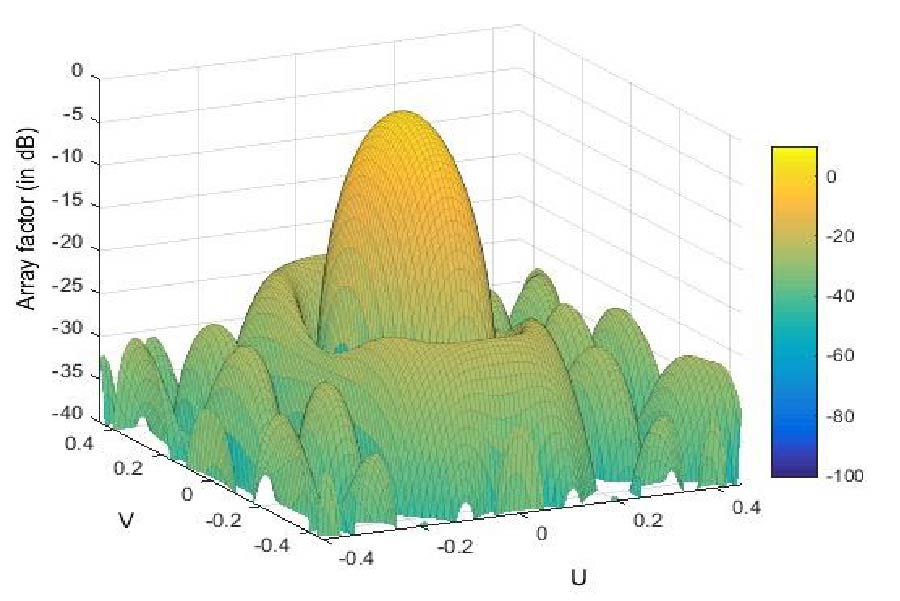
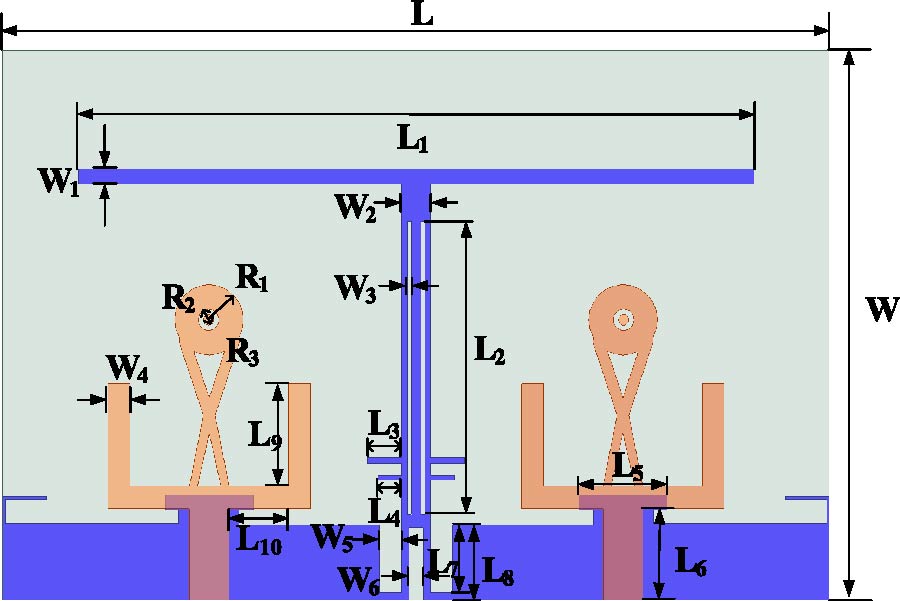
This paper proposes a conformal multiple band four port MIMO antenna for next generation vehicular communications in the extended UWB. The single element consists of a monopole antenna resembling a U-shaped structure with two branches folded and complimentary to each other. It uses coplanar waveguide feeding with a defected ground structure. The antenna is printed on a Kapton Polyamide flexible substrate having a thickness of 0.25 mm. The antenna has dimensions of 0.8λ x 0.8λ x 0.001λ. It resonates at 2.6 GHz, 3.9 GHz and 5.6 GHz which are used in vehicular communications, and can be used in sub-6 GHz 5G applications. It also provides band notches at 2.1 GHz, 3.5 GHz and 4.5 GHz which enables it to mitigate the interferences from any narrow band devices operating in that range. All MIMO parameters are simulated and compared with the measured results, and are found to be in good agreement. The designed antenna can be mounted at any position of the vehicle as it has a conformal structure.
A Conformal Multi-Band MIMO Antenna for Vehicular Communications
2022-12-11
PIER C
Vol. 127, 157-169
C-Band Rectangular DRA with Defective Ground Structure for Satellite Uplink Applications
Syamala Misala and Satya Anuradha Mosa
The C-band RDRA with a defective ground structure operated at resonant frequency 6.2 GHz is best suitable for satellite uplink applications. In the C-band, the broad aperture slot and pentagonal-shaped defective ground structure (DGS) offer excellent isolation and great efficiency. The simple prototype of designed pentagonal DGS RDRA is fabricated, tested, and validated. The proposed C-band RDRA has a fractional bandwidth of 12.14%, a return loss of -30 dB, a gain of up to 7.95 dB, and a minimal VSWR at the resonance frequency of 6.2 GHz. It offers a broad beamwidth of 110.87˚ in the E-plane, 43.73˚ in the H-plane, and 91.5% efficiency.
C-BAND RECTANGULAR DRA WITH DEFECTIVE GROUND STRUCTURE FOR SATELLITE UPLINK APPLICATIONS
2022-12-11
PIER Letters
Vol. 108, 41-48
Light Trapping for Absorption Control in Perovskite-Based Photovoltaic Solar Cells
Maroua Chahmi , Mounir Bouras , Moufdi Hadjab and Mohammad Alam Saeed
Nanostructure based perovskite solar cell with high performance is the emphasis of study in current work keeping in view the improvement in cell efficiency. In the first part of the study, a plane-layered solar cell is studied by adding a 1D photonic crystal at the bottom of the cell in order to facilitate the photon rotation process. However, in the second part of the study, it is observed that addition of grating enhances the light absorption due to photons trapping. Following that, the light absorption of three different structures is compared. The observations reveal that short-circuit current density (Jsc) is found to be -39.93 mA/cm2, which is 87.29% higher than that for a planar structure exhibiting the Jsc value as -21.32 mA/cm2. Ultimately, the efficiencies of these perovskite solar cells based on nanostructures are observed to be significant as well. For the proposed solar cell structure, an 87.24% improvement in the power conversion efficiency (PCE) is observed i.e., from 14.03% for the planar structure to 26.27%.
Light Trapping for Absorption Control in Perovskite-based Photovoltaic Solar Cells
2022-12-11
PIER Letters
Vol. 108, 31-39
A Compact Ultra-Wide Band Antenna with a Notched Band for Wireless Communication Systems
Basma M. Yousef , Allam M. Ameen , Bassant H. El Swiefy and Reham Arnous
An ultra-wide band (UWB) antenna with C-band and X-band notches for wireless communication is presented. The designed structure is printed on a material of ``Rogers 4350B'' with εr = 3.66, tanδ = 0.0037 and a thickness of 0.508 mm. This structure is designed to operate at a UWB range starting from 3.3 GHz up to 10.15 GHz with a stopband range from 6.75 GHz to 8.5 GHz. The rejected bands are the upper C-band (6.75 GHz-8 GHz) and the uplink X-band of the satellite (space to earth) from 7.25 GHz to 7.75 GHz. The overall antenna size is optimized, and its dimensions are 21 × 30 × 0.508 mm3. The antenna gain varies from 2.1 to 4.2 dBi at the passband, and its total radiation efficiency is 96.4%. The suggested structure is designed and simulated using CSTMWS software. Moreover, a prototype of the proposed structure is fabricated and measured. The fabrication process was done using photolithography techniques, and the measurements were done using an R&S vector network analyzer. Good agreement is achieved between the simulated and measured results.
A Compact Ultra-wide Band Antenna with a Notched Band for Wireless Communication Systems
2022-12-09
PIER M
Vol. 114, 205-217
Hybrid Active Disturbance Rejection Decoupling Control for Six-Pole Active Magnetic Bearing Based on Improved Genetic Algorithm
Yeming Li and Huangqiu Zhu
For the sake of decoupling the six-pole radial active magnetic bearing (AMB) with mutual coupling of two degrees of freedom, nonlinear and unstable disturbance, a hybrid active disturbance rejection control strategy based on improved genetic algorithm (HADRC-IGA) is proposed. Firstly, the configuration, magnetic circuit and suspension force model of the six-pole radial AMB are explained and established. Secondly, the HADRC-IGA is designed which is improved on the linear active disturbance rejection control (LADRC). Thirdly, the simulation is carried out, which shows that the capacity of resisting disturbance and the decoupling efficiency of two degrees of freedom of the HADRC-IGA are better than that of conventional LADRC. Finally, the experimental platform is constructed, and the experiments are conducted, which verify the performance of the proposed decoupled control system.
Hybrid Active Disturbance Rejection Decoupling Control for Six-pole Active Magnetic Bearing Based on Improved Genetic Algorithm
2022-12-07
PIER B
Vol. 97, 167-197
Critical Analysis of the Recent Trends and Advancements in Dielectric Resonator Antennas
Shailza Gotra and Vinay Shanker Pandey
A comprehensive overview of dielectric resonator antenna (DRA) is presented in this paper. Several techniques have been reported in the literature for the performance improvement of DRA. Over the past few decades, circularly polarized (CP) DRAs have been widely explored to mitigate multipath fading and polarization losses in comparison to linearly polarized (LP) antennas. Apart from this, high data transfer rate is required, which needs the development in the field of multi-input-multi-output (MIMO) antenna designs. This includes the increase in the channel capacity without exploiting the limited constraints like signal power and bandwidth. Thus, exploring the concept of MIMO in DRA along with the diversity performance features leads to the development in this field. Furthermore, to mitigate the conduction losses at THz and optical frequencies, high-efficiency DRA proves rationale in extending towards the higher frequency ranges. These scintillating features pave the path for efficient devices integration and on-chip applications at higher frequency ranges where the performance of metallic radiator degrades. Also, the dispersive properties of metal conductivity lead to plasmonic behaviour resulting in the dissipation losses at the optical frequencies. These losses can be substantially mitigated using DRAs. This can be efficiently realized for the future application that requires the manipulation of high-resolution light.
Critical Analysis of the Recent Trends and Advancements in Dielectric Resonator Antennas
2022-12-06
PIER Letters
Vol. 108, 25-30
Performance Analysis of a Single Layer X-Band Frequency Selective Surface Based Spatial Filter Implementing Half Jerusalem Cross Slot
Harikrishna Paik and Kambham Premchand
This work proposes and experimentally evaluates a single layer bandpass frequency selective surface (FSS) that resonates at X-band (8-12 GHz). The metal plate of the unit cell has a half-Jerusalem cross slot of size 0.15λ0, where λ0 is the wavelength corresponding to 10 GHz centre frequency. The effects of unit cell parameters on filter response are analyzed through parametric analysis. The results reveal that the proposed bandpass FSS exhibits good polarization stability and angular stability at oblique angles up to 45˚. Furthermore, negligible frequency deviations in both TE and TM polarizations have also been achieved using this structure. A prototype of the bandpass FSS was fabricated on an FR4 substrate to validate the proposed design which includes 10×10 elements in a dimension of 45 mm × 45 mm × 1.6 mm. Measurements show that the bandpass FSS has a fractional bandwidth of 40% centered at 10 GHz from 8 GHz to 12 GHz. The unique feature of the proposed filter is its ability to operate in the whole X band (8-12 GHz) by tuning the filter elements.
Performance Analysis of a Single Layer X-band Frequency Selective Surface Based Spatial Filter Implementing Half Jerusalem Cross Slot
2022-12-05
PIER C
Vol. 127, 145-156
Microwave Imaging of Small Scatterers by MUSIC Algorithm Using a Novel Source Number Detection Method
Roohallah Fazli and Hajar Momeni
Microwave imaging of small scatterers is an inverse scattering problem, and recently, the MUSIC algorithm has been proposed to solve this type of problem. The MUSIC algorithm, by assuming that the number of targets is a priori known, can locate the scatterers from the peaks of the well-known pseudospectrum. The noise and multiple scattering create ambiguity to detect the number of targets. Usually, information-based algorithms such as Akaike information criterion (AIC) and minimum description length (MDL) are employed for source number estimation. However, in the cases of low signal-to-noise ratio (SNR) and close targets, the performance of these methods is seriously degraded. In the present work, we propose a two-step approach to enumerate the scatterers in microwave imaging applications for cases where traditional methods fail. Firstly, the MUSIC algorithm is applied to locate all possible targets by assuming the maximum number of targets, and secondly, we can discriminate between the real and unreal targets by using a novel formula that acts as a spatial filter. The efficiency of the proposed method has been examined through various simulation tests using numerical and experimental datasets, and the results verify that the method can accurately specify the location and the number of scatterers in 2D microwave imaging applications.
Microwave Imaging of Small Scatterers by MUSIC Algorithm Using a Novel Source Number Detection Method
2022-12-04
PIER B
Vol. 97, 149-166
Systematic Design & Analysis of a 42 GHz Gyrotron and the Effects of Structure & Beam Parameters on Its RF Performance
Ashutosh Singh and Pradeep Kumar Jain
The systematic design approach of a 42 GHz CW gyrotron has been extensively presented in this paper. Beam-wave interaction of the conventional tapered cylindrical cavity gyrotron is demonstrated using commercially available Particle-In-Cell (PIC) code. Beam absent and beam present cases have been considered to observe the performance of the device. Beam absent case is presented to validate the design in desired mode as well as resonant frequency whereas beam present case is demonstrated to validate and observe the beam-wave interaction behavior of the device in terms of output power. In order to optimize the dimension of interaction structure to achieve desired performance of the device, several parameters were considered. RF output power of the device is estimated with the variation of structure parameters as well as electron beam parameters to achieve better performance in terms of efficiency. Using the designed parameters, beam present analysis offers a saturated output power well above 250 kW. The particles phase space behavior along the interaction length is demonstrated to realize the energy transfer phenomena. The PIC simulation results are found in close agreement with the self-consistent single mode results. The estimated output power and efficiency support the proper design of proposed gyrotron oscillator.
Systematic Design & Analysis of a 42 GHz Gyrotron and the Effects of Structure & Beam Parameters on Its RF Performance
2022-12-03
PIER C
Vol. 127, 127-143
Inkjet Printed Flexible High Isolation Patch Antenna for 5.8 GHz Full-Duplex Applications
Abdul Rakib Hossain , Md. Samiul Islam Sagar , Nghi Tran , Praveen Kumar Sekhar and Tutku Karacolak
In this paper, a flexible full-duplex antenna is proposed with robust performance and high isolation for 5.8 GHz using foam and PET paper. The patch of the antenna is modified by corner cut and inset feeding, while the defected ground structure is used to improve isolation between transmit and receive ports. Silver nanoparticle ink is used for printing the antenna in an inkjet printer. The fabricated version supports simulated results by showing acceptable performance in desired bandwidth. Bending tests and human body loading experiments are carried out on the fabricated antenna to demonstrate antenna's effectiveness for wearable applications. To the best of authors' knowledge, this is the first flexible full duplex antenna designed, achieving a high isolation level of -50 dB. Moreover, wide bandwidth, improved gain, radiation efficiency, low cost, easy fabrication, and robust performance make it a good option for 5.8 GHz wearable applications.
Inkjet Printed Flexible High Isolation Patch Antenna for 5.8 GHz Full-duplex Applications
2022-12-02
PIER Letters
Vol. 108, 15-23
Research on Multi-Band Absorbers Based on Electromagnetic Metamaterials
Fugui Liu , Bin Xu , Xiaonan Li and Guo-Qiang Liu
The rapid development of telecommunication systems has promoted the research of electromagnetic metamaterial absorbers. Based on the equivalent circuit theory, this paper proposes and designs a broadband absorption absorber based on electromagnetic metamaterials, which adopts a sandwich structure with an overall absorber thickness of 3.234 mm. The results show that the absorber has an absorption rate of more than 90% in the X-, Ku-, and K-bands (8.06 GHz-18.46 GHz) for the incident angle varying in the range of 0-50°. The absorption rate is higher than 90% for TE and TM mode electromagnetic waves and electromagnetic waves with polarization angle in the range of 0-50°. The absorber still has good absorption characteristics. The study shows that the absorber has small size, thin thickness, and broad angle broadband absorption characteristics.
Research on Multi-band Absorbers Based on Electromagnetic Metamaterials
2022-11-30
PIER C
Vol. 127, 113-125
4-Port MIMO Antenna for Sub-1 GHz, IoT, and Sub-6 GHz 5G New Radio Applications
Bisma Bukhari and Ghulam Mohd Rather
A 4-port planar multiple-input multiple-output (MIMO) antenna system design is proposed. The antenna elements are modified meandered wideband antennas which cover frequencies from 674 MHz to 1 GHz, 1.9 GHz to 2.1 GHz, 3.175 GHz to 3.476 GHz, 4.529 GHz to 4.761 GHz and 5.254 to 5.513 GHz for long term evolution (LTE), Internet of Things (IoT), and sub-6 GHz applications and thus can be used for robotic navigation, logistics, healthcare, tracking, transportation etc. Due to very small envelope correlation coefficient (ECC) between the ports (< 0.5), the MIMO configuration can be efficiently implemented which helps in increasing the data rates. It is very compact in size and thus can be used for portable handheld devices. Since there is the problem of current localization due to common ground, the future work aims at minimizing coupling and improving the impedance matching using novel decoupling networks. These MIMO antennas are connected to a common slotted ground plane. Antenna simulation has been done using Computer Simulation Technology (CST) Microwave Studio Suite simulator. A low cost FR-4 substrate with dimensions 65 mm × 90 mm × 1.6 mm has been used for antenna fabrication, and experimental results are obtained using an anechoic chamber and a vector network analyser. ECC and realized gain of the antenna are also obtained experimentally and are almost similar to the simulated results.
4-Port MIMO Antenna for Sub-1 GHz, IoT, and Sub-6 GHz 5G New Radio Applications
2022-11-30
PIER C
Vol. 127, 101-112
Design of a Reconfigurable Band Notch Antenna for UWB Applications
Hua Jing , Ge He , Jiahao Sun and Shengyao Wang
In order to improve the practicability and versatility of ultra-wideband (UWB) antennas, a reconfigurable band notch antenna is proposed in this paper. It has a compact size of 18 mm×16 mm×1.6 mm. The reconfigurable band notch function is realized by two small tunable units. The tunable unit makes up of a split ring resonator (SRR), a dielectric substrate, and a varactor diode. The simulation results show that the antenna combines the functions of band notch emergence, removal and movement. The applied reconfigurable method can effectively broaden the continuous movement range of band notch. The measurement proves that the antenna has the band notch reconfigurable function, and the measured results are in good agreement with the simulation ones. The radiation patterns are measured, which are stable and consistent under two modes with and without band notch, showing omnidirectional radiation characteristics. These research results provide reference value for the design of band notch UWB antenna shielding civil narrowband communication band.
Design of a Reconfigurable Band Notch Antenna for UWB Applications