Vol. 130
Latest Volume
All Volumes
PIERL 130 [2026] PIERL 129 [2026] PIERL 128 [2025] PIERL 127 [2025] PIERL 126 [2025] PIERL 125 [2025] PIERL 124 [2025] PIERL 123 [2025] PIERL 122 [2024] PIERL 121 [2024] PIERL 120 [2024] PIERL 119 [2024] PIERL 118 [2024] PIERL 117 [2024] PIERL 116 [2024] PIERL 115 [2024] PIERL 114 [2023] PIERL 113 [2023] PIERL 112 [2023] PIERL 111 [2023] PIERL 110 [2023] PIERL 109 [2023] PIERL 108 [2023] PIERL 107 [2022] PIERL 106 [2022] PIERL 105 [2022] PIERL 104 [2022] PIERL 103 [2022] PIERL 102 [2022] PIERL 101 [2021] PIERL 100 [2021] PIERL 99 [2021] PIERL 98 [2021] PIERL 97 [2021] PIERL 96 [2021] PIERL 95 [2021] PIERL 94 [2020] PIERL 93 [2020] PIERL 92 [2020] PIERL 91 [2020] PIERL 90 [2020] PIERL 89 [2020] PIERL 88 [2020] PIERL 87 [2019] PIERL 86 [2019] PIERL 85 [2019] PIERL 84 [2019] PIERL 83 [2019] PIERL 82 [2019] PIERL 81 [2019] PIERL 80 [2018] PIERL 79 [2018] PIERL 78 [2018] PIERL 77 [2018] PIERL 76 [2018] PIERL 75 [2018] PIERL 74 [2018] PIERL 73 [2018] PIERL 72 [2018] PIERL 71 [2017] PIERL 70 [2017] PIERL 69 [2017] PIERL 68 [2017] PIERL 67 [2017] PIERL 66 [2017] PIERL 65 [2017] PIERL 64 [2016] PIERL 63 [2016] PIERL 62 [2016] PIERL 61 [2016] PIERL 60 [2016] PIERL 59 [2016] PIERL 58 [2016] PIERL 57 [2015] PIERL 56 [2015] PIERL 55 [2015] PIERL 54 [2015] PIERL 53 [2015] PIERL 52 [2015] PIERL 51 [2015] PIERL 50 [2014] PIERL 49 [2014] PIERL 48 [2014] PIERL 47 [2014] PIERL 46 [2014] PIERL 45 [2014] PIERL 44 [2014] PIERL 43 [2013] PIERL 42 [2013] PIERL 41 [2013] PIERL 40 [2013] PIERL 39 [2013] PIERL 38 [2013] PIERL 37 [2013] PIERL 36 [2013] PIERL 35 [2012] PIERL 34 [2012] PIERL 33 [2012] PIERL 32 [2012] PIERL 31 [2012] PIERL 30 [2012] PIERL 29 [2012] PIERL 28 [2012] PIERL 27 [2011] PIERL 26 [2011] PIERL 25 [2011] PIERL 24 [2011] PIERL 23 [2011] PIERL 22 [2011] PIERL 21 [2011] PIERL 20 [2011] PIERL 19 [2010] PIERL 18 [2010] PIERL 17 [2010] PIERL 16 [2010] PIERL 15 [2010] PIERL 14 [2010] PIERL 13 [2010] PIERL 12 [2009] PIERL 11 [2009] PIERL 10 [2009] PIERL 9 [2009] PIERL 8 [2009] PIERL 7 [2009] PIERL 6 [2009] PIERL 5 [2008] PIERL 4 [2008] PIERL 3 [2008] PIERL 2 [2008] PIERL 1 [2008]
2026-05-08
Approximating Processing Delays in High Energy Laser Directed Energy System Performance Prediction
By
Progress In Electromagnetics Research Letters, Vol. 130, 52-56, 2026
Abstract
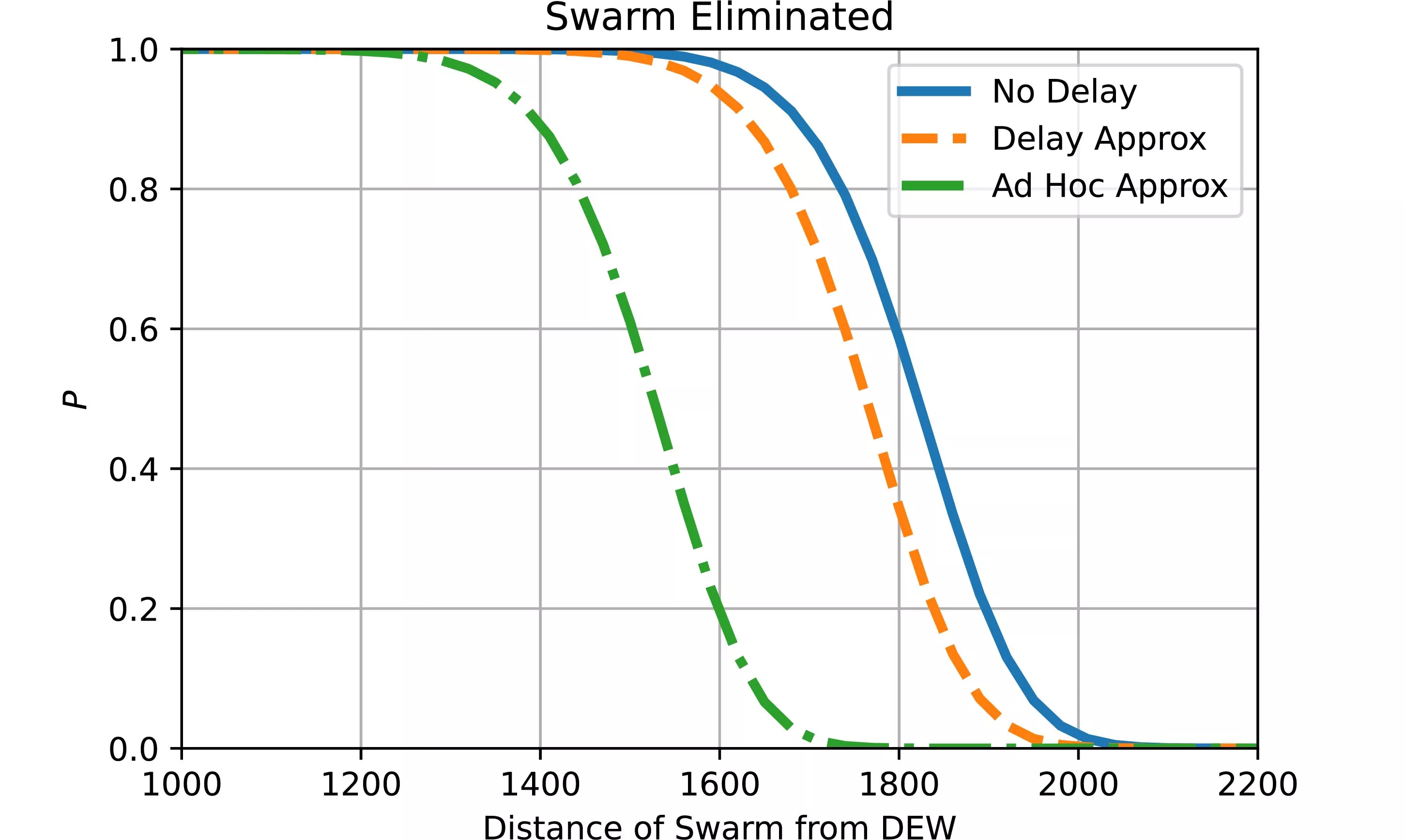
This study addresses an issue with high-energy laser directed energy weapon performance assessment when applied to the problem of countering swarms of uncrewed aerial systems (UAS). Queueing theory provides a suitable modelling framework for the performance assessment of such systems, as a single server queue can process only one threat at a time, based on the order in which threats arrive at the theatre of operation. Consequently, this introduces delays into the processing of sequences of threats. Delays in such queues typically have time-dependent service times, due to the target's movement. This results in considerable complexity in terms of producing performance predictions through stochastic models. In recent applications of queueing theory to directed energy systems an ad hoc approximation has been used to estimate the delays that threats experience while waiting for service. This approach involves approximating the processing delay of a given threat by a constant value. In particular, it has been estimated by measuring the delay as a product of the expected service time and the number of threats present less one. Such an approximation can result in severely reduced and inaccurate performance predictions. In the current study, the mean delay will be used instead, and improvement on the aforementioned approximation will be demonstrated through explicit examples of swarm UAS defeat.
Citation
Graham V. Weinberg, "Approximating Processing Delays in High Energy Laser Directed Energy System Performance Prediction," Progress In Electromagnetics Research Letters, Vol. 130, 52-56, 2026.
doi:10.2528/PIERL26032401
References

1. Nielsen, P. E., Effects of Directed Energy Weapons, 1994.

2. Lavan, M., "High energy laser systems for short range defense," Acta Physica Polonica A, Vol. 115, No. 6, 959-963, 2009.
doi:10.12693/aphyspola.115.959        Google Scholar

3. Sprangle, Phillip, Bahman Hafizi, Antonio Ting, and Richard Fischer, "High-power lasers for directed-energy applications," Applied Optics, Vol. 54, No. 31, F201-F209, 2015.
doi:10.1364/ao.54.00f201        Google Scholar

4. Yun, Qijia, Bifeng Song, and Yang Pei, "Modeling the impact of high energy laser weapon on the mission effectiveness of unmanned combat aerial vehicles," IEEE Access, Vol. 8, 32246-32257, 2020.
doi:10.1109/access.2020.2973492        Google Scholar

5. Steinvall, Ove, "The potential role of laser in combating UAVs: Part 2; laser as a countermeasure and weapon," Technologies for Optical Countermeasures XVIII and High-Power Lasers: Technology and Systems, Platforms, Effects V, Vol. 11867, 14-30, 2021.
doi:10.1117/12.2601755

6. Kracman, Mitchell M., "A stochastic jump model applied to collaborative queue-based high energy laser defense," The Journal of Defense Modeling and Simulation: Applications, Methodology, Vol. 22, No. 2, 187-195, 2025.
doi:10.1177/15485129231161092        Google Scholar

7. Taillandier, M., C. Regnault, A. Beaumadier, A. Beigbeder, and G. Pasquier, "High energy lasers for C-UAS applications," High-Power Lasers and Technologies for Optical Countermeasures II, Vol. 13201, 2024.

8. Weinberg, Graham V., "Performance prediction of directed energy weapons," Progress In Electromagnetics Research M, Vol. 108, 79-88, 2022.
doi:10.2528/pierm21111201        Google Scholar

9. Weinberg, Graham V., Directed Energy System Performance Prediction, Artech House, 2023.

10. Chung, Soon-Jo, Aditya Avinash Paranjape, Philip Dames, Shaojie Shen, and Vijay Kumar, "A survey on aerial swarm robotics," IEEE Transactions on Robotics, Vol. 34, No. 4, 837-855, 2018.
doi:10.1109/tro.2018.2857475        Google Scholar

11. Burley, J. L., Comparison of High Energy Laser Expected Dwell Times and Probability of Kill for Mission Planning Scenarios in Actual and Standard Atmospheres, Air Force Institute of Technology, Ohio, USA, 2012.

12. Puent, D., Integration of Adaptive Optics into High Energy Laser Modelling and Simulation, Naval Postgraduate School, Monterey, USA, 2017.

13. Weinberg, Graham V., "Effect of dwell time, distance, and reflecting area on UAV swarm elimination in the presence of directed energy weapons," The Journal of Defense Modeling and Simulation: Applications, Methodology, Technology, 2025.
doi:10.1177/15485129251340992        Google Scholar

14. Lindley, D. V., "The theory of queues with a single server," Mathematical Proceedings of the Cambridge Philosophical Society , Vol. 48, No. 2, 277-289, 1952.
doi:10.1017/s0305004100027638        Google Scholar

15. Ross, Sheldon M., Stochastic Processes, John Wiley & Sons, 1996.

16. Barbour, A. D., Lars Holst, and Svante Janson, Poisson Approximation, Oxford University Press, 1992.
doi:10.1093/oso/9780198522355.001.0001

17. Durrett, R., Probability: Theory and Examples, Duxbury Press, 1996.

18. Tahir, Anam, Jari Böling, Mohammad-Hashem Haghbayan, Hannu T. Toivonen, and Juha Plosila, "Swarms of unmanned aerial vehicles --- A survey," Journal of Industrial Information Integration, Vol. 16, 100106, 2019.
doi:10.1016/j.jii.2019.100106        Google Scholar

19. Castrillo, Vittorio Ugo, Angelo Manco, Domenico Pascarella, and Gabriella Gigante, "A review of counter-UAS technologies for cooperative defensive teams of drones," Drones, Vol. 6, No. 3, 65, 2022.
doi:10.3390/drones6030065        Google Scholar

20. Ross, S., Simulation, Academic Press, 2002.

21. Sprangle, P., J. Penano, and B. Hafizi, Optimum wavelength and power for efficient laser propagation in various atmospheric environments, 2005.