Vol. 130
Latest Volume
All Volumes
PIERL 130 [2026] PIERL 129 [2026] PIERL 128 [2025] PIERL 127 [2025] PIERL 126 [2025] PIERL 125 [2025] PIERL 124 [2025] PIERL 123 [2025] PIERL 122 [2024] PIERL 121 [2024] PIERL 120 [2024] PIERL 119 [2024] PIERL 118 [2024] PIERL 117 [2024] PIERL 116 [2024] PIERL 115 [2024] PIERL 114 [2023] PIERL 113 [2023] PIERL 112 [2023] PIERL 111 [2023] PIERL 110 [2023] PIERL 109 [2023] PIERL 108 [2023] PIERL 107 [2022] PIERL 106 [2022] PIERL 105 [2022] PIERL 104 [2022] PIERL 103 [2022] PIERL 102 [2022] PIERL 101 [2021] PIERL 100 [2021] PIERL 99 [2021] PIERL 98 [2021] PIERL 97 [2021] PIERL 96 [2021] PIERL 95 [2021] PIERL 94 [2020] PIERL 93 [2020] PIERL 92 [2020] PIERL 91 [2020] PIERL 90 [2020] PIERL 89 [2020] PIERL 88 [2020] PIERL 87 [2019] PIERL 86 [2019] PIERL 85 [2019] PIERL 84 [2019] PIERL 83 [2019] PIERL 82 [2019] PIERL 81 [2019] PIERL 80 [2018] PIERL 79 [2018] PIERL 78 [2018] PIERL 77 [2018] PIERL 76 [2018] PIERL 75 [2018] PIERL 74 [2018] PIERL 73 [2018] PIERL 72 [2018] PIERL 71 [2017] PIERL 70 [2017] PIERL 69 [2017] PIERL 68 [2017] PIERL 67 [2017] PIERL 66 [2017] PIERL 65 [2017] PIERL 64 [2016] PIERL 63 [2016] PIERL 62 [2016] PIERL 61 [2016] PIERL 60 [2016] PIERL 59 [2016] PIERL 58 [2016] PIERL 57 [2015] PIERL 56 [2015] PIERL 55 [2015] PIERL 54 [2015] PIERL 53 [2015] PIERL 52 [2015] PIERL 51 [2015] PIERL 50 [2014] PIERL 49 [2014] PIERL 48 [2014] PIERL 47 [2014] PIERL 46 [2014] PIERL 45 [2014] PIERL 44 [2014] PIERL 43 [2013] PIERL 42 [2013] PIERL 41 [2013] PIERL 40 [2013] PIERL 39 [2013] PIERL 38 [2013] PIERL 37 [2013] PIERL 36 [2013] PIERL 35 [2012] PIERL 34 [2012] PIERL 33 [2012] PIERL 32 [2012] PIERL 31 [2012] PIERL 30 [2012] PIERL 29 [2012] PIERL 28 [2012] PIERL 27 [2011] PIERL 26 [2011] PIERL 25 [2011] PIERL 24 [2011] PIERL 23 [2011] PIERL 22 [2011] PIERL 21 [2011] PIERL 20 [2011] PIERL 19 [2010] PIERL 18 [2010] PIERL 17 [2010] PIERL 16 [2010] PIERL 15 [2010] PIERL 14 [2010] PIERL 13 [2010] PIERL 12 [2009] PIERL 11 [2009] PIERL 10 [2009] PIERL 9 [2009] PIERL 8 [2009] PIERL 7 [2009] PIERL 6 [2009] PIERL 5 [2008] PIERL 4 [2008] PIERL 3 [2008] PIERL 2 [2008] PIERL 1 [2008]
2026-04-30 Latest Published
By Xinwei Chen Xinmiao Zhao Jinrong Su Guorui Han Runbo Ma Li Li
Progress In Electromagnetics Research Letters, Vol. 130, 44-51, 2026
Abstract
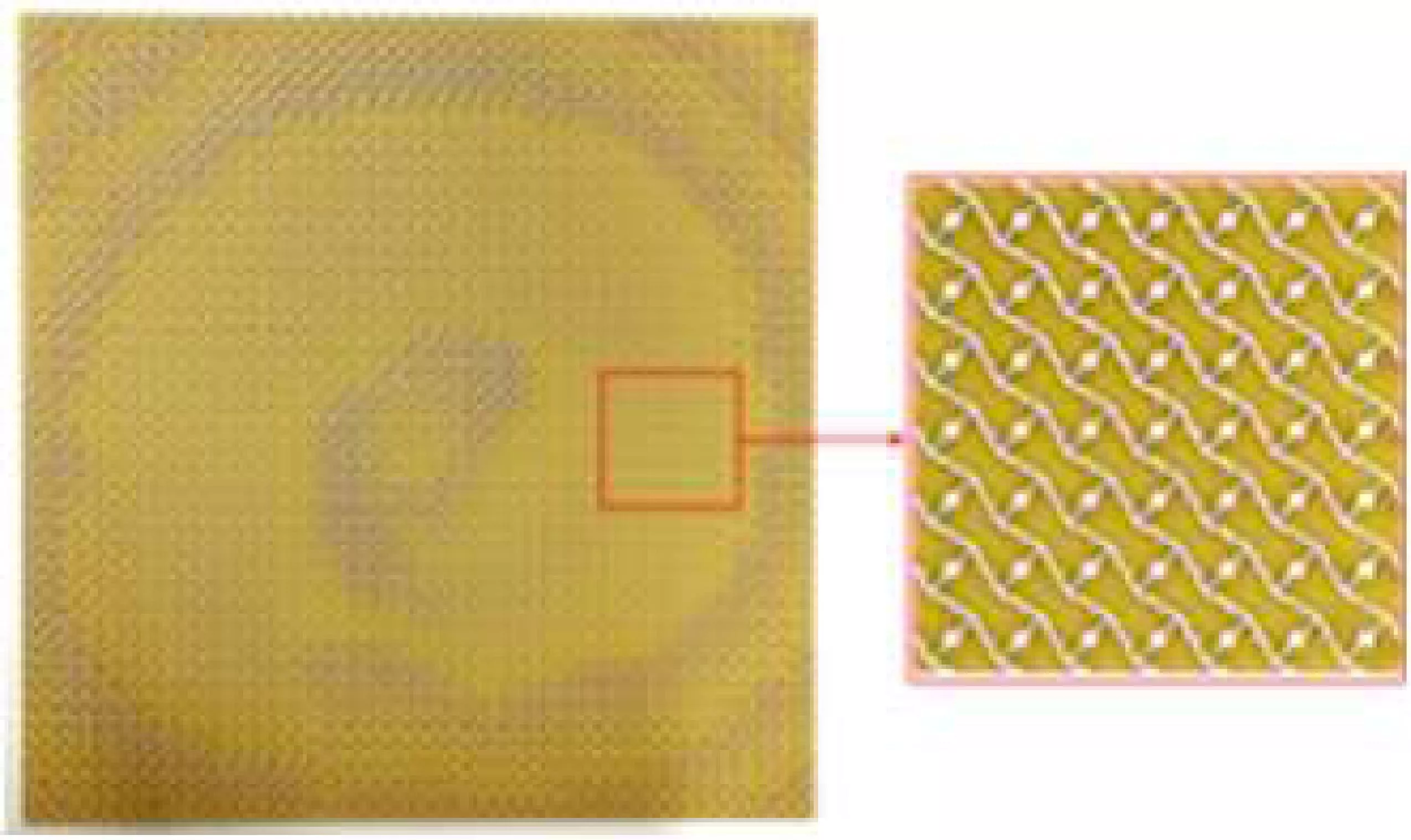
In this study, a single-layer substrate and via-free transmit-reflect-array antenna based on a metasurface is proposed. The array antenna comprises transmissive and reflective unit cells arranged alternately in sequence. To achieve a 360° phase coverage, two sets of antisymmetric U-shaped lines are etched on the top and bottom layers of the substrate to form the transmissive unit cells, and multi-layer stacking and vias are avoided. Moreover, by adjusting the lengths of a split-ring structure with phase delay lines for reflective unit cells, a 360° phase coverage is achieved. The measurement results demonstrate that the antenna simultaneously generates a reflective focused beam with a peak gain of 20.8 dBi and a transmissive +1-mode OAM vortex beam with a peak gain of 20 dBi and a mode purity of 90% at 17 GHz.
2026-04-30
PIER Letters
Vol. 130, 44-51, 2026
download: 33
Design of a Single Layer Substrate and via-Free Transmit-Reflect Array Antenna Based on Metasurface
Xinwei Chen, Xinmiao Zhao, Jinrong Su, Guorui Han, Runbo Ma and Li Li
In this study, a single-layer substrate and via-free transmit-reflect-array antenna based on a metasurface is proposed. The array antenna comprises transmissive and reflective unit cells arranged alternately in sequence. To achieve a 360° phase coverage, two sets of antisymmetric U-shaped lines are etched on the top and bottom layers of the substrate to form the transmissive unit cells, and multi-layer stacking and vias are avoided. Moreover, by adjusting the lengths of a split-ring structure with phase delay lines for reflective unit cells, a 360° phase coverage is achieved. The measurement results demonstrate that the antenna simultaneously generates a reflective focused beam with a peak gain of 20.8 dBi and a transmissive +1-mode OAM vortex beam with a peak gain of 20 dBi and a mode purity of 90% at 17 GHz.
Design of a Single Layer Substrate and Via-Free Transmit-Reflect Array Antenna Based on Metasurface
2026-04-29
PIER Letters
Vol. 130, 36-43, 2026
download: 30
Modulation Technique of Conformal Metasurface for 3D Spiral Shaped Near-Field with High SNR and Efficiency
Hui-Fen Huang and Ke-Chun Niu
The curvature effects of curved metasurface (MTS) lead to oblique incidence and different unit radiation normal vectors (DURNVs). Oblique incidence causes a reduction in scattering amplitude and degrades focusing efficiency (FE), and DURNV distorts the radiation pattern of curved MTSs. To the knowledge of the authors, for the first time, this paper proposes a phase amplitude modulation and phase modulation (PAM-PM) combined modulation technique for cylindrical MTS to generate a high signal-to-noise ratio (SNR) and high FE three-dimensional (3D) shaped near field with a spiral cross-sectional shape. In addition, a near field with controllable spatial positions is a practical application requirement, and this paper provides a method to establish a 3D-shaped near field with controlled spatial positions. The proposed cylindrical MTS with PAM-PM modulation technique outperforms the PM technique significantly, achieving an SNR above 13 dB and an FE of 38.1%. For cylindrical MTS with only PM, there exists some noise, and the FE is 33.2%. This proposed modulation technique can be applied to 3D near-field systems based on conformal MTS, including wireless power transfer, radiometric temperature sensors for hyperthermia, and medical imaging systems.
Modulation Technique of Conformal Metasurface for 3D Spiral Shaped Near-Field with High SNR and Efficiency
2026-04-25
PIER Letters
Vol. 130, 28-35, 2026
download: 110
Compact 13.56 MHz Wireless Power Transfer Architecture Using Self-Resonant Coils with Inherent Source Power Limiting
Zixuan Yi, Ziheng Li, Xiaojun Tao and Meiling Li
Megahertz wireless power transfer (MHz-WPT) enables compact resonant components; yet the matching, compensation, and filtering stages used in conventional systems can dominate loss and standby dissipation at MHz operation. To address this issue, this work proposes a compact 13.56 MHz WPT architecture in which impedance transformation is integrated into the resonant hardware. A self-resonant transmitting coil is co-designed with a Class-E power amplifier to shape the reflected load toward the optimum operating condition, thereby removing the external compensation network, the additional matching stage, and the lumped-element LC output filter. The analysis shows that, when the receiver is removed, the effective load becomes dominated by the transmitter resistance, inherently suppressing delivered power without sensing or closed-loop control. A prototype delivers 9 W over 30 mm with 81.5% end-to-end DC–DC efficiency, while under receiver absence, the DC input power decreases from 11 W to 1.15 W. These results demonstrate a simplified and robust MHz-WPT architecture with reduced component count and inherently low standby dissipation.
Compact 13.56 MHz Wireless Power Transfer Architecture Using Self-Resonant Coils with Inherent Source Power Limiting
2026-04-06
PIER Letters
Vol. 130, 23-27, 2026
download: 140
Integrated Slotted SIW Oscillator-Antenna Based on the TE210 Mode with High Spectral Purity
Abdelmounim Sellidj, Tarek Djerafi, Said Gaoua and Mustapha Yagoub
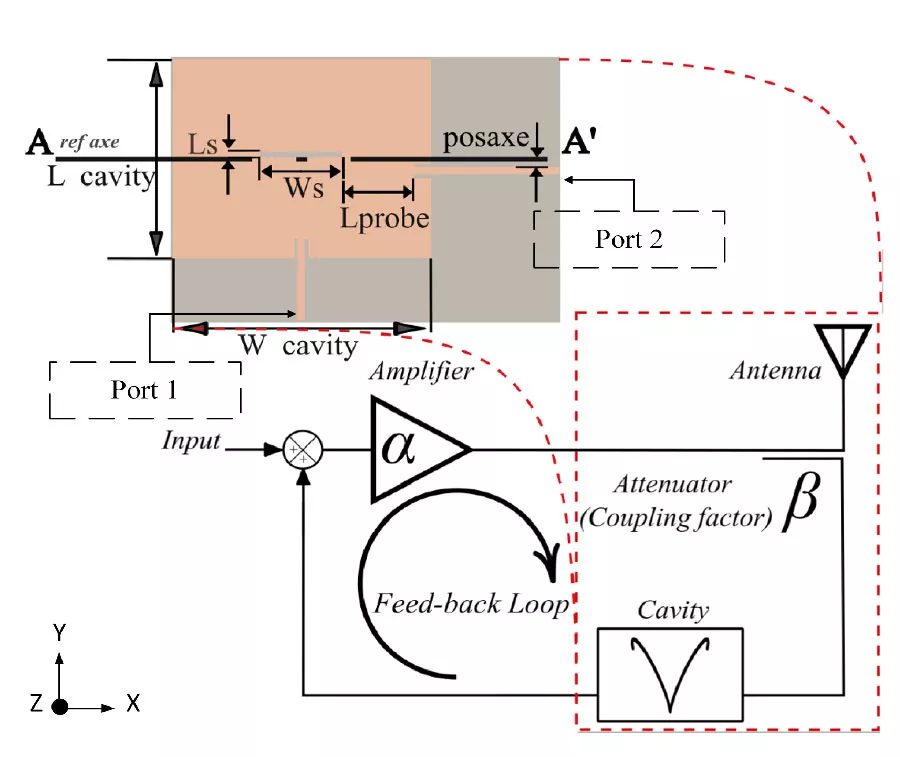
In this work, a Substrate-Integrated Waveguide (SIW) cavity-based positive-feedback oscillator integrated with a slot antenna on a single substrate was designed. The proposed design incorporates a radiating element, an oscillator tank, and a coupling structure within the same cavity, thereby eliminating external interconnections and significantly enhancing overall efficiency. By employing the TE210 mode instead of the TE110, the design exploits a field node to minimize the parasitic loading effects of the oscillator coupling probe on the antenna radiation. This approach simultaneously enhances the cavity's quality factor Q and preserves the spectral purity of the integrated SIW antenna-oscillator, all this without affecting the antenna radiation. The SIW cavity achieves a measured quality factor (Q) of 250, ensuring high spectral selectivity at the 10 GHz resonant frequency. The oscillator exhibits low phase noise of -131 dBc/Hz at a 1 MHz offset, along with exceptional suppression of harmonics, including the total suppression of the third harmonic, while the slot antenna achieves a gain of 6 dBi. This fully integrated architecture delivers performance equivalent to discrete implementations while offering a compact footprint and eliminating insertion losses between the antenna and the oscillator.
Integrated Slotted SIW Oscillator-Antenna Based on the TE210 Mode with High Spectral Purity
2026-04-03
PIER Letters
Vol. 130, 15-22, 2026
download: 114
A High-Selectivity 3-D Dual-Polarized Frequency Selective Rasorber with Wide Absorption Bands Based on Multiple Strip-Type Resonators
Hao Shen, Borui Bian and Dan Zhang
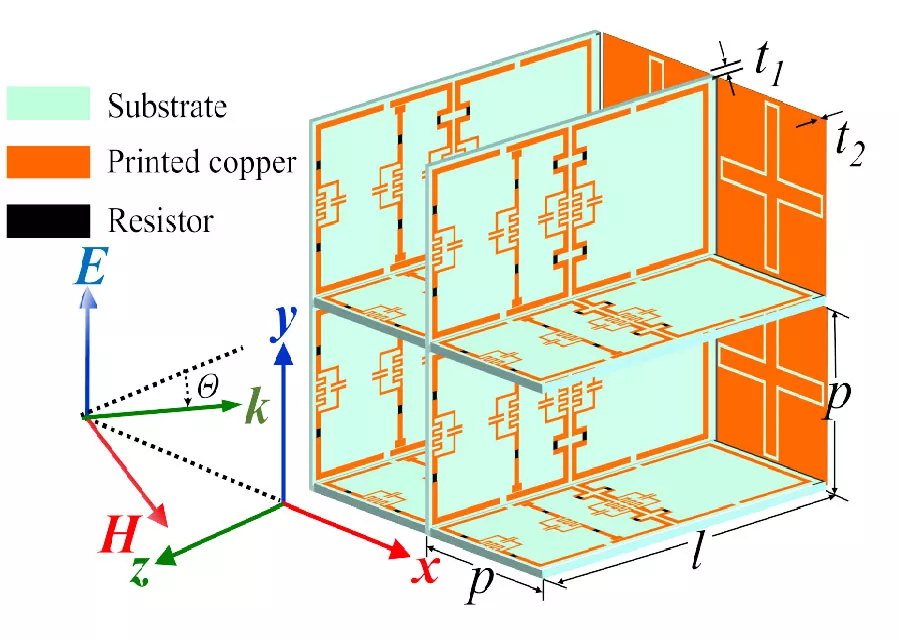
This letter presents a high-selectivity three-dimensional (3-D) dual-polarized frequency-selective rasorber (FSR). The proposed design comprises a 3-D array of multiple lossy strip-type resonators integrated with a planar bandpass frequency-selective surface (FSS). While the multiple resonances of the strips provide wideband absorption, a parallel LC structure is loaded within each resonator to achieve a low-loss transmission band. Numerical and experimental results demonstrate an ultra-wide low-reflection band with a fractional bandwidth (FBW) of 162.2% from 2.0 to 19.2 GHz. This includes a transmission band at 10 GHz with an insertion loss of 0.47 dB, alongside a lower frequency absorption band (2.0-9.5 GHz, FBW 130.4%) and an upper frequency absorption band (10.5-19.2 GHz, FBW 58.6%). The operating mechanism is further validated by an equivalent circuit model and measurement of a fabricated prototype, showing good agreement between theory and experiment.
A High-selectivity 3-D Dual-polarized Frequency Selective Rasorber with Wide Absorption Bands Based on Multiple Strip-type Resonators
2026-03-24
PIER Letters
Vol. 130, 9-14, 2026
download: 231
Design of a Tunable Wide-Stopband Plasmonic Filter Based on a Metal-Insulator-Metal (MIM) Waveguide for Mid-Infrared Applications
Ahmed Lounis, Imane Zegaar, Hocine Bensalah and Abdesselam Hocini
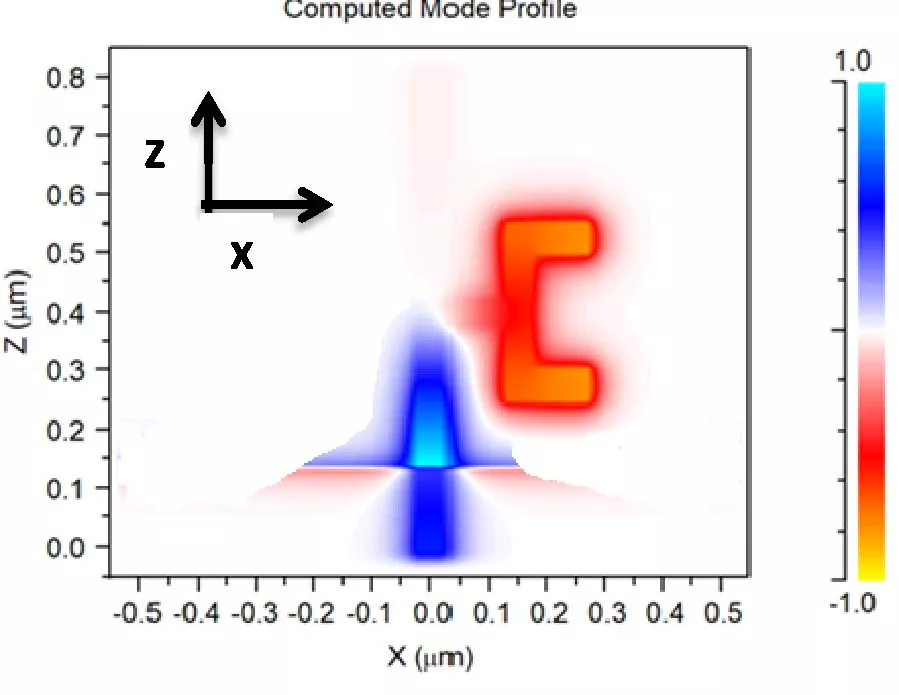
Wide-stopband plasmonic filters are essential components in compact mid-infrared (MIR) photonic systems. This work proposes a geometrically tunable wide-stopband plasmonic filter based on a metal-insulator-metal (MIM) waveguide with dual resonator cavities. The optical response is numerically investigated using the two-dimensional finite-difference time-domain (2D FDTD) method. The influence of the resonator height H2 and the inter-cavity distance D on the stopband characteristics is analyzed. The symmetric dual-cavity configuration enables effective control of the stopband bandwidth and central wavelength. The design achieves a significantly broadened stopband while maintaining compactness and high transmission selectivity, making it a promising candidate for integration into mid-infrared photonic and sensing systems.
Design of a Tunable Wide-stopband Plasmonic Filter Based on a Metal-Insulator-Metal (MIM) Waveguide for Mid-infrared Applications
2026-03-18
PIER Letters
Vol. 130, 1-8, 2026
download: 287
Design and Experimental Validation of Linear to Circular Polarization Converter for Point to Point THz Communication
Murtaza Waheed, Javid Ahmad Ganie, Mingyan Zhong, Qusay Raghib Al-Taai, Kushmanda Saurav and Chong Li
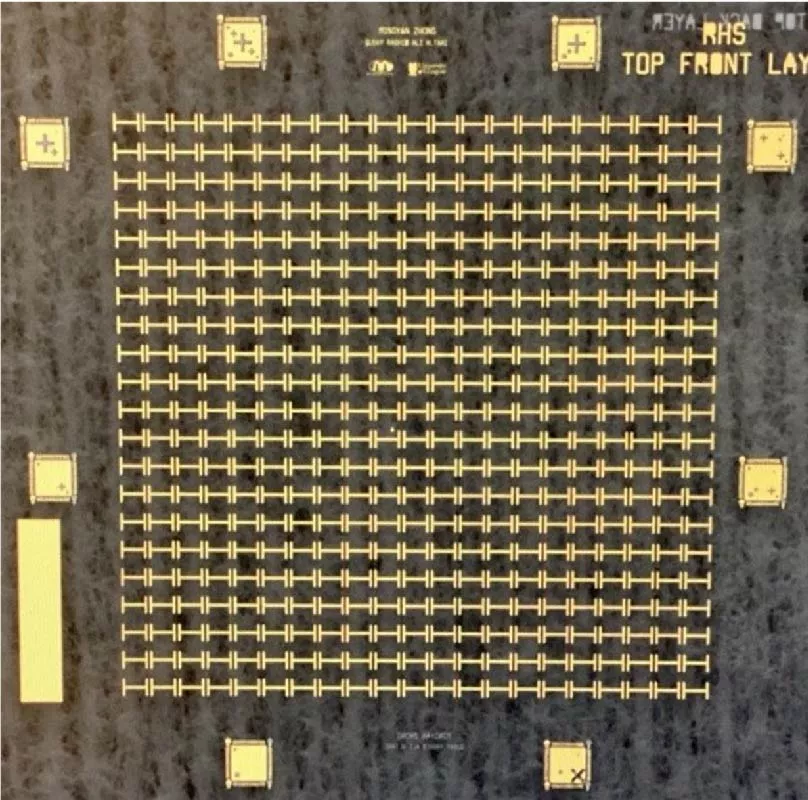
This letter presents a compact, low profile singe substrate transmissive linear-to-circular polarization (LCP) converter designed and experimentally validated for point-to-point THz communication bands. The proposed LCP converter consists of an H-shaped gold metallic pattern deposited on both sides of a 100 μm-thick fused silica substrate. The LCP converter operates within the 0.225-0.307 THz frequency band, achieving a simulated 3-dB axial ratio bandwidth of 30.8% in simulation. Owing to its wide axial ratio bandwidth, the proposed design is a promising candidate for point-to-point THz communication applications. The performance of the proposed converter is verified through surface current distribution, which explains the occurrence of Huygens response and equivalent circuit model. The proposed converter exhibits a measured 3-dB axial-ratio bandwidth of 27.8% in the frequency band 0.229-0.303 THz. The simple geometry and single-substrate implementation, with a thin profile and wide 3-dB axial ratio bandwidth, make the proposed design suitable for practical deployment scenarios.
Design and Experimental Validation of Linear to Circular Polarization Converter for Point to Point THz Communication