Search Results(13788)

2022-09-14
PIER Letters
Vol. 106, 121-128
Period Doubling Analysis on the SBD in Microwave Transmission Line
Yong Xia and Xiao-Wei Shi
A simple electromagnetic system composed by a Schottky barrier diode (SBD) and linear lossless microstrip line is introduced in this paper. The period doubling phenomenon in this circuit system is studied following the train of thought, which is adopted in the field of the driven Resistor-Inductor-Diode (RLD) series circuit. The related phenomenon and its origins have been studied extensively in RLD circuit. However, it will not be able to exhibit period doubling and chaos if SBD is applied in RLD circuit. We show period doubling phenomena in a microwave circuit containing SBD for the first time. This paper reveals that the given circuit can produce cycle period doubling at microwave frequency by means of simulations and experiments. Physical verification and theoretical explanation have been given in this paper.
PERIOD DOUBLING ANALYSIS ON THE SBD IN MICROWAVE TRANSMISSION LINE
2022-09-13
PIER C
Vol. 123, 281-293
NavIC Multipath Signal Analysis for Soil Moisture Sensitivity in the Perspective of a Winter Wheat Crop
Vivek Chamoli , Rishi Prakash and Anurag Vidyarthi
The retrieval of soil moisture in presence of vegetation has received relatively less attention than bare land when observations are made with Global Navigation Satellite System (GNSS). In plane bare land, the reflected GNSS signal is affected by the land characteristics which is dielectric constant of soil. However, in vegetated land, the reflected signal is affected by dielectric constant of soil as well as the characteristics of vegetation which makes the retrieval of soil moisture a cumbersome task in presence of vegetation. Monitoring soil moisture in vegetated land is important for soil health and its suitability for agriculture purposes. Therefore, analysis of soil moisture in presence of vegetation has been studied in this manuscript by utilising the Navigation with Indian Constellation (NavIC) which is a very new entry in GNSS domain by Indian Space Research Organization (ISRO). NavIC receiver setup was installed in a wheat agriculture land situated in Dehradun, India. The wheat crop was sown in the month of November, and it was harvested in the month of April. In situ measurement of soil moisture, crop height, humidity, soil temperature and air temperature were made. Fixed frequency method and Lomb–Scargle Periodogram (LSP) method have been analysed to determine the sensitivity of soil moisture in presence of vegetation. 15° to 30° elevation angle was utilised in the study. The sensitivity analysis was carried out by categorizing the crop based on crop height. Three crop categories have been considered which are 0 to 20 cm, 20 to 80 cm, and greater than 80 cm. The correlation coefficient in the first stage of crop growth using the fixed frequency method was 0.76, which decreased to 0.42 in second stage of crop growth and finally to 0.35 in final stage of crop growth. The correlation coefficient using LSP method was -0.68, -0.65, and -0.50 for the first, second, and third stages of crop growth, respectively. It was observed that for lower crop height (< 20 cm) fixed frequency method is more useful than LSP method. However, for higher crop height (> 20 cm) LSP method is better suited.
NAVIC MULTIPATH SIGNAL ANALYSIS FOR SOIL MOISTURE SENSITIVITY IN THE PERSPECTIVE OF A WINTER WHEAT CROP
2022-09-13
PIER M
Vol. 113, 101-113
Human Motion Recognition in Small Sample Scenarios Based on GaN and CNN Models
Ying-Jie Zhong and Qiusheng Li
In the research of radar-based human motion classification and recognition, the traditional manual feature extraction is more complicated, and the echo dataset is generally smaller. In view of this problem, a method of human motion recognition in small sample scenarios based on Generative Adversarial Network (GAN) and Convolutional Neural Network (CNN) models is proposed. First, a 77 GHz millimeter wave radar data acquisition system is built to obtain echo data. Secondly, the collected human motion echo data is preprocessed, the micro-Doppler features are extracted, and the range Doppler map (RDM) is used to project the velocity dimension and accumulate the two-dimensional micro-Doppler time-frequency map dataset of the human motion frame by frame. Finally, the deep convolution generative adversarial network (DCGAN) is constructed to achieve data augmentation of the sample set, and the CNN is constructed to realize automatic feature extraction to complete the classification recognition of different human motions. Experimental studies have shown that the combination of GAN and CNN can achieve effective recognition of daily human motions, and the recognition accuracy can reach 96.5%. Compared with the manual feature extraction, the recognition accuracy of CNNs is improved by 7.3%. Compared with the original data set, the system recognition accuracy based on the sample augmentation data set is improved by 2.17%, which shows that the GAN has an excellent performance in human motion recognition in small sample scenarios.
HUMAN MOTION RECOGNITION IN SMALL SAMPLE SCENARIOS BASED ON GAN AND CNN MODELS
2022-09-13
PIER Letters
Vol. 106, 111-119
A Modified Magnitude-Selective Affine Function-Based Behavioral Digital Predistortion for Power Amplifiers in MIMO Systems
Haopu Shen , Cuiping Yu , Ke Tang and Yuan'an Liu
In this paper, a modified magnitude-selective affine function-based behavioral model is proposed for the linearization of power amplifiers in multiple-input multiple-output (MIMO) systems. In this model, high-order polynomials in the crossover memory polynomial (COMPM) are replaced by magnitude-selective affine functions to compensate for the crosstalk and nonlinear distortion, leading to a highly efficient hardware implementation. The performance of the model is validated using two 3-carrier long-term evolution (LTE) signals of 20 MHz bandwidth. Experimental results show that the proposed model can achieve nearly the same adjacent channel power ratio (ACPR) and normalized mean square error (NMSE) as COMPM with about 70% reduction of hardware complexity.
A MODIFIED MAGNITUDE-SELECTIVE AFFINE FUNCTION-BASED BEHAVIORAL DIGITAL PREDISTORTION FOR POWER AMPLIFIERS IN MIMO SYSTEMS
2022-09-13
PIER Letters
Vol. 106, 103-110
Parameters of the Probability Density Function of Fluctuations of the Apparent Radiation Center from the Helicopter Propeller Hub
Maksim Stepanov
The properties of the angular glint of radar reflections from the propeller hub are considered. Analytical expressions were obtained based on a known multipoint geometric model of the propeller hub to calculate the probability density function parameters of angular glint for the planes, azimuth, and elevation angle for a single-blade rotor at an arbitrary rotation angle of the head. The relations obtained for a propeller hub with a single blade are generalized to the case of a propeller hub with an arbitrary number of blades. It is shown that the angular glint of the propeller hub is a random process with periodically changing parameters. The theoretical results are confirmed by mathematical modeling.
PARAMETERS OF THE PROBABILITY DENSITY FUNCTION OF FLUCTUATIONS OF THE APPARENT RADIATION CENTER FROM THE HELICOPTER PROPELLER HUB
2022-09-13
PIER Letters
Vol. 106, 97-102
PIN Diodes Loaded 1-Bit Cylindrical Reconfigurable Reflectarray Antenna
Yu Zhao , Shixing Yu and Na Kou
In this paper, we propose a phase compensation method for cylindrical reconfigurable reflectarray antennas and design a cylindrical reconfigurable reflectarray antenna (CRRA) for generating steering beams. Using a PIN diode loaded reflectarray element, 1-bit reflection phase-shift with phase difference of 180°, can be realized. The cylindrical reflectarray consists of 16×18 unit cells whose reflection phase shifts are controlled by bias network independently. Using phase quantization, the reflectarray can generate the desired phase distributions for steering beams. Both simulated and measured results show that the proposed CRRA can achieve beam scanning in ±40˚ angle range. In addition, the measured gain reaches 20.5 dBi, and 1 dB gain bandwidth is 6.9%. The proposed cylindrical conformal reconfigurable reflectarray antenna can provide a reference for the application of the conformal scenario of a reconfigurable reflectarray antenna in the future.
PIN Diodes Loaded 1-bit Cylindrical Reconfigurable Reflectarray Antenna
2022-09-12
PIER C
Vol. 124, 53-68
Finite-Aperture Microwave Bessel Beams with Vortex Twisting, Fracturing, and Dynamic Phase-Shift Control
Vladimir Borisovich Yurchenko , Mehmet Ciydem and Sencer Koc
Finite-aperture microwave vortex beams of various structures in the near-, middle-, and far-field propagation zones have been simulated. The decay of external sidelobes leading to the end of non-diffractive propagation within a fraction of the near-field zone is observed. A ring source of the vortex beams with phase-shift and frequency-sweep control of angular modes and polarization patterns through the use of patch antenna arrays of varying polarization is suggested. A new form of the beam wavefront variation with azimuthal undulation has been proposed that allows one to significantly diversify and dynamically control the beam structure. The consequences of a limited number of antenna patches in a circular array have been considered. The effects of a gradual drop of radiation power along the array and the use of multiple feed points for improving the beams have been simulated.
Finite-aperture Microwave Bessel Beams with Vortex Twisting, Fracturing, and Dynamic Phase-shift Control
2022-09-12
PIER C
Vol. 124, 43-52
A Compact Ultra-Wide Band Printed Log-Periodic Antenna Using a Bow-Tie Structure
Massimo Donelli , Mohammedhusen Manekiya , Viviana Mulloni , Giada Marchi and Roberto Mendicino
This letter, an ultra-wideband compact printed log periodic dipole (LPD) array antenna is designed to operate between 500 MHz and 6 GHz frequencies. The proposed LPD antenna structure consists of one bow-tie dipole and 15 regular dipole elements. The bow-tie element is introduced to improve the antenna's performance at the lowest frequencies below 1 GHz and at the same time to reduce the antenna size maintaining a good performance. An experimental antenna prototype has been designed, optimized, fabricated, numerically and experimentally assessed. The obtained results are very promising, and they demonstrated that the presented antenna prototype is able to operate in the range between 500 MHz and 6 GHz with an average gain of 6 dBi and a very compact size.
A COMPACT ULTRA-WIDE BAND PRINTED LOG-PERIODIC ANTENNA USING A BOW-TIE STRUCTURE
2022-09-11
PIER C
Vol. 124, 33-42
A Novel Method for Rapidly Solving Wideband RCS by Combining UCBFM and Compressive Sensing
Zhonggen Wang , Chenwei Li , Yufa Sun , Wenyan Nie , Pan Wang and Han Lin
While analyzing wideband electromagnetic scattering problems using ultra-wideband characteristic basis function method (UCBFM), the reconstruction of a reduced matrix and the recalculation of an impedance matrix at each frequency point cost a large amount of time. To overcome this issue, a novel method that combines UCBFM with compressive sensing (CS) is proposed in this paper to rapidly analyse the wideband RCS. The proposed method makes the ultra-wide band characteristic basis functions (UCBFs) generated at the highest frequency as the sparse basis, introduces the CS theory, randomly extracts several rows from the original matrix as the measurement matrix, utilizes the corresponding excitation vector as the measurement value, and then employs the recovery algorithm, through which the solution of target induced current can be obtained. Due to partial filling of impedance matrix and efficient recovery algorithm, the wideband RCS computation time of the object is significantly reduced using the proposed method. Furthermore, the numerical simulation results show that the computation efficiency for the target wideband RCS can be further enhanced compared with that of the stand-alone UCBFM.
A Novel Method for Rapidly Solving Wideband RCS by Combining UCBFM and Compressive Sensing
2022-09-11
PIER M
Vol. 113, 87-99
Low Profile/Single Layer X-Band Circularly Polarized Reflectarray with a Linearly Polarized Feed
Shimaa Ahmed Megahed Soliman , Ahmed Attiya and Yahia M. Antar
This paper presents a design of a right hand circularly polarized x-band reflectarray antenna (RA) at a center frequency 12 GHz. The reflectarray is fed by a linearly polarized dipole antenna. The proposed reflectarray antenna can be used for CubeSat applications. The reflecting elements have the shape of a pentagon. This shape is chosen to convert the incident linearly polarized fields to the required circular polarization. A dipole antenna is used as linearly polarized (LP) feeding element for the proposed reflectarray. This dipole antenna is tilted w.r.t the x-axis by an angle 45˚ to introduce nearly equal polarizations in x and y directions on the aperture of the reflectarray. Each reflecting element is adjusted to produce a phase shift 90˚ between the reflection coefficients in x and y directions. The required reflected phase is realized by adjusting a scaling factor (SF) for the pentagonal patch in x direction to the corresponding SF in y axis. This phase difference is responsible for polarization conversion of the incident plane wave into circularly polarized reflected wave. The reflectarray is designed with focal to-diameter (F/D) ratio equals unity. In this work, an efficient technique is discussed for modelling the reflectarray designed. This technique is based on developing a Visual Basic Script file for allocating the reflecting elements with their corresponding dimensions in their location on the simulation tool. This script file is used directly by the simulation tool (HFSS) to draw the complete model automatically. This procedure has a significant role on simplifying the modeling of complicated structure like the proposed reflectarray. The proposed reflectarray antenna is simulated at 12 GHz. The obtained axial ratio (AR) is found to be 2.1 dB, and peak gain is 18 dBi. The antenna is also fabricated and measured for verification.
LOW PROFILE/SINGLE LAYER X-BAND CIRCULARLY POLARIZED REFLECTARRAY WITH A LINEARLY POLARIZED FEED
2022-09-09
PIER C
Vol. 124, 23-32
Gain Enhanced Characteristics of Miniaturized Antenna for 5 GHz WLAN Application
Kakani Suvarna , Nallagarla Ramamurthy and Dupakuntla Vishnu Vardhan
In this article, a miniaturized pentagonal slot antenna (PSA) with a Meander Koch Defected Ground Structures (MK-DGS) and metamaterials (MTM) is proposed for 5 GHz WLAN application. Initially, a Meander Koch DGS was used to lower the resonant frequency of the basic PSA, from 13.1 GHz to 5 GHz. The proposed antenna has been 61.83% miniaturized, close to an electrically small antenna. The performance characteristics of a basic PSA using MK-DGS and MTM superstrate, which improves efficiency, directivity, and peak gain, are also discussed. An antenna with dimensions of 15 × 15 mm2 (or) 0.25λ0 × 0.25λ0 mm2 at a thickness of h1 = 1.6 mm is designed, fabricated, and tested on an FR4 epoxy substrate, and its impact on size reduction performance is evaluated. The gain at 5 GHz is increased from 3.15 to 7.84 dBi by introducing an MTM superstrate made of RT Duriod at a thickness of 1.575 mm above the miniaturized PSA at 17 mm. Test results of the prototype model are corroborated by the simulated results of the proposed model.
GAIN ENHANCED CHARACTERISTICS OF MINIATURIZED ANTENNA FOR 5 GHZ WLAN APPLICATION
2022-09-09
PIER C
Vol. 124, 11-22
Design and Analysis of Quad-Band Notch Characteristics UWB Antenna Using SLR Circuits
Navamani Parthiban and Mohamed Ismail Mohamed
In this paper, a quad-band notch characteristics ultra-wideband (UWB) antenna for Wi-MAX, L-WLAN, U-WLAN, and C-band applications is presented. The initial UWB antenna bandwidth is achieved in the 2 to 12.5 GHz frequency band by using the partial ground method. Spiral lossy resonator (SLR) slots are loaded into the UWB ground structure to achieve quad-band notch characteristics. Each SLRS circuit is accountable for a single notch characteristic by losing EM power at the notch frequency. A quad-band notch is accomplished in this antenna for WiMAX (3.24 to 3.56 GHz), L-WLAN (4.76 to 5.34 GHz), U-WLAN (5.58 to 5.91 GHz), and C-band (7.37 to 7.71 GHz) by loading four SLR slots circuits into the UWB antenna. The proposed antenna is engraved on a Rogers RO4003C (3.55) substrate having an overall volume of 50*40*1.524 mm3. The proposed antenna's performance has been verified through simulation and experiments.
DESIGN AND ANALYSIS OF QUAD-BAND NOTCH CHARACTERISTICS UWB ANTENNA USING SLR CIRCUITS
2022-09-09
PIER M
Vol. 113, 73-86
Bistatic RCS Control on Slot-Sinuous Antenna by Adding 3 and 5 Parasitic Ellipses Openings
Elson Agastra , Alaksander Biberaj , Olimpjon Shurdi and Bexhet Kamo
In this paper, an ultra-wide band modified slot-sinuous antenna has been designed to enhance bistatic radar cross section (RCS) response. The design procedure consists of adding three or five parasitic ellipses openings to each of the slot-sinuous arm cells. The parasitic ellipsis allows to control bistatic RCS without impacting antenna radiation characteristics. Parasitic ellipses opening dimensions are small compared to the relative wavelength of the signal on each active region of the antenna. Ellipses deploy over the entire sinuous arms are scaled by the same expansion coefficient used to design the antenna itself. In the proposed design, ellipses parameters such as ellipses axis, radial position, and relative angle position on the sinuous cell are key parameters to be optimized for bistatic RCS reduction. The total number of designing parameters is finite, but their combination is infinite, which leads to the possibility of designing different antennas based on the required designing goals. The proposed solution and the results presented in this work show the applicability of the designing parameters to control bistatic RCS on active region antennas.
Bistatic RCS Control on Slot-sinuous Antenna by Adding 3 and 5 Parasitic Ellipses Openings
2022-09-09
PIER M
Vol. 113, 59-71
Parameter Identification Based on Chaotic Map Simulated Annealing Genetic Algorithm for PMSWG
Yang Zhang , Chao Zhang and Zhun Cheng
Traditional genetic algorithm identification of permanent magnet synchronous wind generator (PMSWG) parameters is easy to fall into local optimum, resulting in low accuracy of parameter identification results and slow convergence, which reduces the accuracy of parameter tuning of proportional-integral (PI) controller. Aiming at this problem, a chaotic mapping simulated annealing genetic algorithm (CMSAGA) for identifying PMSWG parameters is proposed. The traditional genetic algorithm (GA) has the ability of global random search, combined with the probability breakthrough characteristic of the simulated annealing (SA) algorithm, which avoids the parameter identification result falling into the local optimum and finally tends to the global optimum. With the increase of iteration times, the initial population is mapped with tent chaos mapping theory, and the optimal value of the population is disturbed in each iteration to increase the diversity of the population, making the proposed algorithm converge faster and improve the accuracy. Experiments show that the proposed algorithm has good accuracy and convergence speed, PMSWG stator resistance, stator winding d-q axis inductance and permanent magnet flux can be identified.
PARAMETER IDENTIFICATION BASED ON CHAOTIC MAP SIMULATED ANNEALING GENETIC ALGORITHM FOR PMSWG
2022-09-09
PIER Letters
Vol. 106, 89-95
A Novel CSRR Loaded Compact ACS Fed Monopole Antenna for Sub-6 GHz 5G Applications
Mekala Ananda Reddy , Albert Ruth Jency , Sharma Shabdita and Ramasamy Pandeeswari
The design of a Complementary Split Ring Resonator (CSRR) embedded compact Asymmetric Coplanar Strip (ACS) fed monopole antenna is presented in this paper. By incorporating the ACS feed, a substantial reduction of 27% in antenna dimensions is achieved. Further miniaturization of 68.6% is obtained by embedding CSRR on the designed patch and a trapezoidal ground. The overall size of the antenna is 13.2 × 27 × 1.6 mm3, and it is printed on an FR4-epoxy substrate. The antenna operates with a resonant frequency of 3.6 GHz and a bandwidth of 3.3 GHz (3.2-6.5 GHz). Thus it is appropriate for sub-6 GHz 5G applications. It exhibits a return loss of -28 dB and a gain of 2.8 dBi at the resonant frequency. The antenna is fabricated, and the measured results match well with the simulated ones. Being a simple, cheap, and uniplanar structure, the proposed antenna can meet the requirements of a modern wireless communication system.
A NOVEL CSRR LOADED COMPACT ACS FED MONOPOLE ANTENNA FOR SUB-6 GHZ 5G APPLICATIONS
2022-09-09
PIER Letters
Vol. 106, 81-88
Monopole Antenna Design for UHF Circularly Polarized RFID Applications
Mariam Hossam Mohammed Helmi and Hassan Ragheb
Radio Frequency Identification (RFID) technology is one of the simplest forms of wireless communication systems. It is a unique concept that aims to connect and identify tagged assets or objects to RFID readers to collect information. This paper presents the design and implementation of a compact dual-band RFID applications. The proposed design is a microstrip anetnna composed of two coupled armed meander-lines having 90° between them to achieve circular polarization. The proposed design is mounted on a 1.6 mm thick FR4-epoxy substrate backed by a partial ground plane with the total area of (58 x 80 mm2) to ensure compact size of the tag. The designed antenna is fed through a 50-ohm transmission line of length 28.5 mm. The antenna is considered dual bands that resonate at 850 MHz and 1.5 GHz and radiates circularly polarized waves with axial ratio about 1.4. The simulation results using HFSS software showed promising performance with a bandwidth of 141 MHz at center frequency 850 MHz and 287 MHz at centre frequency 1.5 GHz, respectively after optimizing the proposed design of the tag antenna. The S11 parameter shows return loss at -21 dB at 850 MHz band while at the higher frequency the return loss is much better which was -39 dB. The design provides a perfectly omnidirectional radiation pattern and high radiation efficiency of 93%. Fabrication of the proposed design is done with practical results having a similar trend to the simulated ones to convey good performance of the designed antenna.
Monopole Antenna Design for UHF Circularly Polarized RFID Applications
2022-09-08
PIER C
Vol. 123, 263-279
A Wideband Polarization Conversion Coding Metasurface for Monostatic Radar Cross Section Reduction of High Altitude Aerospace Platforms
E. V. Bhavya , Balamati Choudhury and Raveendranath Nair
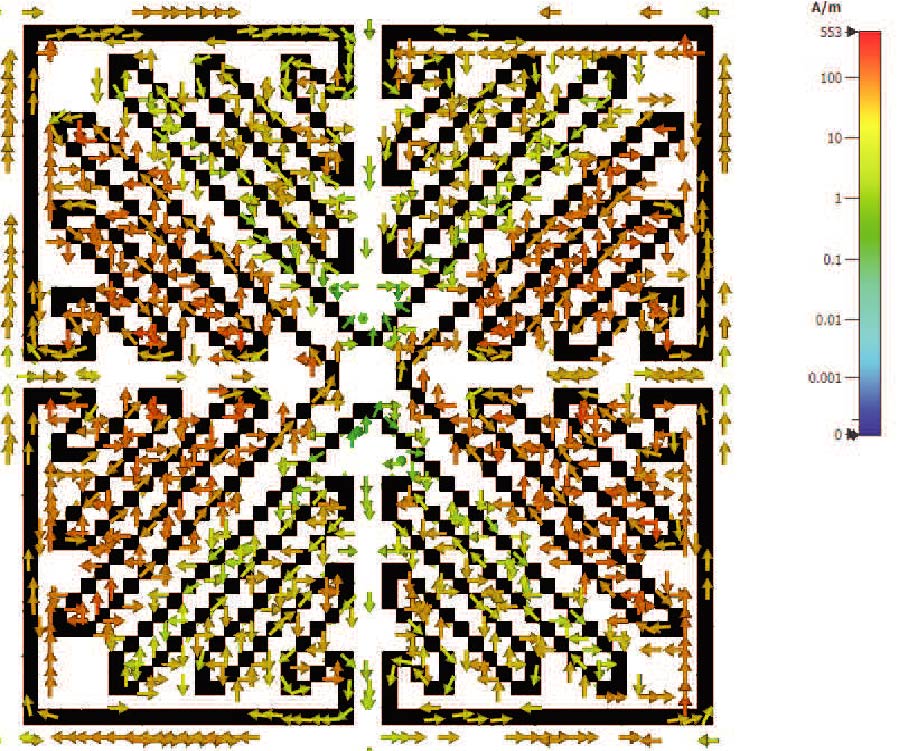
A novel wideband cross-polarized coding metasurface has been presented in this paper towards reduction of monostatic radar cross section (RCS). A broadband reflective cross-polarization converter for linearly polarized (LP) electromagnetic waves covering both X and Ku bands has been designed for this purpose. The proposed unit cell is ultrathin (λ/15.7) and demonstrates a polarization conversion bandwidth of 10.84 GHz from 7.96 GHz to 18.8 GHz for a linearly polarized normal incidence wave which helps in reduction of radar cross section. In order to have a better understanding of cross polarization conversion (CPC), the physical mechanism of the structure has been investigated and elucidated in detail, along with the surface current distribution. The proposed structure has been studied for both transverse electric (TE) and transverse magnetic (TM) polarizations. For 1 bit coding, the suggested unit cell is utilized as the `0' bit, while the 90˚ rotated version of the unit cell is used as the `1' bit. A 4 × 4 matrix is built, and 16 configurations are explored. These combinations are known as the 2 × 2 metasurface sub-blocks, and they are used to build 200 × 200 components with size of 180 mm × 180 mm. The RCS simulation studies have been carried out from 2 to 30 GHz, and the proposed design shows a 10 dB RCS reduction from 10 GHz to 20 GHz. The scattering pattern of the suggested metasurface is comprehensively analyzed at 10 GHz, 15 GHz, and 18 GHz and demonstrates diffuse scattering in the other direction, minimizing the forward scattering RCS. The designed structure of 2.4 mm thickness has been fabricated and measured in the X and Ku bands. The measured results are in good agreement with simulated ones. In order to show the efficiency of the proposed coding metasurface, monostatic RCS estimation of the wing and body sections of high altitude aerospace paltforms (HAPS) has been simulated, and a 14.32 dB reduction has been observed over the body cross section.
A WIDEBAND POLARIZATION CONVERSION CODING METASURFACE FOR MONOSTATIC RADAR CROSS SECTION REDUCTION OF HIGH ALTITUDE AEROSPACE PLATFORMS
2022-09-08
PIER C
Vol. 123, 253-262
A Ku-Band Low-Profile Dual Circularly Polarized Antenna Based on QMSIW
Jingchun Zhai , Wen Wang , Cheng Chang , Yiqing Liu , Luzhen Wang and Zhuopeng Wang
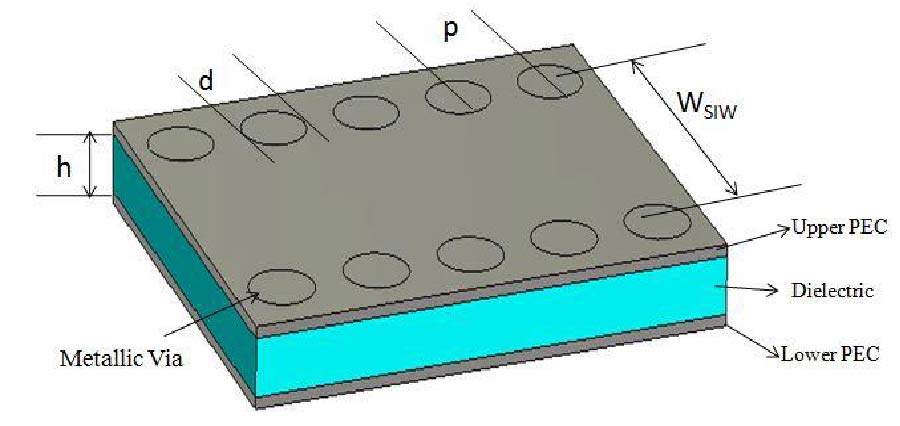
In this paper, a low-profile dual circularly polarized (CP) antenna for Ku band satellite communication is proposed. A quarter-mode SIW (QMSIW) is designed as a circular polarization unit, which realizes circular polarization by using high-order mode TE130, and a pair of units are combined to form the antenna proposed in this paper. Feeding different units can realize left-handed circular polarization and right-handed circular polarization, respectively. The antenna impedance bandwidth is 5.66 GHz (15.16 GHz-20.82 GHz); the circular polarization bandwidth (CPBW) is 540 MHz (15.64 GHz-16.18 GHz); and the gain in the passband is 5.1 dBi, with a minimum axial ratio (AR) of 1 dB. The thickness of the antenna is only 1.5 mm, which has obvious low-profile characteristics.
A Ku-band Low-profile Dual Circularly Polarized Antenna Based On QMSIW
2022-09-08
PIER M
Vol. 113, 47-58
3D Printed Extended Lens as a Button Antenna for off-Body Links at 60 GHz
Shakti Singh Chauhan , Mahesh Pandurang Abegaonkar , Ananjan Basu and Djuradj Budimir
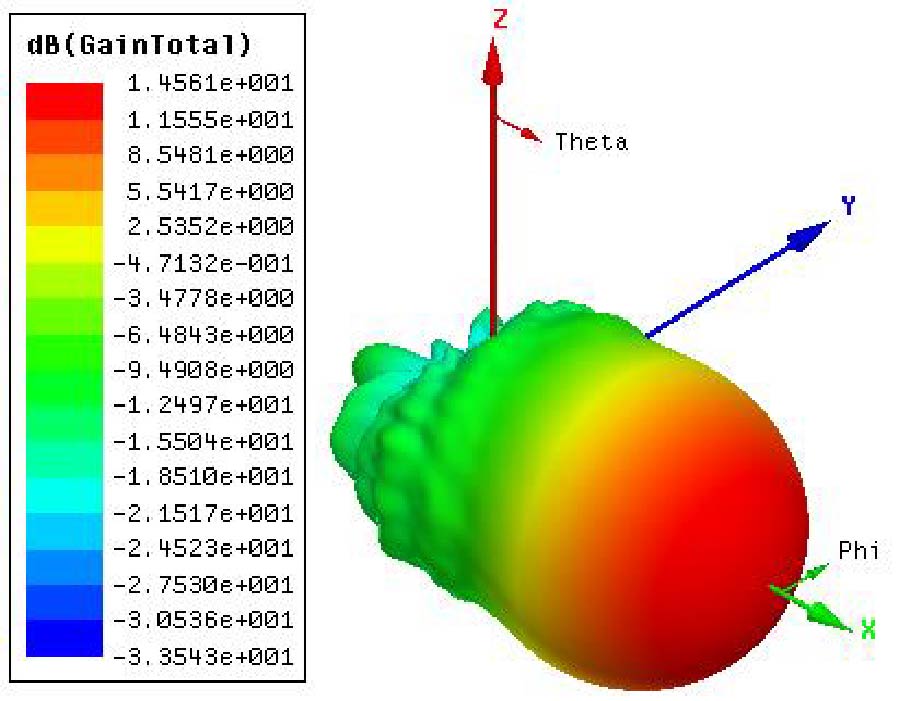
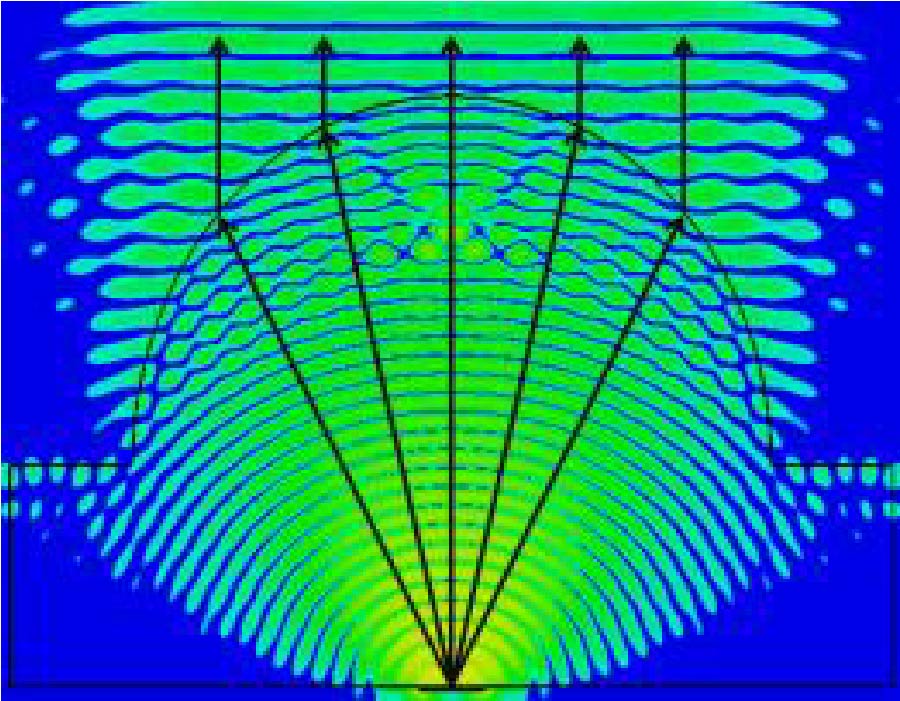
This paper presents a 3D printed extended hemispherical lens antenna for Body Centric Communications in 60 GHz band. The prototype consists of a 3D printed lens made of Polylactic Acid with three planar broadside patch antenna elements used as a source for the lens. The direction of the main beam antenna is switched by changing the excitation of source elements. The measured overlapping impedance bandwidth of the fabricated antenna is from 57.27 GHz to 60 GHz with reflection coefficient better than -10 dB. The main beam direction switches in broadside direction with 3 dB angular coverage from -29.2° to +30° by changing the radiating elements at 60 GHz. The measured gain is 15.28 dBi at 60 GHz. The beam switching capabilities and high gain with broadside radiation characteristics make the proposed antenna a suitable candidate for off-body links at 60 GHz. The effect of placing the antenna structure over the body is also studied in this paper. The body to off-body link measurement is successfully demonstrated with extended lens over the body and an open-ended waveguide as an external node.
3D PRINTED EXTENDED LENS AS A BUTTON ANTENNA FOR OFF-BODY LINKS AT 60 GHZ
2022-09-05
PIER C
Vol. 123, 237-251
Design of Ultra-Wideband MIMO Antenna with Dual Band Elimination Characteristics and Low Mutual Coupling
Ravindra Subhash Bakale , Anil Nandgaonkar , Shankar B. Deosarkar and Mahesh Munde
The paper proposes the design of an ultra-wideband MIMO antenna with low mutual coupling and dual-band elimination characteristics. The proposed structure consists of a microstrip-fed monopole antenna with a stub to enhance the isolation for ultra-wideband applications. The dual rejection bands corresponding to WiMAX and WLAN frequencies are designed using electromagnetic band-gap structures of mushroom-type and placed close to the microstrip transmission line of the designed antenna. The isolation enhancement of |S21| > 20 dB is achieved over the impedance bandwidth by adding two counter-facing F-pattern stubs to the ground. The impedance bandwidth of 9 GHz (2.65-11.65 GHz) for VSWR < 2.13 with the notch bands of 3.6-4.2 GHz and 5.15-5.87 GHz is obtained. The diversity gain, correlation coefficient, radiation pattern, TARC, and peak gain are also studied in the paper. The simulated and measured results are in close agreement with each other. Therefore, the proposed structure is a potential candidate for wireless communication.
DESIGN OF ULTRA-WIDEBAND MIMO ANTENNA WITH DUAL BAND ELIMINATION CHARACTERISTICS AND LOW MUTUAL COUPLING