2026-10-07 Latest Published
By Jie Xiang Chia
King Ho Holden Li
Progress In Electromagnetics Research Letters, Vol. 132, 7-15, 2026
Abstract
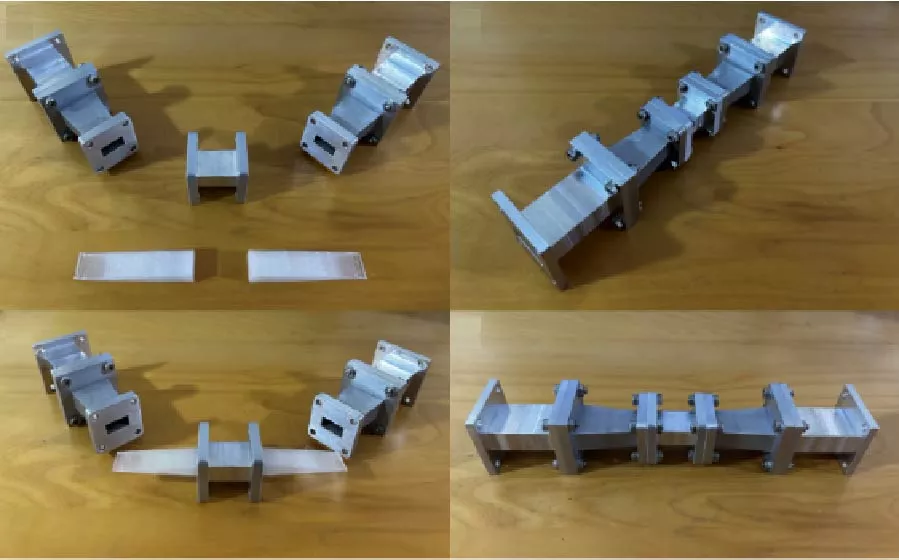
Waveguide transmission lines are known for their low insertion losses, particularly at higher GHz frequencies. However, they tend to be larger and bulkier than other transmission lines. This study investigates using dielectric-loaded waveguides to reduce the overall size and volume of waveguide-routed systems with the dielectric properties of 3D-printed plastics. Compared to other studies that use dielectric loading for size reduction, this study aims to reduce size, volume, and weight while maintaining relatively low losses. The approach is to use low-loss tangent dielectrics with a suitable dielectric constant responsible for reducing size, volume, and weight. Among 3D-printed plastics, Cyclic Olefin Copolymer (COC) is the most suitable based on its dielectric constant and loss tangent in the order of conventional dielectrics such as PTFE. The measured insertion loss of the 3D-printed dielectric-loaded waveguide was 0.22 dB, comparable to that of air-loaded WR90 waveguides of the same length (0.10 dB), while reducing the cross-sectional area by 46.35% and the weight by 26%. The advantage of 3D printing, dielectric-loaded waveguides is the ability to design less constrained waveguide profiles and intricate routing of waveguide transmission lines due to more flexible fabrication capabilities of 3D printing. Combining the benefits of 3D printing and the dielectric properties of COC, this study demonstrates the use of smaller waveguides in a higher frequency band that would be out of band in their air-loaded medium. By loading the smaller out-of-band waveguide with dielectric, the result shows that longer-wavelength signals, which would not be able to propagate without dielectric loading, can now propagate with low insertion loss. The waveguide chain is also miniaturized with a reduced size and overall volume, which would not have been possible with conventional air-loaded waveguides for a given frequency band, as it propagates below the cutoff frequency.