2008-06-16 Latest Published
By Tatsuyuki Hanada
Kiyotaka Fujisaki
Mitsuo Tateiba
Progress In Electromagnetics Research C, Vol. 3, 225-245, 2008
Abstract
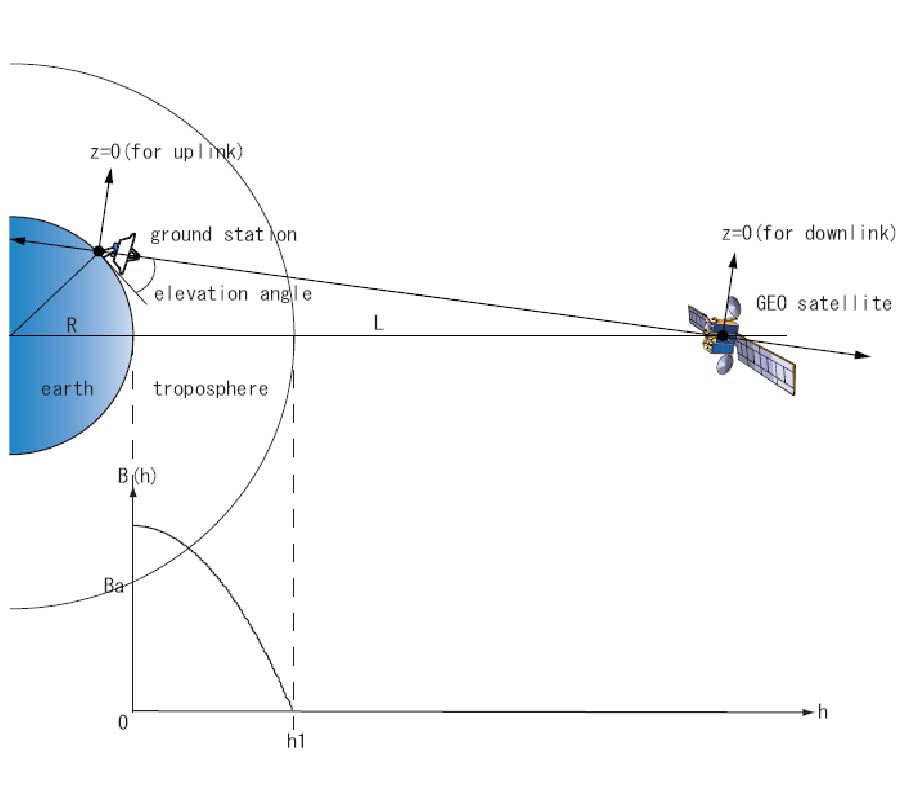
We study the influence of atmospheric turbulence on satellite communication by the theoretical analysis of propagation characteristics of electromagnetic waves through inhomogeneous random media. The analysis is done by using the moment of wave fields given on the basis of a multiple scattering method.
We numerically analyze the degree of the spatial coherence (DOC) of electromagnetic waves on a receiving antenna and the bit error rate (BER) of the Geostationary Earth Orbit (GEO) satellite communication in Ka-band at low elevation angles on the assumption that the spatial coherence of received waves decreases and spot dancing only occurs. In this analysis, we consider the Gaussian and the Kolmogorov models for the correlation function of inhomogeneous random media. From the numerical analysis, we find that the increase in BER for the uplinkcomm unication is caused by the decrease in the average intensity due to spot dancing of received beam waves and that the increase in BER for the downlinkcomm unication is caused by the decrease in DOC of received beam waves. Furthermore, we find that the decrease in DOC of received waves and the increase in BER becomes much more in the Kolmogorov model than in the Gaussian model.