Search Results(13789)

2022-08-04
PIER M
Vol. 112, 163-176
Dipole Antenna with 18×5 Square Electromagnetic Band Gap for Applications Used in Monitoring Children Trapped in Cars
Watcharaphon Naktong and Natchayathorn Wattikornsirikul
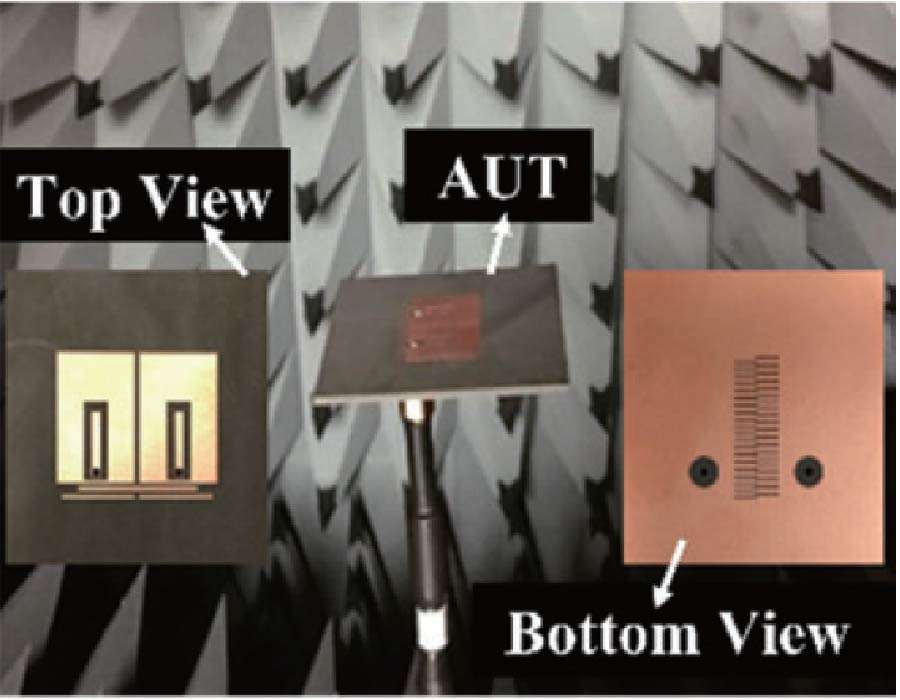
This article presents the design of the dipole antenna structure in combination with a square electromagnetic band gap (EBG), to detect child trapped in carsuse the 750 MHz frequency range, which responds to the most human movement detection. The antenna structure has been designed on a copper plate with a thickness of 0.297 mm and polyester mylar film. The baseplate has a thickness of 0.3 mm, dielectric value 3.2. By design, the dipole antenna is the size as 201.56x12.5 mm2 and a 18x5 units square Electromagnetic Band Gap (EBG) is the size as 254.64x71.86 mm2. The results of the measurement showed that the bandwidth impedance in the operating frequency range was 4.78% (735-771 MHz) with a gain of 6.33 dBi, and has an omnidirectional signal. The dipole antenna has the best distance between the EBG plates 30 mm. When being examined at a distance of 500-1,600 mm, it is the most effective at an average signal strength of approximately 0.032 mW in every time there is movement of the human in the car.
DIPOLE ANTENNA WITH 18×5 SQUARE ELECTROMAGNETIC BAND GAP FOR APPLICATIONS USED IN MONITORING CHILDREN TRAPPED IN CARS
2022-08-04
PIER M
Vol. 112, 151-161
Iron Loss Calculation in Switched Reluctance Motor Based on Flux Integral Path Method
Kuo Li , Aide Xu , Bing Leng , Yang Yang and Jinghao Sun
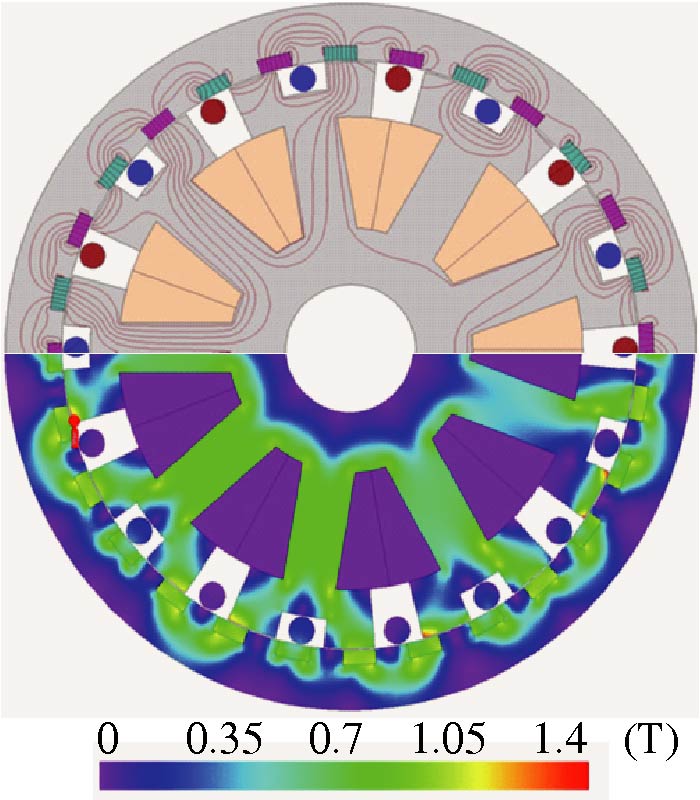
In this paper, a new fast and accurate method, the Flux Integral Path (FIP) method, is proposed for switched reluctance motor (SRM) to analyze the iron loss. The magnetic flux generated by the stator poles is integrated over a period of time, then, the eddy current loss and the hysteresis loss of the whole SRM can be directly calculated by analyzing the path distribution of the flux closed loop without dividing the motor into four blocks (stator pole, stator yoke, rotor pole and rotor yoke). The concept of flux flow is introduced to calculate the eddy current loss, and the piecewise linear fitting of flux density curve in the period is used to approximate the differential and simplify the hysteresis loss calculation. The FIP method can be well applied to non-sinusoidal and nonlinear magnetic density of SRM because of the combination of Finite Element Analysis (FEA) simulation. Furthermore, the loss separation model and the Fast Fourier Transform (FFT) method were compared with the FIP method of the iron loss calculation, and the 2D FEA simulation results were used to verify the method proposed in this paper.
IRON LOSS CALCULATION IN SWITCHED RELUCTANCE MOTOR BASED ON FLUX INTEGRAL PATH METHOD
2022-08-04
PIER M
Vol. 112, 139-149
Propagation Measurements and Modelling of Natural Tropical Caves
Qi Ping Soo , Soo Yong Lim , Irfan Farhan Mohamad Rafie , David Wee Gin Lim , Kian Meng Yap and Sian Lun Lau
Caves are a vital environment with an understudied propagation characteristic to date. In this paper, we investigate the propagation environments of three tourist caves in Malaysia at 900 MHz, 2.4 and 5.8 GHz. Path loss exponents are derived from measurement data for line-of-sight (LoS) and non-line-of-sight (NLoS) sections for vertical-vertical (VV) and horizontal-horizontal (HH) polarizations. Channel fading effects are subsequently analyzed. Beyond the conventional method of computing the path loss exponent values, machine learning is also incorporated into the processing of data for yielding optimum results. The findings of this work lay a good foundation towards a greater understanding of the propagation scenarios in natural tourist caves, and they help towards establishing reliable wireless communications inside such environments.
PROPAGATION MEASUREMENTS AND MODELLING OF NATURAL TROPICAL CAVES
2022-08-04
PIER Letters
Vol. 105, 131-137
A Flexible, Foldable Metamaterial Absorber Fabricated by Matrix-Assisted Catalytic Printing
Pengyu Gong , Huan Lu , Bo Yang , Ruisheng Guo , Siqi Zhang and Rongrong Zhu
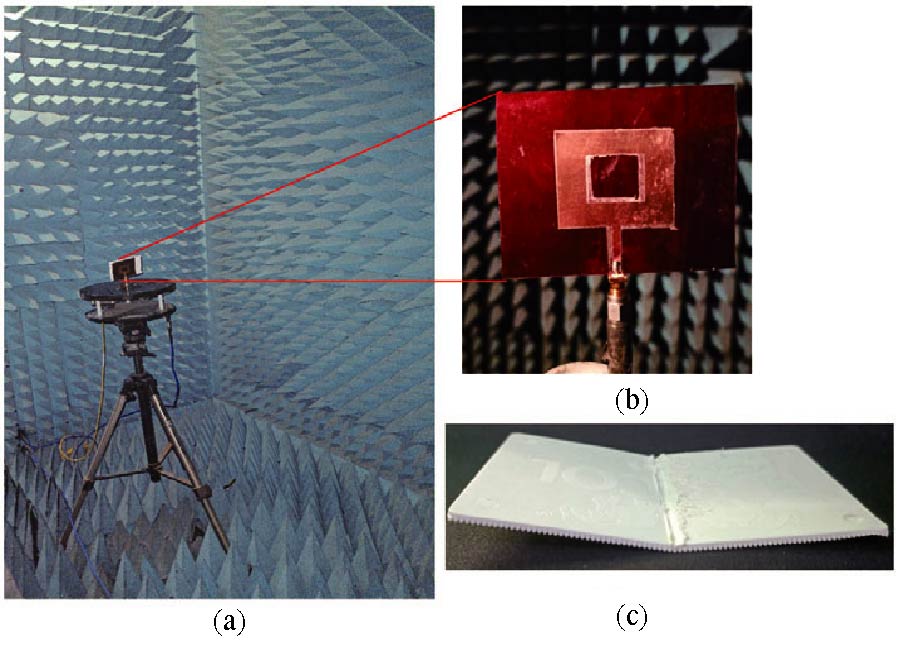
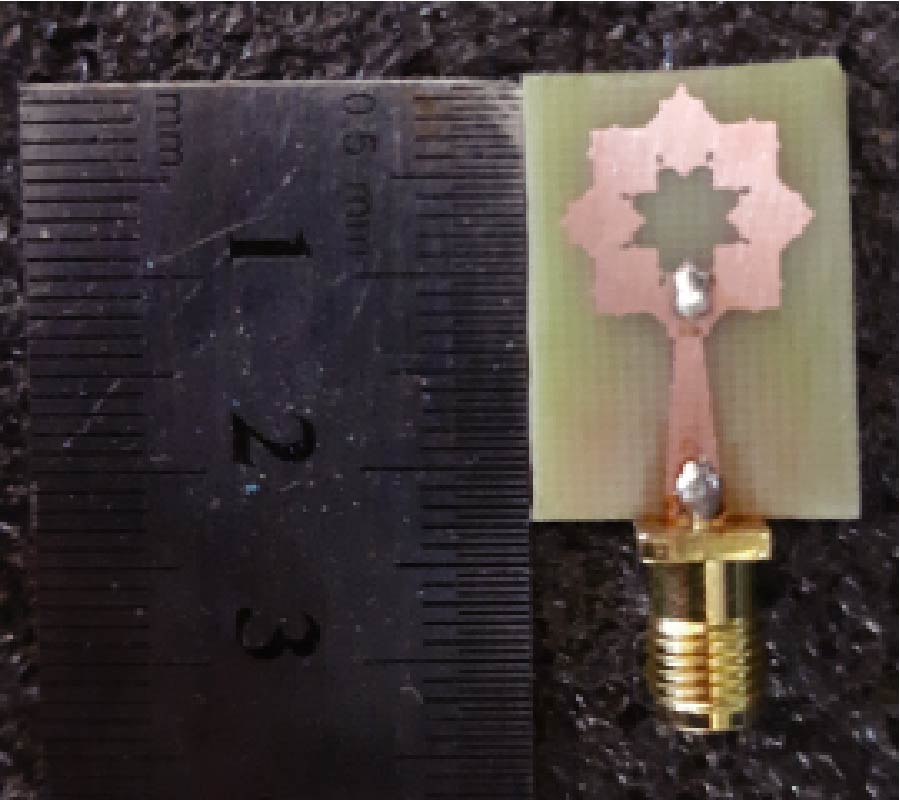
Metamaterial absorbers are widely used in sensing, cloaking, imaging, etc. Currently, most metamaterial absorbers are integrated with hard substrates, which limit their applications for non-planar and irregularsurfaces. In this paper, a flexible, foldable metamaterial absorber is proposed using a matrix-assisted catalytic printing method. The absorber is composed of periodically patterned eight-round sector copper arrays supported by a polyethylene terephthalate substrate. Experimental results show that the absorber exhibits one absorption peak near 10.2 GHz.
A FLEXIBLE, FOLDABLE METAMATERIAL ABSORBER FABRICATED BY MATRIX-ASSISTED CATALYTIC PRINTING
2022-08-03
PIER Letters
Vol. 105, 139-147
Design and Performance Analysis of Metamaterial-Inspired Decagon-Shaped Antenna for Vehicular Communications
Subbaiyan Rajasri and Rajasekar Boopathi Rani
In this article, a metamaterial-inspired decagon-shaped antenna was designed with the dimensions of 30 x 30 x 1.6 mm3 for the vehicular applications that fall under GPS (Global Positioning System), LTE (Long-Term Evolution), UMTS (Universal Mobile Telecommunication System), WLAN (Wireless Local Area Network), Wi-Fi (Wireless Fidelity), INSAT (Indian National Satellite), etc. Initially, a conventional decagon-shaped monopole antenna was designed for the frequency of 4.5 GHz. Then, a decagon-shaped metamaterial unit cell was designed for the frequencies of 1.5 GHz, 2.4 GHz, and 3.5 GHz which were inspired on the monopole antenna to obtain the desired passbandcharacteristics under vehicular bands. All the simulations were done in the ANSYS High-Frequency Structure Simulator (HFSS) 2019 R2 version. In order to determine the metamaterial characteristics of the proposed unit cell, Scattering Parameter Retrieval Method has been used, and the values of permeability have been obtained through MATLAB. Further to examine the antenna performance in vehicular communication, it is placed on the rooftop and front side of the car model in simulation and on a physical car. Return loss characteristics were observed in the simulation as well as in the open space measurement, and the radiation pattern is analyzed with the SBR+ (Shooting and Bouncing Rays) method. The gain and radiation efficiency of the antenna get increased when it is mounted on the car model which is beneficial for the proposed application.
DESIGN AND PERFORMANCE ANALYSIS OF METAMATERIAL-INSPIRED DECAGON-SHAPED ANTENNA FOR VEHICULAR COMMUNICATIONS
2022-08-02
PIER C
Vol. 122, 41-56
Design of Capacitive Coupled Log Periodic Dielectric Resonator Antenna for X Band Applications
Boddapallli Venkata Ramana , Prudhivi Mallikarjuna Rao and Moturi Satyanarayana
In this paper A capacitive coupled Dielectric Resonator Antenna (DRA) array with log periodic method is explored experimentally for X-band applications. The incidence free DRA series consists of seven rectangular Dielectric Resonators (DRs). For both DRA and MPA arrays, a series fed microstrip line was used. In this work, Log Periodic Microstrip Patch Antenna (LPMPA) and Log Periodic Dielectric Resonator Antenna (LPDRA) arrays have been designed and realized, and the performance characteristics such as return loss, VSWR, gain, and bandwidth are simulated and validated experimentally. The LPMPA antenna is in active state from 10.2 GHz to 12.9 GHz with a bandwidth of 2.7 GHz and a gain of 8.55 dB. The LPDRA antenna is in active state from 7.3589 GHz to 12.1060 GHz with an increased bandwidth of 4.7474 GHz and a gain value of 8. 53 dB. The corresponding performance characteristics are presented at the end.
DESIGN OF CAPACITIVE COUPLED LOG PERIODIC DIELECTRIC RESONATOR ANTENNA FOR X BAND APPLICATIONS
2022-08-02
PIER C
Vol. 122, 1-15
FDTD Simulation of a Two-Port Nonlinear Device Characterized by Its X-Parameters.
Joshua M. Kast and Atef Elsherbeni
A new formulation for the finite-difference time-domain (FDTD) technique is presented, for nonlinear circuit components provided that their X-Parameter representations are known. Transient electric fields at specified locations within the FDTD simulation are updated based on the frequency domain behavior of a multi-port nonlinear device, using the X-Parameter behavioral model. The formulation is demonstrated through the simulation of a nonlinear common-emitter amplifier embedded in a microstrip circuit with X-Parameters calculated from SPICE simulation results. Agreement may be seen between the X-Parameter-based simulation results and those acquired using a lumped-element method.
FDTD SIMULATION OF A TWO-PORT NONLINEAR DEVICE CHARACTERIZED BY ITS X-PARAMETERS.
2022-08-01
PIER C
Vol. 122, 31-40
Stub Resonator Based Compact Low-Pass Filter (LPF) with Wide Harmonic Suppression
Arpita Mandal and Tamasi Moyra Panua
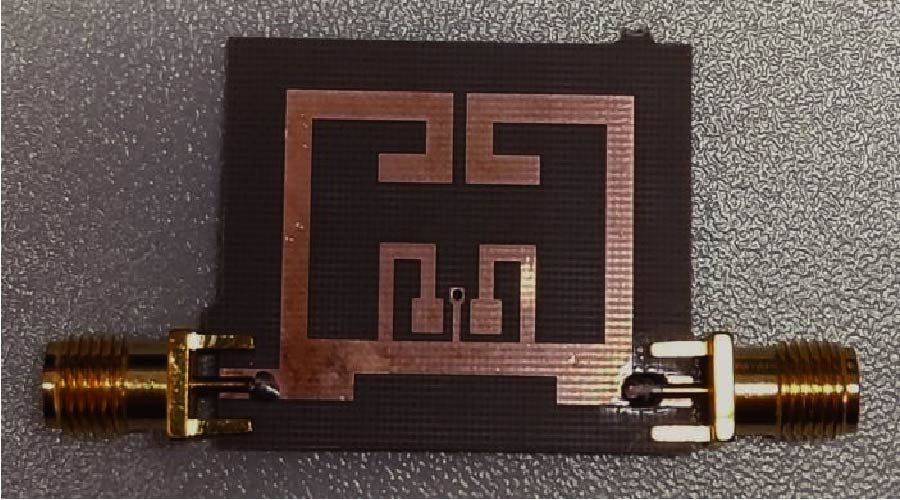
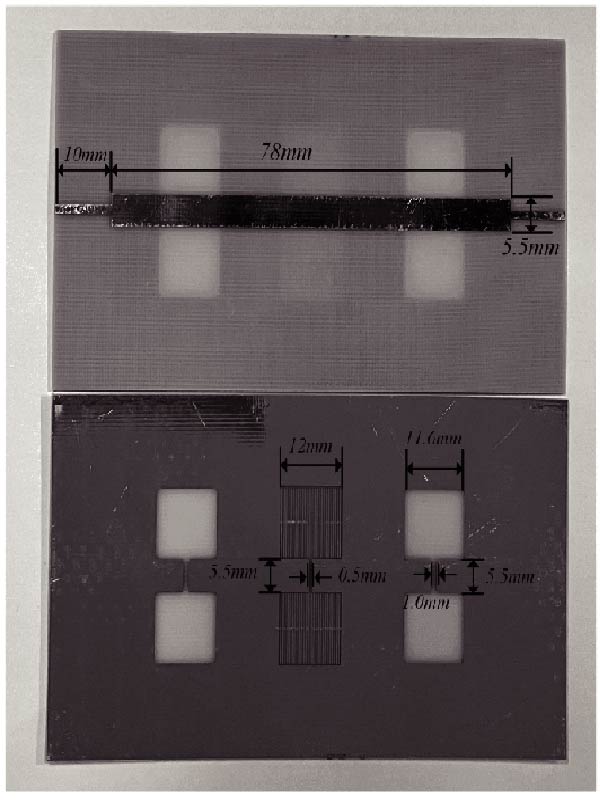
In this article, an open T-shaped stub resonator-based compact microstrip low-pass filter (LPF) with low in-band insertion loss and wide attenuation band is proposed. The folded T-shaped stubs loaded with T-shaped open stubs are symmetrically embedded in the high impedance line of the microstrip structure. The proposed LPF operates at a cut-off frequency of 2.4 GHz, a roll-off factor (ROF) of 62 dB/GHz resonated up to -48.5 dB at the resonant frequency, and an insertion loss of 0.35 dB in the passband region. In the ground plane of the LPF, two dissimilar defected ground structures (DGS) are placed in the array to generate additional attenuation poles for enriching the performance of the stopband. The sixth harmonic suppression is achieved up to 14.6 GHz and relative stopband rejection of 144%. The EM simulated results show a well-matched behavior with the experimental ones. The proposed LPF can be used for Bluetooth, Wi-Fi (2400 MHz), and microwave oven (2450 MHz) applications.
STUB RESONATOR BASED COMPACT LOW-PASS FILTER (LPF) WITH WIDE HARMONIC SUPPRESSION
2022-08-01
PIER C
Vol. 121, 265-279
Multiband Compact MIMO Antenna for Cognitive Radio, IoT and 5G New Radio Sub 6 GHz Applications
Bisma Bukhari and Ghulam Mohd Rather
A planar, handheld device size compatible, multiple-input multiple-output (MIMO) antenna design is proposed. The antenna system has five antennas which cover multiple wireless bands. One pair of elements covers the frequencies below 1 GHz (559 MHz to 828 MHz) for Long term evolution (LTE) and Cognitive radio (CR) applications and frequency bands 1.68 GHz to 1.77 GHz, 2.48 GHz to 2.63 GHz, 3.3 GHz to 3.4 GHz, and 5.79 GHz to 6 GHz for Internet of Things (IoT). The other pair is a modified truncated tetrahedron wideband antenna which covers multiple bands like 854 MHz to 958 MHz, 1.38 GHz to 1.56 GHz, 1.75 GHz to 1.87 GHz, 2.08 GHz to 2.49 GHz, 3.29 GHz to 3.47 GHz and 4.09 GHz to 6 GHz including the triple radio frequency identification (RFID) bands. The antenna is designed and simulated using CST microwave studio simulator and antenna prototype is fabricated to obtain the experimental results.
MULTIBAND COMPACT MIMO ANTENNA FOR COGNITIVE RADIO, IOT AND 5G NEW RADIO SUB 6 GHZ APPLICATIONS
2022-08-01
PIER Letters
Vol. 105, 121-129
Projection Constraint Null Broadening and Deepening Method for Conjugate Array
Shi-Jing Xiao , Bin Li and Qing Wang
The performance of the Capon beamforming sharply decreases against strong directional and large deviation interference. In order to reduce the impact of the abnormal interference, this paper proposes a large degree of freedom null broadening beamforming for non-circular signals. The signal vector is first extended by a uniform linear conjugate array. The covariance matrix of the array is then reconstructed by projection transformation and diagonal loading technique. Finally, the beamforming is constrained by the characteristic subspace of the guide vector matrix, and the analytic expression of the optimal weights of the method is derived. The numerical simulations demonstrate that the proposed null broadening method has the advantages of high degrees of freedom and strong parameter selection robustness.
PROJECTION CONSTRAINT NULL BROADENING AND DEEPENING METHOD FOR CONJUGATE ARRAY
2022-08-01
PIER Letters
Vol. 105, 111-120
Design of Frequency Multiplexed Coding Metasurface for Dual-Functional Beam Control
Honggang Hao , Qinxuan Ling , Wei Ruan and Hanhai Xiao
A frequency multiplexed coding metasurface controlling beam is proposed to enrich the functions of a single metasurface. A square F4B dielectric substrate with a copper-clad bottom surface and a V-shaped and quadrangular cross-shaped metal structure is used as the unit. Applying the different responses of x and y polarized waves and optimization of structural parameters, we can obtain 1-bit coding units for the two frequency bands. The reflection phase can be modulated independently of each other. The design of a dual-band metasurface with different beam splitting effects was realized, achieving the goal of different frequency multiplexing functions on a single metasurface. An RCS reduction of 11 dB at 12 GHz and a double beam splitting at 20 GHz with a pitch angle of ±47.6° are achieved by metasurface. The test results agree well with the simulation results. The proposed metasurfaces offer a simple structure, low cost, good performance, and promising great applications in areas such as frequency multiplexed communications.
DESIGN OF FREQUENCY MULTIPLEXED CODING METASURFACE FOR DUAL-FUNCTIONAL BEAM CONTROL
2022-08-01
PIER Letters
Vol. 105, 103-109
Efficient Broadband Power Amplifier Using Klopfenstein Taper as Output Matching Network
Duo-Wei Liu , Fei Cheng , Chao Gu and Kama Huang
An efficient 0.6-4.2 GHz GaN-HEMT power amplifier based on Klopfenstein taper is proposed in this letter. A method based on source-pull/load-pull simulation has been used to find the optimum source and load impedances across the broad band. Then the Klopfenstein taper is studied and adopted for the output matching circuit design to achieve broadband performance. The measured results show that our proposed power amplifier has a fractional bandwidth of 150%, with saturated output power ranging from 39.45 to 42.32 dBm, power added efficiency from 45.1% to 64.8%, and over 9 dB gain at the whole working band of 0.6-4.2 GHz. The fabricated power amplifier can cover most of the wireless communication frequency bands.
EFFICIENT BROADBAND POWER AMPLIFIER USING KLOPFENSTEIN TAPER AS OUTPUT MATCHING NETWORK
2022-07-31
PIER Letters
Vol. 105, 95-102
Design of an Ultra Compact Antenna for Low Frequency Applications
Basil J. Paul , Shanta Mridula , Anju Pradeep and Pezholil Mohanan
An ultra compact antenna for low frequency application is presented. The resonant frequency band of the proposed antenna is centered at 403.5 MHz, employed for medical implant communication service (MICS) band. The proposed antenna is designed and fabricated on a substrate with εr = 4.4, tanδ=0.02 and thickness h = 1.6 mm. The size of the antenna is only 0.04λ0 x 0.022λ0 x 0.002λ0 (29 mm x 16.5 mm x 1.6 mm), making it very compact for low frequency of operation. The antenna is evolved from a CPW transmission line. During the process of evolution of the proposed antenna, dual-composite right left handed (D-CRLH) behavior is confirmed from the dispersion diagram. The equivalent lumped circuit model for the antenna is also developed, and the D-CRLH behavior is also confirmed from the circuit model.
DESIGN OF AN ULTRA COMPACT ANTENNA FOR LOW FREQUENCY APPLICATIONS
2022-07-28
PIER M
Vol. 112, 127-137
A Novel Compact Dual Notch with High-Gain Multi-Layer Dielectric Resonator Antenna for Ultrawide-Band Applications
Mai F. Ahmed , Mona Abdel Ghany Mohamed , Abdelhameed Abdelmoneim Shaalan and Walid Saber El-Deeb
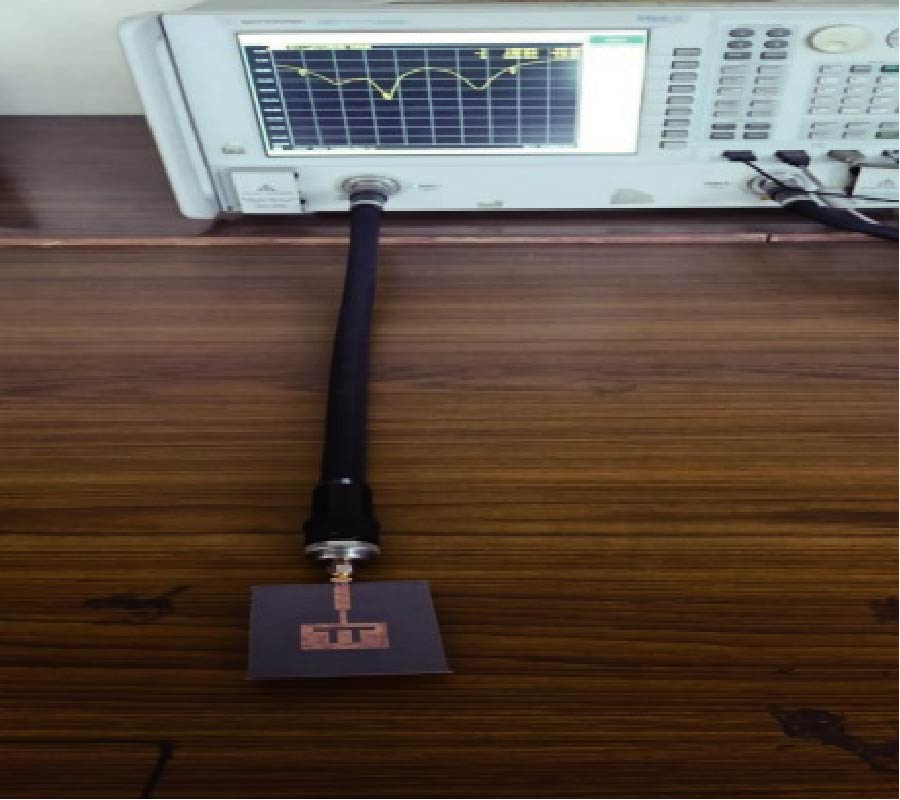
In this paper, a novel compact high-gain multi-layer dielectric resonator antenna for ultra-wideband applications is designed and fabricated. The proposed antenna employs a new technique to make a notch-band for the frequencies within UWB. This technique helps avoid any interference for bands like WLAN and X-band for satellite applications. In this design, several notch bands can get at different frequencies by changing the length of slots. The operating bandwidth of this antenna is between 4.8 GHz and 11.31 GHz with -10 dB return-loss and maximum gain of 6 dBi. Finally, the proposed antenna is fabricated and measured to validate the simulation results. The simulation results are obtained by two different simulators; CST Studio suite TM 2020 and HFSS 15 to ensure the validity of the design results before fabrication. The fabricated antenna is measuredusing Agilent R&S Z67 VNA. There is a good agreement between the simulation and experimental results.
A NOVEL COMPACT DUAL NOTCH WITH HIGH-GAIN MULTI-LAYER DIELECTRIC RESONATOR ANTENNA FOR ULTRAWIDE-BAND APPLICATIONS
2022-07-28
PIER M
Vol. 112, 115-125
A 2-d DOA Estimation Algorithm for L-Shaped Array with Improved Computational Efficiency
Jie Yang and Hu He
A high-precision and high-efficiency reduced-dimension direction of arrival (DOA) estimation algorithm based on an L-shaped array for the problems of large computation and high cost of achieving two-dimensional (2D) DOA estimation by 2D multiple signal classification (MUSIC) algorithm under various complex arrays. The algorithm makes full use of the structural characteristics of the L-shaped array to decompose the uniform L-shaped array into two uniform linear arrays. These two arrays are respectively searched in one-dimension (1D) to estimate the angles between the source and the x-axis and y-axis, and then the 2D DOA estimation is obtained according to the geometric relationship, which greatly reduces the amount of computation. Furthermore, the algorithm increases the utilization of noise subspace information, which not only realizes the automatic pairing of direction angle and elevation angle, but also improves the estimation accuracy. In order to further reduce the complexity and improve the estimation performance, this paper also puts forward the root finding method instead of 1D search, and uses a fast angle matching method to accurately match angles. Simulation results show the feasibility of the proposed algorithm.
A 2-D DOA ESTIMATION ALGORITHM FOR L-SHAPED ARRAY WITH IMPROVED COMPUTATIONAL EFFICIENCY
2022-07-28
PIER M
Vol. 112, 105-114
Hydrostatic Pressure Sensor Based on Defective One-Dimensional Photonic Crystal Containing Polymeric Materials
Sanjeev Srivastava
In this work, the design of a high sensitivity hydrostatic pressure sensor based on one-dimensional photonic crystal (1DPC) containing polymeric materials has been proposed and investigated, theoretically. The proposed structure consists of alternate layers of polystyrene (PS) and polymethyl metahacrylate (PMMA) with a defect of layer of PS, PMMA and air, respectively, in the middle of the PC structure. The sensing principle is based on the shift in the peak of transmitted wavelength when the hydrostatic pressure is applied on 1DPC. In order to obtain the transmission spectrum of 1DPC structure transfer matrix method (TMM) has been used. From the analysis it is found that with the increase in hydrostatic pressure transmission (or resonance) peak shifts towards the lower wavelength side with respect to the center wavelength. The average sensitivity (Δλ/ΔP) of the proposed sensor is found about 0.948 (nm/MPa) with polymer defect and 0.92 (nm/MPa) with air defect in the mid-IR frequency region, and the applied pressure range is 0 to 200 MPa.
HYDROSTATIC PRESSURE SENSOR BASED ON DEFECTIVE ONE-DIMENSIONAL PHOTONIC CRYSTAL CONTAINING POLYMERIC MATERIALS
2022-07-28
PIER M
Vol. 112, 1-14
Electromagnetic Compatibility Study of Quadcopter UAVs: Characteristic Mode Analysis of the Frame's Material and Shape Effect
Mohamed Z. M. Hamdalla , Jesus M. Roacho-Valles , Anthony N. Caruso and Ahmed M. Hassan
The variation in flight attitude, line-of-sight, and speed of unmanned aerial vehicles (UAVs) affect their polarization-dependent coupling cross-section and resultant compatibility to pulsed electromagnetic energy. Here, we present the out-of-band electromagnetic compatibility (EMC) effects of UAV frame material and shape on the UAV subcomponents. Characteristic mode analysis (CMA) is employed to study the fundamental modes supported by UAVs which facilitate the interpretation of its electromagnetic response and the prediction of its effect on the nearby components. Using CMA, we develop a framework that optimizes the placement of wires and traces of printed circuit boards (PCBs) on the frame mitigating interference from undesired electromagnetic sources. A 3-D scanner is used to provide four versions of a quadrotor UAV to study the frame shape effect on the coupling. Materials of differing permittivity are assigned to these frame versions to assist in understanding the material effect on the EM coupling to the UAV.
ELECTROMAGNETIC COMPATIBILITY STUDY OF QUADCOPTER UAVS: CHARACTERISTIC MODE ANALYSIS OF THE FRAME'S MATERIAL AND SHAPE EFFECT
2022-07-27
PIER B
Vol. 96, 39-66
Design Consideration, Challenges and Measurement Aspects of 5G mm-Wave Antennas: A Review
Ashok Kumar , Ashok Kumar , Ping Jack Soh and Arjun Kumar
With the supersonic growth of mobile data demand, the fifth generation (5G) mobile network would exploit the extensive amount of spectrum in the millimeter-wave (mm-Wave) bands to tremendously increase communication capacity. There are conceptual differences between mm-Wave communications and other existing communication systems, in terms of high propagation loss, directivity, and sensitivity to blockage. These characteristics of mm-Wave communications present several challenges to completely exploit the potential of mm-Wave communications, including integrated circuits and system design, interference management, spatial reuse, anti-blockage, and dynamics control. 5G mobile communication systems with sub-6 GHz and millimeter-wave bands are already replacing 4G and 4.5G systems as an evolution towards higher-speed mobile communication and wider bandwidth. From the hardware perspective, the 5G-band causes the miniaturization of RF components including the antennas. In this article, an overview of recent research is presented that discusses design challenges and measurement considerations for various types of compact 5G antennas.
DESIGN CONSIDERATION, CHALLENGES AND MEASUREMENT ASPECTS OF 5G MM-WAVE ANTENNAS: A REVIEW
2022-07-27
PIER
Vol. 175, 29-43
Low Cost and High Performance 5-Bit Programmable Phased Array Antenna at Ku-Band
Xin Li , Han Qing Yang , Rui Wen Shao , Feng Zhai , Guo Biao Liu , Zheng Xing Wang , Hong Fei Gao , Ge Fan , Jun Wei Wu , Qiang Cheng and Tie-Jun Cui
We present a low-cost and high-performance 5-bit programmable phased array antenna at Ku-band, which consists of 1-bit reconfigurable radiation structures, digital phase shifters, and coplanar waveguide feeding network. The 1-bit reconfigurable radiation structure utilizes symmetric geometries and PIN diodes to form stable 180° phase difference. The digital phase shifter provides 168.75° phase difference and together with the radiation structure form a 348.75° phase coverage. The antenna operates between 14.4 and 15.4 GHz, and the overall array contains 24×2 elements with each of them being individually addressable. By changing the states of the diodes and thus adjusting the phase coding sequences of the array, the antenna achieves 0°-60° precise beam scanning at 14.8 GHz, with the sidelobe level, cross-polarization, and gain fluctuation being less than -16 dB, -26 dB, and 2.4 dB, respectively. A prototype was fabricated to verify the design, and the measurement results agree well with simulations. Compared with traditional phased arrays composed of numerous phase shifters and T/R components, the proposed antenna features high performance, high flexibility, low profile, and low cost. The antenna provides a new and feasible solution of wavefront steering and will benefit the various application scenarios.
LOW COST AND HIGH PERFORMANCE 5-BIT PROGRAMMABLE PHASED ARRAY ANTENNA AT KU-BAND
2022-07-27
PIER C
Vol. 122, 17-30
Dual Band Split Ring Monopole Antenna Structures for 5G and WLAN Applications
Shubhangi Mangesh Verulkar , Alka Khade , Mahadu Trimukhe and Rajiv Kumar Gupta
In this paper, dual-band split ring monopole antenna structures for 5G sub-6 GHz and WLAN applications are proposed. The antenna structures are designed from a rectangular annular ring monopole antenna. A compact dual rectangular split ring monopole antenna is designed to operate over dual bands. The two split rings are connected through a common arm. The structure is optimized to provide S11 ≤ -10 dB over 3.3-3.6 GHz and 5.15-5.5 GHz for 5G and WLAN applications. In the second dual-band antenna, a slot is cut in one of the arms to form another closed rectangular ring to further reduce the dimensions of the antenna. This structure provides S11 ≤ -10 dB over 3.3-3.6 and 5.5-5.9 GHz for 5G, WLAN and V2X applications. The two bands can be easily controlled as the dimensions of two rings determine the resonant frequencies of the two bands, and one of the arms of a ring is unresponsive to lower band and affects upper band only. Both antennas offer nearly omnidirectional radiation patterns in both bands. The two prototype antennas are fabricated on a 0.17λ0×0.19λ0 and 0.15λ0×0.19λ0 FR4 substrate, where λ0 is the free-space wavelength corresponding to 3.3 GHz. The measured results agree with the simulated ones.
DUAL BAND SPLIT RING MONOPOLE ANTENNA STRUCTURES FOR 5G AND WLAN APPLICATIONS