Search Results(13789)

2022-05-22
PIER B
Vol. 95, 141-162
Time-Reversal of Sub-THz Pulses in Complex Media
Ali Mokh , Ramin Khayatzadeh , Abdelwaheb Ourir , Mohamed Kamoun , Arnaud Tourin , Mathias Fink and Julien de Rosny
For the last 20 years, the time-reversal (TR) process has been successfully applied to focus pulses in the microwave frequency range and in complex media. Here we examine the specific conditions to obtain the same results but in the sub-THz frequency range. Because of the stronger attenuation at this much higher frequency, it is more challenging to exploit the TR self-focusing property. The TR of pulses is studied in two kinds of complex media: metallic waveguide and leaky reverberating cavity. For each medium, we propose one or two models to assess the quality of the focusing. For the waveguide, we show that the angle of incidence is an important parameter. Based on these results, we perform TR experiments at 273 GHz with a bandwidth that can be as large as 2 GHz. TR experiments are successfully first conducted in a 1 m long and 10 mm diameter straight hollow cylinder and then in a 5 m long and 12 mm diameter curved waveguide. Finally, we present results obtained in a cavity of 72 cm3 that leaks through a copper grid. The best focusing is observed with the longer waveguide.
TIME-REVERSAL OF SUB-THZ PULSES IN COMPLEX MEDIA
2022-05-22
PIER C
Vol. 120, 145-157
Effect of Temperature on the Properties of Omnidirectional Mirror One Dimensional Photonic Crystal
Olfa Nasri , Jihene Zaghdoudi and Mounir Kanzari
In this work, we present numerical results regarding the effects of temperature on the omnidirectional photonic band gap (OPBG) of ternary 1DPC containing metal (Ag) layer or graphene layer. By periodically introducing layer metal (Ag) or graphene into 1DPC, the width of OPBG has been increased. As the temperature increases, the photonic band gap of the OPBG becomes wider. Compared to the conventional OPBG in ternary 1DPC containing Ag, the OPBG in 1DPC containing graphene with temperature T = 1000˚K is greatly broadened by 2.04 times. The theoretical basis of our study adopts the transfer matrix method TMM. In fact, these broad omnidirectional and thermally tunable OPBGs will offer many prospects for omnidirectional mirrors, temperature sensing device, optical filters, polarizer, and other optical devices.
EFFECT OF TEMPERATURE ON THE PROPERTIES OF OMNIDIRECTIONAL MIRROR ONE DIMENSIONAL PHOTONIC CRYSTAL
2022-05-22
PIER M
Vol. 110, 145-156
Integrated Waveform of Frequency Diversity Array Radar Communication Based on OFDM Random Frequency Offset Modulation
Kefei Liao , Jing Zhang , Haitao Wang , Shan Ouyang and Ningbo Xie
The integration of radar and communication has always been one of the cross-research hotspots in the field of radar and communication. In order to solve the problems of integration signal separation and the angle-distance coupling, this paper proposes a radar and communication integrated waveform based on random Orthogonal Frequency Division Multiplexing (OFDM) frequency offset modulation for Frequency Diversity Array (FDA). This waveform directly loads OFDM symbols to the elements of FDA, and each element carries a complete OFDM symbol with different information. Random frequency offsets are added between the elements to separate different signal of different elements, which can solve the problem of signal separation and form decoupled radar beam. After transmitting and receiving a series of the waveform, the transmission of communication data and the positioning of radar targets can be completed at the same time. The simulation results show that the waveform not only solves the problem of separating and uncoupling the integrated signal, but also improves the frequency band utilization rate and information transmission rate of the radar communication integrated system.
INTEGRATED WAVEFORM OF FREQUENCY DIVERSITY ARRAY RADAR COMMUNICATION BASED ON OFDM RANDOM FREQUENCY OFFSET MODULATION
2022-05-20
PIER B
Vol. 95, 123-140
The Role of Jordan Blocks in the MOT-Scheme Time Domain EFIE Linear-in-Time Solution Instability
Petrus Wilhelmus Nicolaas (Pieter) Van Diepen , Roeland Johannes Dilz , Adrianus Petrus Maria (Peter) Zwamborn and Martijn Constant van Beurden
The marching-on-in-time electric field integral equation (MOT-EFIE) and the marching-on-in-time time differentiated electric field integral equation (MOT-TDEFIE) based on a Rao-Wilton-Glisson (RWG) spatial discretization. In both formulations we employ the Dirac-delta temporal testing functions, however they differ in temporal basis functions, i.e. hat and quadratic spline basis functions. These schemes suffer from the linear-in-time solution instability. We analyze the corresponding companion matrices using projection matrices and prove mathematically that each independent solenoidal current density corresponds to a Jordan block of size two. In combination with Lidskii-Vishik-Lyusternik perturbation theory we find that finite precision causes these Jordan block eigenvalues to split and this is the root cause of the instability of both schemes. The splitted eigenvalues cause solutions with exponentially increasing magnitudes that are initially observed as constant and/or linear-in-time, yet these become exponentially increasing at discrete time steps beyond the inverse square root of the error due to finite precision, i.e. approximately after one hundred million discrete time steps in double precision arithmetic. We provide numerical evidence to further illustrate these findings.
THE ROLE OF JORDAN BLOCKS IN THE MOT-SCHEME TIME DOMAIN EFIE LINEAR-IN-TIME SOLUTION INSTABILITY
2022-05-12
PIER M
Vol. 110, 133-143
A New 2×2-Element Subarray Antenna Synthesis Based on Waveguide Cavity Resonators
Raad Salih Jarjees and Rashad Hassan Mahmud
A new design of a 2×2-element subarray antenna based on an all-cavity resonator structure is presented in this article. A novel topology which employs only two resonators to lay out the subarray is proposed, and two X-band rectangular waveguide cavity resonators are utilized for the subarray physical implementation. The first resonator is a conventional half-guided resonator operating at the TE101 mode. The second resonator, which is an oversized TE102 resonator based, is modified in order to keep the TE101 mode to propagate within the bandwidth of interest and facilitate the connection with four radiating apertures. The developed coupling matrix approach is utilized to calculate the desirable frequency response, which is a standard 2nd order Chebyshev response with introducing filtering functionality to the realised gain response of the subarray. The simulation results obtained by two simulation softwares (CST and Ansoft HFSS) validate the calculation results. An extremely wide impedance bandwidth of 23% at center frequency 10 GHz when the reflection coefficient S11 = -10 dB is obtained. A very stable realised gain with less than 0.5 dBi variations over the bandwidth of interest (8.8-11.1 GHz) is obtained with a peak gain value of 13.1 dBi at 11 GHz. The radiation patterns have very low side lobe levels, particularly in the E-plane, due to the existence of small non-radiating area and maintaining small spacing between the radiating apertures. The proposed 2×2-element subarray has the advantages of wider bandwidth and low profile compared with our and other previous 2×2-element subarrays.
A NEW 2×2-ELEMENT SUBARRAY ANTENNA SYNTHESIS BASED ON WAVEGUIDE CAVITY RESONATORS
2022-05-12
PIER Letters
Vol. 104, 47-55
Hexagon Shape SIW Bandpass Filter with CSRRs Using Artificial Neural Networks Optimization
Ranjit Kumar Rayala and Singaravelu Raghavan
A dual-band hexagon shape substrate integrated waveguide (SIW) based band pass filter with single loop complementary spilt ring resonators (CSRRs) is introduced in this paper. The design parameters of this filter are optimized by using artificial neural networks (ANNs). Especially error back propagation multilayer perceptron (EBP-MLP) neural network with Levenberg-Marquart (LM) algorithm is used. A physical prototype of the proposed model is fabricated and tested. In the lower passband from 10.2 to 10.6 GHz, the insertion loss is about -0.8 dB with a fractional bandwidth of 3.85%, and in the upper passband from 12.11 to 13.31 GHz, the insertion loss is about -0.8 dB with a fractional bandwidth of 9.56%. It is observed that the insertion loss is same in both the passbands. The obtained experimental results are in good agreement with the estimated results using full-wave analysis and ANN optimization.
HEXAGON SHAPE SIW BANDPASS FILTER WITH CSRRS USING ARTIFICIAL NEURAL NETWORKS OPTIMIZATION
2022-05-11
PIER C
Vol. 120, 135-144
Dual-Band Dual-Polarized Slotted Coaxial Waveguide Antenna
Wei Yu , Lei Sun , Long Li and Hong-Bing Sun
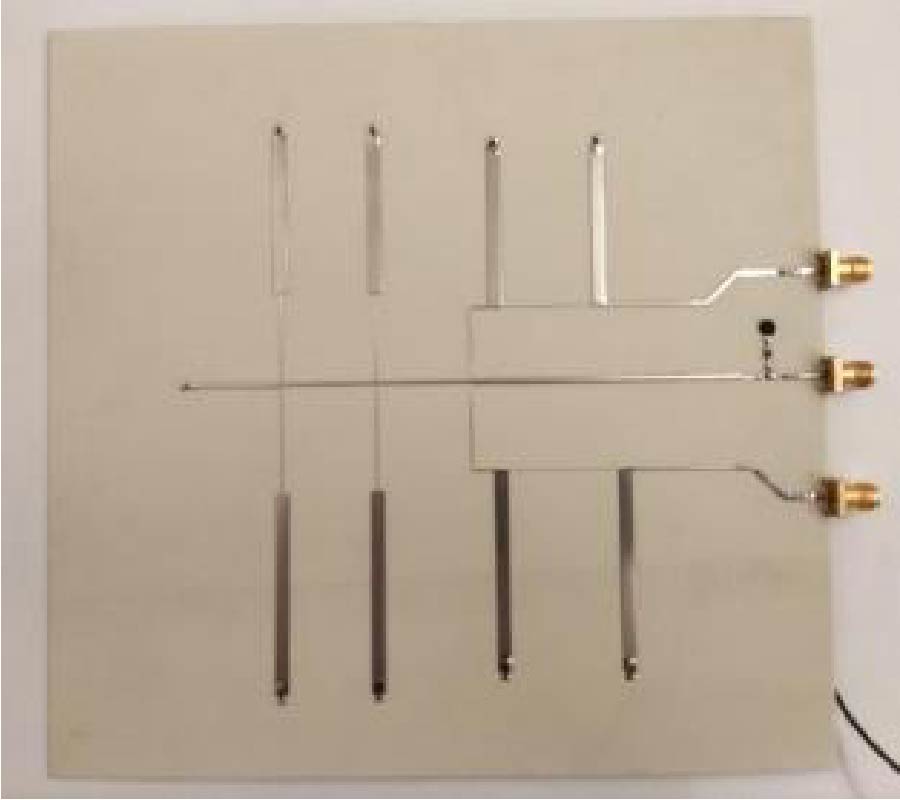
This paper presents a dual-band dual-polarized antenna including one L-band vertically polarized antenna, four C-band horizontally polarized subarrays and four C-band vertically polarized subarrays. Both the L- and C-band radiation elements are designed based on the concept of slotted coaxial waveguide antenna. The coaxial waveguide structure is in rectangular shape which is suitable for multi-element integration. And bending stripline inside the waveguide cavity plays the role of inner connector for the coaxial waveguide and exciter for radiating slots on the waveguide. Results show that impedance bandwidths of 14.9% for L-band and 5.9% for C-band are obtained with good port isolation. The antenna also exhibits good radiation performance with the low cross-polarization. The results indicate that the proposed antenna is suitable for synthetic aperture radar applications.
DUAL-BAND DUAL-POLARIZED SLOTTED COAXIAL WAVEGUIDE ANTENNA
2022-05-11
PIER Letters
Vol. 104, 37-46
Small Formfactor Phased Array for Simultaneous Spatial and Channel Diversity Communications
Daniel Guidotti , Binbin Yang , Muhammad S. Omar , Shang-Jen Su , Yahya M. Alfadhli , Gee-Kung Chang and Xiaoli Ma
A high frequency device design and simulation results are reported for an 8 x 8 phased array of unit cells. Each unit cell comprises a (3 x 3) sub-array of 1/4 wave rod monopole radiators. Each unit cell is the basic building block that can be arranged to form 9 interpenetrating arrays. Each interpenetrating array comprises an independently addressable 8 x 8 array of 1/4 wave rod monopole radiators that fits into the lateral space of a single 8 x 8 array of patch radiators but can operate on 9 independent radio frequency channels within the same contiguous communication band without interference and can direct each radio frequency channel into independent directions simultaneously. The beamformer architecture, operation principle, and simulation results are presented and discussed, and an outline of its construction based on 2.5D integration is presented.
SMALL FORMFACTOR PHASED ARRAY FOR SIMULTANEOUS SPATIAL AND CHANNEL DIVERSITY COMMUNICATIONS
2022-05-11
PIER Letters
Vol. 104, 27-35
Bandpass Filters Based on Hybrid Structure of Substrate Integrated Waveguide (SIW) and Hilbert Defected Ground Structure (HDGS)
Mohammed El Amine Chaib , Mehadji Abri , Hadjira Abri Badaoui and Nabil Cherif
In this article, two compact Substrate Integrated Waveguide (SIW) bandpass filters based on Defected Ground Structure (DGS) technology are proposed. Hilbert Cell of second orderis the resonator shape proposed for the DGS of both filters, where the first filter DGS consists of five pairs, and the second one uses only three pairs. The pair used in the first filter consists of two cells located side to side whereas they are placed face to face in the second filter. In order to enhance the performance of the second filter and based on the evanescent-mode technique, three other pairs of first order Hilbert cells are engraved on the top layer. Both band-pass filters are designed to operate in C band with a measured bandwidth of 1.8 GHz for the first filter and 0.86 GHz for the second one. The proposed structures have the same physical dimensions, which is 38.1 mm×16 mm with different measured insertion losses of -2.5 dB and -2.7 dB. Both structures exhibit an upper stopband rejection with attenuation around -20 dB and -29 dB, respectively. The filters operate in a transmission bandwidth of [5.5 GHz-7.3 GHz] and [5.27 GHz-6.13 GHz] with a fractional bandwidth (FBW) of 28.1% and 15.09% for the first filter and the second filter respectively. A good agreement is reported between the measured and simulated results.
BANDPASS FILTERS BASED ON HYBRID STRUCTURE OF SUBSTRATE INTEGRATED WAVEGUIDE (SIW) AND HILBERT DEFECTED GROUND STRUCTURE (HDGS)
2022-05-10
PIER C
Vol. 120, 119-133
A Novel Antipodal Vivaldi Antenna with Quad Band Notch Characteristics for UWB Applications
Vikas Kumar Rai , Mithilesh Kumar and Shyama Prasad Chakraborty
This work presents a design and analysis of a high gain Antipodal Vivaldi Antenna (AVA) with quad band notch characteristics for Ultra-Wideband (UWB) applications. The proposed AVA is designed on a 1.2 mm FR4 substrate with dielectric constant 4.3 and loss tangent 0.025. Initially, the AVA parameters are optimized in a full wave simulator to get the required UWB performance. The UWB performance is further improved significantly by cutting a C shaped slot from the AVA flares. The C shaped slot introduces an extra resonance that widens the initial bandwidth. The band-notched filtering characteristics are achieved by - adding a Sun Shaped Slot (SSS) on the top and bottom flares of the AVA, inserting a hexagonal shaped Complimentary Split Ring Resonator (CSRR) on the ground plane of the AVA and finally by inserting vias on either side of the feed line. The first designed notch band is from 2.2-2.7 GHz, covering the Bluetooth region. The second notch band is designed from 3.3-3.6 GHz, corresponding to WiMAX applications, and the third notch band is from 4.6-5.7 GHz corresponding to the WLAN band. Finally, a notch is fashioned from 8.8-9.5 GHz, corresponding to ITU applications. The simulated and measured return loss plots show that the antenna achieves an impedance bandwidth of 1.15-14 GHz with a reflection coefficient less than -10 dB, except at the four eliminating bands. To the best of the authors knowledge, the proposed technique is novel, and it allows good narrowband rejection over the UWB regime.
A NOVEL ANTIPODAL VIVALDI ANTENNA WITH QUAD BAND NOTCH CHARACTERISTICS FOR UWB APPLICATIONS
2022-05-10
PIER Letters
Vol. 104, 15-25
Susceptibility of Civilian UAV to Wideband High Power Electromagnetic Pulses
Chaochao Yang , Jin Meng and Haitao Wang
As unmanned aerial vehicle (UAV) is widely used in many civilian fields the wideband (WB) high power electromagnetic radiation devices development, whether the WB radiation would influence the civilian UAV to fulfil its tasks needs to be analyzed. Therefore, the radiated susceptibility of three models of DJI UAVs is studied in the paper. A decimetric wave oscillator with the power of over 500 MW was introduced as the radiation source. In experiment, adjusting the distance between radiation antenna and UAVs to change the electric field and the testing antenna was employed to measure the electric field on line. The three models of UAVs can be shot down by the electric field of 10 kV/m, 20 kV/m and 30 kV/m, respectively. Besides, as electric field reached up to over 35 kV/m, the rotor motor, electric control system and inertial measurement unit (IMU) in Mavic Air and Mavic Air 2 were easier to burn down. Except that, the energy accumulation effect has been proved in the experiment. In conclusion, the UAVs should fulfill tasks in the WB electromagnetic environment whose electric field is much less than 10 kV/m, and some shielding methods are needed to make UAV survive.
SUSCEPTIBILITY OF CIVILIAN UAV TO WIDEBAND HIGH POWER ELECTROMAGNETIC PULSES
2022-05-09
PIER C
Vol. 120, 105-117
Wideband Diversity MIMO Antenna Design with Hexagonal Slots for 5G Smart Mobile Terminals
Hatim S. Alhaqbani , Mohammed M. Bait-Suwailam , Maged A. Aldhaeebi and Thamer S. Almoneef
In this paper, we propose a wideband polarization diversity multiple-input multiple-output (MIMO) antenna array for 5G smart mobile devices. The proposed MIMO antenna array consists of 8-ports dual-polarized L-shaped lines that highly excite radiating slots, where the elements are placed at four-corners of a compact mobile unit of size 75×150 mm2. The uniqueness of the proposed MIMO antenna structure comes from the deployment of octagon-shaped resonant slots within the metallic ground plane, i.e. the octagonal-slots are etched from the bottom (ground) layer of the main mobile board. Due to the unique slots in the ground plane, wideband impedance has been achieved (3.38-3.8 GHz at -6-dB threshold). The proposed smart phone 8×8 diversity MIMO antenna is designed to support the spectrum of commercial sub-6 GHz 5G communications and cover the frequency range of around 3.5 GHz band with high decoupling between antenna ports. The proposed array is designed, numerically simulated, fabricated and tested. Good agreement between simulated and measured results was achieved. The MIMO antenna has a satisfactory far-field performance along with very low envelope correlation coefficient (ECC) < 0.055, high diversity of more than 9.95, and very low specific absorption rate (< 1 W/Kg for a 10-g human tissue).
WIDEBAND DIVERSITY MIMO ANTENNA DESIGN WITH HEXAGONAL SLOTS FOR 5G SMART MOBILE TERMINALS
2022-05-09
PIER M
Vol. 110, 119-131
All-Textile on-Body Metasurface Antenna
Esra Çelenk and Nurhan Türker Tokan
In this work, a novel all-textile washable metasurface antenna is designed for WBAN/WLAN and mid-band 5G applications. Metasurface antenna is obtained by implanting SRR (Split Ring Resonator) metamaterials that show left-hand characteristics to the patch plane. The metasurface arrays consisting of 4×1 and 4×2 SRRs are placed to both sides of a circular patch. The performance of the antenna is verified by a full-wave electromagnetic analysis tool. The results show that metamaterial arrays significantly increase gain and efficiency values of the circular patch antenna. Metasurface antenna consisting of 4×2 array of metamaterials increases the efficiency from 74% to 94.5% and the antenna gain from 6.81 dBi to 9.43 dBi. Performance of the antenna is observed on conformal surfaces, as well. An analysis is carried out to calculate the peak specific absorption rate on an arm phantom. Patterns of vertically bended antenna in ø=0° and 90° planes and low SAR values up to 30 dBm input power proved suitability of the metasurface antennas for on-body applications. The antennas are fabricated by using standard textile manufacturing techniques. It was confirmed by the measurement results that the metasurface formed by the linear SRR arrays increases the antenna gain. With its low cost, fabrication with standard off-the-shelf parts, high gain, and efficiency features, the proposed antenna can be used in wireless body area networks and 5G applications.
ALL-TEXTILE ON-BODY METASURFACE ANTENNA
2022-05-07
PIER C
Vol. 120, 93-103
Minimizing Grating Lobes in Large Arrays Using Clustered Amplitude Tapers
Jafar Ramadhan Mohammed
One of the common ways to design large arrays is by designing a small subarray known as cluster and using it as a repeating element throughout a large array. In this paper, the genetic algorithm is used to optimize the clustered amplitude tapers such that the final array pattern has minimum grating lobes and controlled sidelobe level. The formulation of the synthesis problem includes the minimization of the excess magnitude of the grating lobes or peak sidelobes which are usually higher than a given allowable limit. Moreover, two clustered configurations based on increased/decreased number of elements per cluster around the array center are introduced. Correspondingly, their clustered sizes increase/decrease as they approach the center of the array. Simulation results show that the proposed method has capability to optimize clustered linear and planar arrays without noticeable appearance of undesirable grating lobes. The analysis for an array composed of 20 elements with clusters of different cluster sizes M = 10, 8, 5, 4 and different numbers of elements per cluster Ns = 2, 3, 4, 5 elements found that the complexity reductions were 50%, 60%, 75%, 80%; peak sidelobe levels were -29 dB, -23.6 dB, -21.3 dB, -19.15 dB; and the directivities were 25.53 dB, 25.64 dB, 26.33 dB, 26.32 dB, respectively.
MINIMIZING GRATING LOBES IN LARGE ARRAYS USING CLUSTERED AMPLITUDE TAPERS
2022-05-07
PIER C
Vol. 120, 77-92
A Modified Construction Method of Blended Rolled Edge and Its Application
Yongquan Jiang , Hongcheng Yin , Chongjiang Mo and Dewang Kong
It is of great practical value to study the blended rolled edge of reflector used in Compact Antenna Test Range (CATR). Taking a rectangular aperture reflector as the benchmark, a reflector with ideal blended rolled edge is obtained by means of parameter iterative optimization after accurately establishing the position relationship between the local and global coordinates where the blended rolled edge is located, precisely deriving the geometric equation of the main reflector zone and blended rolled edge zone in the local coordinate, and optimizing continuity condition of curvature radius. On the basis, a blended rolled edge reflector with minimum operating frequency of 0.8 GHz and quiet zone size of 2 m is designed. The simulation results show that the performance of the reflector with blended rolled edge obtained by the proposed method is better than that obtained by the traditional construction method, and the designed reflector has excellent performance. The work in this paper provides a theoretical support for the optimal design and engineering application of the blended rolled edge reflector.
A MODIFIED CONSTRUCTION METHOD OF BLENDED ROLLED EDGE AND ITS APPLICATION
2022-05-07
PIER M
Vol. 110, 109-118
Pre-Compliance Near-Field Tests Based on Oscilloscopes
Marcelo Bender Perotoni , Walter M. Silva , Danilo B. Almeida and Kenedy M. G. Santos
This paper covers the use of oscilloscopes in near-field, pre-compliance radiating tests. Using commercial low-cost planar magnetic probes, a procedure is presented to use the time-domain waveforms to address emitted radiation patterns. In spite of its lower sensitivity in relation to spectrum analyzers, a comparison between both instruments is presented, with the inferior response of the oscilloscope compensated by means of off-the-shelf broadband amplifiers. Complete system calibration is described and performed, relating the voltage measurements in a transmission-line structure to field amplitudes provided by a full-wave simulation. Two different typical devices are tested using the procedure here developed: a direct current motor, driven by a square wave, and a microprocessor board. Results show the potential use of the almost omnipresent instrument in sophisticated field evaluations, enabling its use in situations where spectrum analyzers are not available.
PRE-COMPLIANCE NEAR-FIELD TESTS BASED ON OSCILLOSCOPES
2022-05-06
PIER C
Vol. 120, 61-75
Efficient Indoor Wireless Monitoring of Long-Term Ill/Post Operative Patients with Implants
Samuelraj Chrysolite and Thomas Anita Jones Mary Pushpa
In the medical world, the continuous monitoring of patients having a long-term illness is mandatory. The usual monitoring systems placed around the patients are bulkier and costly. Moreover, the movement of those patients is limited as they are connected to the monitoring devices with probes. To enable the locomotion of the patients a miniaturizedimplantable antenna sensor with the dimension 2.5 x 7 x 0.25 mm3 is proposed to monitor arterial pressure. The proposed antenna sensor is fabricated and verified for its performance metrics. Radiation analysis for the implants is carried out through a metric called Specific Absorption Rate (SAR). Deviation of pressure in the patient is measured through the rate of change of resonant frequency through an external reader coil. Communication established between the Transmitter (patient with implant) and the Receiver for better monitoring is verified through field strength calculated at various locations inside the hospital rooms in order to allocate rooms for the post-operative/long term ill patients efficiently.
EFFICIENT INDOOR WIRELESS MONITORING OF LONG-TERM ILL/POST OPERATIVE PATIENTS WITH IMPLANTS
2022-05-06
PIER C
Vol. 120, 45-60
UWB Filtenna with Reconfigurable and Sharp Dual-Band Notches for Underlay Cognitive Radio Applications
Yousif Mohsin Hasan , Abdulkareem S. Abdullah and Falih Mahdi Alnahwi
In this paper, a compact UWB antenna with a reconfigurable and sharp dual-band notches filter to cancel the interference with some critical applications (5G WLAN, and X-band satellite downlink) is proposed for underlay cognitive radio (CR) applications. The dual notched bands are produced by coupling a pair of π-shaped resonators on both sides of the feed line and by etching a U-slot inside the feed line of the antenna. The proposed UWB filtenna in this configuration has a surface area of 22×31 mm2 and produces simulated (measured) reconfigurable notched frequencies at 5.466 GHz (5.7 GHz) and 7.578 GHz (7.44 GHz) with an impedance bandwidth of 3.024-10.87 GHz (2.825-10.74 GHz). Three PIN diodes are used to switch the presence of the dual-band notch. Two PIN diodes turn ON-OFF simultaneously (D1A & D1B) are inserted within a pair of π-shaped resonators to control the 5G WLAN band notch, and a single diode (D2) is embedded within a quarter wavelength resonator which is located inside the feed line of the antenna for controlling the X-band band notch. The simulation and measured results reveal that the proposed filtenna effectively covers UWB with controlled cancellation for the interference with the intended bands. The realized gain is 4.5 dBi through the passband except in the notched frequencies, where it is decreased to less than -11 dBi in both notch frequencies. In other words, the proposed filtenna has a very high VSWR of greater than 20 at the notched frequencies.
UWB FILTENNA WITH RECONFIGURABLE AND SHARP DUAL-BAND NOTCHES FOR UNDERLAY COGNITIVE RADIO APPLICATIONS
2022-05-06
PIER M
Vol. 110, 97-107
Research on Random Redundant Multi-Carrier Phase Code Signal Against ISRJ Based on MIMO Radar
Ji Li , Qian Deng , Jianping Ou and Wei Wang
For the principle that intermittent sampling and repeater jamming (ISRJ) is obtained by discontinuous sampling of radar signal in time domain, a novel random redundancy (RR) waveform based on multiple input multiple output (MIMO) radar and multi-carrier phase code (MCPC) radar signal is proposed, namely RR-MCPC signal. From the point of waveform design, chaotic sequences are used to encode each chip in time domain for the signal with a multi-carrier phase code multiphase coding structure. Moreover, some chips are randomly arranged with equal amount of redundant coding in time-frequency domain. In MIMO radar, the subcarriers of radar signal are divided into multiple channels for transmission, and then the received signal is processed in each channel. Ensure that the intermittent sampling, whether in time domain or frequency domain, will sample redundant information in a channel. So it cannot match the matched filter. Therefore, the RR processing makes the signal have the characteristics of anti-ISRJ, which can availably restrain the interference of ISRJ false target. The results show that the signal-jamming ratio (SJR) improvement factor of RR-MCPC signal after pulse compression is optimized by 2.47-2.69 dB compared with the multi-carrier phase code signal under the typical parameters expressed in this paper.
RESEARCH ON RANDOM REDUNDANT MULTI-CARRIER PHASE CODE SIGNAL AGAINST ISRJ BASED ON MIMO RADAR
2022-05-05
PIER C
Vol. 120, 27-44
Design of Tri-Band Textile Fractal Antenna Using Three Different Substrate Materials for Wi-Fi Applications
Asit Rajakathar Kittur and Loganathan Balaji
The purpose of this study is to embed an antenna on very thin textile materials. A rectangular Fractal Antenna is chosen for this application. This antenna radiates for three different frequencies viz. 2.4 GHz, 4.2 GHz and 5.9 GHz. The substrate materials used for three antennas are Poly Viscous, Poly Cotton and Linen which are easily available. Instead of using traditional method applying copper plate or copper layer on substrate material, a simple process of pasting carbon conductive ink on substrate materials is used. On each textile antenna above mentioned frequencies are radiated. Performance parameters of all three antennas are simulated and matched with practical results. The optimum antenna having the best result is used for Wi-Fi Applications.
DESIGN OF TRI-BAND TEXTILE FRACTAL ANTENNA USING THREE DIFFERENT SUBSTRATE MATERIALS FOR WI-FI APPLICATIONS