Network Optimization Algorithm for Radar Active Jamming Identification Based on Neural Architecture Search
Zejun Gao ,
Fei Cao ,
Chuan He ,
Xiaowei Feng ,
Jianfeng Xu and
Jianqiang Qin
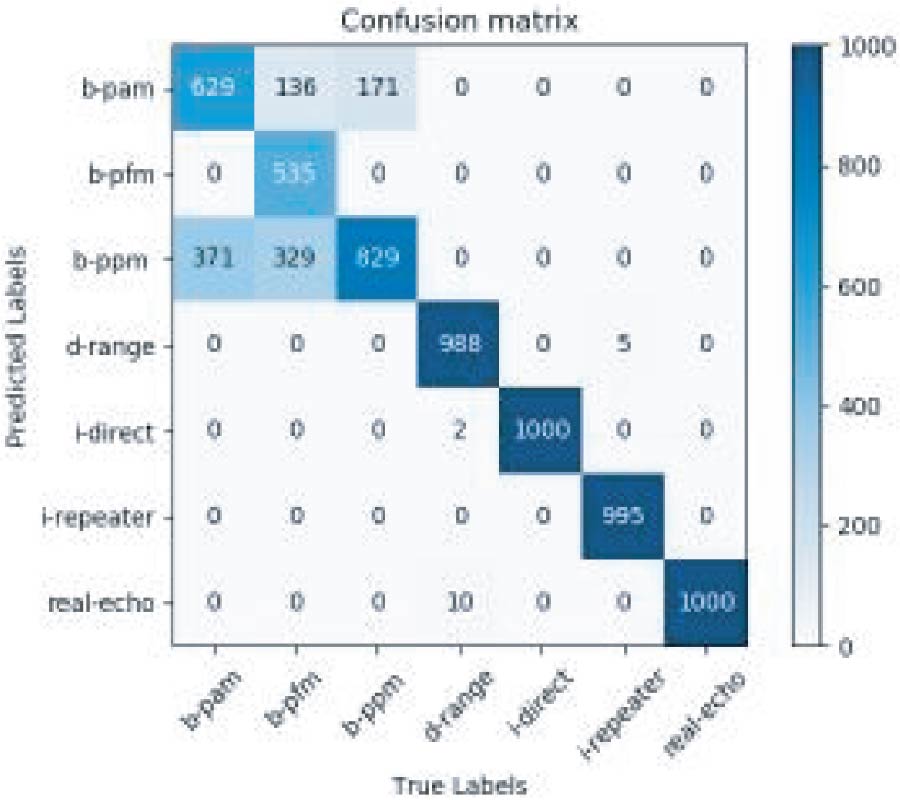
A network optimization approach based on Neural Architecture Search (NAS) and network pruning is suggested to solve the issue of poor recognition performance of missile-borne radar active jamming under the condition of short sample sizes. The approach realized the ideal network design under severely constrained technical indications by combining the benefits of several methods, including NAS, convolutional light-weighting, and network pruning. The recognition network's convolution kernel size parameters were first optimized using NAS. The number of model parameters were then decreased via convolutional substitution. Finally, the structured pruning algorithm further screened the redundant network based on the technical indicators. The WideResNet28_2 wide residual network's recognition accuracy is only 84.38% when there are only 1000 training samples for each type of signal, according to the simulation results. After optimization, the number of new model parameters was increased 2.55M, 2.26M, and 1.78M, respectively, and their respective recognition accuracy was increased to 85.7%, 85.61%, and 85.37%. According to the simulation results, the technique offers a wide range of possible applications in the optimized design of radar active jamming identification networks for small sample sizes.