Search Results(13789)

2022-01-25
PIER M
Vol. 107, 205-216
Investigation of on-Body Antenna Performance Using Motion Capture Technique and Statistical Analysis
George Lee , Daniel Ugochukwu Agu , Brian Garner and Yang Li
The field of wireless body area networks (WBAN) has seen growing interest in recent years due to applications of wearable devices, such as in healthcare. Effective on-body antenna design is necessary to provide optimal performance in real-world scenarios. This study compares several wearable antenna types, which are the monopole, patch, and e-textile antennas, to determine how human body motion affects antenna performance using a human body phantom model and human volunteers. The monopole antenna overall outperforms the patch antenna at 915 MHz and the e-textile antenna at 2.45 GHz and a Weibull distribution can be used as a probability distribution for S21 during an arm swing motion for all antenna types tested.
INVESTIGATION OF ON-BODY ANTENNA PERFORMANCE USING MOTION CAPTURE TECHNIQUE AND STATISTICAL ANALYSIS
2022-01-25
PIER Letters
Vol. 102, 101-107
Compact Dual-Band Bandpass Filter with High Selectivity Using Stub-Loaded Stepped-Impedance Resonators
Zhonghua Zhang , Ming Xia and Guanglin Li
A novel compact dual-band bandpass filter with wide stopband using stub-loaded stepped-impedance resonators is presented in this paper. The characteristics of the dual-mode resonator are investigated by using even/odd mode analysis. The center frequencies and bandwidths of the two passbands can be controlled by adjusting the geometric dimensions of the stub-loaded stepped-impedance resonators. Moreover, the filter has been implemented with five transmission zeros to improve the selectivity. A prototype of a dual-band bandpass filter centered at 3 and 4.35 GHz has been designed and fabricated. The measured bandwidths are 8.3 and 4.6%, and the corresponding insertion losses are 1.7 and 1.6 dB, respectively. A compact dual-band bandpass filter with sharp roll-off rate of 113.3/56.7/56.7/170 dB/GHz, wide stopband of 5.3 GHz, and isolation between two passbands of 25 dB is achieved. The measured results are in good agreement with the simulated ones.
COMPACT DUAL-BAND BANDPASS FILTER WITH HIGH SELECTIVITY USING STUB-LOADED STEPPED-IMPEDANCE RESONATORS
2022-01-21
PIER M
Vol. 107, 193-204
An Approximate Closed-Form Solution of Compensating for Beam Pointing Error with Uniform Linear Arrays
Shuaizhao Li , Zhongjun Yu , Qiang Zhang , Chengxiang Hao and Ning Cui
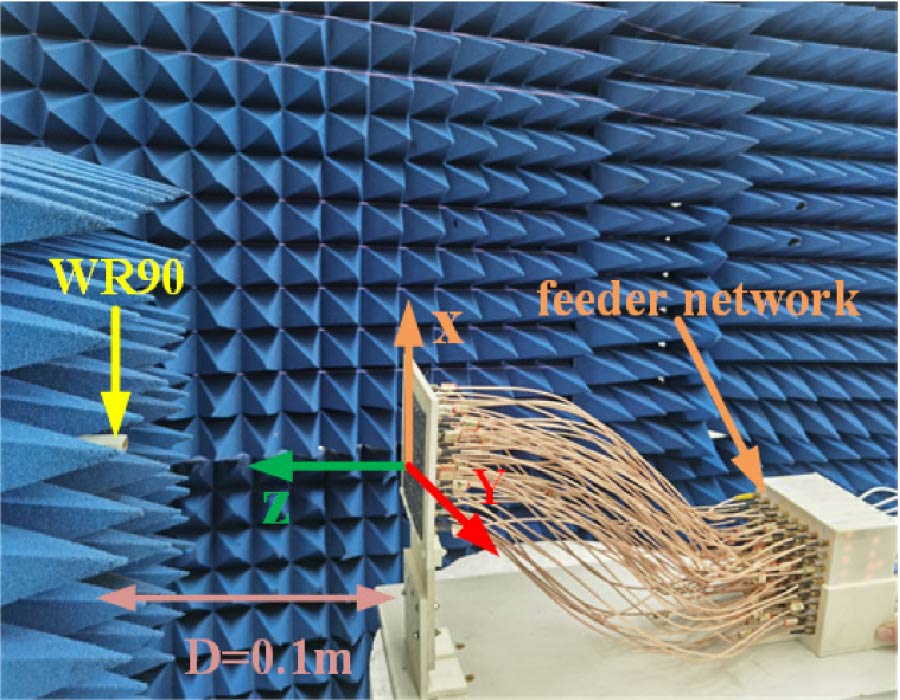
In phased array systems, beam pointing accuracy is one of the major issues for its great effect on radar communication. Regardless of the initial excitation error and the inherent mutual coupling between antenna elements, the anisotropy of antenna element's radiation pattern is the main reason for beam pointing error. In this paper, we propose a closed-form solution of compensating for beam pointing error with uniform linear arrays. It gives a theoretical explanation how beam pointing deviates from the desired angle when scanning angle and the number of elements vary. Then a numerical simulation validates the effectiveness of the proposed theory. Finally, an experiment with an X-band phased array verifies that the closed-form solution can be applied to practical phased array systems in the presence of mutual coupling.
AN APPROXIMATE CLOSED-FORM SOLUTION OF COMPENSATING FOR BEAM POINTING ERROR WITH UNIFORM LINEAR ARRAYS
2022-01-21
PIER M
Vol. 107, 181-191
Compact, Dual-Polarized, Oblong Loop Antenna for 5G Laptops
Saou-Wen Su
A compact, two-port, oblong loop antenna producing two orthogonal waves for fifth-generation (5G) operation in the 3.4-3.6 GHz band with transmission coefficient (S12) lower than -32 dB and excellent envelope correlation coefficient (ECC) less than 0.002 is introduced for laptop antenna applications. Unlike the conventional, probe-fed, dual-polarized patch antennas, the proposed design uses the loop antenna fed by the coaxial cables and has a coplanar structure. The loop antenna is placed 1 mm above the top edge of the display, has a compact size of 30 mm × 4 mm and two feed ports spaced merely 2 mm (about 0.02-λ at 3.4 GHz) apart. Port1 is designed as a coupling feed to the loop while port2 is a direct feed in the loop, all located along the loop's central line. With this feeding arrangement, port2 is located in the current-null region when port1 is excited, whereas maximum currents of port1 excitation are located in the current nulls of port2 excitation. These properties lead to two decoupled, orthogonal radiating waves with very low ECC. Additionally, due to the oblong structure of the loop, pattern diversity is also achieved. Details of the dual-polarized loop antenna for 5G applications are presented.
COMPACT, DUAL-POLARIZED, OBLONG LOOP ANTENNA FOR 5G LAPTOPS
2022-01-21
PIER M
Vol. 107, 167-179
Load-Independence-Based Composite Compensation Network and Control Strategy for Wireless Electric Vehicle Charging System
Wenzhou Lu , Runmin Liu , Xiangxiu Chen , Jian Zhao , Qigao Fan and Chendawei Zhang
Nowadays, wireless charging for electric vehicles has become popular in numerous situations by reason of safety and convenience. In this article, a composite compensation network and the corresponding charging control strategy aiming at optimizing the transmitting efficiency of the system and achieving constant current (CC) output and constant voltage (CV) output are proposed. First, the composite compensation network is analyzed by the equivalent circuit model as a reference. Second, based on the realization of CC/CV output, by analyzing the relationship between charging current/voltage and duty cycles of both DC-DC converters, the optimal duty cycles of both converters can be found. The purpose is to obtain the maximum transmission efficiency. Finally, the experimental results show good agreement with theoretical analysis, proving that the proposal can realize CC/CV charging and optimize the transmission efficiency.
LOAD-INDEPENDENCE-BASED COMPOSITE COMPENSATION NETWORK AND CONTROL STRATEGY FOR WIRELESS ELECTRIC VEHICLE CHARGING SYSTEM
2022-01-20
PIER C
Vol. 118, 11-24
Defected Star-Shaped Microstrip Patch Antenna for Broadband Applications
Mahesh Shankar Pandey and Virendra Singh Chaudhary
This research article proposes a Defected Star-Shaped Microstrip Antenna (DSSMSA) for wideband applications. A designed monopole antenna has a defected star-shaped tuning stub with a defected ground structure energised with a microstrip feed line. An appropriate tuning of resonating modes wideband frequency effect has been achieved by optimising the dimensions of the tuning stub and the dimensions of the defected ground and its notch. Surface current distribution plays a vital role in optimising the antenna geometry and developing mathematical resonating frequencies equations. The simulated and experimental results show that the DSSMSA radiates under the frequency band from 1.6638 GHz to 6.652 GHz with measured fractional bandwidth of 119.9692% for |S11| < -10 dB. Optimised DSSMSA resonates at frequencies 2.05 GHz, 3.382 GHz, and 5.494 GHz. As the geometry of DSSMSA is symmetrical, the symmetric far-field pattern has been found in the far-field.
DEFECTED STAR-SHAPED MICROSTRIP PATCH ANTENNA FOR BROADBAND APPLICATIONS
2022-01-20
PIER Letters
Vol. 102, 95-100
A Super Wideband Washable Antenna Demonstrated on Flannel
Siddaraju Meghana , Gulur Sadananda Karthikeya , Bagepalli Keshavappa Sujatha and Prabhakar Parimala
In this paper, a textile based fractal monopole antenna is proposed with a defected ground structure for wearable application. The proposed antenna is designed on Flannel fabric with a thickness of 1 mm, which translates to 0.03λ at 10 GHz. The total dimensions of proposed antenna is 60 x 40 x 1 mm. The measured fractional bandwidth of the antenna is 110.1%. The proposed flannel based conductive ink antenna is characterized, and the results for washable fabric are illustrated. Both simulated and measured results are presented. The concept of application of low cost conductive ink on flannel fabric is demonstrated using conventional screen printing method. The antenna is characterized for commercial wash ability; the measurement results are invariant with the machine wash of the flannel fabric indicating robustness of the proposed method of fabrication of the antenna element.
A SUPER WIDEBAND WASHABLE ANTENNA DEMONSTRATED ON FLANNEL
2022-01-19
PIER M
Vol. 107, 155-165
Durable Silicon Rubber-Based Miniaturized Antenna with Concentric Circle Structure for a Medical Telemetry Application
Navin M. George and Thomas Anita Jones Mary Pushpa
In this paper, a low-profile flexible antenna using a flexible substrate is presented. The proposed antenna has concentric circle-shaped radiating elements with circular slots to achieve an ISM band. The flexible antenna having dimensions (33 mm x 18 mm x 2 mm) is designed and fabricated on a silicon rubber-based substrate, and measurements were performed to validate the simulation results. The measured and simulated results demonstrate that the antenna radiates at 2.45 GHz center frequency, with a return loss of -24.54. The operating frequency of 2.45 GHz, flexible substrate, and low SAR of 0.0658 W/Kg confirm that the proposed antenna is suitable for medical telemetry applications.
DURABLE SILICON RUBBER-BASED MINIATURIZED ANTENNA WITH CONCENTRIC CIRCLE STRUCTURE FOR A MEDICAL TELEMETRY APPLICATION
2022-01-19
PIER Letters
Vol. 102, 87-94
Near-Field Measurement System Based on a Software Defined Radio
Marcelo Bender Perotoni , Leandro A. Silva , Walter Silva and Kenedy M. G. Santos
This article reports an SDR (software-defined radio) operating as a receiver for near-field measurement, aiming at EMC pre-compliance tests. The SDR replaces professional-grade RF instrumentation with benefits, with the lower costs. Its software application is based on Open-source GNU-Radio, which grants a higher versatility to the signal processing and visualization, requiring a single laptop to analyze the data and control the whole system, in real time. Reported tests used two commercial PCB magnetic field probes, and a proof-of-concept near-field imaging is performed in an S-shaped transmission line at 1100 MHz.
NEAR-FIELD MEASUREMENT SYSTEM BASED ON A SOFTWARE DEFINED RADIO
2022-01-18
PIER C
Vol. 118, 1-10
A Novel Surface Wave Diplexer Based on Tensor Impedance Surfaces
Mojtaba Mighani
In this paper, a new Surface Wave (SW) diplexer in frequency bands of 11.6 GHz and 19.3 GHz is presented based on the frequency variations of the refractive angle when an SW enters from a Scalar Impedance Sheet (SIS) to a Tensor Impedance Sheet (TIS). In this structure, a SIS has been placed alongside a TIS, and using three launchers, SW is excited and received on them. To achieve an SW diplexer, the structure is designed in a way that the refractive angle changes in the expected range when SW enters from SIS to TIS. Finally, the proposed structure is fabricated and measured by printed circuit technology. The measurement results at 11.6 GHz and 19.3 GHz show that this structure has 3.6 dB and 4.1 dB insertion losses and 33.5 dB and 37 dB isolations in the two bands, respectively. These measurements are in good agreement with mathematical modelling and simulations.
A NOVEL SURFACE WAVE DIPLEXER BASED ON TENSOR IMPEDANCE SURFACES
2022-01-17
PIER Letters
Vol. 102, 77-85
Compact and Broadband Uniplanar Microstrip Antenna for Endfire Radiation
Rajbala Solanki
A compact and broadband uniplanar Microstrip Antenna (MSA) is proposed for endfire radiation at sub-6 GHz 5G frequency band. The proposed antenna consists of a semi-elliptical radiating element and a U-shaped ground plane. The use of semi-elliptical radiating element results in a wide impedance bandwidth (BW) and compact size. The U-shaped ground plane further improves the bandwidth due to the increased coupling from radiating element to ground. An endfire radiation pattern, 3.8 dBi peak gain, and 49.8% bandwidth (BW) are achieved while a compact size of 0.47λ0×0.13λ0×0.008λ0 (where λ0 is the wavelength in free space at the center frequency) is kept. A parametric study based on CST-MWS simulations is also presented together with an equivalent circuit analysis to see the effects of various dimensional parameters of the uniplanar MSA with an elliptical radiating element. To validate the simulation results, prototype of the proposed antenna was fabricated and tested. The measured results are in good agreement with the simulated ones.
COMPACT AND BROADBAND UNIPLANAR MICROSTRIP ANTENNA FOR ENDFIRE RADIATION
2022-01-17
PIER Letters
Vol. 102, 67-75
Anti-Crosstalk Noise Performance Analysis of Multi-Symbol Transmission and Joint Crosstalk Reduction Method
Yafei Wang , Rui Li , Chenlong Li , Yanxiao Zhao and Xuehua Li
Crosstalk between interconnected lines is considered from two perspectives in this study. From a physical space perspective, the four transmission lines are reduced to two transmission lines. Meanwhile, the replacement of signal transmission of four-channels 2PAM (Pulse Amplitude Modulation) with signal transmission of two-channels 4PAM can reduce the quantity of transmission line and increase the space between the transmission lines. Thus, it can reduce the crosstalk. Under the same signal-to-noise ratio (SNR), the change in symbol error rate (SER) after signals of four-channels 2PAM are changed to those of two-channels 4PAM is given. Results show that the latter has an advantage in anti-crosstalk compared with the former in terms of the influence of crosstalk on SER. From the signal space perspective, applying signal linear combination transformation can convert the multiplexing signals in the interconnects into orthogonal mode. This process can cancel the crosstalk. In this study, the two methods are combined to save wiring while reducing crosstalk. ADS simulation results show that the eye pattern of 4 PAM signal recovers well by saving half the number of transmission lines.
ANTI-CROSSTALK NOISE PERFORMANCE ANALYSIS OF MULTI-SYMBOL TRANSMISSION AND JOINT CROSSTALK REDUCTION METHOD
2022-01-16
PIER M
Vol. 107, 141-154
Design of Substrate Integrated Folded Waveguide h-Plane Horn Antenna Array with Simultaneous Omnidirectional and Directional Radiation Characteristics
Wriddhi Bhowmik and Shweta Srivastava
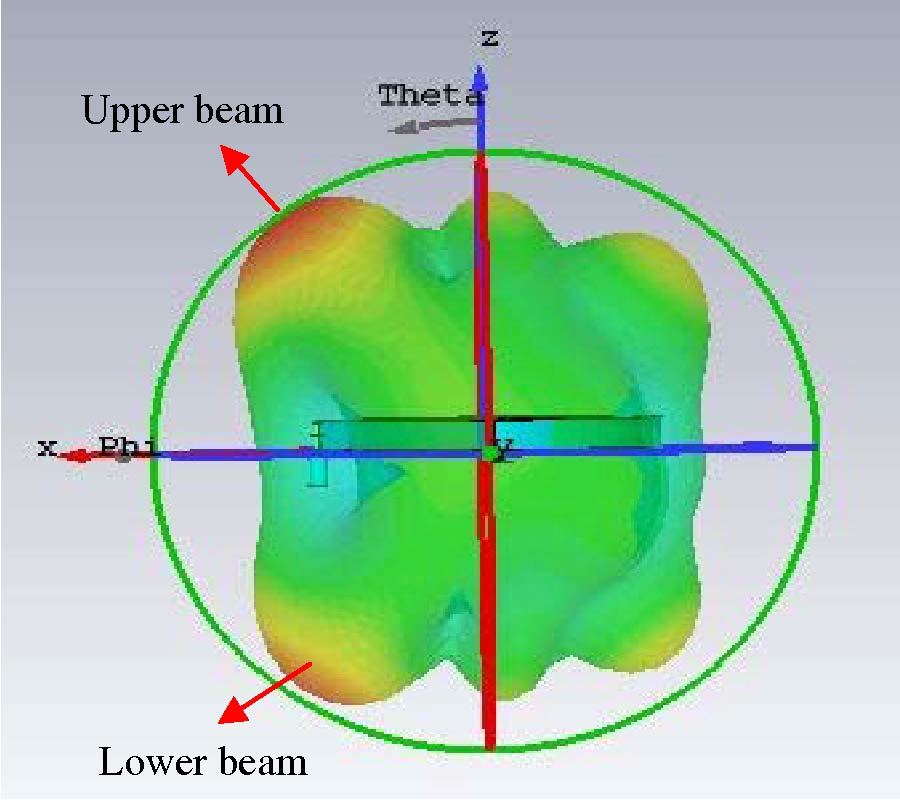
A compact substrate integrated folded waveguide (SIFW) H-plane horn antenna array with simultaneous omnidirectional and directional radiation characteristics for potential utilization to high-speed wireless communication is presented in this article. The realization of the proposed design has been accomplished by placing the apertures of nine exponentially tapered SIFW H-plane horns towards the circumference of a cylindrical substrate with an angular separation of 40˚ between the horns. Every horn flaring includes a column of three slots. Centre probe feed technique has been used to excite the antenna. The radiation of the field by the horn apertures and through the slots of the horns flaring, respectively, results in an omnidirectional and a directional radiation pattern at 13.8 GHz and 18.42 GHz, with the gain of 7 dBi and 10.92 dBi. The proposed antenna has performed well and is in good agreement between simulation and measurement. The dimension of the antenna is 37.3 mm (diameter) × 1 mm (height) (1.710×0.0460 at 13.8 GHz and 2.29λ0×0.061λ0 at 18.42 GHz). SIFW technology makes low profile antenna. The proposed design can be a promising option to be used as a low-profile antenna for high-speed wireless communication.
DESIGN OF SUBSTRATE INTEGRATED FOLDED WAVEGUIDE H-PLANE HORN ANTENNA ARRAY WITH SIMULTANEOUS OMNIDIRECTIONAL AND DIRECTIONAL RADIATION CHARACTERISTICS
2022-01-13
PIER
Vol. 172, 89-99
An Ultra-Compact and Reproducible Fiber Tip Michelson Interferometer for High-Temperature Sensing (Invited)
Xun Wu , Shengnan Wu , Xiaolu Chen , Huaguan Lin , Erik Forsberg and Sailing He
An ultra-compact fiber tip Michelson interferometer (MI), primarily aimed for a reproducible and stable high-temperature sensing probe, is developed and demonstrated. Both single-mode fiber (SMF) and polarization maintaining fiber (PMF) are considered and compared. The tip MI is fabricated by only using a one-step partial-polishing technique, which forms a half oblique and half vertical end face and functions as a beam splitter. A wide spectra analysis proved that the interferometer has an optical path difference (OPD) that is consistent across samples. When the lead-in fiber suffers from bending or twisting, the interference spectrum for the PMF case is more stable than that for the SMF case. Experimental results show a linear average temperature sensitivity of 15.15 pm/˚C in the range of 100˚C to 1000˚C for three tested PMF samples, and the difference between the sensitivities of the samples is less than 4.0%. The ease of fabrication, highly compact structure, reproducibility, and excellent resistance to mechanical disturbance performance suggest that the proposed PMF tip MI is highly promising as a high temperature sensing probe with high spatial resolution.
AN ULTRA-COMPACT AND REPRODUCIBLE FIBER TIP MICHELSON INTERFEROMETER FOR HIGH-TEMPERATURE SENSING (invited)
2022-01-12
PIER M
Vol. 107, 131-140
Analytical and Numerical Studies of Oblique Wave Incidence on Impedance-Matched Graded Interfaces Between RHM and LHM Media
Brage B. Svendsen , Balwan Rana and Mariana Dalarsson
This paper presents analytical and numerical studies of electromagnetic wave propagation through an interface between a regular right-handed material (RHM) and a left-handed metamaterial (LHM). The interface is graded along the direction perpendicular to the boundary plane between the two materials, chosen to be the x-direction. The permittivity ε(ω, x) and permeability μ(ω, x) are chosen to vary according to hyperbolic tangent functions. We show that the field intensities for both TE- and TM-cases satisfy the same differential equations, and we obtain remarkably simple exact analytical solutions to Helmholtz' equations for lossy media. The obtained exact analytical results for the field intensities along the graded RHM-LHM composite are in line with the expected properties of RHM-LHM structures. Finally, we perform a numerical study of the wave propagation over an impedance-matched graded RHM-LHM interface, using the software COMSOL Multiphysics, and obtain an excellent agreement between the numerical simulations and analytical results. The results obtained in the present paper are not limited to any particular application, and are generally useful for all cases of wave propagation over impedance-matched two- and three-dimensional interfaces between RHM and LHM media. The advantage of the present method is that it can model smooth realistic material transitions, while at the same time including the abrupt transition as a limiting case. Furthermore, unlike previously existing solutions, the interface width is included as a parameter in the analytical solutions in a very simple way. This enables the use of the interface width as an additional degree of freedom in the design of practical RHM-LHM interfaces.
ANALYTICAL AND NUMERICAL STUDIES OF OBLIQUE WAVE INCIDENCE ON IMPEDANCE-MATCHED GRADED INTERFACES BETWEEN RHM AND LHM MEDIA
2022-01-12
PIER M
Vol. 107, 119-129
A Parasitic Array Based Pattern Reconfigurable Patch Antenna for Wi-Fi 6E Application
Bhaben Saikia and Kunal Borah
A pattern reconfigurable microstrip patch antenna with two parallel parasitic patches placed close to both sides of a rectangular driven patch is investigated and presented in this article. Four switchable shorting posts are used to enable the parasitic elements to act either as a reflector or director for beam reconfiguration, based on the operating state of four associated PIN diode switches. To avoid large change in the dimension of both parasitic patch and ground plane, and minimize its effect on beam steerability and return loss, two PIN diodes are placed on the top face and the other two on the slots etched on the ground plane. Radiation pattern of the proposed antenna can be reconfigured into four distinct directions in the H-plane with radiation maximum at +40˚, 0˚, -40˚ and ±45˚. With overall compact dimension of (35×55) mm2 and acceptable return loss for all reconfigurable modes around 6.2 GHz frequency, the proposed antenna is a potential candidate for Wi-Fi 6E application. The measured peak gain varies between 3.9 dBi and 5.2 dBi with an average of 4.6 dBi for all beam tilt angles. Consistency between the simulated and experimental results validates the design theory and its promising application.
A PARASITIC ARRAY BASED PATTERN RECONFIGURABLE PATCH ANTENNA FOR WI-FI 6E APPLICATION
2022-01-11
PIER C
Vol. 117, 277-289
Design and Fabrication of a Triple Band Microstrip Antenna for WLAN, Satellite TV and Radar Applications
Prem Pal Singh and Sudhir Kumar Sharma
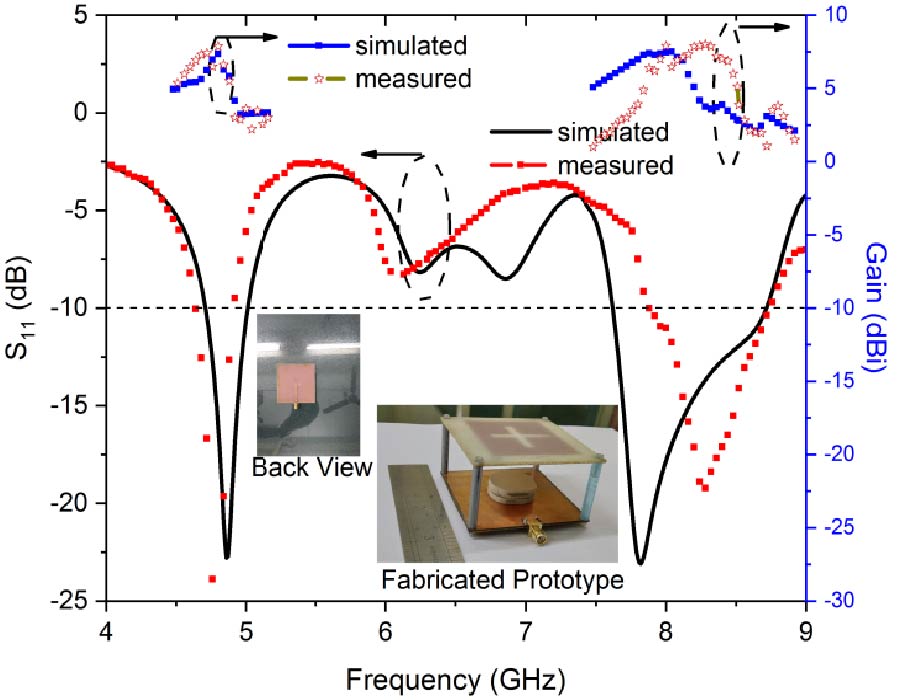
A compact and hexagon-shaped microstrip patch antenna operating in three bands is described in this paper. Multiband functionality of the antenna is achieved by adding two inclined strips and cutting modified slots on the radiating patch. The antenna consists of a hexagonal patch and partial ground plane, has the total dimensions of 15×17 ×1.6 mm3, operates over three frequencies 5.40 GHz, 6.76 GHz, and 8.82 GHz for WLAN, TV satellite broadcasting, WiMAX (5250-5850 MHz), IEEE 802.11a (5.47-5.725 GHz), 5G Unlicensed band (5.2-5.7 GHz), weather monitoring, and radar applications. This antenna has the novelty that it can also be used as a reconfigurable antenna, and the notched bands can be controlled. Simulation of the proposed antenna is carried out using HFSS-15 software. To verify the simulated results, and a prototype of the proposed antenna is fabricated. After measurement, simulated and measured results are in good agreement.
DESIGN AND FABRICATION OF A TRIPLE BAND MICROSTRIP ANTENNA FOR WLAN, SATELLITE TV AND RADAR APPLICATIONS
2022-01-11
PIER M
Vol. 107, 105-118
A Six-Port Slot Antenna System with Wideband and High-Isolation for 5G NR Bands
Weidong Mu , Zhonggen Wang , Ming Yang , Wenyan Nie and Pan Wang
In this article, a slot-antenna array with wideband and high-isolation for multiple-input multiple-output (MIMO) systems is presented that can be used in fifth-generation new radio (5G NR) communication. The MIMO antenna system is realized by loading six identical antennas (Ant1-Ant6) into an FR4 substrate to form a six-port array for a 6×6 MIMO system. Each antenna element is a slot antenna type that is composed of a T-shaped open slot and an L-shaped 50 Ω microstrip line. Each T-shaped slot is formed by inserting an I-shaped open branch in the center of the ground plane's U-shaped slot. The L-shaped microstrip line is placed on the upper surface of FR4 to enable coupling feeding in the 3.3 to 5.10 GHz frequency range to cover the 5G NR bands N77/N78/N79. The isolation is increased to more than 18.1 dB by etching the T-shaped slot between the radiation elements on the metal plate. The proposed antenna system was fabricated and tested. The experimental results indicate that the MIMO system can cover the frequency range of 3.20-5.15 GHz with a return loss of 6 dB and provides isolation greater than 16.2 dB. Additionally, a total efficiency greater than 50% and envelope correlation coefficient of less than 0.02 are obtained. The performance under hand-on scenarios is also good. Simulated and measured results indicate that the stated results are consistent. The test results indicate that the antenna satisfies the 5G communication requirements.
A SIX-PORT SLOT ANTENNA SYSTEM WITH WIDEBAND AND HIGH-ISOLATION FOR 5G NR BANDS
2022-01-11
PIER M
Vol. 107, 91-103
Proximity Fed Triple Band David Fractal 2×1 Microstrip Patch Antenna with DGS
Jacob Abraham
This paper presents a triple band proximity fed 2x1 array antenna with defected ground plane. The proposed antenna configuration is composed of two radiating elements, and both radiating elements are made of a pattern similar to the first iteration level David fractal geometry. The proposed David fractal 2x1 array antenna is designed and simulated on an FR-4 substrate of thickness 1.6 mm and dielectric constant 4.3 by using the CST Microwave Studio simulation tool. In order to improve the radiation characteristics of the antenna an H-shaped defect is etched in the ground plane. The antenna is fabricated and tested. The experimental data show good agreements with simulation results. The fabricated triple band fractal 2x1 array antenna resonates at 2.527 GHz, 3.329 GHz and 3.742 GHz having bandwidths of 303 MHz, 99 MHz, and 102 MHz, respectively. The proposed fractal array antenna can be used in mobile applications such as Wi-Fi, WLAN, Bluetooth and Wi-Max.
PROXIMITY FED TRIPLE BAND DAVID FRACTAL 2×1 MICROSTRIP PATCH ANTENNA WITH DGS
2022-01-10
PIER C
Vol. 117, 261-276
Modified Spokes Wheel Shaped MIMO Antenna System for Multiband and Future 5G Applications: Design and Measurement
Sumeet Singh Bhatia and Narinder Sharma
In this manuscript, a modified spokes wheel shaped two port MIMO (Multi-Input-Multi-Output) antenna with stub loaded ground plane has been presented and experimentally analysed for multiband and EU (European Union) 5900 to 6400 MHz for future 5G mobile terminal applications. The proposed MIMO antenna consists of two radiating patches, and its ground plane is modified to achieve the multiband characteristics as well as enhanced isolation. Initially, a rectangular notch, at the center of ground plane (Ground-1), is employed and reveals four resonant points. Further, the ground plane is modified again by employing two inverted L-shaped stubs along with a series of horizontal rectangular stubs (Ground-2) for enhancing the isolation and reducing the mutual coupling between the elements of proposed MIMO antenna. The antenna with ground-2 exhibits seven frequency bands (S11 ≤ -10 dB) 2.2, 6.0, 7.9, 9.6, 11.1, 12.7, and 15.6 GHz with corresponding isolation (S12/21) -19.47, -31.22, -34.63, -30.05, -27.16, -39.08, and -22.28 dB. Diversity performance parameters of the proposed MIMO antenna such as ECC, DG, CCL, TARC, and MEG are also in acceptable limits at each operational frequency band. The proposed MIMO antenna is designed and fabricated on a low cost FR4 glass epoxy substrate, and the simulations are carried out by using FEM based Ansys HFSS V13 simulator. Simulated and measured results are compared and found in good agreement with each other.
MODIFIED SPOKES WHEEL SHAPED MIMO ANTENNA SYSTEM FOR MULTIBAND AND FUTURE 5G APPLICATIONS: DESIGN AND MEASUREMENT