Search Results(13789)

2021-12-30
PIER
Vol. 172, 41-49
Phase Synthesis of Beam-Scanning Reflectarray Antenna Based on Deep Learning Technique
Tao Shan , Maokun Li , Shenheng Xu and Fan Yang
In this work, we investigate the feasibility of applying deep learning to phase synthesis of reflectarray antenna. A deep convolutional neural network (ConvNet) based on the architecture of AlexNet is built to predict the continuous phase distribution on reflectarray elements given the beam pattern. The proposed ConvNet is sufficiently trained with data set generated by array-theory method. With radiation pattern and beam direction arrays as input, the ConvNet can make real-time and fairly accurate predictions in milliseconds with the average relative error below 0.7%. This paper shows that deep convolutional neural networks can ``learn'' the principle of reflectarray phase synthesis due to their inherent powerful learning capacity. The proposed approach may provide us a potential scheme for real-time phase synthesis of antenna arrays in electromagnetic engineering.
PHASE SYNTHESIS OF BEAM-SCANNING REFLECTARRAY ANTENNA BASED ON DEEP LEARNING TECHNIQUE
2021-12-30
PIER C
Vol. 117, 145-157
Dual-Band Waveguide Fed Hollow Cylindrical Dielectric Resonator Antenna
Sheeba Varghese , Parambil Abdulla , Baby Ann Mary , Puthenveetil Muhammed Jasmine and Kunnath Kodakkat Ansha
In this paper, we present a waveguide-fed hollow cylindrical dielectric resonator antenna (CDRA) with dual-band operation and its modified structure for wider bandwidth and enhanced gain operation. The distinctive nature of the structure provides two bands having resonant frequencies at 8.46 GHz and 9.24 GHz with maximum gains of 5.37 dBi and 6.86 dBi respectively with a single dielectric resonator antenna (DRA). The dual-band is achieved due to the resonance of DRA and the air column inside it. Excellent coupling is achieved in both bands. The dual-band structure is modified by changing the volume of the air column inside the CDRA keeping all other parameters constant to result in a wider band and high gain antenna. A bandwidth of 7.9% with a resonant frequency of 9.0 GHz and a maximum gain of 8.14 dBi is obtained for the modified structure.
DUAL-BAND WAVEGUIDE FED HOLLOW CYLINDRICAL DIELECTRIC RESONATOR ANTENNA
2021-12-30
PIER M
Vol. 107, 25-34
Retrieval of Mesospheric Neutral Wind Based on AgileDARN HF Radar
Guangming Li
In this paper, the inversion method of mesospheric neutral wind is studied based on mid-latitude AgileDARN HF radar. Firstly, the meteor target observation method is carried out using 7.5 km range resolution and 2 s integration time. Then, the method of extracting the meteor echo from the data according to the doppler characteristics of the meteoris studied. Finally, the meridional and zonal components of mesospheric neutral wind are obtained by singular value decomposition method based on doppler velocity of meteor echo. The data analysis shows that the meteor echo has the highest incidence in the morning of local time and the lowest incidence in the evening of local time. The semi-diurnal characteristics of tidal waves can be seen from the meridional and zonal components of mesospheric neutral wind. Aiming at the ambiguity of elevation angle measured by AgileDARN HF radar, a method is proposed to reduce the ambiguity of elevation angle, and the wind field profile of mesospheric neutral wind along altitude is obtained, which lays a foundation for the subsequent study of gravity wave, tidal wave and planetary wave based on mesospheric wind field.
RETRIEVAL OF MESOSPHERIC NEUTRAL WIND BASED ON AGILEDARN HF RADAR
2021-12-30
PIER M
Vol. 107, 13-23
A Triple Band Highly Sensitive Refractive Index Sensor Using Terahertz Metamaterial Perfect Absorber
Sagnik Banerjee , Purba Dutta , Amit K. Jha , Prabhat Ranjan Tripati , Avireni Srinivasulu , Bhargav Appasani and Cristian Ravariu
This research introduces a novel design of a metamaterial absorber having the range in terahertz, capable of sensing changes in the refractive index of the encircling medium. The layout includes adjoining rectangular patches in the form of a plus symbol along with four circular patch resonators (CPRs) on the pinnacle of a Gallium Arsenide (GaAs) substrate. The proposed design comes up with three consecutive absorption peaks, with an absorptivity of 99.0%, 99.75%, and 98.0% at three different resonant frequencies of 2.36 THz, 2.675 THz, and 2.97 THz, respectively, and a Full Width Half Maximum (FWHM) of 0.08, 0.04 and 0.05. This structure's quality factor (Q-factor) at the three resonant frequencies is 29.5, 66.8 and 59.4 together with 6.75, 17.5 and 30 as figure of merit (FoM), respectively. The proposed design offers a sensitivity of 0.54 THz/RIU, 0.7 THz/RIU, and 1.5 THz/RIU in those three absorption bands. To support the selection of design parameters, parametric assessment was done. The designed sensor can find its applications in terahertz sensing.
A TRIPLE BAND HIGHLY SENSITIVE REFRACTIVE INDEX SENSOR USING TERAHERTZ METAMATERIAL PERFECT ABSORBER
2021-12-29
PIER C
Vol. 117, 129-143
MIMO Antenna for N48, N77, N78 5G Applications
Walaa M. Hassan , Khalid Moustafa Ibrahim and Ahmed Mohamed Attiya
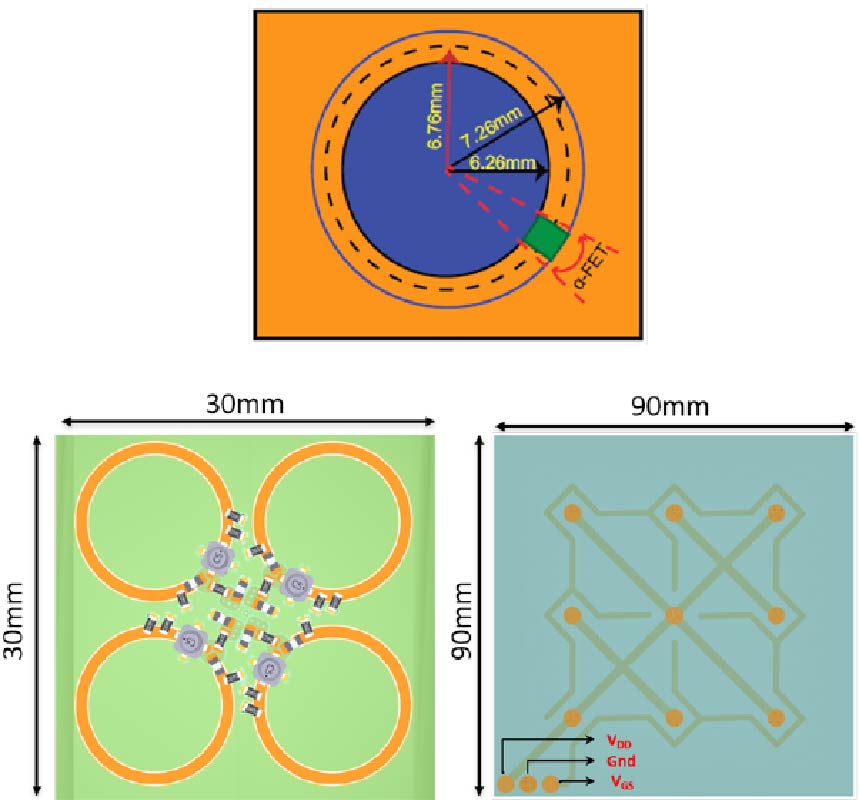
This paper presents a MIMO antenna system composed of eight wideband horizontal dual-loop antenna elements. Each dual-loop antenna is printed on both sides of a smartphone board. The unit element antenna is designed to operate in the frequency range from 3.2 GHz to 5 GHz. The performance of the MIMO system is then analyzed. The performance of the obtained MIMO system in the frequency range from 3.2 GHz to 4.8 GHz is characterized by input reflection coefficient which is less than -6 dB for all antenna elements, and the isolation between the elements is larger than 15 dB. The total efficiency is greater than 55% over the entire band (3.2-4.8 GHz). Parameters of the multichannel antennas including envelope correlation coefficient (ECC), diversity gain (DG), and channel capacity loss (CLL) are analyzed to evaluate the performance of the MIMO system. The effect of the human hand and head on the performance of this MIMO antenna is also investigated. In addition, the effect of the radiated fields on the human body is also studied. The Specific Absorption Rate (SAR) value is found to be less than 0.8 W/kg. The MIMO system antenna is fabricated and measured. Good agreements are obtained between the simulated and measured parameters. The proposed MIMO system is applicable to the 5G N48, N77, and N78 bands.
MIMO ANTENNA FOR N48, N77, N78 5G APPLICATIONS
2021-12-29
PIER Letters
Vol. 102, 9-18
Capacitive-Wireless Power Transfer System for Power Supply of a Wireless Sensor System on a Propulsion Shaft
Van Ai Hoang and Young Chul Lee
We present a capacitive wireless power transfer (C-WPT) system using rotating capacitors for wireless sensor system (WSS) on propulsion shaft. In order to supply stable power to the WSS consisting of four sensors, a controller, and a radio module, we designed the rotating capacitor connected in parallel with multiple plates that minimizes the change in capacitance of the power coupling capacitor of the C-WPT system. A Class-E converter and transformers topology are utilized to drive the C-WPT system for WSS. The fabricated C-WPT system transmitted stable power even when the rotational speed of the shaft was changed from 100 to 300 revolution per minute (rpm), and achieved power of 20.48 W and transmission efficiency of 64.29%.
CAPACITIVE-WIRELESS POWER TRANSFER SYSTEM FOR POWER SUPPLY OF A WIRELESS SENSOR SYSTEM ON A PROPULSION SHAFT
2021-12-28
PIER M
Vol. 107, 1-12
Numerical Simulation and Application of Response Characteristics of High-Frequency Dielectric Logging Instrument
Chen Li , Shaogui Deng , Zhiqiang Li , Yiren Fan , Jingjing Zhang and Jutao Yang
Complex reservoirs such as fresh-water formations and water-flooded reservoirs developed by water injection have complex electrical characteristics owing to the influence of formation water salinity. It is difficult to accurately evaluate and identify the fluid in such complex reservoirs by using the conventional resistivity method. However, the water salinity of the formation has a reduced effect on its dielectric constant; therefore, dielectric logging technology can be used to effectively identify fresh-water formation and evaluate the water-flooding level of the water-flooded layer. The accuracy of the formation response inversion charts of dielectric logging instruments is important for accurately evaluating fluids in complex reservoirs when these instruments are used. This study proposes a full-wave simulation method based on Maxwell's equations and the engineering parameters value of the dielectric logging instrument. The formation response conversion charts of the dielectric logging instrumentare accurately calculated and can be used in practical logging; the simulation results are compared with those obtained using an equivalent magnetic dipole model; Based on the accurate simulation of the formation response of the dielectric logging instrument, a high-frequency dielectric logging instrumentis developed, and it is applied to the fresh-water formation and water-flooded layer in the Nanyang and Ordos Basins.
NUMERICAL SIMULATION AND APPLICATION OF RESPONSE CHARACTERISTICS OF HIGH-FREQUENCY DIELECTRIC LOGGING INSTRUMENT
2021-12-28
PIER M
Vol. 106, 227-237
Reconfigurable Polarization MIMO Dielectric Resonator Antenna
Masoumeh Rezvani , Saeid Nikmehr and Ali Pourziad
This paper introduces a reconfigurable polarization MIMO (Multi-Input Multi-Output) dielectric resonator antenna at millimeter-wave frequency band. The proposed antenna consists of four single dielectric resonator antennas that are placed in 2×2 configuration to form a MIMO antenna, and also this design is based on using the pin diode switching concept to control the antenna polarization. In order to modify the antenna structure for different polarizations, two pin diodes are used in the ground place of the MIMO antenna. The designed antenna operates at 4.35 GHz for polarization diversity applications of the modern wireless MIMO systems. The proposed antenna covers a bandwidth of 11.26% at the central frequency and provides circular and linear polarizations with high gain around 6.4 dB. The antenna performance in terms of reflection coefficient, gain and axial ratio bandwidth in different modes (ON-ON, ON-OFF, OFF-ON and OFF-OFF) is measured. The advantages of the designed antenna are simple structure (using two pin diode switches to modify antenna polarization), high gain, low profile, and light weight. According to the measurement and simulation results, the designed antenna displays good return loss and radiation performance. Using the plexiglass as an antenna material which is very cheap and available in different dimensions is another advantage of the proposed antenna which reduce the fabrication cost.
RECONFIGURABLE POLARIZATION MIMO DIELECTRIC RESONATOR ANTENNA
2021-12-28
PIER M
Vol. 106, 215-226
A Compact Dual Notch-Band Frequency Reconfigurable UWB Monopole Antenna
Jingchang Nan , Jiu-Yang Zhao and Yuan Wang
To meet the requirements of miniaturization, multi-functions, and anti-interference of the antenna, this paper proposes a compact dual notch band frequency reconfigurable ultra-wideband (UWB) antenna. The antenna consists of an angle-cut rectangular radiation patch, a coplanar waveguide (CPW) structure, and a defective ground structure (DGS). A C-slot and an inverted U-slot are introduced to eliminate the interference of the Indian National Satellite band (INSAT), 5G band, and X satellite communication band. By controlling the PIN diodes across the two slots, the antenna can work in four states: UWB, two single notch bands, and one dual notch band. The impedance bandwidth in UWB mode is 2.9-12 GHz, with a relative bandwidth of 122%. The notch frequencies are 4.2-5.2 GHz and 6.2-8.1 GHz, respectively. In the passband of the antenna, the maximum gain is 7.17 dBi, and the group delay is less than 1 ns. The antenna size is 18 × 17 × 1.6 mm3, which is easy to integrate with the communication systems. The antenna can be freely switched between the UWB mode and each notch band mode, which can be applied to the UWB wireless communication systems.
A COMPACT DUAL NOTCH-BAND FREQUENCY RECONFIGURABLE UWB MONOPOLE ANTENNA
2021-12-27
PIER C
Vol. 117, 115-127
A Crescent-Shaped Monopole MIMO Antennas with Improved Isolation for Dual-Band WLAN Applications
Likaa S. Yahya , Loay S. Yahya and Khalil Hassan Sayidmarie
A multi-input multi-output (MIMO) antenna system is presented for wireless devices operating at WLAN (2.45, 5.25, and 5.775 GHz) bands. Each of the two antennas in the MIMO system consists of a crescent-shaped monopole whose first part covers the 2.45 GHz band while its second part covers the 5.25 GHz and 5.775 GHz bands. The second part of the monopole is a slot etched in the protruded ground plane between the two antennas. A decoupling mechanism in the form of two interlaced ring-shaped slots is used. The proposed MIMO antenna system is designed on an FR4 substrate with overall dimensions of 40x47.5x1.5 mm and a small edge-to-edge spacing of 7.3 mm between two antennas. According to the measured results, the proposed design covers two frequency bands (2.2-2.83 GHz and 5.03-5.95 GHz) and has a mutual coupling of -20.78 dB at 2.45 GHz and -42.65 dB at 5.55 GHz. The proposed antenna's performance in both simulations and testing indicates that it is a good choice for WLAN applications.
A CRESCENT-SHAPED MONOPOLE MIMO ANTENNAS WITH IMPROVED ISOLATION FOR DUAL-BAND WLAN APPLICATIONS
2021-12-27
PIER M
Vol. 106, 205-214
Spatially Squeezed Electromagnetic Modes of a Transformational Optics Based Cavity Resonator for Targeted Material Heating
ASRAFALI BARKATHULLA , Chakravarthy Venkateswaran and Natesan Yogesh
Confining electromagnetic (e-m) modes in a tiny space is a desirable aspect for many applications including targeted material heating and light harvesting techniques. In this work, we report spatially squeezed e-m modes of a cavity resonator formed by the modified transformation optical (TO) medium. The proposed coordinate transformation scheme suggests curved contours of refractive index profile such that the e-m mode can be confined within the contours. The effective mode area for a TO cavity is at least 10 times smaller than the air-filled metallic cavity. The confined e-m modes of a proposed cavity are horizontally flattened but vertically squeezed of the dimension of λ/49. The material parameters of the proposed TO medium are approximated with non-magnetic and isotropic dielectric values. For an application aspect, squeezed mode of the TO cavity is used for targeted material heating, and it is demonstrated based on e-m thermal co-simulations. A tiny dielectric material placed at the squeezed part of the cavity mode is heated rapidly with the temperature rise of 2.350˚C/s (110˚C/s) for the single (dual) e-m source excitation with the peak electric field strength of 5 x 10⁴ V/m. We further discuss how one can realize the proposed TO medium practically with a cell-grid approximation using photonic crystals and metamaterials.
SPATIALLY SQUEEZED ELECTROMAGNETIC MODES OF A TRANSFORMATIONAL OPTICS BASED CAVITY RESONATOR FOR TARGETED MATERIAL HEATING
2021-12-26
PIER Letters
Vol. 101, 165-171
A 5.4 GHz Dual-Polarized Printed AMOS Antenna
Wen Luo and Yanfei Li
A novel dual-polarized printed AMOS antenna with high isolation operating at 5.4 GHz is proposed. The horizontal and vertical polarizations have similar radiation patterns in horizontal plane with the HPBW over 90°. In the frequency range of 5.2 GHz-5.6 GHz, the vertical polarization antenna and horizontal antenna have the gain above 7.4 dB and 10 dB, respectively. The S21 between the two input ports of the dual-polarized AMOS antenna is lower than -40 dB.
A 5.4 GHZ DUAL-POLARIZED PRINTED AMOS ANTENNA
2021-12-26
PIER Letters
Vol. 101, 157-164
Exotic Band Structures and Exceptional Points for an Electric Lattice with Periodic Modulation in Time
Alexander Gomez Rojas and Peter Halevi
We study electromagnetic wave propagation in a system that is periodic both in space and in time, namely, a discrete (``lumped'') transmission line with capacitors (``varactors'') that are modulated in time harmonically. These periodicities result in exotic electromagnetic band structures that are periodic in the angular frequency ω and in the phase advance ka of the wave. Depending on the strength of modulation m and the reduced modulation frequency Ω/ω0 (where ω0 is the resonant frequency of a unit cell of the transmission line), this band structure can display frequency or wave vector band gaps, both, or neither. Moreover, minor changes in or the modulation strength can control the aperture or closure of a gap and even transform a k-gap to an ω-gap. Such phase transitions are intimately associated with exceptional or critical points in the (ω, k, Ω, m) space.
EXOTIC BAND STRUCTURES AND EXCEPTIONAL POINTS FOR AN ELECTRIC LATTICE WITH PERIODIC MODULATION IN TIME
2021-12-25
PIER Letters
Vol. 102, 1-8
Bandpass Frequency Selective Surface with Sharp Sidebands for 5G Electromagnetic Shielding of Fixed Satellite System in C-Band
Min Tang , Qi-Kun Liu , Dong-Fang Zhou , Chen-Qing Pan and Zhen-Ning Yao
In this letter, a new bandpass frequency selective surface (FSS) with sharp sidebands is proposed to suppress electromagnetic interferences caused by the fifth generation (5G) mobile communication to fixed C-band satellite system. The proposed design is composed of three cascaded layers separated by air space, whose unit cell geometry comprises metal square loops, square slots and their evolvement. As the overall configuration yields high-order bandpass characteristics with multiple transmission poles and zeros, a flat passband covering 3.7-4.2 GHz is obtained, while the out-of-band shielding effectiveness mostly remains better than 20 dB over frequency lower than 6.5 GHz. Good angular stability and polarization independency are also achieved due to structural symmetry. A prototype was fabricated and measured, whose results agree well with the full-wave simulation.
BANDPASS FREQUENCY SELECTIVE SURFACE WITH SHARP SIDEBANDS FOR 5G ELECTROMAGNETIC SHIELDING OF FIXED SATELLITE SYSTEM IN C-BAND
2021-12-24
PIER
Vol. 172, 33-40
Non-Hermitian Skin Effect and Delocalized Edge States in Photonic Crystals with Anomalous Parity-Time Symmetry
Qinghui Yan , Hongsheng Chen and Yihao Yang
Non-Hermitian skin effect denotes the exponential localization of a large number of eigen-states at boundaries in a non-Hermitian lattice under open boundary conditions. Such a non-Hermiticity-induced skin effect can offset the penetration depth of in-gap edge states, leading to counterintuitive delocalized edge modes, which have not been studied in a realistic photonic system such as photonic crystals. Here, we analytically reveal the non-Hermitian skin effect and the delocalized edge states in Maxwell's equations for non-Hermitian chiral photonic crystals with anomalous parity-time symmetry. Remarkably, we rigorously prove that the penetration depth of the edge states is inversely proportional to the frequency and the real part of the chirality. Our findings pave a way towards exploring novel non-Hermitian phenomena and applications in continuous Maxwell's equations.
NON-HERMITIAN SKIN EFFECT AND DELOCALIZED EDGE STATES IN PHOTONIC CRYSTALS WITH ANOMALOUS PARITY-TIME SYMMETRY
2021-12-24
PIER C
Vol. 117, 99-114
Compact Dual-Band Printed MIMO Antenna with Very Low Mutual Coupling for WLAN, Wi-MAX, Sub-6 GHz 5G and X-Band Satellite Communication Applications
Kommanaboyina Vasu Babu , Sudipta Das , Soufian Lakrit , Shobhitkumar Kiritkumar Patel , Boddapati Taraka Phani Madhav and Hicham Medkour
In this paper, a dual-band modified multiple-input-multiple-output (MIMO) antenna with high isolation is presented and discussed. The proposed compact structure (35 × 25 mm2) consists of two monopole elements and defected ground planes to obtain high impedance bandwidth. Two elliptical-shaped patches are placed orthogonal to each other to obtain high isolation, and a neutralization slit is integrated into the ground plane of each element to further improve the isolation between the elements. The measurement results of the proposed structure show satisfactory agreement with the simulation results. The measured bandwidths are 47.05% (2.6-4.2 GHz) and 64.72% (5.11-10 GHz) at S11 ≤ -10 dB which covers bandwidth requirements of WiMAX (3.4-3.6 GHz, 5.25-5.85 GHz), sub 6 GHz 5G band (3.4-3.8 GHz), WLAN (5.15-5.35 GHz, 5.725-5.825 GHz), and X band satellite communication systems (7.25–8.39 GHz). The designed antenna offers a peak gain of about 9.0 dBi and radiation efficiency of about 92%. The measured minimum isolation is greater than 27.3 dB across the dual band with a maximum value of 73.4 dB. The envelope correlation coefficient (ECC) is below 0.0035, channel capacity loss less than 0.37 bits/s/Hz, and peak diversity gain about 10 dBi.
COMPACT DUAL-BAND PRINTED MIMO ANTENNA WITH VERY LOW MUTUAL COUPLING FOR WLAN, WI-MAX, SUB-6 GHZ 5G AND X-BAND SATELLITE COMMUNICATION APPLICATIONS
2021-12-24
PIER M
Vol. 106, 191-203
Compensation Rotor Vibration of Outer Rotor Coreless Bearingless Permanent Magnet Synchronous Generator Using Variable Step Least Mean Square Adaptive Filter
Huangqiu Zhu , Kai Zhou and Junqi Huan
An outer rotor coreless bearingless permanent magnet synchronous generator (ORC-BPMSG) has the characteristics of long service life, high efficiency, low noise, etc. However, the stability and reliability of the system and the output voltage are affected by the rotor vibration. In this paper, the step size and error of improved variable step least mean square (VSLMS) adaptive filter using improved simplified particle swarm optimization (ISPSO) is proposed, which suppresses the vibration of the rotor. The mathematical model and working principle of the ORC-BPMSG are introduced. The performances of improved VSLMS adaptive filter parameters are optimized by the improved SPSO algorithm, which generates a compensation signal to realize vibration compensation. The simulation system for the vibration compensation of the ORC-BPMSG is constructed, and dynamic suspension experiment and variable speed experiment of the rotor are carried out, which verify the robustness and stability of the proposed method.
COMPENSATION ROTOR VIBRATION OF OUTER ROTOR CORELESS BEARINGLESS PERMANENT MAGNET SYNCHRONOUS GENERATOR USING VARIABLE STEP LEAST MEAN SQUARE ADAPTIVE FILTER
2021-12-24
PIER M
Vol. 106, 179-189
Synthesis of Wideband Reconfigurable Array Antennas for Monopulse Radar Applications
Le Trong Phuoc Bui , Nicola Anselmi , Giada Maria Battaglia , Tommaso Isernia , Paolo Rocca and Andrea Francesco Morabito
A new approach to the bandwidth maximization of reconfigurable antenna arrays for monopulse radar applications is proposed and tested. The provided radiating systems allow switching the radiation behavior from sum to difference patterns (and vice versa) while sharing the excitation amplitudes of a user-decided set of radiating elements. Furthermore, the proposed design procedure guarantees the maximum possible bandwidth performance once the overall antenna size, the desired beamwidth, sidelobe level, and slope in the target direction of the generated power patterns are fixed. The synthesis problem is cast and solved as a sequence of convex programming optimizations, and hence the maximization of performances is attained with advantages in terms of computational times as well as convergence to the global optimum. The given theory is supported by numerical experiments including arrays with ultra-wideband performances.
SYNTHESIS OF WIDEBAND RECONFIGURABLE ARRAY ANTENNAS FOR MONOPULSE RADAR APPLICATIONS
2021-12-24
PIER M
Vol. 106, 167-177
A Novel Miniaturized C-Band Bandpass Filter
Luyao Tang , Xiaoli Jiang , Hao Wei and Weiwei Liu
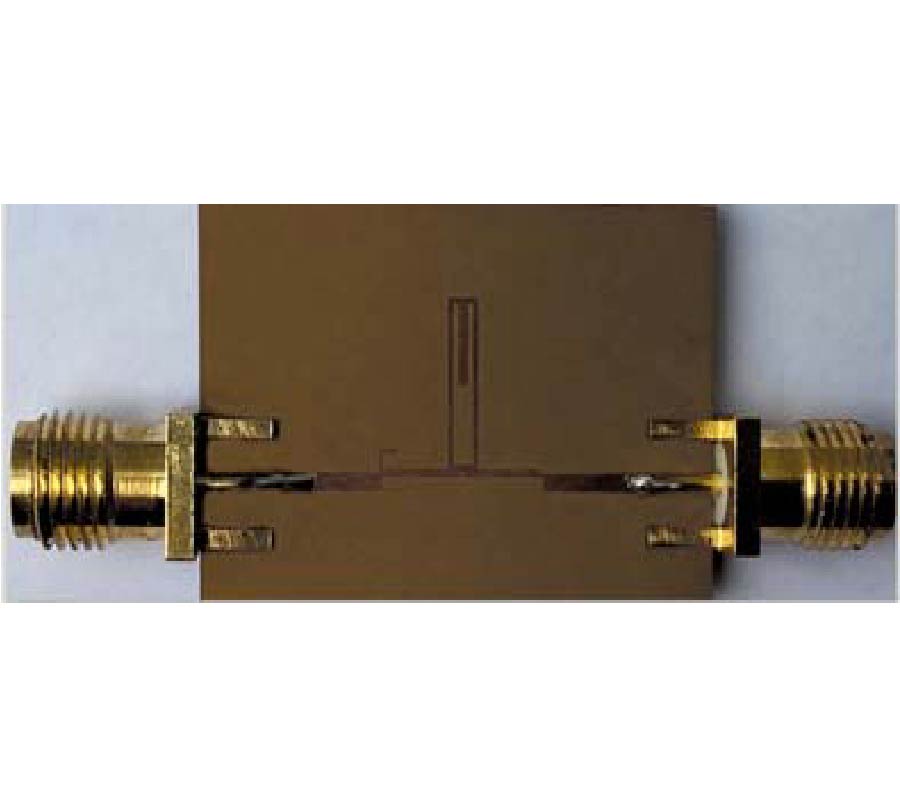
A novel miniaturized bandpass filter (BPF) is proposed, which is based on a stepped-impedance resonator (SIR) and cross-coupling theory. This filter has the characteristics of small size and high out-of-band rejection. The filter consists of four 1/2 wavelength stepped-impedance resonators and two 1/4 wavelength short-circuit microstrip resonators. By designing a new kind of structure, the cross coupling is realized between the second and the fifth resonators, and two transmission zeros are introduced out of band. Zero-degree feeding is realized due to the symmetry of the structure and feeding position, which adds two other transmission zeros outside the band. Four transmission zeros are introduced outside the passband of the filter, which greatly increase the out-of-band rejection of the filter. The passband of the filter is 3.2 GHz~4.2 GHz, and the out-of-band rejection at 2.6 GHz and 4.8 GHz reaches -60 dB. The size of the filter is only 7.2 mm * 8 mm (0.21λg*0.24λg), which realizes the miniaturization of the filter.
A NOVEL MINIATURIZED C-BAND BANDPASS FILTER
2021-12-23
PIER B
Vol. 94, 145-174
Space and Leaky Wave Radiation from Highly Lossy Biological Cylindrical Human-Limps Models
Xenophon M. Mitsalas , Theodoros Kaifas and George Kyriacou
The continuous and discrete radiation spectrum of a highly dielectric constant structure with extremely high losses is revisited herein. This work is motivated by the need of efficient electromagnetic power extraction from antenna-sources implanted into the human body. As the dielectric constant of biological tissues varies between 35 and 80 with a conductivity increasing from 0.5 to 2 S/m with frequency, the involved propagation and particularly radiation phenomena cannot be described by the current state of the art published research. Since the scope of the biomedical applications refers to the communication or energy transfer between an implanted device and an external one, the problem to be addressed involves primarily the near field and secondary the far-radiated field. Many of human body parts as the hands, legs, torso and neck can be modeled as cylinders. Indicatively, a non-magnetic infinite cylinder with an average dielectric constant εr1 = 58.1 and conductivity σ = 1.69 S/m is considered, with focus on the hand with average radius 2.75 cm. Although a plethora of excellent publications elaborates both analytically and numerically on the radiation from dielectric cylinders including losses, there is not any work studying rods with so high dielectric constants and extremely high losses, (loss tangents around unity or higher), while most of them are dealing with the far field rather than the near field. Classical works reveal radiation due to the discrete surface and leaky modes as well as a continuous spectrum, while complex modes appearing as quadruplets are found responsible for only energy storage. These are indications of discrete modes transitions as dielectric losses are increased. It is herein proved that indeed increasing losses are causing not only mode transition but also a change in their nature as surface or leaky, while the complex mode quadruplet breaks resulting in radiation in both the near and far fields, while losses have significant effects in the continuous spectrum (sky or space wave). These phenomena are exploited to serve the main purpose of this paper aiming to devise a physical mechanism supporting efficient energy and signal transferring inwards or outwards a highly lossy, high dielectric constant cylinder. The novelty of the proposed methodology stems from a Wiener-Hopf based non-meromorphic Kernel factorization resulting in a field product representation. This is composed of well defined individual terms with each one of them building on a specific pole-mode. The proposed formulation is found to be equivalent to the generalized ``multiplicative'' and ``additive'' steepest descent methods regarding the far field evaluation, but additionally is capable of providing the near field as well. The latter feature supports important biomedical applications. Due to the huge extent of the subject and in order to facilitate the continuous spectrum the analysis is restricted to the excitation by an infinitesimal electric dipole positioned at the origin and oriented along the axis of the cylinder. Studying this structure, a low attenuation low order mode is encountered which is mainly responsible for the energy transferring. This is in accordance with Frezza et al. findings for a ``deeply penetrating'' mode into highly lossy media.
SPACE AND LEAKY WAVE RADIATION FROM HIGHLY LOSSY BIOLOGICAL CYLINDRICAL HUMAN-LIMPS MODELS