Search Results(13789)

2022-02-20
PIER Letters
Vol. 103, 25-30
Study on the Effect of the Feedline Inductance in Wideband Tunable Band Pass Combline Filters
Seyed Mostafa Mousavi , Javad Soleiman Meiguni and David Pommerenke
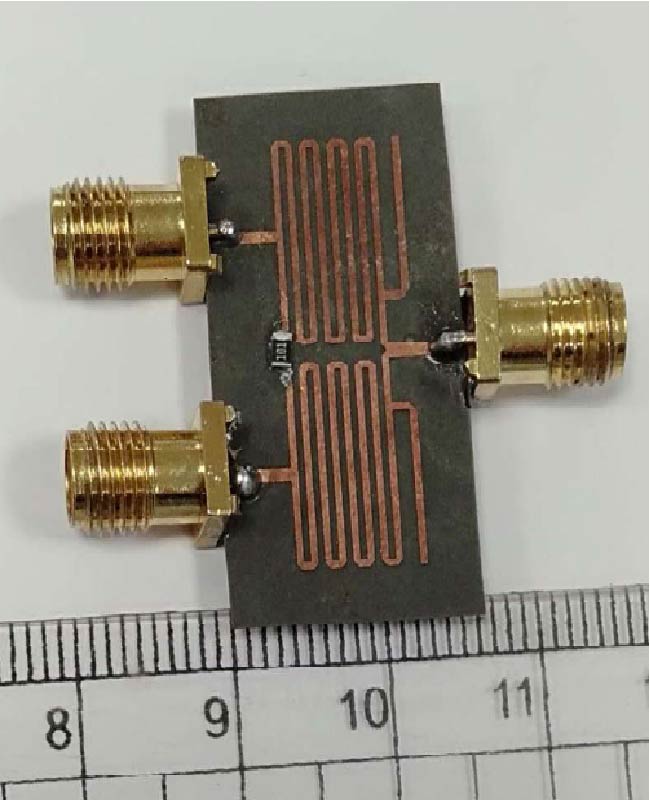
This letter proposes a novel analysis and design method of a continuously adjustable bandpass combline filter. It investigates the feedline design specifications and introduces an external quality factor (Qext) tuning structure to achieve a constant fractional bandwidth over 60% tuning bandwidth. The design approach allows to determine the optimum feedline structure for the filter andis verified by full-wave simulation and measurement. The results show a constant fractional bandwidth of 4.5% over the entire operating frequency range between 225-400 MHz.
STUDY ON THE EFFECT OF THE FEEDLINE INDUCTANCE IN WIDEBAND TUNABLE BAND PASS COMBLINE FILTERS
2022-02-19
PIER C
Vol. 118, 147-158
Vernier Effect Based Temperature Sensor Revealed Ultra-Sensitivity with High-Detection Resolution
Lashari Ghulam Abbas , Farhan Mumtaz , Yutang Dai , Rashda Parveen and Muhammad Aqueel Ashraf
In this study, a Vernier effect based temperature sensor with ultra-sensitivity and high-resolution detection is presented. The structure of the proposed temperature sensor is based on dual cascaded Fabry-Perot interferometers (FPIs), which consists of polymer and air cavity FPIs. The polymer cavity works as the sensing part, whereas the air cavity works as the reference part. The slight difference between the Free Spectral Range (FSR) of the sensing and the reference FPIs can establish the Vernier effect, which improves the sensitivity of the cascaded FPIs structure compared to the single FPI structure. The experimental results show that the proposed structure can provide the ultra-high temperature sensitivity of 67.69 nm/˚C that is 20 times higher than the single FPI, which is 3.36 nm/˚C in the testing range of 26˚C-28˚C. In addition, the structure is simple to fabricate, compact, inexpensive, along with ultra-sensitivity and high-resolution. Therefore, the proposed sensor is a suitable choice for the applications demanding high resolution temperature detection in different fields of engineering and science.
VERNIER EFFECT BASED TEMPERATURE SENSOR REVEALED ULTRA-SENSITIVITY WITH HIGH-DETECTION RESOLUTION
2022-02-19
PIER M
Vol. 108, 151-161
Simultaneous Measurement of Curvature and Temperature Based on a Simple Cascaded Fiber Interferometer
Fang Wang , Yinghui Lu and Yufang Liu
An optical fiber sensor based on thin-core fiber (TCF) and no-core fiber (NCF) interference structures is presented and experimentally demonstrated to measure the curvature and temperature. The fabrication process of the sensor is simple and convenient, and the sensing part is formed by cascading a TCF and an NCF between two single-mode fibers. The dips at resonant wavelengths are generated in the optical transmission spectrum owing to mode interference. The experimental results indicate that an optical curvature sensitivity of -5.76 nm/m-1 is achieved in the linear range of 0.9895-3.2817 m-1, and that a temperature sensitivity of 0.18 nm/˚C is obtained in the temperature range of 25-55˚C. Additionally, the cross-sensitivity problem is solved using the coefficient matrix measurement method, and the cross-sensitivity is as low as 0.0312 m-1/˚C. Therefore, the sensor exhibits a highly reproducible technique and low cross sensitivity, which has a wide range of application prospects in the accurate measurement of mechanical arms and structural health monitoring.
SIMULTANEOUS MEASUREMENT OF CURVATURE AND TEMPERATURE BASED ON A SIMPLE CASCADED FIBER INTERFEROMETER
2022-02-18
PIER M
Vol. 108, 139-149
A Miniaturized Dual-Band Circularly Polarized Implantable Antenna by Half-Cutting
Bo Yin , Ming Ye , Junhao Cong and Yingzhuo Xu
In this paper, a miniaturized dual-band circularly polarized (CP) implantable antenna is proposed. The -10 dB impedance bandwidth of the antenna in Industrial Scientific Medical (ISM) band and the low frequency part of UWB can reach 30.3% (2.02~2.74 GHz) and 39.9% (3.73~5.59 GHz), respectively. The important features are its CP characteristic in two bands and a small volume. The miniaturization of the antenna is realized by half-cutting technique, which is to cut the original antenna meeting the symmetry of structure and electric field distribution into two halves to obtain a compact structure and wider impedance bandwidth, so that the final size is 5×10.4×0.254 mm3. The CP wave performance of the antenna is achieved by exciting orthogonal polarization components on the radiation surface. The proposed antenna provides an axial ratio of less than 3 dB. CP axial ratio bandwidths in the two bands are 24.4% and 18.1%, respectively. In addition, the safety considerations and link margin are evaluated to analyze the performance of the proposed antenna. In order to verify the simulation results, the proposed antenna is fabricated. The measurements are carried out under the human muscle mimicking liquid circumstances. The measured data are in good agreement with the simulation results.
A MINIATURIZED DUAL-BAND CIRCULARLY POLARIZED IMPLANTABLE ANTENNA BY HALF-CUTTING
2022-02-18
PIER M
Vol. 108, 127-137
Design and Analysis of a Compact UWB-MIMO Antenna with Four Notched Bands
Ling Wu , Xia Cao and Bing Yang
In the paper, a very compact UWB-MIMO antenna with four rejected bands property is introduced and investigated. With a T-shape stepped stub on back ground, impedance bandwidth of 3-11 GHz and isolation of -15 dB are achieved. By etching four pairs of symmetrical L-formed slots into the radiators, four bands are isolated. With only a size of 21 mm × 27 mm, the proposed UWB-MIMO antenna system has low port coupling of -15 dB and wide working bandwidth of 3-11 GHz (S11 ≤ -10 dB or VSWR < 2) except 3.5 GHz WiMAX band, 5.3 GHz lower frequency band of WLAN, 5.8 GHz upper frequency band of WLAN and 7.4 GHz X-band. Moreover, other characteristics, such as radiation patterns, antenna gain, antenna efficiency, and ECC (envelope correlation coefficient) are also studied.
DESIGN AND ANALYSIS OF A COMPACT UWB-MIMO ANTENNA WITH FOUR NOTCHED BANDS
2022-02-18
PIER Letters
Vol. 103, 15-23
2D Hybrid Magnetic Model Calculation in Axisymmetric Device
Ammar Abdi
This paper proposes a 2D semi-analytical electromagnetic model to compute the magnetic field and eddy current generated by a variable current density along a conducting billet of induction heater. The developed model is based on the combination of the discretization method and the Biot-Savart theory. Firstly, the analytical solutions of the vector potential and the magnetic field are calculated in all elements discretized cylindrical geometry using the law of Biot-Savart. Then, the total field is determined by the contribution of the superposition of each element of the discretized geometry. The eddy currents are computed using the Ampere law, and it also allows us to determine the exact resulting heating power density, which is the heat source of the thermal problem. The results obtained are in agreement with those obtained using finite element method. Therefore, the developed magnetic model presents a fast and accurate tool for the design of induction heating devices.
2D HYBRID MAGNETIC MODEL CALCULATION IN AXISYMMETRIC DEVICE
2022-02-17
PIER M
Vol. 108, 115-126
An Optimized Compact Rat Race at 2.45 GHz
Stefano Maddio , Giuseppe Pelosi , Monica Righini and Stefano Selleri
A compact microstrip rat race attained by artificially shortening its lines by inserting stubs is presented. The design starts with a preliminary theoretical length reduction where quarter wavelength lines are shortened thanks to shunt open circuit stubs placed in the line mid-points. Such a preliminary design is then optimized via particle swarm optimization (PSO) within a full wave electromagnetic CAD, also bending the stubs to attain maximum compactness. The resulting design occupies an area up to only 37% of a conventional rat race, with performances comparable to those of a standard rat race.
AN OPTIMIZED COMPACT RAT RACE AT 2.45 GHZ
2022-02-17
PIER M
Vol. 108, 103-113
Diffraction of Plane Waves by Arbitrary-Angled Coated Wedges
Giovanni Riccio , Gianluca Gennarelli , Flaminio Ferrara , Claudio Gennarelli and Rocco Guerriero
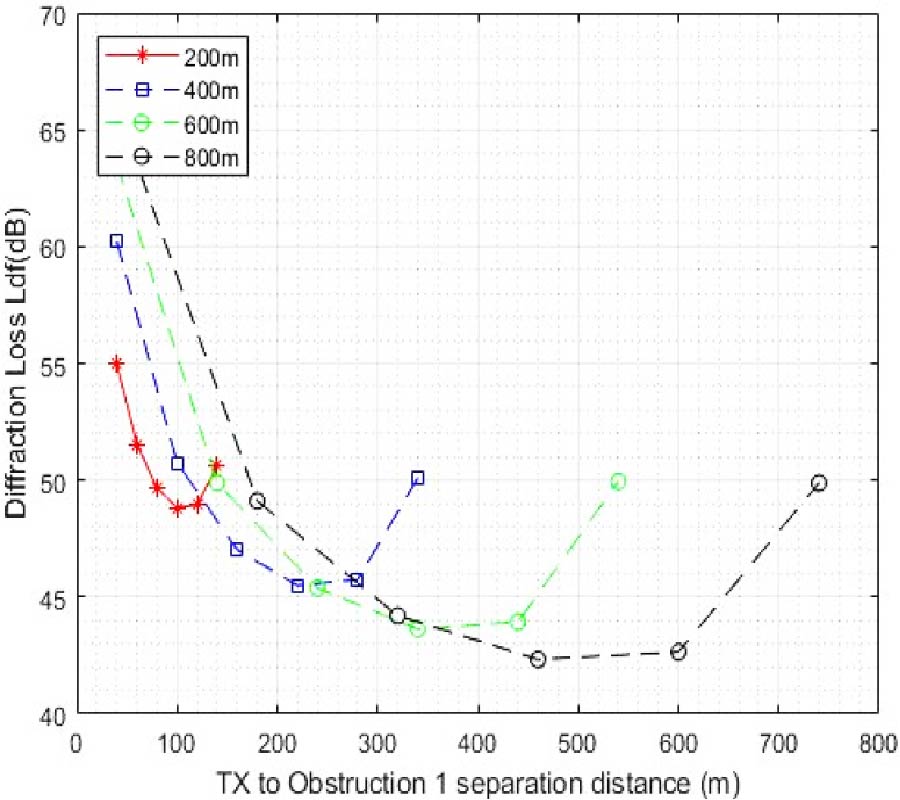
This research work deals with the plane wave diffraction by a coated perfect electrically conducting wedge with arbitrary apex angle. The uniform layer covering the impenetrable wedge is made of a standard double positive material or an unfamiliar double negative metamaterial with negative permittivity and permeability at the operating frequencies. The propagation mechanism is studied when the incidence direction is perpendicular to the edge of the composite structure, and uniform asymptotic solutions are proposed to evaluate the diffraction contribution for both the polarizations. Such approximate solutions are obtained by using the Uniform Asymptotic Physical Optics approach based on electric and magnetic equivalent surface currents radiating in the neighboring free space. The related expressions are user-friendly and provide reliable field values as verified by numerical tests involving a full-wave electromagnetic solver.
DIFFRACTION OF PLANE WAVES BY ARBITRARY-ANGLED COATED WEDGES
2022-02-16
PIER M
Vol. 108, 89-101
Highly Selective UWB Bandpass Filter with Multi-Notch Characteristics Using Comb Shaped Resonator
Piali Chakraborty , Partha Pratim Shome , Jyoti Ranjan Panda and Arindam Deb
This paper aims to present a highly selective, compact size new ultra-wideband (UWB) bandpass filter with three sharp notches for UWB indoor applications. The fundamental geometry of the filter is based on modified multi-mode resonator (MMR) structure which comprises a open-ended step impedance resonator (SIR) attached to an interdigitated uniform impedance resonator (UIR). Realizing a Comb-shaped resonator structure below the UIR and symmetrically extending the lower arm edge of the interdigital coupled lines, three notches are generated at 6 GHz, 6.53 GHz, and 8.35 GHz. These notches have improved the UWB bandpass filter responses by suppressing the existing interferences in the UWB passband created by Wi-Fi 6E (6 GHz), super-extended C band (6.425 GHz~6.725 GHz), X band satellite communications for satellite TV networks or raw satellite feeds (7.25 GHz~8.395 GHz). Concurrently the notched band filter has achieved superiority in other salient features concerning passband and stop band of the filter such as a high passband fractional bandwidth (115.76%), low return loss (-13.27 dB), low insertion loss (0.44 dB~0.97 dB), wide upper stop band (5.37 GHz), nearly flat group delay (0.28 ns~0.45 ns) etc. The ultimate design of UWB bandpass filter is fabricated and verified by comparing the simulated filter responses with the measured results indicating a good agreement.
HIGHLY SELECTIVE UWB BANDPASS FILTER WITH MULTI-NOTCH CHARACTERISTICS USING COMB SHAPED RESONATOR
2022-02-16
PIER M
Vol. 108, 79-88
Performance Prediction of Directed Energy Weapons
Graham V. Weinberg
Directed energy weapons provide a number of useful functions for the modern fighting force, and hence it is useful to produce a framework in which such a weapon's performance can be predicted. Towards this objective this paper introduces a new stochastic model to determine the number of targets defeated by a directed energy weapon over a given time interval. The key to this is to introduce a general queueing model, where arrivals are modelled by a renewal process, and the service time of a target being affected by the weapon is related to its probability of defeat. The queue is assumed to have an infinite capacity, and it is shown how the waiting time of detected threats can be modelled by an auxiliary delay process. A random variable counting the number of targets processed by the queue is then defined. Several functions constructed from this random variable will be investigated in order to identify a suitable metric for assessing performance. In order to facilitate this an example where a high energy laser is used for threat defeat is examined to investigate the utility of the identified performance metrics. As will become apparent, the modelling framework has considerable utility due to the fact that it can be used for performance prediction of any weapon system where an arrival process of threats and corresponding probability of defeat can be specified.
PERFORMANCE PREDICTION OF DIRECTED ENERGY WEAPONS
2022-02-16
PIER Letters
Vol. 102, 167-175
An Efficient ADBF Algorithm Based on Keystone Transform for Wideband Array System
Yiyang Jiang , Mingwei Shen and Guodong Han
In this paper, an efficient wideband array adaptive beamforming (ADBF) approach based on keystone transform is presented. In order to eliminate the aperture effect of the wideband signal, the modified keystone transform is applied to remove the time delay between different array elements. Thus, the wideband array is equivalent to the narrowband array, and the orthogonal projection matrix of the target steering vector can be used to filter the desired signal in the training samples, which avoids the signal cancellation caused in the estimation of ADBF covariance matrix. Compared with theestablished algorithm of sliding window, this approach can significantly reduce the computational burden. The feasibility and effectiveness of the proposed method are validated through numerical simulations.
AN EFFICIENT ADBF ALGORITHM BASED ON KEYSTONE TRANSFORM FOR WIDEBAND ARRAY SYSTEM
2022-02-15
PIER M
Vol. 108, 65-77
Sparse Bayesian Learning Based DOA Estimation and Array Gain-Phase Error Self-Calibration
Zili Li and Zhao Huang
This paper proposes a joint estimation algorithm based on sparse-Bayesian learning (SBL) for the gain-phase problem between array antenna channels. The algorithm uses the idea of the iterative method to jointly estimate the direction-of-arrival (DOA) and gain-phase error calibration coefficients in the iterative process, combining self-calibration and calibration with a calibration source. At each iteration, the rough value of DOA is first estimated using SBL, and then the DOA estimate is used to calculate the gain-phase error calibration coefficient. The value obtained in each iteration is brought into the error cost function, which is constructed based on the principle of signal and noise subspace orthogonality. Iterations are continued until convergence to find the minimum value of the cost function. The algorithm does not require a priori knowledge of array perturbations and has good performance in DOA and array gain and phase error estimation. Simulations and experimental measurements show that the method has better calibration performance than other methods based on optimization algorithms, and the algorithm effectively improves the antenna gain.
SPARSE BAYESIAN LEARNING BASED DOA ESTIMATION AND ARRAY GAIN-PHASE ERROR SELF-CALIBRATION
2022-02-14
PIER Letters
Vol. 103, 7-14
A W-Band High Isolation Single-Balanced Mixer in GaN HEMT Technology
Ping Xiang , Weibo Wang , Shaobing Wu and Hongqi Tao
A W-band high isolation single-balanced mixer using a 0.1-um GaN high-electron mobility transistor process is proposed in this paper. The diode is biased near the threshold voltage to reduce drive level, and the needed LO power is only 3 dBm. Moreover, the reasonable diode layout and phase compensation structure are used in the proposed mixer to enhance the LO-to-RF isolation. The measured results of the proposed mixer demonstrate a single-sideband conversion loss of 9-10.6 dB and a LO-RF isolation of 40 dB from 75 to 110 GHz with 7 dBm LO power. Moreover, a DC-to-18 GHz IF bandwidth is achieved with the LO frequency fixed at 110 GHz. The 1 dB compression point of the proposed mixer is 11 dBm with 16 dBm LO power. The measurement results indicate that GaN mixer has great potential for W-band transceiver system applications.
A W-BAND HIGH ISOLATION SINGLE-BALANCED MIXER IN GAN HEMT TECHNOLOGY
2022-02-14
PIER Letters
Vol. 103, 1-6
A CMOS Compatible Broadband Ruthroff 1:2 TLT Balun Using Broadside-Coupled Lines and Stacked Microstrip Lines
Zeyneb Cheraiet , Mohamed Toufik Benhabiles , Tarek Djerafi , Farouk Grine and Mohamed Lahdi Riabi
Implementation of a broadband Ruthroff-type transmission line transformer balun with a 1:2 step-up impedance transformation ratio is presented in this letter. The proposed Transmission Line Transformer (TLT) balun was investigated with broadside-coupled lines using three stacked microstrip lines. The proposed balun was formed by cascading one section of modified Ruthroff-type 2:1 unbalanced-to-unbalanced TLT with one section of Ruthroff-type 1:4 TLT balun in series. The achieved fractional bandwidth of the balun is 192.17% over the frequency range from 1.2 to 6.6 GHz, which covers the IEEE 802.11 a/b/g WLAN, WiMAX applications. The measured amplitude and phase imbalances are less than 1 dB and less than 4.51˚, respectively at this frequency range.
A CMOS COMPATIBLE BROADBAND RUTHROFF 1:2 TLT BALUN USING BROADSIDE-COUPLED LINES AND STACKED MICROSTRIP LINES
2022-02-11
PIER B
Vol. 95, 1-22
Investigation of Plasmonic Metal Conductors and Dielectric Substrates on Nano-Antenna for Optical Wireless Communication
Shekhara Kavitha , Kanduri Venkata Sairam and Ashish Singh
In this manuscript, plasmonic metal conductors such as Silver, Gold, Aluminum, Copper, Chromium, Tungsten, Titanium, and Nickel are investigated on a T-shaped nano dipole antenna using dielectric materials such as Silicon Dioxide, Zinc Oxide, Indium Tin Oxide, and Silicon Nitride. The optical properties of the conductors and dielectric materials are modeled using Drude and Lorentz dispersive models, respectively. It is observed that the Aluminium metal supports high quality plasmonic oscillations for a wide range of Terahertz frequencies. The Aluminium metal also shows high losses occurring at the Terahertz frequency among the other metals. The Gold and Silver can resonate in the visible region and have moderate losses compared to the other plasmonic metals. It is noticed that the near-zero permittivity point of the Silicon Dioxide substrate occurs at 2875 THz which is much greater than the other three substrates. Further, it is observed that on the Silicon Dioxide, Zinc Oxide, and Silicon Nitride substrates the Silver Nano dipole antenna shows the maximum directivity of 6.615 dBi, 5.671 dBi, and 5.709 dBi, respectively. The Aluminium nano-antenna gives the maximum directivity of 5.066 dBi on the Indium Tin Oxide substrate. The Silver-Silicon Dioxide Nano-antenna will be suitable for the terahertz optical wireless communication.
INVESTIGATION OF PLASMONIC METAL CONDUCTORS AND DIELECTRIC SUBSTRATES ON NANO-ANTENNA FOR OPTICAL WIRELESS COMMUNICATION
2022-02-11
PIER C
Vol. 118, 135-145
Strategies for Selecting Common Elements Excitations to Configure Multiple Array Patterns
Duaa Alys Karim and Jafar Ramadhan Mohammed
In this paper, a single linear antenna array with partially common element excitation amplitudes is used to reconfigure between Taylor-pencil beam and flat-top beam patterns. Two strategies are suggested to properly select the common elements while still satisfying the desired constraints on both patterns. The first strategy uses the central elements of the array as the common elements for the reconfiguration between the required two patterns, while the other one uses the side elements. Since the element excitation amplitudes of the corresponding Taylor and flat-top patterns usually tend to be maximum and similar at the array center, the central common elements approach outperforms the sided one. Compared with the conventional array pattern synthesized methods with completely two separable elements excitations arrays, only a single linear array with a number of common element excitations is needed in the proposed method. Hence, it has advantages of simple structure, low cost, and compact size. Simulation results show that the proposed array with the central common elements approach has the capability to efficiently reconfigure between Taylor and flat-top beams by modifying only 24 elements out of a total 40 array elements with all sidelobe levels of both patterns below -20 dB.
STRATEGIES FOR SELECTING COMMON ELEMENTS EXCITATIONS TO CONFIGURE MULTIPLE ARRAY PATTERNS
2022-02-11
PIER Letters
Vol. 102, 161-166
Loads Estimation for Multi-Receiver Wireless Power Transfer System
Suraj Kumar Panigrahi , Pradyumna K. Sahoo , Durga Prasanna Kar , Renu Sharma and Satyanarayan Bhuyan
It is still a delusion that the transmitter coil is able to drive multiple loads (electrical/electronic devices) in multi-receiver Wireless Power Transfer (WPT) system. Nevertheless, it is found that for a fixed design, the number of receiver load coils that can be driven with their stipulated power level is not selected randomly rather with definite number. The circuit model analysis of series-series compensated multiple-receiver WPT system is proposed in order to estimate the number of loads with respect to the transmitter coil. Both theoretical simulation and experimental studies have proven this finding, and the results obtained are important for designing an effective multiple-receiver WPT system.
LOADS ESTIMATION FOR MULTI-RECEIVER WIRELESS POWER TRANSFER SYSTEM
2022-02-10
PIER Letters
Vol. 102, 151-159
Analysis for Six-Pole Outer Rotor Hybrid Magnetic Bearing
Gai Liu and Huangqiu Zhu
In order to solve the nonlinear and coupling problems of three-pole hybrid magnetic bearing, a six-pole outer rotor hybrid magnetic bearing (HMB) is proposed. Firstly, the structure and working principle of the six-pole outer rotor HMB are introduced. Secondly, the linearity and coupling characteristics curves between radial suspension force and control current are analyzed and verified by the finite element method. In comparison with the analysis results of the three-pole HMB, there is no electromagnetic coupling between radial two degrees of freedom of the six-pole outer rotor HMB, and the nonlinear problem of force-current characteristic is solved. Finally, an experimental platform is built. The research results show that the maximum bearing capacity of the six-pole outer rotor HMB is 32.3% higher than that of the three-pole HMB. The suspension force-current characteristic experiment shows that the suspension force-current properties of the six pole outer rotor hybrid magnetic bearing can be considered linear near the equilibrium position, and there is no magnetic coupling between two radial degrees of freedom of the six pole outer rotor HMB near the equilibrium position.
ANALYSIS FOR SIX-POLE OUTER ROTOR HYBRID MAGNETIC BEARING
2022-02-09
PIER M
Vol. 108, 53-63
Analysis of Electrically Low Profile Wideband Microwave Absorber for C Band Applications
Nitinkumar J. Bathani and Jagdish M. Rathod
In this paper, a wideband polarization-independent broad angular insensitive absorber is proposed with miniaturization novelty. A 12*12 octagon element with parasitic elements interconnected by lumped resister has been fabricated on an FR4 structure with an air gap. Large air gap and lower thickness of substrate material as well as corner notched rectangular with octagonal shape causes the improvement of bandwidth. The proposed wideband absorber exhibits absorptivity above 90%. The same has been achieved from 2.84 GHz to 9.12 GHz with 6.27 GHz fractional bandwidth in TE and TM configurations with an angle from 0˚ to 30˚. The design is λ/6.67 in size and λ/3.33 in thickness miniaturization at the highest cutoff wavelength. The outcome from the proposed model is highly promising and closely matches the simulated configuration. This design has a vital application in absorbing the signal from aircraft, missiles, submarines, satellites, and radar, termed stealth technology.
ANALYSIS OF ELECTRICALLY LOW PROFILE WIDEBAND MICROWAVE ABSORBER FOR C BAND APPLICATIONS
2022-02-09
PIER Letters
Vol. 102, 145-149
A Low-Profile Cylindrical Conformal Transmitarray Antenna
Ben Fu , Shixing Yu , Na Kou , Zhao Ding and Zhengping Zhang
In this paper, we present the design of a cylindrical conformal transmitarray antenna for generating high-gain beam. A low-profile transmitted element with 3-bit quantization is designed. It can cover 360˚ transmission phase shift range with transmission magnitude below -2 dB. A prototype of the cylindrical conformal transmitarray antenna is fabricated and measured. The measured gain is 21.75 dBi with aperture efficiency of 42.7%, and the thickness of the transmitarray is only 0.1 wavelengths at operating frequency.
A LOW-PROFILE CYLINDRICAL CONFORMAL TRANSMITARRAY ANTENNA