Search Results(13789)

2022-03-24
PIER M
Vol. 109, 63-73
Design of Quad Band Operational UWB Antenna with Triple Notch Bands Using Meander Line Slot
Rani Rudrama Kodali , Polepalli Siddaiah and Mahendra Nanjappa Giriprasad
A novel ultra-wideband (UWB) antenna with triple band rejection capabilities operating in quad bands is presented. The proposed UWB antenna is derived from a planar rectangular shaped monopole antenna. In order to improve the bandwidth ratio of the antenna, a partial ground is maintained with a slot at centre along with truncated slots made at bottom two corners and a rectangular slot at top side centre of the radiating patch. In order to achieve the required triple notch characteristics and the multiband operation, a single meander line slot is made in the middle of the patch. The dimensions of the meander line slot are varied to change the notch band characteristics of the antenna. The FR4 substrate with dielectric constant 4.4 with thickness of 1.6 mm is used to design the antenna. The overall size of the antenna is maintained compact with dimensions 40 mm×38 mm. The proposed UWB antenna rejects triple bands 3.29 GHz-4.83 GHz (WiMAX), 5.15 GHz-6.84 GHz (WLAN), & 7.94 GHz-8.49 GHz (X-band satellite uplink). The operational bands of the UWB antenna with triple notch bands are as follows, 2.38 GHz-3.29 GHz, 4.83 GHz-5.15 GHz, 6.84 GHz-7.94 GHz, and 8.49 GHz-13.15 GHz. The measured peak gains at 2.7 GHz, 5 GHz, 7.3 GHz, 8.7 GHz, and 11.5 GHz are 3.4 dBi, 2.8 dBi, 3.6 dBi, 3.3 dBi, & 3.88 dBi, respectively. The step-by-step implementation of the triple notch band UWB antenna and the comparative analysis is presented. The proposed antenna performance is presented with the help of reflection coefficient, VSWR, gain, field distributions and radiation pattern curves. The simulated and measured analysis comparison shows good agreement making the designed antenna a good candidate for UWB applications that require multiband operations with selected bands rejection.
DESIGN OF QUAD BAND OPERATIONAL UWB ANTENNA WITH TRIPLE NOTCH BANDS USING MEANDER LINE SLOT
2022-03-24
PIER M
Vol. 109, 51-61
Decoupling Control of Six-Pole Hybrid Magnetic Bearings
Gai Liu , Junqi Huan , Huangqiu Zhu , Chenyin Zhao and Zhihao Ma
Six-pole hybrid magnetic bearing is a multiple input-output system with strong coupling between the degrees of freedom, a state feedback linearization dynamically decoupling the fuzzy immune PID controller for the subsystem after linear resolution coupling is proposed in this paper. Firstly, the basic theory of linear resolving coupling is expounded. Secondly, the proposed decoupling theory and control strategy are simulated in Matlab. Finally, the experimental platform is built, and the suspension experiments and coupling experiments are performed. It can be seen that the fuzzy immune PID controller has good performance, and the state feedback linearization method can realize the decoupling between the radial degrees of freedom of six-pole magnetic bearings.
DECOUPLING CONTROL OF SIX-POLE HYBRID MAGNETIC BEARINGS
2022-03-22
PIER C
Vol. 119, 115-124
Arrow Cross Shape Slotted Fractal Antenna with Enhanced Bandwidth for Wi-Fi/WiMAX/WLAN Applications
Rani Rudrama Kodali , Polepalli Siddaiah and Mahendra Nanjappa Giriprasad
A fractal antenna with enhanced bandwidth (BW) from 2.62 GHz to 5.2 GHz is presented for Wi-Fi applications. The antenna is designed to achieve a wider BW, and it consists of a rectangular shape patch attached to a half circular disc. The antenna is fed by microstrip feed model. The ground plane of the antenna is maintained partial with a slot at centre. Double head arrow cross shaped slots are etched on the radiating element to form the proposed fractal antenna. While the centre slot is made to look like + symbol, the surrounding four fractal slots are made to look like × symbol. FR4 substrate with dielectric constant 4.4 with thickness 1.6 mm is used to design the antenna. The overall size of the antenna is maintained compact with dimensions 44 mm × 40 mm. The dimensions of the fractal slots are varied, and the operating band is tuned. The proposed antenna covers from 2.62 GHz to 5.2 GHz with BW 2.58 GHz. The step-by-step implementation of the fractal antenna and comparative analysis are presented with the help of reflection coefficient curves. While the proposed antenna covers wideband, it showed peak resonance at dual operating frequencies at 3.2 GHz and 4.8 GHz. The designed antenna-maintained gain of 2.96 dBi and 3.47 dBi at 3.2 GHz and 4.8 GHz frequencies, respectively. The proposed antenna performance is presented with the help of reflection coefficient, VSWR, gain, field distributions, and radiation pattern curves. The simulated and measured analysis comparison showed good agreement making the designed antenna a good candidate for wideband Wi-Fi applications.
ARROW CROSS SHAPE SLOTTED FRACTAL ANTENNA WITH ENHANCED BANDWIDTH FOR WI-FI/WIMAX/WLAN APPLICATIONS
2022-03-22
PIER C
Vol. 119, 97-114
Multi-Objective Optimization and Analysis of Six-Pole Outer Rotor Hybrid Magnetic Bearing
Gai Liu , Zhihao Ma , Huangqiu Zhu , Jingbo Sun and Junqi Huan
The multi-objective optimization of the six-pole outer rotor hybrid magnetic bearing (OSHMB) not only solves the nonlinear and strong coupling problems of the three-pole magnetic bearing (THMB), but also makes the magnetic bearing structure more compact and improves the maximum bearing capacity. Firstly, the structure and working principle of the OSHMB are introduced, and the mathematical models of suspension forces are established by the Maxwell tensor method. Secondly, the key parameters of the OSHMB are multi-objective optimized, and an optimal set of parameters is obtained through the sensitivity analysis, constructing the response surface model, and the multi-objective optimization based on the genetic algorithm. Based on the optimal parameters, the force current characteristics and maximum carrying capacity of the OSHMB are analyzed. Finally, the experimental platform is built. The suspension experiments, anti-interference experiments and load loading experiments are performed. It can be seen that the maximum bearing capacity of the OSHMB is about 9.6% higher than that of the SHMB.
MULTI-OBJECTIVE OPTIMIZATION AND ANALYSIS OF SIX-POLE OUTER ROTOR HYBRID MAGNETIC BEARING
2022-03-22
PIER C
Vol. 119, 81-96
Full Duplex High Speed Data Transmission Based on Partially Coupled Coils in Wireless Power Transmission Systems
Jianxiong Li and Wenlong Yang
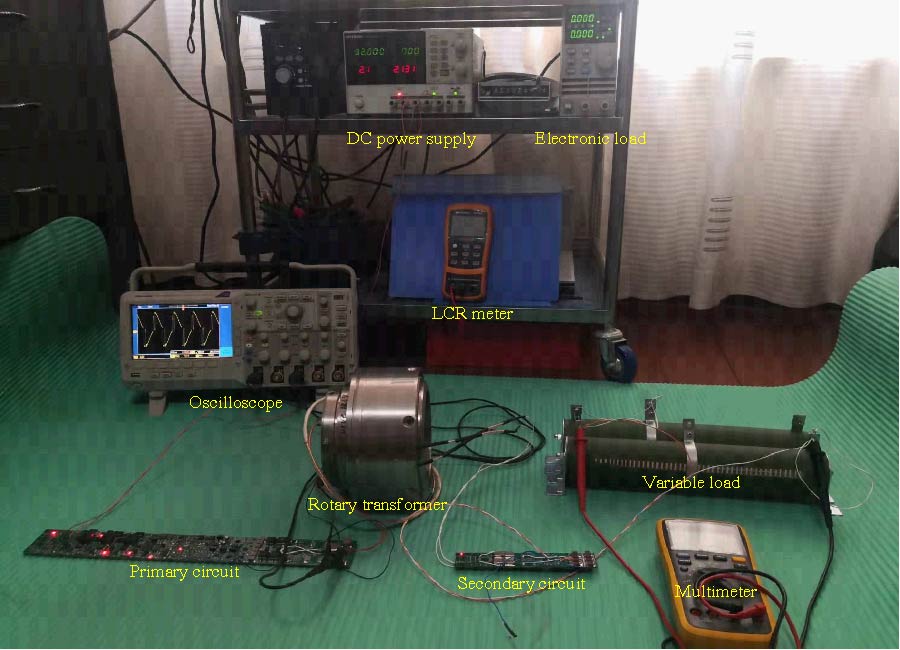
For full duplex communication, a signal parallel transfer method based on partial power transmission couplers is proposed in this paper. The power transfer uses a serial LC compensation structure topology, and the data transmission channel adopts a double coupling resonant circuit. In terms of power transmission, some power coupling inductors and power compensation capacitors form a power resonance network with a high frequency trap function, which can isolate the influence of signal transmission. Therefore, there is no need for an additional trap, which reduces power loss and the space occupied by the structure. In terms of signal transmission, the partial coupling coil method can increase the coupling frequency and the data transfer rate. In addition, the signal transmission circuit has the characteristics of dual resonance frequencies. The forward and reverse signals modulate the carrier at different resonance frequencies to realize full duplex communication. Finally, the simulation results prove that the scheme is practicable for full duplex communication and parallel transmission of power, achieving anoutput power of 1.4 KW, and the highest transmission rate can reach 1 Mbps.
FULL DUPLEX HIGH SPEED DATA TRANSMISSION BASED ON PARTIALLY COUPLED COILS IN WIRELESS POWER TRANSMISSION SYSTEMS
2022-03-21
PIER Letters
Vol. 103, 81-88
A Dual-Polarized Wide-Angle Scanning Antenna with High Isolation for Van Atta Applications
Chunliang Dai and Lei Gan
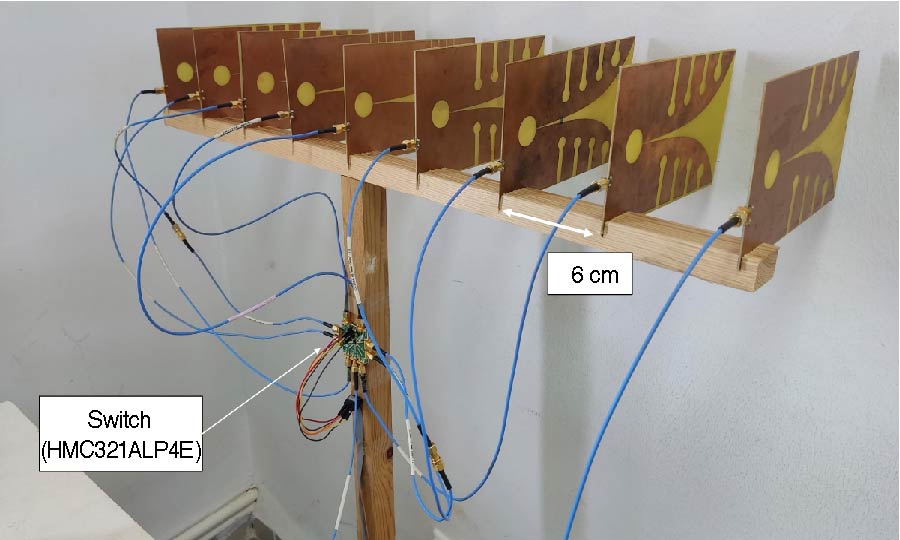
A dual-polarized wide-angle scanning array antenna is proposed in this paper. The proposed antenna array consists of sixteen elements with the working band from 9.5 to 10.5 GHz. A microstrip patch fed from two orthogonal directions is applied to achieve dual-polarization. In order to obtain good impedance matching and wide bandwidth of the antenna, capacitive coupling feeding is adopted. The measured results show that the proposed array can cover a wide scanning range of ±58°. The polarization isolations of antenna are higher than 17 dB. The isolations between receiving sub-array and transmitting sub-array are higher than 22.3 dB. The proposed array antenna is suitable for Van Atta applications.
A DUAL-POLARIZED WIDE-ANGLE SCANNING ANTENNA WITH HIGH ISOLATION FOR VAN ATTA APPLICATIONS
2022-03-21
PIER Letters
Vol. 103, 73-79
A Novel Tunable LC Bandpass Filter with Constant Bandwidth Based on Magnetic Dominant Mixed Coupling
Longchuan Liu , Qian-Yin Xiang , Dinghong Jia , Xiaoguo Huang and Quanyuan Feng
In this paper, a novel tunable LC bandpass filter (BPF) based on LC magnetic-dominant mixed coupling is proposed. The design equations for the coupling coefficient and resonating frequency are given. The magnetic dominant coupling region and electric dominant coupling region are studied. The magnetic-dominant mixed coupling is used to compensate the bandwidth of the tunable filter, so that the tunable filter with constant absolute bandwidth can be obtained. The filter is designed, simulated and measured, and the measurement matches the simulation very well. The measurement shows that the central frequency tuning range is from 72 MHz to 222 MHz with -3dB bandwidth of 16.5±3.5 MHz.
A NOVEL TUNABLE LC BANDPASS FILTER WITH CONSTANT BANDWIDTH BASED ON MAGNETIC DOMINANT MIXED COUPLING
2022-03-18
PIER M
Vol. 109, 39-49
A Novel Miniaturized Capacitor Loaded Interdigital Filter
Luyao Tang , Xiaoli Jiang , Hao Wei , Weiwei Liu and Hao Wei
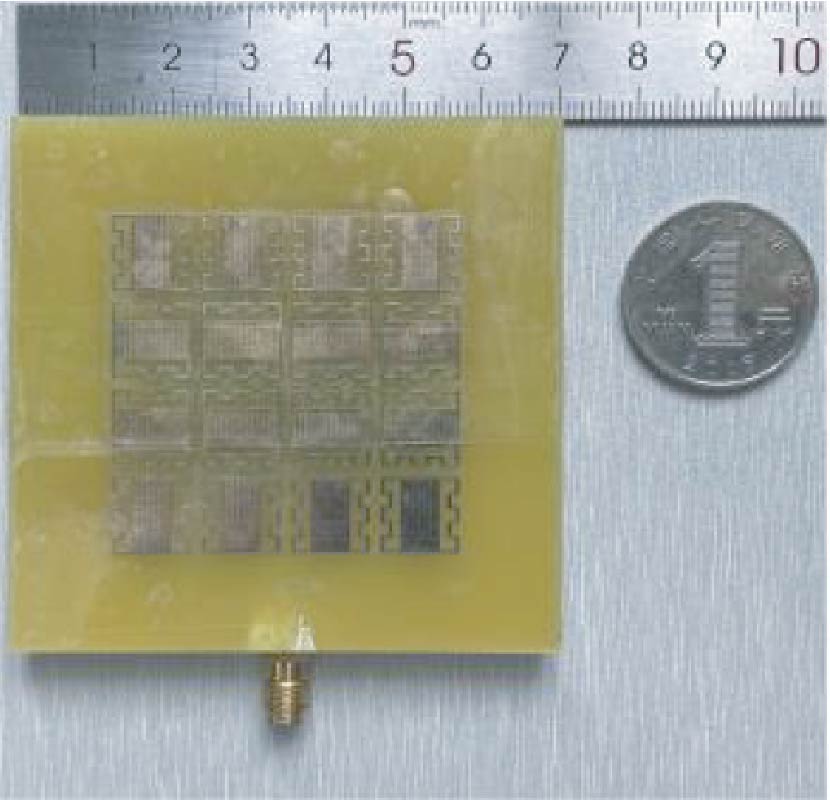
This paper proposes a novel miniaturized interdigital capacitor loaded interdigital filter, which is applied in C-band (3.2 GHz~4.2 GHz). By loading an interdigital capacitor on the open end of the resonator of the interdigital filter, the length of the resonator is shortened by 28%. The resonant frequency offset caused by tap introduction is adjusted by using the method of impedance compensation at the open end of resonator 1 and resonator 5, which further reduces the size of the filter. The miniaturized filter is fabricated on a 0.254 mm-thickness alumina substrate with relative dielectric constant of 9.8 by thin film process. Measured results are as follows: the passband of the filter is 3.2 GHz~4.2 GHz; the insertion at center frequency is -1 dB; the return loss is less than -18.3 dB. The size of the filter is 4.98 mm*6.45 mm (0.15λg*0.20λg), which is 37.8% smaller than that of the traditional interdigital filter.
A NOVEL MINIATURIZED CAPACITOR LOADED INTERDIGITAL FILTER
2022-03-18
PIER M
Vol. 109, 25-38
CB-CPW Fed SRR Loaded ISM and 5G Low Profile Antenna for on-Body Healthcare Monitor
Thangavelu Shanmuganantham , Srinivasan Ashok Kumar and Dhanapalan Sindhahaiselvi
This paper explores a loaded conductor backed coplanar waveguide (CB-CPW) split ring resonator (SRR) fed U-slot planar antenna used for healthcare monitoring via the wireless scientific industrial medical (ISM) band and medical service band at fifth generation (5G-MSB). The antenna has been designed with bio-tissue layers, muscle layers, skin, and fat. The parameters of the designed antennas, such as miniaturization, increased gain, and enhanced bandwidth, are presented. The proposed prototype results in the total size of 640 mm3. Such designed antenna has been operated at (3.4-3.6) GHz - fifth-generation medical service band and at (2.38-2.48) GHz - industrial scientific band and can realize proximately omnidirectional radiation pattern over the operating bands.
2022-03-14
PIER C
Vol. 119, 65-79
Large Intelligent Surface-Assisted Wireless Communication and Path Loss Prediction Model Based on Electromagnetics and Machine Learning Algorithms
Wael Elshennawy
This paper presents the application of machine learning-based approach toward prediction of path loss for the large intelligent surface-assisted wireless communication in smart radio environment. Two bagging ensemble methods, namely K-nearest neighbor and random forest, are exploited to build the path loss prediction models by using the training dataset. To generate the data samples without having to run measurement campaign, a path loss model is developed owning to the similarity between the large intelligent surface-assisted wireless communication and the reflector antenna system. Simple path loss expression is deduced from the system gain of the reflector antenna system, and it is used to generate the data samples. Simulation results are presented to verify the prediction accuracy of the path loss predictions models. The prediction performances of the trained path loss models are assessed based on the complexity and accuracy metrics, including R2 score, mean absolute error, and root mean square error. It is demonstrated that the machine learning-based models can provide high prediction accuracy and acceptable complexity. The K-nearest neighbor algorithm outperforms random forest algorithm, and it has smaller prediction errors.
LARGE INTELLIGENT SURFACE-ASSISTED WIRELESS COMMUNICATION AND PATH LOSS PREDICTION MODEL BASED ON ELECTROMAGNETICS AND MACHINE LEARNING ALGORITHMS
2022-03-14
PIER M
Vol. 109, 13-23
A Novel Dual Material Bionic Flexible Logo Antenna with EBG Structure
Daming Lin , Enchen Wang , Jie Wang , Wen Zhang and Hao Zhang
Based on the principle of bionics, this paper combines the design of flexible bionic antenna with Chinese culture, and proposes a dual-material bionic antenna with Electromagnetic Band Gap(EBG) structure. The antenna uses a polyimide flexible substrate. Radiation patch of this antenna is shaped like a ``pear flower'', and the ``CHINA'' shaped slot is etched on the ground to form a Logo mark. In order to reduce the impact of antenna radiation on human body, the introduction of an EBG structure made of Polydimethylsiloxane (PDMS) material makes the front-to-back ratio of the antenna radiation significantly increased. The antenna was bent in different ways and was placed on human body model for simulation and testing. The results showed that the antenna achieved an impedance bandwidth of 18.8% (2.22-2.46 GHz), the peak gain was 4.02 dBi, and the antenna was low sensitive to deformation, which makes it suitable for modern flexible electronic equipment.
A NOVEL DUAL MATERIAL BIONIC FLEXIBLE LOGO ANTENNA WITH EBG STRUCTURE
2022-03-14
PIER M
Vol. 108, 237-247
A Compact Wide Band MIMO Antenna with Quadruple Notches in UWB
Vanka Saritha and Chakali Chandrasekhar
A Compact wideband operating from 3 to 18 GHz MIMO antenna with quadruple notches is presented in this paper. The elements in MIMO configuration are arranged in orthogonal fashion with each other to minimize the coupling effects. The antenna consists of circular rings and a modified microstrip feed. By engraving a crescent shaped slot, split ring-shaped slot, circle shaped slot in the circular monopole, rectangular spiral shaped slot engraved along the feed line quadruple notches are attained. The antenna operates from 3 GHz to 18 GHz with notches in the range of 3.2 GHz-4.2 GHz centered at 3.5 GHz, 4.5 GHz-5.5 GHz centered at 4.9 GHz, 6.2 GHz-7.3 GHz centered at 6.6 GHz, and 8.1 GHz-8.8 GHz centered at 8.5 GHz. The element has a very compact size of 0.28λx0.22λx0.016λ at 3 GHz and is hence suitable for portable devices.
A COMPACT WIDE BAND MIMO ANTENNA WITH QUADRUPLE NOTCHES IN UWB
2022-03-13
PIER M
Vol. 108, 223-235
Novel Subarray Partition Algorithm for Solving the Problem of Too Low Beam Collection Efficiency Caused by Dividing a Few Subarrays
Jianxiong Li , Ziyu Han and Cuijuan Guo
Beam Collection Efficiency (BCE), sidelobe level outside the receiving area (CSL), and cost are need to be considered in optimizing the transmitting array of a Microwave Wireless Power Transmission (MWPT) system. To solve the problem of too low BCE caused by dividing a small number of subarrays, this paper proposes a novel one-step subarray partition algorithm named Multi-Particle Multi-Parameter Dynamic Weight Particle Swarm Optimization Subarray Partition (MPMP-DWPSO-SP). The algorithm optimizes the position and structure of each element at the same time, and the number of the subarrays is no more than 4. It is verified by simulation that the BCE obtained by using this algorithm to optimize the Sparse Quadrant Symmetrical Rectangular Array (SQSRA) with an aperture of 4.5λ×4.5λ and the array element number of 8×8 can reach more than 90%. In addition, a new intelligent optimization model is designed for dividing the 8×8 array into 2 subarrays, and BCE and CSL can reach 91.69% and -17.61 dB.
NOVEL SUBARRAY PARTITION ALGORITHM FOR SOLVING THE PROBLEM OF TOO LOW BEAM COLLECTION EFFICIENCY CAUSED BY DIVIDING A FEW SUBARRAYS
2022-03-09
PIER
Vol. 173, 53-69
On Fresnel-Airy Equations, Fabry-Perot Resonances and Surface Electromagnetic Waves in Arbitrary Bianisotropic Metamaterials
Maxim Durach , Robert Williamson , Jacob Adams , Tonilynn Holtz , Pooja Bhatt , Rebecka Moreno and Franchescia Smith
We introduce a theory of optical responses of bianisotropic layers with arbitrary effective medium parameters, which results in generalized Fresnel-Airy equations for reflection and transmission coefficients at all incidence directions and polarizations. The poles of these equations provide explicit expressions for the dispersion of Fabry-Perot resonances and surface electromatic waves in bianisotropic layers and interfaces. The existence conditions of these resonances are topologically related to the zeros of the high-k characteristic function h(k)=0 of bulk bianisotropic materials and taxonomy of bianisotropic media according to the hyperbolic topological classes [32, 33].
ON FRESNEL-AIRY EQUATIONS, FABRY-PEROT RESONANCES AND SURFACE ELECTROMAGNETIC WAVES IN ARBITRARY BIANISOTROPIC METAMATERIALS
2022-03-09
PIER
Vol. 173, 37-52
Massively Parallel Multilevel Fast Multipole Algorithm for Extremely Large-Scale Electromagnetic Simulations: A Review
Wei-Jia He , Xiao-Wei Huang , Ming-Lin Yang and Xin-Qing Sheng
Since the first working multilevel fast multipole algorithm (MLFMA) for electromagnetic simulations was proposed by Chew's group in 1995, this algorithm has been recognized as one of the most powerful tools for numerical solutions of extremely large electromagnetic problems with complex geometries. It has been parallelized with different strategies to explore the computing power of supercomputers, increasing the size of solvable problems from millions to tens of billions of unknowns, thereby addressing the crucial demand arising from practical applications in a sense. This paper provides a comprehensive review of state-of-the-art parallel approaches of the MLFMA, especially on a newly proposed ternary parallelization scheme and its acceleration on graphics processing unit (GPU) clusters. We discuss and numerically study the advantages of the ternary parallelization scheme and demonstrate its flexibility and efficiency.
MASSIVELY PARALLEL MULTILEVEL FAST MULTIPOLE ALGORITHM FOR EXTREMELY LARGE-SCALE ELECTROMAGNETIC SIMULATIONS: A REVIEW
2022-03-09
PIER C
Vol. 119, 49-63
The Design and Implementation of an RF Energy Harvesting System Using Dynamic Pi-Matching, Enabling Low-Power Device Activation and Energy Storage
Beragama Vithanage Sandaru Suwan , Wijesekara Withana Gamage Vidula , Wanniarachchi Kankanamge Indika Lasantha Wanniarachchi , Chandima Helakumara Manathunga and Sasani Jayawardhana
Radio-frequency electromagnetic waves can be harnessed to produce an alternative source of energy to replace batteries in many low-power device applications. An efficient radio frequency (RF) energy harvesting circuit was designed and constructed using a dynamic Pi-matching network in order to convert frequency-modulated electromagnetic waves in the range of 88-108 MHz to direct current through a 3-step process. The circuit consists of a 50 Ω copper plate dipole antenna, a Pi impedance matching network, and a five-stage voltage doubler circuit. These three modules are connected through SubMiniature version A (SMA) connectors for convenient assembly. The dynamic Pi matching technique for RF energy harvesting is theoretically explained and simulated in the Advance Design System software environment. The experimental values obtained in this proposed work are in good agreement with the simulations. The harvesting system is capable of producing up to 14.3 V direct current voltage across a 100 kΩ load in field tests carried out at a displacement of 760 m from a transmission tower. At 6.7 km from the tower, a DC value of 61.5 mV was still obtainable at the ground level. The direct-current power that was generated through the energy harvesting was applied for the demonstration of three tasks with satisfactory results: illuminating a light-emitting diode, energy storage in a Panasonic VL2020 rechargeable battery, and activation of a TMP20AIDCKT temperature sensor in an urban area which enabled low power device activation and energy storage.
THE DESIGN AND IMPLEMENTATION OF AN RF ENERGY HARVESTING SYSTEM USING DYNAMIC PI-MATCHING, ENABLING LOW-POWER DEVICE ACTIVATION AND ENERGY 
STORAGE
2022-03-09
PIER C
Vol. 119, 31-47
A New Fault Location Method Independent of Line Parameters
Lihui Zhao , Jingwei Zhu , Hongzhe Yang and Bin Gu
To restore power feeding as soon as possible and reduce repair costs and labor, a precise and robust fault location method for transmission lines is proposed. This method is based on the current and voltage synchronously collected by the phasor measurement units (PMUs) at two terminals of the line and does not require line parameters to calculate the fault distance. The line parameter is not approximately constant, but is affected by power load, temperature, and humidity, which affects the accuracy of most fault location algorithms that rely on line parameters. Therefore, the method proposed in this paper is robust and accurate. The method is based on the sequence fault component network and synchronous measurement technology, which is not affected by the system's pre-fault state, fault type, fault inception angle, and fault phase. Then, the method is verified in PSCAD/EMTDC by choosing different path resistances, fault types, fault inception angles, load currents, and line transpositions. A large number of simulation results show that the proposed method has high accuracy and robustness.
A NEW FAULT LOCATION METHOD INDEPENDENT OF LINE PARAMETERS
2022-03-08
PIER C
Vol. 119, 17-30
Compact Negative-Permittivity Microstrip Patch Antenna for End-Fire Radiation
Masoud Ahmadi , Bruce Veidt and Loïc Markley
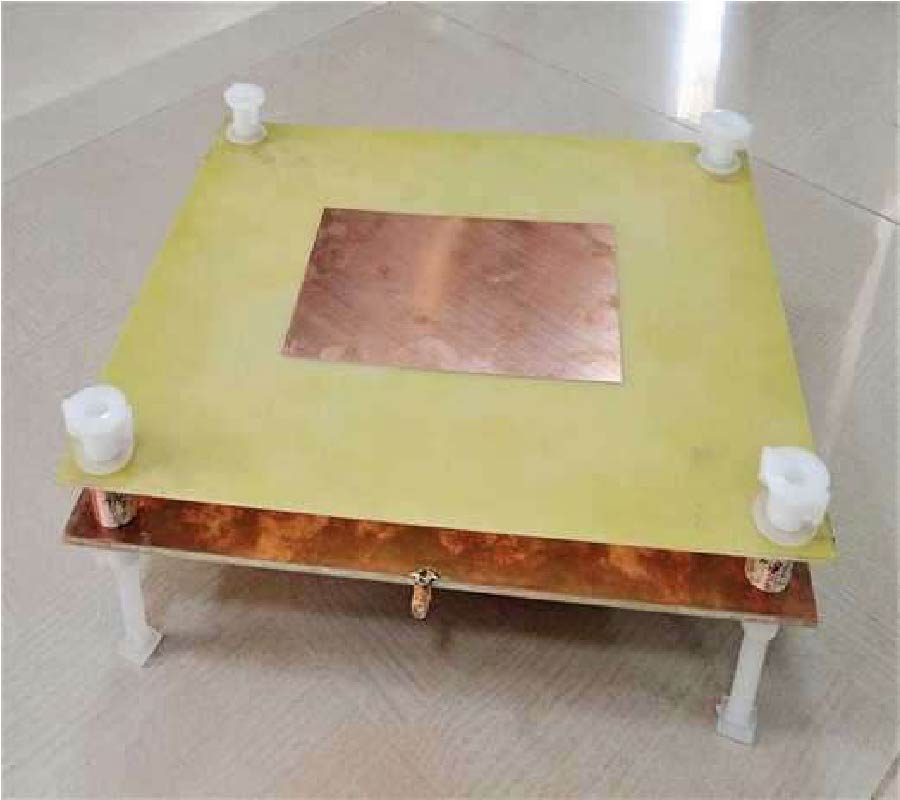
We propose a compact microstrip patch antenna that uses a negative permittivity substrate to achieve an end-fire radiation pattern. The antenna is designed to operate at X-band frequencies with a patch footprint of 0.9λ × 0.05λ and a thickness of λ/20. We show that loading a narrow patch with a negative permittivity substrate introduces an effective shunt inductance that resonates with the strong fringing capacitance of the patch. At resonance, the electric field is vertically polarized and approximately uniform across the patch, producing transverse nulls that improve the directivity of the antenna. The negative permittivity substrate is implemented using a thin-wire effective medium with four vias spread across the patch. The antenna is matched to 50 Ω using a quarter-wavelength transformer. The fabricated antenna operates at 10.8 GHz with a peak return loss of 30 dB and a bi-directional directivity of 10.7 dBi. The antenna has a 10-dB impedance bandwidth of 3.8% and radiates with a simulated efficiency of 93%.
COMPACT NEGATIVE-PERMITTIVITY MICROSTRIP PATCH ANTENNA FOR END-FIRE RADIATION
2022-03-07
PIER Letters
Vol. 103, 65-72
Design of Multiband Band-Pass Filters Based on Novel Associated Band-Stop Resonators
Yi Wu , Erwan Fourn and Philippe Besnier
Although the design of multiband band-pass filters (MBPFs) has been thoroughly studied in the literature, the synthesis of high-order and multiple pass-band filters with controllable transmission zeros (TZs) and high band-to-band isolation is hardly feasible. In this paper, we present a novel design strategy to cope with this issue. Adopting a star-like topology, the proposed design method is based on the parallel association of N-1 band-stop stepped-impedance stubs to form an N pass-bands resonator. We show that such a simple design principle allows the accurate control of TZs positions. The principle and theory of these associated band-stop resonators (ABSRs) based filter are exposed, and their efficiency is shown through the synthesis, design, simulation, and measurement of quad-band and quint-band band-pass filters. Very good in-band filter performance and very high band-to-band isolation are achieved for both filters without the need for complex optimization process. These results make the ABSRs an attractive solution to achieve multiple band responses with advanced specifications.
DESIGN OF MULTIBAND BAND-PASS FILTERS BASED ON NOVEL ASSOCIATED BAND-STOP RESONATORS
2022-03-04
PIER
Vol. 173, 25-36
Portable 4D Snapshot Hyperspectral Imager for Fastspectral and Surface Morphology Measurements (Invited Paper)
Jing Luo , Zijian Lin , Yuxin Xing , Erik Forsberg , Chengdong Wu , Xinhua Zhu , Tingbiao Guo , Gaoxuan Wang , Beilei Bian , Dun Wu and Sailing He
A portable 4D snapshot hyperspectral imager (P4DS imager) with compact size, fast imaging time, low cost, and simple design is proposed and demonstrated. The key components of the system are a projector, a liquid crystal tunable filter (LCTF), and a camera. It has two operating modes dependent on the set state of the LCTF: a 3D light measurement mode that produces a 3D point cloud reconstruction of the object, and a hyperspectral imaging mode yielding spectral data. The camera imaging plane is the same for both operating modes allowing the collected spatial and spectral data to be directly fused into a 4D data set without post-processing. The P4DS imager has excellent performance with a spectral resolution of 10 nm, a spatial depth accuracy of 55.7 um, and total 4D imaging time of 0.8 s. 4D imaging experiments of three different samples, colored doll statue, green broccoli, and a human face, are presented to demonstrate the efficiency and applicability of the system. Due to being cost-effective, portable, and good imaging performance, the proposed system is suitable for commercialization and mass production.
PORTABLE 4D SNAPSHOT HYPERSPECTRAL IMAGER FOR FASTSPECTRAL AND SURFACE MORPHOLOGY MEASUREMENTS (INVITED PAPER)